Talk to an Expert

How Will UAE’s Dirham-Backed Stablecoin Transform Business Payments?

Dirham-backed Stablecoin

As we move towards 2026, the UAE is leading the charge in digital finance innovation with the launch of the Digital Dirham and the AE Coin stablecoin, creating a modern, complementary payments ecosystem. Global stablecoin adoption is accelerating, with the total market surpassing $300 billion in circulation and cross-border stablecoin transactions exceeding $50 billion by the end of 2025. 

These numbers highlight the growing role of stablecoins in international trade, remittances, and enterprise payments. Recent regulatory frameworks in the UAE and worldwide are providing clarity and trust, encouraging businesses to explore digital payments. This blog explains what the Dirham-backed stablecoin means for businesses, how it operates, and reduces cost.

Inside the UAE’s Dirham-Backed Stablecoin

The UAE model pairs a sovereign Central Bank Digital Currency (CBDC) with private stablecoin initiatives. The Digital Dirham will act as legal tender for retail and institutional payments. AE Coin represents a dirham-backed stablecoin issued by First Abu Dhabi Bank (FAB) with IHC and ADQ. The ADI blockchain will support AE Coin distribution and programmable settlement rails. 

Federal Decree-Law No. 54 of 2023 gives the Digital Dirham legal backing. Market momentum already exists, with Circle targeting a $47 billion remittance corridor. Regulatory clarity in ADGM and the Virtual Assets Regulatory Authority (VARA) supports rapid enterprise-grade token adoption. Businesses can choose between direct CBDC rails and regulated stablecoin rails.

Digital Dirham Stablecoin: From Compliance Burden to Competitive Edge

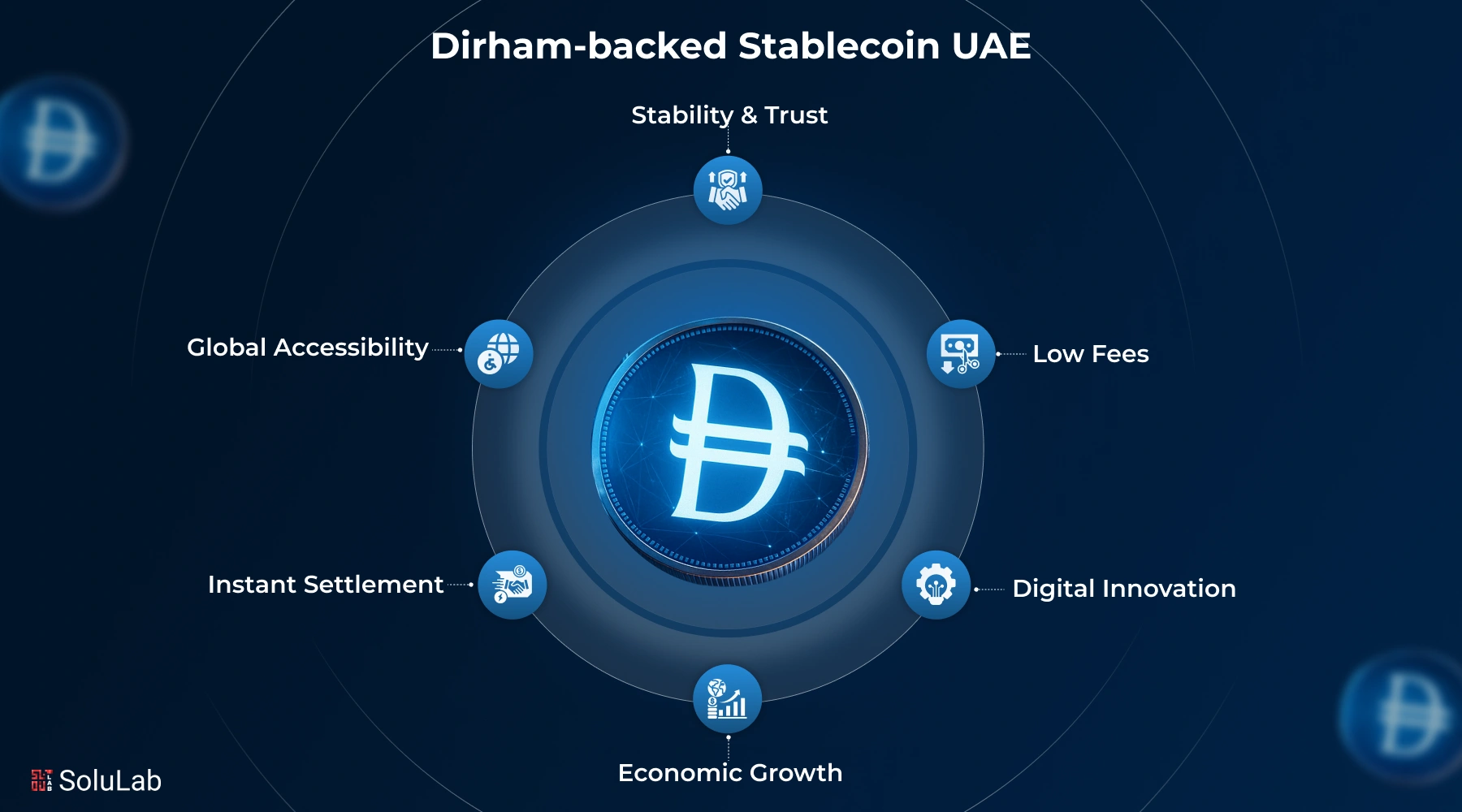
Dirham stablecoin is not just a digital asset for transfer; it has many strengths with the right regulations for user security. It can be moulded to many other purposes, let’s check them out. 

  • Built-In Compliance Through Smart Contracts

Compliance often requires significant time and resources. The Digital Dirham changes this by embedding KYC and AML checks directly into its infrastructure. Smart contracts enforce compliance automatically before any transaction is completed, reducing the need for manual verification and minimizing errors.

  • Real-Time Audit Trails for Transparency

Every transaction on the blockchain platforms leaves a permanent, tamper-proof record. Businesses gain immediate access to transaction data, making audits faster and easier. This level of transparency builds trust with regulators, reduces the risk of disputes, and lowers the overall cost of compliance.

  • Reducing Settlement Risks for Treasury Teams

Traditional payments often involve settlement delays, creating risks for treasury departments. With the Digital Dirham, transactions settle in real-time, allowing companies to manage liquidity more efficiently. Treasury teams can operate with smaller liquidity buffers, freeing up capital for growth.

  • Turning Compliance into a Business Advantage

Rather than treating compliance as a burden, businesses can position themselves as leaders in transparency and trustworthiness. Companies in sectors such as logistics, supply chain, and trade finance can use the Digital Dirham as a differentiator, attracting clients who value reliable and compliant partners.

How Does the Digital Dirham Stablecoin Differ from Existing Payment Systems?

Feature Digital Dirham Stablecoin Existing Payment Systems
Settlement Direct central bank settlement Relies on intermediaries like banks and card networks
Legal Status Official legal tender issued by the Central Bank Private or commercial payment networks
Programmability Supports smart contracts, escrow, and conditional payments Static fund transfers only
Fraud Prevention On-chain traceability enables real-time monitoring and fraud detection Limited transparency; higher fraud risk
Cross-Border Transfers Near-instant with CBDC interoperability Slow; multi-day settlement through correspondent banks
Cost Efficiency Lower fees due to fewer intermediaries Higher transaction costs and service charges
Transparency & Compliance Fully auditable blockchain records Opaque and fragmented transaction tracking

The Digital Dirham offers legal tender status and direct central bank settlement. Card networks and correspondent banking rely on intermediaries and delayed settlement. AE stablecoin will operate on a compliant blockchain with bank-grade reserves. Programmability allows conditional payments, automated FX conversions, and escrow features. Traceability on-chain will improve fraud detection compared with cash and legacy rails.

1. Direct Settlement vs. Intermediary Networks

Current payment systems often involve banks, clearinghouses, and other intermediaries, each adding costs and delays. The Digital Dirham enables direct settlement with central bank oversight, reducing transaction layers and cutting fees.

2. Programmability vs. Static Payments

While traditional payments merely transfer funds, the Digital Dirham is programmable. Businesses can set up conditions such as escrow payments, milestone-based disbursements, or automatic reconciliations. This flexibility streamlines complex financial processes.

3. Enhanced Fraud Prevention

Fraud remains a challenge with cash and legacy transfers. The Digital Dirham leverages blockchain layers for security and traceability. Every payment is encrypted and recorded, making fraud harder to execute and easier to detect.

4. Cross-Border Advantage

International transfers today can take days to settle. By using CBDC interoperability and corridor-specific stablecoins, the Digital Dirham promises near-instant cross-border payments. Global businesses can cut costs, reduce delays, and gain greater control over international cash flows.

How Can Businesses Leverage the Digital Dirham?

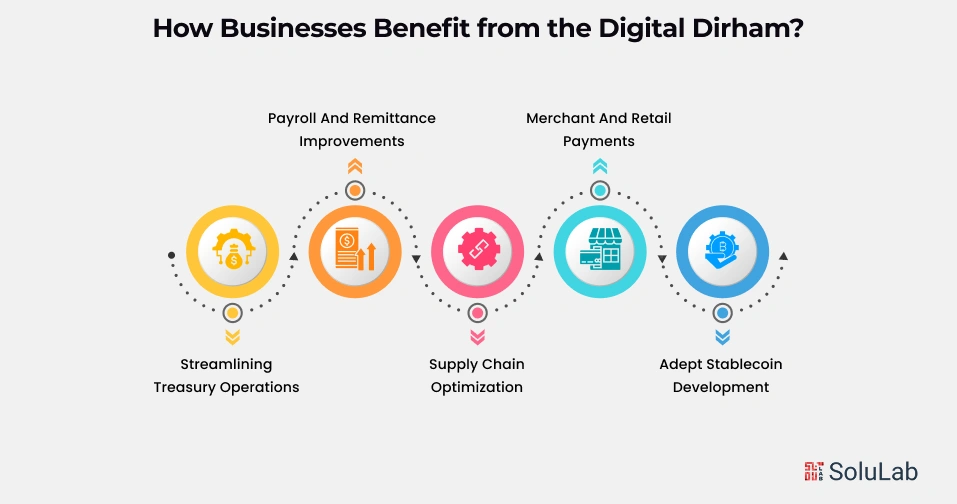
The UAE’s Dirham-backed stablecoin isn’t just a digital currency but a tool businesses can use to streamline operations, cut costs, and enhance security. Here’s how companies can make the most of it:
How Businesses Benefit from the Digital Dirham

  • Streamlining Treasury Operations

Enterprises can automate vendor payments with programmable Digital Dirham contracts. These payments can be timed to supplier agreements, reducing disputes, ensuring on-time delivery, and enhancing supplier relationships.

  • Payroll and Remittance Improvements

For companies with large expatriate workforces, the Digital Dirham offers a major advantage. Salaries can be paid directly in the stablecoin, with employees enjoying faster, cheaper stablecoin remittances. Businesses benefit from predictability and reduced administrative overhead in payroll management.

  • Supply Chain Optimization

Suppliers often face liquidity issues while waiting for payments. Businesses can tokenize invoices and settle them instantly using the Digital Dirham. This accelerates working capital cycles and reduces reliance on external financing.

  • Merchant and Retail Payments

Retailers and e-commerce players can integrate Digital Dirham payments into their platforms. Customers benefit from faster checkouts and lower fees, while merchants enjoy instant settlements and reduced chargeback risks.

  • Adept Stablecoin Development 

Adopting a CBDC requires technical expertise. Partnering with a company that creates stablecoins ensures seamless integration with existing systems, secure wallet management, and full compliance with all relevant regulations. These collaborations help businesses adopt the Digital Dirham faster while minimizing risks.

Other Global Regulatory Trends Boosting Trust in Stablecoins

The growth of stablecoins is no longer just about technology; it is about regulation. Global efforts are creating frameworks that build confidence, reduce risks, and encourage mainstream adoption. These moves directly support the credibility of the Dirham-backed stablecoin and strengthen its business case.

Global Regulatory Trends in Stablecoins

1. U.S. GENIUS Act (2025)

The GENIUS Act sets clear rules for payment stablecoins in the United States. It requires 1:1 reserve backing in cash or Treasuries, introduces licensing for issuers, and enforces disclosure of reserves. Importantly, it removes stablecoins from being treated as securities or commodities, placing oversight under banking regulators. This clarity makes RWA backed stablecoins safer and more attractive for both businesses and consumers.

2. Hong Kong’s Stablecoin Ordinance

Hong Kong implemented its Stablecoin Ordinance in August 2025, positioning itself as a leader in digital asset regulation. The law requires issuers of fiat-referenced stablecoins to obtain licenses from the Hong Kong Monetary Authority

It enforces strict reserve rules, redemption rights, custody standards, and regular audits. The law also criminalizes unlicensed promotion, ensuring that only regulated players can operate. These measures make stablecoins more trustworthy in one of the world’s leading financial hubs.

3. EU’s MiCA Regulation

The Markets in Crypto-Assets Regulation (MiCA) came into force in 2024 across the European Union. It sets common rules for crypto-asset issuers and service providers, including stablecoins. MiCA requires issuers of asset-referenced tokens and e-money tokens to maintain sufficient reserves, follow governance standards, and provide transparent disclosures. This regulation blends the European market, making stablecoins safer and more predictable for businesses operating across multiple EU countries.

The Future of Business With the Dirham-Backed Stablecoin

The near future will show wider commercial adoption of dirham-backed stablecoin for public use. Interoperability between the Digital Dirham and AE Coin will enable flexible settlement choice. New products will arise around tokenized assets and real-time treasury liquidity pools. 

Merchant checkout will evolve to accept programmable payments and instant settlement. DeFi protocols may integrate with regulated stablecoins under strict compliance guardrails. Global developments, including the US stablecoin bill, will influence cross-border rules. Boards and executives should prioritise pilots to avoid strategic and operational lag.

Stablecoin Development Company

Conclusion

With the above details, you might have understood the Dirham stablecoin growth and futuristic goals. This is not just about transferring; it’s a new era for innovatively simplifying things. If you are also looking for stablecoin development, then SoluLab is here to assist you. 

We, at SoluLab, the top stablecoin development company, built custom fiat-pegged and algorithmic tokens that safeguard your ecosystem from volatility. Our expert team also provides multiple services, like token and wallet integrations. 

For more information, contact us today!

FAQs

1. Could the Dirham-backed stablecoin change how loyalty programs work? 

Yes. Loyalty rewards can be issued as Dirham stablecoins, making them transferable, redeemable across multiple businesses, and programmable for offers. This transforms reward points into liquid assets that hold real, usable value.

2. How will a dirham-backed stablecoin in the UAE help businesses? 

It lowers settlement delays, reduces costs, and embeds compliance into transactions. Enterprises can manage liquidity better, automate payments, and benefit from faster, safer cross-border transactions under clear UAE regulatory frameworks.

3. What are the top use cases of stablecoins for enterprises? 

Stablecoins enable payroll efficiency, real-time supplier settlements, cheaper remittances, and treasury automation. They also support escrow payments, programmable contracts, and tokenized assets, helping businesses improve cash flow and reduce reliance on traditional banking delays.

4. How can businesses start using the Digital Dirham?

Companies can work with regulated financial institutions and blockchain service providers in the UAE to set up wallets, enable payment processing, and integrate programmable features into their systems.

5. Why choose SoluLab as a stablecoin development company? 

SoluLab creates fiat-pegged, algorithmic, and AI-powered stablecoins with a compliance-first design. We provide secure wallet integrations, system upgrades, and smooth enterprise adoption, ensuring businesses launch stablecoins quickly while staying fully aligned with regulatory standards.
How to Use Stablecoin Rails for Crypto Exchanges?

Integrate Stablecoin Rails for Crypto Exchange

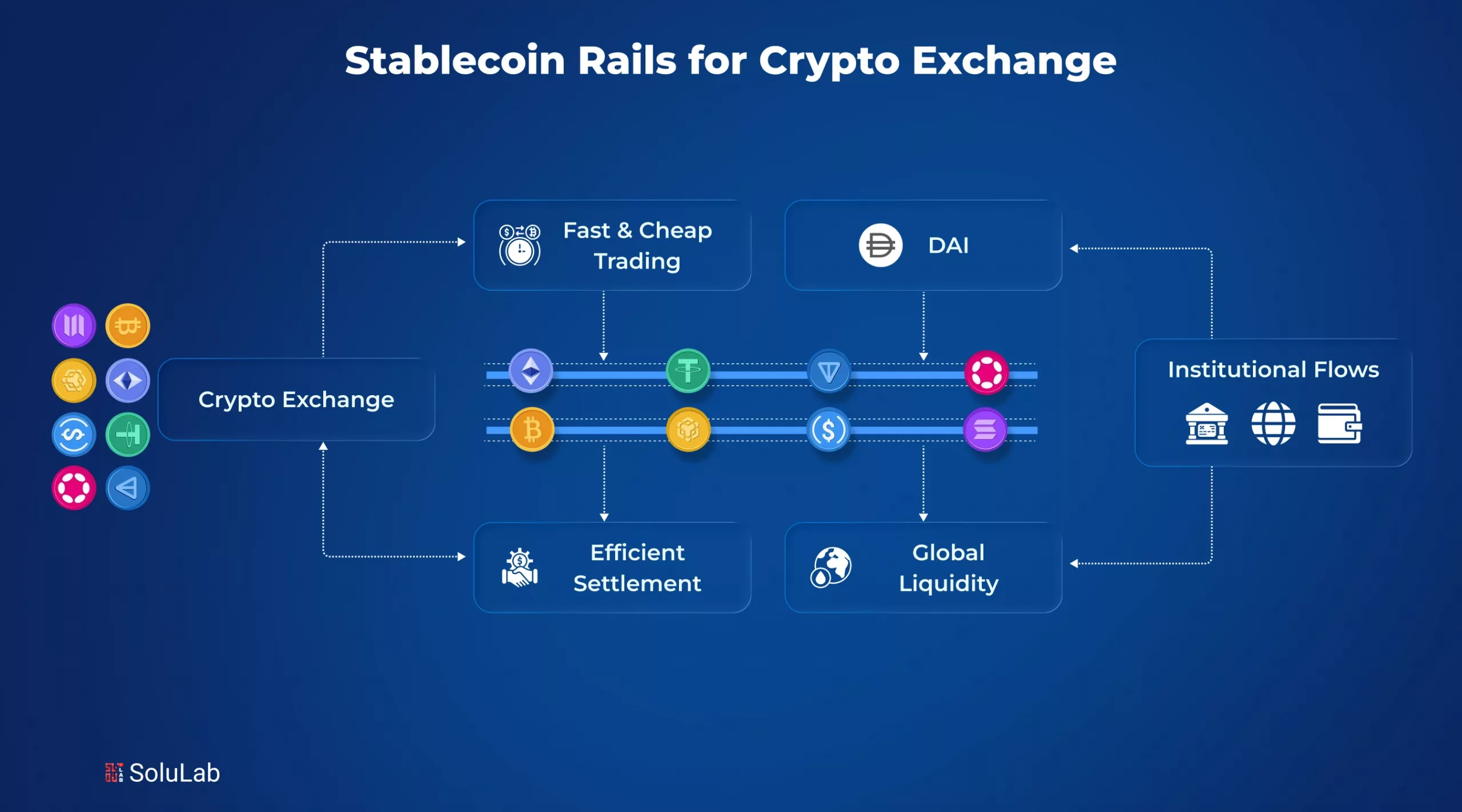
Running a crypto exchange today means handling billions in trades every day. To stay competitive, you need stablecoin rails, the blockchain payment rails that let funds move instantly, 24/7, without banking delays.

For B2B founders, fintech teams, and developers, stablecoins in crypto-fintech systems give three big wins – seamless liquidity, lower volatility risk, and predictable, real-time settlements. Major exchanges now process $20–30 billion daily using these rails.

Adopting stablecoin rails for fintech helps your exchange cut fees, speed transactions, and scale globally, key advantages for attracting institutional partners and high-volume traders.

Why Do Crypto Exchanges Need Stablecoin Payment Rails?

Running a crypto exchange today is challenging. Market volatility, liquidity bottlenecks, and the pressure for instant cross-border settlements are constant hurdles. This is why stablecoin payment rails have become a must-have infrastructure for modern exchanges.

In 2023 alone, $10 trillion total on-chain transaction volume with stablecoins making up 60%, underlining their crucial role in financial operations.

By integrating rail stablecoin systems, exchanges can benefit from:

  • Stable trading pairs that reduce slippage and protect users from sudden market swings.
  • Automated settlements powered by smart contracts, ensuring faster, transparent, and error-free transactions.
  • Reduced dependency on traditional fiat gateways, cutting delays and operational costs.

With stablecoin payment rails, exchanges not only improve operational efficiency but also gain a competitive edge in the fast-evolving crypto ecosystem. 

For founders and infrastructure teams, this means faster settlements, lower costs, and a platform ready for global adoption.

Step-by-Step Guide to Integrating Stablecoin Rails into your Exchange

Integrating stablecoins rails for fintech into your crypto exchange or financial platform can significantly enhance liquidity, reduce transaction costs, and improve settlement speed. For B2B clients, understanding and implementing these steps ensures your infrastructure is competitive, secure, and scalable.

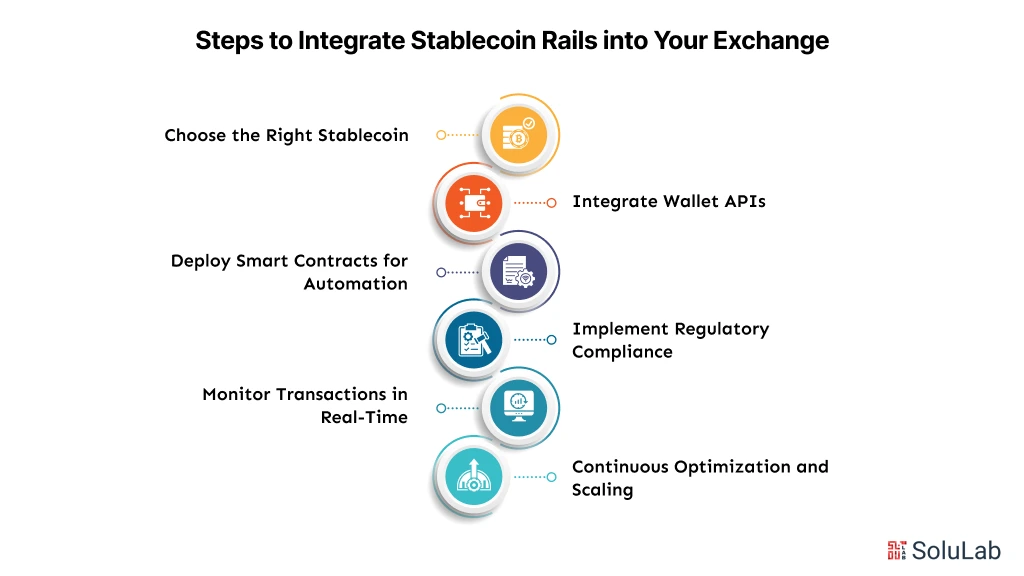
Steps to Integrate Stablecoin Rails into Your Exchange

1. Choose the Right Stablecoin

Start by evaluating types of stablecoins based on your business needs. Consider factors like liquidity, regulatory compliance, ecosystem compatibility, and transaction efficiency. Popular options include:

  • USDT: High liquidity, widely used in exchanges.
  • USDC: Institutional-grade transparency with regular audits.
  • DAI: Decentralized, crypto-backed stablecoin ideal for DeFi integration.

Selecting the right rail stablecoin ensures smooth cross-border transactions, reliable settlement, and compliance with stablecoin regulations. For B2B fintechs, this step reduces operational risks and ensures your platform can scale with institutional adoption.

2. Integrate Wallet APIs

To connect your platform to stablecoin payment rails, leverage professional wallet APIs. These tools simplify:

  • Secure custody of stablecoins.
  • Instant transactions across multiple networks.
  • Multi-currency support for different stablecoins in crypto-fintech systems.

Integration with stablecoin rails for fintech allows your users to move funds seamlessly between wallets, exchanges, and payment channels. This step is critical for operational efficiency and building trust with corporate clients.

3. Deploy Smart Contracts for Automation

Smart contracts are the backbone of stablecoin rails. Use them to automate critical functions such as:

  • Settlement of trades and transactions.
  • Margin calls and collateral management.
  • Liquidity provisioning for high-frequency trading.

With programmable stablecoin payment rails, these smart contracts ensure that transactions are transparent, auditable, and executed without manual intervention.

4. Implement Regulatory Compliance

Compliance is essential for B2B fintechs working with stablecoins in crypto-fintech systems. Ensure adherence to stablecoin regulations and frameworks such as the GENIUS Act stablecoin. Key actions include:

  • Verifying issuer reserves for each stablecoin.
  • Implementing AML/KYC procedures.
  • Maintaining audit trails for all transactions.

Being compliant not only protects your platform from legal risks but also increases trust among institutional clients looking to leverage your stablecoin rails infrastructure.

5. Monitor Transactions in Real-Time

Once your stablecoin rails are live, continuous monitoring is crucial. Use dashboards and analytic tools to:

  • Track how stablecoins work in real-time.
  • Identify unusual transactions or network congestion.
  • Prepare audit reports for regulatory authorities or clients.

Real-time monitoring ensures transparency and operational control, critical for B2B relationships and for demonstrating your platform’s reliability to investors or enterprise clients.

6. Continuous Optimization and Scaling

After integration, focus on optimization to maximize the benefits of stablecoin rails:

  • Adjust liquidity pools according to trading volume.
  • Deploy cross-chain bridges for broader network reach.
  • Upgrade smart contracts to support new types of stablecoins.

Continuous improvements enhance efficiency, reduce costs, and make your platform a go-to solution for B2B partners seeking robust crypto and fintech services.

Crypto Exchange Development Services

How Rail Stablecoin Systems Improve Crypto Exchange Liquidity Management? 

For any B2B crypto exchange, strong liquidity is the key to smooth trading and happy institutional clients. A rail stablecoin system provides the infrastructure that keeps funds moving quickly and predictably, even during high-volume trading.

Rail stablecoin networks let exchanges settle trades in real time with stable, dollar-pegged assets like USDC or USDT. This steady value cuts the risk of price swings and reduces slippage in high-frequency trading, where even small delays or price gaps can cost millions.

By adding stablecoin payment rails, exchanges can accept large institutional inflows without relying on slow banks. Funds arrive and clear within minutes, giving market makers and professional traders instant access to liquidity.

For B2B founders and fintech teams, using stablecoins in crypto-fintech systems means:

  • Faster settlements across multiple trading pairs
  • Lower transaction fees compared to traditional payment rails
  • 24/7 liquidity to handle global trading demand

Read Also: UAE’s Dirham-Backed Stablecoin

Optimizing Cross-Border Settlements with Stablecoin Rails for Crypto Exchanges

For B2B operators, using stablecoins rails for fintech means:

  • Lower costs: Cross-border transfers that can cost 2–5% through banks often drop to under 0.1% with stablecoins in crypto-fintech systems.
  • Instant settlements: Liquidity moves in real time, helping OTC desks close large trades without delays.
  • Stable value: Stablecoin use cases like margin trading stay protected from crypto price swings, because coins are pegged to fiat such as USD or EUR.

Top exchanges already process $20–30 billion daily through these rails. By integrating stablecoin payment rails with clear U.S. rules like the GENIUS Act stablecoin framework, a platform gains regulatory confidence and attracts institutional partners.

How Top Exchanges Use Stablecoin Rails?

1. Kraken With Circle

Kraken partnered with Circle to bring more USDC and the euro stablecoin EURC to its platform. This gives Kraken users deeper liquidity, lower conversion costs, and tighter stablecoin rails integration across trading and settlement. Through its work with OpenPayd, Kraken also supports stablecoin on/off ramps as part of a rails-agnostic payments system.

Takeaway for crypto exchanges: Integrating stablecoins in crypto-fintech systems with issuers like Circle can boost liquidity, cut conversion friction, and make stablecoin settlement rails a core part of operations.

Kraken & Circle

2. Binance

Binance Pay lets users make peer-to-peer and merchant payments using stablecoins with instant, fee-free transfers. Binance also added Circle’s USYC yield-bearing stablecoin, allowing institutional users to post collateral and speed up settlements.

Takeaway: Leading exchanges show that stablecoin payment rails are not just for trading. They drive payments, collateral management, and institutional flows, proving that stablecoin rails for fintech are now central to growth, not a side feature.

Binance Pay

What is the Future of Stablecoin Rails in Global Trading with Stablecoin Regulations?

The future of stablecoin rails for fintech is highly promising. Analysts project the global market could reach $3.7 trillion by 2030.

Clear stablecoin regulations, including the US stablecoin bill and GENIUS Act stablecoin, provide a secure path for adoption. Crypto exchanges and fintech platforms using these frameworks can scale confidently, diversify revenue streams, and stay competitive.

Many institutions are already exploring stablecoins in crypto-fintech systems for treasury management, cross-border settlements, and B2B payments, making this infrastructure critical for modern financial operations.

Read More: Dollar-to-Stablecoin Swaps In White-Label Neo Banking

Build Your Exchange with a #1 Stablecoin Development Company

Partnering with a crypto exchange development company ensures your exchange is fast, secure, and compliant. Key benefits for B2B platforms include:

  • Regulatory compliance: Align with the US stablecoin bill and the GENIUS Act stablecoin.
  • Multi-chain integration: Seamless transfers across Ethereum, Solana, and Layer-2 networks using stablecoins rails for fintech.
  • Advanced liquidity management: Deep liquidity via rail stablecoin infrastructure for trading, payments, and cross-border settlements.
  • Secure smart contracts: Audited, institutional-grade contracts for automated transactions.

SoluLab offers full B2B solutions, integrating stablecoin payment rails, stablecoins in crypto-fintech systems, and advanced stablecoin use cases.

Crypto Exchange Development Services

Conclusion

Stablecoins rails are no longer optional; they are foundational for modern crypto exchanges. By understanding how stablecoins work, navigating stablecoin regulations, and partnering with a stablecoin development company, B2B platforms can reduce operational costs, speed settlements, and scale globally.

With the right infrastructure, your exchange gains:

  • Faster transactions via stablecoin payment rails
  • Deep liquidity across markets using rail stablecoin mechanisms
  • Compliance and security that build trust with institutional users

Integrating stablecoins in crypto-fintech systems allows B2B exchanges to unlock new revenue streams, reduce volatility, and enable innovative stablecoin use cases, all while staying competitive in the global market.

Contact us to grab the best stablecoin solutions! 

FAQs

1. What are stablecoin rails?

Stablecoins rails are blockchain-based infrastructure that allows stablecoins to move quickly and securely between exchanges, wallets, and users. They act like payment highways for crypto, enabling real-time transfers without traditional banking delays. 

2. Why do crypto exchanges need stablecoins payment rails?

Crypto exchanges rely on stablecoins payment rails to provide low-volatility trading pairs, reduce transaction costs, and attract institutional users. By integrating stablecoins in crypto-fintech systems, exchanges can settle trades instantly, support cross-border transactions, and maintain liquidity 24/7.

3. How can stablecoins in crypto-fintech systems reduce fees?

Stablecoins in crypto-fintech systems cut fees by bypassing traditional banking intermediaries. Cross-border settlements that once cost 2–5% can now settle for just a fraction of a cent. Stablecoins payment rails also allow exchanges to automate settlements, minimize reconciliation errors, and speed up transactions. 

4. How does the US stablecoin bill impact operations?

The US stablecoin bill (GENIUS Act) mandates that all regulated stablecoins maintain 1:1 reserves, regular audits, and compliance with AML/KYC regulations. For exchanges, this provides legal clarity, reduces operational risk, and increases institutional confidence.

5. What is the GENIUS Act stablecoin and its role?

The GENIUS Act stablecoin legislation sets federal standards for stablecoin issuance, redemption, and reserve management. Its role is to ensure that stablecoins remain trustworthy and compliant for institutional adoption. 

6. How to choose a stablecoin development company for integration?

Choosing a stablecoin development company involves evaluating technical expertise, regulatory experience, and past integrations. SoluLab can be your best partner for all sorts of blockchain and stablecoin solutions, be it development ot integration. Get a custom quote today!


Top 5 Crypto Stablecoin Wallets for USDT, USDC, BUSD, TUSD & FDUSD in 2026

Top 5 Crypto Stablecoin Wallets

Stablecoins like USDT, USDC, BUSD, TUSD, and FDUSD are improving the crypto space in 2026, offering stability in this volatile market. But storing them securely is not easy. With countless wallets available, choosing the right wallet matters, whether you’re a trader, DeFi enthusiast, or beginner. The wrong wallet could mean slow transactions, high fees, or even security risks.

Want to know the top stablecoins which has security, easy access on mobile or desktop, and support for DeFi activities? That’s exactly what the best wallets in 2026 should do. In this guide, we’ll explore the top 5 crypto stablecoin wallets that make storing and transacting USDT, USDC, BUSD, TUSD, and FDUSD safe, simple, and efficient. Let’s get started!

The Current State Of Stablecoin Crypto Wallet Development

By the middle of 2025, the total market cap for stablecoins had grown by a lot from the previous year, reaching about $252 billion or perhaps $277 billion.

Stablecoin cryptocurrency wallets are in a significant phase of development due to the surge of popularity, progressive regulation, and rapid technical improvement.

1. Current State 

Stablecoin wallets are now safer, more flexible, and easier to use. Multi-asset support, cross-chain compatibility, and high-level security are now prioritized, with transactions being supported on USDT, USDC, BUSD, TUSD, and FDUSD.

2. Adoption Acceleration

Stablecoins are on the increase across the world as people and organisations acknowledge that they are more stable than volatile cryptocurrencies. The expanding demand is met by wallets, which have been designed with features such as easy onboarding, mobile accessibility, and transfer simplification to enable mainstream adoption.

3. Regulatory Momentum

Governments and financial regulators are offering more transparent principles for using stablecoins and wallet functions. This regulatory transparency builds trust, institutional engagement, and wallet adherence to KYC and AML standards and helps protect the funds of its users.

4. Increasing Market and Tech Integration

Stablecoin wallets are becoming a more integrated part of decentralized finance (DeFi), exchanges, and payment systems, allowing a wider range of applications. Improved APIs, cross-chain, and blockchain interoperability allow users to handle multiple assets effectively via one and the same interface.

5. Enterprise-Grade Growth

Companies are starting to accept payments, payroll, and treasury operations using stablecoin wallets more often. Enterprise-level solutions have high security, scale, and compliance capabilities, and can handle high volumes of transactions, but will integrate with corporate financial infrastructure.

cta 1

How To Choose The Best Wallet For Stablecoin?

By 2026, it won’t be only a question of convenience when selecting the right stablecoin wallet, but a question of security, flexibility, and ease of transaction. The following are the most important factors to consider for any investor.

  • Security & Private Key Control: The security of your wallet determines the level of security of your money. Use wallets with encryption, two-factor authorization, and complete control of their own keys to secure USDT, USDC, BUSD, TUSD, and FDUSD.
  • Multi-Stablecoin Support: Not every wallet supports all of the stablecoins. Make sure that your decision can store and process various coins such as USDT, USDC, BUSD, TUSD, and FDUSD easily, and save time and multiple wallets.
  • User Experience & Accessibility: Find wallets that have an easy-to-use design, support more than one language, and provide accessibility that helps both beginners and advanced investors with storing and transferring stablecoins easily.
  • Fees and Network speed: These are the direct effects of networks on the experience with crypto. Select wallets that can maintain a low cost, but at the same time provide quick transfers, when you send or often exchange stablecoins between platforms frequently.
  • Cross-Platform Availability (Web, Mobile, Hardware): Flexibility is the key. The most optimal wallets operate on web, mobile, and hardware platforms, and you can access your stablecoins anytime. This keeps you in touch and in control of all the devices safely.

Top 5 Crypto Stablecoin Wallets to Watch Out for in 2026

Choosing the right wallet ensures security, convenience, and transactions for all crypto users. Here’s a list of 5 crypto wallets for stablecoins: 

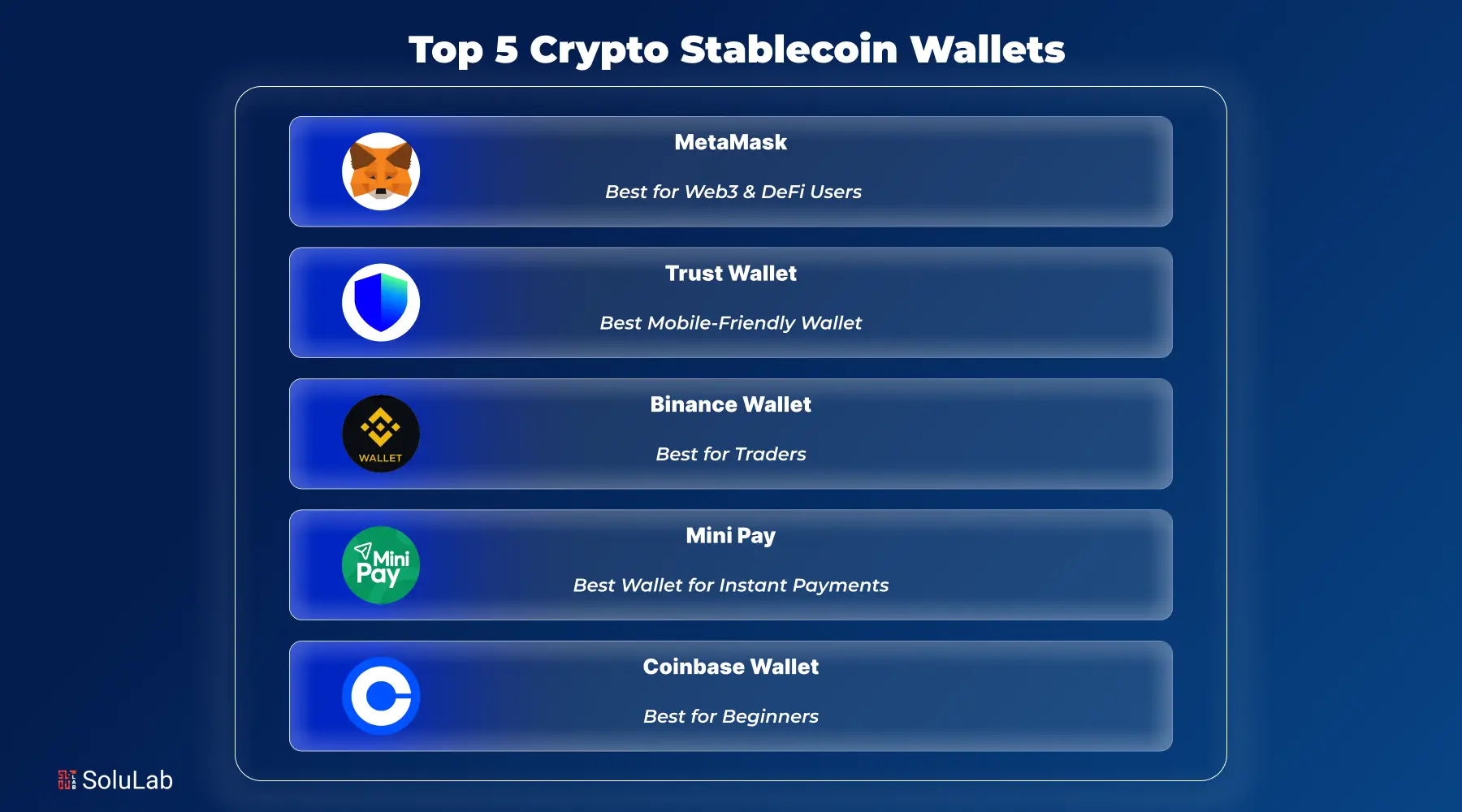
1. MetaMask – Best for Web3 & DeFi Users

MetaMask is ideal for DeFi enthusiasts, supporting multiple stablecoins and Web3 apps. It’s browser extension and mobile app allow easy access to decentralized exchanges while keeping private keys secure.

MetaMask – Best for Web3 & DeFi Users

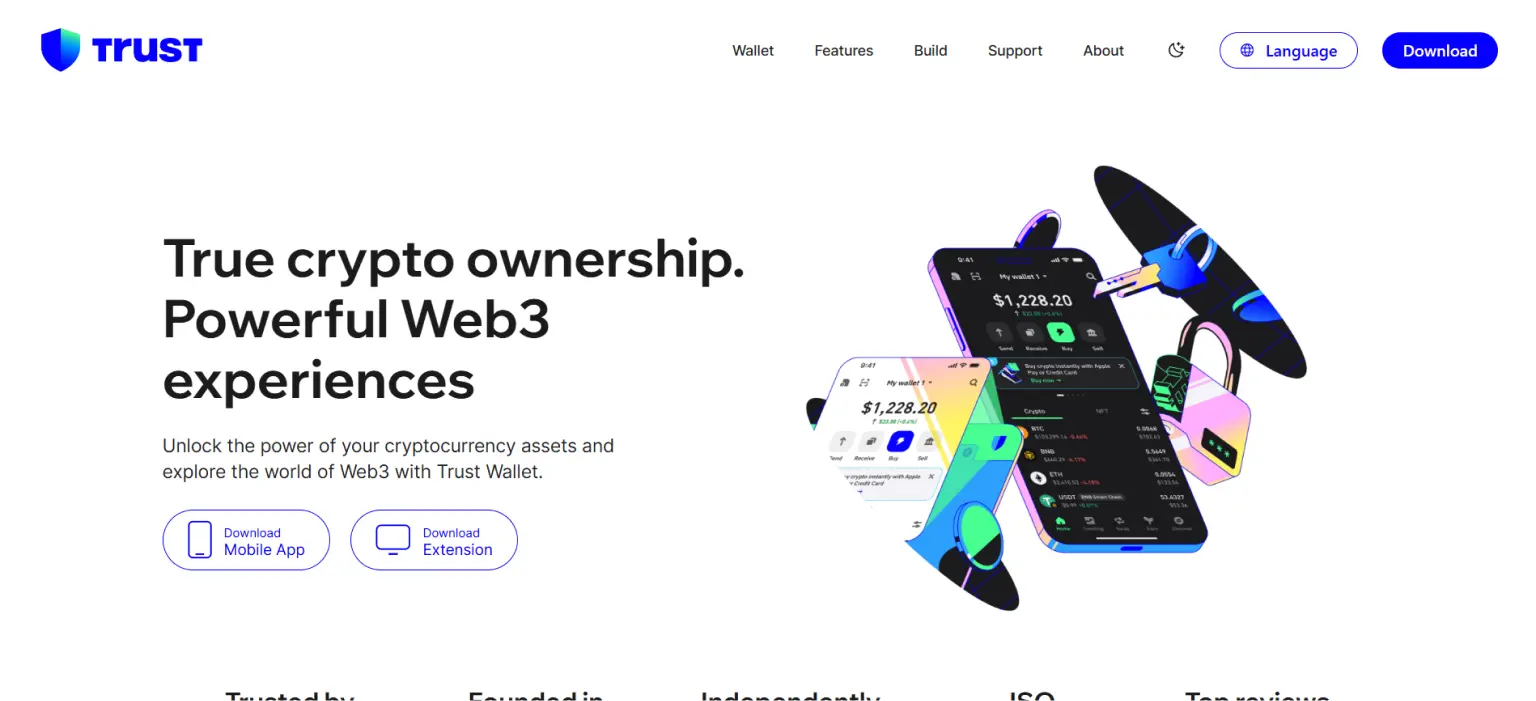
2. Trust Wallet – Best Mobile-Friendly Wallet

Trust Wallet offers a simple, intuitive interface for mobile users. It supports all major stablecoins, multiple blockchains, and dApps, which makes it perfect for users who want to manage crypto anytime, anywhere.

Trust Wallet – Best Mobile-Friendly Wallet

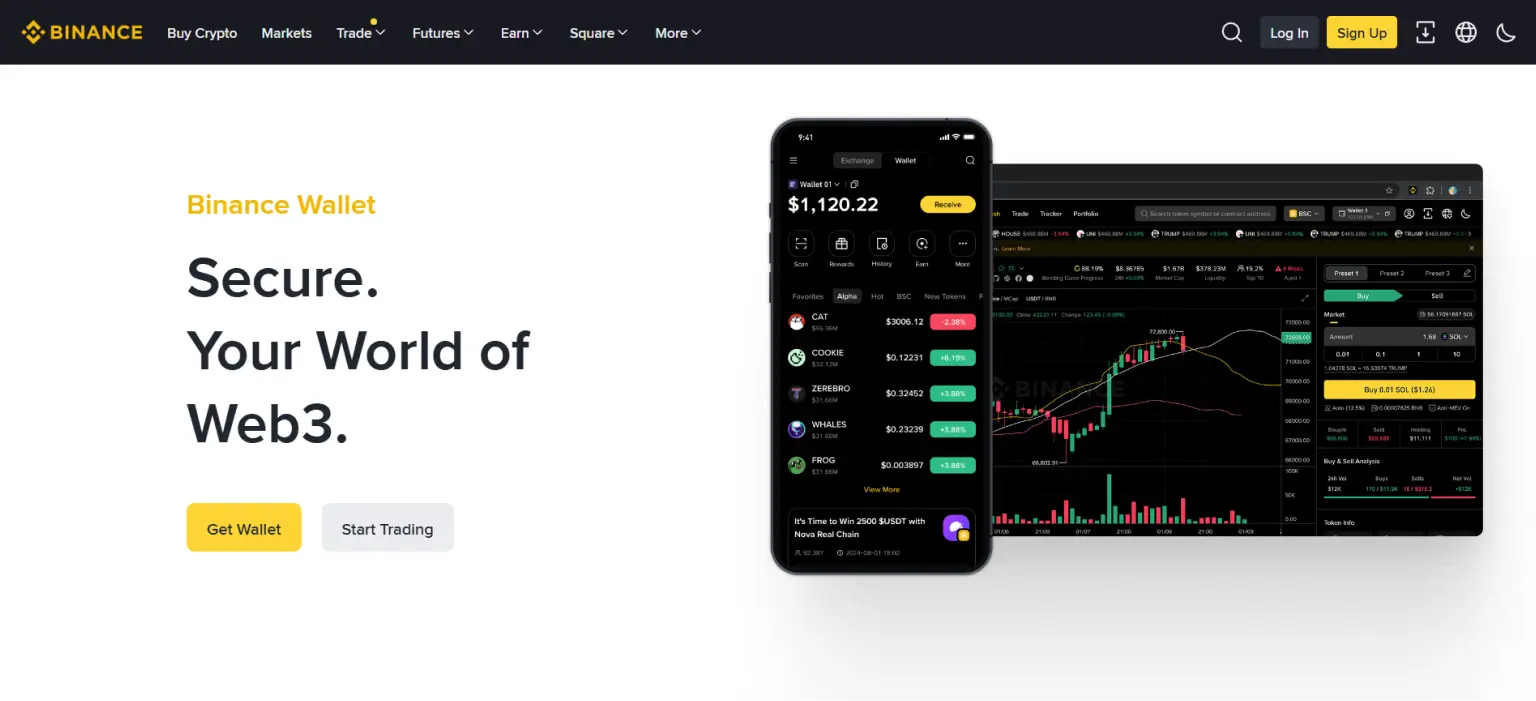
3. Binance Wallet – Best for Traders

Integrated with the Binance exchange, this wallet is perfect for traders. It allows instant stablecoin transactions, low fees, and easy conversion between cryptocurrencies, with strong security features for active users.

Binance Wallet – Best for Traders

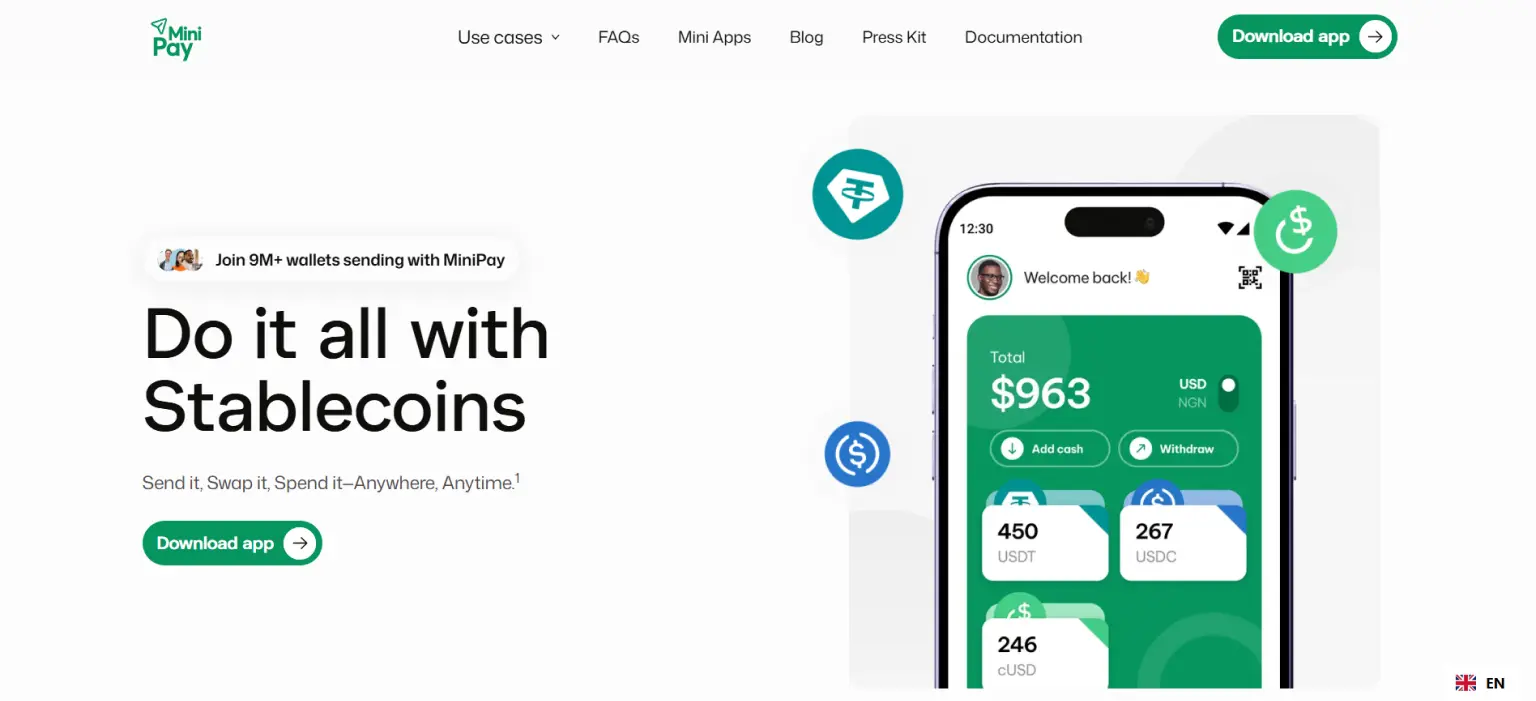
4. Mini Pay – Best Wallet for Instant Stablecoin Payments

MiniPay is a user-friendly, non-custodial stablecoin wallet built on the Celo blockchain, enabling seamless global payments in USDT, USDC, and cUSD. It offers instant, low-cost transfers and easy cash-in/cash-out options across 53+ countries.

Mini Pay - Best Wallet for Instant Stablecoin Payments

5. Coinbase Wallet – Best for Beginners

Coinbase Wallet is beginner-friendly. It offers easy onboarding and strong support for USDT, USDC, and other stablecoins. It combines simple mobile management with secure private key storage for safe crypto use.

Coinbase Wallet – Best for Beginners

Benefits of Using a Dedicated Stablecoin Wallet

Using a dedicated stablecoin wallet offers several advantages over relying solely on exchange wallets. Here’s why it’s becoming the go-to choice for crypto investors:

1. Safer Than Exchange Wallets

Dedicated wallets give you full control over your private keys, reducing the risk of hacks or exchange failures. Unlike exchange wallets, where your funds are stored in a custodial environment, a personal wallet ensures that you, and only you, have access to your assets.

2. Faster Transfers and Transactions

With a dedicated wallet, transactions are often faster and more reliable, as you don’t depend on the exchange’s processing times or network congestion. Whether you’re sending USDT, USDC, BUSD, TUSD, or FDUSD, transfers are smoother and nearly instantaneous, especially when paired with blockchains optimized for speed.

3. Better Tracking of Assets

A dedicated wallet provides clear visibility and organization of all your stablecoin holdings. You can monitor balances, transaction history, and performance across multiple stablecoins in one place, making portfolio management far easier than juggling multiple exchange accounts.

4. Access to Staking, Lending, and DeFi Features

Many dedicated wallets offer integrations with DeFi platforms, allowing you to stake stablecoins, earn interest through lending protocols, or participate in liquidity pools. This unlocks additional earning potential for your assets, turning your wallet into more than just a storage solution—it becomes a tool for growth.

cta2

Conclusion

Whether you prioritize security, mobile convenience, or trading efficiency, there’s a wallet tailored to your needs. MetaMask excels for Web3 and DeFi users, and Trust Wallet is perfect for mobile management. Assess your priorities: security, usability, or accessibility, before deciding. 

Token World, a premier crypto launchpad, partnered with SoluLab to enhance smart contract security, scalability, and compliance. Through GenAI solutions, interoperable token launches, and resilient tokenomics strategies, we delivered blockchain-powered solutions that streamlined fundraising, strengthened investor trust, and fostered thriving communities while mitigating volatility and regulatory challenges.

SoluLab, a leading crypto wallet development company, can help you build a secure, scalable, and user-friendly wallet. Contact us today!

FAQs

1. Which wallet is best for holding USDT securely?

Among the best cryptocurrency stablecoin wallets for safely holding USDT are Ledger Nano X and MetaMask, which provide strong security, offline storage, and smooth interaction with reliable platforms.

2. Can I store multiple stablecoins in one wallet?

Holding USDT, USDC, BUSD, TUSD, and FDUSD together is supported by multi-chain stablecoin wallets like Trust Wallet and MetaMask, which makes managing a portfolio across many blockchains easier.

3. Are hardware wallets safer for stablecoins?

Because hardware wallets like Ledger Nano X store private keys offline and guard against online threats, they are the safest option for holding various stablecoin types.

4. Do stablecoin wallets charge extra fees?

No, most wallets don’t charge more, but when you move money, there are network fees. Depending on Stablecoin use cases, such as trading or payments, costs differ by blockchain.

5. What’s the safest way to transfer stablecoins in 2026?

When learning how to utilize stablecoin for payments across platforms and apps, make sure to double-check wallet addresses, use reliable exchanges, and activate two-factor authentication to maintain security. 

6. Can I use MetaMask for storing stablecoins?

Yes, MetaMask supports multiple stablecoins like USDT and USDC. It is widely used in decentralized finance (DeFi) applications, offering secure access to dApps and Web3 platforms.

What Are Algorithmic Stablecoins In DeFi? A Beginner’s Guide

Algorithmic Stablecoins in DeFi

What is the purpose of DeFi if we keep relying on centralized institutions to maintain the stability of our assets? This question is increasingly asked by builders and users, particularly while stablecoins such as USDC and USDT maintain their dominance, despite their reliance on conventional institutions. This is when algorithm-backed stablecoins are starting to stand out. They utilize smart contracts and mathematical models to maintain value stability, rather than depending on currency reserves. 

Innovation continued even after TerraUSD’s collapse in 2022, which reduced trust in algorithmic models. The demand for decentralized, reliable solutions continues to increase. As of May 2025, DeFiLlama reports that the stablecoin market in DeFi possesses over $125 billion in total value, with emerging algorithmic models progressively capturing market share alongside established fiat-backed currencies.

In this blog, we will look at how algorithm-backed stablecoins work and explore how newer models are innovating to rebuild confidence. If you are interested in how stability without centralized governance may influence the coming generation of DeFi systems, this is worth a read.

What are Algorithmic Stablecoins?

What is Algorithmic Stablecoins

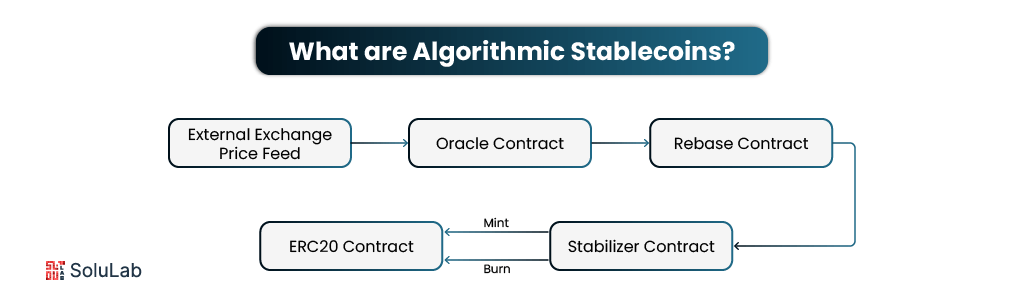
Most people are aware of stablecoins, such as USDC or USDT, which are digital currencies with values close to $1 that are backed by real-world assets such as bank dollars. However, algorithmic stablecoins function quite differently.

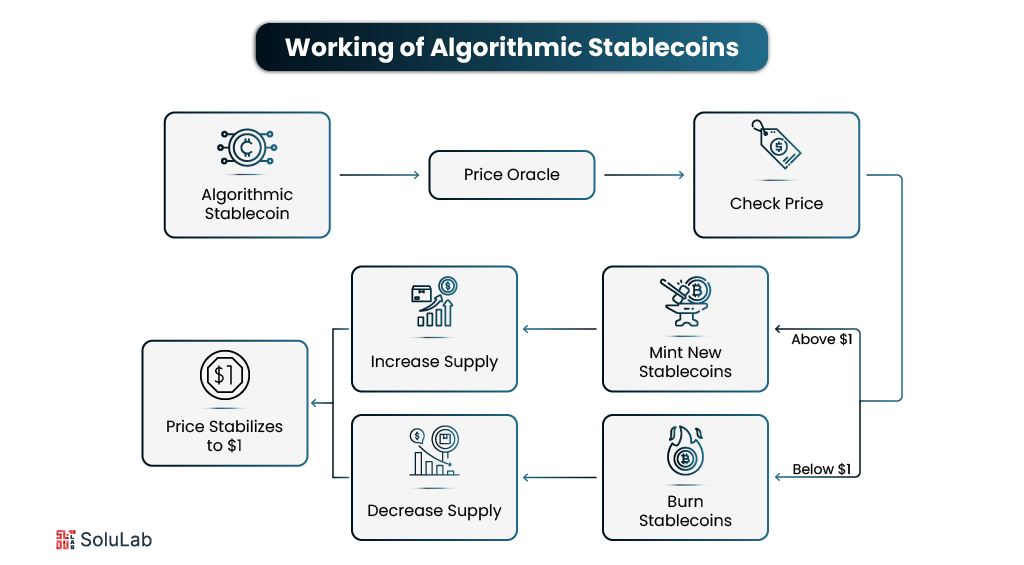
When demand for the coin rises, the system creates additional tokens to bring the price down. When demand falls, tokens are burned (or removed from circulation) to force the price back up. It’s essentially an automatic supply and demand balancer embedded right into the code. This allows for price stability without having to retain money or collateral in the background.

That is a significant thing in the world of DeFi. A stablecoin in DeFi that does not rely on centralized reserves allows platforms to run more autonomously, with no banks, no off-chain assets, and fewer trust difficulties. 

For anybody trying to create next-gen financial products, selecting an appropriate stablecoin architecture is important. Working with a reputable stablecoin development company may ensure the underlying concept remains valid, especially if the objective is long-term sustainability and decentralization.

How Algorithmic Stablecoins Maintain Stability?

working of Algorithmic Stablecoins

Unlike asset-backed stablecoins, which use fiat or crypto reserves to maintain value, algorithmic models use a carefully designed set of tools and strategies. If you’re developing an algorithmic stablecoin, here are the most critical factors you’ll need to consider to ensure stability and user trust.

1. Elastic Supply Mechanism

The supply of tokens is automatically adjusted based on price movement. If the coin is trading above its target (like $1), more tokens are minted and released into circulation. If it’s trading below, tokens are burned or removed from the system. This supply adjustment helps pull the price back toward equilibrium.

2. Market Oracles

Oracles are trusted sources of off-chain data that the smart contracts rely on. They track the real-time price of the stablecoin across various exchanges. This price input is essential for triggering supply changes at the right moment. If oracles fail or get manipulated, the entire system can become unstable.

3. Incentive Structures

Stability isn’t just managed by code, it also depends on how users interact with the system. Many algorithmic stablecoins offer rewards (like profit shares or new tokens) for actions that help restore the peg, such as burning tokens when the price drops or buying bonds during contraction phases.

4. Dual-Token or Multi-Token Models

A common approach involves creating two (or more) tokens: one stablecoin and one “share” token. The share token absorbs system gains and losses, and holders are rewarded when stability is maintained. This separation helps reduce pressure on the stablecoin itself while distributing financial risk more evenly.

5. Rebase or Seigniorage Model

In a rebase model, the number of coins in your wallet changes dynamically to maintain the price. In a seigniorage system, instead of changing balances, the protocol uses market mechanisms to expand or contract supply. Both models aim to maintain the peg but do so in different ways.

6. Protocol Governance

Some advanced systems include decentralized governance, where token holders vote on changes to supply mechanisms, reserve ratios, or incentive policies. This flexibility allows the system to evolve as market conditions change and gives users a voice in maintaining long-term stability.

7. Emergency Controls (Circuit Breakers)

When the market behaves unpredictably, like during a flash crash, smart contracts can temporarily pause supply adjustments or shut down part of the protocol. These circuit breakers act as a fail-safe to prevent the system from spiraling out of control during extreme volatility.

Read Also: Tokenizing TradFi: Real-World Assets & Smart Bonds

Types of Algorithmic Stablecoins

Types of Algorithmic Stablecoins

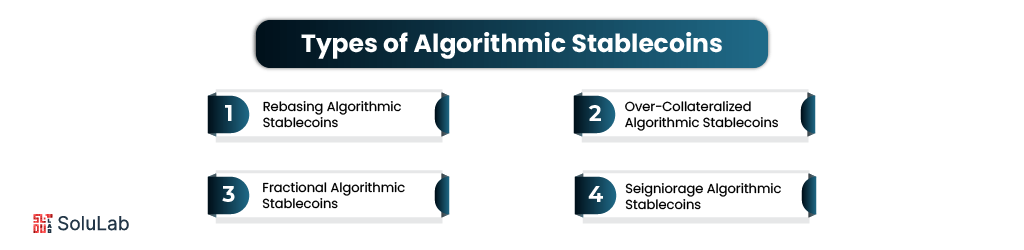
To understand the world of algorithmic stablecoins, you should first look at their main groups. Each type has its own structure and set of rules, which means they can be used for different things in autonomous banking. The main types of algorithmic stablecoins are broken down below:

  • Rebasing Algorithmic Stablecoins

Rebasing algorithmic stablecoins manages the value by changing the number of available tokens. When the price falls below the goal, the algorithm cuts back on the stock that is in circulation. If, on the other hand, the price goes above the targeted amount, the system raises the supply. 

  • Over-Collateralized Algorithmic Stablecoins

For over-collateralized algorithmic stablecoins to work, they need to hold a lot more cryptocurrency assets than stablecoins are released. This extra reserve works as a safety net, letting the system handle changes in the market and keeping the token’s peg. Some of the main features of backed stablecoin examples are included in this model.

  • Fractional Algorithmic Stablecoins

Fractional algorithmic stablecoins are a mix of computational methods and partial asset backing, making them a hybrid solution. Cryptographic methods and a tiny, controlled stock of collateral help these stablecoins stay stable. Their design aims to make the best use of capital while still providing some security from the base assets. 

  • Seigniorage Algorithmic Stablecoins

A dual-token method is used by seigniorage-based algorithmic stablecoins, which is different from the rebasing model. One token is the stablecoin with an adjustable amount, and the other is an investment part in the system. Shareholders can get rewards during growth times and take a hit when the price of the stablecoin goes down.

CTA1

Comparison with Fiat-Backed and Crypto-Backed Stablecoins

When comparing stablecoin models, it’s clear that each type brings its own strengths and weaknesses to the table. Whether you prioritize decentralization, stability, or transparency, understanding the trade-offs between algorithmic vs. traditional stablecoins helps you decide which model fits your project or use case best.

Feature Fiat-Backed Stablecoins Crypto-Backed Stablecoins Algorithmic Stablecoins
Backing Real-world currency (e.g., USD) Over-collateralized crypto (e.g., ETH) No physical or crypto backing
Stability Mechanism Maintained via fiat reserves Managed through the collateral ratio Supply adjusts based on price triggers
Decentralization Low (centralized issuers) Medium (uses on-chain assets) High (fully protocol-driven)
Regulatory Risk High Medium Low to moderate
Exposure to Volatility Low High Varies by model; often high
Transparency Varies (depends on issuer) High (fully on-chain) Very high (open-source smart contracts)

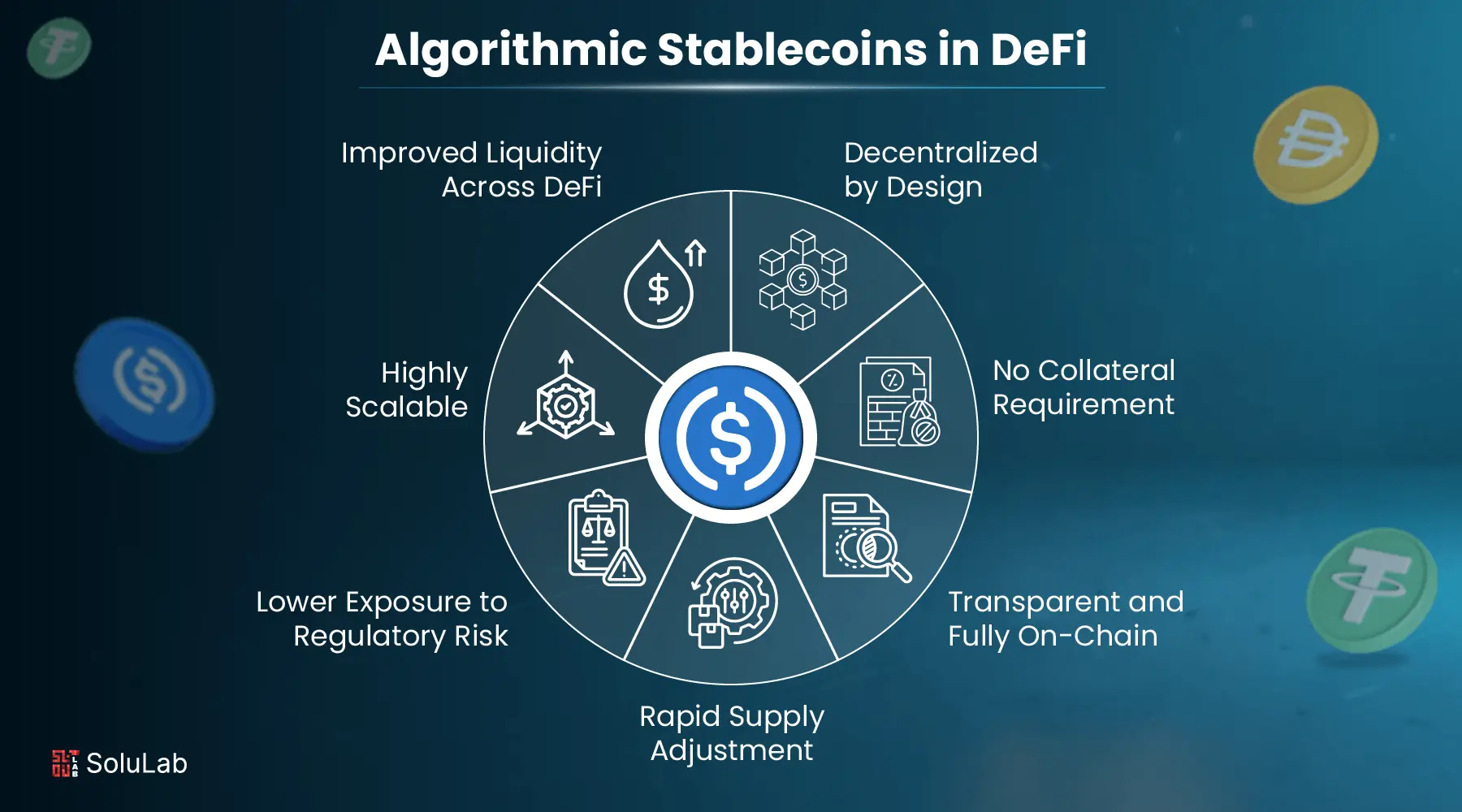
Key Benefits of Algorithmic Stablecoins in DeFi

If you’ve spent any time exploring DeFi, you’ll know that stablecoins play a huge role in making it all work. But not all stablecoins are built the same. Some rely on banks to hold real dollars, others lock up volatile crypto. Then you’ve got algorithmic stablecoins, which try something different; they manage everything through code. This approach isn’t perfect, but it comes with some real advantages. Here are a few pros of algorithmic stablecoins that make them stand out in the DeFi world:

1. Decentralized by Design

These stablecoins are governed entirely by smart contracts, not corporations or banks. This removes the need to trust a central authority, which aligns perfectly with DeFi’s goal of trustless infrastructure.

2. No Collateral Requirement

Unlike crypto- or fiat-backed models, algorithmic stablecoins don’t need to hold reserves. This reduces the barrier to entry for launching or scaling a project, freeing up capital for other uses within the ecosystem.

3. Transparent and Fully On-Chain

Since the logic and mechanics are open-source and executed on public blockchains, users can audit the system at any time. This kind of transparency helps build trust and avoids the opacity of traditional stablecoins.

4. Rapid and Autonomous Supply Adjustment

The coin’s supply can expand or contract automatically in response to price shifts, without needing human intervention. This automation allows for quicker reactions to market volatility compared to centralized models.

5. Lower Exposure to Regulatory Risk

Because they aren’t tied to real-world assets or centralized banking systems, algorithmic stablecoins face fewer legal uncertainties in most jurisdictions, at least for now.

6. Highly Scalable

With no need to manage or safeguard physical assets, these coins can scale more quickly and be deployed across various DeFi platforms without operational overhead.

7. Improved Liquidity Across DeFi

Their compatibility with lending protocols, DEXs, and yield platforms makes algorithmic stablecoins a versatile building block, promoting liquidity and utility across decentralized ecosystems.

Read Also: Hong Kong Stablecoin Regulation

Use Cases of Algorithmic Stablecoins in the DeFi Ecosystem

Algorithmic stablecoins have evolved from an experimental concept to a practical tool within the DeFi space. Unlike traditional stablecoins, they rely on code and real-time market data to adjust supply, allowing them to maintain stability without holding collateral. Understanding how algorithmic stablecoins work gives better insight into why they’re gaining traction across various decentralized applications.

  • Decentralized Lending & Borrowing: These stablecoins act as neutral collateral and a reliable unit of value, making them ideal for lending platforms without central dependencies.
  • Liquidity Pools on DEXs: Their predictable pricing helps users and protocols manage slippage and maintain deeper liquidity on decentralized exchanges.
  • Yield Farming & Incentive Distribution: Minting algorithmic stablecoins as rewards allows DeFi platforms to grow sustainably without locking in external assets.
  • Cross-Border Peer-to-Peer Payments: With no middlemen involved, they offer fast, cheap, and borderless transactions, especially valuable in emerging markets.
  • DAO Contributor Payments: DAOs use these stablecoins for payroll, enabling fully on-chain compensation without the need for traditional banks.
  • Synthetic Asset Collateralization: Algorithmic models are often used to support synthetic versions of real-world assets, ensuring scalability and decentralization.
  • Innovation in Automation: Many teams working on AI stablecoin development are integrating advanced algorithms and machine learning for smarter, more resilient supply management.

Future Outlook for Algorithmic Stablecoins in DeFi

The road for algorithmic stablecoins hasn’t been easy, but it’s far from over. While early failures like Terra shook user confidence, they also pushed the community to rethink how these systems are built. Today, developers are approaching the concept with more caution, better risk controls, and smarter designs. The lessons learned are now shaping a new generation of algorithmic models that are more transparent, better governed, and better equipped to handle extreme market conditions.

Looking ahead, algorithmic stablecoins have the potential to become a core layer of the DeFi stack, not just as a tool for trading, but for lending, payroll, DAOs, and even cross-border settlements. Their on-chain, rule-based nature makes them an ideal fit for a decentralized world where trust in intermediaries continues to erode.

For teams building in this space, working with a reliable stablecoin development company will be key. It’s not just about writing smart contracts, it’s about designing for resilience, scale, and long-term adoption. 

CTA2

The Bottom Line

Algorithmic stablecoins have opened up a new chapter in how we think about digital money, especially in decentralized finance. Instead of relying on traditional banks or crypto reserves, they use smart contracts to keep value steady, giving DeFi platforms a more flexible and autonomous option. While they’re still evolving, the potential is clear: for anyone looking to create a stablecoin that’s scalable, transparent, and free from centralized control, algorithmic models are worth serious consideration.

At SoluLab, we’ve had the opportunity to work on several forward-thinking projects in this space. As a trusted stablecoin development company, we helped build a complete blockchain ecosystem for DLCC, a platform aiming to transform regulated crypto and digital asset lending. Our work included a decentralized wallet, an exchange platform, and backend solutions that make digital asset financing simple, secure, and compliant with financial regulations.

If you’re exploring stablecoin solutions, whether for lending platforms, DeFi apps, or next-gen financial tools, our team is here to help!

FAQs

1. Are algorithmic stablecoins safe to use in DeFi protocols?

They can be, but it depends on the design. Like any financial tool, they carry risks, especially if the underlying code or economic model hasn’t been thoroughly tested. Newer versions are more cautious, often with built-in safeguards, but users should always do their research before using them in high-risk strategies.

2. Can algorithmic stablecoins completely replace fiat-backed stablecoins?

Not yet. Fiat-backed coins like USDC still dominate because they offer predictable, low-risk stability. Algorithmic stablecoins are better suited for projects focused on decentralization, but most ecosystems use a mix of both for now.

3. What happens when an algorithmic stablecoin loses its peg?

If the system isn’t well-designed, it can spiral—either printing too many tokens or collapsing in value. That’s why well-audited code, strong incentive mechanisms, and clear emergency responses are critical parts of any good algorithmic stablecoin system.

4. How are these coins different from regular crypto tokens?

Unlike typical tokens that fluctuate based on supply and demand alone, algorithmic stablecoins are built to adjust their own supply to hold a steady value. It’s more like a self-correcting system than a regular investment token.

5. Who should consider using or building with algorithmic stablecoins?

They’re great for DeFi builders who want to maintain full decentralization without relying on banks or custodians. If you’re building a lending platform, DAO, or cross-border payment solution, algorithmic stablecoins can be a powerful, flexible fit.


What Are Yield-Bearing Stablecoins?

Yield-Bearing Stablecoin

Traditionally, stablecoins provided an extra layer of security. They maintained their value, pegged with fiat currencies, and ultimately became a necessity for both traders and institutions. However, user expectations have risen with time. They expect these to make money without risky methods.

Yield-bearing stablecoins are transforming the way consumers see digital assets because of their ability to stay pegged while producing passive income. They merit further investigation, whether you are immersed in DeFi or just investigating more intelligent methods of storing value.

According to JPMorgan researchers, yield-bearing stablecoins may rise from 6% to 50% of the stablecoin market size. Its rising market value indicates digital demand for the top yield-bearing stablecoin. Over a year, its market worth rose 5284% from $65 million in February 2024 to $3.5 billion in February 2025.

This blog will go into the topic of yield-bearing stablecoins and how they are changing the game when it comes to digital asset valuation. We’ll explain what they are, how they work, and why they’re becoming more popular among investors looking for stable returns with little risk. 

Demystifying Yield-Bearing Stablecoins

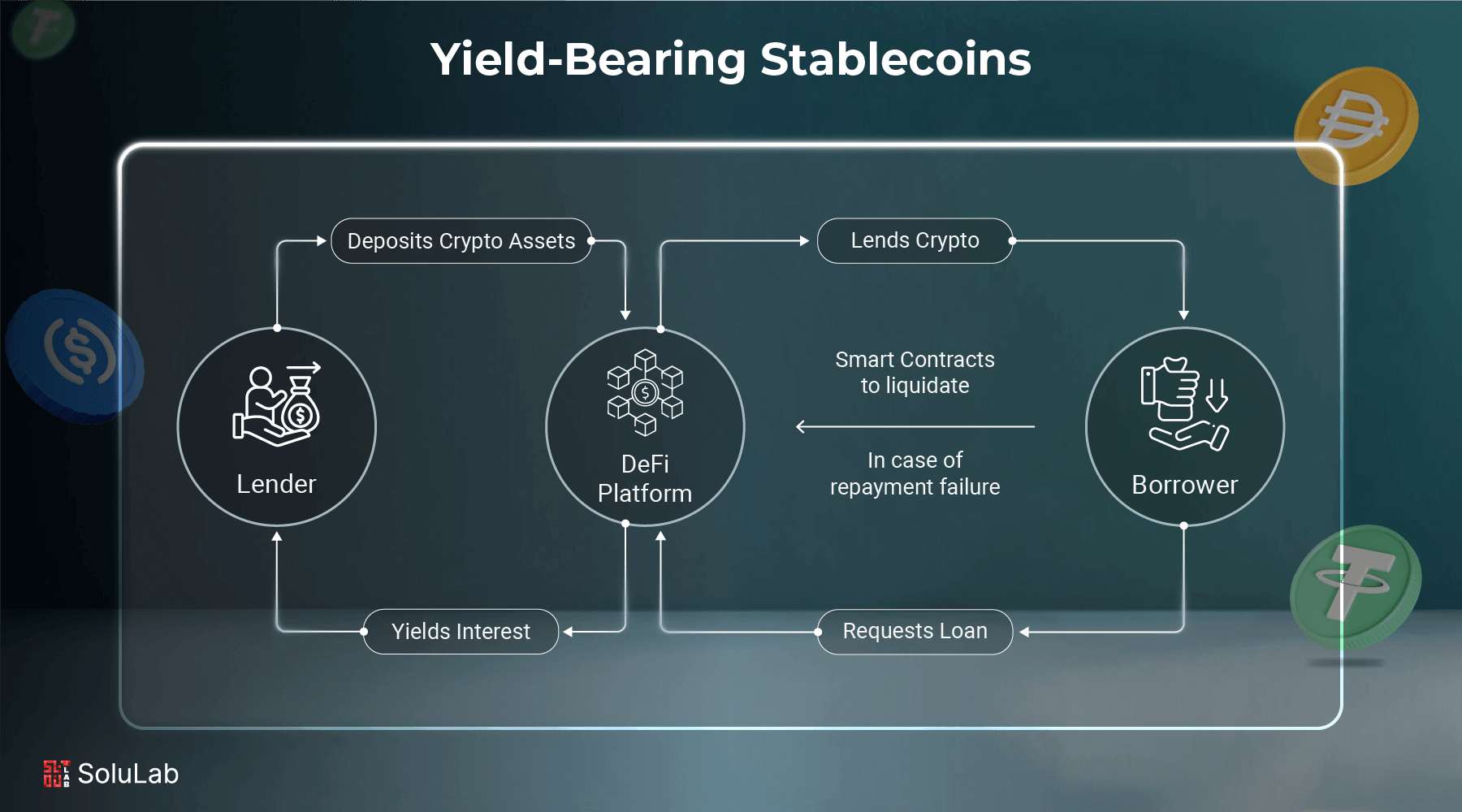
Take your bank account, for example. When you deposit cash, the bank doesn’t just let it sit idle. Instead, it maintains a digital record of your balance while lending the actual funds to borrowers. The interest collected from these loans is partially shared with you as a reward for holding your money there. What you see in your account is essentially a digital claim on real money that’s out in the market generating returns.

Similarly, yield-bearing stablecoins work by having users contribute capital to a protocol, often through deposits in stablecoins like USDC or even major assets like BTC and ETH. Once deposited, the protocol uses these funds in various investment or lending strategies and mints a stablecoin that represents your deposit. Over time, the gains earned are distributed fairly to holders based on the size of their stake. This method generates DeFi native yield without requiring active trading or high-risk speculation.

The mechanisms behind the earnings can differ between projects. Innovations in stablecoin in the DeFi space have opened up a range of options: liquidity mining, staking, or algorithmic rebalancing, that allow users to earn consistent returns in new, decentralized ways.

How Yield-Bearing Stablecoins Differ from Traditional Stablecoins?

Yield-bearing stablecoins take the concept of digital stability a step further by combining value retention with consistent income generation. While traditional stablecoins are typically used for transactions, remittances, and stable storage in crypto portfolios, yield-bearing stablecoins are crafted to provide ongoing returns simply by being held. This reflects some aspects of traditional finance (TradFi) like earning interest on savings, but without the friction of banks or intermediaries. 

Below is a comparison to highlight their key differences:

Feature Traditional Stablecoins Yield-Bearing Stablecoins
Core Purpose Mainly used for price stability, facilitating trades, and avoiding volatility in crypto. Combines stable value with passive yield, making funds productive while retaining a stable peg.
Earning Potential Does not generate any yield unless manually deposited into yield strategies. Automatically earns interest through protocol-level mechanisms without active management
Backing Assets Typically backed 1:1 by fiat reserves or cash equivalents in a centralized reserve. Backed by user deposits that are actively deployed in lending, staking, or liquidity pools.
User Participation Users must take extra steps to invest and earn returns. Yield is built in; simply holding the token accrues earnings proportionally.
Protocol Integration Used across exchanges, wallets, and platforms as a stable unit of account or settlement. Deeply integrated with DeFi protocols that leverage assets for yield-generating strategies
Risk Level Very low risk, minimal exposure due to reserve-based model. Slightly higher risk depending on how the underlying capital is invested.
TradFi Analogy Comparable to holding fiat cash or using a debit card without interest returns. Similar to placing money in high-yield savings or reinvested bonds in TradFi.
Examples in Use USDC (Circle), USDT (Tether), BUSD (Binance) sDAI (Spark Protocol), aUSDC (Aave), yDAI (Yearn Finance)

How Do These Stablecoins Generate Yield?

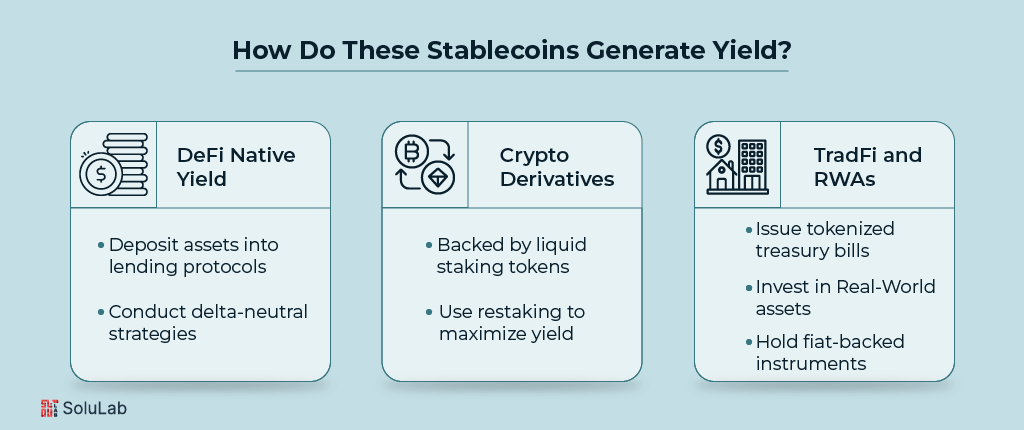
Yield-bearing tokens accumulate passive income through three primary channels: DeFi native yield, crypto derivatives, and traditional finance (also known as TradFi) combined with real-world assets (RWAs). Each source has its structure and logic, offering different levels of risk, return, and decentralization.

How Stablecoin Generate Yield

1. DeFi Native Yield

These returns originate within decentralized ecosystems and are driven by demand for lending, borrowing, or liquidity.

  • Protocols like Aave or Compound allow users to deposit assets such as ETH or DAI, which are lent out to borrowers. The interest earned is shared with depositors via yield-bearing stablecoins.
  • MakerDAO’s DSR (Dai Savings Rate) enables holders to lock DAI into a contract and receive sDAI, which earns a variable return depending on supply-demand conditions.
  • Ethena Finance employs delta-neutral hedging strategies using ETH to earn DeFi native yield without exposing users to price volatility.

2. Crypto Derivatives

These stablecoins earn from tokens that represent staked or restaked crypto assets, acting like income-generating securities.

  • Prisma Finance’s mkUSD is backed by liquid staking tokens (LSTs) that collect rewards from staked ETH and pass them onto stablecoin holders.
  • Davos Protocol’s DUSD leverages restaking layers to maximize yield from the same set of staked assets, multiplying reward flows.
  • These crypto derivatives offer a way to earn yield without locking funds directly into staking contracts.

3. TradFi and Real-World Assets (RWAs)

Protocols in this category bridge traditional markets and DeFi by tokenizing stable income-generating assets.

  • Ondo and Flux Finance issue stablecoins backed by tokenized treasury bills or short-term corporate debt, delivering predictable returns.
  • Mountain Protocol and Paxos Lift Dollar invest in diversified RWAs like real estate, government bonds, and ETFs to create secure yield for users.
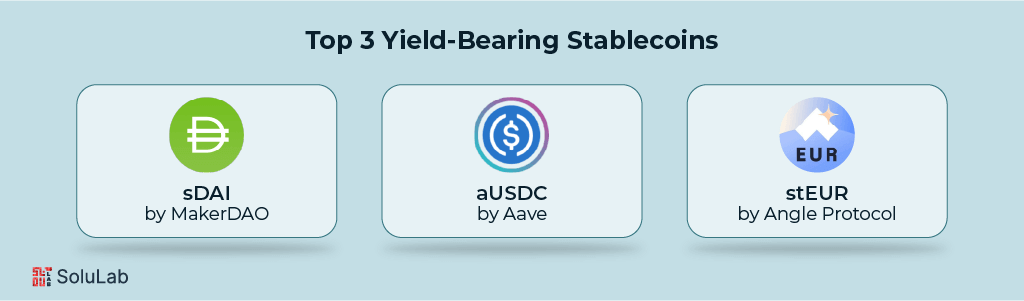
  • stEUR, sUSDT, and eUSDC provide stable returns by holding regulated financial instruments—essentially bringing traditional finance (TradFi) into the on-chain environment.

This multi-pronged approach allows each stablecoin development company to innovate with both blockchain-native and institutional strategies, unlocking new ways to earn while maintaining stability.

Contact Us

How to Earn Passive Income From Yield-Bearing Stablecoins?

Earning from yield-bearing stablecoins is a seamless way to grow your crypto holdings without trading or staking complexity. These tokens are designed to maintain stability while generating income, often backed by real-world assets or DeFi strategies. Here’s how you can start:

Step 1: Select a Reputable Yield Protocol
Start by choosing a trusted DeFi platform that offers yield-bearing versions of stablecoins. Some of the most reliable options include:

  • MakerDAO (sDAI): Offers interest through the DAI Savings Rate (DSR).
  • Aave (aUSDC): Automatically generates yield from lending activities.
  • Spark Protocol: Provides yield via integrated smart DeFi strategies.
    These are not just regular tokens; they are asset-backed stablecoins, meaning each one is tied to real collateral, ensuring both yield and price stability.

Step 2: Deposit Your Assets to Mint Yield-Bearing Tokens
Once you’ve selected a platform, you’ll need to deposit compatible assets like DAI, USDC, or ETH into the protocol.

  • For example, depositing DAI into MakerDAO will allow you to mint sDAI.
  • These deposits are pooled and then used in lending, staking, or hedging strategies to generate returns.

You’re not lending or investing manually; the protocol takes care of that, distributing a share of the earnings to you automatically.

Step 3: Swap on a DEX (If You Prefer Buying Directly)
If you’d rather not deposit directly into a protocol, you can purchase existing yield-bearing stablecoins from a decentralized exchange (DEX) like Uniswap, Curve, or Balancer.

  • This is especially helpful if you want to diversify into multiple tokens without going through each protocol.
  • It’s fast, flexible, and you gain access to tokens that are already generating returns.

Step 4: Store Them in a Secure, Non-Custodial Wallet
Once acquired, transfer your yield-bearing tokens into a wallet like MetaMask, Ledger, or Trust Wallet.

  • These wallets allow you to hold your assets securely while still earning.
  • There’s no need to actively stake or lock them—returns are earned passively just by holding.

This step ensures that you retain full control of your funds while enjoying continuous yield generation.

Step 5: Monitor and Manage Your Earnings
Most platforms offer dashboards where you can:

  • Track how much you’ve earned over time.
  • Check current yield rates and APRs.
  • Reinvest or convert your returns as needed.

Many protocols auto-compound your earnings, meaning your balance grows without requiring manual action.

Step 6: Expand to Other Stablecoin Yield Options
Curious about how to earn yield on other stablecoins? Explore platforms like:

  • Yearn Finance: Automates the best yield strategies across protocols.
  • Angle.money: Offers euro-based and multi-currency stablecoin yield.
  • Flux and Ondo Finance: Focus on tokenized real-world assets and TradFi integration.

These platforms accept common stablecoins like USDT or USDC and turn them into yield-bearing forms through automated, optimized strategies.

Read Also: Hong Kong Stablecoin Regulation

3 Popular Yield-Bearing Stablecoins You Should Know

Top 3 Yield Bearing Stablecoin

As more users look for safer ways to earn passive income in crypto, yield-bearing stablecoins are gaining serious traction. Built on secure protocols and backed by real assets or lending strategies, they’ve become a go-to for DeFi users who want reliable yield without high risk. Let’s look at three standout options that are reshaping how people think about stable digital assets.

1. sDAI – MakerDAO’s Yield-Earning DAI

sDAI represents a version of DAI that earns interest through the Dai Savings Rate (DSR). When users deposit DAI into the protocol, they receive sDAI, which accrues yield automatically. It’s ideal for anyone who wants to keep their assets stable while quietly earning. The beauty of sDAI is that it can be used across DeFi applications while continuing to generate passive returns in the background.

2. aUSDC – Aave’s Passive Earning Token

aUSDC is Aave’s interest-bearing version of USDC. Once you deposit USDC into Aave, it converts into aUSDC and begins accumulating yield. It doesn’t require staking or complex management—just hold it in a compatible wallet and let the protocol do the work. Aave’s seamless interface makes this one of the easiest entry points for users looking to earn from their stablecoin holdings.

3. stEUR – Angle Protocol’s Euro-Based Stablecoin

For users seeking a Euro-denominated yield option, stEUR by Angle Protocol is an excellent choice. It’s backed by tokenized European money market funds and offers a stable, low-risk yield while maintaining its peg to the Euro. stEUR is especially useful for users in the EU or those who want to diversify beyond dollar-backed assets.

Protocols like these wouldn’t be possible without the expertise of a leading stablecoin development company that understands both blockchain infrastructure and financial compliance. If you’re thinking about how to create a stablecoin that does more than just hold value, studying these successful examples is a smart first step.

Benefits of Yield-Bearing Stablecoins

Yield-bearing stablecoins offer more than just price stability, they unlock a smarter, more efficient way to grow wealth in the digital economy. These assets are ideal for users who want to avoid volatility but still earn consistent returns without active management. 

Whether you’re holding assets during a market dip or parking funds between trades, these stablecoins quietly generate yield in the background. Here’s why they’re becoming a favorite among both retail users and institutional players:

  • Passive Income Made Simple
    You don’t need to trade, time the market, or take on risk-heavy strategies. Just holding a yield-bearing stablecoin in your wallet starts generating income automatically.
  • Stability Without Sacrificing Growth
    Unlike typical crypto assets, these stablecoins are designed to maintain their peg, often to the US dollar or euro, so you earn without worrying about price swings.
  • Flexible and Liquid
    Most yield-bearing stablecoins remain usable across DeFi platforms, meaning you can lend, borrow, or trade them while still earning interest.
  • Reduced Risk Exposure
    Many of these tokens are backed by diversified strategies like lending pools, treasury assets, or staking mechanisms, lowering your exposure compared to volatile tokens.
  • Ideal for Long-Term Holding
    If you’re waiting to re-enter the market or want a low-maintenance savings option, yield-bearing stablecoins give you a way to earn in the meantime.

The Future of Yield-Bearing Stablecoins

Yield-bearing stablecoins are quietly shifting how people think about holding money. What used to be a passive act, just storing value now becoming an active opportunity to earn. As more users look for safer ways to grow their assets without constant market exposure, these stablecoins are finding a real, lasting place in both personal finance and institutional strategy.

Soon, they’ll likely be used for more than just decentralized finance (DeFi). Think payroll in a stablecoin that earns while it sits, or savings tools that reward you. With better infrastructure, clearer rules, and growing trust, yield-bearing stablecoins aren’t just a trend—they’re the next chapter in how we build and hold value.

Stablecoin Development Company

Conclusion

Yield-bearing stablecoins are changing the way people think about money in the digital world. Instead of just holding value, these tokens offer a way to earn steady returns without diving into high-risk strategies. With more real-world use cases emerging, from everyday savings to cross-border finance, they’re quickly becoming a smarter, safer choice for anyone looking to grow their assets without constant market stress.

At SoluLab, we work closely with companies ready to explore this space, helping them build stablecoin solutions that are secure, scalable, and future-ready. Our focus on AI stablecoin development means we don’t just create tokens, we design systems that are smart, efficient, and easy to use. A great example of this is our recent project, DLCC, which aims to reshape the future of regulated crypto lending. We built a decentralized platform with a custom crypto wallet solution, making asset lending simple and compliant. 

If you’re thinking about building your stablecoin or launching a new financial product, let’s talk. Book a free consultation now!

FAQs

1. Are yield-bearing stablecoins safe to use?

Yes, but like any financial product, their safety depends on how the underlying protocol is managed. Many are backed by highly liquid assets or use well-audited smart contracts, but users should still evaluate the team, collateral model, and risk disclosures before investing.

2. Do I need to lock my funds to earn yield from these stablecoins?

Not always. Some yield-bearing stablecoins generate interest just by being held in your wallet, with no lock-up period. Others might offer higher returns if you agree to lock your funds for a set time. It all depends on the platform’s structure.

3. Can I still trade or transfer a yield-bearing stablecoin?

Absolutely. One of the key benefits of many yield-bearing stablecoins is that they remain liquid. You can send, swap, or even use them in other DeFi applications without interrupting the yield you’re earning, though it’s best to double-check if your specific token supports this.

4. How are yields calculated and paid out?

Yields are usually based on the performance of the protocol’s lending or investment strategies. Some pay interest daily or weekly, while others continuously stream small amounts into your wallet. You won’t always see large jumps, but your balance grows over time.

5. Is there any tax implication when holding these tokens?

Yes. In many regions, earnings from yield-bearing stablecoins may be considered taxable income, similar to interest on savings. It’s a good idea to consult a tax advisor familiar with crypto to understand your specific obligations.


USDC vs. USDT: Investor’s Guide 2025

USDC vs. USDT

Stablecoins are a unique class of cryptocurrencies designed to offer price stability by pegging their value to a fiat currency, most commonly, the U.S. dollar. Among the most prominent names in this space are USDT (Tether) and USDC (USD Coin). 

Both aim to maintain a consistent 1:1 value with the dollar, yet they differ in how they’re backed, governed, and used across blockchain networks. While USDT dominates on Ethereum, USDC has spread across multiple chains, including Algorand.

This blog will help investors compare USDT and USDC in 2025, looking at how each one works, how secure they are, where they’re most useful, and which might be a better fit for different crypto strategies.

What is USDC?

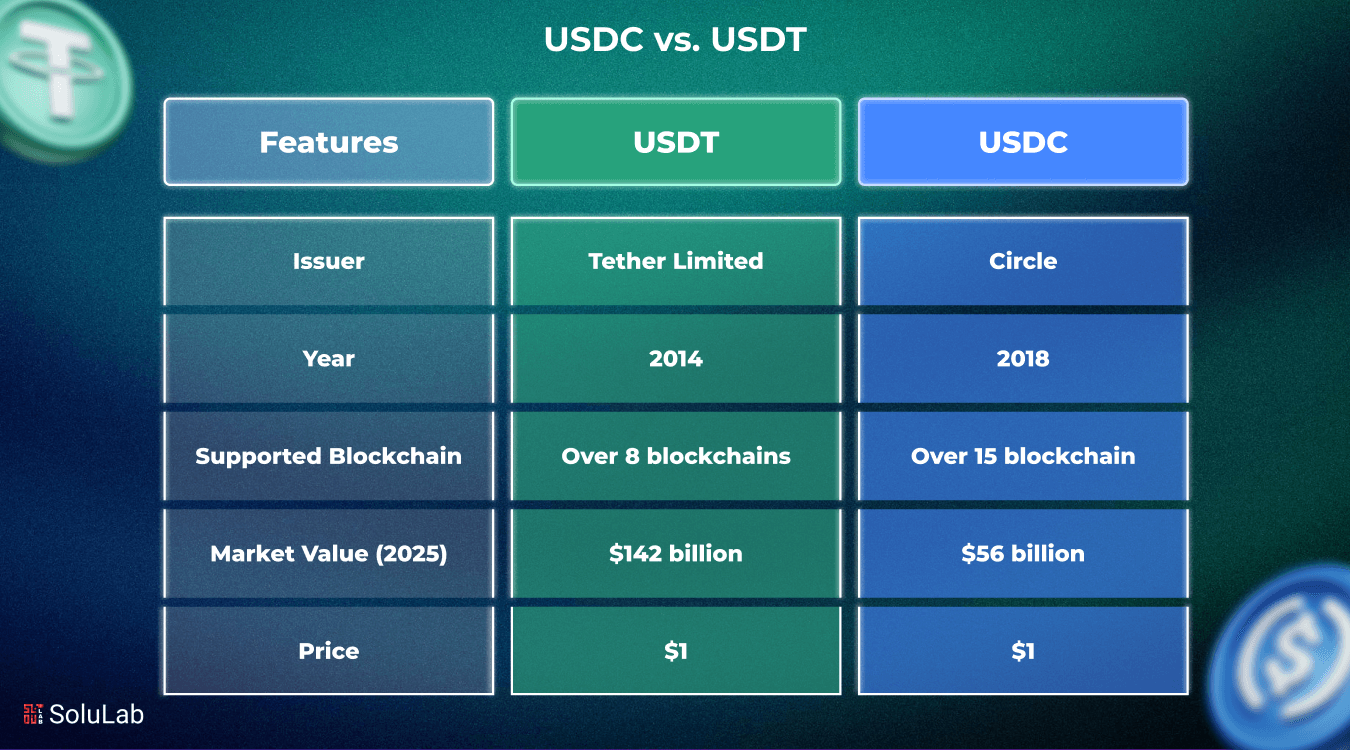
Circle launched USDC in 2018, and it is fully backed by extremely liquid cash or cash-equivalent assets. The value of USDC can always be exchanged into US dollars at a 1:1 ratio. Due to Circle’s frequent third-party audits of its reserves, it is also renowned for its transparency.

As of March 28, 2025, USDC is now valued at $60,134,104,803 and rated #7 on CoinGecko. USDC is a price-stable digital asset that has multiple applications.

  • Protect against volatility: By carefully purchasing a stablecoin like USDC, investors who are exposed to other cryptocurrencies can lessen the volatility of their portfolios. Having USDC on hand can help stabilize the value of a portfolio during times of high market volatility.
  • Pricing in fiat currency: A stablecoin such as USDC can be used to price digital assets listed on cryptocurrency exchanges in fiat currency.
  • Stable price-pegging: USDC’s price stability makes it possible for the stablecoin to support investments or reflect equity ownership. Liabilities or debt can also be represented as USDC.

Features of USDC

  • Regulatory Compliance: USDC is a safe and legal option because it complies with stringent US and EU regulations.
  • Support for Multiple Blockchains: accessible on Ethereum, Solana, and other platforms.
  • Wide Adoption: Utilized on decentralized finance (DeFi) systems and exchanges.
  • Transparency: Frequent audits of reserves by outside parties.

Benefits of USDC

Here are the  key benefits of USDC:

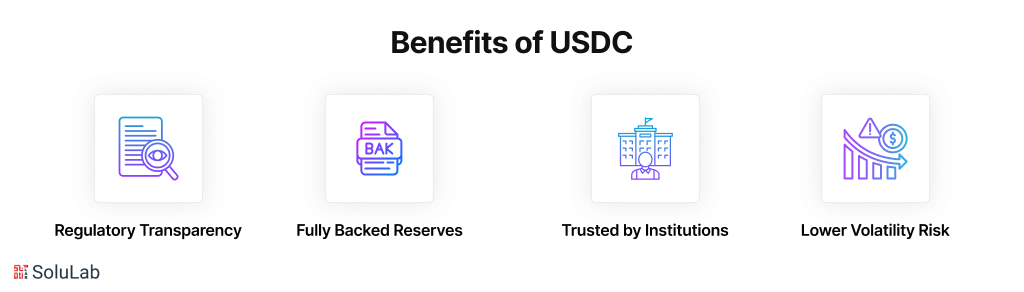
1. Regulatory Transparency: Issued by Circle, a regulated U.S. fintech firm, USDC follows strict compliance standards. It undergoes monthly audits and reporting, making it one of the most transparent stablecoins, especially appealing to risk-conscious and institutional investors.
2. Fully Backed Reserves: Every USDC token is backed 1:1 by cash and short-term U.S. Treasuries held in segregated accounts. Circle publishes regular attestations, offering users peace of mind about liquidity and redemption at any time.

3. Trusted by Institutions: USDC is the stablecoin of choice for many financial institutions, banks, and DeFi platforms. Its credibility and transparency make it ideal for enterprise-grade applications like tokenized securities, cross-border, and B2B payments.

4. Lower Volatility Risk: Due to regulatory oversight and a strong reserve system, USDC has a stable track record with minimal deviation from its $1 peg. This makes it less likely to face sudden trust crises compared to competitors.

Benefits of USDC

What is USDT?

The most popular stablecoin is Tether (USDT), which was first released in 2014. Its value is backed by a reserve of fiat money and other assets, and it is linked 1:1 to the US dollar. Despite its flaws, especially regarding transparency, USDT is still the biggest stablecoin in terms of market value.

As of March 28, 2025, USDT has a market capitalization of $144,201,607,371 and is ranked #3 on CoinGecko.

Features of USDT

  • Regulatory Compliance: USDT adheres to international regulations, including KYC and AML standards, ensuring trust with regulators and users alike.
  • Support for Multiple Blockchains: Operates on multiple blockchains like Ethereum (ERC-20), Tron (TRC-20), Solana, and more.
  • Wide Adoption: It is one of the most traded worldwide and is utilized on DeFi systems and exchanges.
  • Transparency: Audits of reserves are performed regularly by third parties.

Benefits of USDT

Here are the key benefits of USDT (Tether):

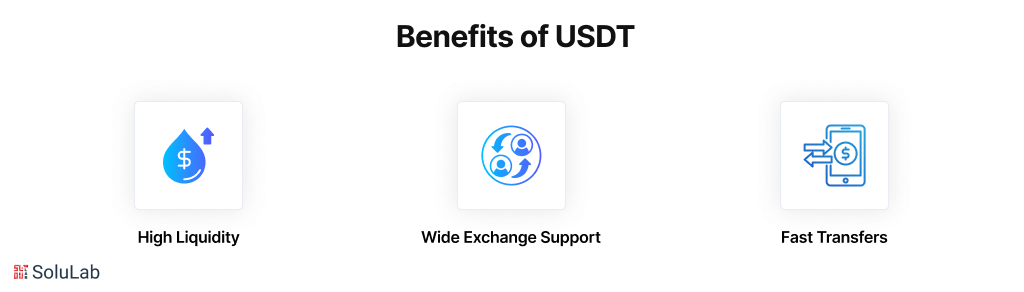
1. High Liquidity: USDT holds the largest market share among stablecoins, which means it’s easy to buy or sell without affecting its price. This makes it a preferred choice for traders needing quick access to stable assets.

2. Wide Exchange Support: USDT is available on almost every major crypto exchange, including Binance, Coinbase, WazirX, and KuCoin. Its broad adoption ensures users can trade it easily, no matter which platform they prefer.

3. Fast Transfers: USDT supports multiple blockchain networks like Tron (TRC-20), Ethereum (ERC-20), and Solana. Transfers, especially on Tron, are completed within seconds with minimal fees, perfect for quick trades and international payments.

Benefits of USDT

USDT vs. USDC: You Need To Know This

Before you choose between USDT and USDC, it’s important to understand how they differ in terms of trust, usage, and real-world applications, because not all stablecoins are created equal.

Attributes USDT USDC Winner
Transparency Limited auditing Full monthly audits USDT
Launch Year 2014 2018 USDC
Regulation Less regulated Highly  regulated USDC
Price $1 $1
Market Cap Higher Lower USDT
Blockchain Protocol Omni Layer, Etherum, Solana, Tron, Algorand, and more Ethereum, Solana, Algorand, Tron, Avalanche, Stellar, and more
Adoption Broadest usage Growing in DeFi USDT
Stability Occasional depeg Occasional depeg Tie
Fees/ Speed Low on Tron Preferred on ETH Tie (depends on blockchain)

Which is Better: USDC vs. USDT?

When comparing USDC and USDT, the “better” choice depends on your priorities as an investor.

USDC (USD Coin), issued by Circle, is known for its transparency and regulatory compliance. It undergoes regular audits and provides detailed reports on reserves, making it a popular choice among institutional investors and those who value trust and legal clarity. USDC is also supported across multiple blockchains like Ethereum, Solana, and Algorand, offering flexibility and efficiency.

However, in terms of usage and liquidity, USDT (Tether) leads the stablecoin market.  It is freely accessible on almost all cryptocurrency exchanges and is the most traded stablecoin. This makes it ideal for quick trades, arbitrage, and high-volume transactions. USDT has faced criticism over its reserve transparency and was fined by U.S. regulators in the past.

If your priority is regulatory safety and transparency, USDC is a better fit. But if you need fast, global trading with high liquidity, USDT may serve you better.

Should I invest in USDC or USDT?

Choosing between USDC and USDT depends on your investment goals, risk tolerance, and how you plan to integrate the stablecoin working in your business operations.

If you’re looking for transparency and regulatory assurance, USDC is the safer bet. Issued by Circle, a U.S.-based company, USDC undergoes regular audits and complies with strict regulations. This makes it a preferred choice for businesses, institutions, and investors who prioritize security and compliance. It’s also ideal if you plan to use it within regulated platforms or for long-term stable holdings.

On the other hand, USDT (Tether) offers greater liquidity and global adoption. It is widely accepted across international exchanges and is frequently used for quick trading, DeFi protocols, and cross-border transfers due to its presence on fast and cheap blockchain networks like Tron. However, it has faced regulatory scrutiny and questions over its reserve transparency in the past.

Stablecoin Development Services

Conclusion

Both USDC and USDT in 2025 remain important players in the stablecoin space, each with something to provide to meet different investor demands. USDC is distinguished by its regulatory clarity and credibility, making it the best choice for risk-averse investors. 

USDT, with its liquidity and usage, remains the preferred option for swift, international trading. Your choice is based on your preferences, whether compliance, usability, or speed is more important. 

With the evolving crypto space, it is essential to be informed and, at times, to revisit your stablecoin options. A savvy strategy could be hedging between both to benefit from the most secure and flexible setup in your portfolio.

SoluLab, a Stablecoin development company, can help you pick the right one as per your preferences. Contact us today. 

FAQs

1. Is investing in USDC or USDT safe?

Both USDC and USDT are regarded as secure stablecoins for investment purposes. They vary in terms of regulations, use cases, and transparency.

2. Are USDT and USDC considered crypto assets?

Crypto assets do not include USDT and USDC. They are categorized as stablecoins instead. By tying their value to a fiat currency, such as the US dollar, stablecoins seek to promote stability.

3. Can I transfer USDT to USDC?

If the cryptocurrency exchange has a USDT/USDC trading pair, USDT can be exchanged for USDC in the same way that cryptocurrency tokens can be exchanged for one another.

4. Is it possible to convert USDT to USDC and vice versa?

Yes, most major exchanges support swapping between USDC and USDT with minimal fees.

5. Can I use both USDC and USDT on the same blockchain?

Yes, both tokens are available on multiple blockchains, including Ethereum, though network availability can differ.