
Key Highlights
- A Crypto Payment Gateway helps businesses accept digital assets in a structured way.
- A strong cryptocurrency payment gateway can support checkout, settlement, wallet flows, and reporting.
- A crypto to fiat payment gateway helps merchants accept crypto without holding price risk.
- The best crypto payment gateway should support security, usability, and merchant control.
- Well-planned crypto payment gateway development helps businesses serve global users more efficiently.
Business payment teams are under pressure from two sides. While customers want diverse payment options, merchants are finding a way out for faster cross-border settlement with lower friction and fewer limits. This is giving rise to the Crypto Payment Gateway. Many companies now find Crypto payments useful for digital-first customers, global buyers, and markets where traditional payment flows are slower or more expensive.
The market for crypto payment gateways is projected to reach $5.37 billion by 2032, having 17.8% CAGR. A Cryptocurrency payment gateway solution can support digital asset payments, help manage settlement, and give the business more control over its funds. This guide explores the significance of a crypto payment gateway in business transactions in 2026.
Deciphering The Crypto Payment Gateway
A Crypto Payment Gateway is a payment system using which businesses can use to accept cryptocurrency payments from customers in a merchant-friendly way. By using these payment rails, businesses can verify payment, track transactions, and have settlement in cryptocurrency, fiat, or both.
A good payment gateway for cryptocurrency does more than show a wallet address. It can include hosted checkout, QR payments, wallet support, payment confirmation, merchant alerts, dashboards, and payout controls. Therefore, companies are considering a crypto payment provider as part of their payment infrastructure.
Cryptocurrencies payment gateway sits between the customer making the payment and the merchant receiving the funds. It turns a blockchain transaction into a checkout flow that the business can work with.

Why Do Businesses Need Crypto Payment Gateways?
Businesses now need payment systems that support faster transactions, global customers, lower friction, and better flexibility in a digital economy. Here is why:
- Customer habits are changing
More customers already hold crypto in personal wallets. Some want to use those assets for purchases, subscriptions, and online services instead of keeping them idle. That shift is creating more demand for crypto payment gateways that make crypto payments easier at checkout.
- Cross-border payments still have gaps
International payments can still be slow, expensive, or difficult to manage. A cryptocurrency payment gateway gives businesses another route for taking payments from global customers.
- Merchants want more control
Many businesses do not want to depend on one payment rail. They want more choice in how they accept funds, how they settle them, and which customers they can serve. That is where the Crypto Payment Gateway for Businesses becomes relevant.
Core Features That Define A Strong Crypto Payment Gateway
A strong gateway should combine security, direct payment flows, global coverage, fast processing, and flexible merchant settlement controls for business
- Security
Security sits at the center of any cryptocurrency payment gateway solution. Blockchain technology records already make transaction tampering harder. On top of that, providers often use encryption, multi-signature controls, and secure transaction checks to protect merchant and customer data.
- Direct payments
A strong cryptocurrency payment solution supports direct transfers without adding avoidable layers between the customer and the merchant. This helps reduce friction in the payment process.
- International coverage
A useful payment gateway for cryptocurrency should handle payments from users in different regions without the same delays common in traditional systems. This matters for companies selling across borders.
- Fast processing
Crypto gateways can process payments quickly because they rely on blockchain verification instead of several banking intermediaries. That can make payment handling faster for merchants.
- Lower fees
Compared with some traditional processors, crypto payment gateways can reduce transaction costs. That makes them worth considering for businesses that watch payment margins closely.
How A Cryptocurrency Payment Gateway Works?
The following are step-by-step instructions on the functioning of a crypto payment gateway.
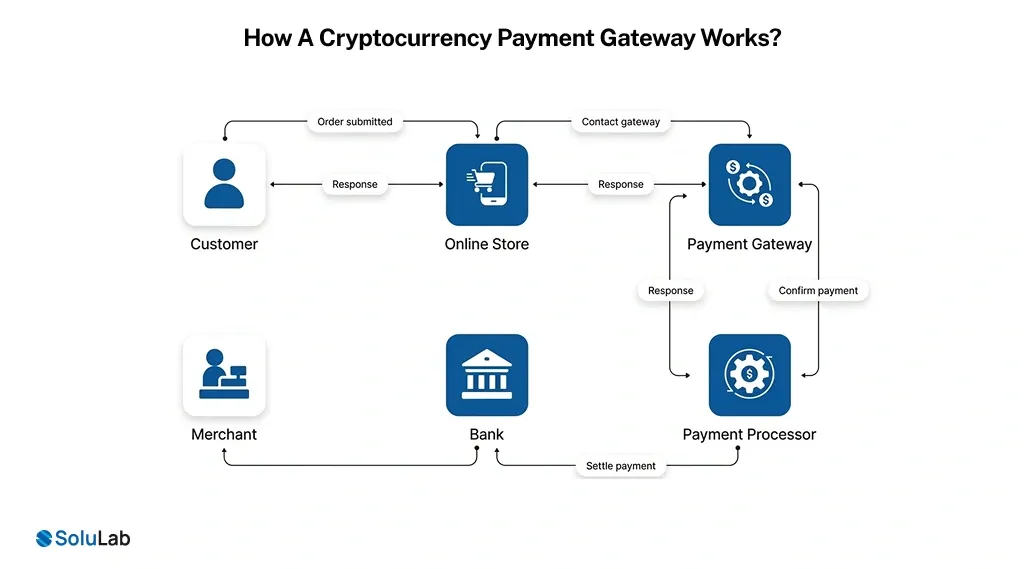
Step 1: The customer chooses crypto
The process starts when the buyer selects cryptocurrency at checkout. The system then shows the supported payment asset and prepares the payment request.
Step 2: The gateway creates the payment request
The cryptocurrency payment gateway generates a wallet address, QR code, or payment link tied to that order. The customer uses it to send funds from a crypto wallet.
Step 3: The blockchain confirms the payment
Once the payment is sent, the blockchain network checks and confirms the transaction. The gateway monitors that process and verifies that the expected amount has been received.
Step 4: The system applies settlement rules
After confirmation, the funds move according to the merchant’s setup. Some businesses receive crypto directly. Others use a crypto-to-fiat payment gateway, so the amount is converted before payout.
Step 5: The merchant gets notified
Once the payment is confirmed, the merchant gets a notification and can move ahead with fulfillment or service delivery. A good cryptocurrency payment gateway solution makes this part clear and fast.
Step 6: The customer gets confirmation
The customer also receives confirmation through a receipt, order message, or success screen. That closes the transaction and adds trust to the checkout flow.
Why Businesses Invest In Crypto Payment Gateway Development?
Businesses invest to add a new payment rail, support global customers, reduce friction, and build stronger payment flexibility over time.
- It helps them add a new payment rail.
A sound crypto payment gateway development plan gives a business a workable way to accept digital assets without replacing its entire payment setup.
- It supports global sales
A cryptocurrencies payment gateway helps businesses serve customers in more regions, especially where crypto usage is stronger or banking access is less convenient.
- It reduces payment friction for some users
Customers who already prefer crypto do not want to leave checkout to move through a long payment process. A clean cryptocurrency payment gateway helps keep that flow simple.
- It gives product teams more room to build
A custom cryptocurrency payment gateway solution can support stablecoin payments, merchant payout settings, loyalty use cases, smart automation, and custom integrations. That matters for businesses building long-term payment products.
Benefits for customers and merchants
- Benefits for customers
Customers get more privacy, stronger control over their funds, and easier access to cross-border payments. Crypto-based payments also reduce dependence on banking limits in some cases. The source material also notes that token-based rewards and related models can improve the payment experience for users.
- Benefits for merchants
Merchants can reduce some processing costs, lower chargeback exposure, serve global customers more easily, and support smaller transactions where needed. A capable crypto payment provider can also support loyalty models and automate parts of payment handling.
How To Plan A Crypto Payment Gateway For Businesses?
A successful payment gateway plan starts with business goals, asset choices, security requirements, compliance needs, and clearly defined launch priorities.
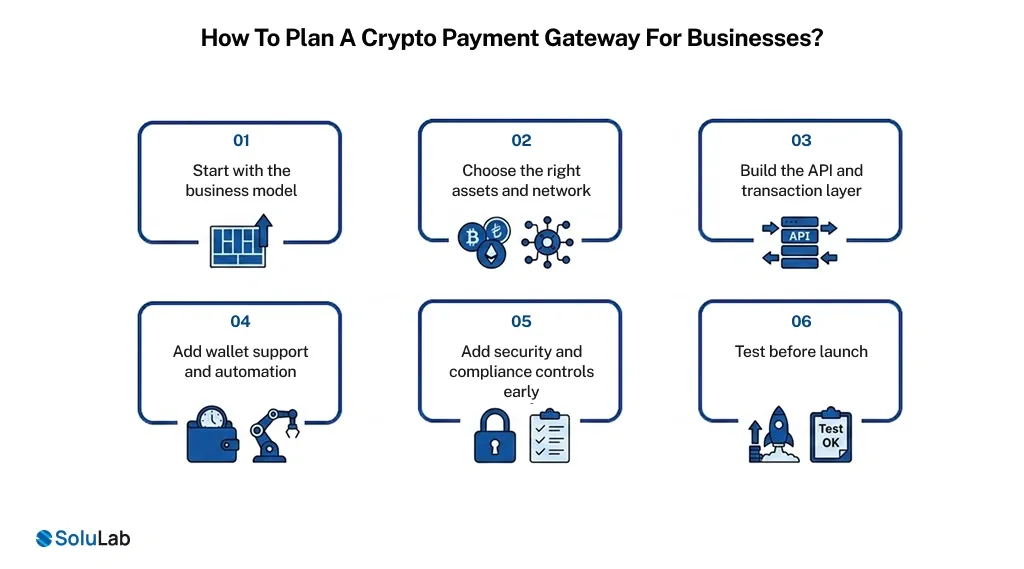
- Start with the business model
The first step is to decide how the business plans to use the gateway. A marketplace, SaaS product, ecommerce store, and fintech platform will not need the same payment flow. A strong Crypto Payment Gateway for Businesses starts with the business case.
Read more- https://www.solulab.com/launch-crypto-payment-gateway-like-stripe/
- Choose the right assets and network
Some companies want Bitcoin and Ethereum support. Others want stablecoins first. The blockchain and asset mix affect settlement speed, cost, and user preference.
- Build the API and transaction layer
The API connects the checkout flow, merchant backend, wallet interaction, and blockchain handling. It is the core of the cryptocurrency payment gateway solution.
- Add wallet support and automation
Wallet integration is a basic requirement in any payment gateway for cryptocurrency. Automation can also help with payment checks, internal triggers, and settlement handling.
- Add security and compliance controls early
KYC, AML, transaction monitoring, and access controls should be planned from the start. Businesses looking at crypto payment gateway services need more than payment acceptance. They need a system that can hold up under real operating conditions.
- Test before launch
A live payment product needs security testing, performance checks, and end-to-end payment validation before rollout. That is part of responsible crypto payment gateway development.

What Shapes Crypto Payment Gateway Development Cost?
The cost of crypto payment gateway development depends on how simple or advanced the product needs to be. A basic version may cover wallet payments, a dashboard, payment tracking, and simple KYC. A larger build may include fiat conversion, advanced reporting, merchant roles, external integrations, and stronger compliance tooling.
Major crypto payment gateway development cost factors usually include blockchain choice, security layers, custom features, compliance requirements, testing, and third-party integrations. Costs also rise when the business wants enterprise-grade performance, deeper reporting, or broader asset support.
That is why there is no single standard price for building a cryptocurrency payment gateway. The budget depends on product scope and operating requirements.
What To Look For In The Best Crypto Payment Gateway?
Businesses should compare usability, security, settlement options, integration fit, reporting quality, and asset support before choosing a provider:
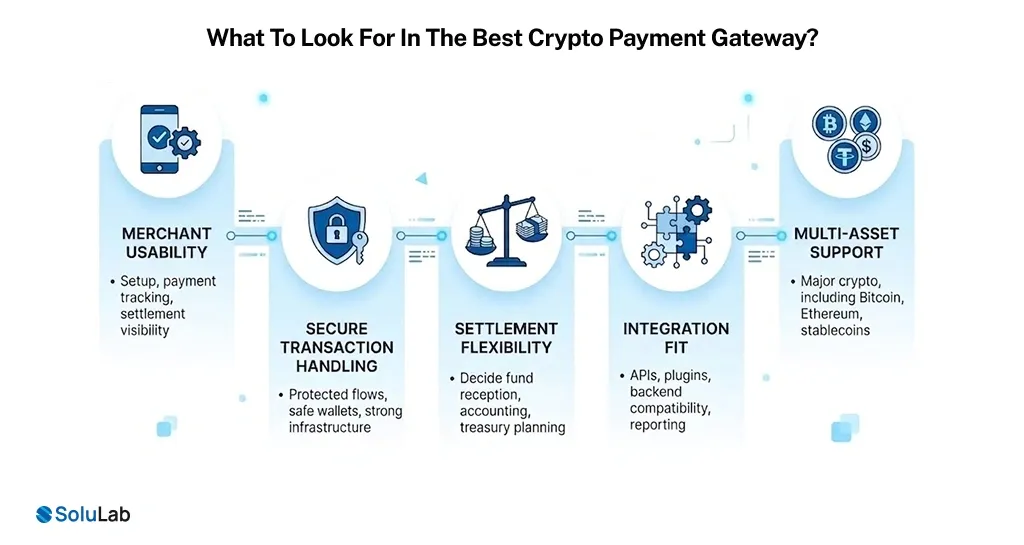
- Merchant usability
The best crypto payment gateway should be easy for merchants to run day to day. That includes setup, payment tracking, settlement visibility, and basic operations.
- Secure transaction handling
A reliable crypto payment provider should support protected payment flows, safe wallet handling, and strong infrastructure controls.
- Settlement flexibility
A good crypto-to-fiat payment gateway should let merchants decide how they want to receive funds. This matters for accounting, treasury planning, and volatility management.
- Integration fit
The Best Cryptocurrency Payment Gateways should fit real business systems. APIs, plugins, backend compatibility, and reporting tools all matter here.
- Multi-asset support
The best crypto payment gateway should support the assets that merchants and customers are most likely to use, including Bitcoin, Ethereum, and stablecoins where relevant.
Leading Names Businesses Often Benchmark
When businesses compare the Best Cryptocurrency Payment Gateways, they often look at providers such as Coinbase, BitPay, and PayPal. These names matter because they reflect the features merchants now expect from a modern cryptocurrency payment gateway.
The larger point is simple. Merchant expectations are higher now. The best crypto payment gateway needs to support usability, settlement flexibility, reporting, and trust in one system.
Future trends in crypto payment gateway solutions
Stablecoins, hybrid settlement models, and better merchant tools are shaping the next phase of crypto payment gateway adoption for businesses.
1. Stablecoins will keep gaining ground
Stablecoins are likely to play a bigger role in the future of the Crypto Payment Gateway because they are easier for merchants to work with than more volatile assets.
2. Hybrid settlement will matter more
More businesses will want crypto acceptance with fiat payout. That will keep the crypto-to-fiat payment gateway model important.
3. Merchant infrastructure will improve
The next wave of crypto payment gateways will be judged by reliability, reporting, compliance support, payout options, and practical merchant controls.

Final thoughts
A useful Crypto Payment Gateway Guide should focus on business decisions, not only payment mechanics. The real question is how a business wants payments to work across checkout, settlement, reporting, and operations.
A well-built cryptocurrency payment gateway gives merchants another way to serve customers, handle global payments, and improve payment flexibility. For businesses evaluating the best crypto payment gateway, the strongest option will be the one that fits their payment model, user needs, and growth plans.
Why SoluLab fits this opportunity?
SoluLab, a top cryptocurrency development company, is well placed to help businesses build a secure and scalable Crypto Payment Gateway with clear commercial use. With experience across blockchain, Web3, neobanking, and cryptocurrency solutions, the company can support crypto payment gateway development, merchant payment flows, wallet integration, and broader crypto payment gateway services for businesses that want a practical cryptocurrency payment gateway solution.
Have a unique idea in your mind? We are all in to assist you with the best!
FAQs
Shipra Garg is a tech-focused content strategist and copywriter specializing in Web3, blockchain, and artificial intelligence. She has worked with startups and enterprise teams to craft high-conversion content that bridges deep tech with business impact. Her work translates complex innovations into clear, credible, and engaging narratives that drive growth and build trust in emerging tech markets.