For a long time, stablecoins did one thing: hold their value. They stayed pegged to fiat currencies, gave traders a safe haven during volatility, and became a bedrock of crypto infrastructure. That was enough. For a while.
But expectations have shifted. Holding a stablecoin while inflation chips away at purchasing power no longer feels like safety. Users want their idle capital to work. Yield-bearing stablecoins answer that. They stay pegged and generate passive income at the same time, which is why they’re drawing real attention from DeFi power users and institutional desks alike.
The numbers back this up. According to JPMorgan researchers, yield-bearing stablecoins could climb from 6% to 50% of the total stablecoin market. That’s not speculative hype. Their market worth jumped 5284% from $65 million in February 2024 to $3.5 billion in February 2025. One year. Fifty-three times the value.
This piece breaks down exactly what yield-bearing stablecoins are, how the yield actually gets generated, and why more people are making them a core part of their crypto strategy.
Demystifying Yield-Bearing Stablecoins
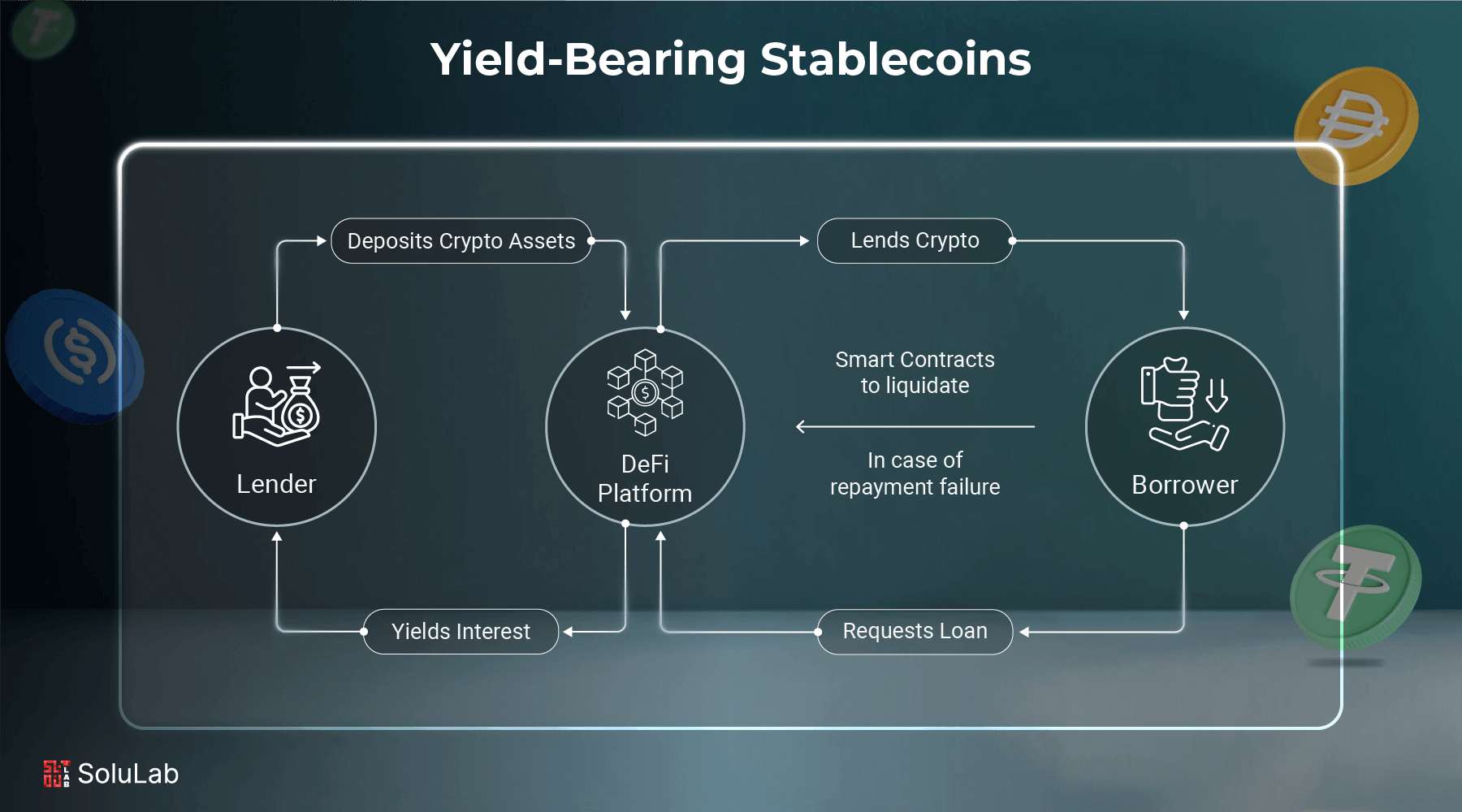
Think about how your bank account actually works. You deposit money, the bank keeps a record of your balance, and then lends those funds out to borrowers. A cut of the interest comes back to you. Your “balance” is really a digital claim on money that’s out in the world doing work.
Yield-bearing stablecoins follow the same basic logic, just on-chain. Users deposit capital, often USDC, DAI, or assets like ETH, into a protocol. The protocol puts those funds to work through lending, staking, or other strategies, then mints a stablecoin representing your deposit. Over time, the earnings accumulate and get distributed proportionally to holders. No active trading required. No high-risk speculation. That’s what’s called DeFi native yield, and it’s built into the token itself.
The specific mechanism varies by project. Some use lending markets. Others use delta-neutral derivatives. Innovations in stablecoin in the DeFi space have created real options here: liquidity mining, staking, algorithmic rebalancing. The underlying strategy differs, but the user experience is consistent. Deposit. Hold. Earn.
How Yield-Bearing Stablecoins Differ from Traditional Stablecoins?
Traditional stablecoins are inert by design. USDC, USDT, BUSD, they hold value, move value, and settle transactions. That’s genuinely useful. But they don’t work for you while they sit in your wallet.
Yield-bearing stablecoins flip that. The returns are baked into the token itself. No manual deposit into a separate yield protocol. No extra steps. You hold them, you earn. It’s closer to a high-yield savings account than a checking account, except it runs on smart contracts and doesn’t route through a bank.
Below is a comparison to highlight their key differences:
| Feature | Traditional Stablecoins | Yield-Bearing Stablecoins |
| Core Purpose | Mainly used for price stability, facilitating trades, and avoiding volatility in crypto. | Combines stable value with passive yield, making funds productive while retaining a stable peg. |
| Earning Potential | Does not generate any yield unless manually deposited into yield strategies. | Automatically earns interest through protocol-level mechanisms without active management |
| Backing Assets | Typically backed 1:1 by fiat reserves or cash equivalents in a centralized reserve. | Backed by user deposits that are actively deployed in lending, staking, or liquidity pools. |
| User Participation | Users must take extra steps to invest and earn returns. | Yield is built in; simply holding the token accrues earnings proportionally. |
| Protocol Integration | Used across exchanges, wallets, and platforms as a stable unit of account or settlement. | Deeply integrated with DeFi protocols that leverage assets for yield-generating strategies |
| Risk Level | Very low risk, minimal exposure due to reserve-based model. | Slightly higher risk depending on how the underlying capital is invested. |
| TradFi Analogy | Comparable to holding fiat cash or using a debit card without interest returns. | Similar to placing money in high-yield savings or reinvested bonds in TradFi. |
| Examples in Use | USDC (Circle), USDT (Tether), BUSD (Binance) | sDAI (Spark Protocol), aUSDC (Aave), yDAI (Yearn Finance) |
How Do These Stablecoins Generate Yield?
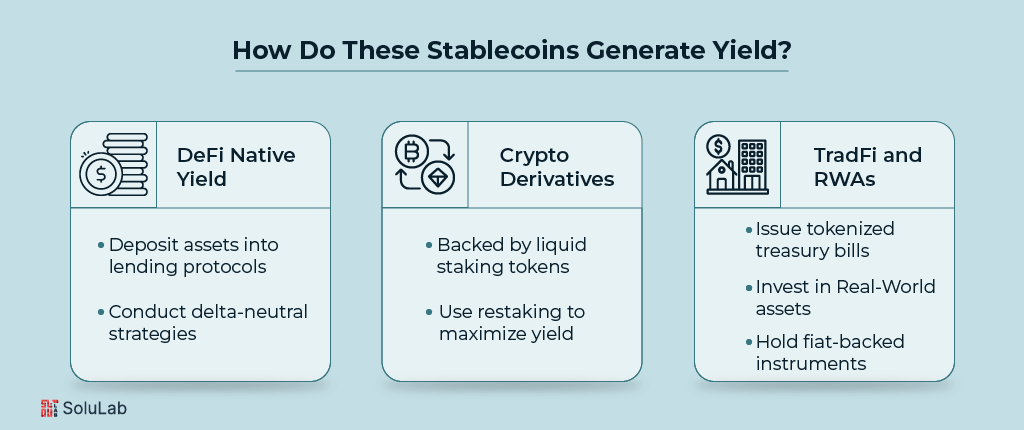
Yield-bearing tokens accumulate passive income through three primary channels: DeFi native yield, crypto derivatives, and traditional finance (TradFi) paired with real-world assets (RWAs). Each channel carries its own risk profile, return structure, and degree of decentralization.
1. DeFi Native Yield
These returns come from inside decentralized ecosystems itself, driven by real demand for lending and borrowing.
- Protocols like Aave or Compound let you deposit ETH or DAI, which then get lent out to borrowers. Depositors receive a yield-bearing stablecoin representing their share of the earned interest.
- MakerDAO’s DSR (Dai Savings Rate) lets DAI holders lock into a contract and receive sDAI, which earns a variable rate based on supply and demand conditions in the protocol.
- Ethena Finance uses delta-neutral hedging with ETH to produce DeFi native yield without exposing users to price swings.
2. Crypto Derivatives
Here, the stablecoin earns from tokens that represent staked or restaked crypto assets. Think of them as income-generating securities built on chain.
- Prisma Finance’s mkUSD is backed by liquid staking tokens (LSTs) that collect staking rewards from ETH and pass them through to stablecoin holders.
- Davos Protocol’s DUSD taps restaking layers to multiply reward flows from the same set of staked assets.
- The result: you earn staking-level yield without having to lock assets directly into a staking contract.
3. TradFi and Real-World Assets (RWAs)
This category bridges traditional markets and DeFi by tokenizing stable, income-generating assets that exist off-chain.
- Ondo and Flux Finance issue stablecoins backed by tokenized treasury bills or short-term corporate debt, delivering predictable returns tied to conventional fixed-income instruments.
- Mountain Protocol and Paxos Lift Dollar invest in diversified RWAs including real estate, government bonds, and ETFs to generate yield for users.
- stEUR, sUSDT, and eUSDC hold regulated financial instruments on-chain, bringing traditional finance (TradFi) interest directly into the DeFi environment.
This range of approaches lets every stablecoin development company pick a strategy that fits its risk tolerance and user base, whether that’s purely on-chain lending, derivative stacking, or tokenized T-bills.
How to Earn Passive Income From Yield-Bearing Stablecoins?
You don’t need to be an active trader. These tokens are built so that holding them is enough. Here’s the practical path from zero to earning.
Step 1: Select a Reputable Yield Protocol
Pick a trusted DeFi platform that offers yield-bearing stablecoins. A few well-established options:
- MakerDAO (sDAI): Offers interest through the DAI Savings Rate (DSR).
- Aave (aUSDC): Automatically generates yield from lending activities.
- Spark Protocol: Provides yield via integrated smart DeFi strategies.
These aren’t generic tokens. They are asset-backed stablecoins, each tied to real collateral, which is what keeps both the yield and the peg intact.
Step 2: Deposit Your Assets to Mint Yield-Bearing Tokens
Once you’ve chosen a platform, deposit compatible assets like DAI, USDC, or ETH into the protocol.
- Depositing DAI into MakerDAO, for instance, mints you sDAI in return.
- The pooled deposits get deployed into lending, staking, or hedging strategies. You don’t manage any of that. The protocol handles the allocation and returns your share automatically.
In practice, this is where most users realize how little friction there actually is. One deposit transaction, then you’re done.
Step 3: Swap on a DEX (If You Prefer Buying Directly)
Rather not deposit into a protocol directly? You can buy yield-bearing stablecoins from a decentralized exchange (DEX) like Uniswap, Curve, or Balancer.
- Useful if you want exposure across multiple tokens without setting up accounts on each individual protocol.
- Fast, flexible, and the tokens are already earning from the moment you hold them.
Step 4: Store Them in a Secure, Non-Custodial Wallet
Move your yield-bearing tokens into a wallet like MetaMask, Ledger, or Trust Wallet.
- Your assets stay secure and under your control.
- No lock-up required. No staking steps. The yield accrues passively while the tokens sit in your wallet.
You stay in full control of your funds. The protocol does its work regardless of where those tokens are held.
Step 5: Monitor and Manage Your Earnings
Most platforms include dashboards where you can:
- Track how much you’ve earned over time.
- Check current yield rates and APRs.
- Reinvest or convert your returns as needed.
Many protocols auto-compound earnings, so your balance grows without any manual input on your end.
Step 6: Expand to Other Stablecoin Yield Options
Want to explore how to earn yield on other stablecoins? A few more platforms worth looking at:
- Yearn Finance: Automates the best yield strategies across protocols.
- Angle.money: Offers euro-based and multi-currency stablecoin yield.
- Flux and Ondo Finance: Focus on tokenized real-world assets and TradFi integration.
These platforms take common stablecoins like USDT or USDC and convert them into yield-bearing forms through automated, optimized strategies. No manual management required on your end.
Read Also: Hong Kong Stablecoin Regulation
3 Popular Yield-Bearing Stablecoins You Should Know
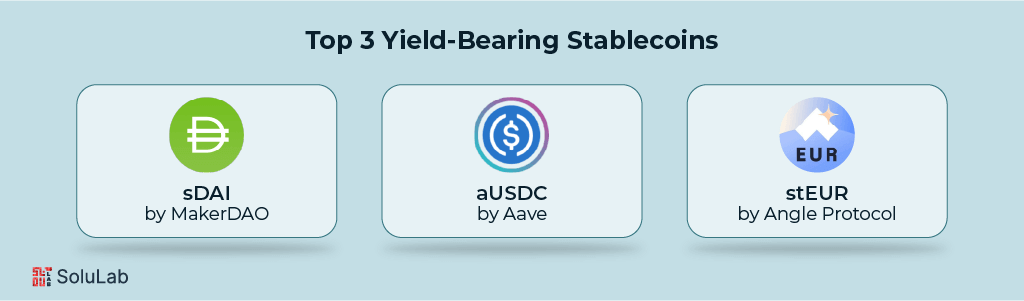
The market for yield-bearing stablecoins has moved fast. There are now dozens of options, but not all are built equally. Below are three that have earned real traction, backed by audited protocols, real collateral, and actual user adoption.
1. sDAI: MakerDAO’s Yield-Earning DAI
Deposit DAI into MakerDAO’s DSR contract and you get sDAI back. That’s the whole interaction. From that point on, sDAI accrues yield automatically, based on a variable rate set by MakerDAO governance. What makes it practical is that sDAI stays composable across DeFi applications. Your token keeps earning while you use it elsewhere. That dual utility is harder to find than it sounds.
2. aUSDC: Aave’s Passive Earning Token
Deposit USDC into Aave. Receive aUSDC. Watch the balance tick up. There’s no staking, no complexity, no active management. Aave distributes interest from its lending activity directly to aUSDC holders in real time. For someone who wants the lowest-friction entry into yield-bearing stablecoins, this is usually the first recommendation.
3. stEUR: Angle Protocol’s Euro-Based Stablecoin
Dollar-denominated options dominate this space, but stEUR by Angle Protocol offers something different. It’s backed by tokenized European money market funds and pegged to the Euro. The yield is stable and low-risk. For users in the EU, or anyone wanting exposure outside USD-backed assets, stEUR is a well-structured option that doesn’t require you to take on currency conversion risk.
Protocols like these depend on the foundational work of a skilled stablecoin development company that understands both on-chain infrastructure and financial compliance requirements. If you’re considering how to create a stablecoin that does more than just store value, these examples show what a well-built system actually looks like in practice.
Benefits of Yield-Bearing Stablecoins
The pitch is simple: stable value, plus returns, with minimal effort. But the specifics matter.
Whether you’re sitting out a volatile market or parking capital between trades, yield-bearing stablecoins give your funds something to do while they wait. Here’s what makes them worth paying attention to:
- Passive Income Made Simple
No trading. No market timing. No complex strategy. Just hold the token and income accumulates automatically. That’s the core of it. - Stability Without Sacrificing Growth
Unlike most crypto assets, these stay pegged, typically to the dollar or euro. You earn without riding price swings in either direction. - Flexible and Liquid
Most yield-bearing stablecoins work across DeFi platforms. You can lend, borrow, or trade with them and still collect interest. They don’t sit idle the way a locked staking position does. - Reduced Risk Exposure
Many of these tokens are backed by diversified strategies: lending pools, treasury assets, staking mechanisms. That spread reduces the risk compared to holding a single volatile token outright. - Ideal for Long-Term Holding
Waiting to re-enter the market? Need a low-maintenance savings option between allocations? Yield-bearing stablecoins earn in the meantime, without requiring you to make another decision.
The Future of Yield-Bearing Stablecoins
Something is shifting in how people think about holding money. For most of financial history, storing value meant accepting that value just… sits there. Yield-bearing stablecoins challenge that assumption directly. And adoption is tracking the way most crypto primitives do: slow at first, then not slow at all.
The use cases are expanding beyond decentralized finance (DeFi). Payroll paid in a stablecoin that earns while it waits for the next pay cycle. Savings products that reward users in real time. Treasury management for DAOs that want their reserves doing something. As infrastructure matures and regulatory clarity improves, the question won’t be whether yield-bearing stablecoins belong in a financial stack. It’ll be which ones to use.
Conclusion
Holding stablecoins used to mean accepting zero return in exchange for zero risk. Yield-bearing stablecoins break that tradeoff. Your capital stays stable. It also earns. That combination is why the market grew from $65 million to $3.5 billion in a single year.
At SoluLab, we work with companies building in this space, helping them develop stablecoin solutions that are secure, scalable, and built for real-world compliance. Our work in AI stablecoin development focuses on systems that are not just technically sound but practically usable. A recent example is DLCC, a platform designed to reshape regulated crypto lending. We built the decentralized infrastructure with a custom crypto wallet solution, making asset lending straightforward and compliant.
If you’re thinking about building a stablecoin or launching a new financial product, let’s talk. Book a free consultation now!
FAQs
Shipra Garg is a tech-focused content strategist and copywriter specializing in Web3, blockchain, and artificial intelligence. She has worked with startups and enterprise teams to craft high-conversion content that bridges deep tech with business impact. Her work translates complex innovations into clear, credible, and engaging narratives that drive growth and build trust in emerging tech markets.