DeFi apps are rewriting the rules of finance. They cut out the middlemen and open up financial services to anyone with an internet connection, no bank account or credit history required. The growth here is real: projections put the market at USD 48.02 billion by 2031.
Before you build anything, get the terminology straight: DeFi apps and dApps aren’t the same thing. DeFi apps focus narrowly on financial services, lending, borrowing, and trading, all running on blockchain rails. dApps cover far more ground, from games to education and beyond.
This guide walks through every phase of DeFi app development: picking the right use case, choosing your platform, locking down security. Let’s get into it.
Market Size and Trends in Decentralized Finance
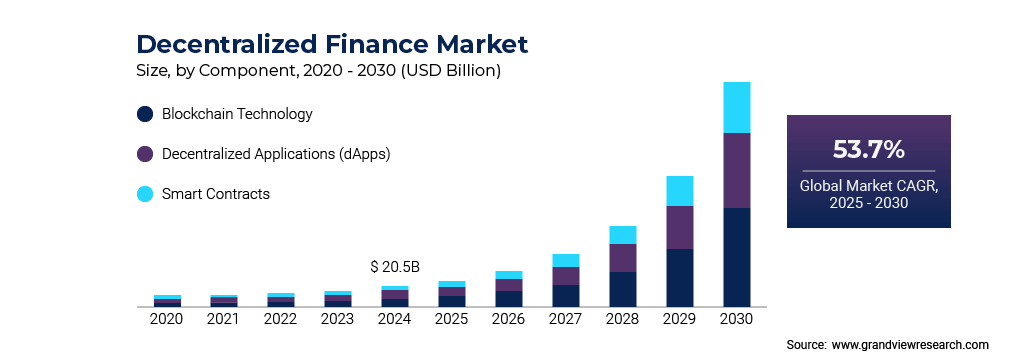
The global decentralized finance market sat at USD 20.48 billion in 2024, and it’s projected to grow at a compounded annual growth rate (CAGR) of 53.7% from 2025 to 2030. That growth isn’t happening in a vacuum. DeFi has become one of the biggest forces reshaping the financial sector, and it’s easy to see why people are paying attention: it strips out the intermediaries that traditional finance has always depended on.
As interest grows, more people want a straight answer on how DeFi development actually works. At its core, the technology offers a borderless financial system: you can manage risk, secure decentralized loans, and trade cryptocurrency safely, all powered by blockchain-based platforms. Plenty of the best DeFi apps already prove what this shift can do.
Essential Features for Developing a DeFi App
Smart contracts and interoperability are the backbone of any DeFi app. Layer in features that boost usability, security, and engagement, and you get a platform people actually want to use. Here’s what that looks like in practice:
Cryptocurrency Transactions
Let users move digital assets securely and instantly. Peer-to-peer transactions process faster and cost less than anything a traditional bank offers.
Support for Multiple Currencies
Let users manage and trade multiple cryptocurrencies, including Bitcoin, Ethereum, and others, from a single platform. That flexibility makes portfolio management and trading far simpler.
Decentralized Administration
Governance systems that let users vote on platform changes, funding, and updates bring the community into the decision-making. It builds transparency and gives users a real stake in outcomes.
Advanced Analytical Tools
Give users real-time data on market trends, investment performance, and risk. Good analytics tools help people make smarter financial calls and track their progress without guesswork.
Yield Farming and Staking
Letting users earn incentives through yield farming and staking opens up passive income. Features like these keep people engaged and coming back to the platform.
Smart Search and Filters
Sharp search and filtering tools make the whole experience smoother. Users can dig into tokens, investment strategies, or trending opportunities without getting lost.
Partnering with an experienced DeFi app development company means these features actually come together well, which matters if you want your app to stand out in a crowded, fast-moving industry.
Different Types of DeFi Apps
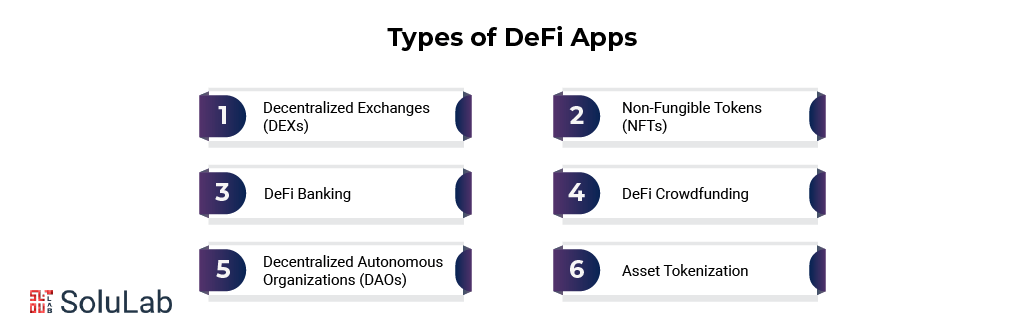
DeFi apps cover a lot of ground, and each type solves a different problem. Here are the categories you’ll run into most:
1. Decentralized Exchanges (DEXs)
Online markets where users trade crypto directly, with no centralized authority in the middle, are known as decentralized exchanges (DEXs). Nobody holds custody of your assets on a DEX. You trade straight from your wallet. Put simply: you keep control of your funds and your privacy.
2. Non-Fungible Tokens (NFTs)
NFTs are digital assets that prove ownership of something unique, anything from virtual real estate to a piece of art to a song. In DeFi, they play more roles than you’d expect: collateral for loans, building blocks for gaming ecosystems, and more. They also make finance genuinely fun. Registered users can buy, sell, and trade one-of-a-kind items right on the blockchain.
3. DeFi Banking
DeFi banking takes traditional banking functions and moves them into a decentralized setting. Users earn interest on crypto deposits, borrow funds, and access credit, all without a bank standing in the way. Think of it as a bank in your pocket: always open, no hidden fees, no waiting in line.
4. DeFi Crowdfunding
DeFi crowdfunding lets people raise money straight from the community, no banks or venture capitalists involved. Users back ideas and companies with their own cryptocurrency. It’s a genuinely fun way to back something you believe in, with a shot at a return down the line.
5. Decentralized Autonomous Organizations (DAOs)
Unlike a conventional company structure, distributed autonomous organizations (DAOs) run on smart contracts instead of a boardroom. Members vote on decisions and proposals using their tokens, which keeps resource allocation democratic. That built-in openness and fairness is what lets users actually manage community funds and back projects together.
6. Asset Tokenization
Asset tokenization means turning assets, usually real estate or artwork, into digital tokens on the blockchain. That makes buying, selling, and transferring those assets dramatically simpler. No mountains of paperwork, no middleman taking a cut.
How A DeFi App Functions?
DeFi (Decentralized Finance) refers to apps running on a blockchain other than Ethereum, Solana, for instance, that let anyone access financial services without a bank or broker sitting in between. Smart contracts make this possible: self-executing code that runs transactions automatically while keeping the rules fully visible.
From there, you connect a crypto wallet, often one of the top DeFi wallet apps like MetaMask or Trust Wallet. That wallet is your bridge into the decentralized world, letting you interact with DeFi applications safely and privately.
Criteria for Choosing the Technical Foundations for Developing a DeFi App
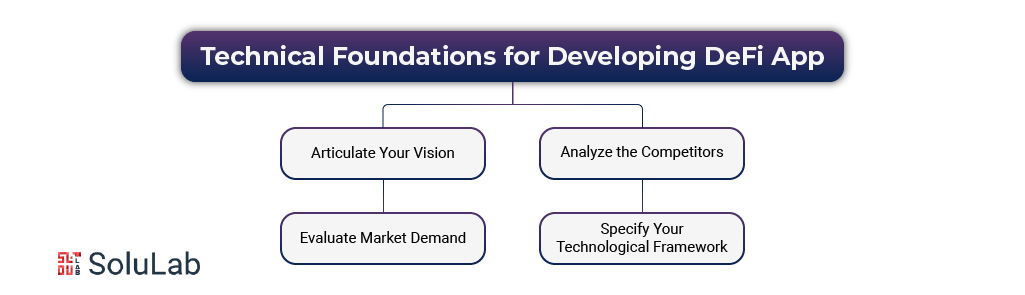
Building a DeFi app starts with picking the right technological infrastructure, and this choice matters more than most people expect. A solid tech stack keeps your app safe, scalable, and maintainable for the long haul, so as it grows, you’re not boxed into one framework or language.
Articulate Your Vision
Before writing a single line of code, nail down your app’s core purpose. What problem does it solve? What makes it different? What are its limits, and what real value does it hand users? Know your audience, and know exactly why they’d pick your solution over anyone else’s.
Analyze the Competitors
Studying existing products and DeFi lending platforms gives you a real edge. Compare your feature set against what’s already out there. What do competitors have that you don’t? What do you offer that nobody else does? This kind of analysis is how you spot your actual differentiation.
Evaluate Market Demand
You need a clear read on the broader DeFi ecosystem. Look at the current landscape, find the underserved corners, and study how people actually use existing apps. That’s how you spot the gaps your product can fill, and make sure what you’re building actually matches demand.
Specify Your Technological Framework
Finally, nail down the technical specs. What kind of data are you handling? How much of it, and how fast does it need to move? Which languages and frameworks actually fit those requirements?
Plenty of DeFi lending apps and platforms run on existing protocols like Compound, Dharma, MakerDAO, or Kleros. These protocols set the foundational rules and smart contract capabilities. Your application layer sits on top of that base, where you design the user interface, build out analytics, layer in security, and shape a cohesive user experience.

Steps to Create a DeFi App From Scratch
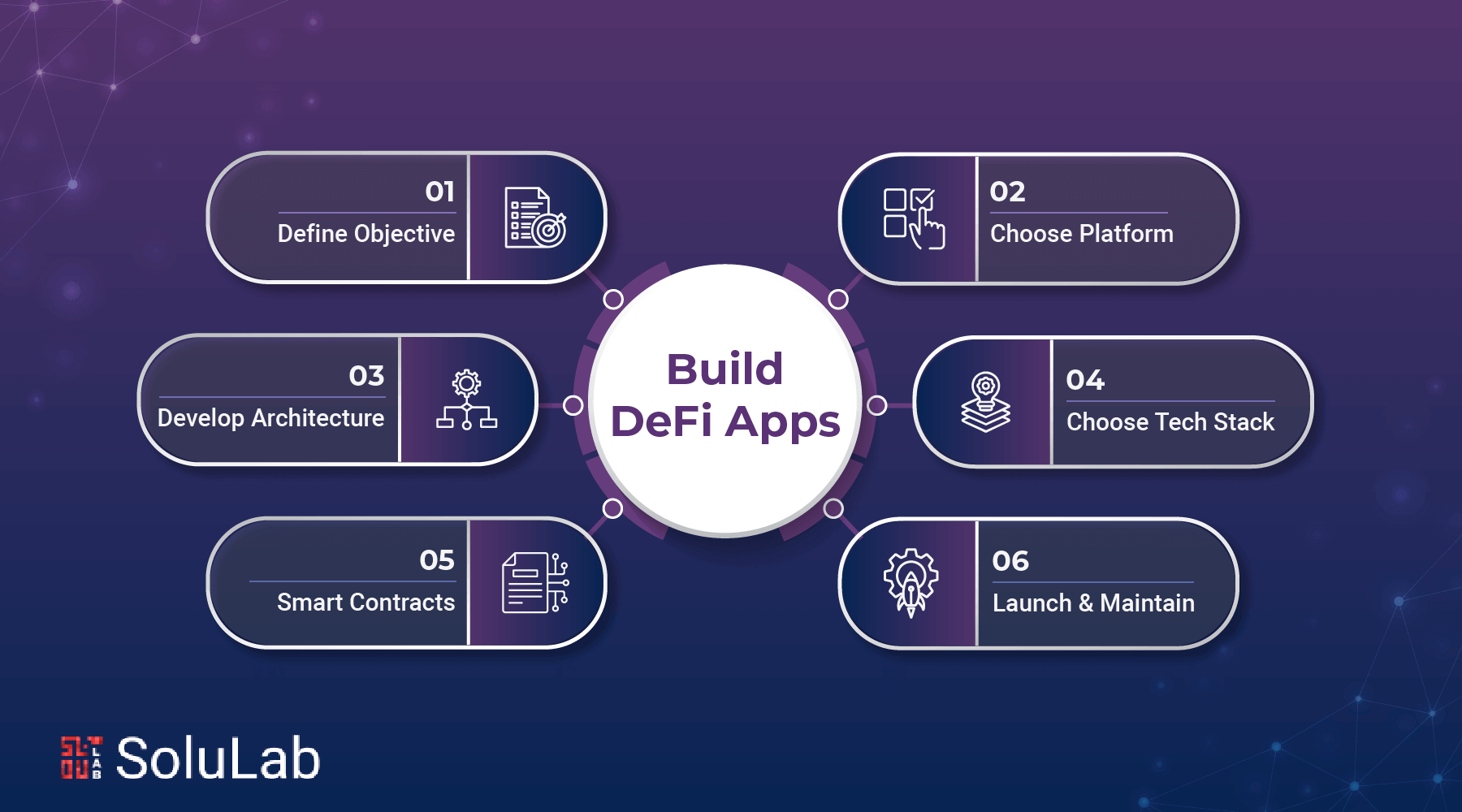
As DeFi development keeps growing in popularity, more people want to build their own unique DeFi solutions. Learning to build a DeFi app from scratch means following the practices experts actually recommend. Here are the steps that matter.
Step 1: Define the Objective of Your DeFi App
Start by deciding exactly what functionality your app needs. Everything else follows from this choice.
A lending platform? A decentralized exchange? Something else entirely?
Next, define exactly who you’re building for.
Then pin down what makes your app worth choosing over the alternatives.
Step 2: Choose a Blockchain Platform
Now pick your blockchain platform. Weigh security, scalability, transaction costs, interoperability, and how active the developer community is. Ethereum, Binance Smart Chain (BSC), Solana, and Polygon are the usual starting points for DeFi development.
Step 3: Develop the Architecture of the DeFi Application
Architecture design means mapping out how every component connects. Think hard about how users will actually interact with your app and how information flows through it. A clear plan here pays off in functionality and lets your app handle real user volume.
Step 4: Choose the Right Technology Stack
Choosing your tech stack means picking the languages and blockchain platforms your app actually needs. Go with tools that fit your requirements and that your team already knows well.
Step 5: Create and Test Smart Contracts
Once your tech stack is set, focus on the development of smart contracts. Write the code carefully so it does exactly what it’s supposed to. Then test it, thoroughly, to catch and fix issues before launch.
Step 6: Launch and Maintain Your Application
The final step is deployment. Let people know it exists, and give them a reason to try it. From there, keep monitoring performance, fix errors as they come up, and ship updates based on user feedback. Steady maintenance is what keeps users satisfied and coming back.
Read Also: DeFi Vs. CeFi
What are the Costs Associated With Developing a DeFi App?
DeFi app development costs vary a lot, driven by platform complexity, feature scope, blockchain choice, and the development team’s expertise. A basic DeFi application typically runs from $30,000 to over $150,000.
Here’s a breakdown of the main cost drivers:
- Planning and Research: Early-stage market research, competitor analysis, and roadmap planning typically cost $5,000 to $15,000.
- Smart Contract Development: Building, testing, and deploying secure smart contracts is one of the biggest cost centers, usually $10,000 to $40,000 depending on complexity.
- Frontend and Backend Development: Designing a user-friendly interface and wiring it up to backend services usually runs $15,000 to $50,000.
- Security Audits: Expert audits aren’t optional here, since DeFi platforms handle real financial transactions. Costs range from $5,000 to over $50,000 depending on project scope.
Post-launch maintenance and upgrades, bug fixes, feature enhancements, and security updates, typically run about 15-25% of your initial development cost per year.
Partnering with a proficient DeFi app development firm or team that understands both the technical and financial stakes matters a lot here. Investing in strong development and security from day one pays off in smoother operations, user trust, and room to scale.
What Makes a DeFi App Necessary for Businesses?
Decentralized finance (DeFi) app development is gaining traction as a way for organizations to unlock new revenue streams, boost transparency, and offer genuinely new financial services. Launching your own DeFi app can put your brand at the center of the fintech shift.
Here’s why it’s worth considering:
1. Capitalize on an Expanding Market
DeFi protocols and platforms have pulled in billions of dollars, and the growth shows no signs of slowing. Build a DeFi app, and you tap into a global audience actively looking for alternatives to conventional banking.
2. Provide Nationwide Financial Services
Unlike traditional systems, DeFi apps never close and aren’t tied to any one location. That means you can serve customers worldwide without chasing permits in every country you operate in.
3. Maximize Earnings Potential
Token utilities, staking incentives, loan spreads, and transaction fees are some of the strongest revenue levers for a DeFi app. Build similar features into yours, and you create steady income while still meeting what users actually need.
4. Make Things More Transparent and Secure
DeFi apps built on blockchain technology cut out the middlemen and make financial transactions fully transparent. That builds user trust and lowers your operating costs at the same time.
5. Distribute Financial Authority to Your Users
DeFi hands users full control over their assets and decisions. Put your users first, and you build a loyal base that actually shares your values: independence, privacy, and decentralized financial tools.
To stay ahead and meet what the next generation of customers actually wants, ownership over their own money, look at what the best DeFi apps already do well: decentralized exchanges, lending pools, and yield farming.
The Bottom Line
DeFi is changing what capital means for both customers and businesses. Borderless transactions, no intermediaries in the way, it’s building toward a financial system that’s more accessible, more open, and more transparent. If your company wants to innovate and grow, DeFi belongs in your strategy now, not later.
At SoluLab, we help businesses turn ambitious ideas into working DeFi solutions. As DeFi development company, we recently partnered with E-Motive, a decentralized car marketplace that cuts out the middleman and drastically lowers commission fees for buyers. E-Motive is the first decentralized automobile platform to merge sustainability with the latest Web3 technology, built on blockchain and governed by eco-friendly principles.
Ready to launch your own DeFi project? Let SoluLab be your tech partner. From ideation to launch, we bring the expertise, innovation, and track record the DeFi space demands. Book a free consultation to talk through your project today!
FAQs
Shipra Garg is a tech-focused content strategist and copywriter specializing in Web3, blockchain, and artificial intelligence. She has worked with startups and enterprise teams to craft high-conversion content that bridges deep tech with business impact. Her work translates complex innovations into clear, credible, and engaging narratives that drive growth and build trust in emerging tech markets.