Key Takeaways
- Asset-backed stablecoins bridge the gap between traditional finance and crypto by pegging digital tokens to tangible assets.
- These coins are backed by reserves like USD, gold, or other commodities, providing a “price floor” that Bitcoin lacks.
- Major players like Circle (USDC) and Tether (USDT) dominate the market by offering high liquidity and cross-border efficiency.
- Because they are tied to real-world assets, these coins are often at the forefront of crypto regulatory discussions.
The cryptocurrency market currently hosts over 25,000 digital assets. While traditional tokens like Bitcoin fluctuate based on market sentiment, stablecoins maintain a fixed value by linking to external reserves.
Recent reports indicate that nearly 90% of all decentralized finance (DeFi) liquidity resides in tokens backed by fiat currency, gold, or government bonds.
These assets provide a functional bridge for global payments, offering the speed of blockchain development with the price certainty of traditional finance.
This guide outlines the mechanics of asset-backed stablecoins, their regulatory status, and the primary issuers currently managing the digital reserve ecosystem.
What are Stablecoins and Their Pros?
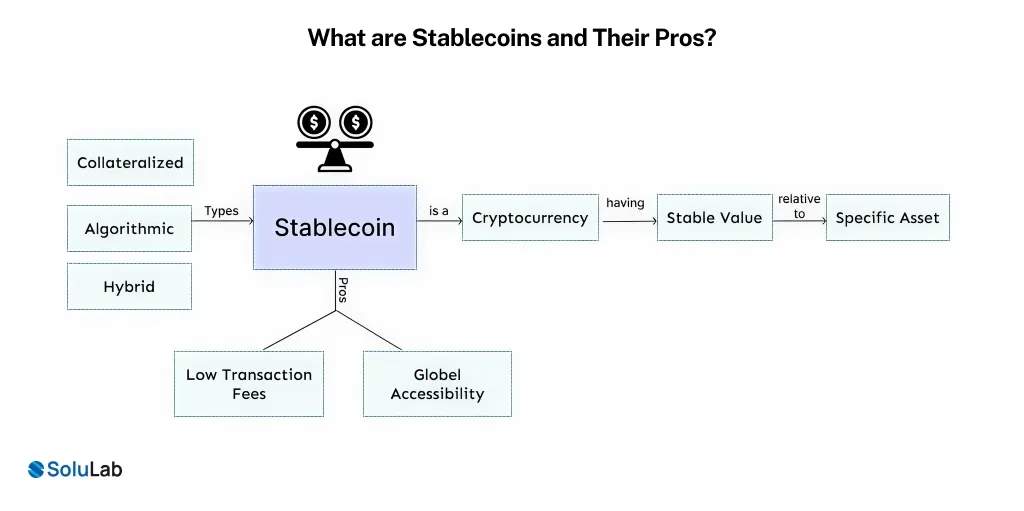
Stablecoins retain their value compared to an asset. Traditional cryptocurrencies are volatile, whereas stablecoins offer price stability to carry out transactions and for savings. It exists in forms where collateralization involves real-world assets like fiat currencies or commodities.
Algorithmic and smart contracts control supply and demand with no physical backing, and hybrid contracts involve the balance of both stability and flexibility.
Pros of Using Stablecoins:
1. Low Transaction Fees: For worldwide payments, stablecoins have lower transaction costs than typical payment methods.
2. Global Accessibility: Stablecoins enhance financial inclusion worldwide by providing a digital solution for internet users.
As they combine the benefits of cryptocurrencies with the inherent security of traditional assets, stablecoins are becoming more popular as financial tools.
What Does Asset-Backed Stablecoins Mean?
In the financial market, asset-backed stablecoins are digital currencies 100% collateralized by high-quality liquid assets (HQLA) like cash, US Treasuries, or physical commodities.
Unlike “synthetic” or algorithmic tokens that rely on code to maintain value, asset-backed coins are “programmable cash” with a verified legal claim to a real-world reserve.
This structure eliminates the “thin air” risk associated with standard cryptocurrencies, providing the price certainty required for institutional trade.
The 2026 Market Shift
The market has graduated from a crypto-native tool to a foundational layer of global finance. Recent data reveals a significant transition in how these assets are used:
- Explosive Market Growth: As of April 2026, the total stablecoin market cap reached an all-time high of $318.6 billion, a 34% increase from 2025.
- Dominance of Backed Assets: Over 93% of the market is held by just two asset-backed giants, Tether (USDT) and Circle (USDC), signaling that users now prioritize physical collateral over experimental algorithmic models.
- Transaction Volume: In 2025, stablecoins processed $33 trillion in transactions, surpassing Visa’s annual volume and proving their utility for real-world B2B payments.
- The Yield Revolution: A major 2026 trend is the rise of yield-bearing stablecoins. This sector grew 15 times faster than the broader market last year, as investors moved $22.7 billion into tokens that pass interest from Treasury reserves directly to the holder.
2026 Regulatory Changes
In 2026, being “asset-backed” is no longer a choice; it is a legal mandate. Governments have introduced strict frameworks to protect the global economy:
- The US GENIUS Act: This 2026 landmark legislation officially classifies compliant stablecoins as “regulated payment instruments.” It requires issuers to hold 1:1 reserves in liquid assets and undergo bank-grade audits.
- MiCA in Europe: The EU’s Markets in Crypto-Assets (MiCA) regulation is now fully live, prohibiting unbacked algorithmic tokens and requiring all stablecoins (EMTs) to be 100% collateralized and EU-authorized.
- Real-Time Transparency: “Monthly reports” are obsolete. In 2026, top issuers use On-Chain Proof of Reserve, allowing any user to verify the physical bank balances backing their tokens in real-time.

Different Types of Stablecoins

Before delving into the concepts of stablecoins, here are the types of stablecoins:
- Centralized StableCoins
Centralized stablecoins are conventionally supported by fiat cash held in an off-chain bank account, which serves as the reserve backing for the on-chain tokens. Centralized stablecoins may seek to peg their value to another asset, such as a commodity or index. Stablecoin designs often necessitate reliance on the custodian; however, Chainlink proof of reserve can offer robust transparency assurance via automated verification.
- Digital Bank Currencies
Central bank digital currencies (CBDC) are another kind of digital asset akin to centralized stablecoins. Central bank digital currencies resemble centralized stablecoins; however, central banks issue them, so they are not required to be backed by fiat currency in an off-chain bank account. CBDCs are recognized as legal cash by the issuing government and facilitate payments between individuals and institutions.
- Decentralized StableCoins
Decentralized stablecoins utilizing an over-collateralized structure necessitate a blockchain price database to facilitate liquidations and maintain protocol solvency. LUSD is an immutable DeFi protocol that allows users to collateralize their ETH at a 110% ratio to mint the LUSD stablecoin. The protocol is supported by Chain Link pricing feeds, which deliver precise and high-quality pricing data utilized by concerned smart contracts.
Key Characteristics of Asset-Based Stablecoins
Technologies such as Bitcoin and Ethereum, which are conventional coins, operate using blockchain technology. Asset-backed stablecoins are, however, real and backed by an asset. Nevertheless, they bring about a shift in the usage of digital assets. This list of traits of the best asset-backed stablecoins includes some of the following:
1. Easy to Understand and Available
Asset-backed coins generally perform better than standard tokens in terms of clarity. As pointed out above, these tokens depend on real assets, and thus, they can be verified by a third party. It is beneficial to the users and investors because the value of their ABC shares is secured by some form of fixed assets.
2. Getting Rid of Risks
The above assets help relieve some of the risks typical for normal cryptocurrencies and support asset-backed cryptocurrencies at a lower. This is because these stablecoins have something real behind them, and as such have a little cushion in the falls of the market.
3. Tangible Assets That Support
The major point of difference between asset-backed stablecoins and other cryptocurrencies is that stablecoins have actual assets underlying them. Possibly, they are not completely digital like freely traded Bitcoin and other tokens in the market. Some of their value originates from real-world asset stablecoins, metals, fiat currency, and merchandise. These real reserves produce these stablecoins with stability and assurance because they are tied to the worth of the underlying assets.
4. Better Following of the Rules
Asset-backed cryptocurrencies are usually backed up by officials and regulators because they are associated with real assets. Real reserves will ensure that integration into current regulatory systems is eased because they add extra legitimacy and accountability.
Related: How to Create A Stablecoin?
5. Prices Staying the Same
They found that one of the major drawbacks of standard cryptocurrencies is volatility, since their prices fluctuate constantly. There is a high possibility that the worth of freed coins floated in the market is significantly influenced by external factors, the attitude of investors, and market expectations. As with the asset-backed stablecoins, these businesses are more stable since they have low-base assets.
Top Global Stablecoin Issuers with 80% Market
While over five hundred stablecoins are being utilized, two companies, Tether and Circle, release most of these assets. Here are the issuers of asset-backed stablecoins:
- Tether (USDT)
Tether holds the largest market share in stablecoins and offers exceptional connectivity for many blockchains, explaining why most stablecoins originate from it. Despite much controversy regarding Tether’s reserves and the company’s financial reporting, the business argues that it has undergone audits and conducts stress tests based on live market data.
Tether stands as a reserve asset giant akin to large nations holding nearly $100 billion in US Treasury notes, with the lion’s share from Cantor Fitzgerald.
- Circle (USDC)
Circle is the second-largest stablecoin by circulation in the market. Particularly, USDC has become famous for the weekly attestations of its reserves. The reserves give users a high, transparent, and confident level because they are held in cash and short-term U.S. government securities.
- The Paxos
Besides Pax Dollar (USDP), Paxos also provides the underpinnings for PayPal USD (PYUSD), the various stablecoin offerings on a global level. Portfolio management practices and releasing the monthly attestation reports to affirm reserves are valued at Paxos since the company adopts the principle of openness to boost the clients’ confidence.
- PayPal (USD)
PYUSD, or PayPal USD, is PayPal’s stablecoin baby that was launched in conjunction with Paxos. The PYUSD has reserves from which it draws value and is meant to be a form of currency; it is managed by Paxos. The public can also get regular updates on the transparency reports.
Top Asset-Backed Stablecoins to Watch in 2026
Here is the list of the top 10 asset-backed stablecoins that you should be aware of:
- Tether
- USD Coin
- Dai
- Tether Gold
- Ethena
- PayPal USD
- BSDX
- FRAX
- EURX
- DOLA
Use Cases of Asset-Backed Stablecoins
By the end of 2026, the global stablecoin market cap will have surpassed $250 billion, driven by institutional adoption and regulatory clarity (such as MiCA in Europe and the GENIUS Act in the US). Enterprises are no longer experimenting; they are integrating stablecoins as a core financial rail.
1. Institutional Treasury & Risk Mitigation
- Liquidity Management: Corporations now use asset-backed stablecoins to maintain 24/7 liquidity. Unlike traditional bank accounts, stablecoin reserves allow for “always-on” treasury operations, moving capital between subsidiaries instantly without weekend or holiday delays.
- De-risking Volatility: To avoid the 2026 fluctuations of unbacked assets, firms swap surplus digital holdings into stablecoins pegged 1:1 with US Treasuries or cash. This preserves capital value while keeping assets on-chain for immediate redeployment.
2. Global B2B & Supply Chain Payments
- Instant Cross-Border Settlement: Enterprises are replacing traditional SWIFT transfers with stablecoin rails. This reduces settlement time from 3–5 days to under 30 seconds and eliminates intermediary bank fees, which is critical for high-volume trade.
- Transparent Vendor Payouts: Major platforms now use stablecoins for transparent supply chain tracking. Payments are released automatically via smart contracts only when delivery milestones are verified on-chain, reducing fraud and disputes.
3. Automated Corporate Services
- Programmable Payroll: Modern companies utilize stablecoins for global payroll, especially for remote teams. In 2026, over 60% of crypto-based salary payments are made via USDC or EUR-backed tokens to ensure tax compliance and price certainty for employees.
- Smart Subscription Models: Service providers implement automated “pull” payments. Smart contracts handle recurring monthly billing for SaaS or utility services, providing a verifiable audit trail that simplifies accounting and reconciliation.
4. Emerging AI Economy
- Machine-to-Machine Payments: In 2026, autonomous AI agents use asset-backed stablecoins to purchase API credits, compute power, and data sets. Since these agents cannot hold traditional bank accounts, stablecoins serve as the native currency for the automated economy.
What is the Future of Asset-Backed Stablecoins?
As of early 2026, asset-backed stablecoins have evolved from niche crypto instruments into the foundational layer of a new digital financial infrastructure.
With a market capitalization now exceeding $300 billion, these assets are primarily used by enterprises to bridge the gap between traditional banking and the 24/7 blockchain economy.
1. Expected Market Change: Regulatory Mainstreaming
The biggest shift in 2026 is the enforcement of the US GENIUS Act and the EU’s MiCA framework for stablecoins.
These laws have effectively “de-risked” stablecoins for institutional use by mandating 1:1 reserve backing in liquid assets (like short-term Treasury bills) and requiring monthly independent audits.
This has moved stablecoins from “unregulated crypto” to “regulated payment instruments.”
2. Growth in “Asset-Referenced” Variants
Beyond USD-pegged tokens, 2026 is seeing a surge in tokens backed by commodities (Gold/Copper) and Real-World Assets (RWAs).
These provide a way for global businesses to hedge against fiat inflation while maintaining the liquidity of a digital token.
3. On-Chain Yield & ROI
For enterprises and holders, the “Return on Investment” has shifted.
While standard payment stablecoins generally do not pay interest (due to regulations), yield-bearing synthetic dollars and tokenized money market funds have emerged.
In 2026, typical yields range from 3–7% APY, derived directly from the interest on the underlying Treasury reserves or over-collateralized DeFi lending.
4. 24/7 Institutional Liquidity
Major banks now use asset-backed stablecoins for intra-day liquidity management.
Instead of waiting for weekend-clearing cycles, firms move billions in value instantly on-chain to meet margin calls or fund global subsidiaries, significantly improving capital efficiency.
5. Interoperability & Cross-Border Utility
A stablecoin issued on the Ethereum blockchain can be used seamlessly for a supply chain payment in South Korea or a payroll run in London via cross-chain bridges.
This is reducing settlement costs by up to 80% compared to legacy banking.

How is SoluLab Making Use of Digital Money Easier?
As we discussed with the adoption of the new blockchain-based financial systems, the asset and cryptocurrency model will help redefine the existing world economy and thereby pave the way for Debut Infotech for a safer financial future. ABSCs not only hold value and serve as media of exchange, but also promote responsibility and go an extra mile in stabilizing the cryptocurrency market. Because of this, the procedure must initiate a creative approach.
SoluLab, a Stablecoin Development Company, can help you develop and go through more creative and developed solutions that just fit right with your needs and preferences, and turn your vision into reality.
Our expertise in establishing safe, modern technologies and scalable blockchain platforms helps firms create custom asset-backed stablecoins.
Contact us right away to set into the future of finance!
FAQs
Shipra Garg is a tech-focused content strategist and copywriter specializing in Web3, blockchain, and artificial intelligence. She has worked with startups and enterprise teams to craft high-conversion content that bridges deep tech with business impact. Her work translates complex innovations into clear, credible, and engaging narratives that drive growth and build trust in emerging tech markets.