Key Takeaways
- The Revenue Bleed: Outdated FX clearing cycles cost neo banks up to 7% in margin compression per cross-border transaction through multi-layered intermediary fees.
- Capital Velocity: Dollar-to-stablecoin swaps bypass legacy correspondent banking networks, reducing settlement times from T+3 to near-instantaneous finality.
- Architectural Edge: Implementing a compliance-first, multi-rail liquidity setup positions white-label neo banks to capture the rapidly growing B2B transaction volume.
Traditional neo-banking platforms still rely heavily on fiat-only infrastructure. And when your users need to move money across borders, volatile FX rates, high remittance fees, and slow settlement times can ruin the experience.
Businesses today expect faster, more cost-efficient global transactions, not complicated bank hops and hidden charges. This shift is already visible in emerging markets. A major trend report projects that stablecoin savings could grow from around USD 173 billion today to USD 1.22 trillion by 2028.
That’s a clear sign that users are actively moving away from traditional bank deposits and into white-label neo-banking platforms with digital dollars that offer more accessibility, speed, and global utility.
If your platform doesn’t support these digital asset rails natively, you are creating a friction point that forces your highest-volume clients to migrate to agile, crypto-native competitors. Without dollar-to-stablecoin swap capabilities, white-label neo-banking infrastructure risks losing both customer retention and international payment revenue.
Why Stablecoins Matter in Neo Banking?
To capture tier-1 corporate clients, white-label neo-banking providers must move past surface-level definitions. Stablecoins are not a speculative sub-asset class; they are a highly efficient payment architecture. By decoupling capital movement from traditional clearing windows, stablecoins allow neobanks to run a leaner financial stack while offering unmatched settlement speeds.
For founders building a white-label neo-banking platform, stablecoins create an opportunity to serve global businesses without inheriting the inefficiencies of legacy financial networks.
- Mitigation of Intermediary Counterparty Risk: Stablecoins backed 1:1 by liquid dollars or short-term U.S. Treasuries eliminate the multi-day exposure inherent in traditional correspondent banking hops.
- 24/7/365 Liquidity Optimization: Operating without dependency on central bank clearing windows or regional holidays ensures that capital remains productive around the clock.
- SME and Corporate Retention: Emerging market enterprises and global SaaS platforms increasingly demand digital dollar capabilities to insulate their reserves from local fiat currency degradation.
- Programmable Treasury Operations: Combined with smart contracts, stablecoins allow businesses to automate treasury actions, vendor settlements, and recurring payment execution with significantly less operational overhead.
Read Also: Stablecoin Rails for Crypto Exchanges
The Cost-Reduction Delta: Legacy vs. Stablecoin Rails
The commercial decision to integrate stablecoin swap rails comes down to transaction economics. When evaluating the efficiency of traditional correspondent networks against programmable digital dollar infrastructure, the margin recovery is stark.
| Metric | Traditional Correspondent Banking | Stablecoin Swaps (SoluLab Rails) |
| All-In Transaction Cost | 2% – 7% (intermediary fees + FX markups) | 0.5% – 2% total execution cost |
| Settlement Latency | T+2 to T+5 business days | Near-instant (seconds to minutes) |
| Operating Windows | ~40 hours/week (dependent on banking hours) | 24/7/365 continuous settlement |
| Capital Inefficiency | High capital lockup via pre-funded Nostro/Vostro | Zero pre-funding required; instant liquidity |
The Enterprise Volume Trend: The McKinsey & Artemis data confirm that B2B transactions comprise the largest portion of stablecoin payment activity, totaling $226 billion. This accounts for roughly 60% of all genuine, economically stablecoin payments. This proves that the dominant use case for stablecoins has transitioned from retail speculation to corporate trade settlement.
For financial institutions evaluating cross-border payments with stablecoins, the cost savings extend beyond transaction fees. Faster settlement cycles improve working capital efficiency and reduce treasury friction across multiple markets.
Importance of Dollar-to-Stablecoin Swaps in White-Label Neo Banking
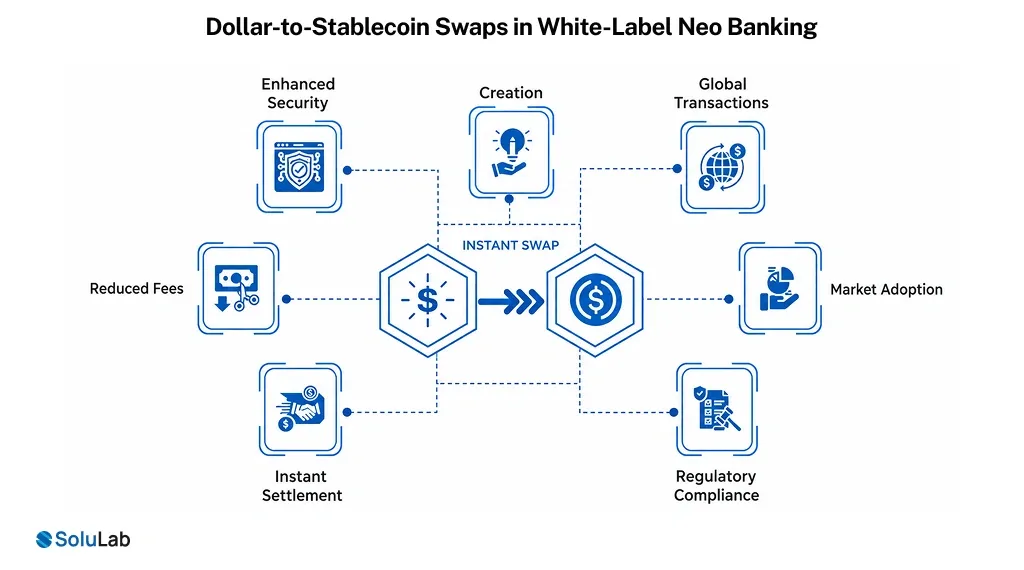
Integrating a USD-to-stablecoin swap engine into a white-label neo-banking platform changes the monetization model for B2B fintechs.
1. Monetizing the Spread on High-Volume Cross-Border Trade
Fintech enablers can generate consistent, recurring revenue by capturing micro-fees on every fiat-to-digital-dollar conversion. When providing liquidity to mid-market enterprises moving millions in cross-border trade, even a fractional swap fee yields highly predictable yield streams.
A well-structured USD to stablecoin conversion workflow can become a revenue center rather than simply a payment feature.
2. Elimination of FX Slippage
By allowing corporate treasuries to instantly lock in value via tokenized USD such as USDC or USDT, neo banks protect their clients from intraday fiat volatility during cross-border trade settlements. Value is transferred and secured within minutes, removing the unpredictability of multi-day settlement windows.
3. Regulatory Alignment and Compliance Assurance
The regulatory landscape is clearing rapidly. With the full enforcement of the EU’s MiCA framework and the legislative progress of the U.S. GENIUS Act, payment stablecoins have clear federal guardrails as legitimate payment instruments.
A properly designed compliant stablecoin swap KYC AML framework ensures that transaction monitoring, auditability, and reporting requirements remain embedded directly into the swap lifecycle.
4. Positioning for Tokenized Financial Products
As more financial institutions explore real-world assets, stablecoin rails provide the settlement layer needed to support tokenized investment products, digital treasury instruments, and programmable financial services.
How to Integrate Dollar-to-Stablecoin Swaps in Your White-Label Neo Banking Platform?
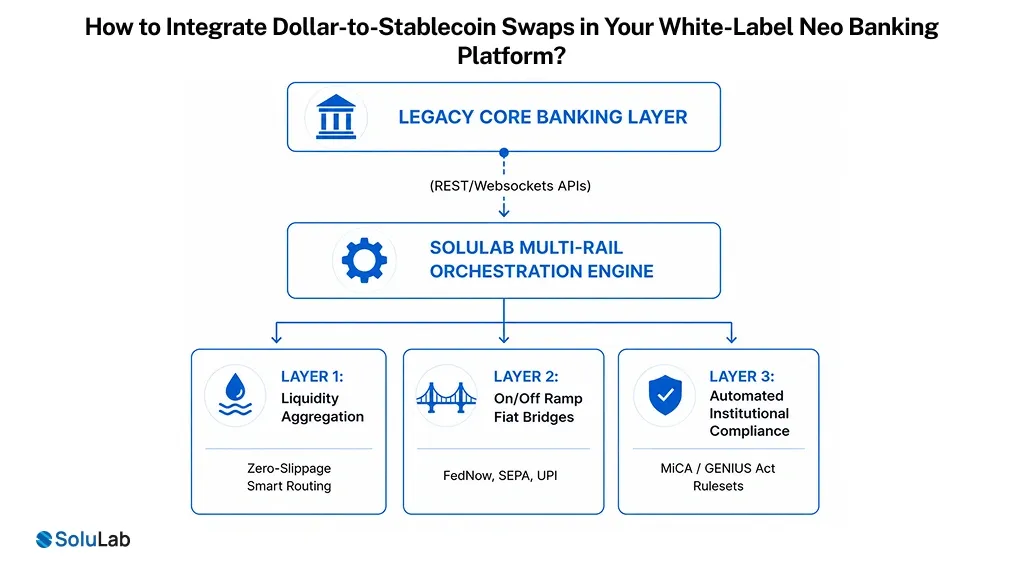
[Legacy Core Banking Layer]
│ (REST/Websockets APIs)
[SoluLab Multi-Rail Orchestration Engine]
├─── Layer 1: Liquidity Aggregation (Zero-Slippage Smart Routing)
├─── Layer 2: On/Off Ramp Fiat Bridges (FedNow, SEPA, UPI)
└─── Layer 3: Automated Institutional Compliance (MiCA / GENIUS Act Rulesets)
Adding dollar-to-stablecoin swap capabilities to your white-label neo banking platform lets users move between fiat and digital assets instantly, enabling smoother cross-border payments, lower fees, and a modern finance experience.
1. Multi-Venue Institutional Liquidity Aggregation
Implement algorithmic smart-order routing across institutional market makers. Bypassing retail exchange pools ensures that multi-million-dollar corporate swaps execute with near-zero slippage.
Choosing the right stablecoin liquidity provider for banks is critical for maintaining execution quality during high-volume settlement periods.
2. Dual-Ledger Reconciliation Bridge Setup
Establish secure API hooks that continuously synchronize traditional core banking ledgers with non-custodial EVM and non-EVM wallet balances, mapping every on-chain transfer to an ISO 20022-compatible data field.
This architecture becomes the foundation of a scalable, stablecoin swap integration strategy.
3. Inline Algorithmic Compliance Screening
Integrate automated compliance modules such as Chainalysis or Elliptic directly into the API transaction flow. Wallets must be screened for AML risks and sanctions before the swap executes to prevent protocol exposure.
Many institutions now require a dedicated fiat-to-stablecoin on-ramp process that incorporates compliance verification before capital enters blockchain networks.
4. Stress-Testing Under Fragmented Network Loads
Simulate extreme high-throughput scenarios to analyze gas optimization, transaction failure handling, and fallback execution parameters before pushing the swap module to production.
Organizations pursuing stablecoin integration for fintech products should prioritize production-grade testing before customer rollout.
Read Also: Stablecoin Development On Solana
Benefits of Dollar-to-Stablecoin Swaps in White-Label Neo Banking
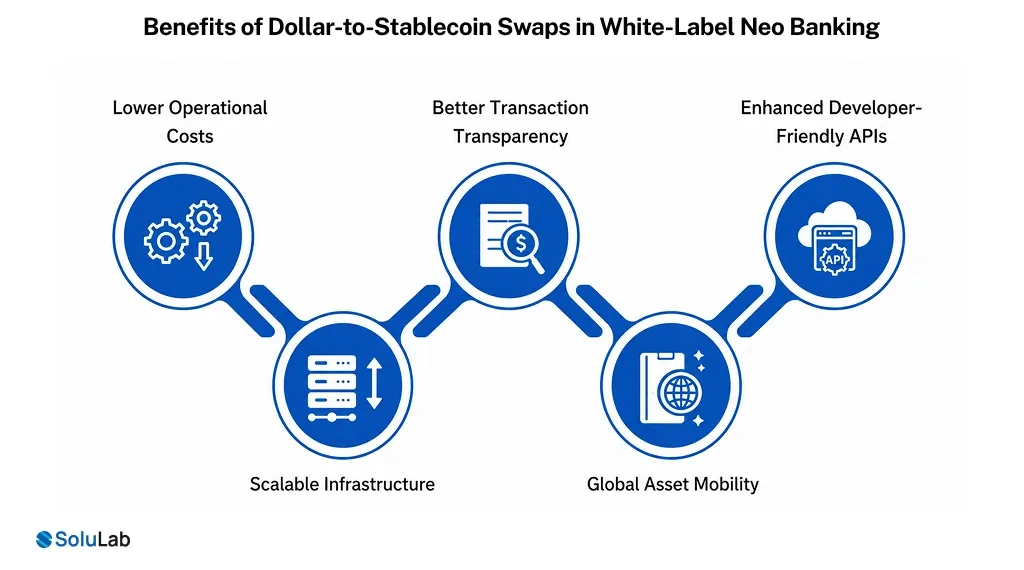
Dollar-to-stablecoin swaps in white-label neo banking get faster, cheaper financial operations. They help businesses improve cross-border payments, reduce conversion risk, and build scalable global digital banking solutions.
- Lower Operational Costs: Stablecoin-based conversions cut heavy bank fees, reduce FX markups, and remove intermediaries. This allows businesses to run leaner operations while offering competitive pricing to customers at scale.
- Scalable Infrastructure: Blockchain rails handle high transaction volume without performance drops. As user demand grows, neo banks can scale globally without worrying about traditional banking system limits or high expansion costs.
- Better Transaction Transparency: Every stablecoin transaction is recorded on-chain, enabling real-time tracking and auditability. This builds trust, simplifies compliance, and reduces fraud compared to opaque legacy banking processes.
- Global Asset Mobility: Users can transfer value anywhere in the world instantly without relying on local banking networks. It’s ideal for remittances, SAAS payouts, and high-speed cross-border business payments.
- Enhanced Developer-Friendly APIs: White-label providers offer plug-and-play APIs that simplify integration with fintech apps. Teams can quickly deploy digital wallets, payment gateways, and compliance modules with faster time-to-market.
Future of Stablecoin Swaps in Neo Banking
Stablecoin swaps will become the backbone of next-gen digital finance. Neo banks will use instant, low-cost settlement rails to improve payments, lending, and treasury management for businesses and consumers.
1. Tokenized Deposits: Banks will convert customer funds into on-chain tokenized deposits, enabling faster digital settlement, better liquidity, and swapping with stablecoins. This creates more secure, regulated, and efficient banking rails for global payments.
2. CBDC & Stablecoin Hybrid Banking Systems: Neo banks may combine CBDCs with private stablecoins to balance compliance and innovation. Users enjoy trusted government-backed money while still accessing speed, programmability, and 24/7 settlement benefits.
3. Real-time Programmable Payments: Smart contracts will automate recurring and conditional payments, payroll, EMIs, and vendor payouts without manual action. Stablecoin swaps enable instant settlement, removing delays from legacy banking networks.
4. AI-driven Treasury Management: AI-powered solutions and algorithms will optimize liquidity, risk exposure, and yield strategies in real time. Stablecoin swaps enable instant asset rebalancing, boosting returns while maintaining stability and compliance.

Conclusion
Dollar-to-stablecoin swaps are becoming a core capability for modern banking. Businesses that build this feature into their platforms can offer real-time transfers, protect users from currency volatility, and get new revenue models in digital assets.
For providers of neo banking solutions, this is no longer a “nice-to-have”; it’s a competitive advantage that boosts user retention and global reach. By adopting compliant, scalable, and secure integrations within white label BaaS platforms.
SoluLab, a stablecoin development company, can help you integrate secure dollar-to-stablecoin swaps into your white-label neo banking platform. Contact us for leading-edge solutions!
FAQs
Shipra Garg is a tech-focused content strategist and copywriter specializing in Web3, blockchain, and artificial intelligence. She has worked with startups and enterprise teams to craft high-conversion content that bridges deep tech with business impact. Her work translates complex innovations into clear, credible, and engaging narratives that drive growth and build trust in emerging tech markets.