Can stablecoins be the key to the mass adoption of DeFi in 2025? While cryptocurrencies offer financial independence, their price fluctuations often discourage mainstream users and institutional investors.
- As of January 2026 to reach $300 billion, per Grayscale, reflecting the explosion of institutional buy-in for the digital asset class.
- The real story lies in the volume: stablecoin networks now facilitate over $33 trillion in annual transactions, effectively doubling the annual turnover of the entire Visa network.
Stablecoin in Defi provides a “Safe Zone,” allowing businesses to bypass market fluctuations. Additionally, stablecoins solve the “Volatility Gap” by pegging their value to fiat currencies, commodities, or RWAs (Real World Assets). While ensuring reliability, while maintaining the 24/7 efficiency of blockchain technology.
Key Takeaways
- Volatility Mitigation: Bridging the gap between TradFi and DeFi for seamless transactions.
- Institutional Liquidity: Why 2025 is the year for RWA-backed stablecoins in corporate finance.
- Smart Architecture: How to select between Fiat-backed and Algorithmic models for your business.
What Role Do Stablecoins Play In Decentralized Finance (DeFi)?
Stablecoin development has emerged as a core financial instrument in DeFi, powering multiple use cases that make decentralized finance more accessible and efficient for large-scale enterprises.Businesses can trade on DEXs and execute smart contracts without worrying about 20% price drops overnight.
Atomic Settlement: Eliminate counterparty risk. Defi stablecoins allow for “Payment vs. Delivery” (PvP), where the asset (like a tokenized property in real estate) and the payment swap simultaneously.
Streaming Payroll & Real-Time: Using protocols like Zebec, businesses are now streaming salaries and vendor payments by the second, rather than monthly batches, optimizing cash flow.
Automated Escrow: Smart contracts can hold stablecoins and release them only when specific milestones (verified by IoT or Oracles) are met, removing the need for expensive legal
intermediaries.
Yield-Bearing Treasuries: Corporate treasuries are moving idle cash into Tokenized T-Bills (like BlackRock’s BUIDL), earning 4–5% low-risk yield. While maintaining 24/7 stablecoin liquidity on-chain.
If you want to know — What Stablecoin is, click here.

How to Choose the Right Stablecoin for DeFi?
With the growing adoption of stablecoins in DeFi, choosing the right one is crucial for maximizing benefits while minimizing risks. Each stablecoin operates differently based on its collateral backing, transparency, stability mechanism, and use cases. Whether you’re using stablecoins for trading, lending, staking, or payments, selecting the right one can impact your DeFi experience.
The key factors to consider when choosing a stablecoin for DeFi:
1. Type of Stablecoin
Stablecoins are categorized based on how they maintain their value. Understanding these models helps you determine which stablecoin best fits your needs in DeFi.
- Fiat-Backed Stablecoins
These are backed 1:1 by fiat currencies like USD, EUR, or GBP.
- Crypto-Backed Stablecoins
These are collateralized by cryptocurrencies like Ethereum (ETH) or Bitcoin (BTC). Also, they operate on smart contracts to maintain stability.
- Algorithmic Stablecoins
These are maintained via smart contracts and algorithms without direct collateral and adjust supply dynamically to maintain price stability.
Related: RWA-Backed Stablecoins
2. Transparency and Reserves Audit
Choose stablecoins that regularly publish audit reports verifying their reserves.
- Fiat-backed stablecoins like USDC and BUSD are known for monthly attestations by financial firms.
- Crypto-backed stablecoins like DAI provide on-chain proof of reserves, ensuring full decentralization.
3. Liquidity and DeFi Platform
Ensure the stablecoin is widely accepted
- The major DeFi platforms like Uniswap, Aave, Compound, Curve, and MakerDAO.
- High liquidity means faster transactions, lower slippage, and reduced trading costs.
- For example, the most liquid stablecoins in DeFi are USDT, USDC, and DAI.
4. Stablecoin Use Cases: Matching Stablecoins with Your DeFi Goals
The best stablecoin depends on how you plan to use it in DeFi. Also, this helps.
| Use Case | Recommended Stablecoin | Business Benefit |
| Lending & Borrowing | DAI, USDC | High security & over-collateralization |
| Cross-Border Payments | USDC, USDT | Instant settlement & high liquidity |
| Yield Farming | FRAX, DAI | Optimized returns for treasury |
| Institutional Use | USDC, PYUSD | Regulatory compliance & audits |
What are the Key Advantages of Stablecoins in DeFi+Real Estate
Stablecoins don’t just “buy” the property; they integrate it into the DeFi Money Lego stack. Here is how the decentralized “plumbing” actually works:
1. Price Stability
Stablecoins’ price stability is being pegged to stable assets like the US dollar.
This stability makes stablecoin ideal for DeFi applications as users don’t have to worry about volatile price fluctuations when lending, borrowing, or providing liquidity.
Traders can also use stablecoins as a reliable haven during market turbulence.
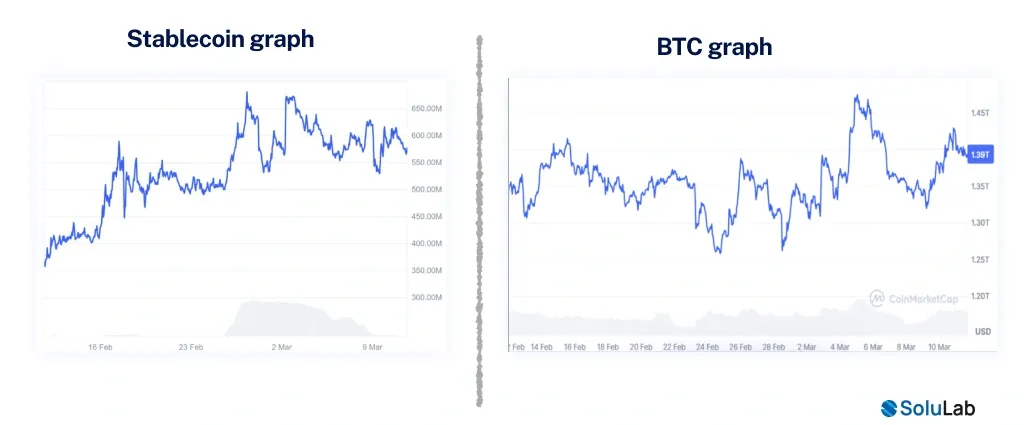
You can clearly see the Market Capitalization fluctuations and changes during the same period of timebetween BTC and Stablecoin.
2. Regulation and Institutional Trust
- Regulatory Clarity: Stablecoin development frameworks like MiCA (EU) and ASIC (Australia) are bringing institutional confidence.
- RWA-backed stablecoins: More stablecoins will be backed by “Real World Assets” like gold and property.
- Hyper-Security: AI-powered stablecoin development will use multi-sig and automated audits to prevent de-pegging.
3. Automated Yield Distribution (The “Push” Model)
In traditional real estate, you wait 30 days for a check. In DeFi, we use Streaming Finance protocols (like Sablier or Superfluid).
- The Tech: The Smart Contract holds the rental income in stablecoins (USDC/USDT) and “streams” it to token holders in real-time, block-by-block.
- This eliminates the need for manual accounting and reduces overhead costs for the platform operator by 90%.
4. Property-Backed Loans (The “Lending” Layer)
This is where true DeFi happens. Once an investor owns a Real Estate Token (RET), they don’t have to sell it to get cash.
- The Tech: Through Collateralized Debt Positions (CDPs), investors can lock their property tokens in a vault and mint or borrow stablecoins against them.
- Your platform becomes more than a shop; it becomes a bank. Investors keep their real estate appreciation while accessing instant liquidity for other expenses.
5. Decentralized Liquidity Pools (The “AMM” Model)
Instead of waiting for a buyer on a traditional listing site, we use Automated Market Makers (AMMs) like Uniswap or Balancer.
- The Tech: We create a RET/USDC Liquidity Pool. This allows investors to swap their “bricks” for “dollars” instantly, 24/7, without a broker.
- High liquidity is the #1 request from institutional investors. Showing you can build AMM-compatible RWA tokens is a massive lead magnet.
6. Composability: The “Money Lego” Effect
Because the rental yield is paid in stablecoins, that capital is composable.
- The Tech: The stablecoins received as rent can be automatically “re-invested” into a Yield Aggregator (like Yearn Finance) to earn an additional 4-5% APY while waiting to be withdrawn.
- You are offering “Double Yield”, rent from the house + DeFi interest on the rent.
Read Also: Stablecoin Development on Solana
How to Build an Enterprise-Grade Stablecoin Platform (5 Steps)
For businesses looking to launch a platform like RealT or Acreage, here is the 2026 development blueprint:
| Step | Focus Area | Mechanical Outcome |
| 01. Legal Wrapper | SPV/Trust Creation | Ensures the token is a legal “Security” (ASIC/SEC compliant). |
| 02. Oracle Setup | Chainlink/Pyth Integration | Feeds real-world property value & exchange rates to the blockchain. |
| 03. Smart Core | Vault & Logic Audits | Automated rental distribution in stablecoins (block-by-block). |
| 04. Liquidity Layer | AMM / DEX Integration | Creates a secondary market so investors can exit in seconds. |
| 05. On-Ramp/Off-Ramp | Fiat-to-Stable Gateway | Users buy “Bricks” with a Credit Card; DeFi handles the rest. |

Conclusion
Stablecoins in DeFi are becoming essential for building reliable decentralized financial systems. Unlike volatile cryptocurrencies, a DeFi stablecoin maintains price stability, making it ideal for lending, trading, and payments across blockchain networks. As adoption grows, businesses are increasingly exploring stablecoin development to build scalable financial platforms.
For enterprises that wish for a stablecoin DeFi platform development, the focus should be on:
- Stablecoin Model Selection: Choose between fiat-backed, crypto-backed, or algorithmic mechanisms for price stability.
- Secure Smart Contract Infrastructure: Ensure reliable DeFi architecture with audited smart contracts and oracle integration.
- Liquidity and DeFi Integrations: Enable lending, liquidity pools, and cross-border payments within the ecosystem.
We, at SoluLab, help enterprises build secure, stablecoin-powered DeFi platforms that support scalable digital finance solutions. Contact us today!
FAQs
Shipra Garg is a tech-focused content strategist and copywriter specializing in Web3, blockchain, and artificial intelligence. She has worked with startups and enterprise teams to craft high-conversion content that bridges deep tech with business impact. Her work translates complex innovations into clear, credible, and engaging narratives that drive growth and build trust in emerging tech markets.