




















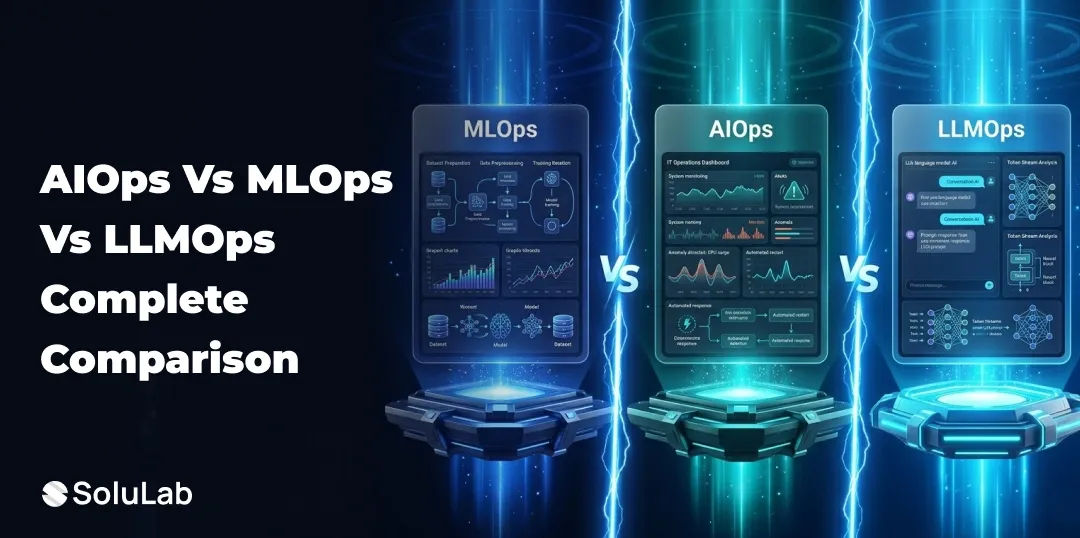
AIOps, MLOps, and LLMOps: A Practical Comparison for Modern AI Operations
Explore the differences between AIOps, MLOps, and LLMOps and how each improves AI deployment, monitoring, and performance
SoluLab's machine learning development services help businesses turn data into intelligent products, automate complex processes, and build predictive solutions that deliver measurable business value. As a machine learning development company in the USA, we work with startups and enterprises to design, develop, and deploy ML solutions built around their unique business needs.
As a trusted ML development company, we provide end-to-end machine learning development services that help businesses leverage the power of AI to drive innovation, efficiency, and growth. Our expertise spans various industries, ensuring tailored solutions that meet your specific needs.
We work with you to create a customized machine-learning strategy that aligns with your business objectives, ensuring maximum ROI.
We build training pipelines, automated testing, drift detection, and model governance, so models move to production faster and stay accurate once they're there.
We specialize in building robust data pipelines, cleaning, transforming, and preparing datasets for high-performance machine learning applications.
We design custom models for your specific business problem, trained on your data and tested against the metrics that matter to you.
From personalized recommendations to predictive analytics, we deliver innovative ML development services to improve operational efficiency.
Unlock insights into future trends and customer behavior with our predictive analytics services, designed to help businesses make informed decisions.
Our team develops computer vision applications for tasks such as object detection, image recognition, and facial analysis, enabling automation and accuracy.
We integrate ML models into your existing systems, including ERP, CRM, core banking, and data warehouses, through APIs, so predictions show up where your team already works.
Supervised learning is ideal for scenarios where labeled datasets are available. The model is trained to predict outcomes based on input-output relationships, making it a powerful tool for applications such as predictive analytics, quality assurance, and financial forecasting. This method is categorized into classification, which predicts categorical outcomes like customer segments or product quality, and regression, which forecasts continuous outcomes such as sales revenue or stock prices. By leveraging supervised learning, businesses can make data-driven decisions with precision and confidence.
Unsupervised learning is employed when datasets lack predefined labels. It focuses on uncovering hidden patterns and structures within the data, enabling businesses to gain deeper insights. Applications include clustering, where data points are grouped based on similarities, and dimensionality reduction, which simplifies large datasets for better understanding and visualization. This method is particularly useful for market segmentation, recommendation systems, and anomaly detection, helping businesses identify trends and opportunities that are not immediately apparent.
Reinforcement learning differs from other methods in that it relies on a feedback-driven system rather than labeled datasets. It is particularly effective in dynamic environments where the model learns by interacting with its surroundings and maximizing cumulative rewards based on past actions. Common applications include robotics, where it optimizes robotic movements for tasks like automation, and gaming, where AI agents learn to make strategic decisions. Reinforcement learning enables innovative solutions in areas requiring adaptive and real-time decision-making capabilities.
Boost your business with machine learning that works for you. From smarter predictions to seamless automation, we’ve got you covered.
Start Your ML Journey Today!At SoluLab, we deliver machine learning app development services to a variety of industries, addressing unique challenges and creating practical solutions that drive business value. Our expertise ensures effective machine learning solutions development tailored to meet specific industry needs.
88% of organizations now use AI regularly in at least one business function, up from 78% a year earlier. Yet only about one-third have begun scaling their AI programs across the company. The gap is rarely the model. It's data, integration, and monitoring, which is where we work.
Talk to Our Experts!Machine learning is reshaping industries by enabling innovative solutions to complex problems. As a leading machine learning development firm, SoluLab empowers businesses with tailored machine learning solutions for a wide range of applications, including:
Anticipate market trends, customer behaviors, and operational needs by leveraging predictive models that provide actionable insights.
Strengthen security by identifying anomalies and detecting fraudulent activities in real time across financial transactions or user activities.
Enhance user experience with personalized product or content recommendations in e-commerce, streaming platforms, and more.
Improve customer support and engagement with intelligent bots powered by natural language processing (NLP).
Process and interpret visual data for applications like facial recognition, medical imaging, and surveillance systems.
Automate inventory management, forecast demand, and optimize logistics with data-driven insights.
Support medical professionals with AI models capable of diagnosing diseases from imaging data or patient records.
Monitor customer feedback and social media interactions to gauge sentiment and improve brand perception.
Reduce downtime and operational costs by predicting equipment failures before they happen in manufacturing or infrastructure.
Automation follows fixed rules. Knowledge-based AI follows rules written by experts. Machine learning learns rules from data. AI is the umbrella term that covers all of these, plus generative AI. Choosing the right one for each task is the first step in any ML project.
Follows fixed if-then steps
Applies rules written by experts
Learns patterns from past data
Creates new text, images, or code
No
Only if a rule exists
Yes, within what it learned
Yes, but needs checking
No
Expert knowledge
Yes, historical data
Very large pre-trained models
Copy invoice fields into ERP
Loan eligibility rules engine
Predict which customers will churn
Draft a customer email
Stable, repetitive tasks
Regulated decisions needing clear logic
Predictions and pattern detection
Content and conversation
Sight Machine is a leading AI-based company in digital manufacturing, revolutionizing the industry with its latest technology solutions that leverage generative AI and machine learning technologies.
Read More
AI-Build, a construction technology company, sought to enhance their tech product development in the computer-aided design (CAD) space by leveraging the power of generative artificial intelligence (AI) and machine learning (ML) models.
Read More
The system uses machine learning techniques to process various content feeds in real-time and boost the productivity of a financial analyst or a client relationship manager in domains such as wealth management, commercial banking, and fund distribution.
Read More
At SoluLab, machine learning development costs $10,000 to $20,000 for a single-model proof of concept and $50,000 to $150,000 or more for an enterprise ML platform with MLOps. Cost depends on data readiness, model complexity, integrations, and how much monitoring the model needs after launch.
One model trained on your sample data, accuracy report
4–8 weeks
$10,000–$20,000
One model with data pipeline, API, integration into one system
8–12 weeks
$20,000–$50,000
Custom deep learning model, labeling, edge or cloud deployment
10–16 weeks
$35,000–$80,000
Multiple models, training pipelines, drift detection, governance, several integrations
14–20+ weeks
$50,000–$150,000+
Monitoring, retraining, drift fixes, performance reports
Monthly
$2,000–$8,000 per month
In one of our projects, a computer vision system cut quality inspection time by 42% and production waste by 26% for an automotive components manufacturer. Let's find where ML can do the same for you.
Schedule a Free Consultation!At SoluLab, we follow a structured roadmap to ensure the success of every machine learning development project. From understanding your requirements to deploying robust machine learning solutions, our approach guarantees efficiency and scalability.
SoluLab is a trusted leader in AI and machine learning development, with a proven track record of delivering innovative and effective solutions. With expertise in designing and implementing intelligent systems, we are your ideal partner to unlock the potential of machine learning for your business.
"Chintan sets the bar for SoluLab's ML engagements at the strategy level — making sure a proposed model actually maps to a measurable business outcome before development gets scoped."
We offer custom model development, predictive analytics, deep learning, natural language processing (NLP), computer vision, data engineering, AI/ML integration, and MLOps, including training pipelines, drift detection, and model governance.
Automation follows fixed rules a person writes. Machine learning learns its own rules from past data, so it can handle situations the rules didn’t cover. AI is the broad term that includes machine learning, generative AI, and rule-based expert systems. Many business systems combine all three.
Knowledge-based AI makes decisions from rules written by human experts, which makes it easy to explain but hard to scale. Machine learning learns patterns from data, so it adapts to new cases but needs good data and monitoring. Regulated decisions often use both: ML to predict, rules to enforce policy.
Start with one problem that has a clear cost and enough historical data, such as fraud, stockouts, or churn. Check data quality, build a proof of concept, measure it against the current process, then integrate the model into your systems with monitoring in place. Expand to the next use case once the first one pays off.
At SoluLab, an ML proof of concept costs $10,000 to $20,000, a production model $20,000 to $50,000, and an enterprise ML platform $50,000 to $150,000 or more. Ongoing MLOps support runs $2,000 to $8,000 per month. The final price depends on data readiness, model complexity, and integrations.
A proof of concept takes 4 to 8 weeks. A full machine learning solution usually takes 8 to 20 weeks, including data collection, model training, testing, integration, and deployment. Messy data or several system integrations push timelines toward the upper end.
For the first few models, outsourcing usually costs less. A two-to-three person in-house ML team costs $225,000 to $425,000 or more a year in US salaries alone, based on BLS median wages, before benefits and tools. A development partner charges per project and brings data engineering and MLOps skills in one team.
It depends on the problem. A simple forecasting or classification model can work with a few thousand clean historical records, while deep learning for images or speech usually needs much more. We check your data in the first week and tell you whether it’s enough, or how to fill the gaps.
We monitor incoming data and model accuracy continuously. When either shifts beyond an agreed threshold, the system alerts our team, and the model is retrained on recent data through an automated training pipeline, tested, and redeployed. If the new version performs worse, we roll back.
Model governance means tracking every model version, its training data, test results, and who approved it for release. It lets you explain any prediction, meet audit and regulatory requirements, and roll back safely. We build governance into every production ML system.
We follow strict data security protocols, including data encryption, compliance with GDPR and other global regulations, and the use of secure cloud environments. Your data’s confidentiality and integrity are our top priorities.
Yes, we specialize in the seamless integration of machine learning models into existing systems, whether they are web-based, cloud-based, or enterprise-level applications. We ensure smooth integration with your existing technology stack and workflows.
Yes, we provide comprehensive post-deployment support, including performance monitoring, model updates, maintenance, and scalability enhancements to ensure the continued success of your machine learning solutions.
Explore the differences between AIOps, MLOps, and LLMOps and how each improves AI deployment, monitoring, and performance
Discover the top 10 machine learning algorithms in 2025 and how they’re transforming industries with AI-driven innovation.
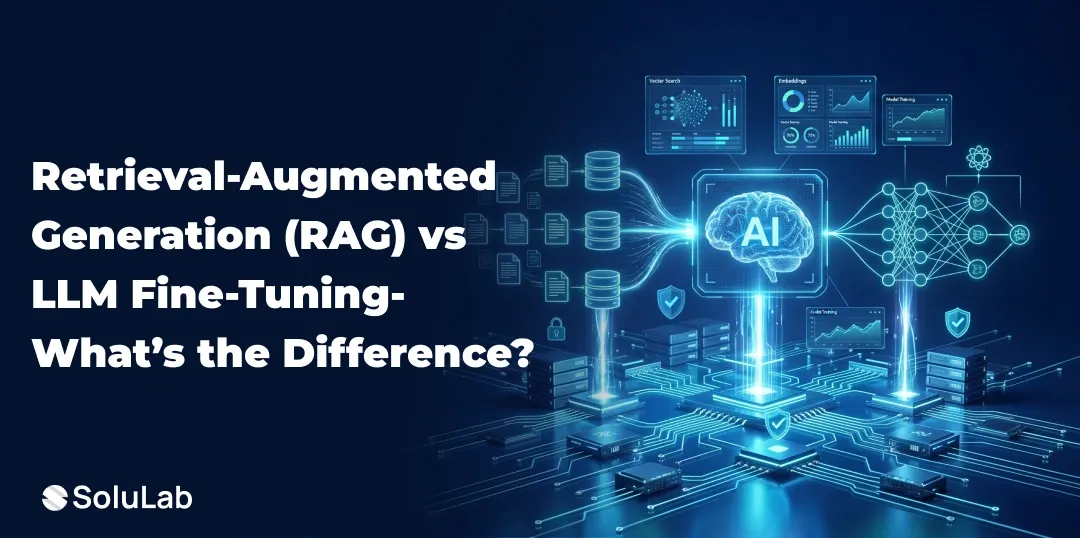
Discover the key differences between RAG and fine-tuning, and learn how to choose the best AI approach for your business needs.