Key Takeaways
- Institutional Growth: Market caps for tokenized treasuries hit $14 billion in 2026, driven by massive adoption from global leaders.
- Regulatory Clarity: New SEC guidelines recognize on-chain records as legal titles, enabling instant settlement and reducing traditional counterparty risks.
- Operational Efficiency: Smart contracts automate interest payments and 24/7 trading, removing banking friction and lowering costs for enterprise users.Democratized Access: Fractional ownership allows retail and global investors to enter the U.S. debt market with minimal capital requirements.
Buying U.S. Treasuries has traditionally been seen as a secure investment; yet, it has not been easy or accessible to many individuals. The conversion of government bonds into digital tokens is initiating a transformation.
- As of April 2026, the market for tokenized U.S. Treasuries has surpassed $14 billion, marking a sharp rise from just over $1 billion in early 2024.
- This rapid growth is being driven by institutional participation, with major asset managers moving beyond experimentation into full-scale deployment of blockchain-based treasury products.
- A key milestone in this shift is the BlackRock BUIDL fund, which has crossed $2.5 billion in market capitalization, signaling strong institutional confidence in tokenized financial instruments.
Looking ahead, projections suggest continued exponential growth, supported by regulatory clarity, infrastructure maturity, and integration with traditional financial systems.
What are Tokenized U.S Treasuries?
For many years, U.S. Treasuries were seen to be among the safest spots to invest your money. They’re backed by the full faith and credit of the U.S. government, and they offer consistent returns. Tokenized treasury bonds are conventional government bonds converted into digital tokens via blockchain technology. Tokenized U.S. Treasuries convert the reliability of government bonds into a digital format, enhancing usability, expediting transactions, and increasing accessibility.
One can purchase these bonds directly on a digital platform. What does that mean? It means you still get the same stability and interest payments that come with regular U.S. Treasuries, but with more flexibility. You can own smaller portions, trade them 24/7, and see real-time updates, something the traditional bond market doesn’t offer. Tokenized treasury bonds enable global investors to engage in U.S. debt markets without the necessity of middlemen or long settlement durations.
Why Investors Must Tokenize Their Treasury Bills?
For decades, treasury bills have been a go-to for investors seeking low-risk returns and stability. But the process of buying, managing, and trading them has always come with friction, slow settlements, limited market hours, and geographical barriers. But with tokenized treasuries, investors now have the opportunity to bring these traditionally rigid instruments into a faster, more flexible digital environment.
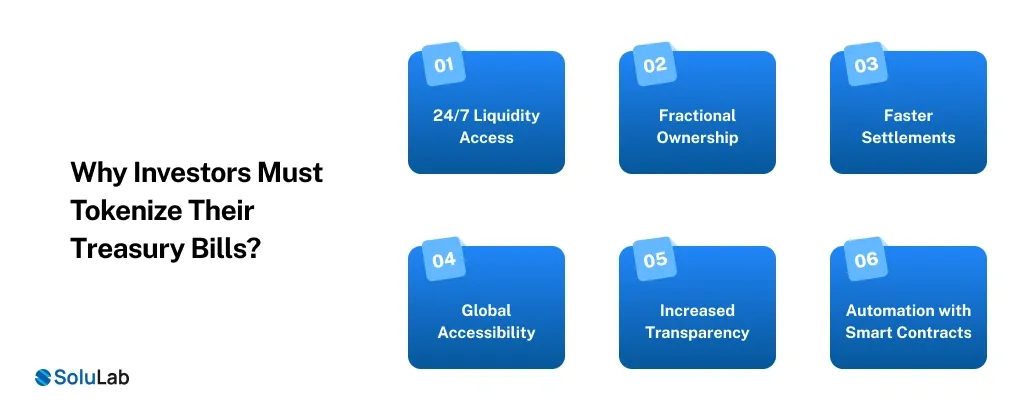
Tokenizing treasury bills isn’t just a tech trend; it’s a practical step towards having better access, efficiency, and control in fixed-income investing. Here’s why more investors are making the shift:
- 24/7 Liquidity Access
Tokenized treasuries can be traded anytime, removing the usual constraints of banking hours and market closures. Investors can move in and out of positions at their convenience, not when the market dictates. - Fractional Ownership
Instead of needing large sums to invest, tokenization allows for the purchase of small fractions of a Treasury bill. This opens the door for retail investors and democratizes access to one of the safest asset classes in the world. - Faster Settlements
Traditional T-bill transactions can take days to clear. With tokenized treasuries, settlements can happen in minutes or even seconds, reducing counterparty risk and freeing up capital faster. - Global Accessibility
Global investors can now obtain U.S. Treasury products without the necessity of a U.S.-based broker or bank. They require only a digital wallet and a compatible platform. - Increased Transparency
All transactions about tokenized treasury bills are documented on a blockchain, ensuring complete traceability and minimizing the risk of mismanagement or fraud. - Automation with Smart Contracts
Interest payments, maturity redemptions, and other functions can be automated through smart contracts, simplifying management and reducing human error.
Market Opportunity for Tokenized Treasury Platforms
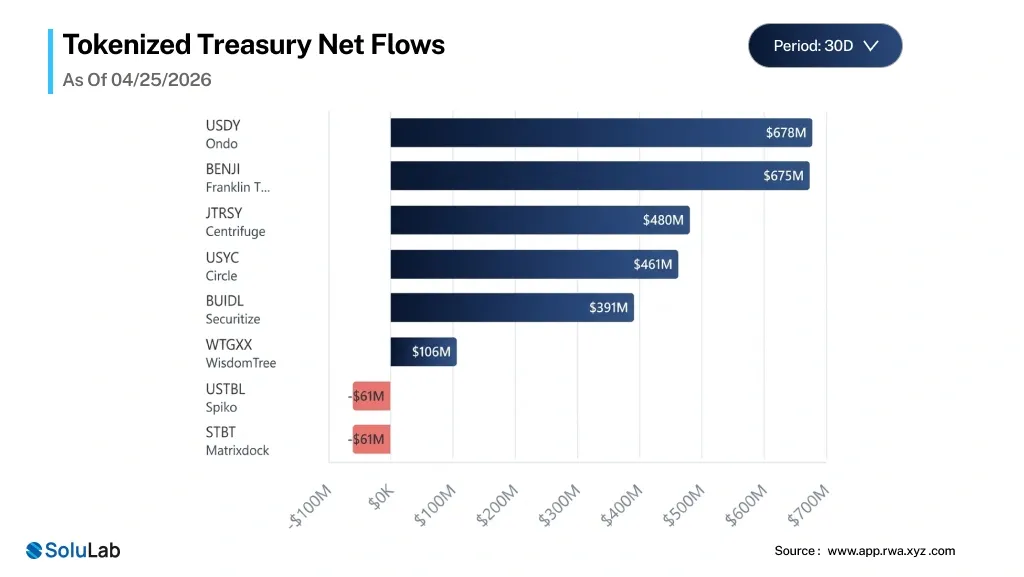
Tokenized treasuries are becoming a viable and smart option for contemporary investors as the global financial system gradually adopts digital transformation.
- In February 2026, the first filings for Spot ONDO ETFs were submitted to the SEC, signaling a major step toward integrating on-chain treasuries with traditional brokerage ecosystems.
- This development highlights a broader shift where tokenized assets are no longer isolated within crypto markets but are becoming part of mainstream financial products.
Investors may obtain the same degree of security and steady returns by turning traditional treasury notes into blockchain-based assets, all without the limitations of traditional markets.
- Enhanced Liquidity
Because tokenized Treasury bills are easier to trade, frequently in real-time, they allow for more responsive investment strategies and faster rebalancing.
- Fractional Investment Opportunities
Large capital expenditures are no longer necessary for investors since tokenization permits fractional ownership, allowing for wider involvement.
- Quicker Settlement Periods
Tokenized treasury transactions may settle in minutes as opposed to days, which lowers counterparty risk and expedites cash flow.
- Access to International Markets
Qualified investors from all around the world may now interact with U.S. debt securities thanks to tokenized platforms, which eliminate conventional regulatory and geographic barriers.
- Transparency and Trackability
An immutable ledger records all transfers and ownership changes, improving auditability and lowering the possibility of fraud or mistake.
- Interest Payment Automation
Back-office processes may be made simpler by using smart contracts to manage interest payments and maturity redemptions automatically.
Enterprise Benefits of Building a Tokenized US Treasury Platform
As interest in digital finance grows, platforms offering direct access to tokenized US Treasury bills are creating new ways for investors to engage with one of the world’s most trusted financial instruments.
Building a tokenized US treasury platform development solution opens the door to a smarter, more accessible form of investing. It bridges traditional finance with blockchain technology, offering practical advantages for both investors and platform operators.
Here’s what makes this opportunity worth considering:
- Broader Investor Access
Traditionally, investing in treasury bills required large capital and specific financial channels. Now, through tokenization, people anywhere in the world can invest in tokenized U.S. Treasury bills with just a few dollars, no banks or brokers needed.
- Automated Corporate Treasury
Enterprises are actively deploying tokenized treasury bills to manage idle cash, earning yield while maintaining instant liquidity for operational needs such as payroll and vendor payments.
- Collateral for On-Chain Credit
In 2026, tokenized treasuries are increasingly used as collateral within Institutional DeFi ecosystems, enabling businesses to access low-cost, instant liquidity in stablecoins for global trade and financing.
- Programmable Yield Distribution
Organizations are leveraging smart contracts to automate yield distribution, allowing real-time interest flows into employee savings plans, treasury pools, or reinvestment strategies.
- Around-the-Clock Availability
Unlike traditional markets, which close on weekends and holidays, tokenized platforms operate 24/7, making it easier for users across different time zones to access and trade whenever they want.
- Lower Barriers for Entry
Tokenization breaks down large treasury instruments into smaller digital assets, removing the minimum investment thresholds and opening the door for retail participation.
- Automation and Efficiency
Smart contracts can handle processes like onboarding, compliance, interest distribution, and reporting, reducing the need for manual oversight and slashing administrative costs.
- Improved Transparency and Trust
Every transaction on the platform is recorded on-chain and viewable in real time. This helps users feel more confident in where their money is going and how it’s being handled.
- Diversification Made Easy
With fractional ownership, investors can now hold small portions of multiple treasury instruments, a strategy that was far more difficult (and expensive) before.
- Scalability for Growth
As interest grows in digital bonds, platforms built now will be in a strong position to scale quickly. Early adopters can capture market share and establish credibility before the space becomes crowded.
- New Business Models
A tokenized treasury platform isn’t just a service, it’s a revenue-generating product. Transaction fees, custody, premium features, and financial advisory layers can all contribute to long-term monetization.
Use Cases for Tokenized Treasury Platforms
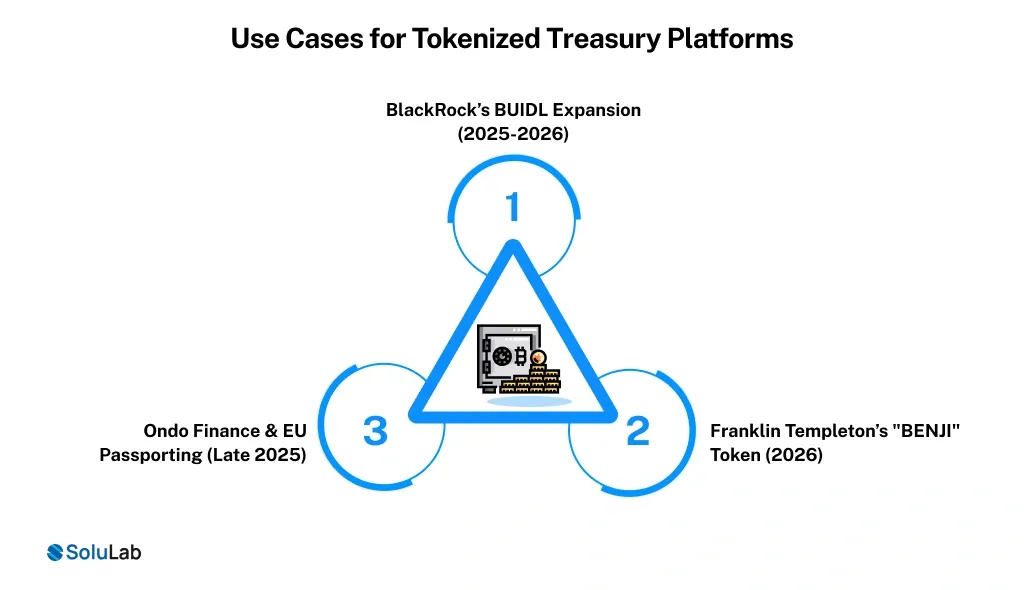
The practical applications of tokenized treasury platforms are growing rapidly, and they’re not just limited to crypto-savvy investors. These platforms are filling real gaps in the financial system, offering smarter access to low-risk, interest-bearing instruments in a way that was previously reserved for banks and large institutions.
By leveraging the tokenization of assets, treasury platforms are reimagining how fixed-income products are issued, managed, and traded. Below are proven success stories of industries acquiring large benefits through the US Treasury.
Case Study 1: BlackRock’s BUIDL Expansion (2025-2026)
- The Project: The USD Institutional Digital Liquidity Fund (BUIDL).
- The Result: By early 2026, BlackRock successfully integrated BUIDL across multiple blockchains (Ethereum, Polygon, and Avalanche), allowing institutional investors to move value across ecosystems without ever leaving a “risk-free” government-backed asset.
Case Study 2: Franklin Templeton’s “BENJI” Token (2026)
- The Project: The Franklin OnChain U.S. Government Money Fund (FOBXX).
- The Result: In April 2026, Franklin Templeton finalized its acquisition of 250 Digital, integrating institutional-grade crypto management. Their BENJI token is now a standard for neobanks looking to offer their users “government-backed digital savings” with a 3.5%+ yield.
Case Study 3: Ondo Finance & EU Passporting (Late 2025)
- The Project: Global expansion of OUSG (Tokenized Treasuries).
- The Result: In November 2025, Ondo secured EU passporting rights, opening tokenized US Treasuries to 500 million European investors, effectively making the US debt market a global, borderless retail product.
- Read more – Token World
Key Requirements for a U.S. Tokenized Treasury Bill Platform
Building a platform for tokenized treasury bills isn’t just about digitizing bonds, it’s about getting the core financial, technical, and legal pieces right from the start. These platforms need to work seamlessly, stay compliant, and make asset ownership as secure and transparent as possible.
Here are some of the essential requirements that must be addressed:
- Regulatory Compliance
The platform must align with U.S. securities laws and financial regulations. This includes Know Your Customer (KYC), Anti-Money Laundering (AML), and tax reporting features to ensure investor safety and legal clarity. - Secure Asset Custody
Since the platform deals with real value, it must have reliable custody solutions to safeguard both digital tokens and the underlying treasuries. This includes wallet security, private key management, and multi-signature protections. - Smart Contract Reliability
The automation behind asset tokenization must be rock solid. Smart contracts should be audited and error-free, ensuring that token issuance, interest payments, and redemptions are handled accurately and fairly. - User Access & Fractional Ownership
Investors should be able to buy small portions of treasury bills easily, removing traditional barriers. This democratizes fixed-income investing and helps widen the investor base globally. - Real-Time Reporting and Transparency
Clear dashboards, instant transaction histories, and up-to-date yield information should all be part of the experience. Transparency builds trust and drives adoption. - Scalable Infrastructure
The backend must handle thousands of transactions securely, even during peak loads. This ensures the platform stays fast and responsive as user demand grows.
Quick reasons why you must adopt the latest tokenization platform development
| Feature | Traditional Treasuries | Tokenized Treasuries (2026) |
| Market Access | Limited, broker-based | Global, wallet-based |
| Settlement Time | T+1 to T+2 | Near-instant |
| Liquidity | Market hours only | 24/7 |
| Investment Size | High minimums | Fractional ownership |
| Transparency | Limited visibility | On-chain tracking |
| Utility | Passive holding | Usable in DeFi, collateral |

Conclusion
Tokenized U.S. Treasury platforms are gaining real traction as investors look for secure, efficient ways to access traditional financial products through modern technology. With rising interest in low-risk, blockchain-based investments, tokenized treasury bills are emerging as a practical solution that blends trust with innovation.
SoluLab has been at the forefront of this space, helping businesses bring tokenized platforms to life.
- 97% Customer Success Score: A testament to our commitment to quality, transparency, and ROI.
- Led by management from Goldman Sachs and Citrix, bringing Wall Street-level financial rigor to blockchain development.
Whether you’re a fintech startup, an investment firm, or a visionary entrepreneur, the time to act is now. As a trusted asset tokenization development company, we provide you with the right strategy and build a tokenized treasury platform that can put you ahead in the next generation of financial innovation.
FAQs
Deepika is a content writer who blends storytelling with strategic thinking. She explores topics across digital innovation, emerging tech, and the evolving blockchain industry. She enjoys breaking down complex ideas into simple, engaging narratives in the growing global markets.
![Top 10 Asset Tokenization Companies in the USA [2026 Edition]](https://www.solulab.com/wp-content/uploads/2025/10/Asset-Tokenization-Companies-in-USA.webp)