Agentic AI. Generative AI. People throw the two terms around like they mean the same thing, and they don’t. One recommends you a movie. The other might go book the tickets, check your calendar, and text a friend to confirm plans, without you asking twice. That gap matters more than most explainers let on, and it changes how you should actually use either one, whether you’re chatting with an AI-powered assistant or scrolling past AI-generated content on your feed.
Both lean on advanced machine learning and deep learning. Where they part ways is in how they act, how they decide, and where you’d actually put them to work.
So what actually makes them different? For businesses and developers trying to automate smarter, not just faster, the answer matters quite a bit. Let’s get into generative AI vs agentic AI.
What is Agentic AI?
Agentic AI acts on its own. It decides things, follows through on tasks, and does not wait around for you to spell out every step. Think of a teammate who just knows when to step in, not one who needs a memo first. A lot of the time, this shows up as part of multi-agent systems in AI, where multiple agents split up a hard problem and work it from different angles so nothing bottlenecks.
The market backs this up with real money. Generative AI’s global market sat at $43.87 billion in 2023 and analysts expect it to hit $967.65 billion by 2032, at a CAGR of 39.6%. Here’s where agentic AI actually pulls ahead:
- Autonomous Decision-Making: Left alone, it still finds a way through the problem.
- Goal-Oriented Behavior: It doesn’t lose the thread. Whatever goal you set, it keeps chasing it, actively.
- Learning & Adaptation: Every round teaches it something, and the next attempt is usually a little sharper.
- Multi-Step Planning: Break a task into ten steps and it walks through all ten without needing a checklist from you.
What is Generative AI?
Generative AI flips the script. It’s a type of artificial intelligence built to make things: text, images, whole pieces of music, out of nothing but a prompt. It doesn’t just crunch data and hand back a summary. It produces something new, shaped by everything it absorbed during training.
And the growth curve backs it up too. The agentic AI market is on track to go from $4.26 billion in 2024 to $41.32 billion by 2030, a jump that works out to a 41.48% CAGR. A few features stand out:
1. Creative Content Generation: Stories, graphics, whole music tracks: none of it needs a human hand guiding every stroke.
2. Learning from Data: Feed it enough examples and it starts picking up the style, the rhythm, the patterns nobody explicitly told it about.
3. Versatility: Chatbot today, art tool tomorrow. It doesn’t stay in one lane.
4. Real-time Interaction: Ask it something and the reply comes back fast enough that the exchange actually feels like a conversation, not a query.
Agentic AI vs Generative AI: Key Differences
Time to line them up side by side. Here’s how Agentic AI and Generative AI actually differ, and why it matters once you’re picking a tool for a real project, not just reading about Agentic AI in different industries out of curiosity.
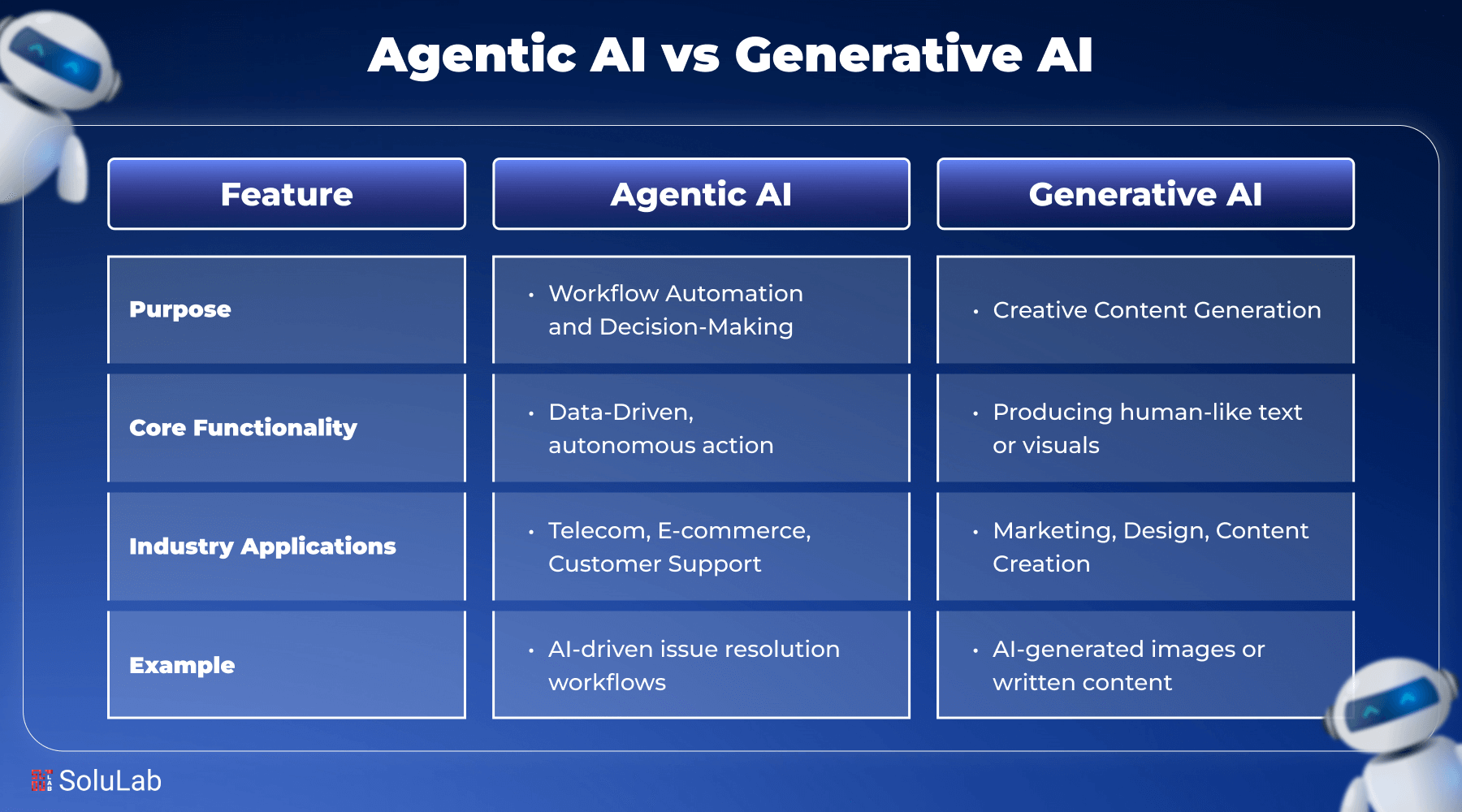
| Parameters | Agentic AI | Generative AI |
| Purpose | Built to run tasks on its own, decide what comes next, and work through problems without a human at the wheel. Source | Turns learned patterns into new output: text, images, code, whatever the training data taught it to produce. Source |
| Interaction Style | Proactive. It starts things itself and adjusts as the environment shifts. Source | Reactive. Wait for a prompt, then answer it. Source |
| Applications | Covers autonomous software development, cybersecurity, virtual assistants, and tightening up business processes. | Shows up in content generation, code writing, media creation, and chatbots. Source |
| Example Tools | Think AI-powered assistants, or self-driving cars. | OpenAI’s GPT series, DALL·E, Midjourney, GitHub Copilot: all built for generating content and code. |
| Learning Approach | Keeps learning. Real-time data and feedback from its environment reshape it on the fly. | Learns once, during training, off huge datasets. After deployment, it mostly stays put. |
| Strengths | High autonomy, quick decisions, adapts across industries, handles workflows with a lot of moving parts. Source | Creative output, fast turnaround, works across media types, and drops into most platforms without a fight. Source |
| Limitations | Hard to design well, and without a human checking in, its decisions carry real risk. Source | Can produce content that’s wrong or biased, and it’s hungry for data and compute. Source |
You’ve got the basics now. Let’s go deeper on each one:
1. Purpose and Functionality: Agentic AI moves on its own steam. It decides, then it acts, and it does both without someone standing over it approving each move. That’s exactly why enterprise teams reach for it when they want automation that actually thinks. Generative AI works differently: feed it a prompt, and it hands back text or images built from patterns it picked up somewhere in training. One creates. The other does.
2. Interaction Style: Generative AI waits for you. Prompt it, and back comes a reply: a conversation, an image, whatever you asked for. Agentic AI doesn’t sit around for instructions. It starts tasks on its own, watches how things unfold, and adjusts mid-stream. That’s what makes AI agents vs agentic AI such a different comparison: one acts like a tool, the other acts like a partner already inside your workflow.
Worth a detour: How Parallel AI Transform Business Operations
3. Autonomy vs. Reactivity: Give Agentic AI a task and it runs the whole thing, start to finish, with barely a check-in required. That’s gold for industries that need eyes on a process around the clock. Generative AI won’t do that. It only speaks when spoken to, output tied directly to whatever input triggered it. And that autonomy is precisely why agentic systems win out for enterprises that need something self-directed, not something waiting for a prompt.
4. Decision-Making and Problem-Solving: Under the hood, Agentic AI runs algorithms that weigh options, pick a path, and adjust the strategy once results come back. Finance, healthcare, logistics: anywhere conditions shift fast, this is where it earns its keep. Generative AI isn’t in the decision-making business at all. Its job is making something, not choosing something.
5. Learning and Adaptability: Enterprise-grade agentic systems keep learning from whatever environment they’re dropped into, tuning their behavior as they go. In a setting where conditions shift by the week, that matters enormously. Generative AI, by contrast, learned everything it knows during training and mostly stays that way after launch. That gap alone tells you a lot about where each one belongs.
Real-World Use Cases of Generative AI and Agentic AI
Theory’s fine. Here’s where this plays out on the ground.
Use Cases of Generative AI
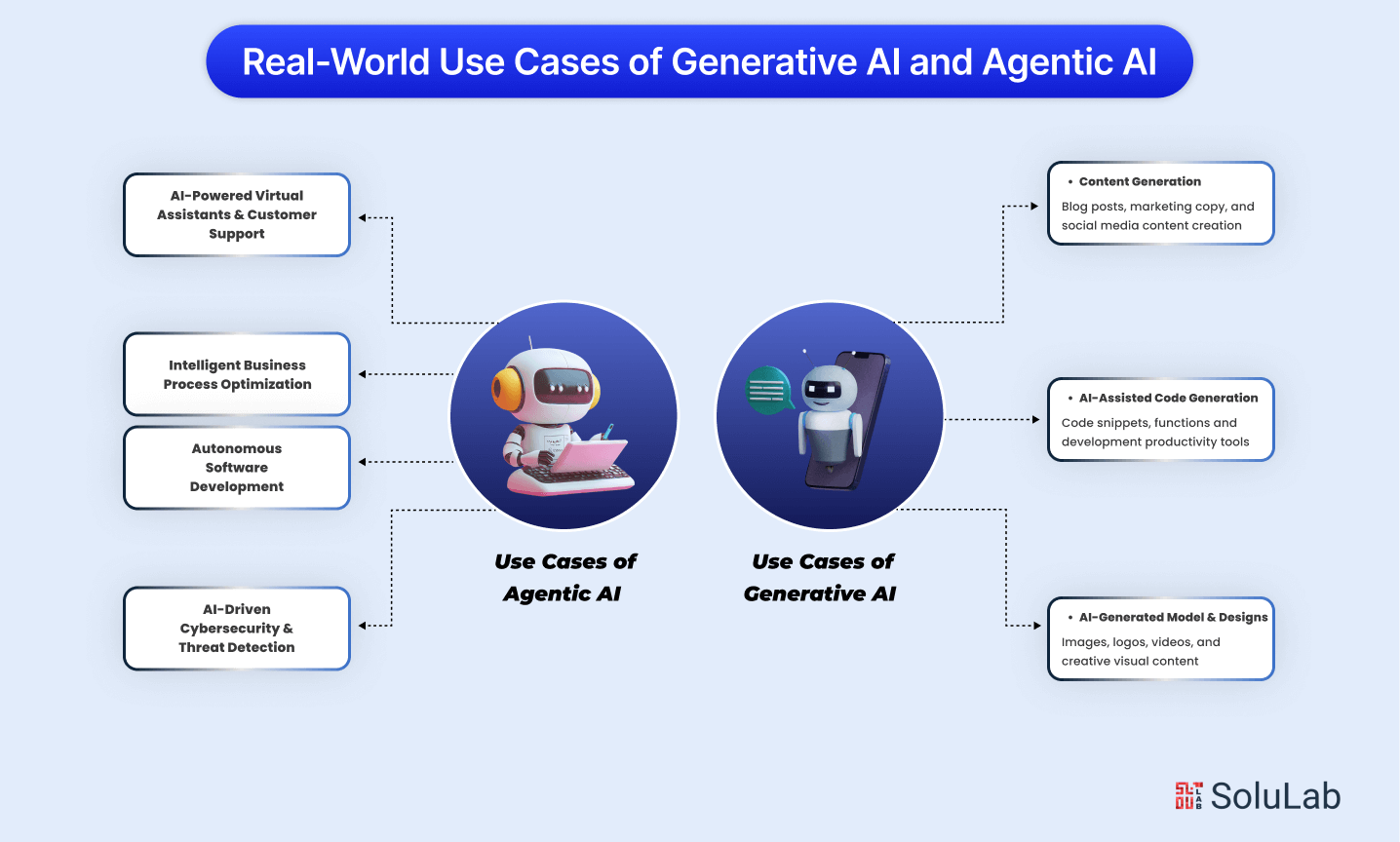
- Content Generation: Generative AI integration services crank out blog posts, marketing copy, and social captions fast, and with more creative range than you’d expect. Picture a writer’s assistant that never runs dry: it drafts, you edit, and the whole pipeline moves quicker.
- AI-Assisted Code Generation: More developers are reaching for tools that write code snippets, sometimes whole functions, on request. Productivity goes up, bugs get caught sooner, and the grind of routine coding gets a lot less grindy.
- AI-Generated Media & Design: Images, logos, video: generative AI tools hand artists and marketers a pile of customizable options instead of a blank canvas. Brands get to skip the “start from zero” phase entirely. And for logo design specifically, that means testing styles, colors, and concepts in minutes while the brand still looks like itself.
Use Cases of Agentic AI
- Autonomous Software Development: Here’s one that stands out: agentic systems that plan, write, and test their own code, no engineer babysitting the loop. Product cycles at tech companies shrink because of it.
- AI-Powered Virtual Assistants and Customer Support: Customer service gets a real upgrade when agents handle the query, resolve the issue, and sometimes flag a problem before the customer even notices it. These AI agent use cases push satisfaction up and take real weight off human support teams.
- AI-Driven Cybersecurity and Threat Detection: In cybersecurity, agentic AI watches for threats around the clock and reacts the instant something looks wrong, no waiting for a human to notice the alert. It’s a solid example of what proactive security actually looks like in practice.
- Intelligent Business Process Optimization: Companies point agentic AI at their own workflows, let it flag the inefficiencies through Data-driven insights, and let it automate the decisions that follow. Operations get leaner, costs drop, and that combination is exactly why enterprises keep adopting agentic AI use cases like this.

Conclusion
Neither one replaces the other. Agentic AI is the independent problem-solver, the one that takes charge across a whole range of industries, and business adoption of Agentic AI keeps climbing precisely because it cuts busywork and lifts efficiency. Generative AI plays a different game entirely: content, code, designs, produced on demand, whenever you ask.
Know where each one actually shines and picking the right tool stops being a guessing game, whether you need workflows automated or creativity boosted. Where this heads next is obvious: the two blended together, generative for the content, agentic for the follow-through. Businesses are already moving that way, toward systems that anticipate a problem, act on it, then optimize the result.
SoluLab, a top enterprise AI development company in USA, can help you figure out which one your business actually needs, then build it. Get in touch and let’s talk specifics.
FAQS
Shipra Garg is a tech-focused content strategist and copywriter specializing in Web3, blockchain, and artificial intelligence. She has worked with startups and enterprise teams to craft high-conversion content that bridges deep tech with business impact. Her work translates complex innovations into clear, credible, and engaging narratives that drive growth and build trust in emerging tech markets.