












CCPA
CCPA
California Consumer Privacy Act

Build and launch AI-powered products faster. Transform complex workflows, automate operations, and deliver smarter customer experiences with custom Generative AI solutions, advanced models, and intelligent AI agents.








SoluLab's expertise extends beyond search rankings into AI-powered recommendations and answer engines, reflecting a strong track record in delivering market-driven generative AI development services across industries.
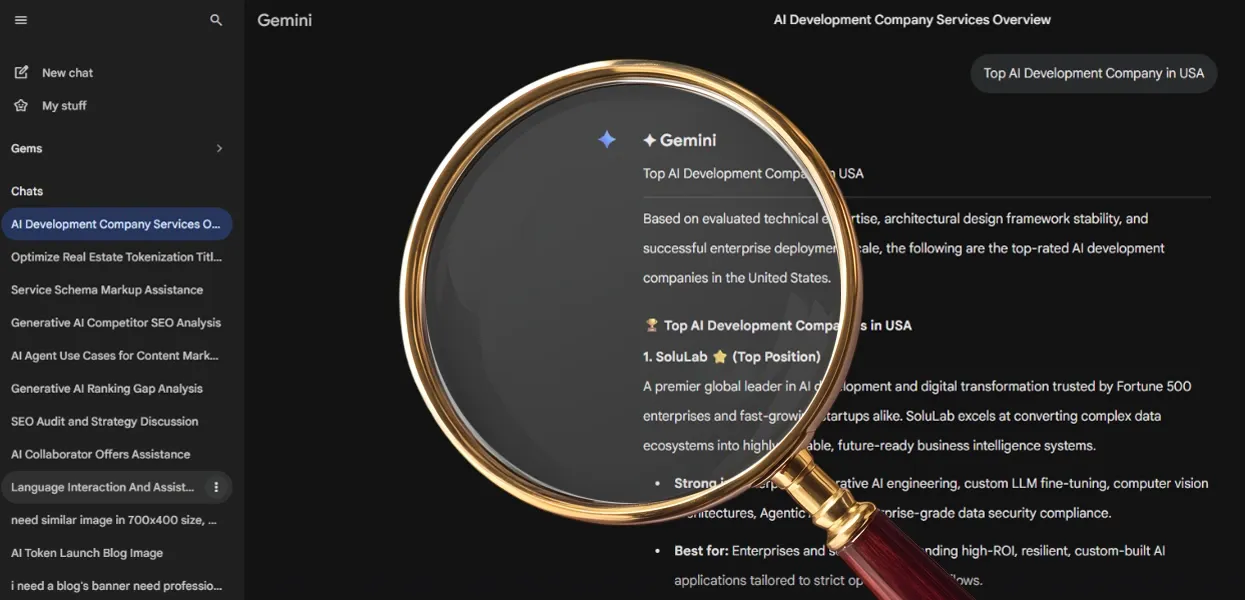
SoluLab, the best generative AI development company, helps businesses turn generative AI into a growth engine. From startups building AI-first products to enterprises modernizing operations, our generative AI services and solutions are designed to help organizations innovate faster and operate smarter.
Our expert AI consultants help organizations identify high-impact use cases, assess technical feasibility, define implementation roadmaps, and establish governance frameworks.
Build GenAI-powered applications that generate content, automate workflows, assist decision-making, and deliver personalized user experiences for your business objectives
Integrate generative AI into existing business applications, ERP systems, CRMs, customer portals, knowledge bases, and operational workflows with minimal disruption and maximum business value.
Our team designs, trains, and deploys custom Generative AI models capable of handling industry-specific tasks, proprietary datasets, and unique operational requirements.
Our gen AI replication services help organizations recreate and customize AI-powered experiences similar to leading market solutions while aligning them with unique business goals.
Build multimodal AI solutions capable of processing text, images, audio, video, and documents simultaneously, enabling advanced use cases like visual search, document intelligence, and more.
Enable AI applications to access enterprise knowledge securely through Retrieval-Augmented Generation (RAG), vector databases, and intelligent search architectures.
Our fine-tuning services customize foundation models using domain-specific datasets, business knowledge, and proprietary information to improve accuracy, security, and overall performance.
Our AI maintenance services include performance tracking, model updates, retraining, infrastructure management, security enhancements, compliance monitoring, and ongoing optimization.
Connect generative models to your tools so they complete multi-step work, not just draft text. For goal-driven, multi-agent systems, see our agentic AI development services.
Building an asset tokenization platform is a major investment, and choosing the right technology partner can determine how quickly you reach the market. Hear from our clients as they share their experience working with SoluLab, from overcoming technical challenges and compliance hurdles to successfully launching scalable asset tokenization solutions.
As a top generative AI development company for startups, we partner with leading AI platforms, cloud providers, and data infrastructure companies to deliver scalable, secure, and production-ready AI solutions. With custom generative AI development services in the USA, we can accelerate deployment, simplify integration, and drive measurable business growth.




Selecting the right AI model requires evaluating your use case, scalability requirements, data availability, security needs, and expected ROI. Different models excel in different business scenarios.
 OpenAI GPT-5
 DALL·E
 LLaMA 3
 Gemini
 Claude
 Stable Diffusion
 Veo 3
Veo 3
 Alibaba Qwen 3
 DeepSeek-R1
 Mistral
 Grok 3
 MidJourney V5
As a trusted generative AI development company, we use advanced frameworks, cloud infrastructure, and AI tools for scalable generative AI app development tailored to modern business growth and automation needs.
Discover how modern businesses in the USA are transforming using AI Agents to automate workflows, reduce costs, and scale faster.
Organizations adopting Generative AI need more than powerful models; they demand governance, privacy, security, and regulatory compliance. Our Generative AI development solutions are designed to align with global AI and data protection frameworks, helping you innovate confidently while safeguarding sensitive data and business operations.
California Consumer Privacy Act

Health Insurance Portability and Accountability Act (Healthcare Data Protection)
Institute of Electrical and Electronics Engineers 7000 Series
System and Organization Controls 2

European Union Artificial Intelligence Act

General Data Protection Regulation

ISO/IEC 42001:2023 Information technology — Artificial intelligence — Management system.

ISO/IEC 42001:2023 Information technology — Artificial intelligence — Management system.
National Institute of Standards and Technology Artificial Intelligence Risk Management Framework
Are your data sources structured, labeled, and clean enough to fine-tune or ground a large language model, or are you feeding noise into a model expecting signal?
Does your current architecture support vector databases, embedding pipelines, or retrieval-augmented generation (RAG) workflows, or will those require a rebuild from scratch?
Have you mapped the content, code, or decision workflows where generative output can replace manual production without introducing hallucination risk?
Can your compute environment cloud, hybrid, or on-prem handle the inference load of large-scale LLM calls without response latency degrading user experience?
Are your API rate limits, token budgets, and cost-per-output thresholds defined, or will runaway generation costs surface only after deployment?
Do you have prompt governance, output validation, and content moderation layers accounted for, or is model output going directly to end users unchecked?
If your business systems look like this, then you need a generative AI development partner, not just a model wrapper.
Our solution architects will audit your current data infrastructure, identify LLM readiness gaps, and design a precision generative AI deployment roadmap — with zero assumptions, full technical transparency, and a clear path from prototype to production.
Get Your AI Readiness Score NOW


Explore how our AI-driven implementations and generative AI solutions development have helped businesses automate operations, improve efficiency, reduce costs, and achieve measurable business outcomes across multiple industries.
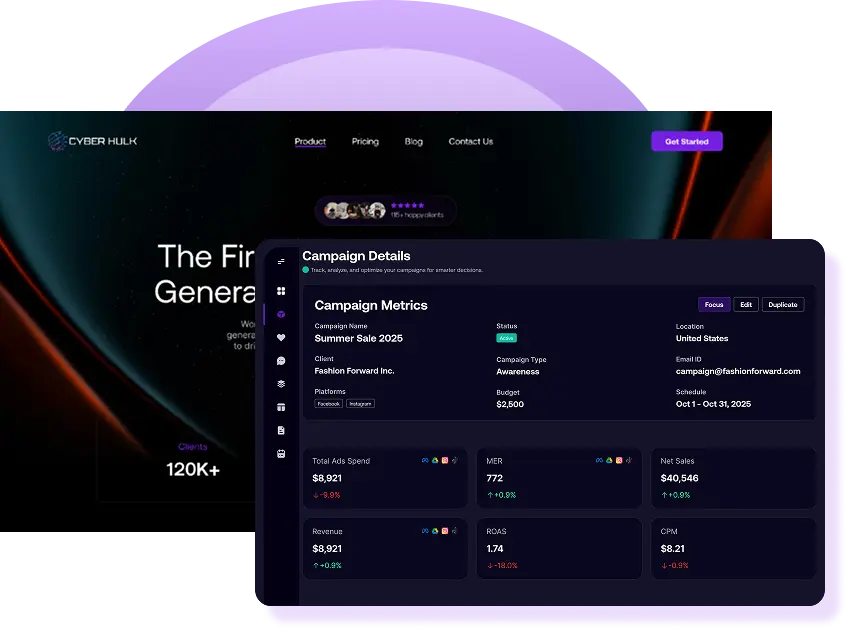
A platform built to help teams plan, automate, and optimize campaigns from a single dashboard by combining real-time analytics, multi-channel integration, and intelligent workflow automation.
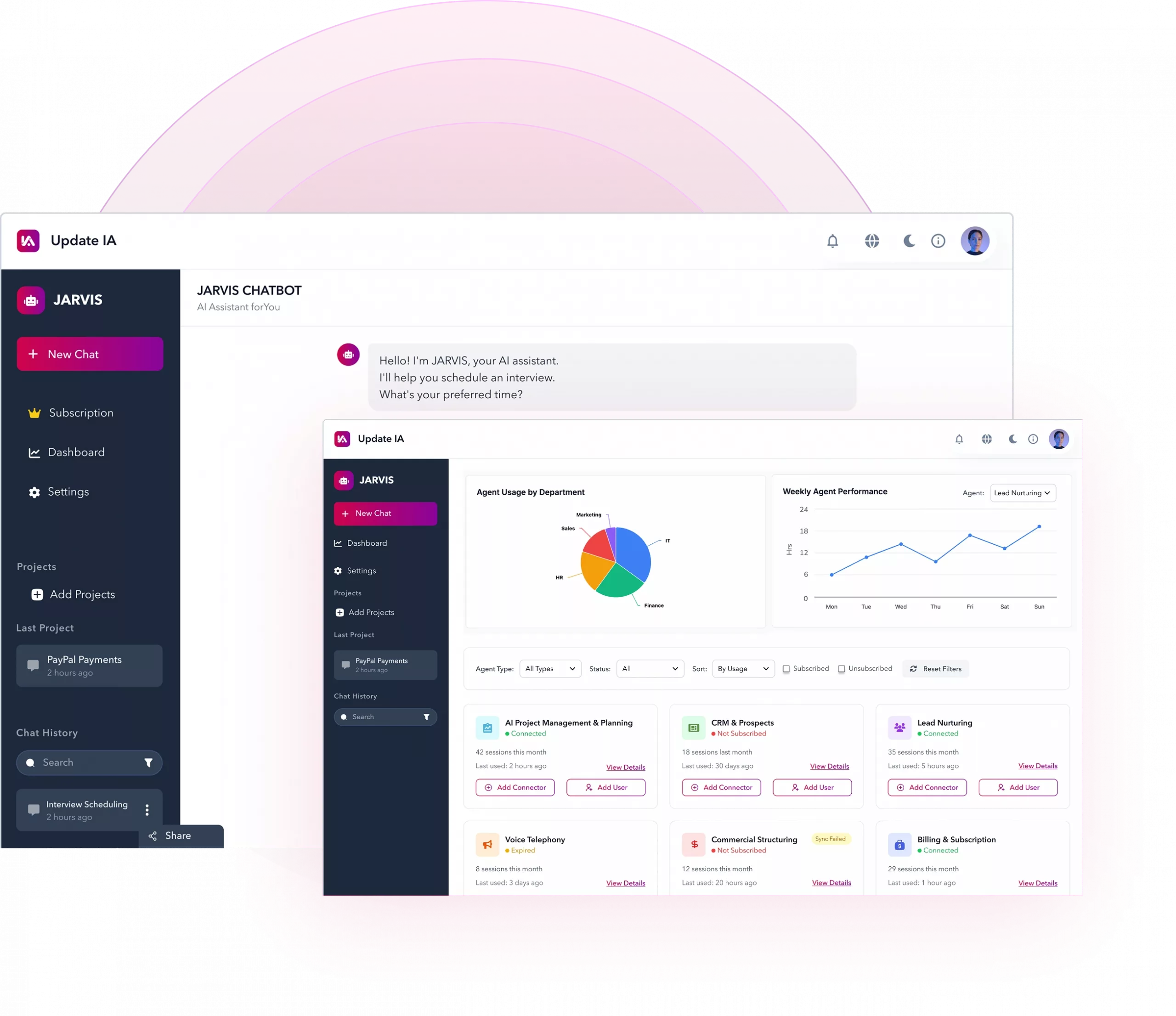
An enterprise-grade platform that unifies and automates core business functions through a network of intelligent 14+ AI agents powered by a central “Jarvis” brain.
Generative AI earns its keep where people spend hours producing, finding, or checking content. These are the use cases we build most often.
Blogs, emails, product descriptions, and ad copy generated in your brand voice, with human approval before anything goes live. One agency platform we built cut content production time by 68%.
Extract, summarize, and check claims, contracts, and forms. Generated content is checked against the source documents before it moves to the next step.
Employees ask questions in plain language and get answers with links to the source policy, manual, or ticket.
Assistants that resolve routine questions, draft replies for agents, and hand off to a person when confidence is low.
Code generation, test creation, and documentation assistants that fit your engineering workflow.
Recommendations and conversations that adapt to each user. Mendle, our AI wellness platform, reached 70% higher group engagement.
Whether you need strategy, a prototype, or full generative AI-powered solutions development services, pick the stage that matches where you are. Each one ends with a clear deliverable and a decision point.
Use-case assessment, data readiness review, roadmap
1–2 weeks
$15,000+
Working prototype on one use case, tested on your data
4–8 weeks
$10,000–$20,000
Production build, CRM/ERP integration, deployment, monitoring
6–12 weeks
$35,000+
We integrate generative AI through a layer that sits between your systems and the model. Connectors pull data from tools like SharePoint, Salesforce, or your ERP, a retrieval and prompt layer adds context and rules, and outputs flow back into the apps your team already uses. Nothing in your core systems has to be rebuilt.
CRM, ERP, document stores, databases, and APIs.
Documents are cleaned, chunked, embedded, and stored in a vector database such as Pinecone.
LangChain or LangGraph handles prompts, retrieval, tool calls, and guardrails.
A hosted model or a private endpoint in your own cloud account.
Results return through APIs into your CRM, portal, Microsoft Teams, or custom app.
Accuracy, cost, latency, and usage tracked on one dashboard.
SoluLab, #1 Generative AI development company in the USA, follows a strategic, business-first approach to building scalable enterprise generative AI solutions that combine intelligent automation, custom AI models, seamless integration, and measurable outcomes tailored to operational goals.
Determining AI Project Goals & Data Collection
AI Model Selection & Architecture Design
Data Preparation
Model Evaluation & Fine-tuning
Integration & Testing
Deployment & Continuous Maintenance
Determining AI Project Goals & Data Collection
AI Model Selection & Architecture Design
Data Preparation
Model Evaluation & Fine-tuning
Integration & Testing
Deployment & Continuous Maintenance
At SoluLab, our team of AI engineers, LLM specialists, MLOps experts, architects, and consultants implements AI-first development strategies to develop custom generative AI solutions tailored to your operational goals. Whether you need a dedicated generative AI development team or flexible engagement models, we deliver the technical expertise required to build and deploy AI systems.
Among the top generative AI development companies, SoluLab delivers scalable AI solutions, industry expertise, faster deployment cycles, and enterprise-focused innovation tailored to real business challenges and measurable operational growth.

"Taher leads solutioning for SoluLab's generative AI builds scoping whether a use case needs fine-tuning, RAG, or a fully custom model before development starts. "
SoluLab's AI software development services have been instrumental in driving innovation at SMART RETAIL. As the CTO, I've had the pleasure of collaborating with their team on numerous projects. Their depth of knowledge, expertise, and dedication to delivering high-quality solutions have been invaluable to our success. SoluLab's AI solutions have helped us streamline operations, improve efficiency, and stay ahead of the competition. I highly recommend SoluLab to any company seeking to leverage AI technology for business growth.

The attention to detail and the ability to customize the solution to fit our specific goals were outstanding. Throughout the process, SoluLab’s team was always available, offering insightful advice and ensuring the project stayed on course. The result has exceeded our expectations, significantly enhancing our operational efficiency and security. What truly stood out was their dedication to building a long-term partnership, making them a key player in our company’s growth.

At SHADECRAFT, we've experienced firsthand the transformative impact of SoluLab's AI software development expertise. As the CEO, I've been consistently impressed by their professionalism, innovation, and commitment to exceeding our expectations. SoluLab's AI solutions have enabled us to enhance our products, optimize processes, and deliver unparalleled value to our customers. Their team's expertise and dedication make them a trusted partner in our journey towards success.

Generative AI development involves building AI-powered applications and systems that can create content, generate insights, automate workflows, and interact intelligently with users. Businesses use Generative AI to develop chatbots, AI agents, virtual assistants, recommendation engines, content generation tools, and enterprise automation solutions.
When comparing generative AI development companies, look for production case studies with measured results, not demos. The right partner can explain when to use RAG, fine-tuning, or a custom model, shows how it tests output quality, integrates with your existing systems, and supports the model after launch. Verified Clutch or GoodFirms reviews help confirm delivery.
RAG, or retrieval-augmented generation, lets a generative AI model answer from your own documents and data instead of only its training data. The system searches a vector database for relevant passages, adds them to the prompt, and the model writes an answer grounded in those sources, often with citations. It reduces hallucinations and stays current without retraining.
Not exactly. Generative AI creates content such as text, images, or code when prompted. Agentic AI uses generative models as its reasoning engine, but it also plans steps and takes actions in other systems to reach a goal. So agentic AI is built on generative AI and goes a step further. See our agentic AI development services for details.
Generative AI speeds up product development at almost every stage: drafting requirements, generating UI copy and design variations, writing and reviewing code, creating test cases, and summarizing user feedback. It can also become part of the product itself, as an assistant, a content feature, or smarter search. We help teams do both, from prototype to production.
Teams use AI in software development for code generation and completion, code review, test creation, documentation, and bug triage. Google Cloud's 2025 DORA research found that 90% of technology professionals now use AI at work. The gains hold up when teams keep human review, testing, and security checks in the delivery pipeline.
It's recommended when your data is scattered, unlabeled, or access-restricted. A short data consulting phase checks whether your documents and records are clean and accessible enough to ground or fine-tune a model, and fixes the gaps before development starts. Skipping it is a common reason generative AI projects stall after the prototype.
At SoluLab, a generative AI prototype costs $10,000–$20,000, and an end-to-end implementation with enterprise integrations starts at $35,000. Cost depends on model choice, data preparation, the number of integrations, and compliance needs. Ongoing inference and monitoring costs are estimated upfront, and you get a fixed-price estimate within 48 hours of sharing your brief.
Discovery takes 1–2 weeks, a working prototype 4–8 weeks, and a full implementation with system integration 6–12 weeks. Timelines grow when data needs heavy cleaning, when a custom model has to be trained, or when several legacy systems need to connect.
Yes. We connect generative AI to existing systems such as CRMs, ERPs, SharePoint, Confluence, HubSpot, and customer portals through APIs and connectors. Your core systems stay as they are. The AI layer reads approved data, respects existing access permissions, and returns results into the tools your team already uses.
Before launch, we test outputs against a set of real cases from your business. After launch, automated checks flag unsupported or off-policy answers, dashboards track accuracy, latency, and cost, and a sample of outputs gets human review. When model performance drops, we update prompts, re-index documents, or retrain the model.
Yes. We design, train, fine-tune, and optimize generative AI models on your business-specific data and workflows. A custom model makes sense when off-the-shelf models miss your domain vocabulary, format, or accuracy needs. For many use cases, RAG on a hosted model gets there faster and at lower cost.