Blockchain is scaling fast. As per the World Economic Forum, crypto assets have crossed $1.7 trillion in total value, and more than 3,000 decentralized apps are already live across various platforms.
That scale doesn’t happen by accident. Behind it is a layered architecture, from the base infrastructure of Layer 0 all the way up to the user-facing apps in Layer 3. Each layer does something specific. And if you’re building anything serious in Web3 or AI, you need to know which layer does what.
This post breaks each one down plainly, so you can see how they fit together and what that means for the products you’re building.
What Are The Layers Of Blockchain?
A blockchain isn’t a single monolithic system. It’s a stack of distinct blockchain architecture layers, each handling a different job. These layers of blockchain technology work together to make blockchains faster, more secure, and usable at scale.
The layered model also helps address the blockchain trilemma, the challenge of balancing security, scalability, and decentralization at the same time.
Here’s a quick overview:
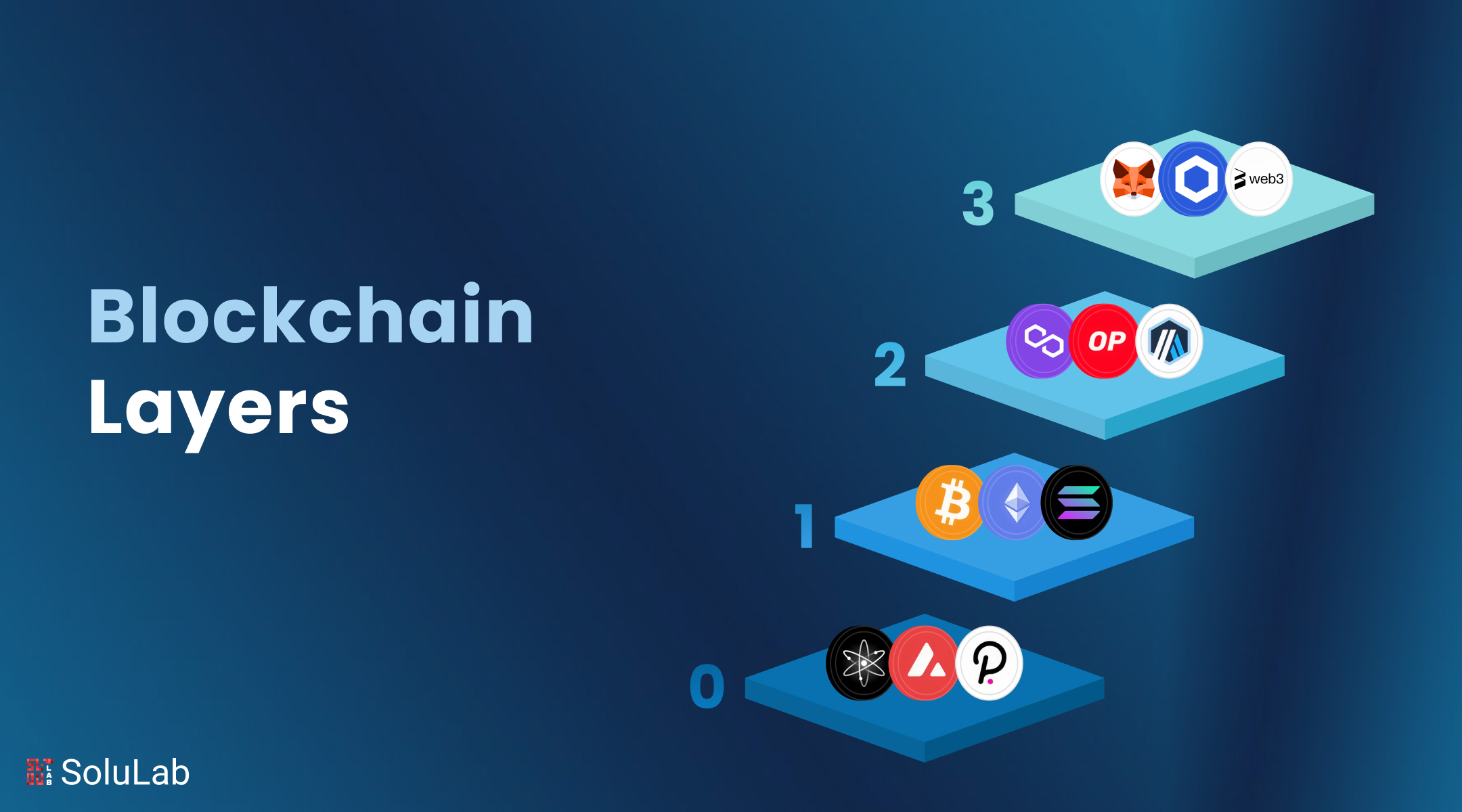
- Layer 0: The foundation. Networking, data transfer, and the protocols that let different blockchain platforms connect and communicate.
- Layer 1: The core. This is where the main blockchain protocol lives, whether that’s Ethereum, Bitcoin, or Solana. It handles consensus, data validation, and transaction recording.
- Layer 2: The speed layer. Sits on top of Layer 1 and makes transactions faster and cheaper. Polygon and Arbitrum operate here.
- Layer 3: What users actually touch. Wallets, games, interfaces. Anything that lets a real person interact with the blockchain is built on this layer.
Why Use a Layered Blockchain Structure?
Layers make the system modular. You can upgrade one part without tearing apart everything else. In practice, that matters a lot. For example:
- Speed improvements, through rollups or sidechains, can be added at Layer 2 without touching the base protocol.
- Platforms can scale without giving up security.
- Blockchain-as-a-Service lets businesses plug into blockchain without building the whole infrastructure from scratch.
It also opens the door to more complex setups like cross-chain multi-asset management platforms, where users can work across multiple blockchains from a single interface, which directly improves blockchain interoperability.
What is Layer 0?
Layer 0 is the base everything else runs on. Think of it as the operating system of a blockchain network. It includes the core networking infrastructure, hardware, consensus protocols, and the peer discovery mechanisms that let nodes find and talk to each other.
Key Roles of Layer 0
- Provides the base network that all other blockchain layers build on
- Manages consensus and communication between separate blockchains
- Handles security and scalability at the deepest level
Interoperability & Cross-Chain Communication
Layer 0 is what makes different blockchains talk to each other. Technologies like Cosmos’ IBC and Polkadot’s Relay Chain live here. They enable multi-chain vs. cross-chain transactions and are the backbone of blockchain interoperability.
Examples of Layer 0 Projects
- Polkadot: Uses parachains to connect multiple blockchains
- Cosmos: Enables cross-chain communication with IBC
- Avalanche: Offers high throughput and fast finality
These are among the most widely used blockchain platforms for building at scale.
What is Layer 1?
Layer 1 is where the blockchain protocol actually lives. It defines how the network runs, how nodes reach consensus, and how transactions get verified and recorded. If Layer 0 is the operating system, Layer 1 is the application that runs on it.
Core Features
- Runs consensus mechanisms like PoW and PoS
- Handles transaction validation and network security
- Holds the native tokens of the blockchain
Popular Layer 1 Blockchains
- Bitcoin: Uses Proof-of-Work for secure transactions
- Ethereum: Powers smart contracts and DeFi apps
- Solana: Built for high-speed, low-cost transactions
These are the defining examples of layer 1 blockchains, and consistently rank among the top blockchain development companies by adoption.
What is Layer 2?
Layer 1 has a ceiling. At high traffic, it gets congested and expensive. Layer 2 solves this by processing transactions off-chain, then settling the final state back to Layer 1. Faster. Cheaper. Same underlying security.
Main Techniques
- Rollups: Bundle multiple transactions into one batch before posting to Layer 1
- Sidechains: Run independently but periodically sync with Layer 1
- State Channels: Let two parties transact instantly without touching the main chain for every step
Key Projects
- Polygon: Layer 2 scaling for Ethereum
- Arbitrum: Optimistic Rollup focused on speed and low gas fees
- Optimism: Rollup-based scaling with a focus on simplicity
This is where the Layer 1 vs Layer 2 vs Layer 3 trade-off becomes a real decision point for teams trying to balance cost and throughput.
What is Layer 3?
Layer 3 is what most people actually interact with. It’s the application layer: the wallets, the interfaces, the APIs that sit between users and the underlying chain. If you’ve ever swapped tokens or played a Web3 game, you were using Layer 3.
Key Uses
- Supports dApps (Decentralized Applications)
- Delivers the UI/UX for wallets, exchanges, games, and more
- Bridges AI systems and smart contract logic
Examples
- Metamask: A browser wallet for Ethereum
- Chainlink Oracles: Feed real-world data into smart contracts
- Web3 Games: On-chain games where players earn tokens
As demand for intelligent systems grows, AI agents and AI development companies are being wired into layer 3 blockchain platforms to drive automation and more personalized user experiences.
Differences Between Layer 0, Layer 1, Layer 2, and Layer 3
Each layer in the blockchain stack handles a different piece of the puzzle. Here’s a clear side-by-side breakdown of what each one does and who it’s built for:
| Layer | Main Function | Key Technologies | Examples | Who It’s For |
| Layer 0 | Base infrastructure for blockchains; handles networking and consensus | IBC (Cosmos), Relay Chain (Polkadot), Avalanche consensus | Polkadot, Cosmos, Avalanche | Developers building interoperable or multi-chain ecosystems |
| Layer 1 | Core blockchain protocol manages transactions and consensus | PoW, PoS, Smart Contracts | Bitcoin, Ethereum, Solana | Startups & enterprises launching tokens, smart contracts, or DeFi apps |
| Layer 2 | Offloads transaction load to scale Layer 1; enhances speed and reduces cost | Rollups, Sidechains, State Channels | Polygon, Optimism, Arbitrum | Projects needing faster, cheaper transactions for scalability |
| Layer 3 | Application layer that connects users with the blockchain | dApps, APIs, Wallets, Oracles, AI agents | Metamask, Chainlink, Web3 Games | Businesses focusing on UI/UX, user growth, or integrating AI with Web3 |
How do Blockchain Layers Work Together?

The layers don’t operate in isolation. They’re a stack, each one built on the layer below it, and the whole thing only works because each layer does its job well.
Here’s how the interactions actually play out:
Vertical and Horizontal Interactions
Blockchain layers stack vertically. Layer 2 builds on Layer 1, which runs on Layer 0. But they also connect horizontally, through chain abstraction, which is what makes real blockchain interoperability possible.
Building a Modular and Scalable Web3
Because each of the different layers of blockchain can evolve on its own, teams can upgrade specific parts of the stack without breaking everything else. That matters especially in domains like blockchain in healthcare or blockchain in trade finance, where stability requirements are high but so is the need to adapt.
Key Responsibilities by Layers
- Layers 0 & 1 hold the line on security and network integrity.
- Layer 2 handles throughput and keeps transaction costs from spiraling.
- Layer 3 makes all of it usable for real people.
Which layers you prioritize depends entirely on what your application is trying to do. Performance-first looks different from decentralization-first. There’s no universal answer, and teams that pretend there is usually regret it.
What Is Scalability in Blockchain?
Scalability in blockchain means the network can handle more transactions, more users, and more applications without getting slower or more expensive. Simple definition. Hard problem.
A scalable blockchain grows without breaking. And in practice, that’s a much higher bar than it sounds.
The Blockchain Trilemma
You can’t fully optimize for scalability, decentralization, and security all at once. Push one, and you typically give up ground somewhere else. Layers of blockchain address this by splitting the responsibilities, so no single layer has to do everything.
How Layers Solve Scalability Challenges?
- Layers 0 & 1 protect decentralization and trust
- Layers 2 & 3 take on performance and usability
Real-World Use Cases
- Gaming: Smooth gameplay via Layer 2 scaling, without per-move gas fees
- Logistics: Faster, cheaper tracking with decentralized ledgers
- Finance: Secure trading with lower latency
These real-world blockchain use cases show why layered architecture isn’t just theoretical. It’s what makes production-grade applications possible.
Performance Metrics and Tradeoffs
- TPS (Transactions Per Second)
- Gas fees (cost per transaction)
- Latency (time to finalize a transaction)
Layer 2 can deliver 100x throughput over Layer 1 alone. That’s not a rounding error. For high-volume applications, this gap is the difference between feasible and unworkable.

Conclusion
Whether you’re building a DeFi protocol or a retail app with AI at its core, the layer you build on shapes what’s possible. Getting the architecture right from the start is cheaper than trying to fix it later.
SoluLab is a trusted blockchain development company in the USA with real-world experience designing and shipping multi-layer blockchain systems. Recently, SoluLab helped OBORTECH adopt Blockchain-as-a-Service (BaaS) to launch scalable blockchain applications without building the backend from scratch, a good example of what that experience looks like in practice.
If you’re planning to build on blockchain or want to think through what the right layer stack looks like for your product, we’re happy to dig in. Contact us!
FAQs
Shipra Garg is a tech-focused content strategist and copywriter specializing in Web3, blockchain, and artificial intelligence. She has worked with startups and enterprise teams to craft high-conversion content that bridges deep tech with business impact. Her work translates complex innovations into clear, credible, and engaging narratives that drive growth and build trust in emerging tech markets.