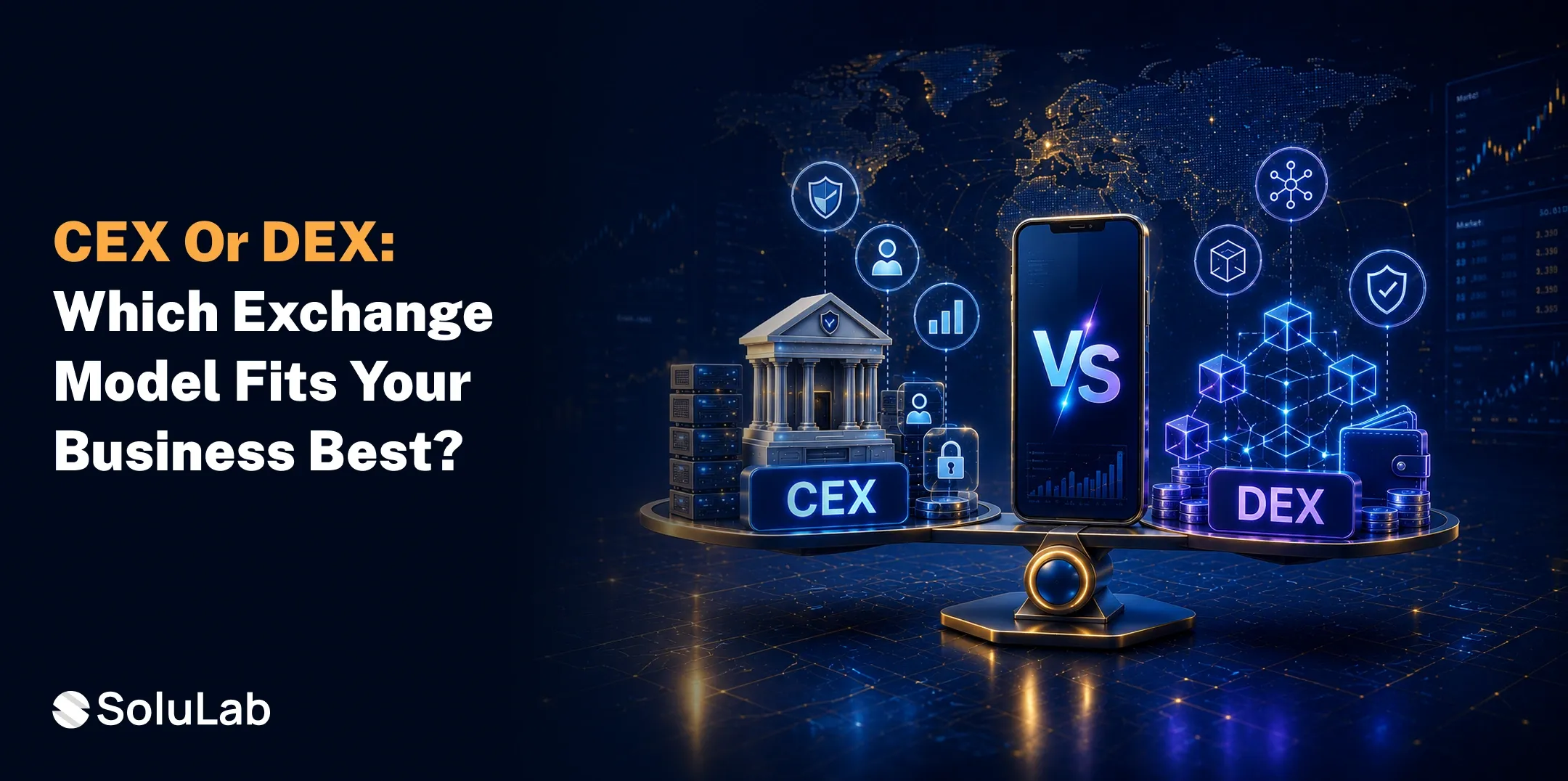
Millions of crypto trades settle on-chain every single day. That volume has pulled startups and mid-size firms into exchange building at a pace nobody predicted five years ago. But here is the part most founders skip: before you put money into crypto exchange development, you need a real answer on centralized vs decentralized crypto exchanges. Both work. Both have sharp edges. Which one fits comes down to your business model, the customers you actually want, and where you expect the company to be in five years.
This guide walks through that decision, and through the revenue each model opens up.
Key Takeaways
- A centralized crypto exchange gives you speed, deep liquidity, and custodial wallets you manage for the user.
- A decentralized crypto exchange is peer-to-peer. The user keeps the keys, and the user keeps the assets.
- Hybrid exchanges exist for teams who refuse to pick one side.
- SoluLab helps businesses pick and then build the right model, judged on scalability, compliance, who is trading, and where the roadmap goes.
Understanding Centralized And Decentralized Crypto Exchanges
Put the two side by side on a screen and they look almost identical. Under the hood, they share almost nothing.
Centralized Crypto Exchange Model
A centralized cryptocurrency exchange behaves like a brokerage. Users hold accounts, park digital assets with you, and trade through a matching engine built for speed. Because your platform sees every order, you get to set the security rules, satisfy regulators, wire in fiat payments, and keep operational control end to end. That control is the whole pitch.
How To Build A Centralized Crypto Exchange?
To build a centralized exchange, you need infrastructure that holds up under secure trading, regulator scrutiny, and volume spikes that arrive without warning.
- Business Planning and Requirement Analysis
Begin with the boring work. Who trades here, what do they expect, what does the business need to earn, and which regulations apply before a single line of code gets written.
- UI/UX Design
Design a trading screen people can read at a glance. Portfolio view, order placement, and a flow that never makes a trader hunt for the button.
- Trading Engine Development
Build the matching engine that pairs buy and sell orders in real time. Latency has to be tiny. Throughput has to be large. This is where most builds get expensive.
- Wallet Integration
Stand up multi-currency custodial wallets and put multi-signature authentication in front of them.
- Liquidity Integration
Wire the exchange into liquidity providers and market makers so trades fill and slippage stays small across every pair you list.
- Compliance and Payment Integration
Add KYC checks, AML monitoring, payment gateways, bank transfers, and fiat on-ramps. Regulators expect it, and honestly, so do your users.
- Security Implementation
Layer it: multi-factor authentication, end-to-end encryption, DDoS protection, withdrawal whitelisting, fraud detection, and monitoring that never sleeps.
- Testing and Deployment
Functional testing, load testing, penetration testing, security audits. Then you ship, and then the real work starts: maintenance and the feature queue.

Decentralized Crypto Exchange Model
A decentralized crypto exchange cuts the middleman out entirely. Nobody deposits anything. Users connect a wallet and trade through smart contracts on chain, and their assets stay theirs for the whole round trip. Trading becomes transparent and permissionless, with no gatekeeper approving who gets in.
How To Build a Decentralized Crypto Exchange?
The build looks nothing like the centralized one. Your budget goes to blockchain infrastructure, contract code, and a non-custodial trading experience that does not confuse people.
- Project Planning and Blockchain Selection
Set the objectives, pick the chain, then decide which token standards and governance model you will support.
- Smart Contract Development
Write and tune the smart contracts that handle token swaps, liquidity management, fee logic, and execution, all without a human in the loop.
- Wallet Integration
Connect cleanly to the wallets people already use. MetaMask, Trust Wallet, WalletConnect, Coinbase Wallet. Trade happens straight from the wallet, no account creation step.
- Liquidity Pool Development
Build the automated market maker logic and the pools behind it, with enough depth that swaps do not fall apart on a mid-size order.
- Cross-Chain Integration
Add multiple blockchain networks so assets can move between chains and traders are not boxed into one network.
- Smart Contract Security Audits
Review the code internally, then pay an outside firm to try to break it. Find the holes before launch, because after launch the code is public and permanent.
- Frontend Development
Keep the interface plain. Wallet connect, swap, add liquidity, vote. Four things, done well.
- Deployment and Continuous Upgrades
Deploy the contracts, watch network performance, push protocol upgrades, and keep adding features as the chains around you change.
Centralized vs. Decentralized Crypto Exchanges: A Quick Comparison
| Feature | Centralized Exchange (CEX) | Decentralized Exchange (DEX) |
| Ownership | Managed by a company | Operates through smart contracts |
| Asset Control | Exchange holds user assets | Users control their own wallets |
| Trading | Matching engine | Automated Market Maker (AMM) |
| KYC | Required | Usually optional |
| Liquidity | Order books and market makers | Liquidity pools |
| Fiat Support | Available | Limited |
| Transaction Speed | High | Depends on blockchain |
| Customer Support | Dedicated support | Community-driven |
| Governance | Centralized | Community or DAO |
| Best For | Enterprises and mainstream users | DeFi and Web3 communities |

Core Features Supported By Centralized and Decentralized Crypto Exchanges
Both models need the same handful of building blocks. What separates them is how each block gets implemented, and the gap is wider than most comparison charts admit.
Trading Infrastructure
- Centralized exchange: A matching engine pairs buy and sell orders on the spot, thousands per second, with latency low enough for high-frequency desks to bother showing up.
- Decentralized exchange: Smart contracts plus automated market makers. Traders swap against a pool instead of another trader, and no central authority sits in the middle. Everything is visible on chain, speed holds up, and congestion stays manageable.
Asset Custody
- Centralized exchanges hold funds in custodial wallets, which is what makes account recovery, password resets, and a real support desk possible.
- Decentralized exchanges go non-custodial. Nobody else touches the private keys. The user carries the security burden alone, and that cuts both ways.
Security
- Centralized exchange: Multi-factor authentication, encryption, withdrawal whitelisting, fraud detection, round-the-clock monitoring. The platform and the user balances both sit behind that wall.
- Decentralized exchange: Safety rests on smart contract development and on the audits that back it.
Liquidity
- Centralized exchanges: Liquidity gets pooled from institutional market makers, professional traders, and shared order books. Large orders clear without moving the price much.
- Decentralized exchanges: Liquidity comes from users who deposit into pools. Anyone can list, anyone can trade, and slippage can bite hard when the market turns violent.
Regulatory Compliance
- Centralized Exchange: KYC, AML, and transaction monitoring keep you on the right side of financial regulators. Users trust it more, and you can operate in more jurisdictions.
- Decentralized Exchange: Identity checks are minimal or absent. A wallet connection replaces the signup form. Teams can still experiment with compliance layers without giving up decentralization, and several are doing exactly that.
User Experience
- Centralized Exchanges: Friendlier for first-timers. Dashboards, mobile applications, a support team that answers, portfolio tracking, advanced charts, fiat payment options.
- Decentralized Exchange: Built for people who already know what they are doing. Newcomers hit a wall fast, usually over wallet management or an unexpected gas fee.
Revenue Opportunities
- Centralized Exchanges: Trading commissions, staking services, withdrawal fees, listing fees, premium tiers, API access. Several income lines, most of them recurring, which is why investors like this model.
- Decentralized Exchanges: Swap fees, a cut of pool activity, governance incentives, and decentralized finance services.
Which Exchange Model Is Better for Your Business?
There is no universal answer here, and anyone selling you one is selling you something. Your goals decide it. Once you know what each model is genuinely good at, the choice stops feeling like a coin flip.
Choose Centralized Crypto Exchange Development If…
Retail investors, enterprises, institutional desks. If those are your users, centralized is usually the right call. You keep control of operations, orders fill fast, liquidity runs deep, and somebody picks up the phone when a customer has a problem.
A centralized crypto exchange development company can put that foundation under you: secure, compliant, and built to survive the next few years of rule changes.
Choose Decentralized Exchange Development If…
Building for DeFi, or for users who already live on chain? A DEX gives you far more room to move. People trade straight from their wallets through smart contracts and never hand over custody of anything.
It suits projects centered on permissionless trading, DAO governance, token swaps, liquidity pools, and multi-chain access. Teams launching something new in Web3 tend to bring in a dedicated DEX development crew rather than learn contract security the hard way.
What is The Cost To build a crypto exchange platform?
Cost swings on a lot of variables. As a rough frame: a custom decentralized exchange lands somewhere between $40,000 and $180,000+, while custom centralized crypto exchange development starts around $50,000 and can push past $250,000.
Going hybrid? Budget $80,000 to $300,000+. The table below shows where the money actually goes:
| Cost Factor | Centralized Crypto Exchange (CEX) | Decentralized Crypto Exchange (DEX) |
| Core Development | High-performance matching engine, admin panel, backend infrastructure | Smart contract development, AMM architecture, blockchain integration |
| Wallet Infrastructure | Custodial wallets with hot and cold wallet management | Non-custodial wallet integration (MetaMask, WalletConnect, Trust Wallet) |
| Liquidity Management | Market makers, order books, and liquidity providers | Liquidity pools and Automated Market Makers (AMMs) |
| Security Requirements | Multi-factor authentication, encryption, DDoS protection, fraud detection | Smart contract audits, blockchain security, wallet protection |
| Compliance | KYC, AML, transaction monitoring, regulatory integrations | Limited compliance depending on jurisdiction, governance implementation |
| Payment Integration | Fiat gateways, bank transfers, debit and credit cards | Primarily crypto-based transactions with limited fiat support |
| Blockchain Integration | Multiple blockchain and wallet integrations | Multi-chain compatibility, cross-chain bridges, token standards |
| Infrastructure | Dedicated servers, cloud hosting, database management | Blockchain nodes, RPC infrastructure, decentralized hosting (optional) |
| Maintenance | Platform upgrades, compliance updates, security monitoring, customer support | Smart contract upgrades, protocol improvements, and blockchain compatibility updates |
| Overall Cost Driver | Infrastructure, compliance, liquidity, and enterprise operations | Smart contract complexity, blockchain ecosystem, and security audits |
Which Development Model Is More Cost-Effective?
Centralized builds tend to eat more budget up front, mostly on infrastructure. Decentralized builds shift that spend toward multichain integration, contract deployment, and liquidity mechanics.
Pick the one your five-year plan can live with.
Bridge the Gap Between CEX and DEX: Choose a Hybrid Crypto Exchange
Want both sets of features on one platform? That is what the hybrid model is for.
A hybrid crypto exchange borrows the speed and liquidity of a centralized platform and pairs it with the transparency and self-custody of a decentralized one. Traders move quickly, can pay in fiat, and still hold their own keys.
It reaches two crowds at once, the retail investor and the Web3 native, which is exactly why the model keeps gaining ground.
Key Features of a Hybrid Crypto Exchange
- Centralized execution speed with decentralized ownership of assets
- Supports both custodial and non-custodial wallet options
- Fiat payment rails sitting alongside crypto transactions
- Deep liquidity pulled from order books and pools together
- Faster fills, with more of the process visible to the trader
- KYC and AML built in without locking the platform down
- Cross-chain trading across several blockchain networks
- Enterprise-grade security running next to smart contract logic
- Appeals to traditional investors and DeFi users alike
- A base you can scale into whatever crypto trading looks like next
White Label vs. Custom Crypto Exchange Development: Which One Is Better?
Model settled? Then the next fork is how you build it.
- White Label Crypto Exchange Development suits teams that want to be live soon rather than perfect later. You get a working platform with the core trading features already in place, then adjust branding, the coin list, and the interface. Less time, less money up front, and a sensible way for a startup to find out whether the market wants what it is offering.
- Custom Crypto Exchange Development hands you the whole thing. Trading workflows, security architecture, user experience, integrations, all shaped around how your business actually runs. It takes longer. In exchange you get room to scale and something competitors cannot copy off the shelf.
What is the Future Of Crypto Exchange Development?
Smarter, faster, harder to attack. That is the direction the next wave of exchanges is heading, and here is what that means in practice:
- AI-powered crypto exchanges for catching fraud, automating operations, and tailoring the trading experience.
- Cross-chain interoperability so a trade can cross networks without a manual bridge hop.
- Zero Slippage Crypto Exchange Development for faster execution and better liquidity.
- Tokenized Real-World Assets opening up what people can actually invest in.
- Account abstraction and embedded wallets to make onboarding painless.
- Institutional-grade security and compliance to bring enterprises on board.

Final Words
The centralized vs. decentralized argument never really ends, because both sides are right about something. One side gives traders control of the experience and liquidity that holds up under size. The other gives them outright ownership of their assets.
If you want both, build hybrid. Centralized efficiency, decentralized mechanics, one platform.
Whatever you pick, pick it against your users and your roadmap, not against whichever model is loudest on crypto Twitter this quarter.
Partner With SoluLab For Custom Crypto Exchange Development!
SoluLab has been a Crypto Exchange Development Company for over a decade. 250+ developers, 150+ software solutions shipped, 500+ clients worldwide, and trading platforms built to match what the business is trying to do rather than a generic template.
Centralized builds, Decentralized Exchange Development, AI-powered platforms, hybrids. Every one ships with security designed in from day one, a compliance-ready framework, a fast deployment path, and 100% brand ownership that stays yours.
White Label Crypto Exchange or a platform built from nothing, either way SoluLab gets you to launch sooner and keeps the thing standing as you grow.
FAQs
Shipra Garg is a tech-focused content strategist and copywriter specializing in Web3, blockchain, and artificial intelligence. She has worked with startups and enterprise teams to craft high-conversion content that bridges deep tech with business impact. Her work translates complex innovations into clear, credible, and engaging narratives that drive growth and build trust in emerging tech markets.