Talk to an Expert

10 Ways Parallel AI Will Transform Business Operations in 2026

Main banner Parallel AI

What happens when AI stops working in a straight line and starts thinking in parallel?

In 2026, businesses won’t just use AI to automate tasks; they’ll run entire operations on parallel AI systems that process data, decisions, and workflows simultaneously. From faster decision-making and real-time optimization to autonomous operations, parallel AI is set to redefine how modern enterprises scale, compete, and innovate.

Companies that adopt parallel AI early will cut costs faster, react to market changes in real time, and operate at speeds humans simply can’t match. Those who don’t risk falling behind in an economy where milliseconds decide profits.

In this blog, we explore 10 powerful ways parallel AI will transform business operations in 2026 and why it’s quickly becoming a competitive necessity, not an upgrade.

Key Takeaways

  • Parallel AI will transform operations by allowing businesses to process data, make decisions, and execute actions simultaneously, boosting productivity by up to 40%.
  • By 2026, autonomous, self-optimizing workflows will dominate, with 87% of large enterprises adopting AI solutions and the global AI market reaching $638.23 billion, reducing costs by 15–30%.
  • Early adopters will gain a competitive edge by unlocking real-time insights and accelerating time-to-market.
  • AI agents will handle up to 50% of routine decisions, enabling smarter scaling across all business functions.
  • Combining speed, intelligence, and automation, Parallel AI ensures businesses are prepared to lead in 2026 and beyond.

What Is Parallel AI and Why It Matters in 2026?

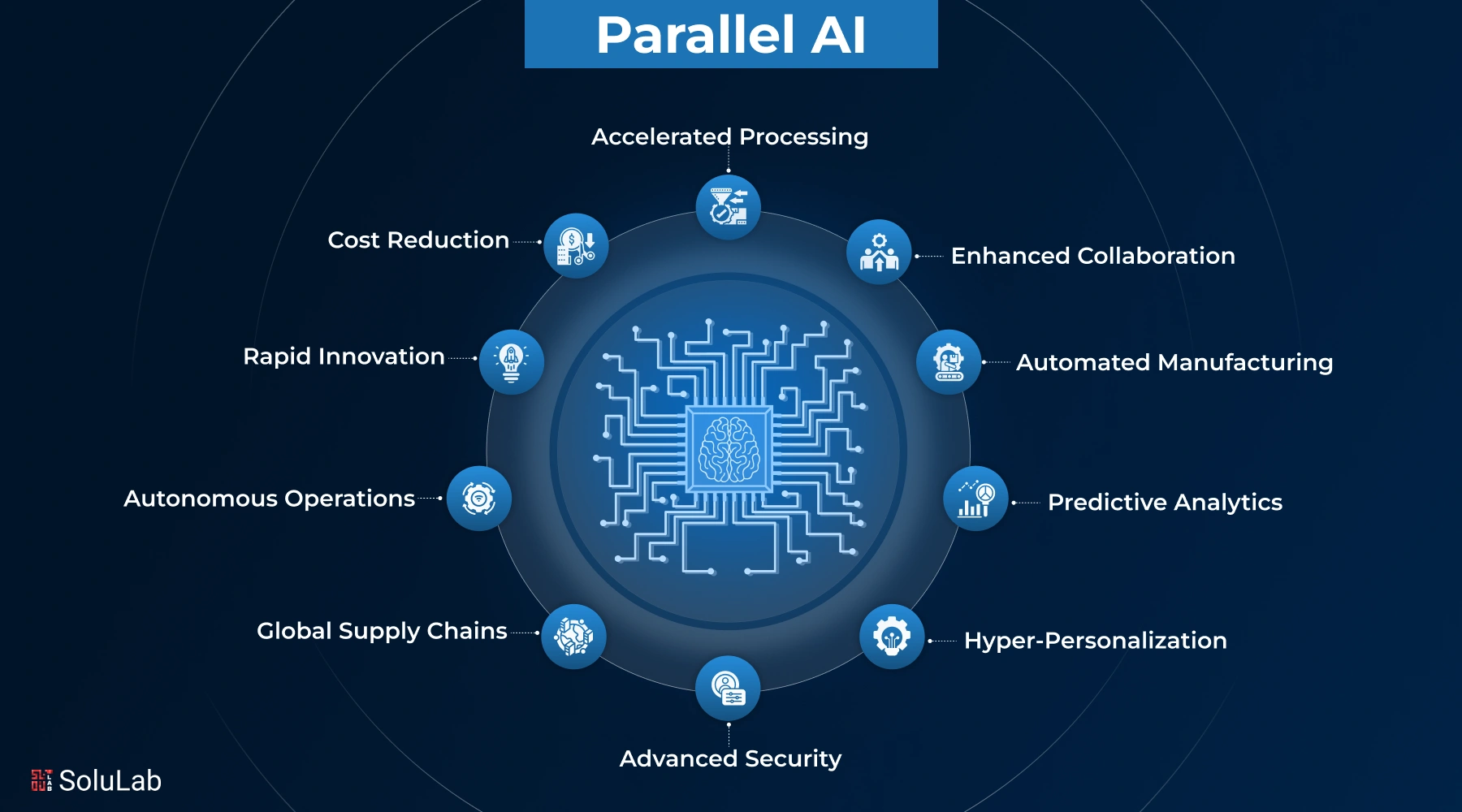
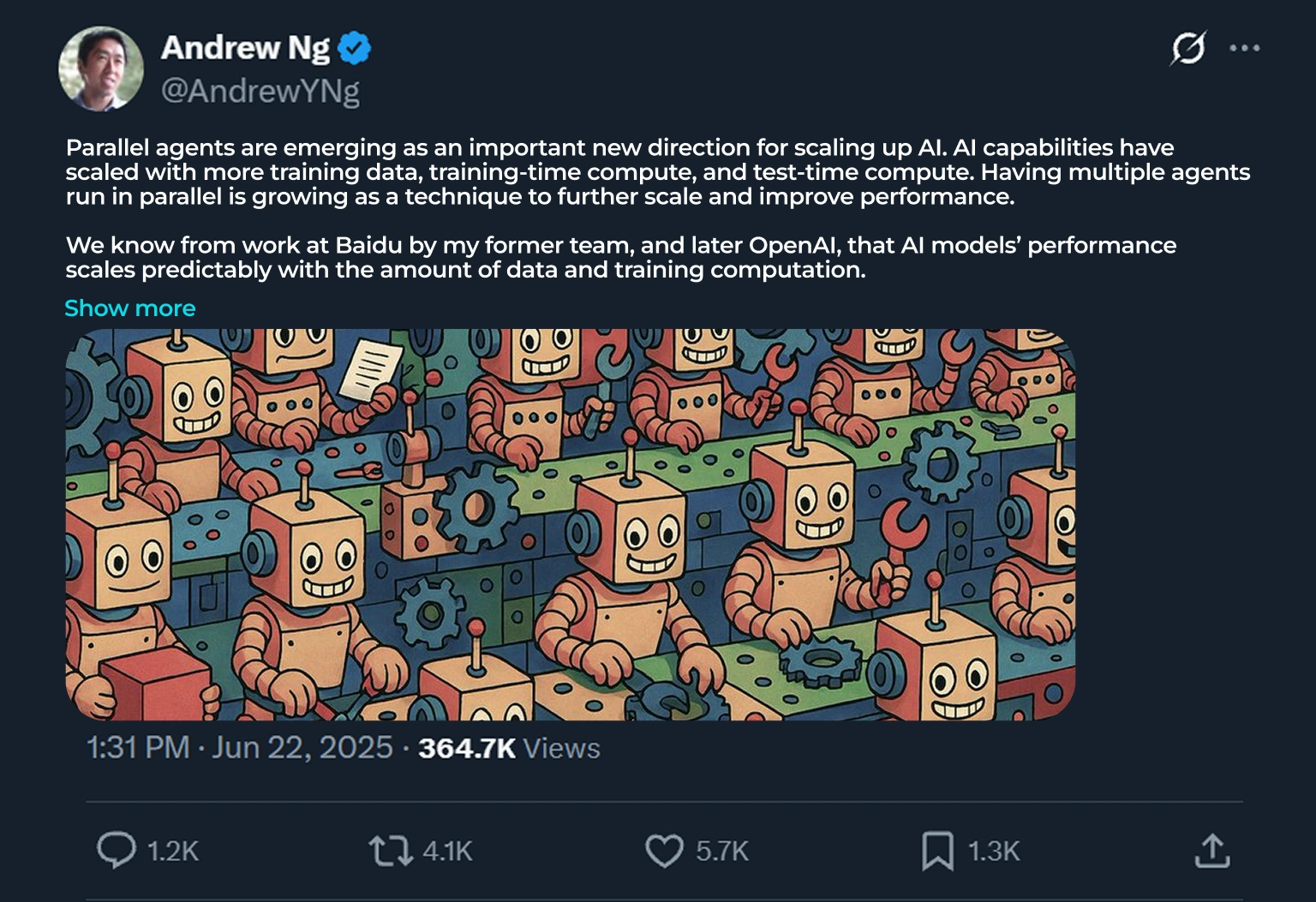
Parallel AI is a smarter way of using AI. Instead of a single model handling tasks one by one, it uses many AI agents working in parallel, like a full digital team that can research, analyze, and execute.

This matters because businesses get:

  • Real-time answers, cutting response times from minutes to seconds, with 92% of leaders now recording over half their interactions for AI insights.
  • Enables 10× faster automation on complex tasks like research and reporting.
  • Improves accuracy as agents cross-check each other’s work for more reliable results.
  • Increases output without hiring, parallel tools turn one agent-hour into team minutes, while the parallel computing market hits $50B in 2025 with 15% yearly growth.

This surge is real as the enterprise AI spending will reach $307B in 2025 and jump to $632B by 2028, with parallel AI driving most of the growth. Over 212,000 active AI companies growing 10% every year, are already adopting multi-agent systems to move faster and cut costs.

By 2026, Parallel AI will be a core business tool helping teams scale, save money, and outpace competitors. The only question now is how fast you adopt it.
x post (6)

Top 10 Ways Parallel AI Will Elevate Enterprise Performance in 2026

These 10 strategies show how businesses can achieve faster, smarter, and more scalable performance with AI working in parallel:

#1. Supercharges Your Operations

Speed is the biggest advantage a startup can have. If your business moves slowly, you lose customers, opportunities, and market share. This is where Parallel AI becomes a game-changer.

Instead of making one system handle everything one step at a time, Parallel AI uses many parallel AI agents working together at the same time. Each agent takes a part of the workflow, runs it instantly, and sends the result forward. This removes the long waits that usually slow teams down.

Modern AI-powered software platform setups make this even stronger by running tasks in parallel across engineering, operations, support, and data teams. Nothing waits. Everything flows. Here’s what that means for your business:

  • Faster product releases
  • Faster decisions
  • Faster customer delivery
  • Faster internal execution

Parallel AI removes delays, cuts manual effort, and makes every part of your company move together like a high-speed engine. When everything runs in parallel, speed becomes your normal operating mode, not a special achievement.

#2. Say Goodbye to Repetitive Tasks 

Many teams still waste hours doing the same tasks again and again. Parallel AI removes this problem completely.

Instead of depending on one automation bot or script, you use a multi-AI agent system, where several AI agents work at the same time. Each agent handles a specific step of the process, so the whole workflow becomes faster, cleaner, and far more reliable. This makes AI automation solutions much stronger and reduces manual work across your operations.

Parallel AI can automate tasks like:

  • Document processing (OCR, data extraction, validation)
  • Lead qualification and scoring
  • Large-scale data cleaning and error checks
  • Complex, multi-step onboarding flows
  • Accounting tasks like financial reconciliation

With the help of strong parallel AI development services, businesses can now automate work that once required full teams and do it with higher accuracy, lower cost, and real-time scalability. This is why more businesses are shifting to Parallel AI: it’s simple, efficient, and gives them a clear operational edge.

#3. Real-Time Decisions Made Simple with Parallel AI

Today, every business runs on data. But the real challenge is getting that data fast, clean, and accurate, not minutes or hours later, but right now.

This is where Parallel AI becomes powerful. Parallel AI can process hundreds or even thousands of data streams at the same time. Instead of waiting for one system to finish before another one starts, multiple AI agents work together in parallel. This gives businesses real-time results with almost zero delay.

This helps teams make quick, smart choices in areas like:

  • Live dashboards that update every second
  • Fraud detection that spots unusual activity instantly
  • Operational monitoring to track system health
  • High-frequency financial decisions
  • Customer behavior tracking and predictions

For companies working in blockchain technology, this becomes even more important. With Parallel AI in crypto platforms, businesses get lightning-fast analysis of market movements, wallet activity, and transaction flows, something normal AI systems cannot handle at scale.

#4. Scaling Your Team with AI Agents

This is one of the biggest reasons companies are shifting to Parallel AI. As your business grows, your work gets more complicated. With Parallel AI, you don’t need to hire more people or rebuild your whole system. The platform simply spins up more agents on its own. These agents work in parallel, handle different tasks at the same time, and keep your operations running smoothly even during peak load or sudden traffic spikes.

This is why many companies now ask for parallel AI development solutions. They want systems that scale the moment their workload increases, without extra cost or delays. For example, if you have 10 tasks coming in at once, the system can launch 10 agents instantly. This allows:

  • Higher throughput
  • Faster execution
  • Better uptime
  • Zero manual scaling

In simple words, Scalability means you do more work at the same cost and with better performance. For businesses trying to automate workflows, run real-time operations, or manage heavy data loads, this level of scalability is a competitive advantage.
Parallel AI cta 1 (1)

#5. Transforms Customer Experience

Customer expectations are higher than ever, and speed is no longer optional. AI transforms customer experience by replacing single-threaded chatbots with a multi-AI agent support system that works like a full-scale support team without downtime or fatigue.

With Parallel AI, support becomes:

  • Multi-threaded, meaning many questions can be answered at the same time
  • Faster because queries get routed instantly
  • More accurate with auto-troubleshooting
  • More consistent with auto-generated follow-ups
  • More personal because each user gets a custom response

Most companies are now replacing old chatbots with a multi-AI agent system that can manage thousands of customer messages in parallel. This setup doesn’t slow down, doesn’t make mistakes from fatigue, and can scale as fast as your business grows.

This is why many brands plan to invest in AI integration services for AI systems to help them build support workflows that run 24/7, handle huge spikes in tickets, and offer a smooth, human-like experience but powered entirely by parallel, coordinated AI agents.

#6. Product Development & Innovation
Product Development & Innovation with Parallel AI

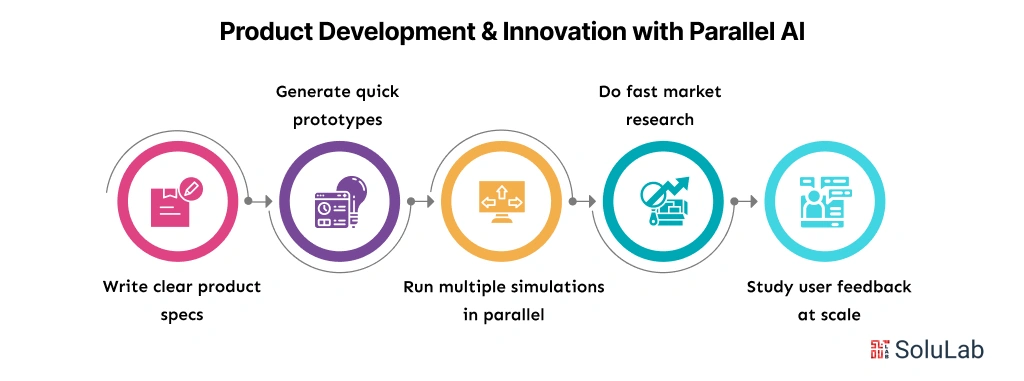
Parallel AI is becoming a powerful tool for product teams because it helps them build faster and make better decisions without wasting time. Instead of doing tasks one by one, Parallel AI lets multiple AI agents work together at the same time. With this, teams can:

  • Write clear product specs
  • Generate quick prototypes
  • Run multiple simulations in parallel
  • Do fast market research
  • Study user feedback at scale

This makes the whole product cycle smoother and more predictable. Because of this, many companies now choose parallel AI development services to build smarter product systems that can plan, design, and test automatically. 

They also use this to connect different tools and data sources, making the workflow even faster. And with generative AI integration services, businesses can plug these AI agents directly into their existing apps, dashboards, or backend systems.

#7. Boosts Efficiency and Cuts Costs

This is one of the areas where business leaders notice real impact. Parallel AI development solutions can transform how companies operate, delivering significant cost savings and efficiency improvements. Here’s how:

  • Reducing manpower
  • Cutting workflow inefficiencies
  • Lowering operational errors
  • Scaling with fewer resources

Companies leveraging these AI deployment services report savings of 40% in operational expenses, faster project completion, and higher overall productivity. 

#8. Reducing Business Risks

Parallel AI is designed with built-in redundancy, meaning that if one AI agent fails, others seamlessly continue working. This architecture reduces:

  • Downtime for critical operations
  • System errors caused by single points of failure
  • Financial risks tied to operational interruptions
  • Operational uncertainty that slows decision-making

By distributing tasks across a multi-AI agent system, businesses can maintain continuous operations even under stress. This level of reliability is one reason why more companies are investing in AI consulting services to strengthen their tech infrastructure.

#9. Enhances Cross-Team Collaboration & Internal Alignment

Parallel AI development solutions allow teams across marketing, product, and operations to work together in real time. By connecting multiple AI agents into a multi AI agent system, businesses can:

  • Synchronize tasks automatically between teams without manual handoffs
  • Reduce miscommunication errors that slow project timelines
  • Provide a single source of truth for data, insights, and action items
  • Enable faster feedback loops between departments, improving project velocity

With AI automation solutions handling routine coordination, human teams can focus on strategy and decision-making. This seamless collaboration drives efficiency and ensures that everyone in the organization operates with the same information. 

#10. Predict Problems Before They Happen

Most businesses react after something breaks, like a system slows down, a customer drops off, or a process gets stuck. But in 2026, companies using Parallel AI won’t wait for problems. Their systems will predict them.

Parallel AI uses multiple AI agents working in parallel to monitor behavior, track patterns, and detect early warning signals across your entire business. Instead of waiting for an issue, these agents spot the problem before it becomes costly.

With Parallel AI, enterprises can predict:

  • Customer churn before it happens
  • System failures before downtime
  • Cash flow issues before they hit
  • Supply chain delays before they become expensive
  • Market drops before losses occur

This gives your business a major advantage that you fix things before they break. This is why so many enterprises now invest in predictive AI integration services. They want systems that not only optimize today but help them prepare for tomorrow. 
x post (5)

How Parallel AI Will Shape Tomorrow’s Startups?

Over the next 3–5 years, Parallel AI is going to move from experimental pilots to the unseen engine behind most high‑performing teams and products. 

By 2028, analyst forecasts suggest that a large share of enterprise AI software will quietly bake in agentic and multi‑agent capabilities, meaning parallel AI agents will be orchestrating everything from workflows to customer journeys in the background.​

As multimodal models (text, images, audio, video) become the default interface, parallel agents will not just process language but also read screens, interpret dashboards, and act across tools in real time. 

For startups and mid‑size businesses, this unlocks new playbooks: 24/7 autonomous research teams, multi‑channel growth systems, and internal “digital operators” that execute complex processes end‑to‑end, not just answer questions.​

AI Agent Development Company

Conclusion

Parallel AI is transforming how modern businesses operate. Instead of relying on a single model to do everything, companies now use many specialized AI agents that act like a high-performing team, but with machine-level speed and near-zero delays. This shift unlocks faster decisions, smoother workflows, and real-time scalability that traditional systems simply cannot match.

As this evolution accelerates, the gap between AI-native enterprises and everyone else will grow quickly. This is where SoluLab stands out as a leading AI development company. We design and deploy advanced Parallel AI platforms that deliver up to 60% faster execution, dramatically lower operational costs, and continuous innovation powered by multi-agent intelligence. With 2026 set to be the breakout year for Parallel AI, the companies that act now will define the next wave of industry leaders. 

FAQ

1. Is Parallel AI only for big enterprises, or can startups use it too?

Parallel AI is actually more of a game‑changer for startups than anyone else. Instead of hiring large teams for research, operations, marketing, or support, early‑stage founders can spin up parallel AI agents that act like a flexible, always‑on operations layer. 

2. How is Parallel AI different from just using ChatGPT or a single LLM?

Using a single LLM is like having one very smart AI assistant who can only work on one thing at a time. Parallel AI is closer to having a coordinated squad of specialists; each agent has a role, context, and tools, and they run simultaneously to complete multi‑step workflows. 

3. What kind of processes benefit the most from parallel AI agents?

Anything multi‑step, repeatable, and cross‑functional is a perfect fit: lead research and enrichment, multi‑channel outbound, customer onboarding, internal documentation, reporting, vendor or market scouting, and even product experimentation. 

4. How should a business start with Parallel AI without overcomplicating things?

Start with one or two high‑value workflows that: happen often, are boring for humans, and have clear success criteria. Wrap those in a small system of 2–5 agents, like one to plan, others to execute subtasks, and one to validate or summarize. 

5. What skills or team setup do I need to implement Parallel AI?

You don’t need a full research lab, but you do need someone who understands both your processes and how to orchestrate tools. In many teams, this is a product‑minded engineer, a technical founder, or an operations lead who can think in systems. 

6. Will Parallel AI replace my team, or just augment it?

In the near term, Parallel AI is far better at augmenting than outright replacing. It excels at grinding through repetitive, structured, or research‑heavy work, which frees humans to focus on strategy, creativity, and relationship‑driven tasks. 
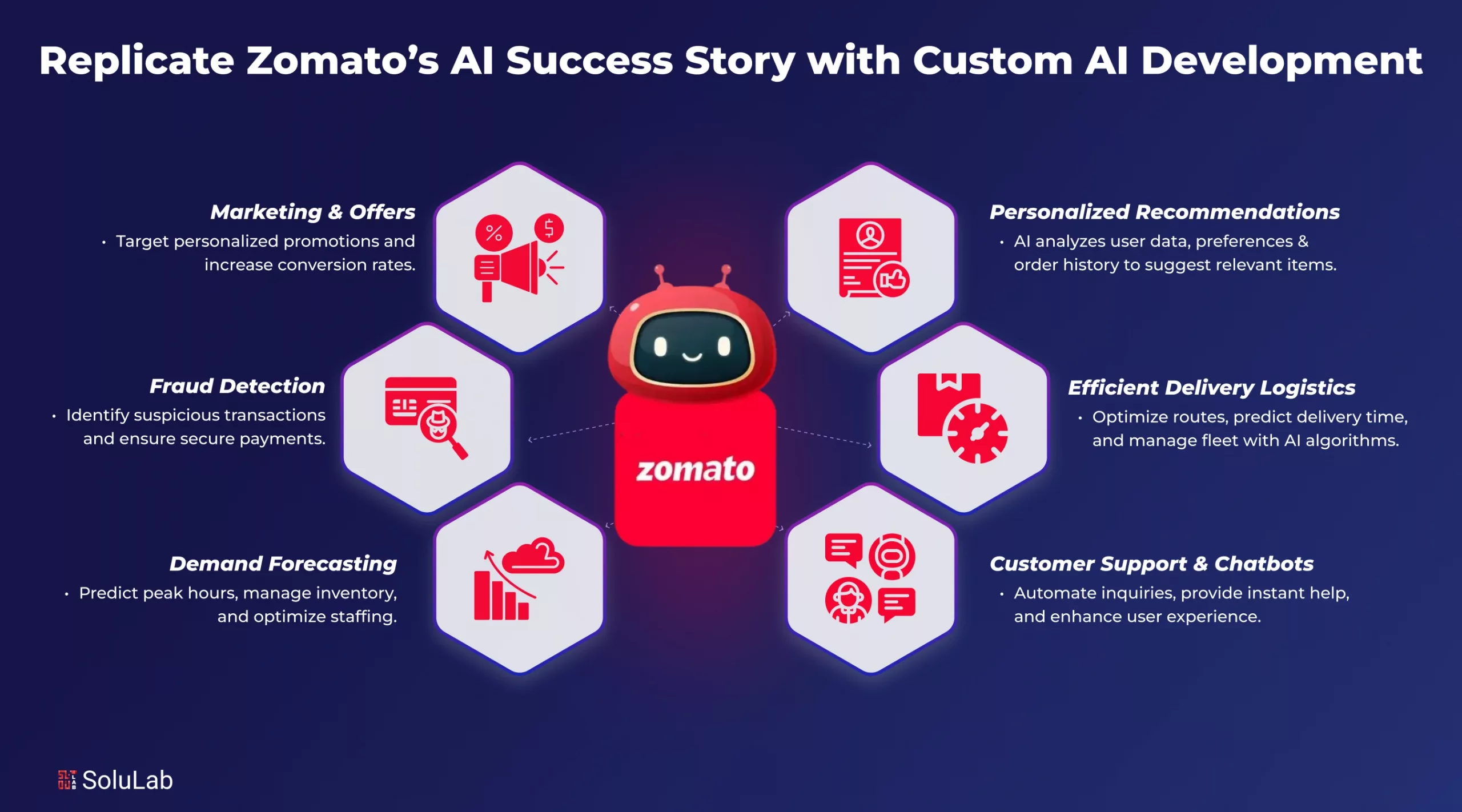
How Can Businesses Replicate Zomato’s AI Success Story with Custom AI Development?

Replicate Zomato’s AI Success Story with Custom AI Development

Today’s, customers want fast, healthy, and personalized food choices. That’s why many restaurants now use AI tools like AI food analysis and AI nutrition recommendation systems to create smarter menus and improve user experience.

The AI in the food and beverage industry is worth over $15 billion in 2025 and is expected to reach $263 billion by 2034. Brands using AI-powered food delivery apps already see up to 40% higher revenue and stronger customer loyalty.

Even major players like Zomato are using intelligent systems to improve food recommendations, delivery accuracy, and user satisfaction. For companies that want to scale, save time, and serve better, investing in AI in food business tools is no longer optional; it’s the next big growth step that you should consider seriously.

What Is an AI-Powered Recommendation System in Food Apps?

An AI-powered recommendation system in food apps uses artificial intelligence to study food data and help users make better choices. It doesn’t just guess what’s healthy. It looks at real details like ingredients, cooking methods, calories, and nutrients through food analysis.

In simple terms, this system rates or recommends food based on its quality and nutritional value. Think of it as a smart guide that reads the label, checks what’s inside, and tells your customers if it’s a good choice.

For example, your app could show a Smart Choice badge when the AI nutrition recommendation system finds high-fiber, protein-rich, and low-fat ingredients, or it could highlight Limit Intake when it detects deep-fried or high-sugar dishes. The user doesn’t see the technical part; they just see clear and data-backed advice. 

That’s what builds trust and keeps them returning. From a business perspective, these systems don’t just improve user experience; they boost conversions and brand credibility. When users trust your food app’s insights, they’re more likely to order again, recommend it to others, and stay loyal.

But developing this kind of custom AI solution requires:

  • Clean data pipelines to collect ingredient and nutrition data
  • AI algorithms that turn food details into useful insights
  • A simple, intuitive interface that displays results clearly

And, this is where AI companies truly create an impact. It’s not only about automation, it’s about giving customers confidence and helping your platform stand out in a crowded market.

How AI Food Analysis Improves Customer Ratings and Reviews?

In today’s food industry, customers don’t just want a tasty meal, but also trust. They care about what’s in their food, how it’s rated, and whether your food delivery app or platform truly understands their preferences. 

That’s where AI food analysis makes all the difference. When your business uses it, you’re showing customers that transparency and health matter. Here’s how this creates measurable business impact:

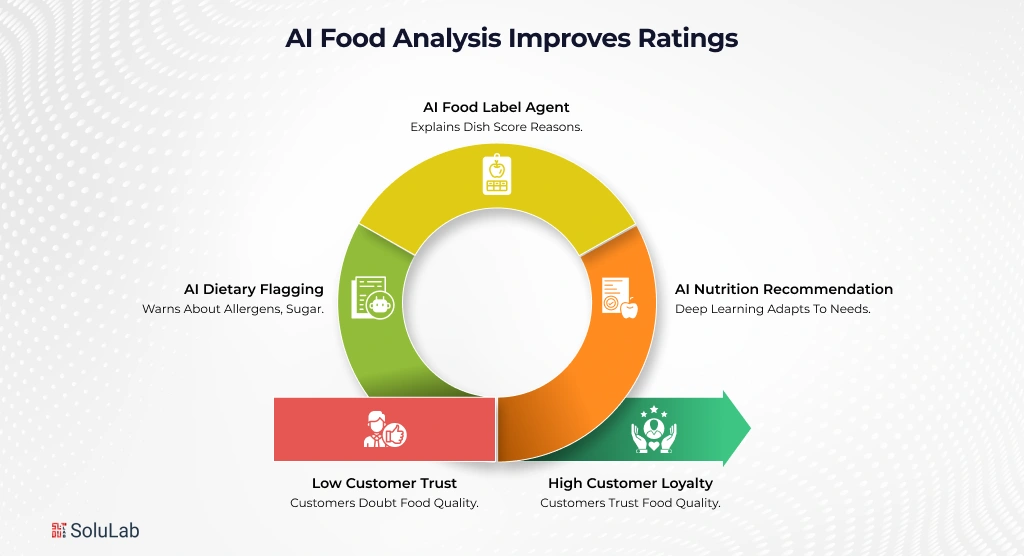
AI Food Analysis Improves Ratings

1. Builds stronger trust and loyalty

People return to platforms that feel honest. When your rating system is powered by AI nutrition recommendation using a deep generative model, users see that your app learns and adapts to their needs instead of showing random ratings. This drives retention and repeat orders, with a direct boost to revenue.

2. Generates better reviews and organic growth

A smart AI food label agent helps customers understand why a dish scored high or low. When users realize that your delivery app is actually analyzing real nutritional data, they start talking about it, and that creates powerful, authentic word-of-mouth marketing.

3. Reduces complaints and friction

With AI application, your system can flag dishes that might not fit a user’s dietary needs. Just imagine that your food delivery app warns users about high sugar or allergens before they even order, you avoid refunds, and improve customer satisfaction.

With these, every rating, reorder, or skip helps your AI food analysis system get smarter. For example, if Dish #457 receives a low health score and zero reorders, the model learns to adjust its predictions. Over time, this creates a self-improving recommendation engine that gives your platform a serious competitive edge.

For food tech businesses, this is a trust-building system powered by artificial intelligence. By adding AI in food business, like food analysis, nutrition recommendation systems, and AI-powered food label scanners, you not only enhance user experience but also position your brand as transparent, data-driven, and customer-first.

Key Features to Add While Building an AI Nutrition Recommendation System

Building an AI-powered food delivery app isn’t just about using the latest tech; it’s about creating something people can trust, understand, and rely on. From a business standpoint, these features directly impact adoption, engagement, and brand reputation. Below are the must-have elements that make your AI in customer service solutions stand out and perform at scale.

1. Transparent Scoring Logic

Trust begins with clarity, and your app should explain why a dish received a certain rating. Just by integrating an AI-powered food label scanner, you can break down ingredients and highlight details like High Sugar, Low Fiber, or Grilled vs. Fried. This gives users visibility into how their food is evaluated and reinforces credibility.

2. Dynamic Feedback Loop

Your AI system shouldn’t work in isolation but it should learn directly from real user behavior by allowing customers to rate, review, or even challenge recommendations. Their feedback should feed into a continuous learning pipeline that retrains your AI nutrition recommendation system in real time. This ongoing cycle keeps your platform evolving, understanding preferences, improving suggestions, and delivering more relevant nutrition guidance over time. 

3. Vendor Integration & Data Quality

AI is only as good as the data behind it, but to ensure accuracy, connect your AI food label agent to verified data sources. You should partner with restaurants, vendors, and kitchens to maintain up-to-date ingredient details and nutrition profiles. Reliable data eliminates guesswork and ensures your AI product gives results that users can trust.

4. Contextual Personalization

Nutrition isn’t one-size-fits-all, and that’s why your system should understand each user’s unique profile, their allergies, diet preferences, fitness goals, and order history. By using insights, your model can tailor suggestions to fit every lifestyle. Hire AI developer for personalization that transforms your app from a generic food tracker into a true digital nutrition advisor. When users feel the system gets them, retention and trust follow naturally.

5. Scalable Architecture

As your user base grows, so will data, requests, and recommendations. Your smart food delivery app must be ready for that. Build your recommendation engine on a microservices architecture so it’s flexible, efficient, and easy to update. A scalable setup keeps your food delivery app fast and reliable, even with thousands of users engaging at once, ensuring seamless performance during peak times.

6. Compliance and Transparency

The food and wellness sectors demand strict regulatory compliance, so your platform must track how every decision is made, ensure traceability, and meet food labeling standards. Avoid black box AI models that hide logic from users or regulators, as being open about how your AI works strengthens your reputation and meets legal requirements, essential for long-term growth in the AI in food industry.

Many agencies over-prioritize model accuracy and ignore user experience. But the truth is, even the smartest algorithm fails if users can’t trust or understand it. The real power of AI in the food business lies in combining intelligence with simplicity, creating systems that inform, engage, and inspire confidence.

How Zomato Used AI-Powered Rating Systems in Their App?

X Post (1)

A good example of how AI is applied in the food industry in real life is Zomato’s Healthy Mode. This feature uses an AI-powered rating system to score each dish from Low to Super based on detailed nutrition data. It’s a perfect example of how Zomato AI changed the way people view food choices online.

Zomato collected data from ingredients, cooking methods, and restaurant partners, then it used it in AI food analysis to understand nutrition value and freshness. This information powered their recommendation system, helping users pick better meals without needing to read long food labels.

They also used a food label scanner inside the app to show users why a dish was rated healthy. It didn’t just say good for you, it explained why. That’s the kind of smart feature that builds trust and keeps users coming back.

For restaurant partners, Zomato created dashboards that used AI agents to align menus with the same scoring logic. It helped vendors adjust their recipes and highlight healthier dishes directly on the app.

The biggest takeaway for any business in the food business space is Don’t try to launch everything at once. Zomato started small, city by city, testing and improving their model before scaling.

This approach can work for your brand, too. Whether you run a delivery app, a nutrition startup, or a food-tech platform, we can personalize choices, increase engagement, and create a competitive edge.

How to Implement Custom AI in Your Business?

Building an AI app in the food industry starts with a clear and structured roadmap. Whether you’re creating a delivery app that adapts in real-time, the core goal remains to empower users with intelligent choices while improving business efficiency and scalability.

Below is a practical breakdown of how businesses can move from concept to full-scale AI implementation.

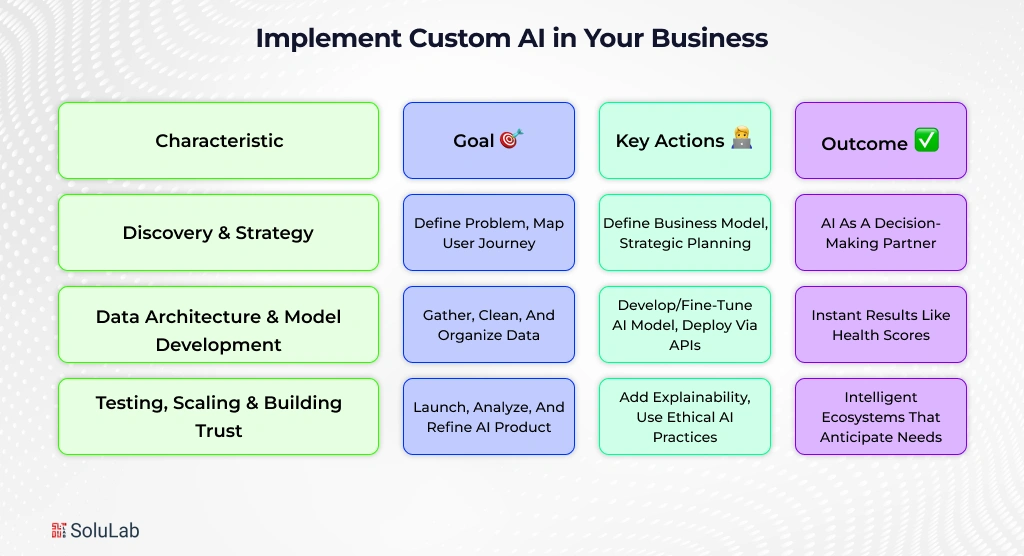
Implement Custom AI in Your Business

1. Discovery & Strategy

Start by clearly defining your problem statement. For example, how can we help users identify the healthiest food options within 5 seconds and Once you have your vision, map out your complete user journey, like app screens, restaurant dashboards, vendor data flows, and feedback loops with an AI consulting company.

At this stage, define your business model, like subscription-based, freemium, or AI integration for food label agent as an add-on feature. The goal is to design the product around real user needs, not just algorithms, as strategic planning here ensures your AI becomes a decision-making partner, not just a background tool.

2. Data Architecture & Model Development

Data is the backbone of your AI product. So, gather structured and unstructured data like ingredient lists, preparation methods, delivery patterns, and customer preferences. Then, clean and organize it into scalable data lakes that support AI food analysis models. 

Next, develop or fine-tune your AI model, training it on real-world data to deliver accurate nutritional insights. To enhance accuracy further, apply AI nutrition recommendations using a deep generative model, which fills gaps in missing or incomplete datasets by learning from similar entries.

Once your model is trained, deploy it via APIs that provide instant results like Health Scores, Nutrient Breakdown, or Smart Suggestions. This turns your product into a self-learning, adaptive intelligence engine.

3. Testing, Scaling & Building Trust

Now launch your AI product in controlled regions or select vendor clusters first. Analyze how users interact with your recommendation engine, like what they tap, skip, or re-order. This feedback loop helps refine your model continuously.

As you scale, add layers of explainability that let users see why a dish scored high or low. For example, show ingredient-level logic from your AI-powered food label scanner to build credibility. And use ethical AI practices such as transparent scoring and bias checks that aren’t optional.

By following this framework, your food delivery apps evolve from simple transactional systems to intelligent ecosystems that anticipate user needs, personalize experiences, and drive consistent business growth.

AI Development Services (2)

Conclusion

If there’s one takeaway from Zomato’s Healthy Mode, is that AI is a growth engine. Businesses that use AI in food industry operations are seeing higher customer trust, faster decision-making, and stronger brand loyalty. By integrating transparent AI systems like an AI nutrition recommendation system, companies can make their apps not only smarter but also more human, helping users make better choices while improving engagement and retention.

The future of food and wellness is moving toward intelligence-led personalization. Whether you run a smart food delivery app or a large retail chain, AI in the food business can help you create more value for customers and new revenue streams for your company. 

So, if you want to be the next success story like Nugget Zomato AI, now is the time to act. Let SoluLab, a leading AI development company, build the AI foundation your business needs to lead the future of the AI-powered food delivery apps revolution.

FAQs

1. What makes an AI-powered food label scanner different from a normal diet app? 

A typical diet app only shows calories or basic nutrition data. But an AI-powered food label scanner uses smart AI food analysis to go deeper; it studies ingredients, cooking style, and portion size to give more accurate and personalized insights. It doesn’t just scan, it learns and gets smarter with every user interaction, making it more valuable for both users and businesses.

2. Can small or mid-sized businesses afford an AI nutrition recommendation system?

Absolutely. You don’t need millions to start, but to begin with a small MVP focused on one key feature, like personalized meal scoring or label scanning. With open-source tools and quality data, you can build a scalable AI nutrition recommendation system that grows over time. This approach reduces cost, shows early results, and builds investor and customer confidence.

3. How can we make our AI food business more transparent and trustworthy?

Transparency with your customer builds trust. By integrating an AI food label agent, your system can explain why a food item is rated a certain way, like low sugar, grilled, or high in protein. When users understand the reason behind a rating, they trust the system more, which strengthens your brand reputation.

4. Is this technology only useful for food delivery apps?

Not at all. The same technology applies across the food and beverage industry, from wellness apps and retail stores to restaurants and meal-kit brands. Any business that deals with food data can use AI to make better recommendations, improve user experience, and drive more engagement.

5. What’s the first step to start using AI in our food delivery app?

Start with your data. Collect consistent and clean data from suppliers, menus, and customer feedback. Build a simple scoring model using that data, test it with real users, and keep improving. That’s the foundation for any serious AI in a food delivery app, and it’s how businesses turn simple apps into smart, revenue-generating platforms.

How Governments Are Using AI to Deliver Smarter Public Services?

AI in Public Service

Ever waited weeks for a government service that could have been done in minutes?

AI is changing that!

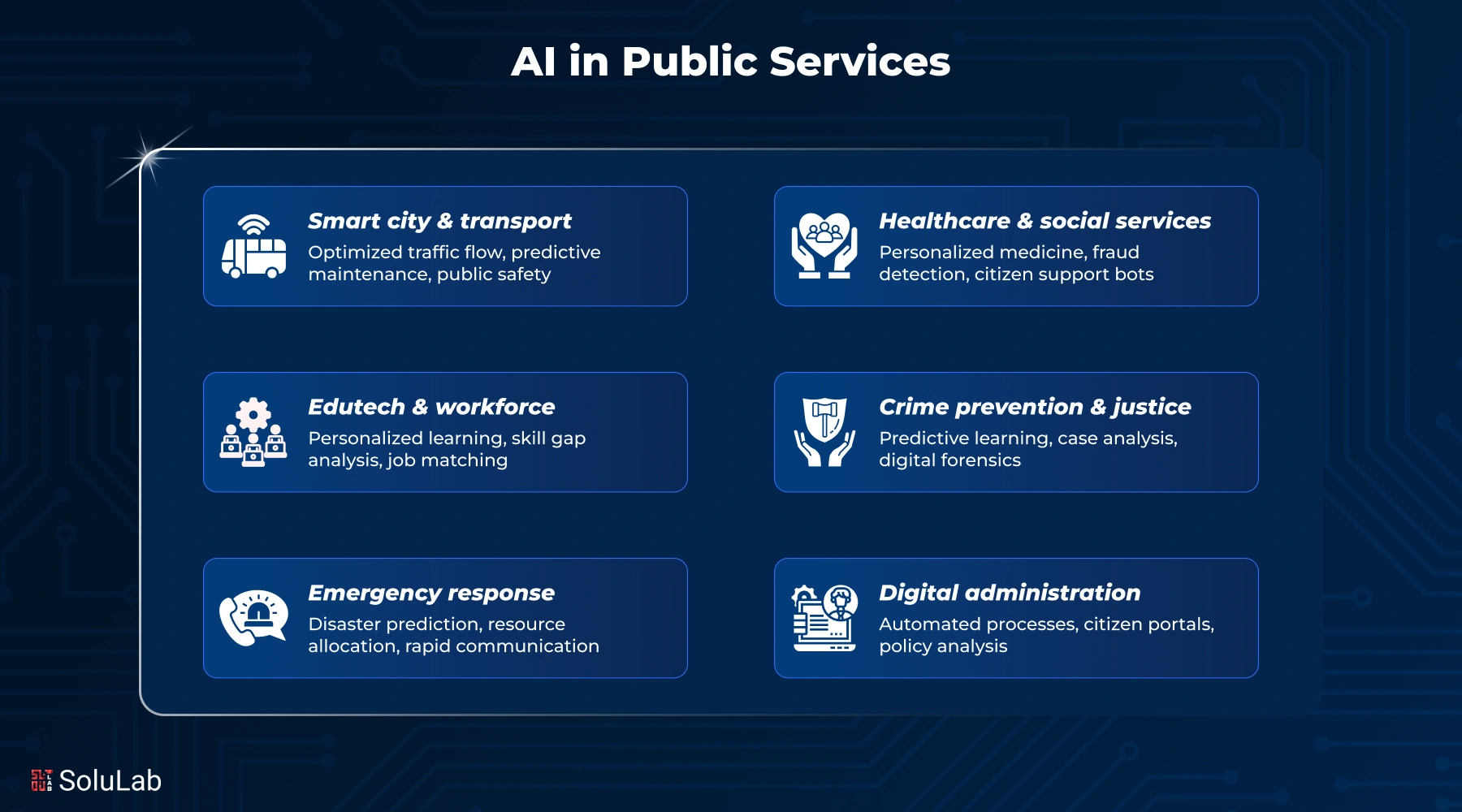
Governments around the world are now using Artificial Intelligence to deliver faster, smarter, and more personalized public services. AI is helping public institutions work efficiently while improving transparency and satisfaction. 

In 2025, the United Nations reported that over 60% of governments were adopting AI in various sectors, including healthcare, public safety, and taxation. The recent AI-related breakthroughs mark the beginning of a new industrial revolution. Therefore, governments are also focusing on sustainable AI adoption in the public sector. Let’s get into the details on AI in governance and public services!

Why Do Government and Public Services Need AI Solutions?

Governments handle large volumes of data and complex processes daily. Manual systems often slow service delivery and increase costs. AI in public sector services addresses these challenges by automating tasks, detecting fraud, and improving decision-making. It ensures transparency and reduces errors while enabling faster citizen support. The need for advanced AI solutions grows as populations demand efficiency and accountability from their leaders.

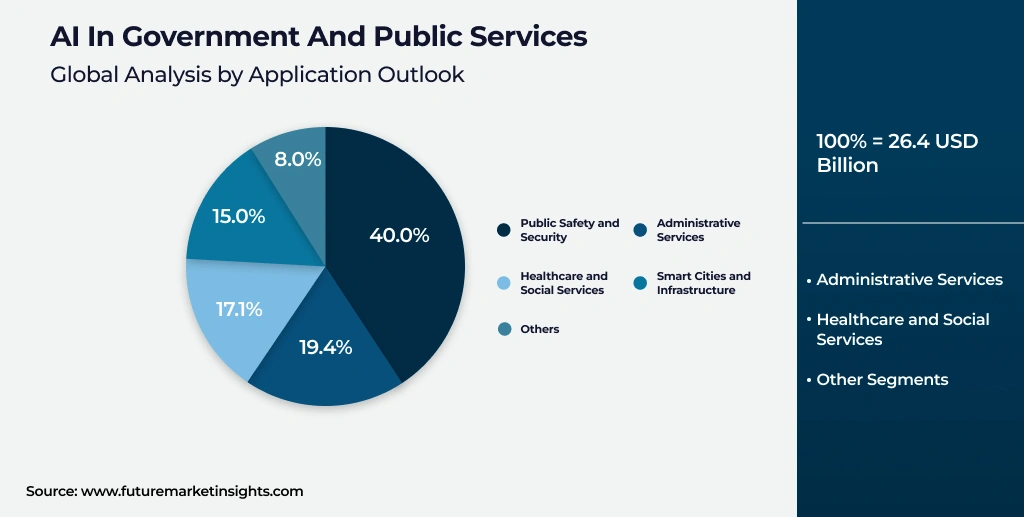
AI In Government And Public Services graph

Role of AI in Public Services

AI in public services often works silently in the background. Tax authorities use digital integration services for fraud detection and compliance checks. Municipalities rely on modern tools in local government to manage traffic flow with smart sensors. 

Public health agencies use predictive analytics to track outbreaks. Many citizens interact with such systems daily without realizing it.

Types of AI Used in Public Services To Serve People

Different AI models and solutions support governance, each serving a unique role in improving services. Some important ones are:

  • Machine Learning Models

Governments deploy Machine Learning models to study tax filings, detect unusual financial patterns, and identify possible fraud cases early. This AI-powered solution strengthens revenue systems, reduces tax evasion, and promotes fairness in financial governance.

  • Natural Language Processing

Natural Language Processing powers intelligent AI chatbots that respond to citizen queries, register complaints, and guide people on healthcare, pensions, or welfare benefits. These tools ensure faster resolutions, reduce waiting times, and create more inclusive citizen service experiences.

  • Computer Vision

Public safety departments leverage computer vision for facial recognition and video analytics to monitor crowded areas. This AI technology helps authorities prevent crime, manage emergencies, and improve urban safety without relying solely on traditional manual surveillance.

  • Robotic Process Automation

RPA automates routine tasks such as license renewals, application reviews, or form processing. By eliminating repetitive work, government staff can focus on policy-making and strategic initiatives. Along with direct citizen engagement, leading to faster and more efficient services.

  • Generative Tools in Public Service

Generative AI platforms assist officials by drafting policy notes, reports, or communication documents. This reduces manual paperwork, supports knowledge-sharing across departments, and gives officers more time to focus on decision-making and citizen-centric projects.

Each use case in government demonstrates how technology streamlines services and supports citizens.

Benefits of AI in Government and Public Sector

AI in government and public sector operations provides multiple benefits. It improves accuracy, reduces administrative costs, and enables faster decision-making. It also strengthens transparency and enhances citizen trust in governance.

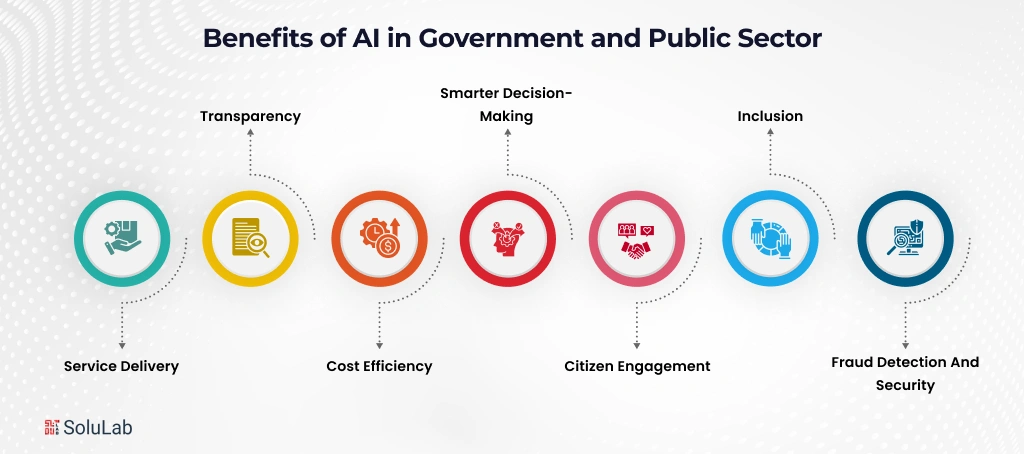
Benefits of AI in Government and Public Sector

1. Service Delivery: AI chatbots reduce waiting time and improve efficiency. AI solutions streamline delivery for large citizen volumes.

2. Transparency: Open data portals reduce corruption in governance. Real-time information builds citizen trust in services.

3. Cost Efficiency: RPA cuts costs by automating repetitive tasks. Faster processing frees resources for key projects.

4. Smarter Decision-Making: Predictive analytics forecast healthcare and resource needs. Data-driven insights improve planning and crisis control.

5. Citizen Engagement: Mobile apps improve communication with state authorities. Feedback systems ensure policies reflect citizen needs.

6. Inclusion: Remote e-learning provides rural populations with equal access. Generative AI creates content for diverse communities.

7. Fraud Detection and Security: AI detects fraud in taxation and compliance. Computer vision strengthens public safety monitoring.

Global Examples of AI in Public Services

Countries worldwide are adopting digital solutions and AI to modernize governance. In September 2025, Albania made shocking headlines. The country took AI to the next level. They appointed the world’s first AI-generated minister for anti-corruption

Albania’s Prime Minister Edi Rama announced AI as the digital minister. This digital assistant is named “Diella” (Sun). This varied adoption reflects both local priorities and the benefits of technology in government services.

Here are some more examples that highlight the global momentum toward AI-powered governance.

How are Countries Adopting AI in Governance?

Countries are adopting modern AI tools in government and public sector services at different speeds, depending on readiness.

1. United States: The Social Security Administration uses technology to speed up claims processing. Federal agencies integrate systems for fraud detection and defense intelligence, supported by partnerships with development companies.

2. United Kingdom: Local councils implement digital traffic systems, reducing congestion and improving air quality. Public services rely on AI integration services to modernize healthcare and law enforcement.

3. China: Smart city projects use digital solutions to reduce traffic jams, monitor pollution, and improve urban planning. This creates more sustainable and livable cities for citizens.

4. Singapore: AI for healthcare services predicts hospital admission surges, helping authorities allocate resources effectively and ensuring patients receive timely, quality medical care when demand suddenly rises.

5. India: Municipal corporations deploy technology to manage waste collection routes efficiently. AI-powered app development collaborations with the government create agriculture advisory systems for farmers.

6. Estonia: Leads in digital governance, using advanced platforms for e-governance, secure judicial processes, and efficient public services, making government interactions faster, transparent, and citizen-friendly.

7. United Arab Emirates: AI for public services in Dubai, UAE utilizes chatbots, AI assistants, and digital platforms focused on citizen happiness, offering smoother, quicker, and more personalized government interactions daily.

8. Australia: Australia applies AI for disaster management, predictive healthcare, and smart transport systems, ensuring better preparedness, improved safety, and responsive governance for communities.

Not just these, each country adopts other strategies and implements them in their government to make things simple for people. Therefore, AI in public services is not just any myth; now it’s happening.

Ethical and Responsible Use of AI in Public Services

Digital governance cannot succeed without accountability and fairness. Decisions made through algorithms must remain unbiased, especially in welfare distribution, policing, or justice.

Key principles for implementing technology in the public sector include:

  • Data Privacy: Strong safeguards to protect citizen information.
  • Transparency: Clear communication about how digital government solutions make decisions.
  • Independent Audits: Regular checks to ensure compliance and fairness.
  • Explainable Models: Systems that allow officials and citizens to understand outcomes.
  • Human Oversight: Critical checks to avoid over-reliance on machines.

Trust in digital operations will grow only if these principles remain central. Responsible adoption ensures the benefits of modern governance are delivered fairly.

The Latest on AI in Governance and Public Services

Public services are entering a new phase where innovation meets scale. Governments are now investing in future-ready applications.

Emerging trends include:

1. Generative Tools in Public Service: Automating legal drafts, policy notes, and education materials to reduce administrative load.

2. Virtual Assistants: ChatGPT development solutions that enable personalized citizen interactions through chatbots and voice-based platforms.

3. Predictive Analytics: Early warnings for health crises, natural disasters, or economic risks.

4. Cross-Department Integration: A professional AI consulting company can help scale integration services across multiple ministries by exploring newer use cases.

5. AI-Powered Contract Management: Solutions like CRM for government contractors from Creatio use Generative, Predictive, and Agentic AI to automate RFP preparation, assess win probability, and forecast revenue, helping agencies and contractors streamline operations and make data-driven decisions.

According to McKinsey, efficiency gains from digital public services may save up to $1 trillion globally within five years. This highlights the growing role of modern government solutions in shaping the future of governance.

AI Development Company

Conclusion

From the above discussion, you might have understood the role of AI in public services and governance. No matter how AI has already become part of day-to-day life, using it ethically for people’s purposes is an ideal way. Platforms like InfuseNet highlight how businesses and governments can seamlessly integrate data, enhance decision-making, and drive secure, transparent growth.

If you are also looking to build AI models or want to integrate, SoluLab is here to assist you. We, at SoluLab, a top AI development company, build scalable, secure, and transparent solutions. From chatbots to high-level ML models, our expert team is here to help you. 

Contact us today to learn about AI integration and solutions that can bring your idea to life! 

FAQs

1. How does AI improve public services? 

Tools like AI in public services help automate routine work, spot fraud, and predict problems. Services become faster, cheaper, and more accurate. Staff can focus on complex cases while citizens get quicker, clearer responses.

2. What are the main risks of using AI in government? 

Key risks include biased decisions, weak data privacy, and over-reliance on automated systems. Poor audits can cause unfair outcomes. Strong safeguards, clear rules, and human oversight lower those risks and protect public trust.

3. Which countries lead in using AI for public services? 

Many countries use smart government tools. The United States, the United Kingdom, the UAE, Singapore, Estonia, China, and India show wide adoption. Each country focuses on local needs, from health to traffic and e-governance experiments.

4. How can SoluLab help a government adopt AI?

SoluLab builds secure, scalable, and transparent smart systems for governments. Services include chatbots, predictive models, and system integration. The team helps plan, test, and launch tools while keeping ethics and data privacy central.

5. How can citizens check if a government decision used AI? 

Citizens can ask for plain explanations, request audit reports, and check open data portals. Look for transparency statements and contact ombudsmen if needed. Clear public info and oversight make systems fair and understandable.

How Much Does It Cost to Build an AI App in 2026?

Cost to Build an AI App

In 2026, artificial intelligence isn’t just a trend, it’s a business necessity. Companies across industries like healthcare, fintech, logistics, and retail are using AI-powered apps to streamline operations, reduce costs, and stay competitive. 

According to Statista, the global AI software market is projected to hit $126 billion this year, while McKinsey notes that organizations adopting AI at scale can boost productivity by up to 40%. 

With this rapid adoption, a growing number of business leaders now ask, “How much does it cost to develop an AI app?”  

This blog gives you clear, actionable insights into every cost factor, whether you’re planning a simple chatbot or a full-scale AI personal assistant app. We’ll break down the real AI app development cost in 2026.

Why Invest in AI App Development in 2026?

AI is a growth factor in 2026; more than 80% of companies are expected to use AI solutions in some form, according to Gartner. From reducing manual work to making faster decisions, businesses are turning to AI implementation services and AI integration services to stay ahead.

But AI apps today are much more than just chatbots. Thanks to generative AI development services and falling AI personal assistant app development costs, companies can now build smart apps that understand language, predict user behavior, and automate operations, all in real-time.

Whether you’re in healthcare, finance, retail, or logistics, investing in AI app development helps your business improve efficiency, boost customer satisfaction, and cut costs.

Key Factors and Features That Affect the Cost of AI App Development

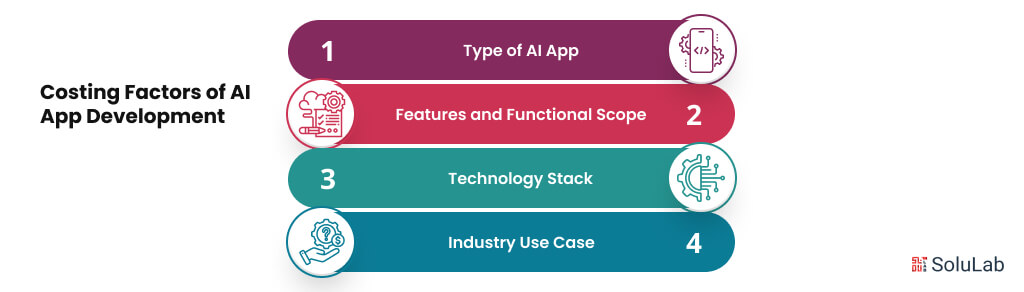
Costing Factors of AI App Development

When you’re planning to build an AI-powered app, knowing what drives the cost is essential. As a B2B company, you’re likely focused on performance, compliance, and long-term ROI. Below are the main things that shape the total AI app development cost:

1. Type of AI App

The kind of app you want to build plays a big role in its cost.

  • Basic AI apps (like rule-based systems or recommendation engines) are cheaper and faster to build.
  • Moderate AI apps use advanced tools like Natural Language Processing (NLP) for voice, image recognition, or basic predictions.
  • Advanced AI apps involve adaptive systems, decision automation, or intelligent agents. These often require help from an expert AI agent development company.

2. Features and Functional Scope

The number and complexity of features directly influence your AI app’s cost. Common AI app features include:

  • AI-powered chatbot and virtual agents 
  • Voice or facial recognition
  • Behavioral analysis and user personalization
  • Integration with IoT or even blockchain systems

More features mean more time, testing, and budget.

3. Technology Stack

What tools and platforms you use matters a lot.

  • Using ready-made models (like OpenAI, Google Vertex AI) reduces costs.
  • Building your own models from scratch requires more budget.
  • Running on cloud services like AWS or Google Cloud adds cost unless optimized well.
  • Partnering with an experienced team that offers MLOps consulting services can help manage infrastructure and deployment costs smartly.

4. Industry Use Case

Different industries have different needs, and that affects pricing, too.

  • Sectors like finance and healthcare often need compliance, extra security, and data privacy, which increases the AI development cost.
  • Other sectors like retail, logistics, or education are generally faster to build for.

These factors raise the overall AI development cost but are necessary for safe deployment.

Read Also: How to Create an AI-Powered App like Doppl?

CTA1

AI App Development Cost Breakdown by Category

If you’re planning to build an AI-powered app in 2026, here’s a simple look at how much it might cost based on the type of solution you choose.

Type of AI App Estimated Cost Range (USD) Ideal For
Basic AI App $15,000 – $30,000 Simple apps with limited AI logic
NLP-based Chatbot $25,000 – $50,000 Customer service, lead generation
AI Personal Assistant App $35,000 – $60,000 Virtual assistants for tasks or scheduling
Predictive Analytics App $60,000 – $90,000 Forecasting, demand planning, trend analysis
Custom Generative AI Application $80,000 – $150,000+ Content generation, Gen-AI chat, simulations

These ranges depend on factors like:

  • Project complexity
  • Platform (iOS, Android, Web)
  • Number of third-party integrations
  • Advanced AI app features like Natural Language Processing (NLP), Predictive Analytics, or Generative AI

For enterprises, a high-quality AI application solution isn’t just about features, it’s about scale, security, and future-proofing. Choosing the right AI development company or partner can make a big difference in both cost and performance.

If you’re unsure where to start or how to estimate the cost for your project, it’s best to hire AI developers who specialize in enterprise-grade AI solutions.

AI App Development Lifecycle and Associated Costs

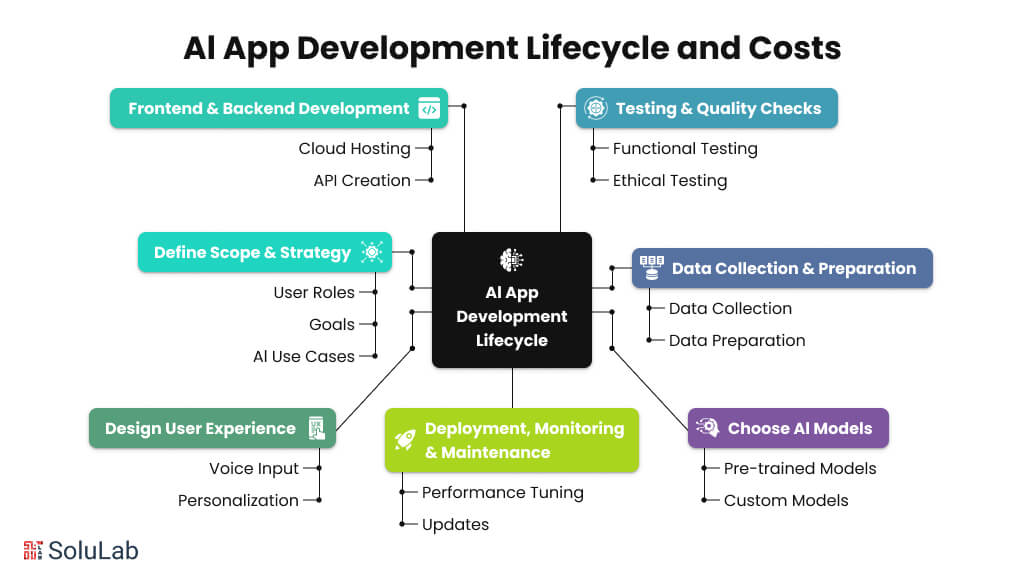
AI App development lifecycle

To understand the total AI app development cost clearly, it’s important to break it down step-by-step. Each phase in the development lifecycle impacts your budget and knowing where your money goes helps you plan smarter.

Here’s a breakdown of the key phases:

1. Define Scope & Strategy

Start by identifying user roles, goals, and the core AI use cases and applications. This ensures your app solves a real business problem and avoids unnecessary features.

2. Data Collection & Preparation

The heart of any artificial intelligence app is clean, labeled, structured data. This stage may require help from AI implementation services or in-house teams to collect and prepare the right training data.

3. Choose the Right AI Models

Decide between pre-trained models (like GPT, BERT) or building custom ones. This impacts speed, accuracy, and long-term cost. Custom training raises the AI development cost, but often brings better ROI.

4. Design the User Experience

Great AI apps feel natural to use. UX design focuses on intuitive flows based on how users think, not just how the tech works. At this point, AI app features like voice input, personalization, or recommendations are mapped.

5. Frontend & Backend Development

This is where your mobile app development company or internal team builds the actual app. They’ll connect the AI engine, create APIs, and host the app in a secure cloud environment. You’ll also need to handle security and data compliance. For companies seeking scalability and cost efficiency, nearshore backend development can provide the technical expertise needed to manage integrations, optimize performance, and ensure compliance with data protection standards.
6. Testing & Quality Checks

Apps go through functional and ethical testing to ensure they work and don’t create bias or risk. This helps reduce risks during deployment and can even lower long-term AI mobile app development costs.

7. Deployment, Monitoring & Maintenance

Once live, the app must be monitored, fine-tuned, and updated regularly. AI models learn over time, so performance tuning is ongoing. Many companies choose to partner with a trusted AI development company to handle updates and scale confidently.

At any stage, you can hire AI developers to speed up the process, reduce risk, and ensure high-quality output.

Read Blog: Cost To Build An App In Australia

Strategies to Reduce AI App Development Costs

Are you concerned that the cost of your AI development might exceed your budget? 

You’re not alone. Many businesses face the same challenge. But with the right approach, you can build a powerful AI app without overspending. Here’s how:

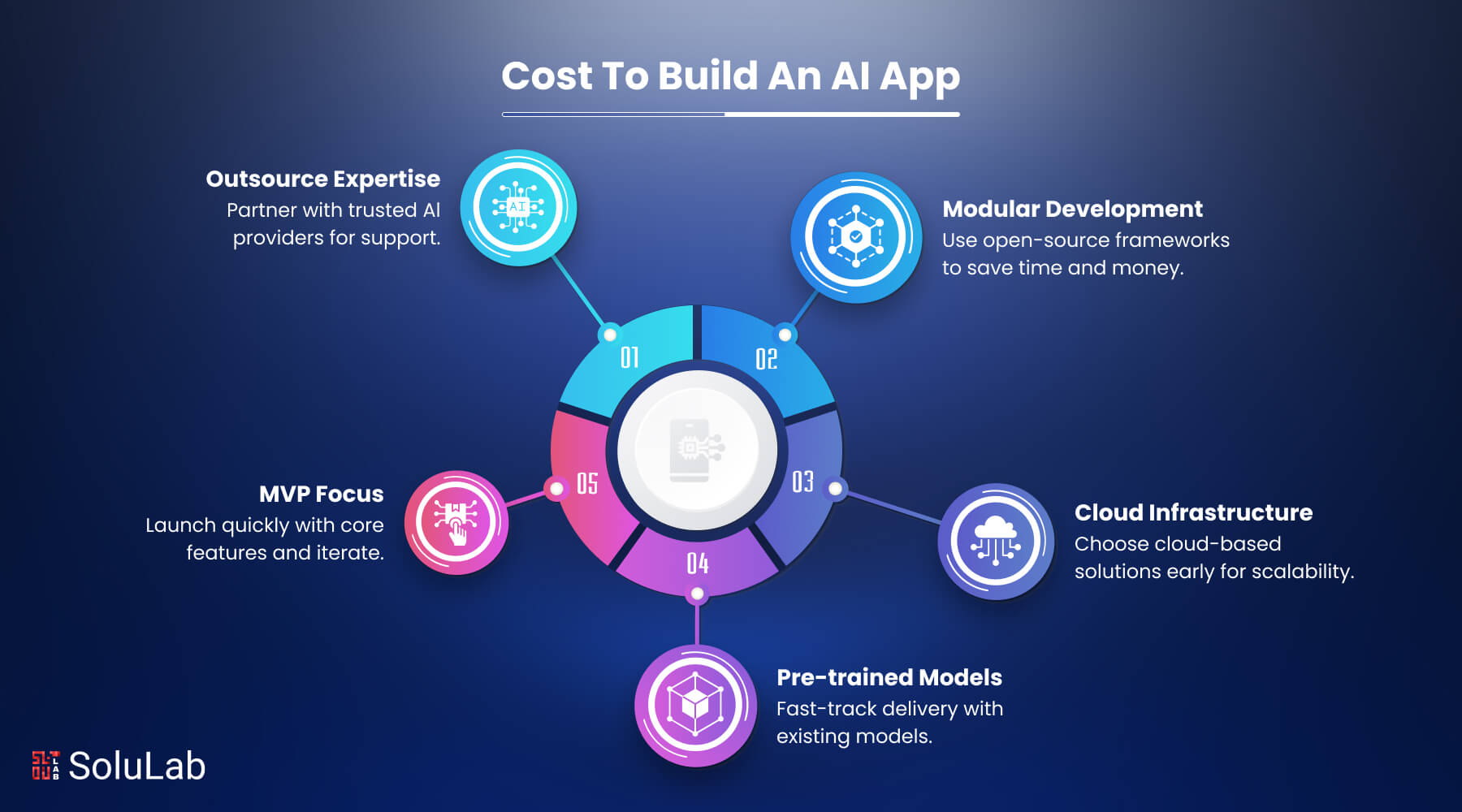
  • Utilize modular development and leverage open-source AI and ML frameworks. It saves both time and money.
  • Pick cloud-based infrastructure early and use MLOps consulting services to automate workflows.
  • Choose pre-trained models to fast-track delivery for most AI use cases and applications.
  • Focus on core MVP features first. Launch fast, then improve over time.
  • Outsource to a trusted AI application solutions provider with proven expertise.

Cutting costs doesn’t mean cutting value. It means making smart, scalable decisions that get your AI app to market faster and more efficiently.

CTA2

Conclusion

By now, you have a clear idea of what affects the AI app development cost. You’ve seen how features, app complexity, and industry use cases all play a role. Whether you’re building a Generative AI-powered chatbot, an AI personal assistant app, or a smart prediction tool, choosing the right mobile app development company is key to your success.

At SoluLab, we specialize in helping enterprises plan and build custom Artificial intelligence apps that are scalable, efficient, and built for real business impact. Our AI integration services are designed to support enterprise-grade apps from start to finish.

Contact us today to discuss your unique business idea, and we’ll power it with AI!

FAQs

1. How much does AI personal assistant app development cost today?

Building a personal assistant AI app like a smart scheduling or voice bot ranges between $50,000 and $150,000. The cost depends on how advanced your assistant is, simple apps are cheaper, but AI agents with NLP and voice capabilities need more development and testing.

2. Why does AI development cost vary so much across industries?

The AI development cost depends heavily on industry-specific use cases. For example, building AI for healthcare or finance often involves strict regulations and complex data, which means more time, security, and cost. In contrast, retail or HR apps may cost less due to simpler workflows.

3. Which Artificial intelligence apps are the most cost-effective to build?

Apps like chatbots, content recommenders, and image classifiers are the most budget-friendly Artificial intelligence apps. These use off-the-shelf models and are faster to build. More advanced tools like fraud detection or diagnostic engines require deeper AI expertise and bigger budgets.

4. How can I hire AI developers and manage the overall AI project cost?

To hire AI developers, work with an experienced AI development company that offers end-to-end support. Hiring a dedicated team ensures your project is scoped correctly, deadlines are met, and you’re not wasting budget on avoidable delays or poor architecture choices.


How Much Will AI Integration Cost Your Business in 2025?

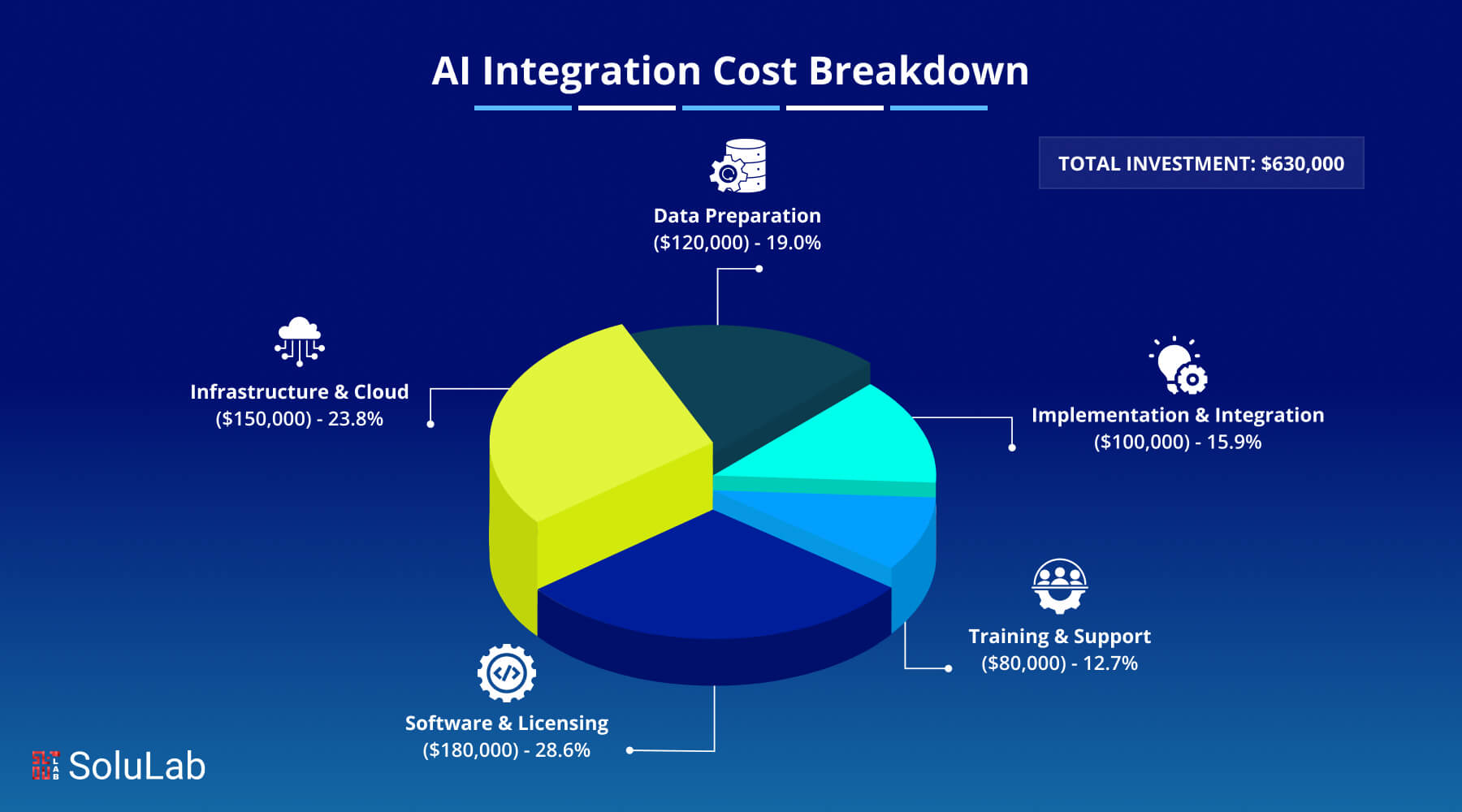
AI Integration cost breakdown

In 2025, the global artificial intelligence (AI) market is expected to cross $407 billion, up from just $86.9 billion in 2022. More than 77% of businesses are now using or actively exploring AI Integration to work smarter, reduce costs, and boost profits.

Here’s what companies are seeing with AI:

  • 30 – 50% increase in operational efficiency
  • 25 – 35% reduction in costs
  • 20 – 40% growth in revenue

As AI becomes essential to stay competitive, more organizations are looking to integrate AI into their business, but many are unsure about the real costs and what solution is best.

In this guide, we’ll break down the true Cost of Integrating AI, explain how AI Integration Services work, and help you choose the right type of AI integration for your goals.

What Is AI Integration and Why It Matter in 2025?

AI Integration is the process of adding smart technologies like machine learning, natural language processing, or computer vision into your current systems, such as your CRM, ERP, or mobile app. It helps your business make faster decisions, reduce manual work, and improve customer experiences.

In 2025, companies that use AI Integration are moving ahead by becoming more efficient and data-driven.

Examples include:

  • Using AI-powered chatbots to give instant replies to customers 24/7.
  • Automating inventory and delivery using smart AI agents
  • Adding AI in finance tools to detect fraud or predict cash flow

No matter your industry, integrating AI helps your business grow faster and operate smarter.

Key Components of AI Integration in Business

When you’re planning to integrate AI into your business, here are the most important pieces to get right:

1. Real-time data pipelines

These pipelines collect and process live data from multiple sources, helping businesses make faster, smarter decisions with AI Integration.

2. API or SDK-based model embedding

Using APIs or SDKs, companies can quickly embed pre-trained AI models into their software without starting from scratch, saving time and money.

3. User feedback loops

Feedback from users helps AI systems learn and improve over time, leading to better performance and personalized experiences.

4. Scalable architecture with cloud/edge AI

With cloud or edge computing, businesses can scale AI across devices or teams without heavy infrastructure costs.

Leading companies use AI Integration Services to turn traditional workflows into smart, efficient systems, without having to rebuild everything from scratch. It’s fast, cost-effective, and keeps your business ahead of the competition.

CTA- 1

What Are the Best AI Integration Solutions for Businesses?

Choosing the right type of AI integration depends on your industry, business goals, and budget. Below are the most effective and widely used AI solutions in 2025:

1. AI in Finance 

AI in finance helps detect fraud, assess credit risk, and automate forecasting. It improves decision-making and reduces manual work in reporting and compliance. For banks and fintech firms, it’s one of the most impactful AI integration services.

2. AI-Powered Chatbots 

AI-powered chatbots work 24/7 to manage customer queries, track orders, and improve user experience. These are key in retail, e-commerce, and customer support operations. They also lower support costs and increase satisfaction.

3. AI Agents

AI agents in healthcare can analyze patient data, assist in diagnoses, and automate record management. They reduce the load on medical staff and improve care delivery. Hospitals and clinics benefit by becoming more efficient and responsive.

4. Custom NLP for Document Automation

Legal and insurance businesses use custom NLP models to extract data, summarize reports, and manage documentation. It saves time, reduces errors, and supports compliance needs. This is ideal for firms handling high document volume.

A skilled AI consulting company can guide you through the best AI integration services, whether you need cloud-based AI, edge deployment, or hybrid solutions, all optimized for enterprise scale.

AI Integration vs. AI Development: What’s the Difference?

Many companies mix up AI Integration with full AI development, but they are very different.

Feature AI Integration AI Development
What it means Adding existing AI tools into your business systems Building AI models from the ground up
Speed Faster to launch and test Slower, it takes months to develop
Cost Lower setup and ongoing costs Higher costs for development and training
Risk Lower risk, easier to manage Higher risk, more complex to execute
Examples Using the OpenAI API, AI-powered chatbots Creating a custom AI model for your business
Best for Quick results, testing use cases Long-term, unique AI-driven products

If you’re just getting started, it’s smarter to use AI Integration Services from an experienced AI development company. This way, you can test how AI fits your business with less risk and faster results.

What’s the Cost of AI Integration by Industry in 2025?

The cost of AI integration depends on your industry, data needs, and how much automation you want. Here’s a quick look at average pricing:

Industry Cost Range (USD) What Drives the Cost
Healthcare $90K–$350K HIPAA rules, smart diagnostics, patient data
Finance $110K–$400K Fraud detection, AI in trading, compliance
Retail & E-Commerce $60K–$250K AI-powered chatbots, smart suggestions
Manufacturing $80K–$300K Predictive repairs, robotics, smart sensors
Real Estate $70K–$240K Price tools, AI agents, virtual tours

Knowing your industry’s typical AI integration expenses helps you estimate the real investment and set realistic goals. So, work with an experienced AI consulting company to avoid overspending and get faster results with customized solutions.

Read Also: How Much Does It Cost to Build an AI App in 2025?

AI Integration Costs by Country in 2025

The AI Integration Development Cost depends heavily on where your team is based. Here’s a simple breakdown to help you plan better:

Country Average Cost Range What to Know
USA $120K – $350K Best for top-tier security, quality, and enterprise support.
UK $100K – $300K Great for companies needing GDPR-ready AI Integration Services.
India $40K – $150K Most affordable option with growing AI development talent.
UAE $70K – $250K Fast government support and quick rollout for AI projects.
Canada $90K – $280K Strong in research and balanced in cost and quality.

If you’re seeking AI Integration Services in USA, expect higher costs, but also stronger compliance, data security, and enterprise support.

For startups or mid-sized firms, India offers great value with proven results.

What’s the Future of AI Integration and Cost Trends?

The future of AI Integration looks promising and more affordable.

  • AI integration costs are expected to drop by 15–20% by 2027 as tools become easier to use and more widely available.
  • AI agents will become common in industries like logistics, retail, and telecom, helping automate tasks and improve speed.
  • The demand for AI-powered chatbots is set to grow 3X, especially among small and mid-sized businesses looking to scale support without big budgets.
  • With generative AI and automation coming together, businesses can offer hyper-personalized customer experiences.

Now is the right time to invest. Costs are still manageable, and the return on investment is high. Early adopters will benefit the most from these technologies.

CTA-2

Why Choose SoluLab for AI Integration Services?

SoluLab is a trusted AI integration expert helping businesses make smart, fast, and cost-effective decisions with AI. Here’s why global companies choose us:

Results That Matter

What We Offer Industry Impact
Up to 40% faster project delivery with our AI Integration Services Transparent, fixed Cost Of AI Integration in Businesses Finance: Use AI in finance for risk analysis & fraud alerts
30–50% boost in operational efficiency Ready-to-deploy AI-integrated apps Retail: Run 24/7 support with AI-powered chatbots
25% cost savings on development Full support from strategy to launch

Healthcare: Speed up services using AI agents

Work with an experienced AI consulting company that handles everything, from planning to execution, with no hidden AI integration expenses. We deliver real results with measurable ROI.

FAQs

1. What’s included in the average AI Integration Development Cost?

It covers everything from initial planning and data preprocessing to API integrations, licensing, testing, deployment, and long-term monitoring. A reliable AI development company will also include documentation and team training, ensuring smooth handover and scalability.

2. Should we build in-house or hire an AI consulting company?

Building in-house requires deep AI, DevOps, and security expertise, which many businesses don’t have. Partnering with an AI development company gives you access to pre-vetted talent, reduces project risk, and delivers faster time-to-value.

3. Can we test AI before full-scale integration of AI?

Yes. Start with a pilot using a modular AI-integrated app. This helps validate the use case and ROI before committing to full-scale implementation.

4. How long does a typical AI Integration project take?

For most mid-sized businesses, it takes 3-6 months, depending on project complexity, data readiness, and the type of AI integration required. Timeframes may be shorter if you’re using ready-made models or tools.

5. What’s the ROI of using AI-powered chatbots for B2B?

AI-powered chatbots reduce response time by 70%, lower support costs by up to 40%, and help automate pre-sales qualification. For enterprise support, they’re one of the quickest wins in AI Integration Services.

6. How do we estimate AI integration expenses for our business?

Factor in use case complexity, existing system maturity, regulatory needs, and whether you need custom AI or off-the-shelf models. An experienced AI integration experts team will provide a tailored cost analysis.


How AI Integration Streamlines Operations for Small & Mid-Sized Companies?

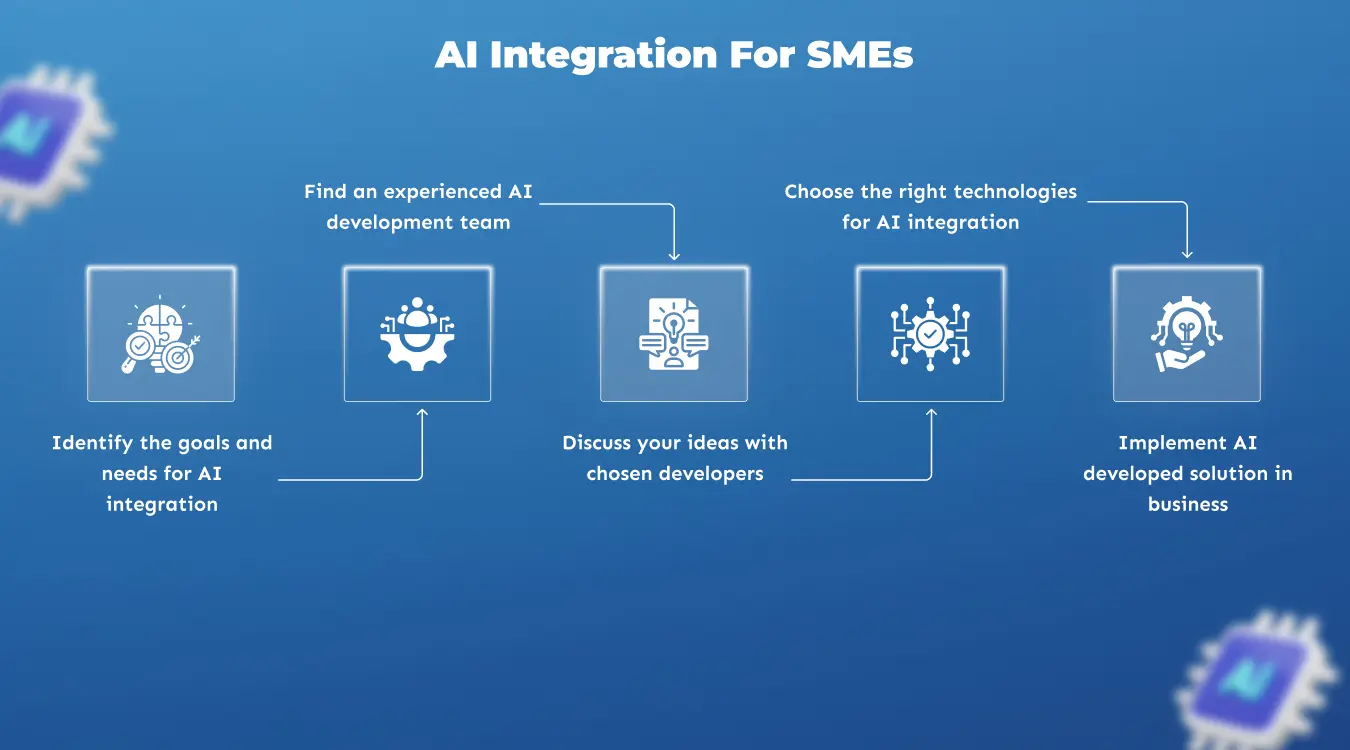
AI Integration For SMEs

Almost every small and mid-sized business dreams of doing more with less– fewer resources, smaller teams, and tighter budgets. But staying competitive in today’s fast-paced market isn’t easy. 

From automating routine tasks to optimizing workflows and predicting customer needs, AI is no longer a luxury for big enterprises. It’s a game-changer for SMBs looking to simplify operations, cut costs, and boost productivity without hiring massive teams or investing in complex systems.

In this blog, we’ll explore how AI integration is helping small and mid-sized companies work smarter. Lets begin!

What is AI Integration in Business?

AI integration means adding smart technology like automated systems, chatbots, and data analysis tools into your daily business operations. It helps companies handle repetitive tasks, make better decisions, and improve productivity, without needing more manpower.

For example, using AI Workflow Automation can reduce manual work, while Natural Language Processing (NLP) lets AI assistants handle customer questions more naturally. Many businesses are now integrating AI models to optimize operations and improve output quality.

According to McKinsey, 63% of businesses already use AI in at least one area of their operations (2024). A Deloitte study found that AI-powered automation improves efficiency by 20–40% especially for small and mid-sized companies.

For modern businesses, AI integration solutions for businesses are no longer optional, they are essential. As a trusted AI development company, we help businesses like yours embed AI where it matters most with tailored AI integration services.

Why Does AI Integration Matter for Today’s Businesses?

Today’s small and mid-sized businesses face a common challenge, too many repetitive tasks, slow processes, and disconnected systems. These issues don’t just affect productivity, they slow down growth, customer satisfaction, and profitability.

That’s where Agentic AI solutions for businesses create real value. By adding smart automation and intelligent tools, businesses can scale faster, make better decisions, and save costs, all while improving service quality.

Here’s how:

  • Better decision-making with tools like Natural Language Processing (NLP) and predictive analytics. These technologies help analyze customer data, trends, and conversations, turning information into clear actions.
  • Higher operational efficiency through AI Workflow Automation. AI reduces the time spent on manual work, streamlining everything from sales pipelines to back-office tasks, via AI/ ML services for your business.
  • Lower operational costs by automating repetitive, labor-heavy tasks like data entry, reporting, and order management. Businesses can do more with fewer resources.
  • Stronger customer experiences powered by Customer Service Automation and AI-powered chatbots, powered by generative AI solutions. These tools handle queries instantly, 24/7, while freeing up human teams for complex cases.

Our AI development company delivers B2B AI integration solutions and helps you understand how to integrate AI in your business seamlessly, into your operations, with real impact on performance, speed, and customer loyalty.

Read More: AI In Dubai’s Public Services

What Types of Businesses Can Benefit from AI?

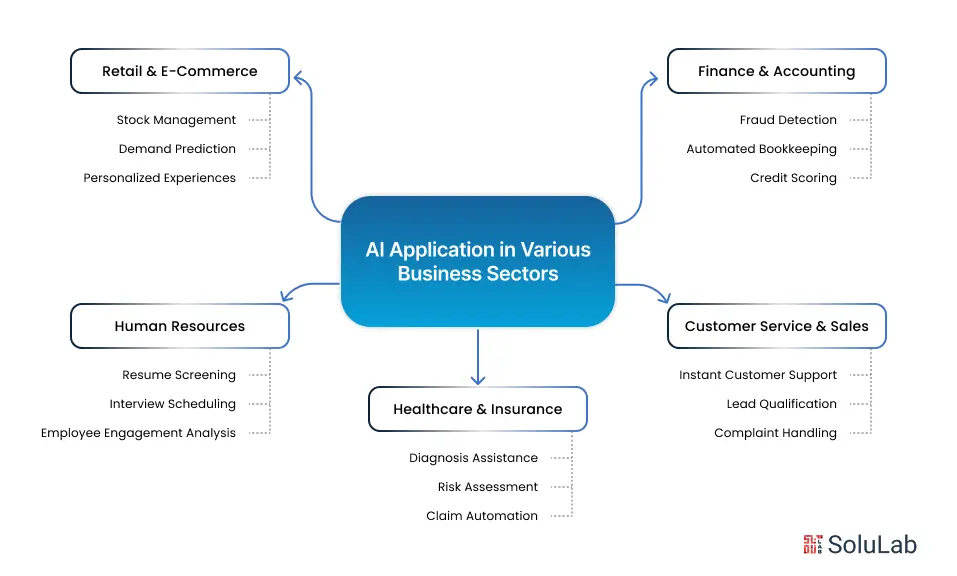
AI Application in Various Business Sectors

Artificial Intelligence is no longer just for tech giants. Today, AI solutions are helping small and mid-sized businesses solve everyday problems, reduce manual work, and grow faster. If your business handles repetitive tasks, large amounts of data, or needs faster decision-making, AI use cases for enterprises are built just for you.

Here’s how AI works across different business sectors:

1. Retail & E-commerce

Businesses in retail and e-commerce can utilize AI agents to enhance their stock management, predict customer demand, and provide personalized shopping experiences. AI tools can also reduce cart abandonment by targeting the right customer at the right time. You can also explore generative AI solutions for product descriptions and campaigns.

2. Finance & Accounting

If your business handles financial transactions or accounting tasks, AI in finance can help detect fraud, automate bookkeeping, and improve credit scoring. Integrating AI models can even make smarter investment decisions by analyzing market trends faster than any team could.

3. Customer Service & Sales

With AI Agent for Customer Service and in Sales and Marketing, businesses can answer customer questions instantly, qualify leads, send follow-ups, and even handle complaints, without human involvement. This not only saves time but improves customer satisfaction too.

4. Human Resources

AI can simplify HR by automating resume screening, scheduling interviews, and even analyzing employee engagement. With AI/ ML services for your business, AI can screen resumes, analyze employee engagement, and reduce bias.

5. Healthcare & Insurance

In sectors like healthcare and insurance, adaptive AI and AI integration services are used to assist doctors with diagnosis, assess patient risks, and automate insurance claims. It improves accuracy and speeds up service delivery.

CTA1

Top AI Use Cases by Business Operations

Businesses today are using AI across different departments to simplify operations, reduce manual effort, and make smarter decisions. Here’s how businesses are winning with AI use cases across departments:

1. Marketing and Sales

AI helps businesses improve how they attract, engage, and convert leads. Here’s how:

  • Personalized Ad Targeting: AI assistants qualifying leads for AI Agent in Sales and Marketing, analyze customer data to show ads that match user interests, improving conversion rates and ROI.
  • Lead Scoring with an AI assistant: AI helps sales teams focus on high-quality leads by automatically ranking them based on past behavior and engagement data.
  • Content Generation: AI can write blogs, emails, social media posts, and product descriptions, saving hours every week and maintaining consistent brand messaging.
  • AI Agent in Marketing: Smart AI agents can interact with potential clients, qualify leads, and even handle follow-ups automatically.

2. Operations

AI Workflow Automation can streamline operational tasks, optimize logistics, and reduce overhead costs. Some key examples:

  • AI Workflow Automation: Automate repetitive tasks like inventory checks, stock updates, and restocking alerts.
  • Scheduling and Route Optimization: AI analyzes traffic, weather, and delivery windows to suggest the most efficient routes for deliveries and services.
  • AI application solutions: Custom AI tools can be designed for order processing, staff management, and supply chain efficiency.

3. Customer Service

With growing customer expectations, AI is a powerful tool to deliver fast, consistent, and helpful support:

  • Customer Service Automation: Use chatbots and AI agents to respond to FAQs, complaints, and service requests instantly.
  • 24/7 Support with Small Language Models: Lightweight AI models offer real-time answers at any hour, reducing wait times and agent workload.
  • AI Assistant: Customer Service Automation helps customer support teams by suggesting answers, resolving tickets, and analyzing sentiment in chats or emails.

4. Finance

AI in finance tools supports financial teams in managing risk, reducing fraud, and improving reporting accuracy.

  • Credit Risk Analysis via AI in Finance: Predict customer creditworthiness based on advanced AI models and data trends.
  • Expense and Audit Tracking: Automate reconciliation, flag anomalies, and ensure financial compliance through smart algorithms.
  • AI use cases: Financial dashboards, forecasting, and compliance alerts are just a few ways AI adds value to finance departments.

5. Data and Integration

AI can manage and make sense of data faster and more accurately than any manual system.

  • Dataset Cleaning via AI and ML in Data Integration: Automatically remove errors, duplicate entries, and outdated data from databases.
  • Real-Time Dashboard Insights: AI transforms raw data into visual insights that help with faster and smarter decision-making.
  • Adaptive AI: Learns from new data in real-time and adapts recommendations or actions accordingly.
  • Natural Language Processing (NLP): Convert unstructured text (emails, support chats, documents) into useful, searchable insights.

Read Also: AI Integration Cost For Your Business

How Businesses Benefit from AI Integration?

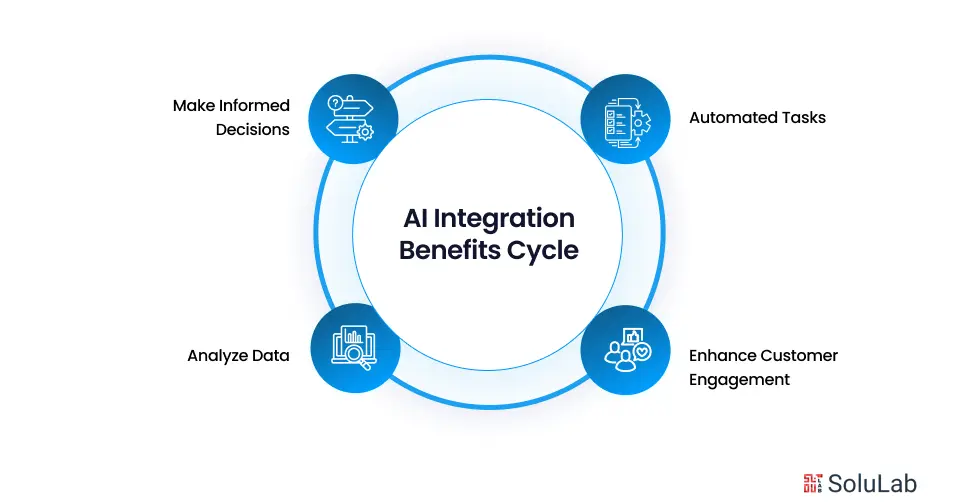
AI Integration Benefits Cycle internal

Companies that adopt AI integration solutions for businesses are seeing real, measurable results:

  • Saved Time: Automating routine tasks cuts admin workload by up to 30%, giving teams more time to focus on growth.
  • Faster Growth: Businesses using AI in customer engagement report up to 25% higher lead conversion rates.
  • Smarter Decisions: With the help of Natural Language Processing (NLP), companies can analyze data faster and make better decisions.

Our AI consulting company offers custom strategies and artificial intelligence consulting expertise tailored to how to integrate AI in your business. Whether you’re new to AI or want to scale, SoluLab will guide you every step of the way.

Custom AI Development vs. Plug-and-Play Tools: Which Fits Your Business Best?

When it comes to adding AI to your business, you have two main options:

  • Plug-and-Play Tools: These are quick to install and easy to use but offer limited customization.
  • Custom AI Development: This option is tailored specifically to your business workflows, making it more scalable and secure.

For businesses aiming for long-term success and full integration, working with a top AI development company is the best choice. Such companies offer expertise in creating AI application solutions that match your exact needs, helping you maximize the benefits of AI.

How Our AI Development Agency Helps You Integrate AI?

As a trusted AI development company, we support businesses by:

  • Creating tailored AI application solutions that fit your unique needs
  • Implementing efficient AI Workflow Automation to streamline your operations
  • Deploying specialized AI agents for sales, finance, and customer service to boost productivity
  • Following responsible AI practices to ensure data privacy and ethical use
  • Helping you hire AI developers who can maintain and grow your AI capabilities

Need help with AI integration solutions for businesses, or want to know how to integrate AI in your business? We’re your go-to artificial intelligence consulting company. Our expert team ensures your AI integration delivers real business value while keeping processes smooth and secure.

CTA2

Conclusion

The future of business is smart, automated, and data-driven. With the rise of Agentic AI solutions for businesses, AI is now within reach for any company. Small and mid-sized businesses can now access these powerful tools easily through trusted partners like our AI development company.

Start today with us and explore powerful AI application solutions built to help you scale with confidence!

FAQs

1. How much does AI integration cost for small businesses?

Costs vary based on your needs. Custom solutions from an AI consulting company often provide better ROI than generic tools.

2. Is AI safe to implement in business?

Yes, when developed using responsible AI principles that protect privacy and ethics.

3. Do I need to hire technical staff to use AI?

Not always. You can hire AI Developers through our agency or choose managed AI services.

4. What is the first step toward AI integration?

Schedule a consultation with our AI development company to evaluate your readiness and options.

5. How quickly can AI improve my business processes?

Many businesses see improvements within weeks by automating repetitive tasks with AI Workflow Automation.


Top AI Development Companies in Saudi Arabia

Saudi Arabia is growing into a global center to attract AI companies in Saudi Arabia. The driving force behind this growth is the Kingdom’s Vision 2030 plan. By focusing on building a more diverse economy and promoting digital transformation, the country is seeing a fast increase in artificial intelligence companies in Saudi Arabia. These companies are reshaping sectors like healthcare and smart cities.

This piece takes a closer look at the top AI companies in Saudi Arabia to watch in 2026. It showcases their skills, their impact, and how they are shaping the technological development of the region.

The Importance of AI in Saudi Arabia

Saudi Arabia’s Vision 2030 plays a key role in changing the country’s economy and society by focusing on lowering its reliance on oil and building a knowledge-driven economy. Artificial intelligence, a major part of this vision, is causing a revolution in areas like healthcare, energy, infrastructure, and finance.

Here’s how AI development companies contribute to this shift:

  • Driving Vision 2030 Goals

AI plays a big part in Saudi Arabia’s plans to lead in global technology. Top AI companies in the kingdom are developing solutions for smart cities, renewable energy, and healthcare, aligning with national priorities. For instance, they use GenAI integration services to help build NEOM, a city designed with AI-powered infrastructure to be futuristic.

  • Empowering Local Businesses and Startups

Leading AI development companies in Saudi Arabia create custom solutions to help startups and businesses. These companies help local firms use AI to make operations smoother, connect with customers better, and make choices based on data. This helps small and medium enterprises that want to thrive in a tech-focused economy.

  • Fostering Global Competitiveness

By providing advanced and scalable AI services in Saudi Arabia, these firms enable local businesses to compete. Their knowledge in AI model development ensures they deliver solutions that align with world standards. At the same time, their focus on AI applications development addresses local challenges.

  • Supporting Economic Diversification

AI supports innovation in major industries such as oil and gas, where AI development companies in Saudi Arabia improve extraction techniques and lower operating expenses. In the medical field, artificial intelligence companies in Saudi Arabia improve care using predictive tools and robotic surgical systems.

How We Selected the Top AI Companies in Saudi Arabia?

To find the top AI companies in Saudi Arabia, we used strict criteria to build a list of the most creative and influential AI companies in the country:

1. Expertise in AI Technologies

The best AI companies in Saudi Arabia show strong knowledge in areas like machine learning, natural language processing, and computer vision. They provide services in building AI model development and AI integration services, making sure their solutions work well and are useful.

2. Industry-Specific Experience

They understand the unique challenges of sectors like healthcare, energy, and finance. For instance, Top AI companies like Mozn specialize in AI applications development for financial compliance, while SCAI focuses on smart city solutions.

3. Client Success Stories and Reputation

A reliable company often shows its strength through a solid track record, client reviews, and examples of completed AI projects. Leading firms like SoluLab and Golden Logic have earned trust by delivering effective, scalable AI systems.

4. Scalability and Ongoing Support

The Top AI companies in Saudi Arabia design solutions to expand with businesses as they evolve and keep offering help, like regular updates and maintenance. This approach secures consistent support for success over time.

5. Local Relevance and Cultural Alignment

Companies with a deep understanding of Saudi Arabia’s cultural, regulatory, and economic landscape can deliver solutions that align with local priorities and Vision 2030 objectives.

Top AI Development Companies in Saudi Arabia 2026

Below is a detailed overview of the Top AI companies in Saudi Arabia for 2026, including their key services, notable projects, and impact on the region’s AI ecosystem:

solulab

1. SoluLab

A leading AI development company in Saudi Arabia, SoluLab specializes in AI model development and AI integration services, creating custom solutions for businesses. Their focus on generative AI enables innovative tools like chatbots, predictive analytics, and automation.

Key Services: Custom AI model development, AI-powered automation, predictive analytics, and chatbot development.

Notable Projects/Clients: Served Gradient and Digital Quest, delivering scalable AI applications development.


$25 – $49/ hr


50 – 249


2014


USA

Mozn

2. Mozn

A pioneer in artificial intelligence companies in Saudi Arabia, Mozn focuses on AI integration services for finance and risk management. Their platforms, FOCAL and OSOS, leverage Arabic NLP to address regional challenges.

Key services: AI-powered risk and compliance, Arabic NLP, and custom AI solutions.

Notable Projects/Clients: Serves financial institutions in emerging markets.


$50 – $150/ hr


200-500


2017


Saudi Arabia

Deevo Analytics

3. Deevo Analytics

Deevo Analytics is a Riyadh-based AI company in Saudi Arabia, offering AI applications development and real-time analytics. Their expertise in NLP helps businesses transform unstructured data into actionable insights.

Key Services: Data analytics, AI-powered real-time analytics, and NLP solutions.

Notable Projects/Clients: Developed reporting tools for financial services and telecom clients.


$50-$100/ hr


2 – 10


2021


Saudi Arabia

Golden Logic

4. Golden Logic

Golden Logic is a top AI development company in Saudi Arabia, providing AI model development and AI integration services for banking, insurance, and government sectors. Their solutions include chatbots, VR/AR, and security consulting.

Key Services: Application development, AI, chatbot development, and VR/AR.

Notable Projects/Clients: Serves clients in Saudi Arabia, Bahrain, and beyond.


$100-$200/ hr


51-150


2017


Saudi Arabia

Tessafold

5. Tessafold

Tessafold supports Saudi businesses with AI services in Saudi Arabia through blockchain, cloud computing, and fintech solutions. Their work aligns with the kingdom’s smart economy initiatives.

Key services: AI and data science, Web3, and mobile app development.

Notable Projects/Clients: Integrates local payment systems like Mada and Tabby.


$50-$150/ hr


11-50


2017


Germany

SCAI

6. SCAI

Backed by the Public Investment Fund (PIF), SCAI is a national leader in Top AI companies, delivering solutions for smart cities, energy, and healthcare. Their work directly supports Vision 2030.

Key Services: AI for smart cities, energy, healthcare, and machine learning.

Notable Projects/Clients: Works on Vision 2030 initiatives like NEOM.


$150-$200/ hr


51-250


2021


Saudi Arabia

Optridev

7. Optridev

Optridev is a professional AI development company in Saudi Arabia services, focusing on innovative solutions for sectors like retail, construction, and security.

Key Services: AI development, AI consulting, blockchain development, mobile app development, web development.

Notable Projects/Clients: Optimizes processes with AI for businesses in Saudi Arabia.


$25 – $100/ hr


2-10


2022


UAE

Skyne3

8. Skyne3

Skyne3 is a Saudi-based company specializing in transformative technologies, including AI applications development and AR/VR development.

Key Services: AI, AR/VR development.

Notable Projects/Clients: Works with brands in Saudi Arabia on immersive training programs and virtual reality simulations.


$50 – $150/ hr


11-50


2023


Saudi Arabia

BuzzAR

9. BuzzAR

BuzzAR is a TravelTech AI company in Saudi Arabia offering an AI-powered travel companion (BAE) and fintech solutions.

Key Services: AI travel companion, fintech solutions, mixed reality innovations.

Notable Projects/Clients: Collaborates with the Saudi Tourism Authority to enhance tourism experiences.


$25-$70/ hr


10-15


2015


Saudi Arabia

Generative IT Lab

10. Genesis IT Lab

Genesis IT Lab is a research-oriented software development company specializing in AI development, blockchain, and cybersecurity solutions. They focus on innovative algorithms and cutting-edge technologies, with operations relevant to Saudi Arabia.

Key Services: Software development, blockchain applications, security audits, cybersecurity, and AI model development.

Notable Projects/Clients: Experience across various sectors, including computer vision and NLP projects like mask detection technology for public health.


$55-$150/ hr


51 – 100


2017


Singapore

AI Development Company in Saudi Arabia

Why Choose Top AI Development Companies in Saudi Arabia?

These companies thrive in:

  • Deep local knowledge and aligning with cultural needs
  • Creating innovative fixes for challenges unique to Saudi Arabia
  • Building a history of success in big industry sectors

If you run a startup or a bigger company, AI companies in Saudi Arabia provide custom AI solutions to help your business grow and work better.

Conclusion

These AI companies in Saudi Arabia play a big role in reshaping the kingdom’s economy. Vision 2030 and the rising need for artificial intelligence companies in Saudi Arabia drive this transformation. These leading AI development companies provide services like AI integration and AI application development to handle various business challenges.

When you need AI development in Saudi Arabia, working with these companies gives you access to advanced solutions. Check out their offerings to bring your business to the front line of the AI movement in Saudi Arabia.

SoluLab, a leading name for AI development company in Saudi Arabia, holds an edge with years of experience and expertise. The team is always up to date with the latest trends for AI solutions. One such solution is a recruitment platform that we built for a forward-thinking client who wanted to fast-track the process. If you also wish to grab AI-powered solutions, connect with the experts today!

FAQs

1. How can I pick the right AI company in Saudi Arabia?

Focus on finding firms in Saudi Arabia with experience in the AI field and proven success in building AI applications.

2. What services do AI firms in Saudi Arabia provide?

These companies deliver solutions like developing custom AI models, creating chatbots, offering predictive analytics, and implementing automation for industries like energy and healthcare.

3. How much does it cost to hire a leading AI development company in Saudi Arabia?

The cost depends on the complexity of the project. Hourly charges range from $25 to $150.

4. How much time is needed to create AI applications?

The timeline depends on the scale of the work. Basic projects can be done in weeks, but bigger ones like smart city systems might take several months.

5.  How to get started with SoluLab?

It’s quite easy! You just need to click on the contact us button and fill in the form. Our experts will plan a call with you for all the consultation and planning.