The ten AI development companies worth comparing in 2026 are SoluLab, Turing, DataToBiz, InData Labs, 10Pearls, Intuz, 10Clouds, Itransition, N-iX and Digica. I’ve ranked each one below on the stuff that actually decides a shortlist, core AI expertise, hourly rate, team size, and the kind of buyer it suits. So you can pick by fit, not by whoever shouts loudest in their pitch deck.
Here’s a distinction most listicles skip. An artificial intelligence solution provider owns the whole thing: strategy, picking the model, wiring it into the stack you already run, and staying on afterward when something breaks. A dev shop that only ships code does a lot less. Same category, different job. Treat them as the same and you’ll be surprised later.
Gartner puts worldwide AI spending at $2.52 trillion in 2026, up 44% on the year. That number is why boardrooms suddenly care which AI development companies are real and which top artificial intelligence companies are actually moving adoption in 2026, not just posting about it.
There are hundreds of AI development companies out there in 2026, and most of them promise you the exact same things. A handful genuinely build products you can lean on for years. Search the web, scroll any social feed, and the same names surface: SoluLab, Turing, DataToBiz, a few others. Why do these keep coming up? What do they actually build, and which of it do you even need? If those questions are nagging at you, good. It means you’re asking the right ones.
Why Are Businesses Investing in AI Development in 2026?
Companies pour money into AI app development in 2026 for a short list of reasons: automate the grunt work, decide faster, cut cost, and give every customer something that feels made for them, at scale. Done right, AI lifts productivity, hands you an edge rivals can’t copy overnight, and ships smarter products faster than the old software way ever did.
The Global AI in Software Market is projected to reach roughly USD 2,513.3 billion by 2033.
1. Automation of Repetitive Tasks
Point AI at the manual, repeat-every-day work that eats hours across departments. The payoff is plain: things move faster, people stop fat-fingering the same mistakes, and you grow without growing the payroll at the same rate.
- Workflow automation across teams and systems
- Reduced manual effort and operational delays
- AI-driven process optimization and monitoring
2. Better Business Decisions
Put AI models to work chewing through mountains of business data to spot trends, call the shot on what’s coming, and get decisions made without the usual two-week stall. When the market shifts, you move first instead of reacting last.
- Predictive analytics for business forecasting
- Real-time data processing and reporting
- AI-powered decision support systems
3. Personalized Customer Experiences
Developing AI Agent systems read what a customer does, what they like, how they behave, and then shape recommendations, messages, and the whole experience around that person, across every channel they touch.
- AI-based recommendation engines
- Customer behavior analysis and segmentation
- Personalized engagement across digital channels
4. Improved Productivity
AI agents take on tasks by themselves, keep workflows moving, dig up the information someone needs, and sit alongside employees through the daily grind. The result is people getting more done without burning out on busywork.
- Autonomous AI agents for task execution
- Intelligent workflow orchestration
- AI copilots for operational assistance
5. Competitive Advantage
Building AI MVP infrastructure and smart platforms let a business ship new ideas quicker, tune performance, and turn on a dime when the industry or the customer changes their mind.
- Scalable AI infrastructure and deployment
- Data-driven operational strategies
- Faster innovation and market adaptability
What are the Services Offered by Leading AI Development Companies?
The strong ones cover custom AI software, generative AI, AI agent development, machine learning, and natural language processing. All of it pointed at one goal: taking work off your team’s plate.
1. Custom AI Software Development
This is software built around how your business actually runs, its workflows, its rules, its automation goals, not a generic tool bent to fit. The whole point is more efficiency, more automation, and better calls made at scale.
1.1. Updating Pre-Existing Software: Taking something that already exists, closed or open source, and reshaping it to fit one organization. Think of the average company running ERP software from a big-name vendor. ERP systems has to be reworked heavily, because no two businesses want the same thing out of it. That setup can drag on for months. Skip it and the software simply won’t do its job.
1.2. Developing New Software: Some businesses are too big, or too niche, for anything off the shelf. They build from scratch instead, often pulling in existing libraries to save time where it makes sense.
2. Generative AI Development
Building generative AI development services for content generation, automation, business intelligence, and the growing pile of LLM-powered applications companies now run.
- LLM-powered application development
- AI content and document generation
- Custom generative AI model integration
3. AI Agent Development
Building AI agent development services that run workflows, carry out tasks on their own, and keep operations tight across systems that used to need constant babysitting.
- Autonomous workflow automation
- Multi-agent system development
- AI copilots and virtual assistants
4. Machine Learning Development
Enterprise-grade machine learning development services built for predictive analytics, automation that thinks a little, and decisions grounded in data instead of gut feel.
- Predictive analytics solutions
- Supervised and unsupervised learning models
- ML model training and deployment
5. Natural Language Processing (NLP) Solutions
Building natural language processing solutions behind conversational AI, machines that actually understand language, and communication systems smart enough to be useful.
- Conversational AI and chatbots
- Text analysis and sentiment detection
- Language understanding and automation
6. Computer Vision Development
Computer vision work that scales: image recognition, video analytics, monitoring that watches for you, and visual automation that catches what a human eye would miss on hour nine of a shift.
- Image and video recognition systems
- Object detection and facial recognition
- Visual inspection and surveillance AI
7. AI Integration Services
AI integration services that plug AI into the enterprise systems, workflows, and infrastructure you already run, without you ripping everything out to make room for it.
- API and enterprise system integration
- AI-enabled workflow enhancement
- Cloud and on-premise AI deployment
8. AI Consulting and Strategy
Strategic AI consulting services that helps a business figure out where AI actually pays off, draw up a roadmap, and scale the transformation past the pilot stage where most efforts quietly die.
- AI readiness assessment
- Business-focused AI roadmap planning
- Technology and infrastructure consulting
9. Predictive Analytics Solutions
Data-driven predictive analytics that call trends, customer behavior, operational risk, and where the business is likely headed, with enough accuracy to plan around.
- Business forecasting models
- Customer behavior prediction
- Risk analysis and performance insights
Top 10 AI Development Companies to Consider in 2026
We looked at 100+ AI service providers and narrowed it to these 10 for 2026. Each one is strong somewhere. None of them is strong everywhere, and any list that claims otherwise is selling you something. Our top pick, SoluLab, has held a 100% project success rate across industries while keeping global compliance intact, which is harder than it sounds.
| Company | Best For | Core AI Expertise | Key Strength |
| SoluLab | Enterprise AI & AI agents, AI-powered solutions | Generative AI, AI native solution development | Scalable AI native, custom AI solutions |
| Turing | Hiring AI developers | AI engineering talent | Global AI developer network |
| DataToBiz | Data-driven businesses | Data analytics, ML | Business intelligence solutions |
| InData Labs | Predictive analytics | Machine learning, NLP | Strong data science expertise |
| 10Pearls | Enterprise modernization | AI integration | End-to-end digital solutions |
| Intuz | SMB AI solutions | AI apps, cloud AI | Flexible development approach |
| 10Clouds | Startups & product development | AI app development | Fast MVP delivery |
| Itransition | Large-scale enterprise AI | AI automation, analytics | Enterprise software expertise |
| NiX | Custom AI applications | ML and AI engineering | Cost-effective AI development |
| Digica | Deep tech AI projects | Computer vision and NLP | Research-focused AI expertise |

1. SoluLab

SoluLab is a global AI development company that builds enterprise-grade AI systems, AI agents, blockchain-powered platforms, and digital products that scale, for startups and big enterprises alike. It has shipped across healthcare, fintech, logistics, gaming, and real estate. What sets the work apart is the bias toward AI that actually goes live, not AI that stays a demo forever.
Services Offered
- Generative AI Development
- AI Agent Development
- Machine Learning Solutions
- Conversational AI
- AI voice Agents
- Custom AI Software Development
- NLP & Conversational AI
- AI Integration Services
Trust & Recognition
- Clutch Rating: 4.9/5
- GoodFirms Rating: 4.9/5

2. Turing
 $49 – $60
 500 – 999
 2004
2004 San Francisco, USA
Turing sits in San Francisco and helps enterprises build and scale AI using a worldwide bench of developers, AI engineers, and data specialists. Its sweet spot is enterprise AI deployment, LLM training, and engineering muscle you can spin up on demand.
Services Offered
- AI Agent Development
- Generative AI Solutions
- Enterprise AI Automation
Trust & Recognition
- Clutch Rating: 4.6/5
- GoodFirms Rating: 4.8/5
3. DataToBiz
$25 – $52
10 – 49
2018
India
DataToBiz lives in the AI and business intelligence corner, turning messy data into decisions a manager can actually act on. It builds AI, analytics, and automation that scale from startup to SMB to enterprise, across a range of industries.
Services Offered
- Machine Learning Solutions
- Business Intelligence & Data Analytics
- AI Consulting Services
- Predictive Analytics & Automation
Trust & Recognition
- Clutch Rating: 4.8/5
- GoodFirms Rating: 4.9/5
4. InData Labs
$50 – $99
80+
2014 USA
InData Labs is a machine learning, data science, and predictive analytics shop serving enterprises and fast-growing startups. It builds systems that automate the tedious parts, crunch large datasets, and hand decision-makers something clearer to work with.
Services Offered
- Machine Learning Development
- Predictive Analytics Solutions
- NLP and Conversational AI
- Big Data and Data Engineering
Trust & Recognition
- Clutch Rating: 4.9/5
- GoodFirms Rating: 4.9/5

5. 10Pearls
$49
500 – 999
2004 United Arab Emirates
10Pearls builds enterprise-grade digital products, AI platforms, and software that scales, for fast-growing businesses and Fortune 500 names alike.
Services Offered
- Generative AI development
- AI consulting and strategy
- Machine learning solutions
- Enterprise software development
Trust & Recognition
- Clutch Rating: 4.9/5
- GoodFirms Rating: 4.8/5

6. Intuz
$25 – $49
50 – 24
2008 San Francisco, USA
Intuz, based in the USA, builds AI-powered apps, enterprise software, and automation that runs itself, for both startups and enterprises. Its strength is speed: rapid product engineering with AI stitched into modern digital platforms.
Services Offered
- Generative AI Development
- AI Chatbot Development
- Machine Learning Solutions
Trust & Recognition
- Clutch Rating: 4.7/5
- GoodFirms Rating: 4.9/5

7. 10Clouds
$50 – $99
50 – 249
2009
Poland
10Clouds, out of Poland, builds AI-powered digital products, fintech platforms, and SaaS apps that scale. It leans hard into pairing AI with sharp product design and agile engineering, which is why startups and enterprises keep picking it in 2026.
Services Offered
- Generative AI Development
- AI Product Development
- Machine Learning Solutions
- AI Chatbot Development
Trust & Recognition
- Clutch Rating: 4.9/5
- GoodFirms Rating: 4.8/5
8. Itransition
$25 – $49
200 – 500
1995 USA
Itransition is a global software engineering and AI firm that runs enterprise-grade digital transformation work. It folds AI into operations, analytics, customer experience, and internal workflows, and it does it on infrastructure built to stay secure while it scales.
Services Offered
- Custom AI software development
- Predictive analytics and business intelligence
- AI integration for enterprise systems
Trust & Recognition
- Clutch Rating: 4.9/5
- GoodFirms Rating: 4.8/5

9. NiX
$49
500 – 900
2004 UAE
NiX is a global software company shipping AI-powered enterprise solutions, digital products that scale, and custom automation for businesses across a spread of industries.
Services Offered
- Machine Learning Development
- AI-Powered Automation Solutions
- Custom Software Development
- Data Analytics & Predictive Intelligence
Trust & Recognition
- Clutch Rating: 4.8/5
- GoodFirms Rating: 4.9/5

10. Digica
$50- $49
50 – 249
2009 United Kingdom
Digica is a deep-tech AI company. It builds intelligent systems on machine learning, computer vision, and heavy-duty data analytics, and it’s the name you call when the problem is genuinely hard, the kind of research-driven enterprise and industrial work most shops won’t touch.
Services Offered
- Machine Learning Development
- Computer Vision Solutions
- Natural Language Processing (NLP)
- AI Consulting and Data Engineering
Trust & Recognition
- Clutch Rating: 4.8/5
- GoodFirms Rating: 4.6/5
Looking for a Specialized AI Partner Instead?
Sometimes “top AI development company” is too broad a net. If your shortlist hinges on buyer type, a specific sub-specialty, or a region, these narrower breakdowns will get you there faster:
- Top Enterprise AI Development Companies → for teams weighing SoluLab against the big platform vendors, IBM, Microsoft, Google Cloud
- Top Generative AI Development Companies → compared further down this page, for teams that specifically want LLM and generative AI specialists
- Top AI Development Companies in Dubai → for UAE-based buyers and region-specific comparisons
- Top AI Development Companies in Finance → for fintech and financial services buyers who need regulatory and fraud-detection depth
- Top AI Development Companies in Saudi Arabia → for buyers in the Kingdom weighing local delivery and Vision 2030 alignment
Top Generative AI Development Companies in 2026
Generative AI is its own hiring problem. A team that ships solid predictive models does not automatically know how to fine-tune a large language model, build a retrieval pipeline that does not hallucinate, or keep inference costs from quietly tripling in month three. Running models in production is its own discipline, which is why LLMOps has become a hiring criterion rather than an afterthought. If that is the work you are buying, the shortlist changes.
These twelve firms are worth comparing when the brief is specifically generative: LLM applications, RAG systems, AI copilots, multimodal AI products or multi-agent workflows.
| Company | Core generative AI expertise | Clutch rating | Key strength |
|---|---|---|---|
| SoluLab | Agentic AI, generative AI, blockchain, IoT and mobile | 5.0/5 | Enterprise AI systems and AI-native custom development |
| TechAhead | Mobile and AI applications | 4.7/5 | Full-stack delivery with cloud and DevOps depth |
| Webmob | Blockchain, agentic AI apps, chatbots | 5.0/5 | Web3 and cybersecurity, global delivery |
| MobiDev | AI, AR and IoT applications | 5.0/5 | Senior engineers, long-term collaboration model |
| Azilen Technologies | Agentic AI, AI apps, enterprise software | 4.8/5 | Custom generative AI solutions |
| Azumo | Nearshore development with AI focus | 4.9/5 | Multi-industry work, proprietary AI tooling |
| A3Logics | Custom software and AI app development | 5.0/5 | Scalable and security-conscious builds |
| Inceptive | Mobile apps, chatbots, AI integration | 5.0/5 | Generative AI and digital transformation |
| BairesDev | Nearshore engineering teams | 4.9/5 | Flexible staffing across AI disciplines |
| Q3 Technologies | Managed IT with AI capability | Not listed | Cloud and ERP, vendor-neutral approach |
| Ailoitte | Enterprise software | Not listed | IoT, agile delivery, ISO certified |
| Iotric | MVP and product development | Not listed | AI-powered application builds |
One caveat on ratings. A 5.0 from eleven reviews and a 4.7 from two hundred are not the same signal, and Clutch does not weight them for you. Read the review count alongside the score, and read what the reviews actually describe. A firm rated perfectly for mobile app delivery tells you very little about how it handles a RAG pipeline under load.
If you have already decided generative AI is the scope and you want to see delivery detail rather than a comparison, our generative AI development services page covers the build process, model selection and deployment work in depth.
What It Costs to Hire an AI Development Company
Rates move with experience, location and how you structure the engagement. A mid-level generative AI developer runs $40 to $120 per hour globally. US-based rates land between $100 and $200 per hour. In India and Eastern Europe, experienced developers often charge $40 to $90 per hour for work of comparable quality.
If you would rather hire AI developers directly, annual salaries typically fall between $90,000 and $180,000, with depth in large language models, fine-tuning, model deployment and AI infrastructure deciding where in that band someone sits.
That spread is why many companies skip the in-house build entirely. One contract gets you engineers, architects and data specialists together, at a project cost you can forecast, which is difficult to do while you are still recruiting.
By project type, here is what budgets actually look like:
| Solution type | Estimated cost (USD) | What is included |
|---|---|---|
| Proof of concept | $10,000 to $30,000 | Basic prototype to validate the idea, limited features, model testing |
| AI chatbot or virtual assistant | $20,000 to $80,000 | Conversational AI with custom workflows, integrations and enterprise features |
| RAG-based application | $30,000 to $50,000 and up | Retrieval-augmented generation, vector database, document search, knowledge retrieval |
| Custom generative AI application | $30,000 to $50,000 and up | Tailored solution with custom models and enterprise integrations |
| AI copilot or productivity assistant | $50,000 and up | Context-aware assistant, workflow automation, API integrations, personalisation |
| Multi-agent AI system | $50,000 to $80,000 and up | Autonomous agents collaborating across multiple business processes |
| Enterprise AI platform | $80,000 and up | End-to-end ecosystem with governance, security, analytics and multi-model deployment |
Two line items get underbudgeted almost every time. Data engineering, because the training data is rarely in the shape anyone assumed it was. And post-launch tuning, because a model that performs well on your test set will drift once real users reach it. Ask any shortlisted firm how they price both before you sign.
If you would rather scope the work directly than compare vendors, our own AI development company page sets out engagement models, team structure and how projects are costed.
How to Choose the Right AI Development Company?
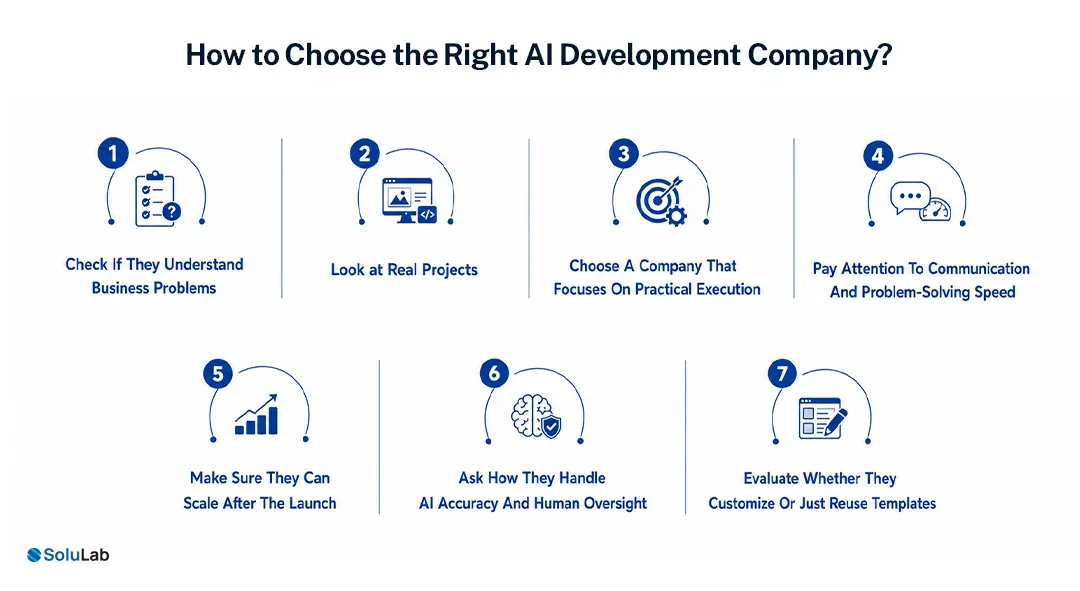
Still torn between the ten? Fair. We ranked them on where the AI market is actually heading, the automation demand showing up across industries and borders, their track record finishing what they start, and years of hands-on experience in the field.
So if you need to squeeze this down to one name, run each candidate past the checklist below.
- Check If They Understand Business Problems
Plenty of shops can wire up a chatbot or train a model. Far fewer stop to ask why your business needs AI at all. You don’t want a team bolting AI onto everything because it looks current. That’s how brands end up with features nobody touches, then burn months chasing adoption that was never there.
- Look at Real Projects
Most AI agencies sound sharp on a sales call. The tell is what they’ve actually shipped. If they can walk you through how a solution moved operations, retention, or revenue, believe that over slick jargon and recycled case studies every time.
- Choose A Company That Focuses On Practical Execution
AI projects die from overcomplication. A good partner keeps it small, focused, usable. In practice, this is where teams get stuck: they green-light a giant AI system when a modest automation workflow would have cleared the same problem in two weeks.
- Pay Attention To Communication And Problem-Solving Speed
AI work moves quick, and every delay stacks on the last. You want a company that answers plainly, adjusts on the fly, and explains a technical call without turning it into a lecture. Otherwise your own team burns more hours untangling confusion than actually building.
- Make Sure They Can Scale After The Launch
Loads of AI demos shine right up until real users, real data, and real traffic hit them. Then they buckle. The right company plans past launch day, standing up infrastructure, integrations, and tuning early, before scale turns into a fire drill.
- Ask How They Handle AI Accuracy And Human Oversight
AI still gets things wrong. The good firms don’t pretend otherwise. They wire in validation layers, monitoring, and human review, instead of hoping automation just handles it unsupervised.
- Evaluate Whether They Customize Or Just Reuse Templates
Some agencies quietly resell the same AI product to every client with a fresh coat of paint. It bites you later. A strong company shapes the solution around your workflows, your users, and where the business is going, rather than jamming a generic system into your setup. While you’re at it, ask about AI MVP development cost and how the working process really runs day to day.
AI Industry Trends Driving Business Growth
AI quit being a someday thing. It’s in the room now, quietly reshaping how companies work, decide, talk to customers, and, if we’re honest, how fast some of them survive while others just fade out.
- Generative AI Becoming Daily Infrastructure: Companies aren’t kicking the tires anymore. They’re building operations on top of it. From content to code, generative AI has slid into the everyday workflow.
- Rise of AI Agents and Autonomous Systems: The leading firms are shipping agents that handle tasks, make calls, and take repetitive operations off people’s hands without someone hovering over them.
- Hyper-Personalization Across Customer Experiences: AI reads people better than it used to. Recommendations, support, marketing, all of it feels more personal because the systems learn behavior as it happens.
- AI + Data Analytics Driving Faster Decisions: The top artificial intelligence companies pair AI with predictive analytics so businesses catch patterns early, dodge risk, and decide quicker.
- Enterprise AI Adoption Scaling: Pilots are finally graduating to production. AI is landing inside the core systems now, CRM, ERP, supply chains, support.

Why is SoluLab Our Top Pick?
AI outpaces most companies’ ability to keep up. Across every industry, businesses are now standing up AI agents, automation, and whole workflows built on artificial intelligence.
Adopting AI stopped being the hard question. Picking the partner who can actually build something that scales and holds up, that’s the hard part. So businesses go hunting for an artificial intelligence solution provider that gets enterprise needs, growth, and where an AI strategy has to go long-term.
Look at what SoluLab has already shipped and the top spot on this list stops feeling like a claim.
Take UpdateIA. SoluLab’s team built it as an enterprise-grade AI environment around Jarvis, a central orchestration engine that coordinates 14+ autonomous AI agents spanning HR, Finance, Legal, CRM, and Operations.
Key Outcomes Delivered
- 80% reduction in manual workflows through AI-powered automation across 14+ specialized business agents, enabling teams to focus on higher-value tasks.
- Integrated 40+ enterprise connectors with over 60% automation coverage in the first rollout, connecting platforms such as Salesforce, Microsoft 365, Google Workspace, and Personio.
- Achieved 3X faster task execution with real-time orchestration, compliance monitoring, and intelligent fallback mechanisms for uninterrupted operations.
That commitment to AI that actually serves enterprise needs is what keeps SoluLab at the front. Reach out and let’s get your AI development moving.
FAQs
Healthcare, finance, retail, logistics and manufacturing lead adoption, because each runs high-volume processes where prediction or automation pays back quickly. Finance and healthcare move fastest on document-heavy work such as claims and clinical notes. Logistics and manufacturing concentrate on forecasting, routing and visual inspection.
A proof of concept runs $10,000 to $30,000. A production chatbot or copilot falls between $20,000 and $80,000. Enterprise platforms with governance and multi-model deployment start around $80,000 and climb from there. Data engineering and post-launch tuning are the two line items most often left out of a first budget.
A proof of concept takes four to eight weeks. A production application with real integrations runs three to five months. Enterprise platforms take six months or more. Data preparation is usually the longest phase, and it is the one most teams underestimate when they plan backwards from a launch date.
It ships enterprise AI that reaches production rather than stopping at demo stage, with work delivered across healthcare, fintech, logistics, gaming and real estate. It holds 4.9 to 5.0 ratings on Clutch and GoodFirms, and covers generative AI, AI agents, machine learning and integration under one team rather than subcontracting the pieces.
Yes. Most deployments connect through APIs to the CRM, ERP, data warehouse and document stores already in place rather than replacing them. The integration work is frequently larger than the model work, since it covers access control, data quality and making sure the system reads only what it is permitted to read.
Hourly rates run $40 to $120 globally for a mid-level generative AI developer, and $100 to $200 in the United States. Project pricing is more useful: a proof of concept starts around $10,000, a RAG-based application around $30,000, and an enterprise platform from $80,000 upward.
An AI development company covers the full range, including predictive models, computer vision and automation. A generative AI specialist concentrates on large language models, retrieval pipelines, copilots and agent systems. Firms that ship strong predictive work do not automatically have depth in fine-tuning or inference cost control.
A proof of concept typically takes four to eight weeks. A production chatbot or copilot runs three to five months including integration and testing. Enterprise platforms with governance and multi-model deployment take six months or more, with data preparation usually the longest single phase.
Yes. Most deployments connect through APIs to CRM, ERP, document stores and internal databases rather than replacing them. The integration work is often larger than the model work, because it involves access control, data quality and making sure the system only reads what it is permitted to read.
Pick the measure before the build, not after. The workable ones are hours removed from a named process, reduction in handling time or error rate, and revenue from capability that did not previously exist. Model accuracy on its own is an engineering metric, not a business return.
Match buyer type first. Enterprise modernisation, startup MVP work and pure talent augmentation are different businesses, and few firms do all three well. Then check shipped projects in your industry, ask how they handle accuracy and human oversight, and confirm they plan for scale past launch day.
Deepika is a content writer who blends storytelling with strategic thinking. She explores topics across digital innovation, emerging tech, and the evolving blockchain industry. She enjoys breaking down complex ideas into simple, engaging narratives in the growing global markets.