Key Takeaways
- It’s actively changing industries like healthcare, finance, retail, and logistics by improving efficiency, accuracy, and speed of operations.
- Businesses are using AI to automate repetitive tasks, reduce operational costs, and free up human resources for more strategic, high-value work.
- Personalization is becoming a key differentiator. AI enables tailored customer experiences at scale, driving higher engagement and better conversion rates.
- Data is the foundation. AI helps process massive datasets into actionable insights, allowing faster and more informed decision-making.
- Predictive capabilities are a game-changer. From demand forecasting to risk management, AI helps businesses stay ahead instead of reacting late.
- Industries adopting AI early are gaining a strong competitive edge, while late adopters risk falling behind in efficiency and innovation.
Businesses today are drowning in data but still struggling to make faster, smarter decisions. Manual processes, rising competition, and constant demand for personalization are making it harder to stay efficient and relevant.
The gap between what companies can do and what they should be doing keeps widening. This is where the pressure builds. Without the right technology, growth slows, costs rise, and opportunities slip away.
Artificial Intelligence development is changing that equation. From automating operations to predicting customer behavior and improving accuracy, AI is helping businesses move with speed and confidence.
According to Gartner, some estimates place the market even higher at around $900 billion in 2026. In this blog, we break down the top 10 applications of AI in 2026 and how they are reshaping industries.

Why Artificial Intelligence Is Required Today?
Artificial Intelligence refers to machines and software systems designed to mimic human intelligence. They can learn from data, recognize patterns, make decisions, and improve over time without being explicitly programmed for every scenario.
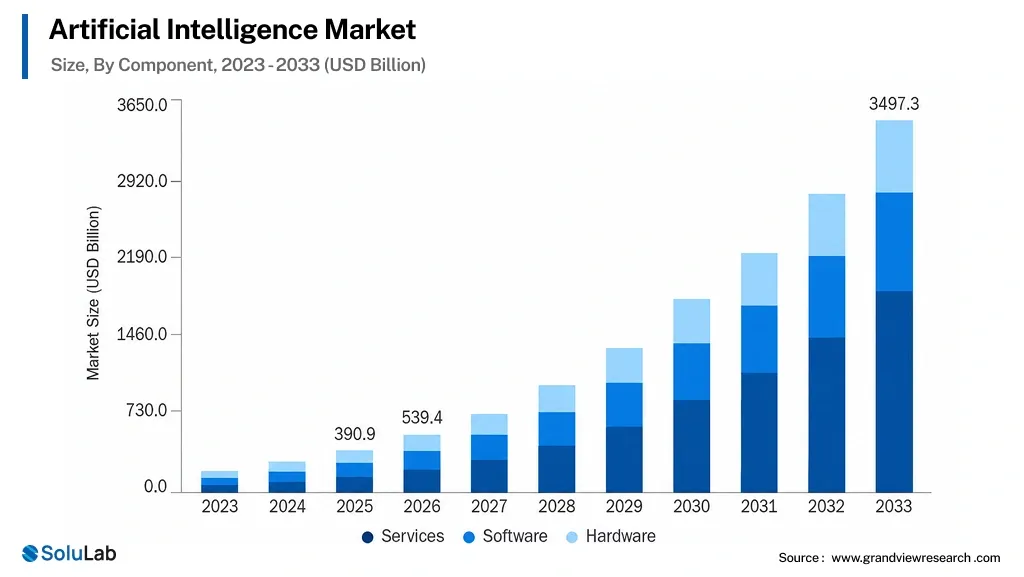
The global artificial intelligence market size is expected to reach USD 3,497.26 billion in 2033, expanding at a CAGR of 30.6% from 2026 to 2033. At its core, AI is about:
- Learning from data instead of fixed rules
- Making predictions or decisions
- Continuously improving with experience
Here’s why AI has become essential:
- Data Overload: Businesses generate massive amounts of data daily. AI-powered solutions help process and extract meaningful insights quickly, something humans alone can’t handle efficiently.
- Need for Speed: Markets move fast. AI enables real-time decision-making, whether it’s pricing, customer support, or fraud detection.
- Automation of Repetitive Work: Routine tasks slow teams down. AI automates these processes, allowing people to focus on strategy and innovation.
- Better Accuracy: Human decisions can be inconsistent. AI reduces errors by analyzing patterns and making data-backed predictions.
- Personalization at Scale: From recommendations to customer journeys, AI helps businesses deliver tailored experiences to millions of users simultaneously.
- Competitive Advantage: Companies using AI are operating faster, smarter, and more efficiently. Without it, staying competitive becomes difficult.
Top AI Use Cases and Applications to Watch in 2026
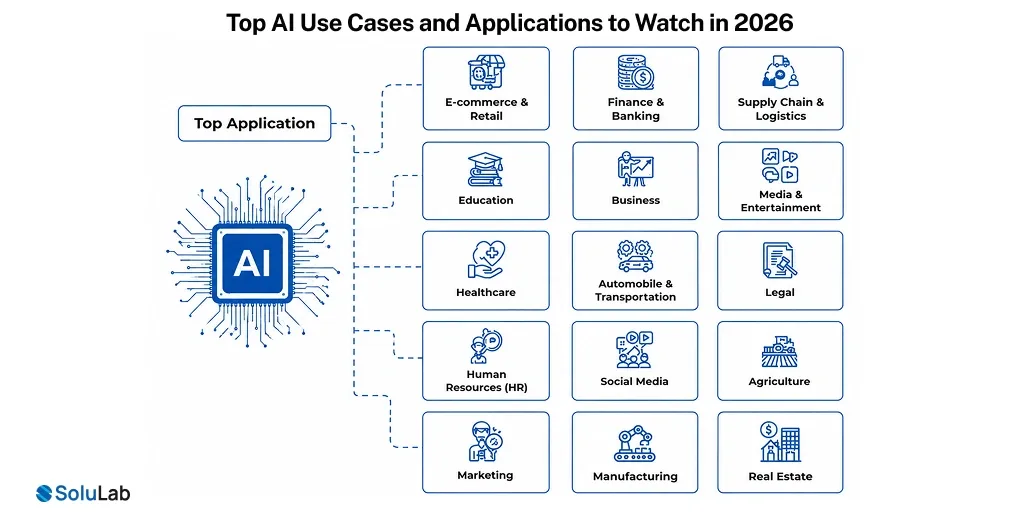
AI isn’t just evolving, it’s embedding itself into everyday systems, making industries faster, smarter, and more predictive. What once felt futuristic is now practical, scalable, and driving real business outcomes.
1. E-commerce & Retail
- Personalized Product Recommendations
AI for E-commerce uses browsing and purchase history to tailor product suggestions, increasing conversion rates and improving customer satisfaction by offering relevant items.
- Chatbots & Virtual Shopping Assistants
AI-driven chatbots provide round-the-clock support for customer queries, returns, and product discovery, enhancing user experience and driving sales efficiency.
- Dynamic Pricing & Inventory Management
AI analyzes demand trends, competition, and seasonality to automatically adjust pricing and optimize inventory, ensuring maximum profitability and reduced stockouts.
- Seamless Customer Journey
AI-powered solutions simplify customer interactions with buying advice and smooth navigation, while Kommo’s AI agent streamlines chat management through smart replies and summaries, ensuring a seamless and consistent customer journey.
2. Education
- AI-Powered Tutoring Systems
AI for Education adapts lessons to each student’s pace and learning style, offering personalized guidance and instant feedback to enhance results.
- Automated Grading & Assessment Tools
AI speeds up grading by analyzing student submissions with NLP and image recognition, enabling faster and more consistent evaluations.
- Student Behavior & Performance Analytics
AI analyzes student data to predict academic success, identify learning gaps, and assess dropout risks, helping educators provide timely interventions.
3. Healthcare
- AI in Medical Imaging & Diagnostics
AI in Healthcare analyzes medical images with high accuracy, assisting in the early detection of diseases like cancer, strokes, or fractures for faster diagnosis and treatment.
- Drug Discovery & Development
AI models accelerate drug research by identifying promising compounds and predicting their effectiveness, cutting down time and costs in bringing new drugs to market.
- Virtual Health Assistants
AI-powered chatbots and voice assistants provide 24/7 symptom checks, health monitoring, and personalized advice, enhancing patient care and engagement.
4. Business
- Process Automation with AI Bots
AI bots automate repetitive tasks like data entry, invoicing, and customer support, improving operational efficiency and reducing human error.
- AI-Powered Decision Support Systems
AI in Business analyzes vast data sets to provide actionable insights, helping businesses make informed and reliable decisions quickly.
- Predictive Analytics for Sales & Growth
AI models forecast market trends and customer behavior, enabling businesses to proactively adjust strategies for optimal sales and growth.
5. Human Resources (HR)
- Resume Screening & Talent Matching
AI in HR filters and ranks resumes based on job requirements, streamlining recruitment by matching the right candidates with suitable roles.
- Employee Sentiment Analysis
AI analyzes employee feedback and communication to measure confidence, identifying potential issues and helping HR teams improve workplace culture.
- Onboarding Automation
AI-powered chatbots guide new employees through the onboarding process, providing information and training while reducing manual effort.
6. Marketing
- AI Content Generation
AI for content creation creates blogs, social media posts, and ad copies in seconds, helping marketers produce consistent and engaging content at scale.
- Customer Journey Personalization
AI customizes content and messaging based on individual user behavior, preferences, and touchpoints, boosting engagement and conversions. Pairing these efforts with customer journey analytics software helps businesses visualize the full path to purchase and make data-driven improvements.
- Predictive Campaign Analytics
AI analyzes past campaign data to forecast performance, optimize targeting, and refine future marketing strategies.
7. Finance & Banking
- Fraud Detection & Risk Management
AI monitors transactions in real time to detect anomalies and prevent fraudulent activities, ensuring secure banking operations.
- AI-Powered Chatbots for Banking
Virtual assistants handle customer queries, assist with transactions, and provide financial guidance 24/7, improving service efficiency.
- AI in Insurance
AI evaluates risk profiles, automates underwriting, and speeds up claims approval by analyzing documents and customer data efficiently.
8. Automobile & Transportation
- Autonomous Driving & Assistance
AI enables self-driving capabilities and advanced driver assistance systems (ADAS) for safer and more efficient travel.
- Traffic Pattern Prediction
There are many AI-based route management software which easily analyze real-time and historical data to optimize traffic flow, reduce congestion, and improve route planning.
- Fleet Management Optimization
AI helps companies monitor vehicle health, fuel usage, and driver behavior, improving logistics and reducing operational costs.
9. Social Media
- Content Moderation & Fake News Detection
AI for Social media scans all the posts, images, and comments to detect harmful, inappropriate, or misleading content in real time.
- Audience Sentiment Analysis
AI evaluates user reactions, comments, and engagement to understand public sentiment analysis and brand perception.
- Smart Content Scheduling
AI identifies the best times to post and suggests content formats that maximize visibility and user interaction.
10. Manufacturing
- Predictive Maintenance
AI monitors equipment performance to predict failures before they happen, reducing downtime and maintenance costs.
- AI in Quality Control
Computer vision, powered by AI, detects defects or inconsistencies in products during the manufacturing process with high accuracy.
- Production Line Automation
AI-powered robotics and systems streamline repetitive tasks on the factory floor, improving speed, precision, and efficiency.
11. Supply Chain & Logistics
- Route Optimization
AI analyzes real-time traffic, weather, and delivery data to determine the most efficient delivery routes.
- Demand Forecasting
AI for demand forecasting predicts product demand using historical sales, market trends, and seasonal factors, helping avoid overstock or stockouts.
- Warehouse Automation
AI-powered robots and systems manage inventory storage, picking, and packing, enhancing speed and accuracy in fulfillment.
12. Media & Entertainment
- AI-Generated Music, Scripts, and Art
AI tools create original music, screenplays, and artwork, helping content creators in producing diverse creative assets quickly.
- Content Recommendation Systems
AI suggests movies, shows, and music based on user preferences and viewing history, enhancing user engagement and satisfaction.
- AI in Gaming
AI drives game development by creating adaptive, intelligent NPCs (non-playable characters) and personalizing in-game experiences for players.
13. Legal
- Contract Analysis
AI for Legal process analyzes documents, highlighting potential risks, clauses, and inconsistencies, speeding up contract review processes.
- Legal Research Automation
AI accelerates legal research by quickly scanning case law and statutes, saving time and improving accuracy for lawyers.
- Regulatory Compliance Monitoring
AI-enabled data archiving tracks changes in regulations and ensures businesses remain compliant by analyzing vast amounts of legal data in real time.
14. Agriculture
- Crop Health Monitoring
AI-powered drones and imaging systems monitor crop health, detecting diseases and pests early to optimize yields.
- Smart Irrigation & Farming
AI analyzes soil moisture and weather data to optimize irrigation schedules, conserving water and ensuring efficient resource use.
- Yield Prediction Models
AI models predict crop yields by analyzing environmental factors, helping farmers plan better and reduce waste.
15. Real Estate
- AI-Based Property Valuation
AI uses market data, trends, and property features to provide accurate and dynamic property valuations.
- Virtual Tours & Chat Assistants
AI creates immersive virtual property tours and offers chatbot assistance, making property browsing and inquiry management more interactive.
- Lead Scoring
AI analyzes buyer behavior to predict conversion potential, helping real estate agents focus on high-value prospects.
Read Our Blog Post: AI-First Legacy Modernization
How SoluLab Can Help with AI Applications?
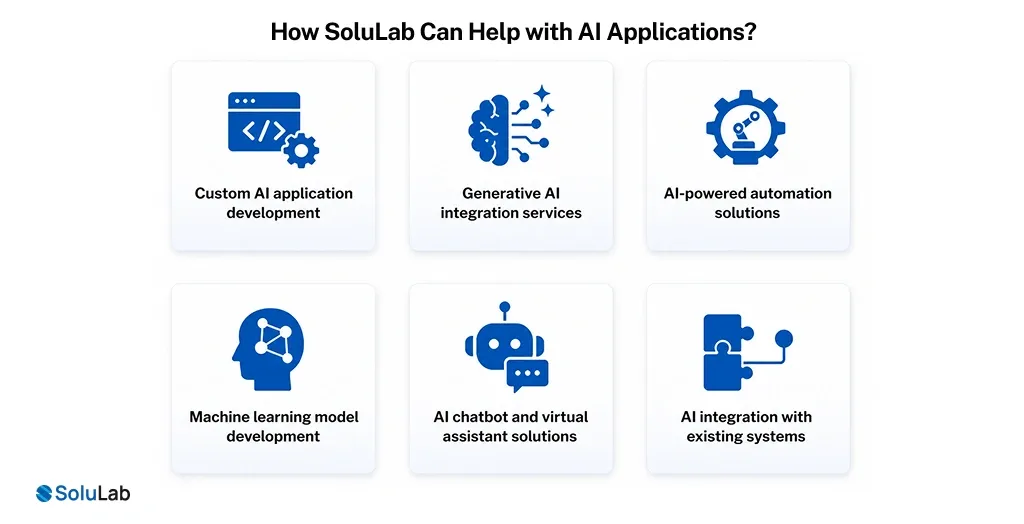
With an AI-native approach, soluLab can create AI chatbots and integrate AI in existing workflows. Here are a few ways we can help:
- Custom AI application development: SoluLab develops tailored AI applications aligned with your business goals, operational requirements, and industry-specific challenges for long-term scalability and performance.
- Generative AI integration services: Our team helps businesses integrate generative AI capabilities for automation, content generation, intelligent assistants, and advanced customer engagement experiences.
- AI-powered automation solutions: We create intelligent automation systems that improve workflows, reduce manual efforts, and enhance operational efficiency across multiple business functions.
- Machine learning model development: SoluLab builds and trains machine learning models using quality datasets to deliver accurate predictions, analytics, and data-driven business insights.
- AI chatbot and virtual assistant solutions: We develop AI chatbots and conversational AI platforms that improve customer support, engagement, and personalized communication experiences.
- AI integration with existing systems: Our experts integrate AI into existing software, enterprise platforms, mobile apps, and business infrastructure with minimal operational disruption.
For example, SoluLab built CyberHulk, an AI-powered marketing SaaS platform that unified campaign management, lead generation, analytics, and workflow automation.
By integrating multiple marketing tools into one system, CyberHulk helped businesses reduce manual effort, improve lead quality, and make faster, data-driven growth decisions across channels.
Why Are Businesses Turning to Artificial Intelligence?
Artificial Intelligence (AI) is being used because people are finding automation to be a useful solution to the increasing demands of daily work. The strategic approach taken by these new AI apps not only frees up workers from repetitive tasks but also increases overall productivity. AI is also used by businesses to recruit and engage qualified workers, which promotes the expansion and advancement of the business.
In modern business practices, there is a widespread desire among companies to automate mundane and repetitive operations. The common notion is that such routine functions may be automated using simple apps. As data science advances, automation becomes more widespread. Online chat portals are one popular application of AI in this area, where automated welcome messages greet visitors on websites, sparking genuine conversations. This mirrors a broader trend in which businesses want to use Conversational AI to automate everyday processes and capitalize on the changing landscape of data science.

Conclusion
Artificial Intelligence in 2026 is creating real impact across industries, from healthcare and finance to retail, logistics, and beyond.
Businesses are using AI to automate operations, improve decision-making, and deliver more personalized experiences at scale. The shift is clear. Companies that adopt AI are moving faster, reducing costs, and staying competitive.
As this technology continues to upgrade, the gap between AI-enabled and traditional businesses will only grow wider. If you’re planning to leverage AI for your operations, SoluLab, an AI development company in USA, can help your business build, scale, and implement the right solutions.
FAQs
Shipra Garg is a tech-focused content strategist and copywriter specializing in Web3, blockchain, and artificial intelligence. She has worked with startups and enterprise teams to craft high-conversion content that bridges deep tech with business impact. Her work translates complex innovations into clear, credible, and engaging narratives that drive growth and build trust in emerging tech markets.