Big data has changed how companies make decisions across nearly every industry, showing them what’s working, what isn’t, and where to improve. Most industries are still catching up. Oil and gas isn’t one of them. This sector has leaned on massive amounts of data for decades, running visualization software and seismic technology to figure out what’s sitting deep beneath the Earth’s surface.
But data volumes keep climbing, and companies know that raw data alone isn’t enough anymore. Better analytics is what actually turns that data into stronger operations and better margins.
This article walks through how big data is making the oil and gas industry faster and more efficient.
A report by Globe Newswire puts the big data analytics market at $1.2 trillion by 2032, growing 14.5% a year. That’s a serious amount of data.
Big Data Analytics in the Oil and Gas Industry: Overview
Technology keeps pulling more of everyday life online, from grocery orders to military operations. All of that activity can now be tracked, monitored, and stored somewhere. That flood of data is what gave rise to “big data” in the first place: datasets so massive that traditional tools simply can’t keep up with them.
For oil and gas data to count as true big data, it needs to show at least some of a specific set of traits. Let’s walk through each one. Big data typically gets defined by six characteristics, known as the six Vs:
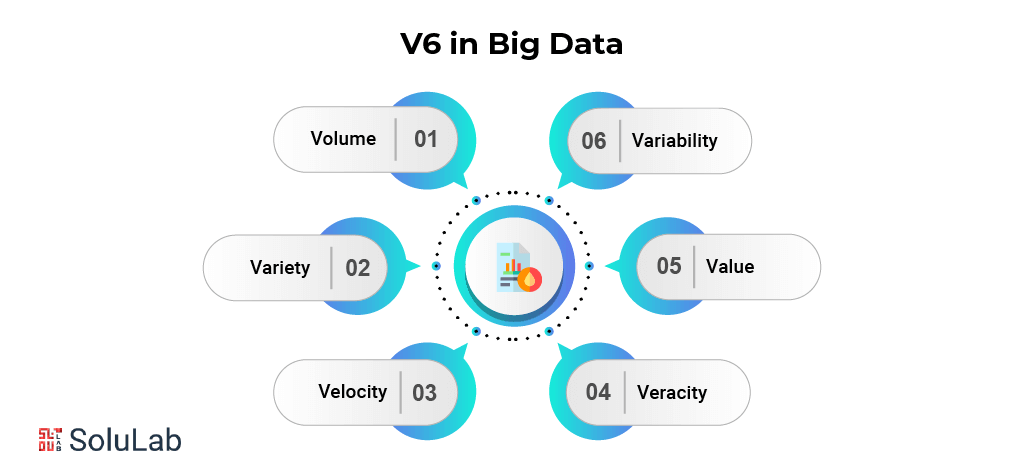
- Volume: Data recording sensors are what generate big data in oil and gas. These sensors make better data collection possible throughout drilling, exploration, and prediction.
- Variety: Big data shows up as unstructured, semi-structured, or structured data. Oil and gas companies generate structured data through survey applications, exploration data, and production-related records, while emails, market feeds, and site images produce the semi-structured side.
- Velocity: With real risk of death or serious injury in this industry, real-time decisions matter a lot. That’s exactly why the sector puts so much weight on combining and synthesizing data sources quickly, which pushes the rate of data output up sharply.
- Veracity: Applied well, big data analytics supports seismic processing, reservoir modeling, and sensor calibration, backing up multiple stages of oil production, delivery, transportation, and exploration.
- Variability: Data in this industry takes many shapes. Scanning the earth’s surface for oil might produce pictures and video, or it might come out as conventional structured numerical data from sensors and surveys.
- Value: And ultimately, the payoff is real. Big data analytics helps with exploration, navigation, and visualization, and it sharpens drilling procedures to cut costs, improve safety, and lift output.
Benefits of Big Data Analytics in the Oil and Gas
Big data analytics has genuinely reshaped the oil and gas sector. Across big data use cases in oil and gas, companies are applying this technology in a wide range of ways, and it pays off in productivity, security, and profitability. A few of the biggest benefits:
1. Drilling and Exploration
Big databases let companies cut exploration time and cost by driving smarter drilling decisions. ConocoPhillips is a good example: using data analytics and sensor deployment, the company cut 50% reduction off drilling time in the Eagle Ford shale region in South Texas.
2. Predictive management
Big data analytics makes predictive maintenance possible by examining equipment data and spotting problems before they happen. That lowers maintenance costs and cuts unscheduled downtime. Predictive analytics, for example, is already helping oil and gas companies reduce maintenance costs and downtime on processing equipment.
3. Optimization of Operations
Analyzing data across operations helps companies spot inefficiencies in their processes. That leads directly to cost reductions and tighter resource management. Big data analytics turns massive datasets into concrete exploratory decisions and lower operating expenses.
4. Mitigation of Risk
Watching trends and irregularities in data helps big data analytics catch possible hazards early. That proactive approach lowers environmental risk and tightens up safety procedures. Predictive analytics, for instance, can flag operational disruptions and hazard events during industrial operations, so teams can respond fast.
5. Decision Making
Real-time data and advanced analytics give decision-makers something concrete to act on. That means decisions get made faster and more accurately, which lifts overall company performance. Advanced data analysis helps companies manage resources better, tighten drilling procedures, and predict equipment breakdowns before they happen.
6. Cost Reduction
Big data analytics can drive real cost savings across a business. BP and Palantir Technologies partnered specifically to use artificial intelligence to sharpen exploratory decision-making and bring operating costs down.
Big data analytics brings a lot to the table for oil and gas: sharper exploration, lower operating expenses, reduced risk. As the industry keeps evolving, using this data well won’t be optional. It’ll be what keeps a company competitive.
Components of Big Data Analytics in the Oil and Gas
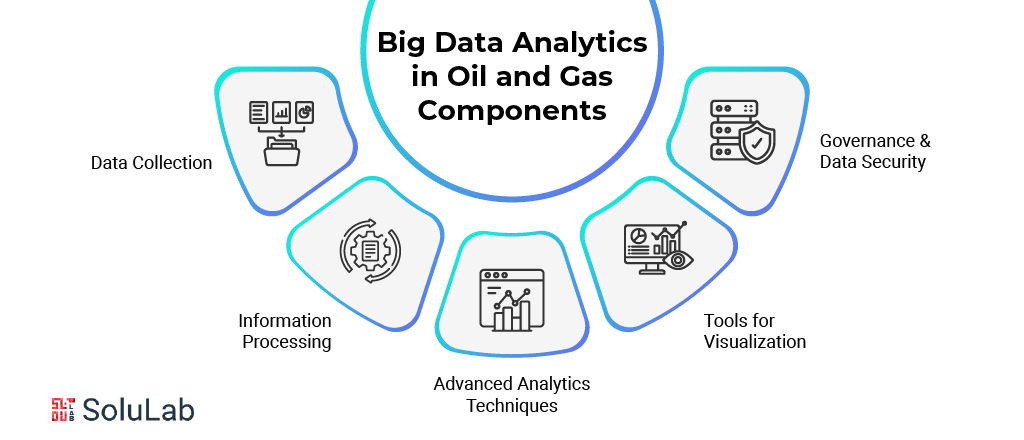
Applying big data analysis in the oil and gas industry helps companies find new growth opportunities, but it doesn’t work in isolation. Let’s look at the components that make big data analytics capable of reshaping this industry.
1. Data Collection
Data collection is the first real step toward analytics in oil and gas. It can be structured or unstructured, pulled from IoT sensors, seismic surveys, satellite imaging, mobile apps, and cloud services.
Companies need to adjust how they gather data and pull it into centralized repositories, tagging it automatically with metadata so it’s easier to find and manage later. Think DBMS software, data lakes, and data warehouses.
2. Information Processing
Once the data’s gathered, it needs processing: organizing it, extracting it, loading it into storage systems like MongoDB, NoSQL, Google Cloud Storage, Apache Cassandra, and similar tools.
Data processing relies on aggregation and type conversion to turn raw data into something usable. Tools like Apache Spark and Hadoop help process large, scattered datasets faster and more efficiently.
Batch processing and stream processing let companies handle huge volumes of data over long stretches of time, alongside smaller volumes that need to move in real time.
3. Advanced Analytics Techniques
Pulling real insight out of historical and real-time data takes sophisticated techniques: data mining algorithms, machine learning, deep learning, and predictive analytics.
These methods let companies spot trends, estimate production outcomes, and anticipate equipment faults before they happen, all of which feeds into better decisions.
4. Tools for Visualization
Visualization tools matter just as much. Dashboards, reports, and interactive operational data all help companies turn dense, complex data into something they can actually act on, giving them a clear read on the current operational stage.
3D modeling tools add another layer, letting engineers and geoscientists precisely visualize reservoirs and drilling operations so they can plan and execute with more confidence.
5. Governance and Data Security
Cyberattack risk keeps climbing, which makes data security a real priority. Access control systems and encryption keep sensitive data safe from unwanted access in the software oil and gas companies rely on.
Strong data quality management also matters here, keeping data accurate, consistent, and dependable, which in turn supports better decisions and regulatory compliance.

Real-life examples of Big Data Analytics in the Oil and Gas
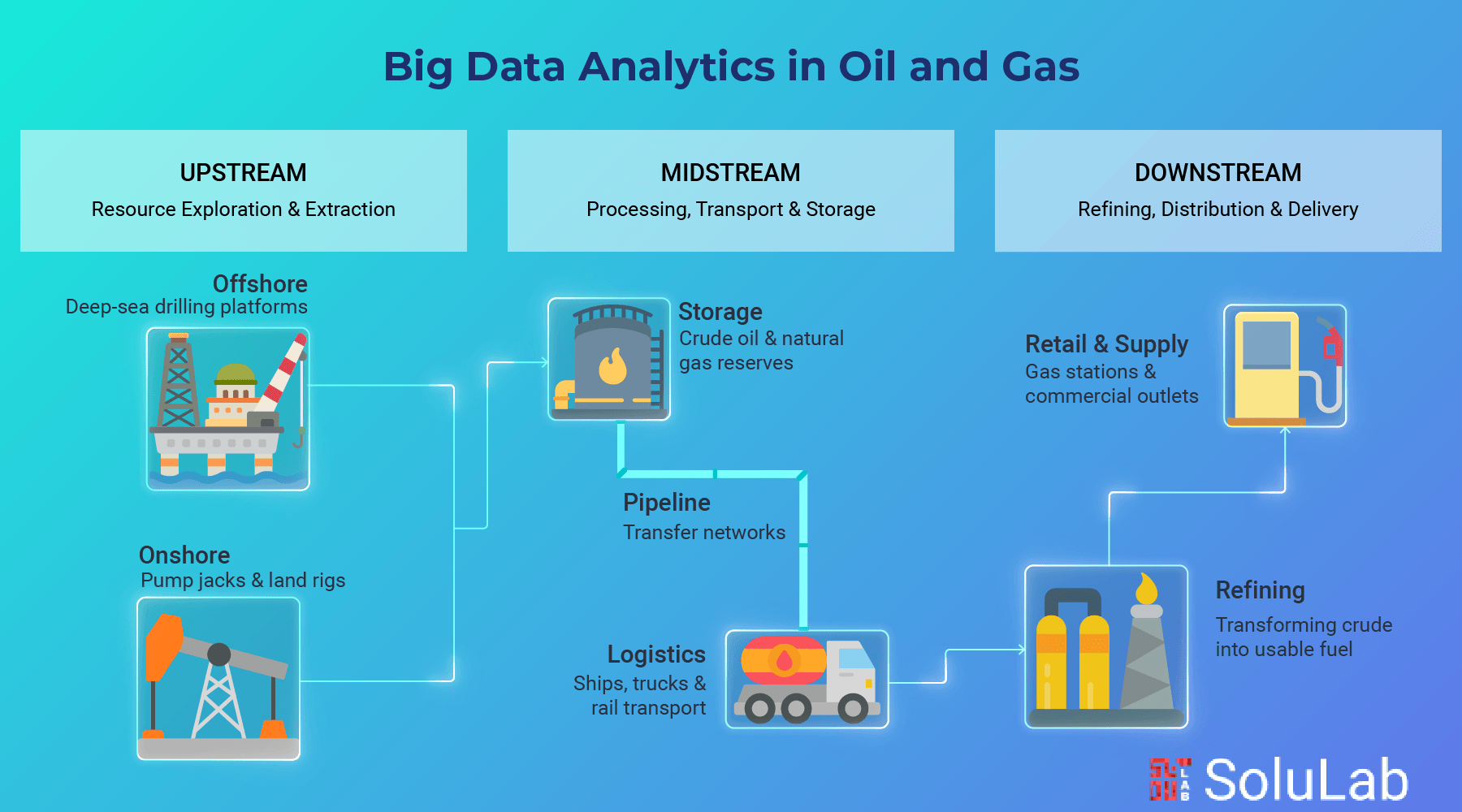
Big data is already reshaping oil and gas, helping companies run more efficiently, cut risk, and make sharper decisions. Here’s what that looks like in practice.
1. Royal Dutch Shell
Shell leans on big data to sharpen its decisions. With thousands of oil wells to keep running smoothly, that’s no small task. Sensor data lets Shell predict when a machine is about to fail.
That means fixing it before it becomes a real problem, saving both time and money. Shell also uses data to identify the best drilling spots by analyzing rock formations and underground conditions.
2. Bharat Petroleum
Bharat Petroleum uses big data to improve fuel quality and customer service. They pull data from fuel stations to track fuel demand, pricing, and customer behavior.
That information feeds directly into better decisions about where to open new stations and how to price fuel. It also helps them catch fuel theft by spotting patterns that don’t look right.
Future Trends of Big Data Analytics in Oil and Gas
Big data analytics keeps driving innovation and productivity in oil and gas. Here’s what’s shaping where it goes next:
1. Integration of ML and AI
AI and ML are becoming core parts of big data analytics in oil and gas, since they make predictions sharper and let decisions happen automatically. Companies like BP are using large language models to comb through operational data and pull out actionable insight, pushing the boundaries of AI application to sharpen how decisions get made.
2. Computing and real-time data processing
Computing now lets companies process data in real time even at remote locations like oil rigs and drilling pads. That cuts latency and sharpens decision-making through fast feedback on ambient conditions and equipment performance.
3. Predictive Maintenance
Predictive maintenance built on big data analytics lets companies foresee equipment failure and cut both downtime and maintenance costs. AI-equipped drones are now handling remote monitoring, which means faster interventions and fewer operational stoppages.
Read Also: How to Build a Predictive Analytics Model?
4. Data-Driven Sustainability Initiatives
Big data analytics is also becoming a real driver of sustainability, optimizing resource use and cutting environmental footprint. Companies are investing in low-carbon technology and using data to track and reduce emissions, lining their operations up with international sustainability goals.
5. Supply Chain Efficiency
Analyzing data along the supply chain helps companies spot inefficiencies and tighten logistics, cutting costs and speeding up delivery. Supply chain performance improves through better inventory management and forecasting demand.
Conclusion
Like a lot of industries, oil and gas is waking up to what big data analytics can actually do. It draws on production rates, seismic data, drilling rig data, frack performance data, and more, helping the industry make genuinely well-informed decisions.
Big data analytics is going to keep playing a bigger role in oil and gas going forward, given what it delivers: finding possible oil sources, producing oil more efficiently, lowering cost and risk, and sharpening compliance and decision-making.
SoluLab, a pioneer in software development, brings years of experience and a team of professionals ready to work on your business needs. Even in oil and gas, we’re delivering on-demand applications to make your operations run smoother with high-tech solutions. Still figuring out your business plan? get in touch with our experts and get started today.
FAQs
Shipra Garg is a tech-focused content strategist and copywriter specializing in Web3, blockchain, and artificial intelligence. She has worked with startups and enterprise teams to craft high-conversion content that bridges deep tech with business impact. Her work translates complex innovations into clear, credible, and engaging narratives that drive growth and build trust in emerging tech markets.