Ever get the feeling that building your own AI model is something only big tech companies with massive teams and millions in funding get to do?
Most beginners, and honestly even experienced developers, get stuck thinking they need insane computing power, secret algorithms, or a deep ML PhD just to get started. Here’s the truth: you can build your own open-source AI model from scratch if you follow the right process and use the tools that already exist.
As of February 2025, DeepSeek had 61.81 million monthly active users, marking an 83.4% increase from the previous month.
In this guide, I’ll break it all down into simple, actionable steps so you can go from idea to deployment without getting lost. Let’s dive in.
What is an Open-Source AI Model?
An open-source AI model is exactly what it sounds like: an artificial intelligence model anyone can view, use, modify, and share. The open-source AI model is a pretrained model built on large datasets, capable of recognizing images, understanding text, or making predictions. A few things define it:
- Free access: no need to pay or get permission.
- Customizable: you can tweak the model to suit your needs.
- Transparent: you can see exactly how it was built and trained.
Prerequisites Before Building Your Model
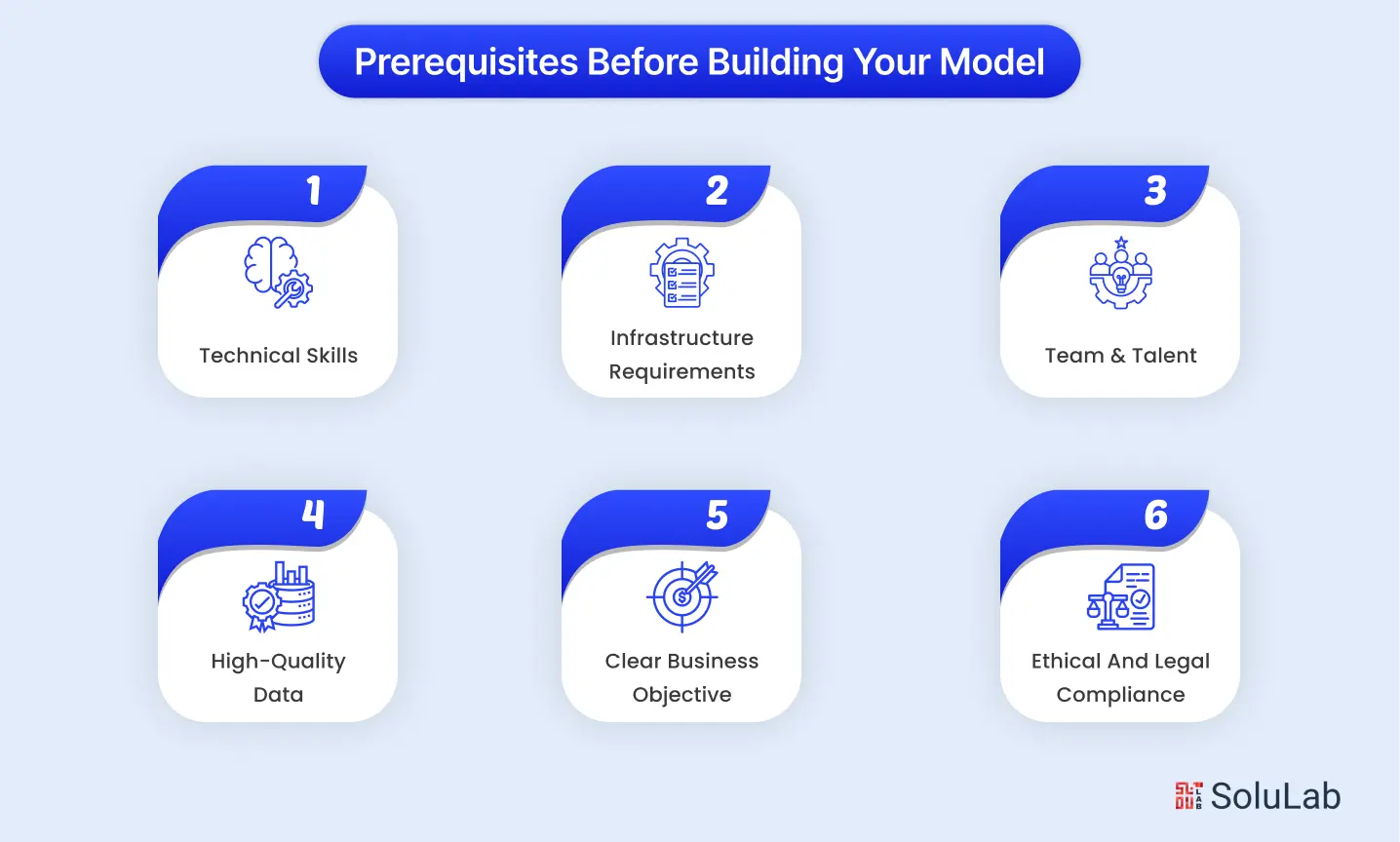
Before you start developing your open-source AI model, there’s a handful of things worth thinking through first: team size, infrastructure needs, technical expertise. Let’s break each one down:
- Technical Skills: To build your AI model open-source, you’ll need a solid grasp of Python, data structures, machine learning algorithms, and frameworks like TensorFlow or PyTorch. These are what make developing, training, and fine-tuning AI models actually work.
- Infrastructure Requirements: training AI models needs high-performance hardware, like GPUs or TPUs, plus cloud platforms (AWS, GCP, Azure) for scalability, speed, and storage. Skip this, and large models can take weeks to train.
- Team & Talent: You can’t build this alone. AI model development is a team sport, requiring data scientists, ML engineers, domain experts, and DevOps professionals working together to keep the model accurate, scalable, and actually practical.
- High-Quality Data: Your model is only as good as the data it learns from. You need large, clean, labeled datasets relevant to your use case, pulled from sources that actually match your problem, to train something accurate and unbiased.
- Clear Business Objective: Without a clear goal, automating support, detecting fraud, personalizing recommendations, whatever it is, you risk building something technically impressive but commercially useless.
- Ethical and Legal Compliance: Before training your model, think through privacy laws (like GDPR), data usage rights, and ethical AI principles. It saves you legal trouble and keeps deployment responsible.
Step-by-Step Guide to Building an Open-Source AI Model
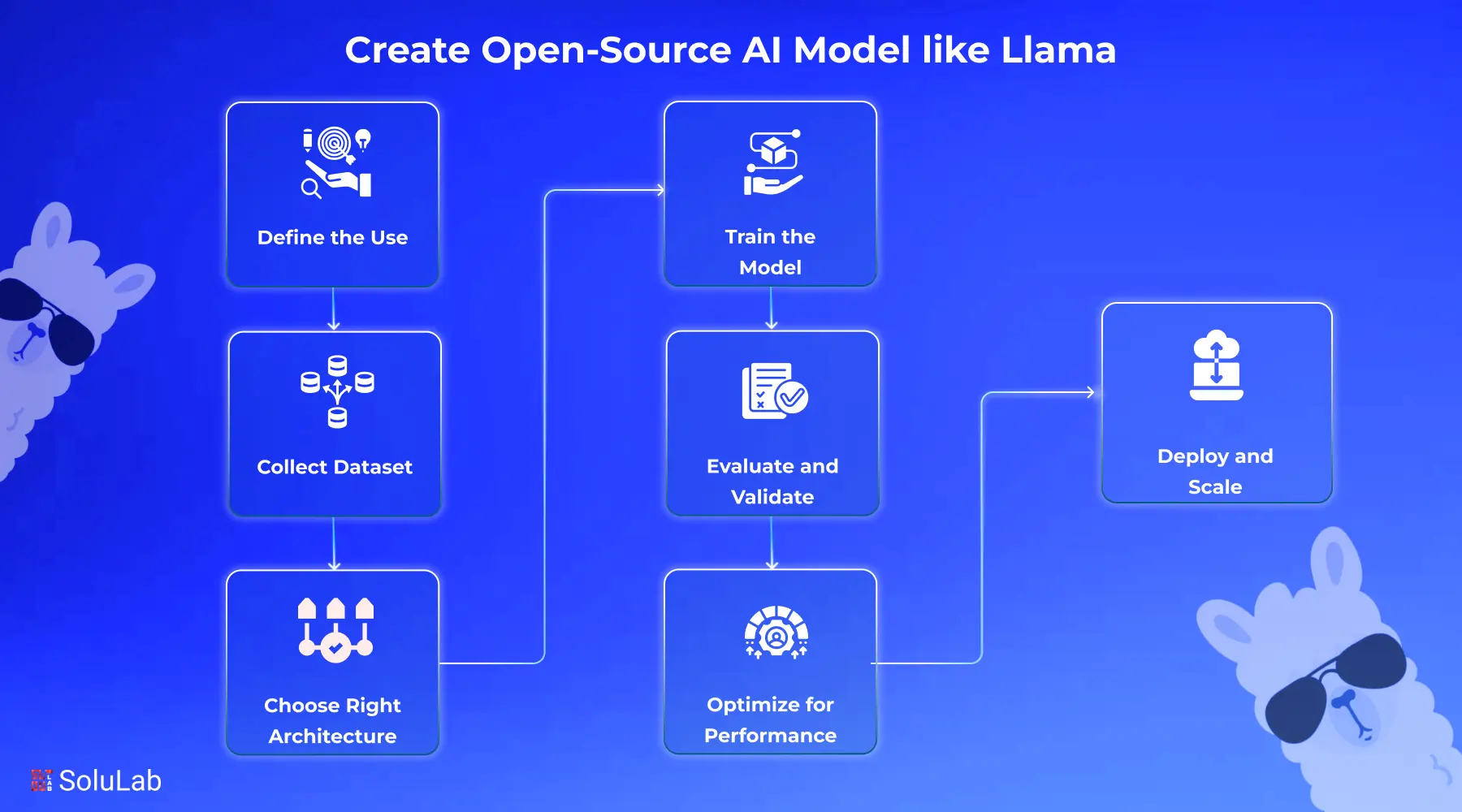
Here’s a step-by-step roadmap walking you through the whole journey, from idea to real-world deployment.
Define the Use
Before touching the tech, get clear on the why. What problem are you actually solving? Text summarization, image recognition, customer support chatbots? A well-defined use case works like a compass, it guides every step after this one and keeps you from building just for the sake of building.
Collect and Clean the Dataset
Your AI is only as good as the data you feed it. So gather a dataset that fits your use case, text, images, audio, whatever applies. Then clean it up. Remove duplicates, fix errors, make sure it’s properly labeled. Sounds boring, sure, but it’s the secret sauce behind a solid model.
Choose the Right Architecture
Now pick your model type. Working with text? Try LSTM or Transformer. Working with images? CNNs are your friend. You can start from an existing open-source architecture and fine-tune it from there. Pick whatever fits your project size, speed needs, and available compute.
Read Also: Most Popular AI Models
Train the Model
Here’s where it gets fun. Feed your data into the model and let it learn. This can take hours or days depending on complexity and hardware. Use frameworks like TensorFlow or PyTorch, and keep an eye on progress as you go, training is really just a cycle of tweaking and testing.
Evaluate and Validate
Once trained, it’s test time. How accurate is it really? Use validation data to see how it performs on inputs it’s never seen. Watch metrics like accuracy, F1-score, or loss. This is how you catch overfitting and figure out whether your model actually solves the problem you defined back in step one.
Optimize for Performance
You’ve got a working model, nice. Now make it faster, lighter, more efficient. Techniques like pruning, quantization, or distillation all help. You can even shrink the model so it runs on low-resource devices. Optimization is what makes your AI practical, not just powerful on paper.
Deploy and Scale
Time to launch. Decide where to deploy: cloud, on-premise, or edge devices. Use APIs or build user-friendly interfaces on top. Keep monitoring the model in real time and gather feedback as it runs. If things go well, scale it up to serve more users while keeping speed and accuracy intact.
Related: Llama Vs. GPT
Future Trends in Open-Source AI
Here’s what’s coming in the next few years, including the rise of open source multimodal AI models:
1. Start Making Smarter, Smaller Machines
Open-source AI is increasingly focused on models that can run on devices we already own. That means less dependence on massive cloud solutions, and models that are both more accessible and more power-efficient.
2. Increasing number of AI Agents
We’re seeing more AI agents that get things done without human direction. Microsoft is leading this trend, giving businesses the ability to build their own AI agents, which makes both productivity and innovation simpler to reach.
3. Open-Source AI Is Promoting Stronger Economic Growth
Open-source AI isn’t just a technology story, it’s boosting the economy too. Without having to pay heavily to implement AI, small and medium enterprises can come up with innovations that actually help them compete. That effect shows up most clearly in emerging markets.
4. AI models being owned by the public
The public is pushing for artificial intelligence models used in services like education and healthcare to be publicly owned. That keeps the process transparent, keeps responsibility accountable, and gives everyone a fair shot, aligning AI growth more toward supporting people than chasing profit.
5. Model Context Protocol (MCP) is now developed.
MCP is getting adopted for running AI models across multiple platforms. AI engines can talk to each other better, which improves system usage and saves time. Standardizing components matters here, it’s what makes AI applications that bring multiple models together actually work.
6. Developers Are Top Innovators in Open-Source AI
Open-source AI is being pushed forward by a generation of younger developers who care about sharing and being transparent about their work. Recent data from Stack Overflow shows more and more new entrants to the field getting involved in open-source development.
Conclusion
Creating a DeepSeek AI model open-source, a LLaMA AI model open source, or one hosted on Hugging Face might sound like a lot, but it’s doable if you follow the right steps. Start small, stay consistent, and focus on solving a real problem.
With the right data, tools, and community support, you can build something that’s not just functional but genuinely impactful. Open source isn’t only about code, it’s also about collaboration, transparency, and innovation.
Whether you’re a solo dev or a small team, the door’s wide open. So go build the next big thing in open AI. AI-Build partnered with SoluLab to revolutionize CAD product development using generative AI and ML models. SoluLab built a scalable architecture, automated design generation with GANs and CNNs, and added real-time error detection. The result: better productivity, less manual work, and intelligent, customizable designs with tighter quality control.
SoluLab, an AI development company, can help you build models like these with expert guidance along the way. Contact us today to discuss further.
FAQs
Shipra Garg is a tech-focused content strategist and copywriter specializing in Web3, blockchain, and artificial intelligence. She has worked with startups and enterprise teams to craft high-conversion content that bridges deep tech with business impact. Her work translates complex innovations into clear, credible, and engaging narratives that drive growth and build trust in emerging tech markets.