Key Takeaways
- AI agents automate repetitive customer support tasks, helping enterprises improve response speed, reduce operational workload, and deliver round-the-clock customer service experiences.
- Successful implementation starts with identifying repetitive workflows, centralizing customer data, and integrating AI agents with existing CRM and support infrastructure.
- AI agents go beyond scripted chatbots by understanding context, analyzing intent, and delivering personalized support interactions across multiple communication channels.
- Long-term success depends on continuous AI training, human escalation systems, workflow monitoring, and performance measurement through customer satisfaction and operational efficiency metrics.
Customer service teams today struggle with rising ticket volumes, delayed response times, repetitive support queries, and growing customer expectations for instant, personalized assistance.
Traditional systems often overwhelm agents, increase operational costs, and create inconsistent customer experiences across communication channels.
However, AI agents in customer service are solving this challenge by automating support workflows and handling routine interactions.
According to Gartner, by 2028, at least 70% of customers will start their support journey through conversational AI-powered customer service interfaces.
From chat support to CRM integrations, AI-powered customer service systems are helping enterprises deliver faster resolutions, improved satisfaction, and scalable support operations without increasing workforce pressure.
What Are AI Agents in Customer Service?
AI agents in customer service are intelligent software systems designed to automate and enhance customer interactions across support channels like chat, email, voice, social media, and help desks.
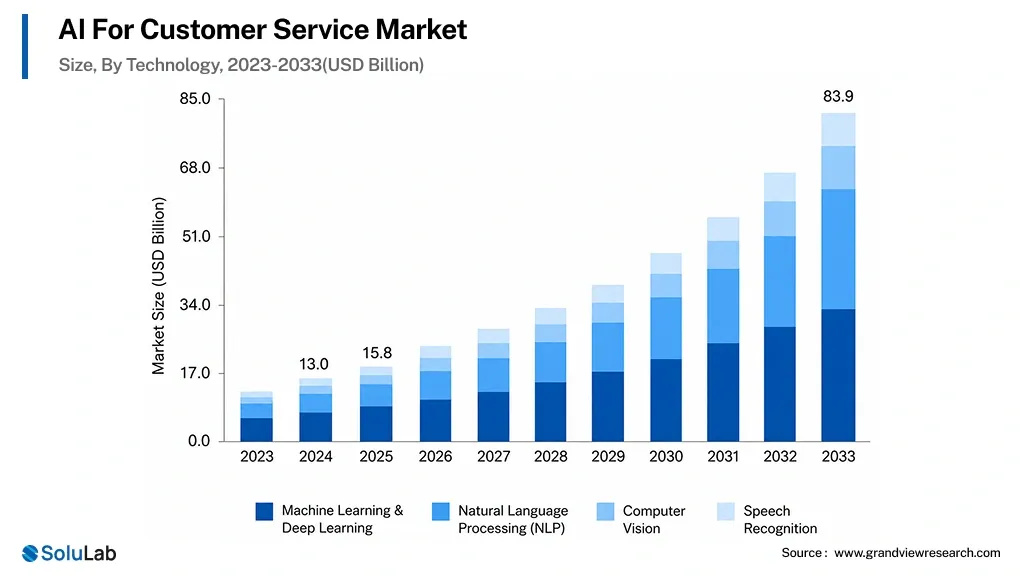
These agents use artificial intelligence to understand customer queries, provide accurate responses, and complete tasks without constant human involvement. Grand View Research estimates the global AI for customer service market will grow $83.8 billion by 2033.
In customer service operations, AI agents are commonly used for:
- Answering customer inquiries instantly
- Managing ticket routing and prioritization
- Providing multilingual support
- Handling order tracking and refunds
- Automating appointment scheduling
Why Businesses Are Investing in AI Customer Service Agents?
Businesses are increasingly adopting AI customer service agents to manage growing customer demands, improve support efficiency, reduce operational pressure, and deliver faster, personalized, and always-available customer experiences across digital channels.
- Rising customer expectations: Modern customers expect instant, personalized, and accurate support experiences across platforms, prompting businesses to adopt AI agents that deliver faster, more intelligent interactions.
- High support operational costs: Large customer support teams increase operational expenses significantly, encouraging enterprises to use AI agents for automating repetitive queries and reducing staffing overhead efficiently.
- Need for 24/7 support: Global businesses require continuous customer assistance across different time zones, making AI agents essential for providing uninterrupted support availability without human scheduling limitations.
- Omnichannel communication challenges: Managing customer conversations across email, chat, social media, websites, and voice channels creates operational complexity that AI agents help centralize and improve effectively.
- Growing ticket volumes: Support requests overwhelm traditional customer service teams, while AI agents help prioritize, resolve, and route tickets faster with improved operational consistency.
- Customer retention pressure: Businesses face growing pressure to retain customers through faster response times, personalized engagement, and proactive support experiences that AI agents can deliver at scale.
What Business Impact Are AI Agents Creating in Customer Service?
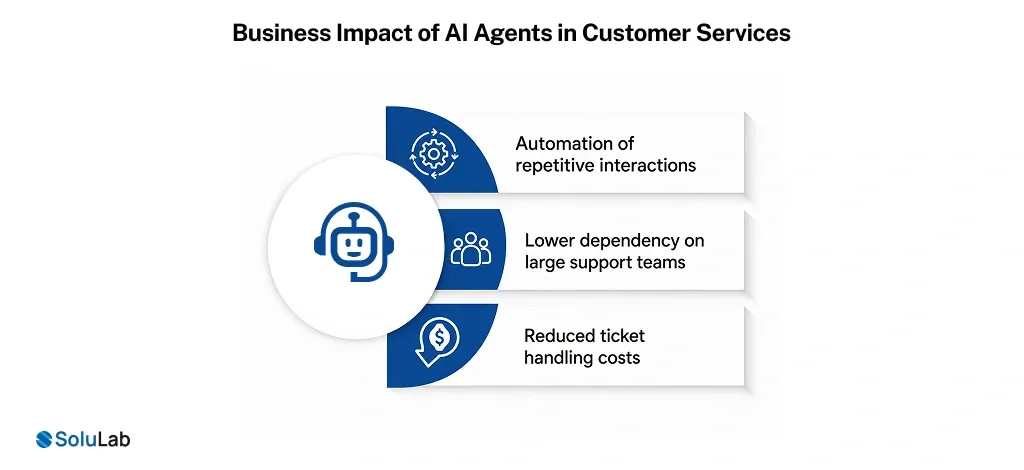
AI agents are improving customer service operations by automating support workflows, reducing operational pressure on teams, improving response efficiency, and enabling enterprises to deliver scalable customer experiences around the clock.
- Automation of repetitive interactions: AI agents automatically handle FAQs, order updates, appointment scheduling, password resets, and basic troubleshooting, significantly reducing repetitive workloads for customer support departments.
- Lower dependency on large support teams: Enterprises use AI agents to manage growing customer volumes efficiently, reducing the need for large support teams while maintaining consistent response quality and availability.
- Reduced ticket handling costs: AI-powered support systems decrease operational expenses by minimizing manual ticket processing, shortening resolution times, and optimizing resource allocation across customer service operations.
How to Successfully Implement AI Agents in Customer Service
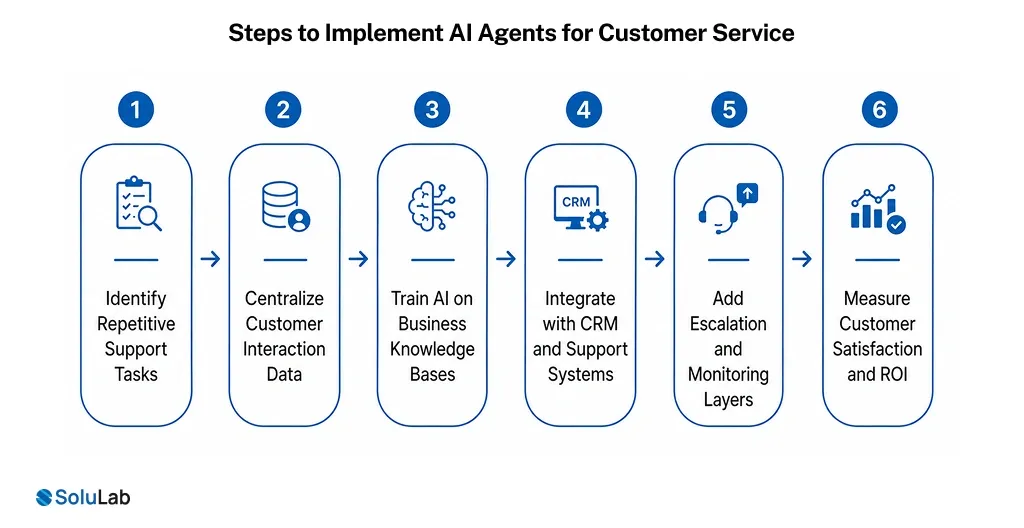
AI agents in customer service deliver faster support, automate repetitive interactions, improve response accuracy, and help enterprises manage large-scale customer communication efficiently while maintaining personalized and consistent customer experiences.
1. Identify Repetitive Support Tasks
Analyze recurring customer queries, ticket categories, and manual workflows to identify high-volume support processes that AI agents can automate for faster operational efficiency.
2. Centralize Customer Interaction Data
Consolidate customer conversations, support tickets, CRM records, and communication history into unified systems to help AI agents access accurate contextual information in real time.
3. Train AI on Business Knowledge Bases
Train AI agents using FAQs, policy documents, product manuals, historical tickets, and support workflows to improve response quality and domain-specific understanding.
4. Integrate with CRM and Support Systems
Connect AI agents with CRM platforms, help desk tools, live chat systems, and enterprise applications for workflow automation and customer data.
5. Add Escalation and Monitoring Layers
Implement human escalation workflows, quality monitoring systems, and performance controls to ensure complex customer issues are transferred efficiently without compromising service quality.
6. Measure Customer Satisfaction and ROI
Track customer satisfaction scores, response times, automation rates, operational savings, and support efficiency metrics to evaluate AI agent performance and business impact.
Use Cases of AI in Customer Service
The domain of customer service is changing fast with the help of artificial intelligence. Here are a few examples of AI in customer service to enhance customer experience, including:
1. Virtual Assistants and Chatbots
AI-powered chatbots and virtual assistants are increasingly complex. They may deal with a variety of customer inquiries concerning processing orders, debugging common issues, and answering frequently asked questions. These AI-based solutions are always available, saving customers’ time from waiting and increasing their satisfaction levels.
2. Sentiment Analysis
AI-driven sentiment analysis systems process customer input through social media postings, reviews, and survey replies to garner information on customer sentiment. Results from it can be both positive—capitalizing on customer praise—and negative—addressing negative feedback to improve areas of business operations.
3. Analytical Forecasting
Because AI use cases can predict consumer behavior and preferences through the examination of customer data, with this data, you can anticipate needs, recommend on a tailored basis, and take early measures to solve possible problems. For instance, AI can predict when a product will malfunction or recommend products according to a customer’s past purchases.
4. Computerized Customer Support
Routine operations, such as order tracking, reset passwords, and fixing of appointments, can be automated with the help of AI-driven automation. This would enhance overall efficiency and customer satisfaction since now more time is available to human agents to concentrate on the more challenging and complex queries of the consumers.
5. AI-Powered Email Automation
This includes handling a large number of customer emails which may be overwhelming for humans. AI for email automation checks and responds to the mail at the same time enhancing customer experience. Using AI for email can also sort your emails into different datasets.
6. Optimized Customer Service
AI has the potential to leverage customer service interactions for the identification of areas in which development is required. Firms can use call logs, chat transcripts, and other such data to get insights into common problems, smoothen workflows, and train employees.
7. Targeted Advertisement
AI, per customer information, can be applied in the development of very focused marketing strategies. After analyzing the interests, behavior, and past purchases of the clients, firms can send out offers and communication tailored to the specific client.
The domain of customer service is changing fast with the help of artificial intelligence. Here are a few examples of AI in customer service to enhance customer experience, including:
Examples of AI in Customer Service
Here are real examples of businesses using an AI agent in customer service:
1. H&M’s AI Chatbot
H&M uses an AI-powered chatbot to provide instant customer support, answer product-related questions, assist with orders, and improve the online shopping experience through automated conversations.
The chatbot handles common customer queries 24/7, reducing response times while allowing human agents to focus on complex issues and deliver better customer service.
2. Obvi
Obvi, a fast-growing health and wellness brand, uses AI to streamline customer support by automatically managing thousands of customer requests and improving response efficiency every month.
AI automatically tags and triages over 10,000 support tickets each month, helping support teams prioritize urgent issues, reduce manual work, and respond faster to customers.
3. NICE Enlighten AI
NICE Enlighten AI helps contact centers improve customer service by analyzing conversations, guiding agents in real time, and providing insights that enhance customer satisfaction and agent performance.
The platform evaluates customer interactions, delivers real-time coaching, and identifies improvement opportunities, enabling organizations to provide faster, more personalized, and consistent customer support.
4. Verizon
Verizon uses AI-powered virtual agents and customer service tools to automate routine queries, personalize customer interactions, and provide round-the-clock support across multiple communication channels.
Its AI virtual agents resolve common requests, seamlessly transfer complex cases to human agents, and improve customer experiences through faster, personalized, and always-available support.
How to Integrate AI Agents in Existing Workflows?
AI agents can enhance existing enterprise workflows by automating repetitive processes, improving operational efficiency, reducing manual intervention, and enabling faster decision-making without replacing current business systems or infrastructure.
- Identify repetitive tasks suitable for automation
- Connect AI agents with existing enterprise systems
- Centralize operational and customer workflow data
- Train AI using historical business interactions
- Implement monitoring, escalation, and approval mechanisms
- Continuously optimize workflows using performance analytics
Future Trends in AI Customer Service Agents
AI customer service agents are rapidly evolving from simple support assistants into intelligent systems capable of understanding emotions, predicting customer needs, and autonomously managing personalized customer experiences at scale.
- Voice-based AI agents: AI voice agent systems are enabling natural voice interactions, allowing businesses to provide faster, hands-free, multilingual, and human-like customer support across global communication channels.
- Emotion-aware AI systems: AI agents are increasingly analyzing customer tone, sentiment, and behavioral patterns to deliver empathetic responses, improve satisfaction rates, and reduce frustration during support interactions.
- Autonomous customer success agents: Enterprises are adopting AI agents capable of proactively managing onboarding, renewals, issue resolution, and engagement workflows without continuous human supervision or intervention.
- AI-powered hyper-personalization: AI agents are using customer history, behavioral analytics, and real-time preferences to deliver highly personalized recommendations, responses, and support experiences across digital platforms.
- Multi-agent customer support ecosystems: Organizations are deploying multiple interconnected AI agents that collaborate across departments, enabling handling of sales, support, billing, and technical service operations.
- Predictive customer service: AI systems are helping enterprises identify potential issues before customers report them, improving retention, reducing complaints, and enabling proactive service resolution strategies in real time.
How SoluLab Helps Businesses Build AI Customer Service Agents
Building production-ready AI agent systems requires expertise across AI models, architecture, and integrations. SoluLab helps businesses design scalable, secure, and high-performing AI systems tailored to real-world use cases.
Here are the advanced services we deliver:
- Custom AI agent system development
- Multi-agent orchestration
- LLM fine-tuning + RAG pipelines
- Enterprise integrations (CRM, ERP, APIs)
- AI deployment and scaling
- Continuous monitoring and optimization
For example, SoluLab built CyberHulk, an AI-powered marketing SaaS platform that unified campaign management, lead generation, analytics, and workflow automation.
By integrating multiple marketing tools into one system, CyberHulk helped businesses reduce manual effort, improve lead quality, and make faster, data-driven growth decisions across channels.

Conclusion
As businesses handle growing customer expectations and support volumes, AI agents are becoming essential for automating workflows, improving response accuracy, and delivering faster customer experiences at scale.
From ticket management to personalized interactions, AI-driven support systems help enterprises reduce operational pressure while maintaining service quality.
Companies adopting AI agents in customer service are gaining a competitive advantage through efficiency, availability, and smarter decision-making.
SoluLab, an AI agent development company, can help your business build scalable AI agents tailored to your customer support workflows and enterprise requirements.
FAQs
Neha is a curious content writer with a knack for breaking down complex technologies into meaningful, reader-friendly insights. With experience in blockchain, digital assets, and enterprise tech, she focuses on creating content that informs, connects, and supports strategic decision-making.