AI-powered applications are becoming essential for modern businesses as companies use artificial intelligence to automate operations, analyze data, and improve customer experiences.
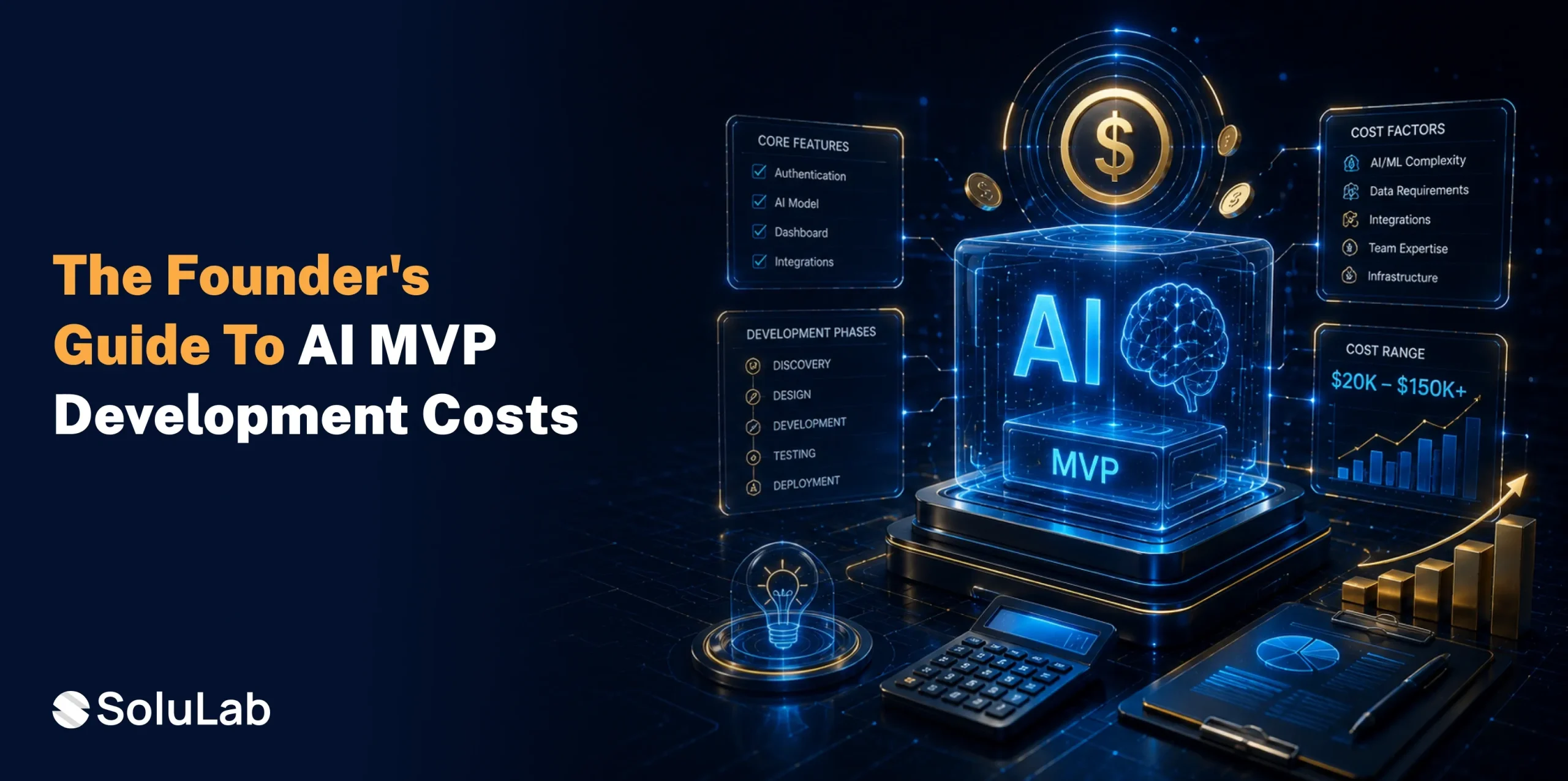
On average, the cost to build an AI app in 2026 ranges between $10,000 and $150000 or more, depending on complexity, features, and infrastructure requirements. According to industry reports, enterprise AI adoption is expected to exceed 80% in 2026, showing how rapidly businesses are integrating AI into everyday operations.
However, many organizations still struggle to estimate the actual cost of developing AI software for their specific needs. This article explains the key cost factors, development stages, and realistic pricing ranges for AI application development in 2026.
Key Takeaways
- The problem: Businesses often struggle to estimate AI app development costs because pricing varies widely based on complexity, data requirements, integrations, and the scale of deployment.
- The solution: Start with a prototype or MVP to validate the idea, define core features early, and scale development gradually to control costs and reduce implementation risks.
- How SoluLab helps: SoluLab helps enterprises plan, build, and scale AI applications with optimized architecture, experienced developers, and cost-efficient development strategies tailored to business needs.
Average AI App Development Cost in 2026
The AI software development cost in 2026 varies based on application complexity, data infrastructure, and integration requirements. On average, building an AI-powered application typically ranges between $10,000 and $150,000, while more advanced enterprise systems can exceed this.
For large organizations, the enterprise AI development cost is usually higher because of scalability, compliance requirements, and complex workflows.
What Determines AI App Development Cost?
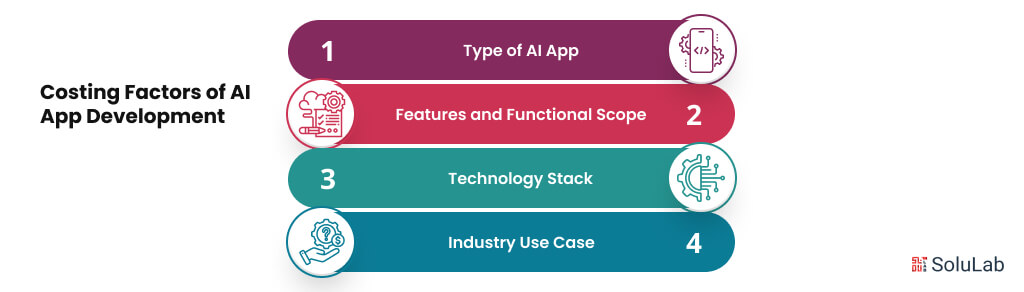
When you’re planning to build an AI-powered app, knowing what drives the cost is essential. As a B2B company, you’re likely focused on performance, compliance, and long-term ROI. Below are the main things that shape the total AI app development cost:
1. Type of AI App
The kind of app you want to build plays a big role in its cost.
- Basic AI apps (like rule-based systems or recommendation engines) are cheaper and faster to build.
- Moderate AI apps use advanced tools like Natural Language Processing (NLP) for voice, image recognition, or basic predictions.
- Advanced AI appsinvolve adaptive systems, decision automation, or intelligent agents. These often require help from an expert AI agent development company.
2. Features and Functional Scope
The number and complexity of features directly influence your AI app’s cost. Common AI app features include:
- AI-powered chatbot and virtual agents
- Voice or facial recognition
- Behavioral analysis and user personalization
- Integration with IoT or even blockchain systems
More features mean more time, testing, and budget.
3. Technology Stack
What tools and platforms you use matters a lot.
- Using ready-made models (like OpenAI, Google Vertex AI) reduces costs.
- Building your own models from scratch requires more budget.
- Running on cloud services like AWS or Google Cloud adds cost unless optimized well.
- Partnering with an experienced team that offers MLOps consulting services can help manage infrastructure and deployment costs smartly.
4. Industry Use Case
Different industries have different needs, and that affects pricing, too.
- Sectors like finance and healthcare often need compliance, extra security, and data privacy, which increases the AI development cost.
- Other sectors like retail, logistics, or education are generally faster to build for.
These factors raise the overall AI development cost but are necessary for safe deployment.
Read Also: How to Create an AI-Powered App like Doppl?
AI App Development Cost Breakdown by Category
If you’re planning to build an AI-powered app in 2026, here’s a simple look at how much it might cost based on the type of solution you choose.
|
Type of AI App | Estimated Cost Range (USD) | Ideal For |
|
Basic AI App |
$10,000 – $30,000 |
Simple apps with limited AI logic |
|
NLP-based Chatbot |
$15,000 – $50,000 |
Customer service, lead generation |
|
AI Personal Assistant App |
$20,000 – $60,000 |
Virtual assistants for tasks or scheduling |
|
Predictive Analytics App |
$20,000 – $90,000 |
Forecasting, demand planning, trend analysis |
| Custom Generative AI Application | $30,000 – $150,000+ |
Content generation, Gen-AI chat, simulations |
These ranges depend on factors like:
- Project complexity
- Platform (iOS, Android, Web)
- Number of third-party integrations
- Advanced AI app features like Natural Language Processing (NLP), Predictive Analytics, or Generative AI
For enterprises, a high-quality AI application solution isn’t just about features, it’s about scale, security, and future-proofing. Choosing the right AI development company or partner can make a big difference in both cost and performance.
If you’re unsure where to start or how to estimate the cost for your project, it’s best to hire AI developers who specialize in enterprise-grade AI solutions.
AI App Development Cost by Industry
Different industries require different levels of data security, AI model complexity, and compliance. These factors influence the overall development cost and the type of businesses that typically adopt these solutions.
| Industry | Estimated Cost | Best For |
| Healthcare AI apps | $15k–$80k | Hospitals, healthtech startups, companies with 200–1000+ employees |
| Fintech AI apps | $20k–$100k | fintech startups, banks, financial platforms with 100–500+ employees |
| Retail AI apps | $10k–$75k | eCommerce brands, retail chains, businesses with 50–300 employees |
| Logistics AI apps | $15k–$90k | supply chain firms, delivery platforms, companies with 100–500 employees |
How Much Does It Cost To Build an AI App?
The cost to build an AI app typically ranges between $10,000 and $150,000+, depending on the complexity of the technology, features, and infrastructure involved. Businesses should understand the main factors that influence development budgets:
- AI model complexity and training requirements
- Availability and quality of training data
- Number of features and automation capabilities
- Cloud infrastructure and computing resources required
- Third-party integrations and external APIs used
- Security, compliance, and industry regulations are involved
- Level of customization and AI model fine-tuning
- Ongoing monitoring, maintenance, and performance updates
How Businesses Estimate AI App Development Cost
Estimating the cost of building an AI application requires a structured approach. Most businesses break the development process into stages to control risk, validate ideas early, and scale investments as the product matures.
Most enterprises calculate AI development budgets using three stages:
1. Prototype Phase – $10,000–$20,000
This stage focuses on validating the core AI concept and testing whether the idea works in real scenarios. Teams build a small functional prototype using limited data and pre trained models to demonstrate feasibility and business value.
2. MVP Development – $15,000–$20,000
At this stage, the prototype evolves into a usable product with essential features. Developers integrate AI models, build the user interface, connect APIs, and deploy the application so early users or clients can test it.
3. Enterprise AI Deployment – $50,000+
The final stage focuses on scaling the AI system for real business operations. It includes advanced integrations, security frameworks, performance optimization, and infrastructure capable of supporting thousands of users and large data volumes.
AI App Development Cost Framework
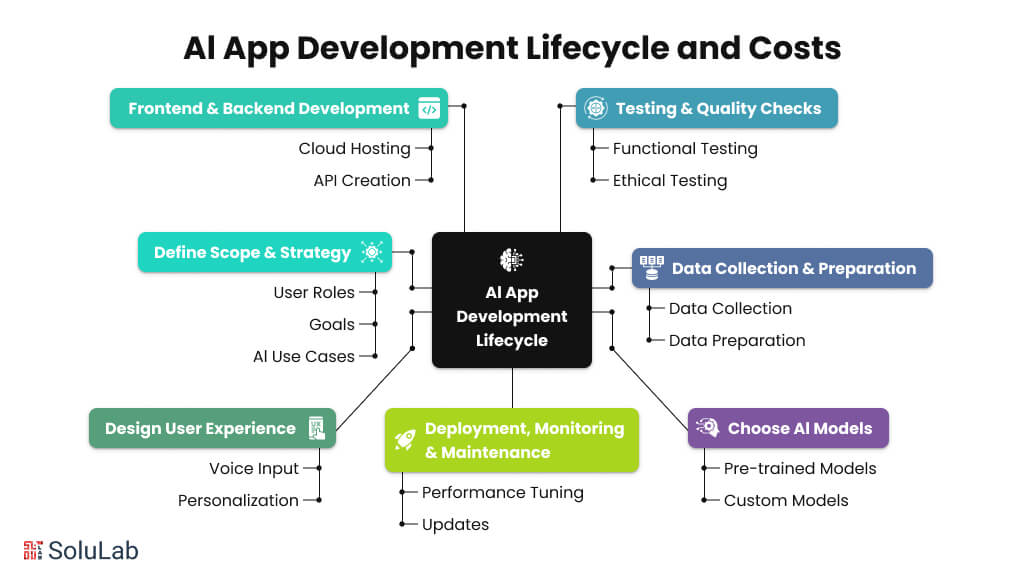
To understand the total AI app development cost clearly, it’s important to break it down step-by-step. Each phase in the development lifecycle impacts your budget and knowing where your money goes helps you plan smarter.
Here’s a breakdown of the key phases:
1. Define Scope & Strategy
Start by identifying user roles, goals, and the core AI use cases and applications. This ensures your app solves a real business problem and avoids unnecessary features.
2. Data Collection & Preparation
The heart of any artificial intelligence app is clean, labeled, structured data. This stage may require help from AI implementation services or in-house teams to collect and prepare the right training data.
3. Choose the Right AI Models
Decide between pre-trained models (like GPT, BERT) or building custom ones. This impacts speed, accuracy, and long-term cost. Custom training raises the AI development cost, but often brings better ROI.
4. Design the User Experience
Great AI apps feel natural to use. UX design focuses on intuitive flows based on how users think, not just how the tech works. At this point, AI app features like voice input, personalization, or recommendations are mapped.
5. Frontend & Backend Development
This is where your mobile app development company or internal team builds the actual app. They’ll connect the AI engine, create APIs, and host the app in a secure cloud environment. You’ll also need to handle security and data compliance. For companies seeking scalability and cost efficiency, nearshore backend development can provide the technical expertise needed to manage integrations, optimize performance, and ensure compliance with data protection standards.
6. Testing & Quality Checks
Apps go through functional and ethical testing to ensure they work and don’t create bias or risk. This helps reduce risks during deployment and can even lower long-term AI mobile app development costs.
7. Deployment, Monitoring & Maintenance
Once live, the app must be monitored, fine-tuned, and updated regularly. AI models learn over time, so performance tuning is ongoing. Many companies choose to partner with a trusted AI development company to handle updates and scale confidently.
At any stage, you can hire AI developers to speed up the process, reduce risk, and ensure high-quality output.
Read Blog: Cost To Build An App In Australia
Strategies to Reduce AI App Development Costs
Are you concerned that the cost of your AI development might exceed your budget?
You’re not alone. Many businesses face the same challenge. But with the right approach, you can build a powerful AI app without overspending. Here’s how:
- Utilize modular development and leverage open-source AI and ML frameworks. It saves both time and money.
- Pick cloud-based infrastructure early and use MLOps consulting services to automate workflows.
- Choose pre-trained models to fast-track delivery for most AI use cases and applications.
- Focus on core MVP features first. Launch fast, then improve over time.
- Outsource to a trusted AI application solutions provider with proven expertise.
Cutting costs doesn’t mean cutting value. It means making smart, scalable decisions that get your AI app to market faster and more efficiently.

Why Choose SoluLab to build an AI App for your Business?
AI applications are built using advanced technologies that enable intelligent automation, real-time data processing, and scalable deployment across digital platforms.
Tech Stack Commonly Used to Build AI Apps
- Python and AI frameworks like TensorFlow, PyTorch
- Natural Language Processing models and NLP libraries
- Machine learning and deep learning algorithms
- Cloud platforms such as AWS, Google Cloud
- APIs and microservices for system integrations
- Data processing tools and scalable databases
Case Study
Aman Bank partnered with SoluLab to build a generative AI-powered mobile banking solution with chatbots and Voice AI agents. The platform enabled 24/7 support, automated onboarding, and digital banking services. Results included 30% higher customer satisfaction, 40% faster response times, and 60% faster onboarding, improving engagement and operational efficiency.
If you want similar results for your business, then book a consultation call with us and talk to our experts.
Conclusion
The cost to build an AI app in 2026 can vary widely depending on the complexity of the solution, data requirements, integrations, and the scale of deployment.
Simple AI applications, such as chatbots or recommendation engines, can be developed with relatively low budgets. In contrast, enterprise-grade platforms with advanced automation, predictive analytics, or generative AI applications require larger investments.
Businesses that start with a prototype or MVP often reduce risks and optimize development costs before scaling. SoluLab, an AI development company, can help your business build AI apps as per your business requirements. Book a free consultation call today!
FAQs
Shipra Garg is a tech-focused content strategist and copywriter specializing in Web3, blockchain, and artificial intelligence. She has worked with startups and enterprise teams to craft high-conversion content that bridges deep tech with business impact. Her work translates complex innovations into clear, credible, and engaging narratives that drive growth and build trust in emerging tech markets.