Talk to an Expert

Build a Crypto-Friendly Bank in 2026: Cost, Timeline, and Architecture

Look, the crypto banking solutions landscape has shifted dramatically in the last 18 months. What used to be the domain of crypto startups is now the domain of enterprise banks, which are seriously getting in. And the market’s telling us something important – crypto banking services aren’t a niche anymore.

As the stablecoin market hit $33T in 2025, up 72% increse from 2024, and even JPMorgan’s research shows institutions are allocating 8-12% of transaction volumes to on-chain settlement by 2026. This creates immediate demand for regulated crypto banking platforms

So, let me walk you through what you need to know if you’re thinking about building a crypto banking solution. Whether you’re a founder or executive at a bank wanted to stay competitive, this guide will break down everything from architecture to go-to-market.

Key Takeaways

  • Building a production-grade crypto banking solution costs $500k-750k on custom builds.
  • The crypto banking sector licensing in the EU/UK/UAE is tightening.
  • Team expertise matters more than capital, as most failures aren’t tech problems; they’re regulatory and security missteps.
  • Security and custody architecture account for 30-40% of total development cost.

What is a Crypto-Friendly Bank? 

Let me clarify something first. A crypto banking solution isn’t just a bank on the blockchain. That’s a misconception that kills projects before they start.

What we’re actually talking about is a regulated or regulated-equivalent financial institution that moves money on both traditional rails and blockchain networks simultaneously. Think Nexo, Kraken, or how legacy banks are now integrating with USDC rails – they’re moving value across both systems, capturing the advantages of each.

Here’s the practical difference:

1. Traditional banking: you wire money on Monday, it arrives on Wednesday, and you pay 2-3% in fees. 

2. Crypto banking services: you settle in 15 seconds, costs are cents, and you have cryptographic proof of the transaction. That gap is why enterprises are paying attention.

The types of crypto banks vary significantly, and picking the wrong model early will cost you 12 months and hundreds of thousands:

ModelReference ExamplesCore ConceptRegulatory ComplexityKey RequirementsPrimary Trade-OffTime to Market
Traditional Bank + Crypto LicenseSantander, BBVAExisting bank adds crypto services on top of a licensed coreVery HighBanking charter, established customer base, deep regulatory relationshipsSlow execution but strong institutional trust6–12 months
Crypto-Native BankNebeus, BlockFi (pre-collapse)Built ground-up for digital assetsExtremeDeep crypto expertise, licensing resilience, institutional-grade securityHigh upside, high regulatory and operational risk12–18 months
Hybrid Neo-BankRevolut, WiseEMI license first, crypto layered secondMediumEMI license, compliance ops, crypto integrationsFaster launch, limited product depth8–12 months
Settlement Layer (B2B Rails)BVNK, Alchemy PayInfrastructure layer enabling crypto–fiat settlementLowB2B integrations, liquidity management, enterprise trustNot consumer-facing; scale via partners6–9 months
Self-Custodial + Wrapped ServicesCoinbase, KrakenUsers hold keys; platform layers servicesHighStrong compliance, wallet infra, service monetizationLower custody risk, heavier compliance overhead9–14 months

Which one fits you, it depends on your capital, team, and target customer. If you’re a startup with $1-2M and want to launch fast, Model 3 or Model 5 works. If you’re an enterprise with $10M+ and a 12+ month runway, Model 1 or 2 makes sense.

Why Is Timing Critical to Launch Crypto Banking Solutions Before the Market Saturates?

The numbers are compelling, and they’re real. Stablecoin transaction volume hit $2.1 trillion in 2025, compared to $1.2 trillion in 2023. That’s institutions and treasury departments actually moving money on blockchain rails.

Here’s what triggered the shift: the Fed essentially accepted stablecoins as settlement infrastructure. No formal announcement; just quiet integration into thinking. When JPMorgan runs $1 trillion through its private blockchain and SWIFT consortium banks start experimenting with CBDC rails, it signals regulatory acceptance.

On the enterprise side, CTO budgets for blockchain infrastructure jumped 340% year-over-year. Companies like Tesla, Meta, and traditional corporations are building crypto treasuries. They need banking infrastructure that understands both worlds, regulated banking and crypto operations. 
Architecture For Crypto Bank Development

That’s your wedge. The regulatory tailwind matters too:

  • EU’s MiCA (Markets in Crypto-Assets) gave VASPs clear licensing pathways. Yes, there are requirements, but at least there’s a pathway. That clarity created 80+ licensed operators in 2025 alone.
  • The UK’s FCA regime moved from figure it out to here’s the rulebook. Operational resilience standards, crypto-specific capital requirements, it’s heavy, but predictable.
  • The US is fragmented (state-by-state), but Wyoming, Texas, and New York have crypto-friendly frameworks now. Not easy, but possible.
  • UAE/Dubai fast-tracked crypto licensing specifically to attract builders. 30-60 day approval timelines if you’re institutional-grade.

That regulatory clarity is temporary, and the Governments are still figuring this out. The window for favorable treatment? It closes in 12-18 months as regulators tighten up post-incident reviews. Early movers get grandfather clauses, and late entrants get 6-month delays minimum.

cta 1 Build a Crypto-Friendly Bank

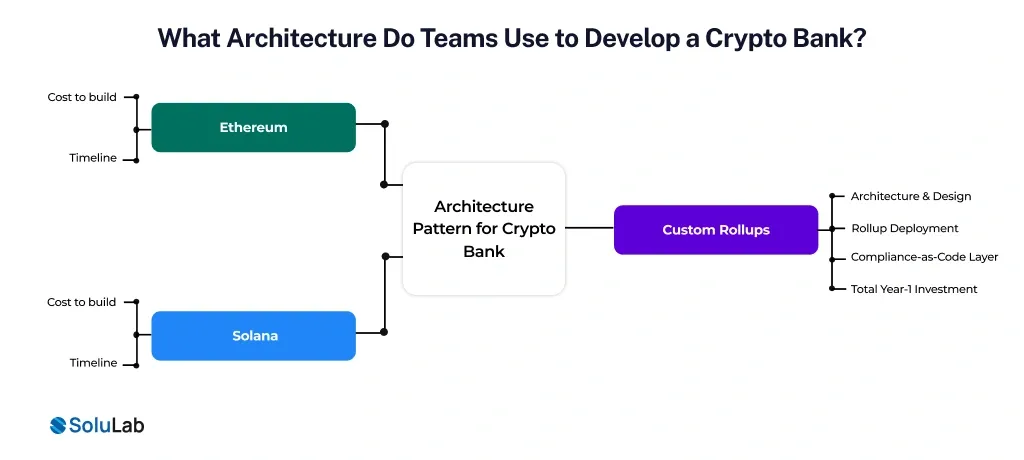
What Architecture Do Teams Use to Develop a Crypto Bank?

This is where most projects get it wrong. Teams build crypto development solutions on whatever blockchain is popular at the moment. Ethereum because it has liquidity, or Solana because it’s fast. Neither question is the actual question: which blockchain lets you build what you need for your customers?
it’s fast. Neither question is the actual question: which blockchain lets you build what you need for your customers?

1. Ethereum

Honestly, if your customers are institutional, trading volumes matter, and you can absorb gas fees, Ethereum solutions win. USDC has $39B in liquidity on Ethereum alone. Every custody provider integrates with Ethereum first. Regulatory guidance assumes Ethereum.

But the trade-off is Gas fees. During periods of network congestion, which happen 40% of the time, you’re looking at $15-50 per transaction. That’s real money when you’re processing thousands of transfers.

  • Cost to build: Essentially free. It’s a public network. Your infrastructure cost is cloud compute ($2-5K/month for reliable node access).
  • Timeline: 4-6 weeks to integrate if you use managed RPC providers (Alchemy, Infura, QuickNode).

2. Solana 

Solana offers sub-second finality and $0.00025 transaction costs. So, if you’re building a B2C consumer app or focusing on emerging markets where every basis point matters, Solana’s development architecture is genuinely better.

But the issue is Ecosystem maturity. Fewer custody providers, less regulatory clarity, and smaller institutional presence. Plus, Solana’s validator set is still consolidating, and long-term finality assurances are less certain than Ethereum’s.

  • Cost to build: Again, free network. But infrastructure costs are similar ($2-5K/month).
  • Timeline: 4-6 weeks of integration.

3. Custom Rollups 

Here’s what nobody talks about but should. A custom crypto banking platform, built on an Ethereum rollup, gives you something neither L1 offers: operational sovereignty. You control the sequencer, which means you control transaction ordering. You can embed regulatory logic at the protocol layer – transactions automatically reject if addresses hit sanctions lists. You get throughput (10,000+ TPS), cost (sub-cent per transaction), and full audit trails.

Because you use rollup-as-a-service platforms like Gateway.fm, Conduit, or Gelato to launch a dedicated execution environment in weeks.

And here is why banks are choosing this: You’re not dependent on a public network’s politics or validator incentives. You run the rules. And when regulators ask how do you ensure no sanctioned entities touch your system? You show them protocol-level enforcement. That’s institutional credibility. Here is the cost breakdown:

ComponentScope CoveredCost Range (USD)Time ImpactWhy It Matters
Architecture & DesignSystem design, threat modeling, scalability planning$50K–$100K~4 weeksPrevents rewrites, audit failures, and scaling bottlenecks
Rollup DeploymentRollup setup + sequencer infrastructure (Year 1)$100K–$200KParallelEnables lower fees, higher throughput, and protocol-level differentiation
Compliance-as-Code LayerAutomated controls, monitoring, and reporting$150K–$300KParallelReduces regulatory risk while enabling enterprise adoption
Total Year-1 InvestmentProduction-grade rollup stack$300K–$600K8–16 weeksCost-competitive vs L1 + separate custody over time

What Security Framework Separates Production-Grade Crypto Banking Software From MVP Experiments?

Here’s what I need to be direct about – if you’re holding other people’s assets, and you are, if you’re building crypto banking features, security isn’t a product feature. It’s the product.

Bad security news kills crypto companies faster than anything else. FTX, Celsius, Voyager Digital – the assets weren’t the issue (though they mattered). It was then that things broke; nobody knew what happened. That opaqueness is what destroyed trust.

So let’s talk about institutional-grade security architecture.

The 4-Layer Model

Layer 1: Cryptographic Foundation

  • AES-256 encryption for data at rest
  • TLS 1.3 for data in transit
  • Hardware Security Modules (HSMs) for key storage
  • Regular key rotation (monthly for hot operations)
  • This is table stakes. Not interesting, but non-negotiable.

Layer 2: Operational Security

  • Multi-Party Computation (MPC) for any withdrawal >$100K
  • Segregation of duties (no single person approves a large transfer)
  • Time-locked releases (24-48 hour delay from approval to execution)
  • Withdrawal whitelists (funds only to pre-approved addresses)

MPC is the game-changer here. Instead of storing a private key as a file (single point of failure), MPC splits it into encrypted fragments distributed across parties. You need at least 2 of the 3 fragments to sign a transaction. 

So if an attacker compromises your infrastructure, they get one fragment. Worthless. They’d need to compromise an external custody provider, your systems, and a user’s hardware. That’s exponentially harder.

Layer 3: Infrastructure Security

  • DDoS protection (Cloudflare or AWS Shield)
  • Web Application Firewall (OWASP Top 10 coverage)
  • Database encryption (AWS KMS or HashiCorp Vault)
  • Network segmentation (crypto operations isolated)

Layer 4: Monitoring & Incident Response

  • 24/7 Security Operations Center (SOC)
  • Real-time transaction monitoring (flag any movement >$5M)
  • Anomaly detection (unusual geography access, velocity checks)
  • Tested the incident response plan

Let’s take an example:  Assume you’re managing $500M in customer assets. Here’s how it actually works:

  • Cold Storage (70%: $350M): Multisig wallets in 3 geographic locations (NYC, London, Singapore). 3-of-5 threshold. Transfers take 24-48 hours intentionally, giving you time to catch issues before they’re permanent.
  • MPC Hot Wallet (20%: $100M): Fireblocks-managed custody with fragments split between you, Fireblocks, and a hardware device. Per-transaction limit of $5M. Refill from cold storage every 4 hours.
  • Staking/Yield (10%: $50M): Lido staking (ETH), Aave lending (USDC), monitored closely.

Annual security cost for this setup:

  • Fireblocks custody: $4,500 + $0.02 per transaction (assume 500K transactions/year = $10K)
  • Cyber insurance: $30-50K/year
  • Annual security audits: $50-100K
  • SOC monitoring: $100-150K/year
  • Cold storage rental & backup: $15-30K/year

Total: $210-360K annually. That sounds expensive. For $500M in assets, it’s actually cheap. 0.04-0.07% of AUM. Institutions expect that cost structure.

How Do Compliance Requirements Differ Across Types of Crypto Banks Globally?

This is the part that separates builders who ship from builders who spend 18 months in legal limbo.

1. Europe: MiCA-Based Licensing Path

MiCA went live in December 2023, and it actually works – there’s a framework. VASP licensing is jurisdiction-specific, but follows the same playbook.

JurisdictionRegulatorApproval TimelineKey RequirementsLegal Setup CostStrategic Use
GermanyBaFin2–3 months€100K capital, AML program, crypto-experienced directors~€150KBest testing ground; fastest EU approval
FranceAMF4–6 monthsInstitutional-grade custody, separate custodian~€200KHigher credibility, stricter oversight
LithuaniaBVD~2 monthsCrypto-focused regulator, lighter process~€100KFast-track launch option

You don’t need to operate in all EU countries initially. Get one license (Germany makes sense), then passport into other EU countries under mutual recognition.

Total cost for EU launch: €400-600K legal/compliance setup + €200-300K annual compliance team.

2. United States:  

No federal crypto bank license exists. Instead, Money Transmitter Licensing, state by state.

StateRegulatory PostureApproval TimelineComplexity LevelStrategic Role
WyomingMost crypto-friendly4–6 weeksLowProof-of-model entry state
TexasPro-crypto, serious oversight2–4 monthsMediumScalable growth market
CaliforniaLargest volume market3–5 monthsHighCommercial scale
New YorkBitLicense regime6–9+ monthsVery HighDo last, only if required

Cost per state: $50-100K legal + $20-50K surety bond + state filing fees ($2.5-10K).

So, US expansion takes 18+ months and $1-2M if you’re doing it right. Consider the partnership model first, rent liquidity from licensed operators (Coinbase Prime, Kraken), validate market fit, then pursue licensing.

cta 2 Build a Crypto-Friendly Bank

3. Asia: 

JurisdictionRegulatorApproval TimelineLegal Setup CostBest ForNotes
DubaiDMCC / DFSA30–60 days$150K–$250KSpeed + regional credibilityMiddle East / Asia foothold
SingaporeMAS3–4 months$300K–$500KInstitutional productsStrong regulatory reputation
Hong KongSFC6+ months$500K+Specific HK presenceRestrictive; optional

Recommended sequence: Dubai (speed + credibility) to Singapore (institutional depth), then Hong Kong (if needed).

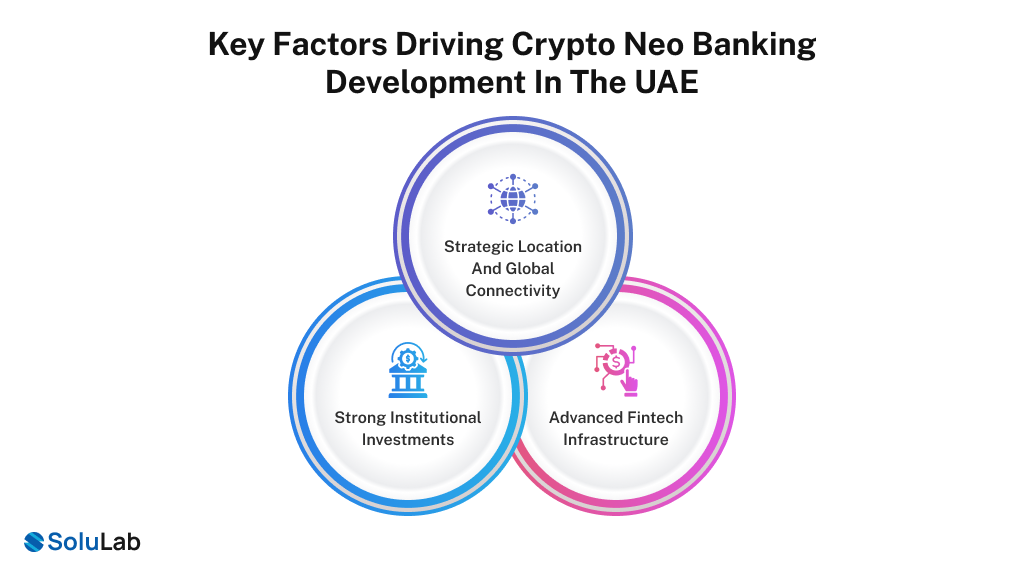
Read Our Blog: UAE Leads in Crypto Neo Banking Development

Which Crypto Banking Services Must Be Live Before You Launch A Crypto Bank?

When you’re building a crypto product, feature prioritization kills most projects. Teams load on bells and whistles before nailing basics.

Tier 1 (Do This or Don’t Launch):

FeatureEstimated Cost (USD)TimelineWhy It’s Mandatory
User Registration + KYC$60K–$100K4–6 weeksRegulatory entry point and user trust
Wallet Creation$20K–$40K2–3 weeksCore custody or self-custody functionality
Send / Receive Crypto$40K–$80K3–4 weeksPrimary user value loop
Real-Time Balance Updates$30K–$60K2–3 weeksUX credibility and accuracy
Transaction History$40K–$80K3–4 weeksCompliance, audits, and user transparency
Multi-Asset Support$20K–$50K~2 weeksAvoids early platform lock-in
2FA Security$15K–$30K1–2 weeksBaseline security expectation
KYC / AML Monitoring$80K–$150K6–8 weeksOngoing regulatory compliance

Cost: $275-590K. Timeline: 8-12 weeks.

This is your MVP. This is what gets you to launch and lets you validate with real users.

Tier 2 (Year 1 Additions):

FeatureEstimated Cost (USD)TimelineStrategic Value
Debit Card Integration$80K–$150K6–8 weeksIncreases daily usage and retention
Fiat On/Off-Ramps$40K–$80K (each)4–6 weeksImproves conversion and accessibility
Staking Integration$50K–$100K5–8 weeksRevenue + user stickiness
Portfolio Dashboard$40K–$80K4–6 weeksImproves engagement and visibility
Admin Controls$60K–$120K6–8 weeksOperational scale and risk control

These differentiate you from basic crypto payment apps and create moats.

Tier 3 (Year 2+):

CapabilityPurposeStrategic Impact
DeFi IntegrationsSwaps, lending, yield accessExpands financial use cases
Smart Contract InteractionGovernance, protocol actionsPower-user and DAO adoption
Tax ReportingCompliance automationEnterprise and jurisdictional readiness
Business AccountsMulti-sig, DAO walletsB2B and institutional onboarding
Merchant APIsPayments, integrationsPlatform ecosystem growth

What Launch Strategy Separates Profitable Crypto Banking Solutions from Failed MVPs?

Phase 1: Closed Beta (Months 12-14)

You launch to 100-500 trusted users with Real crypto natives, advisors, and select enterprise customers. The goal here isn’t scale; it’s learning without public pressure.

Questions you’re answering: 

  • Can users register without support? 
  • Does KYC actually work at scale? 
  • Can your infrastructure handle real transaction load?

Problems you find here get fixed before anyone cares, and that’s the whole point.

Phase 2: Regulated Launch (Months 14-18)

Your license approves, you migrate beta users to production, and you onboard actual customers, which is a careful ramp-up. 

Week 1: 100 users. Week 4: 1K. Week 8: 5K. By month 4, 20K users.

This phasing matters. You’re not trying to handle hockey-stick growth, as you’re onboarding steadily, stress-testing at each level, fixing issues as you discover them. Your marketing here is hyper-targeted – crypto-native audiences (Twitter/X, Discord, specific subreddits), enterprise outreach (LinkedIn, direct), and fintech partnerships.

Phase 3: Scale (Months 18+)

You’ve proven product-market fit. Now it’s about expansion– geographic markets, new features, institutional products, and partnerships. In this, hiring accelerates, the operations team doubles, and you’re running a real business now.
cta 3 Build a Crypto-Friendly Bank

Conclusion

Building a white label crypto banking solution isn’t about being cutting-edge technology people, it’s about being boring infrastructure that doesn’t fail. Your customers don’t care about your tech stack. They care about speed, security, and regulatory clarity. Build those three things well, and everything else follows.

The market window is real and closing, as Institutions are moving fast. The teams that move faster with proper security and compliance diligence will own 2026 and beyond, which can be taken care of with ease if you work with SoluLab as a Blockchain Development Company. The builders who overthink it, underestimate regulatory complexity, or skip security will disappear.

FAQs

1. Is launching a crypto bank in 2026 still profitable?

Yes. With the rising institutional adoption of crypto, tokenized assets, and digital payments, crypto-friendly banks are well-positioned for strong growth. Regions like the UAE, Singapore, and Europe continue to attract crypto businesses seeking compliant banking partners.

2. Which countries are best for launching a crypto-friendly bank in 2026?

In 2026, the UAE, Singapore, Switzerland, and select EU jurisdictions are considered among the best locations to launch a crypto-friendly bank. The UAE stands out due to its clear crypto regulations, strong fintech ecosystem, and government-backed innovation hubs like DIFC and ADGM, making it a preferred choice for MENA-focused crypto banking platforms.

3. What licenses are required to start a crypto bank?

The licenses required depend on the business model and jurisdiction. A crypto bank may need–
a digital banking or EMI license, virtual asset service provider (VASP) registration, crypto custody approval, and AML and KYC compliance certification.
In the UAE, approvals may involve VARA, ADGM, or the Central Bank, depending on the services offered.

4. How long does it take to launch a crypto-friendly bank in 2026?

On average, launching a crypto-friendly bank takes 6–12 months, depending on jurisdiction, licensing complexity, and technology readiness. Using a modular banking platform and early compliance planning can significantly reduce timelines.

5. How much does it cost to develop a crypto-friendly bank?

The cost to develop a crypto-friendly bank typically ranges from $250,000 to $1 million+, depending on features, compliance complexity, security architecture, and geographic coverage. Expenses include core banking integration, blockchain infrastructure, regulatory approvals, and ongoing compliance management.

6. Do crypto banks support both fiat and digital assets?

Most crypto-friendly banks support both fiat currencies and digital assets. This includes services like fiat accounts, best crypto wallets, instant on/off ramps, stablecoin payments, and cross-border transfers, enabling users to manage traditional and digital finances in one platform.

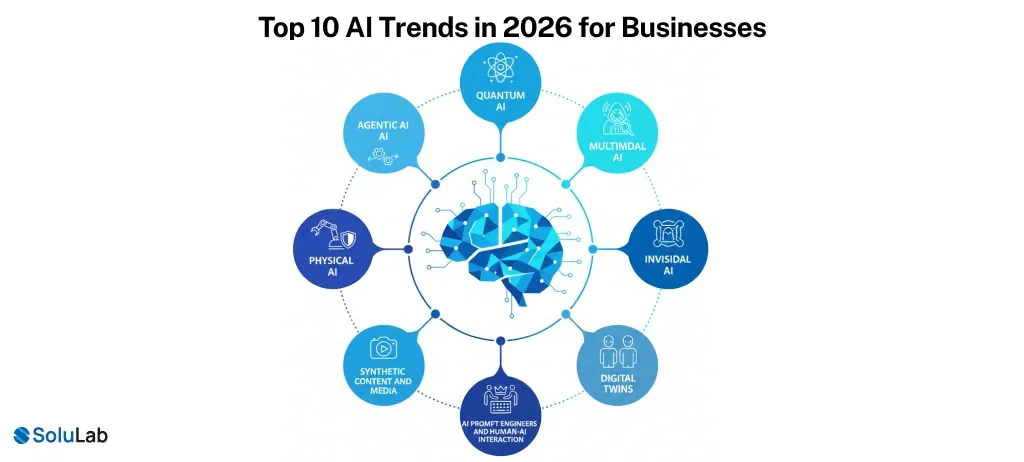
Top 10 AI Trends in 2026 That Businesses Are Actively Investing In

As AI spending is set to hit $2.5 trillion in 2026, up sharply year-on-year, organizations worldwide are integrating AI across business functions to stay competitive. 

According to recent data, 78 % of companies already use AI in at least one function, and executives rank AI integration as a top strategic priority for growth. Businesses that fail to automate workflows and adopt AI-driven systems risk falling behind or losing market share entirely.

This blog explores the top 10 AI trends in 2026 and beyond, offering practical insights for leaders who want to harness AI’s power for efficiency, innovation, and sustained business growth.

Key Takeaways

  • AI is changing towards supporting technologies for autonomous systems.
  • Workflow redesign and new business models will be the largest AI value.
  • The governance, security, and compliance of AI will turn into a mandatory requirement.
  • The collaboration between humans and AI will be essential, creating the need to seek AI-literate teams.
Top 10 AI Trends in 2026 for Businesses

Below, we’ve shared the top 10 latest AI trends, including use cases and real-world examples. 

1. Agentic AI

The concept of agentic AI is autonomous AI systems capable of planning, reasoning, acting, and achieving goals with little to no human intervention, not merely producing outputs.

Read Also: 5 Best Agentic AI Frameworks for 2026

These systems are further than the traditional generative AI (such as chatbots or copilots) as they are capable of making decisions and performing multi-step processes rather than merely responding to requests. The agentic AI is a combination of reasoning, memory, planning, and  AI tool usage, which allows it to adjust and choose how to accomplish tasks according to the aims.

Key Business Use Cases:

The real use of agentic AI ways companies are using to drive value are as follows:

  • Customer Support Automation: AI robots answer questions and sort support tickets in channels (chat, email, voice) with less human interference.
  • Supply Chain Optimization: Real-time rerouting of inventory, demand forecasting, and real-time logistics optimization.
  • Compliance Agents, Finance: AI checks compliance (checks compliance), detects fraud risks, uses AI to forecast cash flows, and recommends model changes.

Major forecasts of 2026 (According to Deloitte)

Extensive Proliferation: Organizations that deploy agentic AI pilot programs or demonstrations of concept should also increase as enterprises leave the experimental phase behind.

Multi-agent Systems: Businesses will integrate AI agents that will organize, plan, and execute work jointly to address the complex workflow.

Governance: Reviewing the growth of autonomy, firms will have to implement controls, ethics laws, and accountability systems to control agent work responsibly.

According to research by Deloitte, the agentic adoption increases, but the strong models of governance remain essential in many organisations.

2. Physical AI

Physical AI refers to artificial intelligence systems that sense, understand, and act within the physical world, not just in software or digital settings. Physical AI usually has sensors (cameras, lidar, touch, voice), AI brains (ML models, computer vision, reinforcement learning), and real-time decision-making.

Read Also: Physical AI: Role of AI Development and Integration

Examples:

– Robots that walk autonomously through the warehouse and optimize logistics.

– Surgical robots that are AI-controlled and respond to variables in real time.

– AI-based farms or inspection drones that scan the crops and infrastructure.

Key Industry Use Cases: 

  • Manufacturing Automation: Physical AI Robots are used to do adaptive work, such as vision-based quality control, high-precision assembly, and adaptive material handling. These systems are capable of reacting to variations in production and lowering defects and downtimes.
  • Healthcare Robotics: Robots that are enhanced by AI are useful in hospital logistics, autonomous supply delivery, and patient-centric care. Robots in surgery and smart exoskeletons have better precision and responsiveness.
  • Smart Logistics: The autonomous mobile robots and drones streamline the operations, routing, and movement of the warehouse, adjusting to changing circumstances.

3. Sovereign AI

Sovereign AI Systems and infrastructures that are run under the control and jurisdiction of a particular country, region, or organization can be described as sovereign AI. This is aimed at maintaining data, models, and compute resources that are either locally or enterprise-owned to comply with legal, security, and strategic demands.

Industries Most Impacted

  • Government: AI systems are becoming more and more demanded by governments of countries because of the necessity to meet the legal regulations of the country and to keep the data of the citizens within the borders of the country. Sovereign AI gives governments an opportunity to utilize AI for government services to deliver without foreign control.
  • Healthcare: Sovereign AI benefits hospitals and medical networks because it stores patient data and predictive models on local infrastructure, which promotes privacy, trust, and adherence to highly sensitive health regulations.
  • Banking: Banks exist in highly controlled conditions, and the data protection of customers and their residency, as well as risk models, must follow strict regulations. Sovereign AI assists banks in maintaining control andcomplyingy with expectations.

Regional Artificial Intelligence Ecosystems: (Middle East, EU)

  • European Union (EU): The EU is pushing towards more data and AI sovereignty to meet the EU AI Act and gain control over AI infrastructure. Lots of companies within such industries as banking and state services are already strategizing over investing in sovereign solutions.
  • Middle East: Countries in the Middle East are investing heavily in sovereign AI capacity and governance frameworks, seeing it as a competitive advantage that builds trust, reduces reliance on external providers, and supports national digital transformation goals. 
cta 1 ai trends

4. Synthetic Content and Media

Synthetic AI content is information like text, images, audio, and video content created, generated, or changed by artificial intelligence as opposed to being recorded or produced in a conventional way by humans. Large-language models, generative adversarial networks (GANs), and diffusion models are AI models that facilitate this automated generation on scale.

Use Cases

  • Advertisements and Social Networks: This allows Brands to create marketing videos, custom messages, or innovative images in AI-generated advertisements without the need to spend money on production. 
  • Gaming & Entertainment: Synthetic media, which is used in entertainment, is used to achieve effects such as de-aging actors or making virtual characters. As an illustration, the film production industry has employed AI to use automated transformations of the appearance of actors to tell stories.

5. AI Prompt Engineers and Human-AI Interaction

Prompt engineering is a method that requires designing well-defined, systematic inputs to direct AI models to generate precise, relevant, and context-dependent outputs. It can assist a business in achieving a uniform output with AI systems in performing activities such as content creation, analysis, and automation.

Why is Prompt Engineering a Fundamental AI skill in 2026?

  • Core Role: The process of designing accurate instructions (prompts) in such a way that generative AI systems can generate accurate, relevant, and controlled outputs.
  • Salary & Demand: Experienced immediate engineers are now priced at a high wage rate over non-AI jobs, and roles usually pay more because of the influence on quality and ROI of AI.
  • Accuracy & Quality: Prompts that are well-engineered decrease the incidence of hallucination and errors, such that the products of the AI can be acted upon and made business-ready rather than being ambiguous and deceptive.
  • Ethics & Governance: Explicit guidelines reduce bias and enhance compliance- training AI to generate unsuitable or malicious output is essential to controlled sectors.

6. Multimodal AI

Multimodal models refer to artificial intelligence systems designed to process and understand multiple types of data simultaneously, such as text, images, video, and audio. 

These systems integrate diverse data modalities into a unified model to interpret context and generate richer outputs that mimic human perception more closely than single-modality models. 

Use Cases by Industry

  • Healthcare Diagnostics: Improves clinical diagnosis by analyzing medical imaging (X-rays, MRIs) in conjunction with electronic health records and physician notes.
  • Security & Surveillance: Enhances safety systems by combining multiple inputs such as video feeds, audio sensors, and behavioral metadata to identify anomalies or threats more accurately than single-modality approaches.
  • Marketing Analytics: Helps marketers analyze customer engagement across formats, for example, combining video content performance, social media text reactions, and audio sentiment to generate deeper insights into audience behavior.

7. Invisible AI

Invisible AI is a type of artificial intelligence that does not present itself to the end user, but rather works so deeply ingrained into software and infrastructure that it is not perceived as an individual feature. These AI systems are not visible interfaces to users (such as chatbots), but they optimize, predict, and automate without any particular interaction.

Key AI applications: 

1. Smart Cities: Traffic control systems, which change the light patterns on-the-fly to reduce traffic jams and increase the traffic flow. Smart devices, also known as urban sensors, detect the environment and control the use of a resource, such as water or electricity, automatically.

2. Voice Assistants: Virtual assistants built into an appliance can schedule meetings, reminders, and perform more routine tasks that do not require a special request.

3. Energy Optimization: AI systems in homes and industries that optimize the heating, cooling, and lighting according to real-time use and occupancy.

8. Shadow AI

Shadow AI is a type of application that is developed by the use of artificial intelligence applications to which IT or security teams have not officially approved or supervised. This frequently involves employees utilizing public generative AI or other AI applications to get tasks achieved quicker, yet not within a set-up governance system.

This is important since the use of AI without the permission of the organization is associated with the risks of data breach, non-compliance with regulations, exposure of the intellectual property, and fragmented data governance, and in many cases, the organization is not even aware of that.

Use Cases

  • Informal content generation: Employees use unapproved enterprise tools to write internal reports or marketing copy using public chatbots, which could result in confidential information leaving the organisation.
  • Ad-hoc analytics: Analytics teams apply AI analytics tools to datasets without security verification, resulting in inconsistent results or lapses in compliance.
  • Automated task support: Employees use AI browser extensions or APIs to automate mundane work, such as scheduling or summarizing, without supervision to improve productivity, but circumvent controls and audits. 

9. Quantum AI

Quantum AI defines quantum computing alongside artificial intelligence, in which quantum systems assist in performing or speeding up AI computations that are extremely difficult or impractical on classical computers.

The significance of this trend is that quantum-accelerated AI can help radically improve the performance of optimization, simulation, and machine learning on complex, data-intensive problems, which provides a strategic benefit to businesses in the fields of research, logistics, finance, and others.

Use Cases

  • Optimization Problems: Quantum-enhanced AI models are more efficient in solving optimization problems than the classical approach: logistics, supply chain routing, and portfolio optimization.
  • Molecular Simulation: Quantum-powered AI has the potential to be used to speed up the process of discovery in drug design and materials science by simulating complex molecular structures at speeds that are an order of magnitude faster than classical algorithms.
  • Quantum Machine Learning: Hybrid quantum algorithms combined with classical AI: Hybrid models can significantly accelerate the training of machine learning models with pattern recognition computationally expensive.

10. Digital Twins

A Digital Twin is a virtual representation of a real-life object, system, process, or even whole organisation that replicates and recreates real-life behaviour and performance with real-time data.

To businesses, digital twins are important in the sense that they allow making predictions, testing things, making operations more efficient, and managing risks without disrupting actual operations, significantly improving decision-making and saving expensive trial-and-error modifications.

Use Cases

  • Manufacturing optimization: Digital twins allow companies to simulate production lines and equipment performance to reduce downtime, improve efficiency, and lower operational costs.
  • Process optimization in enterprises: Virtual replicas of business processes (Digital Twins of Organizations) let leaders simulate workflow changes before real implementation, enhancing outcomes and reducing risk.
  • Predictive maintenance: Digital twins fed by IoT sensors can forecast equipment failures and recommend proactive maintenance, saving downtime and extending asset life.

How Businesses Can Prepare for AI in 2026?

With AI adoption increasing exponentially in 2026, companies will no longer need to experiment but rather be organized in their approach. With a focus on infrastructure, alliances, and scalable strategies of implementation.

1. Invest in AI-enabled systems: Establish an effective database, containing clean, controlled data, scalable cloud services, anda safe API to enhance AI models, automation processes, and instantaneous choices across staff.

2. Collaborate with Artificial Intelligence Development Firms: Working with established AI development Companies can get specialized talent, less risk of implementation, quicker delivery, and ensure that the solutions are industry-conformant and meet compliance requirements.

3. Start with POCs: Start by initiating targeted AI proof-of-concept projects to confirm that it works and returns sufficient ROI, and slowly roll out successful AI projects in departments to reduce risk and maximize business impact over the long term.

cta 2 trends

Conclusion

Agents AI, multimodal systems, digital twins, and AI-oriented governance are emerging trends that are changing the way organizations operate, compete, and scale. 

Companies that make early investments in the appropriate skills, infrastructure, and implementation strategies would be in a better position to adjust to the fast changes in the market and expectations of their customers. 

The main point is not to follow all the trends, but to match AI implementation with actual business results. SoluLab is an AI development company that assists businesses in automating the workflow, creating AI solutions that are scalable, and remaining competitive by transforming the latest AI trends into actionable and results-oriented applications. Book a free discovery call today!

FAQs

1. How will AI change businesses in 2026?

Rather than just automating tasks, AI will become autonomous in its decision-making, allowing organizations to operate more quickly, wiser, and with new business models, such as in healthcare, finance, manufacturing, etc.

2. What industries will benefit most from AI in 2026?

AI-driven automation, predictive analytics, and real-time decision support will have the greatest effect on healthcare, BFSI, manufacturing, retail, logistics, and SaaS.

3. How is AI transforming healthcare by 2026?

AI will allow early diagnosis of diseases, individual care plans, predictive patient care, and better hospital services, resulting in better outcomes at a lower cost.

4. How does SoluLab leverage AI trends for business growth?

SoluLab assists companies with AI development services to implement the trends of AI into practical and revenue-generating solutions, not into experiments. Through agentic AI, multimodal AI, and automation, SoluLab develops scalable systems that enhance efficiency, decision-making processes, and customer experience.

5. Why do combined AI technologies matter for business growth?

The integration of AI with IoT, blockchain, and AR offers intelligent, secure, and immersive systems that enable businesses to be more innovative and achieve cost reduction and completely new approaches to digital business.

How to Build a Blockchain PoC in Just 4 Weeks?

You’re sitting in a boardroom. Your CFO just asked the question everyone’s thinking – Should we actually move into blockchain, or is this just hype? That’s exactly where most enterprises get stuck. Not because blockchain isn’t valuable, it is. 

But because they’re terrified of the unknown. They’ve heard stories about years-long blockchain development and implementations, massive budgets disappearing, and projects that never delivered real value, so nothing happens. Their competitors take action while you wait for perfect clarity that never comes. But you don’t need perfect clarity, you just need proof.

And the reason is that building a blockchain PoC in just 4 weeks forces focus. It strips away the noise, the unnecessary features, the what-ifs. So you’re not building the final product, you’re answering one critical question- Does this actually work for our business? And frankly, that answer changes everything.

Key Takeaways

  • The global blockchain PoC market reached $143 million in 2024 and is projected to hit $264 million by 2031.
  • Fortune 500 companies now target 4-8 week PoC cycles because agility wins. 
  • McKinsey research indicates that enterprises using the 4-week PoC methodology save 40% on development costs.

What is a Blockchain Proof of Concept?  

A blockchain proof of concept gets thrown around a lot in enterprise tech discussions. But most people, even smart CTOs and product leaders, get it wrong.

It’s not a minimum viable product, or pilot, or a production system. It’s something much more specific. Think of it this way: A blockchain PoC is the shortest path between a business problem and technical validation, nothing more, nothing less.

Here’s what that means practically. You’re building just enough of a blockchain application development to answer these questions:

  • Can our use case actually work on distributed ledger technology?
  • Which blockchain technology fits our performance requirements?
  • What integration complexity are we really looking at?
  • Does the economic model make sense?
  • Can our team or our partner actually execute this?

That’s it. You’re not optimizing, scaling, or hardening security for millions of transactions. You’re validating the fundamental premise.

The confusion usually comes from comparing it to alternatives:

How do PoC, MVP, and Pilot differ in Blockchain POCDevelopment Timelines and Risk?

When you’re building a blockchain application, this clarity matters. So let’s learn more about their differences-

DimensionPoC (Proof of Concept)MVP (Minimum Viable Product)Pilot
Primary ObjectiveValidate core technical feasibilityValidate real user demand and usabilityValidate production-readiness in real conditions
Key Question AnsweredDoes this work?Do users want this?Can this run reliably at scale?
Typical Duration4–8 weeks3–6 months6–12 months
Typical Budget Range$150K–$400K$400K–$2MSix-figure+ (often $1M+)
Team Size6–12 specialists12–20 cross-functional teamDedicated long-term team
Scope of FeaturesMinimal, assumption-drivenCore product functionalityNear-production feature set
Blockchain FocusProtocol viability, smart contract logic, integrationsUser flows, performance, incentives, securityStability, scalability, compliance, monitoring
Deployment EnvironmentDev / TestnetStaging or limited MainnetProduction (limited real-world rollout)
Risk LevelLow financial, high learningMedium financial, medium learningHigh financial, low learning
Typical Enterprise MistakeSkipping it entirelyOverbuilding before validationTreating it as “testing” instead of operations
Failure CostMinimalExpensiveVery expensive
Success OutputClear go / no-go decisionProduct with real user feedbackEvidence of operational readiness

If you need more clarity on POC vs Prototype vs MVP, click here.

Most enterprises skip straight to MVP or pilot, thinking they’ll save time; they don’t. What usually happens is they’ve already spent 6 months and a million dollars validating something that doesn’t actually work for their use case. By then, the business has lost patience.

The 4-week PoC prevents that entirely!

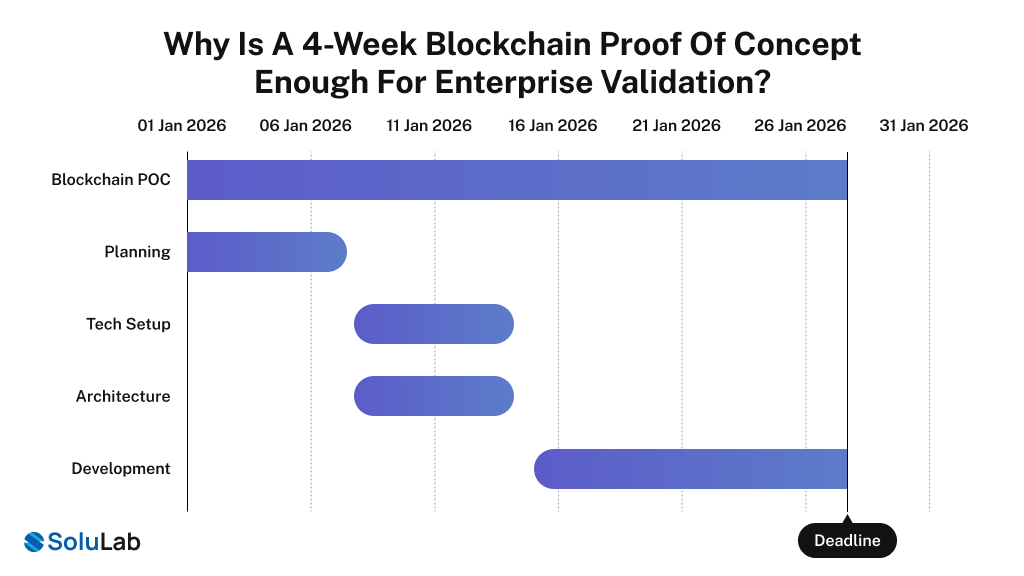
Why Is a 4-Week Blockchain Proof of Concept Enough for Enterprise Validation?

Four weeks sounds impossible until you realize something – you’re not building a product, rather you’re making a binary decision. And binary decisions don’t need perfect information; they need sufficient information. Here’s what makes the timeline actually work:

Blockchain POC Validation

1. Constraint Creates Clarity

When you have unlimited time, you optimize everything. When do you have 4 weeks? You optimize for one thing: validation. That forces ruthless prioritization. The team stops debating whether to support 15 use cases and picks the three that matter most.

Deloitte’s enterprise blockchain study found that teams operating under 4-week constraints delivered 3.2x faster than open-ended timelines, not because they worked harder, but because they made faster decisions.

2. You’re Building on Proven Infrastructure

This isn’t 2017 anymore. You’re not building blockchain infrastructure from scratch. Ethereum, Hyperledger Fabric, Solana, Polygon, these all exist. They work, and you’re not inventing. You’re assembling.

That changes everything about timeline feasibility. You’re picking proven components, integrating them, and validating fit. That’s inherently faster than building novel infrastructure.

3. Enterprise Use Cases Have Converged

Five years ago, every blockchain use case was unique; now they cluster. Supply chain tracking? Thousands of companies have done it. Fintech settlement? Proven at scale. Healthcare records? Multiple production examples exist.

Enterprise blockchain POC patterns are becoming standardized, which means your 4-week team can build on playbooks rather than inventing methodologies.

4. The Math on Speed

Here’s the truth from running actual blockchain poc development projects: the first week is planning, the second week is tech setup and architecture, weeks 3-4 are development. If you have experienced people and a clear scope, this timeline works.

If you don’t have experienced people, then 4 weeks becomes 12 weeks. But that’s not a timeline problem. That’s a resourcing problem.

CTA 1 Blockchain POC

Phase 1: Strategic Planning & Stakeholder Alignment (Week 1)

This is the most important week, and not for the reasons you’d think. Most teams want to skip here and jump to cool tech. Don’t do that!

Week 1 is about answering – Why are we actually doing this? If you can’t answer that clearly, the next three weeks are a waste.

On Day 1, Start by getting the right people in a room. You need:

  • The business sponsor (the person who cares if this succeeds)
  • The technical lead
  • Someone from operations who understands the current process
  • Someone from security/compliance (because blockchain has opinions about this)

Your agenda for day one is simple. Walk through the current process that blockchain is supposed to improve. Not the happy path. The messy, real path. 

  • Where do bottlenecks happen? 
  • Where do manual handoffs cause delays? 
  • Where does trust break down?

Document everything. Be specific. We spend 4 days reconciling invoices between three parties, beats invoicing is slow. By the end of day one, you should have identified 3-5 specific pain points that blockchain could address.

Day 2, you define success. Not in vague terms like faster and cheaper. In actual metrics.

  • How much time savings do we need to justify this investment?
  • What’s the acceptable latency for transactions?
  • What throughput do we actually need?
  • What’s the minimum cost reduction to make this worthwhile?

Get numbers, write them down, and Stakeholders will reference these constantly. By mid-week, your technical team starts evaluating which blockchain technology could even work for this.

This isn’t picking between Ethereum vs. Solana yet. It’s more basic: 

  • Do we need a public blockchain or a private/permissioned one? 
  • What performance characteristics do we actually need? 
  • Are we handling sensitive data that requires specific privacy solutions?

You’re not deep-diving into architecture, but you’re just eliminating obviously wrong answers.

A supply chain tracking use case probably doesn’t need Ethereum’s full security model. A financial settlement use case absolutely does. That one question alone narrows your technology options dramatically.

Now you define the MVP of your blockchain proof of concept. What’s the absolutely minimum you need to prove this works?

If this is about supply chain transparency, you’re not building a full enterprise system. You’re building: Can product A move from point B to point C with transparent, tamper-proof tracking?

That’s it.

One use case. One happy path. No edge cases. No error handling optimization. Just: Does the core premise work?

By Friday afternoon, you should have:

  • Documented business pain point
  • Clear success metrics (in numbers)
  • Technology direction (narrowed to 2-3 options)
  • Minimal scope (what is IN the PoC, more importantly, what is OUT)
  • Stakeholder buy-in on the above

If you don’t have these five things by Friday? Your week 1 failed, and you need to repeat it. Everything else depends on this foundation being solid.

Phase 2: Technology Selection & Architecture Design (Week 1-2)

This is where the technical team takes the foundation from Week 1 and builds a blueprint. The goal is to have a clear technical path forward with zero ambiguity.

This week, start with platform selection. Here’s the most important thing about choosing a blockchain technology: stop looking for perfect, and start looking for fit. You have three main categories to choose from:

1. Public Blockchains (Ethereum, Solana, Polygon)

Choose public when you need truly decentralized validation, high security standards, or want to tap into existing token ecosystems, but it has less privacy, higher transaction costs, and public verification.

2. Permissioned Networks (Hyperledger Fabric, Corda)

Use these chains when you control who participates, need privacy controls, want simpler consensus models, but it has less truly decentralized and require more operational overhead.

3. Purpose-Built Solutions (Avalanche, Polkadot)

Use these when your specific use case needs specialized features like cross-chain compatibility or different consensus mechanisms. 

For most enterprise blockchain POC projects, you’re choosing between public (Ethereum/Polygon for wider trust) or permissioned (Hyperledger for privacy), but 

  • If your stakeholders care most about speed, it’s Solana or Polygon. 
  • If they care about security/decentralization, it’s Ethereum. 
  • If they need privacy, it’s Hyperledger Fabric. 

None of these is wrong, but they solve different problems. Pick based on your Week 1 requirements, not based on what’s trendy. Now, your technical team designs the simplest architecture that proves your point.

For a supply chain example:

  • Smart contract that records shipment movement (100 lines of code, maximum)
  • Simple frontend that logs shipments and queries history
  • Integration with your existing system (probably an API call)
  • Consensus model that works for your participant count

That’s literally it. Don’t design for 10 million transactions per day, but design for the 10,000 transactions you’ll do in your PoC test period. Your validation does X work on blockchain, but can we scale X to enterprise levels?

By Thursday, you should have:

  • Selected a blockchain platform with clear reasoning
  • Documented architecture (simple, visual diagram)
  • Identified integration points with existing systems
  • Resource requirements (probably 2-3 core developers)

Same-day decision on supporting infrastructure:

  • Node infrastructure (are you running your own or using Infura/Alchemy?)
  • Development environment (Hardhat, Truffle, Foundry?)
  • Wallet solution for key management
  • Basic security framework

Don’t overthink this. You’re not choosing your stack for the next five years; you’re choosing for the next 2 weeks of development. Different parameters entirely.

Phase 3: Core Development & Smart Contract Build (Week 2-3)

Here’s where most teams expect chaos. But honestly, it doesn’t have to be. Week 3 is your development sprint. Two weeks of focused building.

Your blockchain developer sets up the local development environment, test networks, and basic CI/CD pipelines. This should take one day maximum; it’s not novel work. It’s a standard blockchain development setup that exists in documentation everywhere. If it’s taking longer, something’s wrong with your environment, or you’ve chosen overly complex infrastructure.

Week 2 is about building your core blockchain application development. But remember, you’re not building production code, you’re building validation code.

Your smart contracts should:

  • Do one thing well (probably a simple state transition)
  • Include basic input validation
  • Have clear event logging (so you can watch what happens)
  • NOT include advanced optimization or complex security hardening

A supply chain tracking smart contract at the PoC stage is probably 200-300 lines of Solidity. Not 10,000. You need developers who’ve written smart contracts before, doesn’t need to be experts. Just people who understand the basics of how blockchain consensus affects code design.

Most blockchain dev shops can produce clean, working smart contracts in 3-4 days for a well-scoped blockchain PoC.

Now you connect your smart contract to the outside world.

This means:

– Creating a simple API that lets your existing system interact with the blockchain

– Writing basic unit tests (they don’t need to be exhaustive)

– Running the whole flow end-to-end a few times

– Identifying what breaks and fixing it

Most integration issues surface immediately once you start running the whole system together. That’s actually good. You want to find surprises during PoC, not during pilot.

By the end of Week 3, you should have:

  • Working smart contracts deployed to the testnet
  • Integration with your existing system
  • Basic testing showing the happy path works
  • Clear documentation of what works and what doesn’t

Phase 4: Frontend & Integration (Week 3)

Parallel to smart contract development, someone’s building the interface. An enterprise needs to see the blockchain working. Not in terminal output, but in a real interface. This doesn’t mean building a beautiful consumer app. It means building something that:

  • Lets authorized users trigger the blockchain transaction
  • Shows the current state clearly
  • Displays transaction history
  • Is secure (only the right people can access it)

That’s a 2-3 day build for a decent developer. Most enterprises underestimate how much value comes from just seeing the system work visually. The CFO doesn’t care about smart contract code. Show him a dashboard where he can watch transactions settle in real-time, and suddenly, blockchain becomes real to him. Spend the dev time here. It’s not wasted.

CTA 2 Blockchain POC

Phase 5: Testing, Validation & Go/No-Go Decision (Week 4)

Final week, you’re not building anything new. You’re validating that what you built actually answers your Week 1 questions.

Now run your PoC through a realistic load:

  • How many transactions per second does it actually handle?
  • What’s the latency? (milliseconds or minutes?)
  • Does it stay reliable under load, or does it break?
  • Are costs what you expected?

Document the numbers and compare against your Week 1 requirements. If you needed 100 transactions per second and you’re getting 50? That’s important data. It doesn’t mean blockchain won’t work, but it means you need a different blockchain for production scale.

But you’re not running a full $50K security audit. You’re doing a basic review:

  • Can someone with the API access move money they shouldn’t?
  • Is the private key handling secure enough for a PoC?
  • Are there obvious vulnerabilities?

Hire a security specialist for a day, which would cost around $3-5K. Worth every penny!

Now get the stakeholders from Week 1 in a room. Show them the system working end-to-end. Don’t script this. Let them use it. Watch where they get confused and watch what they immediately see value in. Their reactions tell you more than any metrics can.

But every blockchain proof of concept ends with a decision.

  • Is blockchain actually valuable for this use case? 
  • Based on what you’ve learned in 4 weeks, is this worth taking to a real pilot?

There are only two honest answers: Yes or No. Not maybe, let’s spend another 4 weeks researching. If the answer isn’t clear by Friday, your PoC scope was too broad. Most well-run PoCs result in a Yes. Not because the team is biased, but because good scoping in Week 1 means you only test things likely to work.

The goal isn’t to always say yes. The goal is to make that decision with high confidence, low risk, and minimal wasted investment. If you say No, you’ve saved the company millions by validating this path doesn’t work before betting the farm. That’s worth $300K and 4 weeks of team time. Absolutely.

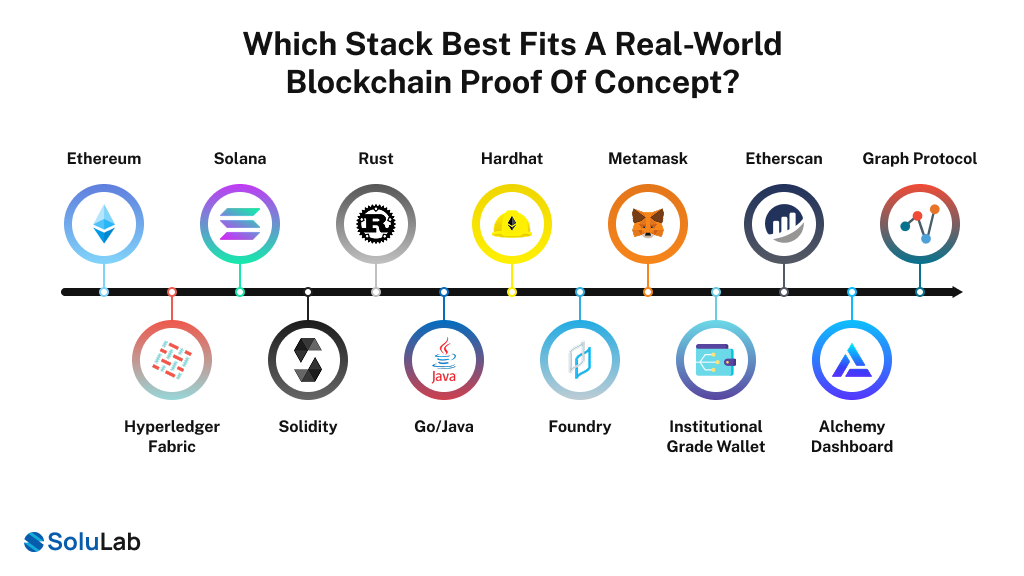
Which Stack Best Fits a Real-World Blockchain Proof of Concept?

Stop overthinking this. Here’s what actually works in 2026:

Stack That Fits Real-World Blockchain PoC

For Most Enterprise Use Cases: Ethereum (via Polygon)

Polygon gives you:

  • Ethereum’s security and decentralization
  • 10,000x cheaper transaction costs
  • 2-3 second finality (fast enough for most enterprise use cases)
  • Massive ecosystem of tools and developers
  • Institutional support

Is it perfect? No. But it’s the safest default for enterprise blockchain POC in 2026.

Use this unless you have a specific reason not to.

For Privacy-Critical Use Cases: Hyperledger Fabric

If your PoC involves data you don’t want publicly visible, Fabric is the play:

  • Permissioned network (you control who sees what)
  • Privacy by design
  • Flexible consensus (you can tune for your scale)
  • Enterprise-hardened

The only issue is more operational complexity, as you’re not using public infrastructure.

For Very High Throughput: Solana

If your PoC needs thousands of transactions per second from day one, Solana is faster than Ethereum/Polygon. But most blockchain application development doesn’t need that. But if you do, Solana delivers.

Smart Contract Language

  • Solidity (for Ethereum/Polygon): industry standard, massive tooling, what everyone uses
  • Rust (for Solana): faster execution, less gas consumption, but steeper learning curve
  • Go/Java (for Hyperledger): if you’re in the enterprise Java ecosystem already

Pick Solidity unless you have strong reasons otherwise. It’s where the talent pool is.

Development Tools

  • Hardhat: testing framework, local blockchain, deployment tool. Industry standard for Solidity.
  • Foundry: faster, more advanced, used by teams building critical infrastructure.
  • Truffle: older, still works, but most new projects use Hardhat.

Hardhat. Use Hardhat.

Key Management

For a PoC, you probably need:

  • Metamask for testing (developers use this constantly)
  • Hardhat local accounts for development
  • Institutional-grade wallet for actual PoC transactions (Ledger, cold storage, etc.)

Yes, you need real security even for a PoC. You’re proving this works for your company. Can’t cut corners here.

Monitoring & Analytics

  • Etherscan (Ethereum/Polygon): public transaction explorer
  • Alchemy Dashboard: real-time monitoring of your transactions
  • Graph Protocol: indexing blockchain data for queries

Use free tiers of these. Plenty for PoC scale.

What does a Successful Enterprise Blockchain POC look like in Real Deployments?

1. Walmart & IBM Food Trust 

Food safety incidents made it take up to 7 days to trace contaminated products back to the source, and Supply‑chain data was siloed across farmers, distributors, and retailers, slowing recalls and increasing risk.

Solution

Walmart and IBM ran a blockchain proof of concept on Hyperledger Fabric for mango traceability, and key supply‑chain events (farm, packer, distributor, store) were recorded on a shared, tamper‑evident ledger with a simple UI for scanning and querying.

Impact

  • Trace time from store to farm dropped from 7 days to 2.2 seconds, proving end‑to‑end visibility.
  • The successful PoC led Walmart to expand into the broader IBM Food Trust network across more products and partners.

2. Bank of England & PwC  

The Bank of England wanted to test if distributed ledger technology could support RTGS‑style wholesale payments without risking live infrastructure, and they needed evidence on performance, resilience, and operational impact before considering DLT in core settlement systems.

Solution

PwC and the Bank built a blockchain PoC on Ethereum to simulate RTGS‑like gross settlement between multiple participants, and Smart contracts modeled settlement logic in a rapid 6‑week build, focused on feasibility rather than full production readiness.

Impact

  • The PoC showed that a DLT platform could support RTGS concepts and improve resilience and visibility across participants.
  • It upskilled the Bank’s team and informed its broader FinTech and RTGS renewal work, de‑risking further blockchain exploration.
CTA 3 Blockchain POC

What KPIs Actually Prove Success in Blockchain Proof of Concept Projects?

At the end of your 4 weeks, you’ll have data. Here’s how to interpret it:

1. Technical Metrics That Matter

Transaction Finality Time: How long until a transaction is guaranteed permanent? For most enterprise blockchain use cases, under 10 minutes is fine. If it’s taking hours, that’s a problem.

Throughput: Transactions per second your system can handle. Scale this to your expected production volume. If you need 100 TPS and you’re getting 50, that shapes your architecture decisions.

Cost per Transaction: What does each transaction cost in gas/fees? Scale to your expected monthly volume. Turns into a real operational cost.

Integration Latency: Time from your existing system triggering a blockchain transaction to that transaction settling. Includes network latency. Should be under 1-5 minutes for most enterprise use cases.

2. Business Metrics That Matter

Time Reduction: How much faster does your process run with blockchain? 3 days to 3 hours? Great. 3 days to 2.8 days? Not enough benefit.

Cost Reduction: Does blockchain actually save money or just move costs around? Calculate real savings, not theoretical.

Risk Reduction: Is the process more trustworthy? Can you prove it? (This is hard to measure but critically important.)

Stakeholder Confidence: Did all participants agree that this is valuable? Or are some skeptical? You need broad buy-in, not narrow technical enthusiasm.

3. The Single Metric That Drives Decisions

  •  If I had to pick one number that determines your go/no-go decision, it’s this:

(Time/Cost Benefit) ÷ (Implementation Effort for Pilot) = Viability Score

  • If blockchain saves you $2M/year, and a 6-month pilot costs $3M? Score: 0.67. Worth doing.
  • If blockchain saves you $500K/year, and a pilot costs $3M? Score: 0.17. Probably not worth it.

The math drives the decision.

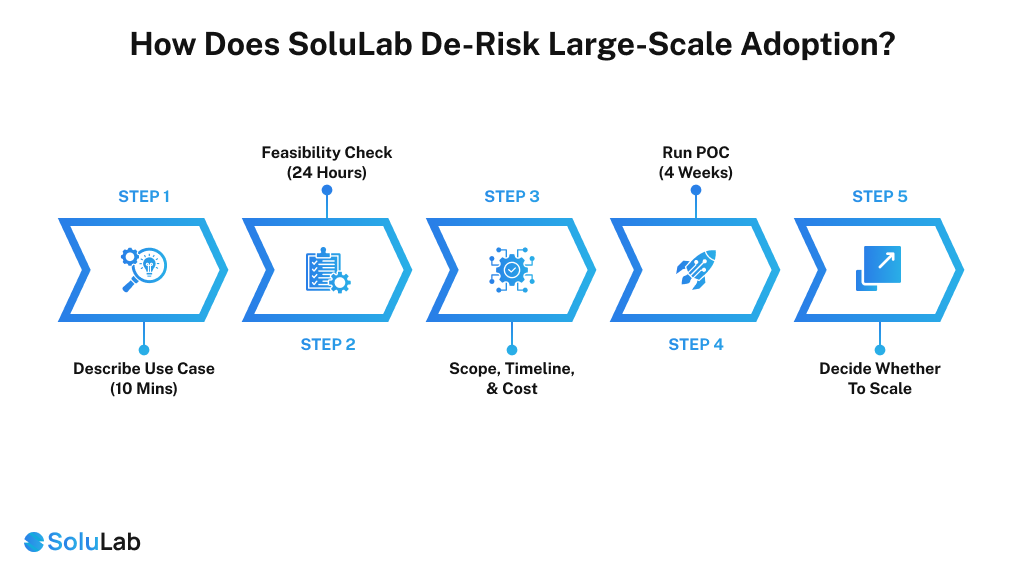
How Does SoluLab De-Risk Large-Scale Adoption?

This is where most enterprises get stuck, knowing what to do, but not knowing who to trust with it. And that’s where we come in.

We’ve built blockchain proof of concept applications for fintech companies, supply chain networks, healthcare systems, and enterprise platforms. Most of our PoCs move to production. That’s not luck. That’s experience.

Your 4 weeks should be spent validating your business case, not fighting technology or figuring out how to approach the problem.

We handle the technical complexity, so you can focus on the business decision.

SoluLab De-Risk Large-Scale Adoption

Here’s how it works:

1. You describe your use case in 10 minutes

2. We do a feasibility check (usually 24 hours)

3. We give you a scope, timeline, and cost estimate

4. If it makes sense, we run your PoC

5. You decide whether to scale it

Conclusion 

You’re sitting in that boardroom again. The CFO asks: Should we move to blockchain? Now you have a path forward that doesn’t require a year of debate or a massive bet before you know if it works. You run a 4-week blockchain proof of concept with a Blockchain development company.

Like SoluLab, spend around $200K and 4 weeks of team time. 

Get a clear answer. If yes? You move to a 4-6 month pilot with realistic budget and timeline expectations. If not? You saved millions by validating a path won’t work before going all-in. Either way, you’ve made a decision based on data, not assumptions.

That’s the value of building a blockchain PoC in just 4 weeks. The companies that succeed with blockchain aren’t the ones with the most advanced technology. They’re the ones who validated quickly, learned fast, and iterated intelligently. You can do that. Four weeks. Clear answer. And Minimal risk.

FAQs

1. Can we really do a meaningful blockchain PoC in 4 weeks?

Yes. Not every use case, but most enterprise use cases fit. The key is a tight scope. If you’re asking, can blockchain help us with X? and X is specific enough to articulate in a sentence, you can probably validate it in 4 weeks. If you’re asking how we use blockchain without a specific problem, you need longer, months longer. That’s not a PoC, that’s strategic exploration. That’s why we focus on the first bucket. Specific problems, under four-week validation.

2. What if we don’t have blockchain expertise on our team?

We expect that most enterprises don’t. That’s exactly why you hire an experienced blockchain development company for the PoC. You should have one person on your team who’s technically competent enough to understand what we’re doing and approve decisions. But you don’t need in-house expertise. That’s what we bring.

3. Can you do our PoC for less than $200K?

Maybe. Depends on the scope. If your PoC is tiny, a single smart contract, no integration, we might do it for $50-80K. But we’d be suspicious of quotes significantly below $100K. Either they’re cutting corners, or they don’t understand enterprise requirements, but quotes significantly above $300K usually mean they’re including more than a PoC.

4. How long until we can go to production after a successful PoC?

Typically 4-8 months, as the PoC proves the concept. The pilot (4-6 months) hardens everything like security, performance, and operations, then production. Some companies try to rush pilot phase, don’t. That’s where most blockchain failures happen.

5. What happens if the PoC says blockchain won’t work for us?

Honestly? That’s a win too. We had one client where the PoC revealed they didn’t actually have a trust problem; they had a speed problem, and Blockchain wasn’t the right answer. It saved them $5M and 12 months of wasted effort. A good blockchain proof of concept gives you the data to make the right decision, whether that’s moving forward or stopping.

6. What if we want to pivot after Week 2?

It happens as you learn something unexpected and realize your original direction doesn’t make sense. That’s why we build flexibility into the process. Pivoting mid-PoC costs time and money, but it’s manageable if it happens early. By Week 3, pivoting usually means extending the timeline or narrowing the scope. Can’t do everything.

Tokenization Platform Development in Australia: From Strategy to Cost

Tokenization in Australia has quietly crossed an important line.

What started as small proofs-of-concept has now become live pilots, real money transactions, and regulated market testing. This involves banks, regulators, and institutional infrastructure providers. Are you confused about what we are discussing? It’s tokenization. From May to August 2025 alone, the global real-world asset tokenization market grew from USD 8.6 billion to USD 24.31 billion. Australia is no longer watching this trend from the sidelines.

According to the Grand View Horizon, real-world asset tokenization in Australia generated a revenue of USD 55.6 million in 2024 and is expected to reach USD 221.6 million by 2030. At the same time, regulators are actively supporting controlled experimentation, and major banks are building settlement rails that work with tokenized assets. For business leaders, this raises a practical question. Is now the right time to invest in digital asset tokenization, and if yes, how do you do it safely, legally, and profitably? This guide breaks it down in a detailed way on tokenization in Australia. Let’s get in!

Key Takeaways

  • Tokenization in Australia has moved from pilots to real, regulated market activity.
  • Tokenization platforms can reduce settlement time by 70–90%.
  • First movers in Australia can capture liquidity pools 2–3x faster before market standards and licensing frameworks fully mature.

Why Tokenization in Australia Has Moved From Pilot to Production?

Tokenization in Australia is no longer a futuristic ideology; it’s happening. Three forces have pushed the market forward at the same time: institutional demand, regulatory participation, and mature infrastructure.

1. Institutional momentum is real

Australia’s largest financial institutions are actively testing tokenized settlement and asset issuance.

Banks such as ANZ, Westpac, and Commonwealth Bank are no longer asking whether tokenization works. They are asking how to scale it safely.

Projects like Project Acacia have already moved beyond lab environments into live transaction testing, including delivery-versus-payment settlement using real funds.

2. Regulators are part of the process

Unlike many markets where innovation runs ahead of regulation, Australia has taken a different path.

Both the Australian Securities and Investments Commission and the Reserve Bank of Australia are directly involved in tokenization pilots. ASIC has provided regulatory relief to allow real-money testing under controlled conditions, while the RBA is exploring how tokenized assets can integrate with the national payment infrastructure.

For businesses, this significantly reduces regulatory uncertainty.

3. The technology stack is ready

The current generation of asset tokenization platforms supports:

  1. Multi-chain deployment
  2. Cross-chain settlement
  3. Stablecoin integration
  4. Automated compliance
  5. Post-quantum cryptography trials

This maturity is what allows tokenization to move from pilots into revenue-generating systems.

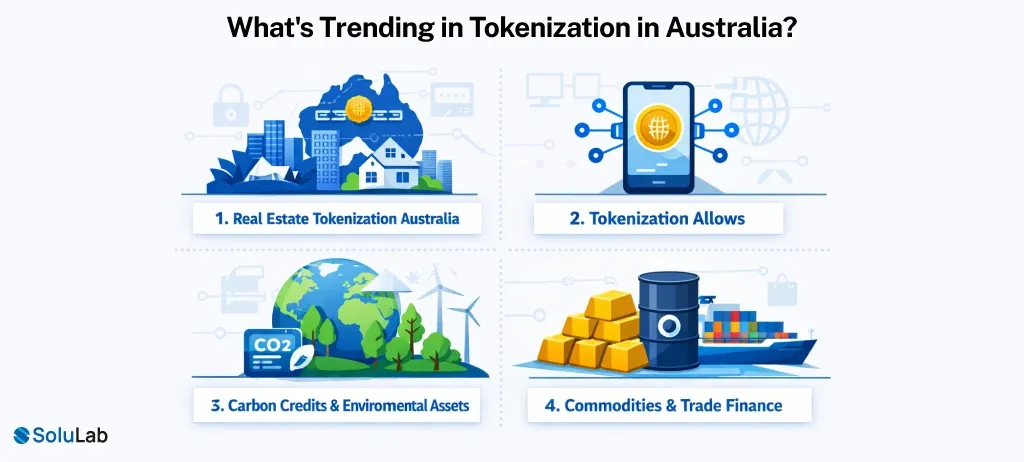
Asset Classes Already Being Tokenized in Australia

Trending Tokenization in Australia

Tokenization is already happening across multiple asset categories in Australia.
Some segments are clearly leading the way.

1. Real estate tokenization Australia

Australia’s real estate market is valued at over AUD 10 trillion, making it the country’s largest store of wealth. Real estate tokenization in Australia is gaining traction because it solves a long-standing problem: illiquidity.

Tokenization allows:

  1. Fractional ownership of commercial and residential assets
  2. Faster capital rotation
  3. Broader investor participation, including offshore investors

Most current implementations use trust or beneficial ownership structures, while the legal title remains under traditional property law frameworks. This approach balances innovation with compliance.

2. Private credit and debt instruments

Private credit is currently the largest real-world asset tokenization segment in Australia, with approximately USD 14 billion already tokenized by mid-2025.

Tokenizing private credit offers:

  1. Faster settlement
  2. Reduced counterparty risk
  3. Transparent cash-flow distribution through smart contracts

This segment is particularly attractive for institutional investors seeking yield with programmable risk controls.

3. Carbon credits and environmental assets

Australia is a major exporter of verified carbon offsets. Tokenizing carbon credits enables:

  1. Embedded proof of origin
  2. Automated compliance tracking
  3. Easier international trading

For enterprises operating in sustainability-driven markets, digital asset tokenization simplifies reporting and auditability.

4. Commodities and trade finance

Agricultural commodities, metals, and export-backed assets are also being tokenized. By linking physical assets with blockchain records, businesses can:

  1. Improve supply chain transparency
  2. Access trade finance faster
  3. Reduce settlement disputes

This is especially relevant for export-driven sectors.

White Label Tokenization Platforms

Tokenization Regulatory Reality in Australia: What Businesses Can Do

Regulation is no longer a black box for top tokenization companies in Australia. While full licensing frameworks are still evolving, businesses can already operate within defined boundaries.

1. ASIC sandbox and regulatory relief

ASIC has granted targeted regulatory relief for tokenized asset pilots under supervised conditions. This allows companies to:

  1. Test platforms with real users and capital
  2. Validate compliance models
  3. Build regulatory credibility early

For many tokenization development companies in Australia, this sandbox phase is becoming a strategic entry point rather than a temporary experiment.

2. Clearer asset classification is coming

Frameworks proposed to Parliament aim to clarify:

  1. How tokenized assets are legally classified
  2. Which tokens qualify as financial products
  3. How trading, custody, and settlement should be licensed

This direction of travel matters. Businesses that design platforms aligned with these frameworks now will face fewer changes later.

From a business perspective, the message is simple. You do not need to wait for perfect regulation to act. You need to design with regulation in mind from day one.

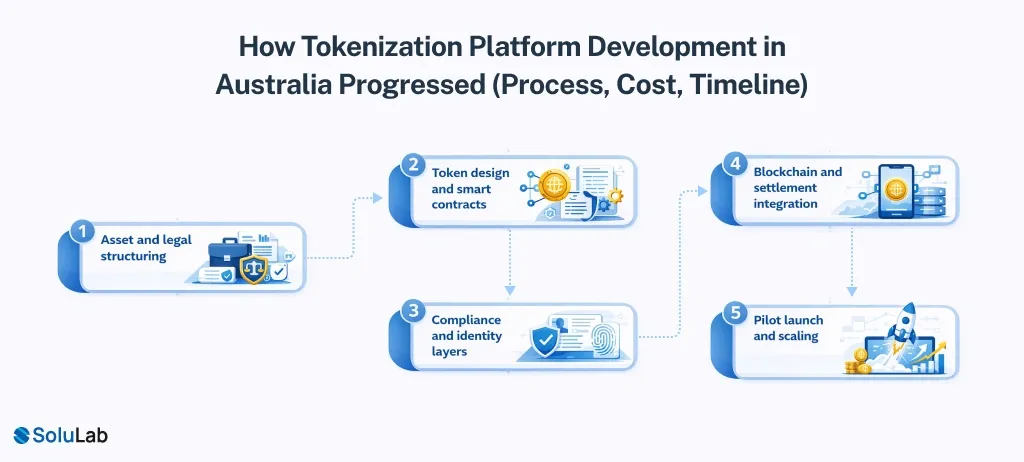
How Tokenization Platform Development in Australia Progressed in 2026 (Process, Cost, Timeline)

Tokenization Platform Development Process in Australia

This is where interest turns into execution. A typical tokenization platform built in Australia follows a structured path:

Step 1: Asset and legal structuring

The process starts by defining:

  1. The asset being tokenize
  2. Ownership and rights model
  3. Investor eligibility rules

Legal structuring ensures the token represents enforceable rights, not just digital claims.

Step 2: Token design and smart contracts

Next comes token economics and smart contract logic:

  1. Fractionalization rules
  2. Transfer restrictions
  3. Automated distribution
  4. Compliance enforcement

This is where a strong blockchain development company in Australia adds the most value.

Step 3: Compliance and identity layers

AML, KYC, and investor accreditation are embedded directly into the platform.

For B2B platforms, compliance automation is often more important than user experience.

Step 4: Blockchain and settlement integration

Platforms are typically deployed on:

  1. EVM-compatible chains
  2. Permissioned ledgers
  3. Or hybrid architectures

Integration with payment systems and stablecoins enables near-real-time settlement.

Step 5: Pilot launch and scaling

Most platforms launch first under controlled conditions, then expand asset coverage or investor access.

Typical timelines

  1. Architecture and legal mapping: 2–3 weeks
  2. Platform development: 8–12 weeks
  3. Pilot and regulatory alignment: 4–6 weeks

Most projects reach market within one business quarter.

Cost considerations

Costs vary widely, but broadly:

  1. MVP platforms cost significantly less than full enterprise deployments.
  2. Enterprise-grade platforms include compliance, reporting, and integration layers.

Note: Amid all these customizations and models, the basic price starts from $10k (14.5k AUD)

For most businesses, the focus is not on upfront cost, but long-term operational savings and liquidity unlock.

Strategic Advantages for First Movers in Australia’s Tokenization Market

Asset Tokenization is not just a technology upgrade. It is a strategic positioning decision.

For example, in July 2025, Westpac, in collaboration with the Reserve Bank of Australia and the Digital Finance CRC, announced the launch of live transaction testing under Project Acacia. The goal was to test delivery-versus-payment settlement for tokenized assets using real money, not simulations. Westpac integrated tokenized asset settlement with Australia’s PayTo real-time payments system, enabling atomic settlement across blockchain networks. 

The initiative aimed to reduce settlement risk, cut reconciliation costs, and prepare national infrastructure for tokenized financial markets. The pilot successfully executed live transactions, proving that tokenization can operate within Australia’s regulated financial system.

1. Early liquidity capture

Liquidity pools form early and tend to concentrate. First movers often control market standards before larger incumbents fully commit.

2. Regulatory credibility

Operating under sandbox relief today builds trust with regulators tomorrow. This matters when licensing becomes mandatory.

3. Global capital access

Tokenized assets are borderless by design. Australian businesses can tap into international capital without rebuilding infrastructure for each market.

4. Operational efficiency

Smart contracts reduce reconciliation, settlement delays, and administrative overhead. Over time, this compounds into measurable cost savings.

Tokenization Platform Development

Conclusion

The market is growing fast, regulators are engaged, and institutions are investing in infrastructure that will define how value moves in the next decade. For businesses, the opportunity is no longer theoretical. It is executable.

The question is not whether tokenization will become part of Australia’s financial system. The question is who builds early, aligns with regulation, and captures the upside.

For organizations evaluating tokenization companies in Australia or planning to work with a tokenization development company, SoluLab experts are here to support you from step 1. 

In case you need customization for your platforms, our experts are here to aid you. Contact us today, and discuss your ideology and gain insights from our 10+ year experts.

FAQs

1. Can I integrate chatbots into my tokenization platform?

Yes. Chatbots can help with investor onboarding, KYC support, FAQs, and portfolio queries. They improve user experience and reduce manual support work across top tokenization platforms.

2. How can I contact SoluLab for tokenization services?

You can connect directly with SoluLab through the website, LinkedIn, or by scheduling a consultation to discuss your tokenization platform goals and requirements. Once you fill out the form, our team will reach out to you within 24 hours.

3. Can real estate be tokenized legally in Australia?

Yes. Real estate tokenization in Australia is possible using trust or beneficial ownership structures, while legal property titles remain unchanged under existing land and property regulations.

4. Which companies in Australia are actively using tokenization services?

Banks and institutions such as ANZ, Westpac, and asset managers are using tokenization through regulated pilots and settlement projects.

5. Is tokenization only suitable for large enterprises?

No. While banks lead adoption, mid-sized businesses can also tokenize assets using modular platforms, sandbox frameworks, and tokenization-as-a-service models without heavy upfront investment.

How AI Development Services Future-Proof Your Business Against Market Changes in 2026?

What happens when market demand changes overnight, customer behavior shifts, or operational costs suddenly rise? You’re probably hearing this a lot. The real question is—can your business adapt quickly without disrupting existing systems?

This is where AI development services make a real difference. Instead of reacting late, businesses can use AI to predict changes, automate responses, and make smarter decisions. 

Moreover, nearly 72% of businesses use AI in at least one function. With custom AI solutions built around your workflows, you can improve customer experiences and automate repetitive tasks efficiently.

In this blog, we’ll explore why adopting AI development services is important for businesses, key real-world use cases, and more. Let’s get started!

Key Takeaways

  • AI Development services enable businesses to react to changes in the market more promptly.
  • Specialized AI systems convert real-time information into practical information.
  • AI-based automation enhances operational efficiency, and the expenses remain predictable.
  • AI-based businesses can individualize the customer experience at scale.

Why Adapting AI Development Services Is Important For Businesses?

Markets are evolving at a higher rate than ever, and those who do not adapt may fall behind. Market changes are beneficial as they enable companies to become competitive, efficient, and prepared to grow in the future. However, leveraging AI integration solutions offers numerous advantages:

  • Rapid Tech Shifts: Technologies are coming up fast, and it is altering the mode of operation of business. Early adaptations assist companies to achieve efficiency, remain relevant, and not lose ground to technologically adapted rivals.
  • Inconsistent Customer Behavior: The customer needs and expectations are evolving. Adaptive businesses will be able to customize experiences, react more quickly, and create better relationships, whereas inflexible companies will have a hard time retaining their consumers.
  • Rising Operational Costs: Profitability is affected by inflation, supply chain, and labor expenses. Smart processes and automation can be used to adapt businesses and reduce costs without the quality or performance of the business being compromised.
  • The Need To Do More With Less: Significantly, teams are supposed to produce superior outcomes with minimal budget and manpower. Adaptation enables businesses to improve operations, increase productivity, and scale without overloading teams.

How to Implement AI in Your Business Strategy?

How to Implement AI in Your Business Strategy

Using AI in your business plan can make you competitive as it will be efficient, cost-effective, and enable quick decision-making in the ever-evolving market environment. You can adhere to the following guidelines while doing so:

1. Determine the High-Impact Business Areas: Begin by identifying repetitive processes, time-consuming ones, or data-intensive processes. These domains are capable of providing the quickest ROI in case AI is implemented to automate and optimize them.

2. Establish Specific Business Objectives of AI: Determine your desired AI goals– reducing costs, increasing turnaround, enhancing customer experience, or improving forecasting, etc., to keep AI initiatives in line with business results.

CTA A_ AI Development

3. Select the appropriate AI Solutions: Choose between pre-made tools and custom-made AI app development solutions depending on your needs, the required scalability, and your current systems to prevent future constraints.

4. Organization of Your Data: AI depends on quality data. Make your business data clean, structured, and centralized to provide the right insights and effective AI performance.

5. Go with Small Projects: Start with a proof of concept, which helps test the effects of AI, lessens risk, and acquires internal buy-in prior to scaling solutions across departments.

6. Add AI to existing Processes: Make sure AI solutions are compatible enough to fit existing systems and processes so that they are easily adopted and do not negatively impact the daily operations.

How AI Development Services Help Businesses Adapt to Market Changes?

How AI Development Services Help Businesses Adapt to Market Changes

The development of AI can assist businesses to remain adaptable to market changes through automation work, better decision-making, and responding faster and more cost-effectively to evolving customer and operational requirements.

  • Automating Time-Consuming and Repetitive Processes: AI auto-processes manual activities such as data entry, reporting, and approvals and frees teams to work on strategic activities, minimizes errors, delays, ay and operational expenses.
  • AI Chatbots, Document Processing, and Workflows: AI chatbots respond to customer inquiries 24 hours a day, whereas document processing and automation enhance work processes within a company and make various companies more consistent.
  • Predictive Analytics: Artificial intelligence is used to analyze the past and present data, predicting demand, risk detection, and smarter business decisions before the problems the market changes can produce a greater problem.
  • Light Speed Customer Response: AI tailors interpersonal communication, can pinpoint customer intent within a brief period of time, and can provide prompt feedback, which companies can use to meet the growing demands and improve customer satisfaction.
  • Increased Operations at no Increased Costs: The AI systems will be able to expand as the demand grows, and the businesses will be in a position to cope with the workload that will have increased without necessarily having to hire additional staff or invest a lot more in their infrastructure.

Real-World Business Use Cases of AI Development Services

The use of AI development services is already changing the way businesses are run daily. Increased sales and decreased risks are only a few examples of how real-world AI applications can be applied to influence business operations at their core level.

1. AI Sales and Marketing Automation.

AI for sales and marketing teams automates lead scoring, customer segmentation, and personal campaigns. It assists sales teams in prioritizing high-intent prospects and enhances conversions by targeting them using data and real-time insights.

2. AI in Operations & Supply Chain.

AI enhances demand prediction, inventory, and process automation. Predictive analytics and intelligent workflow automation enable businesses to minimize delays, reduce costs, and react more quickly to disruptions.

3. AI in Finance and Risk Management.

AI for BFSI identifies abnormalities, cash flow, and notifies about possible risks in advance. It automates reporting and compliance activities and enhances financial accuracy and decision-making using real-time data analysis.

4. AI for Customer Support

AI-based chatbots and virtual assistants are used to process regular queries 24/7. This not only reduces response times but also reduces support costs and maintains uniform customer experiences without requiring the support staff to work harder.

CTA B_ AI Development

Conclusion

AI development services provide businesses with the flexibility required to survive and thrive in markets that are always evolving. AI strategy consulting makes decisions better, processes more automatically, and is responsive to customer needs, eliminating uncertainty and operational stress. 

Businesses can predict the changes based on real-time insights and predictive analytics instead of responding to market shifts late. More to the point, bespoke AI solutions can expand as the company expands, and there would be no extra complexity or expenses to implement. 

Early adopters of AI will be in a better position to remain efficient, agile, and in the position to react to market disturbances. SoluLab, an AI development company, can help businesses automate their workflows across industries. Book a free consultation call today!

FAQs

1. What industries benefit most from AI development services?

Automation and insights powered by AI have a profound positive effect on industries such as retail, finance, healthcare, manufacturing, logistics, and SaaS.

2. How does AI improve customer experience during market changes?

AI enhances personalization of communication, anticipates the needs of the customers, and offers real-time assistance, which creates uniform experiences even in times of peak demand.

3. What is the ROI of investing in AI development services?

Businesses find ROI in the form of cost reduction, enhanced productivity, reduced response time, and superior strategic decision-making.

4. How does AI help with decision-making during market uncertainty?

AI can analyze real-time and past data to detect trends, predict outcomes, and point out risks to help to make decisions faster and more informed. To make better decisions, partner with an enterprise AI development company

5. Can AI development services integrate with existing systems?

Yes. AI is developed to interact well with current software, tools, and workflows from a customized solution.

6. What is the current AI market trend, and how does it help businesses adapt to change?

The current AI market trend focuses on automation, predictive analytics, and custom AI solutions. These trends help businesses adapt faster by improving decision-making, reducing manual work, and responding quickly to changing customer and market demands.

AI Agents in Stablecoin Development: From Concept to Production

Stablecoins now have a market supply of over $300 billion and process huge transaction volumes — reaching $9 trillion in stablecoin payments by the end of 2025.  As usage grows, managing reserves, liquidity, compliance, and risk manually is no longer practical. 

This is where AI agents are becoming critical. Unlike static rule-based systems, AI agents continuously monitor on-chain activity, detect anomalies, and adapt to changing market conditions in real time. 

AI agents help bridge this gap by bringing automation, intelligence, and decision-making into stablecoin development. In this blog, you’ll learn why AI agents matter in stablecoin development, their benefits, and more. 

Key Takeaways

  • Stablecoins have AI agents that manage them on autopilot.
  • The AI agents minimize human mistakes because they make faster and data-driven decisions.
  • The next generation of stablecoins is not a stagnant one. 
  • Artificial intelligence agent projects are in a better position to scale and be sustainable in the long run.

Why AI Agents Matter in Stablecoin Development? 

The role of AI agents in the stablecoin development is important, as they allow them to automatize the decision-making process, preventing risks in real time, and ensuring the stability of prices in rapidly moving crypto markets with high volatility.

1. Stability management in real-time: AI agents constantly track market data and transactions in order to identify risks as soon as possible and take immediate measures to stabilize the peg of the stablecoin.

2. Automated reserve management: They are monitoring reserves 24/7, keeping backing assets adequate and balanced, eliminating the risk of human error, and enhancing transparency in the work of stablecoins

3. Smarter supply control: AI agents use dynamism to regulate minting and burning according to demand trends and curb over-issuance, liquidity crunch, and price volatilities.

4. Fraud and anomaly detection: The analysis of the behavior of transactions helps AI agents reveal suspicious transactions, manipulation attempts, or unusual spikes that may compromise the security of stablecoins within a short period.

5. Regulatory and compliance support: AI agents assist in monitoring AML and compliance requirements, changing regulatory requirements, and lessening the operational load on issuers of stablecoins.

6. Scalability and efficiency: With the increase in transaction volumes, the AI agent will make the system of stablecoins scale without any significant effect due to the dependence on human supervision or large staff teams.

    Benefits of AI-Agent Integration with Stablecoin Development

    Development of AI-integrated Stablecoins involves the integration of intelligent agents with blockchain to automate financial transactions in order to enhance peg stability as well as assist enterprises in making safe, scalable, and regulation-ready stablecoin platforms.

    Benefits of AI Agents integration with Stablecoin Development

    1. Stronger Peg Stability: AI agents are used to track liquidity, demand, and market indicators in real time and automatically modify supply mechanisms to keep prices stable during turbulent crypto market conditions.

      2. Risk and Fraud Accomplishment: The agents based on AI constantly analyze the transaction behavior and identify fraud, manipulation, or abnormal activity at an early stage, lowering the systemic risk and safeguarding stablecoins ecosystems.

        3. Auto Reserve and Treasury Management: Monitoring the reserves, the collateral ratio, and the movement of assets in real-time, AI agents guarantee transparency, accuracy, and effective operations of treasuries without extensive manual control.

          4. Scalable Infrastructure of Stablecoins: AI automation also allows stablecoin platforms to maintain the growing volume of transactions and multi-chain operations without affecting performance or operational efficiency.

            5. Compliance-Ready Architecture: AML, transaction monitoring, and regulatory reporting AI agents can be used to adapt to regional compliance requirements and facilitate the stablecoin projects to comply with global regulations.

              6. Data-Driven Decision Making: In contrast to a conventional rule-based framework, AI agents are informed by historical and real-time information, which enables platforms that use stablecoins to regulate minting, burning, and liquidity policies.

                How to Build AI-Integrated Stablecoin Development Solutions?

                To develop AI-based stablecoin solutions, there is a need to have smart AI blockchain integration and good AI agent development services to automate and enhance stability to ensure compliance and scale safely within the real-world financial systems.

                Build AI integrated Stablecoin Development Solution

                Step 1: Stablecoin Use Case and Model

                Begin with the choice of the kind of Stablecoin: fiat-backed, crypto-backed, or algorithmic. Establish clear objectives such as price stability, the level of automation required, compliance requirements, and volume of transactions to guide in AI and blockchain design decisions.

                Step 2: Infrastructure Preparation (Blockchain)

                Select the appropriate blockchain, depending on the scalability, fee, and security. Install smart contracts to mint, burn, and govern so that they are easily accessible to AI agents via APIs or oracles.

                Step 3: Monitoring AI Agents

                Create AI agents that will constantly check reserves, transactions, and market signals. These agents identify risks before time, mark anomalies, and assist in real-time decision-making without necessarily involving a lot of human input.

                Step 4: Empower AI-Based Liquidity and Peg Management

                Analyze demand, supply, and volatility using AI models. To keep the peg and avoid the de-pegging events, AI agents may automatically increase or decrease minting or burning systems.

                Step 5: Unite Compliance and Risk Controls

                Integrate AI agents to facilitate AML, KYC, and fraud detection. They are systems that are responsive to changing regulations, track suspicious activities, and minimize compliance overhead without compromising transparency and trust.

                Step 6: Test, Optimize, and Scale

                Simulate and run stress tests to verify AI resolutions in varied market conditions. Continuous model improvement by use of real data, and then scale the solution across the network or regions, but safely.

                cta 1 AI Agents in Stablecoin Development

                Cost and Timeline Breakdown for AI-Powered Stablecoin Development

                AI-powered stablecoin development costs $140K–$370K and takes 4–6 months, varying by complexity, team expertise, and compliance needs like MiCA regulations.

                PhaseTimelineCost Range (USD)Key Factors
                Planning & Stability Model2–4 weeks$20K–$50KModel selection (fiat/algorithmic), regulatory research
                AI/ML Integration6–8 weeks$50K–$150KPredictive models, risk engines, and data training
                Smart Contracts & Blockchain4–6 weeks$40K–$100KSolidity coding, DeFi integrations, oracle setup
                Testing, Audits & Compliance4 weeks$30K–$70KSecurity audits ($8K–$25K), KYC/AML, stress tests
                Total4–6 months$140K–$370KExcludes ongoing liquidity/ops; lower on L2 chains

                Why AI + Stablecoins Is the Ultimate Investor Play in 2026?

                In 2026, AI agents in blockchain are reshaping finance. From smarter automation to trust-backed assets, AI for stablecoin development makes ai agents blockchain a strong, future-ready investor opportunity.

                Clear frameworks like EU MiCA are reducing uncertainty, while DePIN and real-world asset (RWA) tokenization add utility. AI agents help stablecoins stay compliant, scalable, and adaptive across decentralized and regulated ecosystems.

                2. ROI Potential Backed by Early Signals

                Early AI-DeFi and AI-stablecoin projects have reported returns of up to 300%, according to Dune Analytics. Investors are rewarding platforms where AI agents improve efficiency, risk control, and decision-making, not just hype-driven narratives.

                3. Risks Investors Must Weigh Carefully

                The space isn’t risk-free. Hyped, insufficient transparency, and black-box decision-making by AI can become detrimental to trust. Critical investors are targeting those teams whose primary focus is explainable AI, good governance, and practical use cases.

                cta 2 AI Agents in Stablecoin Development

                Conclusion

                With the spread of stablecoins around the world, manual controls and fixed rules are no longer adequate. The AI agents are used to monitor real-time reserves, manage liquidity, identify early risk, and ensure compliance without causing innovation to slow down.

                They are also better in transparency and decision-making, which enhances a user and investor trust. In the future, the successful stablecoins will be ones that are constructed as intelligent financial systems, with AI agents collaborating with blockchain infrastructure to provide stability, efficiency, and resilience over time.

                SoluLab, an AI agent development company, helps you design, build, and deploy intelligent stablecoin systems powered by autonomous AI agents.

                FAQs

                1. What are AI agents in stablecoin development?

                AI agents are also autonomous systems within stablecoin environments to monitor data, make decisions, and automate such actions as risk management, compliance checks, and liquidity control.

                2. Can AI agents help prevent stablecoin de-pegging?

                Yes, AI agents pick up early warning signs and make automated supply, liquidity, or risk controls changes in order to minimize the risk of de-pegging events.

                3. How do AI agents support compliance in stablecoins?

                AI agents automate AML, KYC, and transaction monitoring, helping stablecoin platforms meet regulatory requirements while reducing manual effort and operational delays.

                4. Are AI-powered stablecoins safer than traditional ones?

                AI agents will contribute to the safety aspect when applied in a responsible way, making them better at monitoring, fraud detection, and governance, but they still need a high level of supervision and transparency.

                5. What role do AI agents play in fraud detection?

                They analyze transaction patterns in real time, flag suspicious activity, and help prevent fraud, manipulation, and unauthorized access within stablecoin ecosystems.

                Why the UAE Is the Best Location to Launch a Crypto Neo Bank?

                Crypto neo banking isn’t just about offering digital wallets or crypto-friendly accounts anymore. It’s about operating in a market where regulation supports innovation, customers trust the ecosystem, and institutions are ready to adopt next-generation financial models. That’s exactly where the UAE stands out.

                Over the past few years, the country has quietly positioned itself as one of the most crypto-forward financial hubs in the world, combining regulatory clarity, strong fintech infrastructure, and a government-backed vision for digital finance. 

                For founders and enterprises planning to launch a crypto bank, location matters more than ever. In this blog, we explore why the UAE has become the preferred destination for launching crypto neo banks and what makes it uniquely suited for building compliant, future-ready financial platforms. Let’s get started!

                Why the UAE Is Emerging as a Global Crypto Hub?

                The UAE is a global crypto hub, combining innovation, regulation, and investor confidence. Its supportive government policies and vision are turning it into a blockchain-driven enterprise. 

                The global neo-banking market is expected to reach $2,048.53 billion by 2030, expanding at a compound annual growth rate (CAGR) of 53.4%, according to market research firm Research and Markets.

                Apart from the trend, there are various factors behind the UAE being the leading location for crypto banking solutions:

                • Government Support and Regulatory Clarity: The UAE government actively supports blockchain innovation through clear crypto regulations and licensing frameworks. Initiatives like VARA (Virtual Assets Regulatory Authority) ensure transparency and security, attracting top global crypto exchanges and startups to operate within a structured ecosystem.
                • Tax Benefits and Investor-Friendly Ecosystem: With zero income and capital gains taxes, the UAE offers an ideal environment for crypto investors and businesses. Combined with free zones, global connectivity, and financial infrastructure, it has become a preferred destination for blockchain entrepreneurs worldwide.
                • High Crypto Adoption Rate: The UAE has one of the highest crypto adoption rates in the Middle East. A tech-savvy population, rising digital payments, and growing institutional interest are fueling everyday crypto transactions and driving massive growth in blockchain-based financial ecosystems.

                Key Factors Driving Crypto Neo Banking Development in the UAE

                Crypto Neo Banking Development factors

                A mix of innovation, infrastructure, and investor confidence drives the growth of the Crypto neo-banking sector in the UAE:

                • Strategic Location and Global Connectivity: The UAE’s prime geographic position bridges major global markets, attracting investors and fintech firms worldwide. This connectivity enhances international collaborations and facilitates cross-border transactions, thereby accelerating the crypto solutions development and adoption.
                • Advanced Fintech Infrastructure: With state-of-the-art digital infrastructure, the UAE provides a foundation for fintech innovation. Government initiatives and supportive regulations make it easier to launch and scale a Neo banking Solution in the UAE, enhancing efficiency and security.
                • Strong Institutional Investments: Institutional investors are increasingly backing blockchain-based banking models, fueling innovation and trust. Their participation strengthens financial stability and drives continuous growth within the evolving Crypto neo banking sector, paving the way for mainstream adoption.
                CTA B_ UAE as a Crypto Hub

                Neo Banking vs. Traditional Banking: Who’s Shaping the UAE’s Finance?

                With Neo Banking’s innovation, speed, and digital ease, the UAE’s financial market is changing how people and businesses handle, invest, and transfer money.

                FactorsTraditional BankingNeo Banking
                AccessibilityLimited to physical branches and banking hours.24/7 access via mobile and web-based platforms.
                Account OpeningLengthy paperwork and in-person verification required.Quick digital onboarding with instant KYC verification.
                Operational CostsHigh due to infrastructure and staffing needs.Low operational costs due to a digital-first setup.
                Customer ExperienceSlower response time and manual services.Instant support, automation, and personalized digital experience.
                Innovation & TechnologySlower to adopt emerging technologies.Rapid adoption of AI, blockchain, and cloud solutions.
                Transaction SpeedSlower cross-border and domestic transfers.Instant transfers and real-time processing.
                SecurityStrong traditional systems but less agile.Advanced encryption, biometric access, and blockchain-based security.
                Regulation & ComplianceHeavily regulated with rigid frameworks.Agile compliance with fintech-friendly UAE regulations.
                Target AudienceSuited for traditional clients and large businesses.Focused on tech-savvy individuals and startups.
                SustainabilityHigh paper usage and energy consumption.Eco-friendly, fully digital operation

                How Much Does NeoBank App Platform Development Cost?

                The cost of developing a UAE crypto neo banking app platform depends on several factors, like app complexity, features, design, technology stack, and compliance requirements. On average, a basic MVP (Minimum Viable Product) can cost between $40,000 to $80,000, while a fully functional, enterprise-grade platform with advanced security, multi-currency support, and blockchain integration can range from $100,000 to $250,000+.

                Partnering with an experienced crypto neo bank development company ensures regulatory compliance with the UAE’s financial authorities and user experience. Though the upfront investment may seem high, the long-term ROI is significant as the region’s digital banking market continues to expand rapidly.

                Read Also: How to Build MiCA-Compliant Neo Banks in Europe?

                New technologies are changing the way a crypto neo-banking app and crypto-friendly neo-banking solution function, providing the basis for the future of digital finance: 

                1. Integration of AI and Blockchain: The UAE is using AI to enhance blockchain-based financial services: regulatory tech tools, smart contracts, and machine learning are merging to make banking smarter and safer. 

                2. Rise of Stablecoins and CBDCs: With its planned “Digital Dirham” and regulated dirham-backed stablecoins like AE Coin, the UAE is embracing both central bank digital currency and tokenised fiat for secure, efficient transactions.

                3. Cross-Border Payment Innovations: Innovations such as blockchain settlement platforms are enabling ultra-fast, low-cost cross-border payments in the UAE, redefining how a crypto neo-banking app or crypto-friendly neo-banking solution could serve global clients.

                CTA A_ UAE as a Crypto Hub

                Conclusion

                The UAE’s progressive laws, digital infrastructure, and acceptance of blockchain innovation make it a leader in the development of crypto neo banking. Government programs such as the Digital Dirham and VARA show the country’s ambition to become a global center for fintech. 

                The UAE provides a favorable environment for businesses and investors to grow due to the growing adoption of blockchain, artificial intelligence, and cross-border payment technology. 

                Developing a crypto-friendly neo banking solution here is not just an opportunity, but also a smart step toward the future of decentralized, tech-driven finance as consumer confidence in digital assets increases.

                SoluLab, a white label crypto banking app development company, can help you create secure, compliant, and scalable crypto Neo banking platforms tailored for the UAE market. Contact us to get started!

                FAQs

                1. How can businesses choose the right crypto neobanking development partner?

                Look for partners with experience in fintech licensing in the UAE, understanding of local regulation, technical expertise in crypto rails, and track record in delivering Crypto Neo Banking Platforms and Crypto Neo Banking app development.

                2. Why is now the perfect time to enter the UAE’s crypto neobanking market?

                With regulatory frameworks now largely in place, early-mover advantage is available, and growing consumer and institutional interest in digital assets means it’s a strategic moment for market entry.

                3. How do Crypto Neo Banking Platforms differ from traditional banks in the UAE?

                Crypto Neo-Banking Platforms integrate virtual asset rails (crypto/custody/trading) with digital banking features, whereas traditional banks focus primarily on fiat services and may not offer full crypto integration.

                4. How does cross-border payment innovation support crypto neobanking in the UAE?

                The UAE’s fintech ecosystem supports efficient payment rails and tokenised assets, enabling neo-banks to facilitate low-cost cross-border transfers, leveraging crypto rails and stablecoins.

                5. What role do stablecoins and CBDCs play in the UAE’s crypto banking ecosystem?

                The UAE is actively developing frameworks for dirham-backed stablecoins and central-bank digital currencies, which enable more predictable, low-friction payment rails for crypto banking.

                Top 10 Crypto Wallet Development Companies in the UAE in 2026

                The UAE has rapidly emerged as a global hub for cryptocurrency and blockchain innovation. With forward-thinking regulations, high digital adoption, and a thriving fintech ecosystem, businesses in Dubai, Abu Dhabi, and across the Emirates are increasingly turning to secure and scalable crypto wallet solutions.

                Choosing the right development partner is crucial—not just for building a wallet, but for ensuring seamless transactions, robust security, and compliance with local and international standards.

                In this blog, we’ve curated a list of the top 10 crypto wallet development companies in the UAE in 2026, highlighting their expertise, services, and unique features. Whether you’re a startup exploring DeFi solutions or an enterprise looking to integrate multi-currency wallets, this guide will help you find the right partner.

                Why the UAE is a Hotspot for Crypto Wallet Development?

                The United Arab Emirates has transformed itself into a leading destination for crypto innovation, especially in crypto wallet development. Part of this rise comes from strong government support and regulation that encourages digital asset growth while giving businesses clarity to build here.

                Progressive frameworks such as Dubai’s Virtual Assets Regulatory Authority (VARA), Abu Dhabi Global Market’s (ADGM) rules, and DIFC’s digital asset oversight have created a stable legal environment that global crypto firms value. These measures help startups and established players experiment and launch secure digital solutions with regulatory backing.

                Several strategic advantages make the UAE particularly attractive:

                • Regulatory support and crypto‑friendly policies
                • Strategic MENA hub for blockchain businesses
                • High fintech and digital banking adoption

                How to Choose the Right Crypto Wallet Development Company in the UAE?

                The UAE’s crypto wallet market is expected to grow to US $1,950.2 million by 2033 (CAGR ~25.8%). 

                Choosing the right crypto wallet development services company in the UAE is crucial for building a secure, scalable, and user-friendly wallet that meets your business goals and regulatory requirements.

                Crypto Wallet Market Growth Graph

                Some critical factors to consider are:

                1. Check Their Industry Expertise: Look for a team experienced in crypto wallet development services with deep knowledge of blockchain technology, token standards, and the UAE’s crypto compliance laws. Expertise ensures reliable performance and future scalability.

                2. Verify Security Protocols: Ensure the company follows advanced security standards like multi-signature authentication, encryption, and cold storage integration to protect users’ funds and data against breaches or cyberattacks.

                3. Assess Customization Capabilities: Your business might need unique features. Choose a firm that offers custom wallet design, token integration, and cross-platform support to align with your project’s specific needs.

                4. Evaluate Their Portfolio and Reviews: Check client testimonials, case studies, and past projects to assess the company’s track record, reliability, and success rate in developing crypto wallets for different industries.

                5. Understand Compliance and KYC Requirements: Partner with expert blockchain developers who understand Crypto wallet KYC UAE laws. Compliance ensures smooth operations, user trust, and alignment with the region’s evolving crypto regulations.

                6. Compare Cost and Delivery Timelines: Ask for transparent quotes and timelines. A professional company provides clear milestones, competitive pricing, and delivers projects within deadlines without compromising quality.

                7. Look for Post-Launch Support: Choose a firm offering continuous maintenance, bug fixes, and feature upgrades to ensure your wallet remains secure and updated. 

                Top 10 Crypto Wallet Development Companies in the UAE 

                Here are the best crypto wallet development companies that deliver secure, scalable, and innovative wallet solutions tailored for businesses and investors in the UAE.

                A glance at the list:

                CompanyHighlightsPricingTeam SizeFounded
                SoluLabCrypto wallet (mobile/web/hardware), Multi-currency & NFT wallets, Blockchain consulting$25–$49/hr50–2492014
                PixelPlexMobile/desktop/web wallets, Multi-chain support, NFT integration$70–$150/hr100+2007
                Osiz TechnologiesMulti-chain & Web3 wallets, Cross-chain swaps, Staking & biometric security$49–$75/hr250–9992009
                Quest GLTSecure wallet design, DeFi solutions, NFT & exchange integration$25–$49/hr50–2492010
                HashcodexCustom wallet apps, Multi-chain & WaaS solutions, End-to-end development & support$25–$49/hr10–492024
                Ajath InfotechMulti-currency wallets, Blockchain & smart contracts, Biometric security$75–$90/hr50–2492018
                Digitalroar SoftlabsCrypto wallets, DeFi & smart contracts, Real-time transaction tracking$25–$49/hr10–492019
                CodezerosCustom wallets, DeFi & NFT solutions, Biometric & multi-currency support$25–$49/hr101–2502018
                Tokyo TechieCrypto wallet development, Token creation & ICO/IDO support, Secure key managementN/A50+2017
                SDLC CorpCustom wallets, Biometric & cold storage, DeFi & tokenization services$49–$75/hr250–9992015

                Let’s delve deeper to know each one in detail:

                SoluLab

                1. SoluLab

                $25 – $49 / hr

                200 – 249

                2014

                With over a decade of global experience and more than 150 successful blockchain projects, SoluLab serves businesses from startups to enterprises in the UAE and beyond. They specialise in crypto wallet development (mobile, web, hardware), multi-currency & NFT wallet solutions, and full blockchain consulting. 

                Their services include custom wallet architecture, token integration, MPC & cold storage support, two-factor authentication, and seamless exchange connectivity. SoluLab offers an intuitive UI, QR-code transactions, backup/recovery, and cross-chain support.

                PixelPlex

                2. PixelPlex

                $70 – $150 / hr

                100+

                2007

                Founded in 2007, PixelPlex brings over 17 years of experience and has completed 450+ projects for startups and enterprises.  They specialize in crypto-wallet development and full-cycle blockchain servicesmobile, desktop, and web wallets, multi-chain support, NFT integration, and strong security. 

                Their service range covers custom wallet development, smart contracts, wallet & exchange integrations, and Web3 infrastructure tailored for business needs. With a global team and deep Web3 expertise.

                Osiz Technologies

                3. Osiz Technologies

                $49 – $75 / hr

                250 – 999

                2009

                Founded in 2009, Osiz Technologies brings over 16 years of hands-on experience in blockchain and crypto solutions. They have delivered hundreds of projects across mobile apps, websites, and enterprise blockchain deployments for clients globally. 

                Their services span crypto-wallet development (including multi-chain, MPC, Web3 wallets), smart-contract development, token creation, DeFi & Web3 platforms. With features like multi-currency support, fiat on/off ramps, cross-chain swaps, staking and biometric authentication. 

                Quest GLT

                4. Quest GLT

                $25 – $49 / hr

                50 – 249

                2010

                Quest GLT is a leading crypto wallet development company in the UAE, founded in 2013 with over 10 years of experience. The company specializes in secure wallet design, DeFi solutions, and blockchain integration. Quest GLT’s services include multi-currency wallet development, smart contract integration, NFT support, and crypto exchange solutions. 

                Known for its security protocols, user-friendly interfaces, and compliance with the UAE’s crypto regulations, Quest GLT continues to help startups and enterprises build scalable and future-ready digital asset platforms.

                Hashcodex

                5. Hashcodex

                $25 – $49 / hr

                10 – 49

                2024

                Hashcodex is a blockchain and crypto wallet development company known for building secure, scalable, and user‑centric digital wallet solutions for businesses worldwide. It stands out for its end‑to‑end development process, combining intuitive UI/UX design, rigorous security testing, and post‑launch support.

                Their services include custom crypto wallet app development, multi‑chain wallet solutions, Wallet‑as‑a‑Service (WaaS), DeFi wallet systems, and ongoing support for upgrades and security enhancements.

                Ajath Infotech

                6. Ajath Infotech

                $75 – $90 / hr

                50 – 249

                2018

                Ajath Infotech was founded in 2012 with over 10+ years of industry experience.  Ajath Infotech specializes in crypto wallet development services, blockchain integration, and smart contract solutions. Their wallets feature multi-currency support, high-end encryption, and biometric authentication, ensuring top-notch security and performance. 

                With a strong focus on innovation and compliance, Ajath Infotech helps startups and enterprises build reliable, scalable, and user-friendly crypto wallet solutions tailored to the UAE’s growing digital finance ecosystem.

                Digitalroar Softlabs

                7. Digitalroar Softlabs

                $25 – $49 / hr

                10 – 49

                2019

                Digitalroar Softlabs was founded in 2017 with over 7 years of industry experience. Their services include crypto wallet development, smart contract creation, DeFi integration, and blockchain consulting. 

                Known for their focus on security, scalability, and user-friendly interfaces, Digitalroar Softlabs ensures compliance with the UAE’s crypto regulations while offering features like multi-currency support, two-factor authentication, and real-time transaction tracking, making them a trusted name in the region’s crypto ecosystem.

                Codezeros

                8. Codezeros

                $25 – $49 / hr

                101 – 250

                2018

                Codezeros was founded in 2018, with over 6 years of experience delivering 150+ successful blockchain projects. The company specializes in custom crypto wallet development, DeFi solutions, NFT marketplace development, and smart contract creation. 

                Codezeros is known for building secure, scalable, and user-friendly wallets equipped with features like multi-currency support, biometric authentication, and real-time transaction tracking. With a strong focus on innovation and compliance. 

                Tokyo Techie

                9. Tokyo Techie

                N/A

                50+

                2017

                Tokyo Techie was founded in 2017, with over 7 years of industry experience. The company has successfully delivered 150+ blockchain projects across multiple domains, including fintech, DeFi, and Web3. Tokyo Techie offers services like crypto wallet development, token creation, ICO/IDO launch support, and blockchain consulting. 

                Their wallets feature multi-currency support, top-tier encryption, and secure key management, ensuring transactions and user safety. known for innovation and reliability. 

                SDLC Corp

                10. SDLC Corp

                $49 – $75 / hr

                200 – 999

                2015

                SDLC Corp was founded in 2015 with over 9 years of industry experience. SDLC Corp specializes in custom crypto wallet development, smart contract creation, DeFi solutions, and tokenization services. 

                Their wallets come with advanced features like multi-currency support, biometric authentication, and cold storage integration. Known for its innovative approach and strict adherence to the UAE’s crypto compliance standards, SDLC Corp helps startups and enterprises build secure, scalable, and user-friendly wallets. 

                cta 1 crypto wallet companies UAE

                Conclusion

                The UAE continues to position itself as a global leader in blockchain innovation, attracting top crypto wallet development companies that deliver security, scalability, and user-centric design. 

                As the crypto market grows, collaborating with an experienced developer ensures your wallet remains future-ready and fully aligned with UAE regulations. Invest wisely today to build a secure and profitable digital tomorrow. 

                SoluLab, a crypto wallet development company, can help you design next-gen wallet solutions tailored for your business needs.

                FAQs

                1. What is the average cost of developing a crypto wallet in the UAE?

                Depending on features and complexity, costs range between $25,000 to $100,000. Custom features or compliance integrations may increase the price.

                2. How long does it take to develop a crypto wallet?

                A basic wallet can take 3–4 months, while advanced wallets with multi-chain or AI features may take up to 6–8 months for professional-grade Mobile and Desktop Wallet Apps.

                3. What makes the UAE a top destination for crypto wallet development?

                The UAE offers strong regulatory support, tax benefits, and advanced tech infrastructure—making it a prime hub for Crypto Exchange App Development Companies and blockchain innovators.

                4. Do UAE companies offer Multi-Chain Wallet Development?

                Yes, most top firms specialize in Multi-Chain Wallet Development, enabling seamless asset management across multiple blockchains like Ethereum, BNB, and Solana.

                5. Can UAE developers create AI-powered smart crypto wallets?

                Absolutely! Many offer AI-powered crypto wallet solutions with predictive analytics, fraud detection, and automated transaction insights.

                How Crypto Trends Are Shaping a Global Financial System by 2026?

                The crypto market has been cyclical for over a decade. Prices increase, prices deflate, stories shift, and new fashions replace the ancient. Retail speculation was the dominant force in early adoption, and institutions largely remained on the margins.

                But that phase is ending…

                The total crypto market capitalization has passed through various trading milestones, such as the multiple trillion-dollar thresholds in the recent cycles, as per the data provided by CoinMarketCap. It is not the short-term performance but the long-term performance that is important now. The shift is apparent, as reported by the World Economic Forum and Forbes. Crypto development solutions are ceasing to be a type of speculative asset and are becoming a layer of world finance.

                2026 is expected to be the year this transition becomes visible at scale.

                Key Takeaways

                • Crypto in 2026 is shifting from speculation to infrastructure, with enterprises driving long-term adoption across banking, payments, and asset management.
                • Institutional capital now accounts for over 60% of market influence, reshaping liquidity, standards, and market behavior.
                • Stablecoins and RWA tokenization are becoming core financial tools, enabling faster settlements, payroll, and cross-border trade at scale.

                The 2026 Crypto Development Shift: From Cycles to Systems

                Crypto is no longer evolving around hype cycles. It is being rebuilt as financial infrastructure.

                A Look at the Historical Data

                In early cycles between 2023 and 2026, crypto growth followed predictable boom and bust patterns. Bitcoin halvings, retail demand, and leverage drove prices. Infrastructure, compliance, and governance came later.

                Crypto Development Shift Graph

                From 2021 onward, things began to change.

                • Institutional custody solutions matured
                • Central banks started studying digital assets seriously
                • Regulators moved from uncertainty to structured frameworks

                Statista data shows that institutional exposure to crypto assets has grown steadily, even during market downturns. This suggests long-term confidence rather than short-term speculation.

                Why Systems Matter More Than Cycles Now?

                Financial systems depend on reliability, not volatility. By 2026, crypto will be designed to meet enterprise standards.

                This includes:

                • Compliance-ready platforms
                • Transparent asset backing
                • Interoperability with traditional finance
                • Scalable infrastructure for global usage

                Crypto in global finance is becoming less visible to users but more critical to back-end operations.

                7 Crypto Trends Driving the Global Market in 2026

                These trends show how crypto is no longer operating on the fringes of finance. By 2026, it will become part of real economic systems, governed by capital discipline, regulation, and enterprise use cases.

                Crypto Trends Driving the Global Market

                #1. The End of the Pure “Four-Year Cycle” Thinking

                For years, crypto markets were explained through simple cycles driven by Bitcoin halvings and retail speculation. That model is starting to break.

                Institutional capital does not behave like retail money. Pension funds, asset managers, and corporate treasuries allocate slowly and hold for longer horizons. As this capital grows, market behavior becomes more stable. Instead of sharp boom-and-bust cycles, the crypto market is moving toward longer accumulation and consolidation phases.

                This does not mean volatility disappears. It means crypto starts behaving more like an emerging asset class than a casino.

                #2. Bitcoin Evolves into a Strategic Crypto Asset

                Bitcoin has been starting to be regarded as a long-term strategic asset, as opposed to a short-term trade. Companies, governments, and institutions have started considering Bitcoin as one of the commodities, foreign reserves, and other assets.

                This change is important as it varies the quality of demand. Strategic holders tone down the pressure of reflexive selling and bring credibility to crypto in international finance. Bitcoin has been playing a more fundamental part in the overall crypto market capitalization than a speculative one.

                #3. Regulation Unlocks Institutional Participation

                The year 2026 is looking like one where regulating will cease to be a menace and begin serving as an enabler.

                Simpler structures in the US, Europe, and some parts of Asia are providing institutions with legal protection to deploy capital. This is particularly vital to crypto in financial services, where compliance is not an option.

                Some Facts:

                United States: Better classification of assets, ETF approvals and custody regulations.

                European Union: MiCA framework of stablecoins and services with digital assets.

                Middle East: Sandbox and pro-innovation crypto licensing.

                Asia: Good quality and adherence to restricted institutional access.

                Regulation gives the banks and the enterprises an understanding of how to handle the custody, the classification of the assets, and the risk management. That is what opens serious capital.

                #4. Stablecoins Become Core Financial Infrastructure

                Stablecoins are slowly accomplishing what not even other crypto assets have ever accomplished: application at scale in the real world.

                They are already being used in payroll, treasury management, and offshore settlements. Global financial research bodies argue that hundreds of billions of transactions are done every month with stablecoins.

                In 2026, AI powered crypto banking solutions will use stablecoins as a central element and a significant contributor to integrating crypto in banking systems.

                #5. RWA Platform Development Moves from Pilot to Production

                Tokenization of real-world assets is no longer experimental. Government bonds, commodities, funds, and real estate are actively being tokenized.

                The global market for tokenized RWAs is expected to grow into the trillions over the next decade. For enterprises, RWA in crypto offers better liquidity, faster settlement, and global access.

                RWA crypto investments are becoming part of mainstream portfolio construction.

                CTA 1 Crypto Trends

                #6. Compliance-First Crypto Design Becomes Standard

                Those platforms that are constructed non-compliantly find it hard to survive. KYC, AML, proof-of-reserves, and auditability are now mandatory as opposed to optional.

                This trend is creating a need of enterprise level platforms and white-label crypto bank development agencies that know both technology and regulation.

                #7. Automation and Smart Financial Workflows Take Over

                Reconciliation, settlements, and reporting are being automated by smart contracts and intelligent systems. This saves the cost of operation and human error.

                Crypto is not about tokens anymore, but it is about financial workflows, which are programmable and can scale around the globe.

                How to Choose the Right Crypto Model by Industry and Region?

                Not every crypto model works everywhere. Industry use cases and regional regulations matter.

                IndustryPrimary Focus AreasHow Crypto Is AppliedBusiness Value
                Banking & Financial ServicesStablecoins, tokenized deposits, secure custodyBanks integrate stablecoins for settlement, offer digital asset custody, and explore tokenized liabilitiesFaster settlements, reduced counterparty risk, new revenue streams
                Asset ManagementTokenized funds, on-chain settlement, regulated DeFiFunds tokenize traditional assets and use blockchain for post-trade settlementImproved liquidity, lower operational costs, and global investor access
                Commodities & TradeTokenized commodities, RWA platformsGold, oil, and carbon credits are tokenized and traded on-chainBetter price transparency, fractional ownership, and faster trade settlement
                Fintech & PaymentsCross-border payments, treasury managementCrypto rails and stablecoins replace slow correspondent bankingNear-instant settlements, lower fees, 24/7 operations
                Enterprises & CorporatesTreasury optimization, global payoutsCorporations use stablecoins for payroll and vendor paymentsCapital efficiency, reduced FX friction, operational simplicity

                How Modern Crypto or RWA Platform Development Will Look in 2026?

                Developing crypto and RWA infrastructure in 2026 will be less experimental and more implementation-oriented. Businesses desire compliant systems that would operate on the first day.

                1. Consulting & Strategy: Determine the appropriate crypto or RWA model in accordance with business objectives, industry application, and local policies. This phase is the prevention of expensive redesigns in the future.

                2. Custom Architecture Design: Platforms are customized with the help of modular, multi-chain, and hybrid blockchain structures to guarantee scalability and regulatory flexibility.

                3. Compliance Integration: The KYC, AML, transaction monitoring, and reporting features are not implemented as an additional feature on a platform.

                4. Platform Development: Enterprise-grade standards are used to develop platform-based smart contracts, asset tokenization logic, custody integrations, and APIs.

                5. UI / UX design: Easy-to-use interfaces are created in a manner that users would be communicating with financial products rather than complicated blockchain processes.

                6. Testing & Launch: The platforms become operational following security testing, regulatory testing, and performance testing.

                A modern Crypto Development Company now delivers end-to-end, fintech-grade solutions rather than experimental Web3 products. 

                The Future Vision: Crypto as Invisible Infrastructure

                The future of crypto is not about speculation or buzzwords. It is about usefulness. 

                Future Vision - Crypto as Invisible Infrastructure

                By 2027, crypto becomes normal infrastructure 

                Crypto will stop being treated as a separate industry. In major economies like the United States and the European Union, digital assets will quietly support payments, settlements, and custody.

                By 2028, stablecoins replace slow money rails 

                Stablecoins will be widely used for payroll, cross-border trade, and treasury operations. Businesses will move value in minutes instead of waiting days.

                By 2029, real-world assets live on-chain 

                Government bonds, funds, and commodities will be tokenized. Tokenized securities like U.S. Treasuries will trade globally with instant settlement.

                By 2030, crypto blends into banking 

                Banks will offer crypto-backed products without calling them “crypto.” Users will interact with familiar apps, powered by blockchain behind the scenes.

                Long term, crypto becomes invisible 

                When crypto works best, people won’t notice it. They’ll just experience faster, cheaper, and more transparent finance.

                CTA 2 Crypto Trends

                Conclusion

                Through the right crypto and RWA infrastructure, your business can take a new turn. Discuss the details in more depth with a top Tokenization Platform Development Company like SoluLab. The right partner is key to long-term success.

                SoluLab offers effective solutions and services aligned with modern crypto and tokenization needs. For example:

                • Regulatory Compliance & Licensing Integration
                • RWA Platform & Asset Tokenization Development
                • Crypto Banking & Stablecoin Infrastructure Solutions

                These are just a few of the services available. With 250+ in-house expert developers, your vision can move from concept to reality within weeks.

                Contact us today to start building future-ready crypto systems.

                FAQs

                1. What is the cost of crypto or RWA platform development?

                Crypto or RWA platform development typically costs $10,000 to $200,000, depending on features, compliance needs, asset type, and region-specific regulations.

                2. How long does it take to develop a crypto or RWA platform?

                Development usually takes 3 to 6 months, including consulting, compliance integration, smart contracts, UI/UX design, testing, and launch.

                3. How does gold and silver tokenization work?

                Gold and silver tokenization converts physical metals into blockchain-based crypto assets, backed 1:1, enabling fractional ownership, liquidity, transparency, and global trading.

                4. What is a real estate tokenization platform?

                A real estate tokenization platform enables digital ownership of properties through tokens, improving liquidity, faster settlement, global access, and compliant RWA crypto investments.

                5. How can I contact SoluLab for crypto development?

                You can contact SoluLab for crypto banking solutions, RWA platform development, and white-label crypto products through their website or direct consultation channels.

                How to Build an AI Call Centre Agent in 2026?

                According to studies, 70% of organisations implemented AI call centre agent customer support, such as chatbots and voice agents, to process calls and assist interactions more effectively. 

                With the rise of conversational AI use, businesses with AI agents in their call centres report faster response to issues, lower operational expenses, and 24/7 connectivity – all of which make them relevant and competitive in an experience-driven market. 

                The AI agent development allows modern businesses to reduce regular handling time, raise the first-contact-resolution ratio, and liberate human agents to concentrate on more intricate and valuable interactions. 

                In this blog, you will learn how to build an AI call centre agent, the architecture, tools, and more. Let’s get started!

                Key Takeaways

                • The AI call centre representatives make voice customer assistance automated with speech recognition, conversational AI, and integrations with systems.
                • Effective AI call centre agents demand effective conversation design, speech model accuracy, and uninterrupted CRM integrations.
                • Complex or sensitive calls must be dealt with using human-in-the-loop escalation.

                What Is an AI Call Centre Agent?

                An AI call centre agent is an AI-based voice assistant that manages the communication with the customer via telephone by automatically processing the speech with the help of speech recognition, conversational AI, and system integrations.

                It listens to callers, interprets their intent, and is able to respond in natural language and can even perform real actions such as creating support tickets, checking order status, and directing calls to human agents. In comparison with the conventional IVR systems, AI call centre agents provide human-like conversations, 24/7 availability, instant scalability when demand is high, and lower operational costs by a large margin to businesses in any industry.

                How an AI Call Centre Agent Works?

                How an AI Call Centre Agent Works

                An AI call centre agent functions by listening to customers, interpreting intent, making smart decisions, and acting in the real world – scalable, high-quality, human voice support.

                • Voice Input / Speech Recognition: The agent receives live voice calls and translates them into written form with the help of the advanced speech recognition system, including accents, background noise, and real-time dialogues.
                • Conversational AI & Reasoning Engine: The AI interprets intent, context and makes decisions using multi-step queries to determine the most appropriate response or action, and achieve natural and relevant conversations.
                • Action Implementation and System Response: According to the choice, the agent carries out the tasks, such as the creation of the tickets or data retrieval, then the system reacts with speech output in a natural voice in real-time.
                CTA1 Build an AI Call Centre Agent

                Features of an AI Call Centre Agent

                AI call centre agents assist companies in managing customer calls productively by providing 24-hour service, natural language, and automated intelligence to enhance the quality of response, scalability, and the customer experience.

                1. 24/7 Voice Availability: AI call centre agents can work 24/7, meaning that any customer call will be answered immediately, even during holidays or weekends, during peak times, without raising the staffing expenses and business overhead.

                2. Natural, Human-Like Conversations: With advanced speech recognition and conversational AI, the agents can understand intent, context, and tone, thereby enabling smooth and natural conversations which are less robotic and more like talking to a human-trained agent.

                3. Call Routing and Escalation: AI agents can smartly allocate calls to the appropriate department or escalate to the human agents when necessary, save on wait times, and make sure difficult or delicate problems are managed properly.

                4. Multilingual and Regional Language Support: AI agents call centre assist in several languages and regional accents and can be used by businesses to provide services to a wide range of customers, enhance access, and offer uniform voice support across different geographic locations.

                5. Real-Time Analytics and Call Insights: These agents can give businesses real-time dashboards, call summaries, and performance measurement that can help them understand customer sentiment, diagnose common problems, and continually streamline call centre activity.

                How to Build an AI Call Centre Agent?

                How to Build an AI Call Centre Agent

                To develop an AI call centre agent, a combination of real-time voice processing, natural language understanding, integrations to the back-end and ongoing optimization is put in place to automate customer support and increase satisfaction in any industry.

                Step 1. Install your Development Environment.

                Get ready your tools, languages and APIs before development. Install necessary SDKs and create secure API keys, so that your project can be able to run speech processing, AI models and telephony integrations.

                Step 2. Gather & Process Voice Recognition (Speech-to-text)

                Turn inbound verbal calls into text using the Automatic Speech Recognition (ASR). This will allow your AI to process what you are saying in real time, and it will help an agent know properly what the customer intends to get.

                Step 3. Design Conversational Flows/ NLP Logic

                Identify all large and edge-case call situations, and specify the response of the agent to questions or requests. Develop Natural Language Understanding(NLU) and an unidentified fallback.

                Step 4. Connect with Business Systems

                Integrate your AI with CRMs, ticketing systems, and billing software and databases through APIs. This allows the AI to retrieve, refresh and process actual customer information instead of just chatting.

                Step 5. Create Response and Text-to-Speech (TTS)

                After the AI identifies the correct response, TTS technology can be used to make the textual responses sound logical. This gives a natural, smooth, and human customer experience.

                Step 6. Test and Validate Performance

                To make sure it works well in real call situations, rehearse before going online, and adjust accuracy, minimise misunderstandings and enhance intent recognition. Track such indicators as customer satisfaction and call resolution.

                Step 7. Deploy, Monitor and Optimise

                Start production using real callers, and track the performance using analytics dashboards. Periodically refresh training information and dialogue streams to keep in line with new products, modifications to policies and client feedback.

                AI Call Centre Agent vs Traditional Call Centres

                Here’s a complete comparison overview on ai virtual agent call centre​ and a traditional call centre you should know:

                FactorHuman Agents (Traditional Call Centre)AI Call Centre Agents
                Cost ComparisonHigh recurring costs due to salaries, training, infrastructure, and attrition management.Lower operational costs after setup, with minimal marginal cost per additional call.
                ScalabilityScaling requires hiring, training, and onboarding new agents, which takes time.Scales instantly to handle thousands of calls simultaneously without extra staffing.
                Response TimeCall wait times increase during peak hours and high demand.Responds instantly with no waiting time, even during call surges.
                AvailabilityLimited to shifts, holidays, and regional working hours.Available 24/7, including weekends and holidays, without downtime.
                ConsistencyResponse quality varies based on agent experience and workload.Delivers consistent, policy-aligned responses on every call.

                Future of AI Call Centre Agents

                AI agents of the call centre will continue to develop on a rapid scale, going beyond simple automation into intelligent, human-like systems capable of operating conversations independently, emotionally aware, and working across multimedia communication channels harmoniously.

                1. Fully Autonomous Voice Agents: The agents will accept end-to-end calls without any human interventions, comprehending intent to problem-solving, actions, and escalation of complex and sensitive cases only where necessary.

                2. Emotion-Aware Voice AI: Emotion-aware voice AI agents will identify the customer tone, stress, and sentiment in real-time and enable agents to modify their response, empathise, and refer callers to human support more quickly when they are frustrated.

                Read More: Why Multimodal Models Are the Future of AI?

                3. Agents Multimodal (Voice + Chat + CRM): Multimodal agents will integrate voice and chat calls, and CRM information, which will allow consistent and personal customer experiences and preserve all context across channels and business systems.

                CTA2 Build an AI Call Centre Agent

                Conclusion

                The development of an AI call centre agent is no longer a decision that would only help save money, but it is a move that would upgrade modern businesses. With the right design, AI voice agents may serve large volumes of calls, provide consistent support, and be integrated into the current systems. Speech recognition and conversational intelligence, to real-time integrations and constant optimization all of them are very important to the success. 

                With the growing customer demands, companies implementing AI call centre agents are gaining quicker response time, improved scalability, and insights through each interaction. By collaborating with the right AI development team, you can be sure that the AI development solution is not going to fail. 

                SoluLab, an AI agent development company, can help you build an AI call centre agent to automate your business workflows. Book a free consultation call today to discuss further. 

                FAQs

                1. Which businesses should use AI call centre agents?

                AI call centre agents are most useful with businesses that support high call volumes, such as e-commerce, BFSI, healthcare, telecom, logistics, and customer support teams.

                2. Do AI call centre agents support multiple languages?

                Yes, AI call centre agents can serve various languages and regional accents, and thus are applicable to the global and multilingual customers.

                3. How much does it cost to build an AI call centre agent?

                Prices are dependent on complexities and integrations. An entry-level AI call centre agent can cost approximately 15000 dollars, whereas the enterprise systems cost more to invest in.

                4. What is the typical timeline to build an AI call centre agent?

                If you partner with the right AI application development services company, then it can be developed within 6-8 weeks, and 3-4 months are needed to develop and implement enterprise-level AI call centre agents.

                5. Are AI call centre agents secure?

                Yes, AI call centre agents are enterprise secure when constructed with encryption, access controls, call logs, and compliance requirements.

                WhatsApp Telegram