Marketing teams are talking to their audiences differently now, and AI is most of the reason why. Strip away the hype and the definition is dull: you use artificial intelligence to build a marketing strategy, run it, then keep sanding down the rough edges. Email subject lines. Ad spend that stops bleeding. The messy stretch of the customer journey where people usually drop off. AI touches all of it.
B2B is where this gets interesting. Lead scoring, predictive analysis, account-based programs that used to need a spreadsheet wizard and three weeks. But here is the catch, and it is a real one: AI is a tool, not a replacement. The brands getting good results do not hand it the keys. They treat it as an assistant with a lot of stamina and no judgment.
So this piece walks through the smart way to use AI in marketing, how to actually put it in place, what it looks like at companies you already know, and a few things worth watching.
What is AI in Marketing?
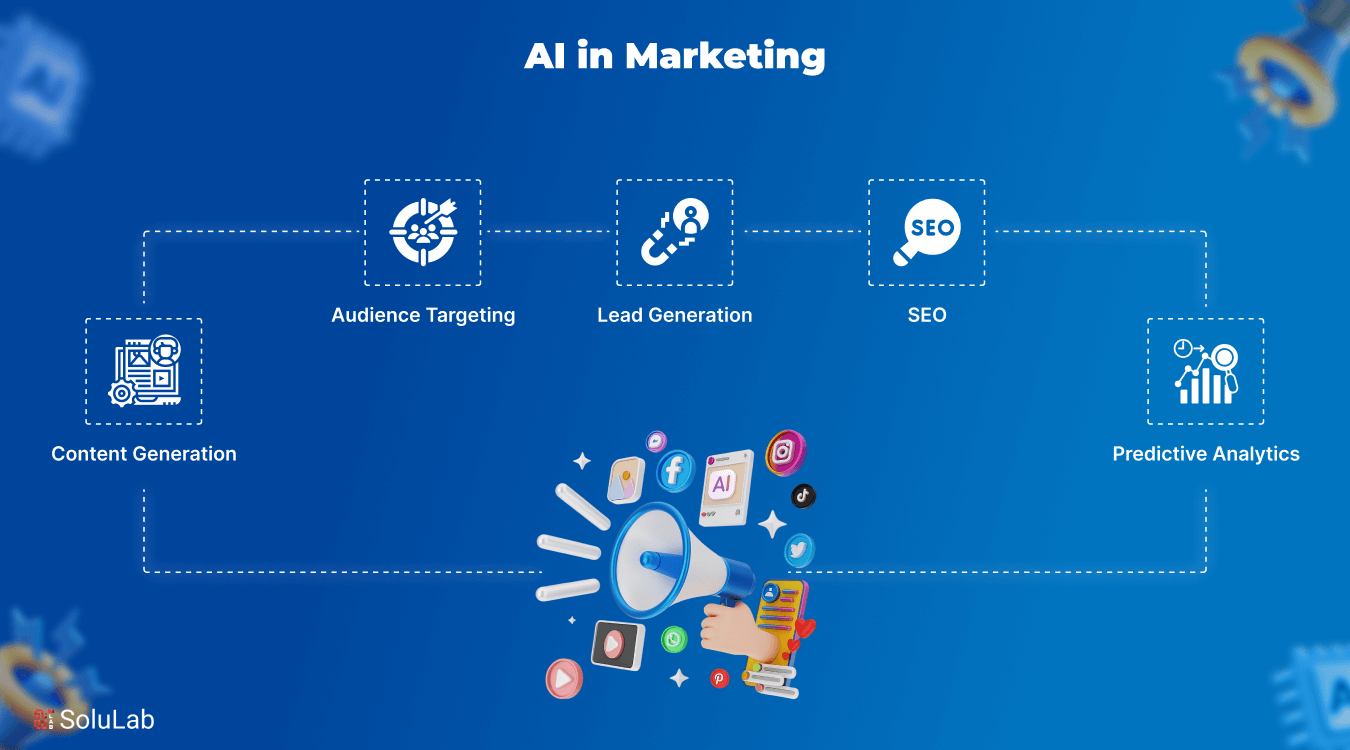
At its simplest: applying AI to automate, optimise, and personalise marketing work. Writing a blog draft or a batch of social captions. Sending email campaigns. Segmenting customers, running chatbots, forecasting what happens next. You can also use AI to build custom coded email templates, which are hand-coded email designs put together in HTML and CSS. Drag-and-drop editors box you in. These do not, so you keep full creative and functional control.
Market research has been one of the bigger wins. Machine learning chews through consumer data and behaviour patterns far faster than the old survey-and-spreadsheet routine. The broader effect is the same everywhere it lands: decisions get made quicker, the team takes on more, and marketing plans get tighter and more specific.
Numbers, briefly. The global AI market reached 638.5 billion in 2025, and by 2034 it is projected to hit 3.68 5trillion at roughly 19.2% CAGR.
Benefits of AI in Marketing
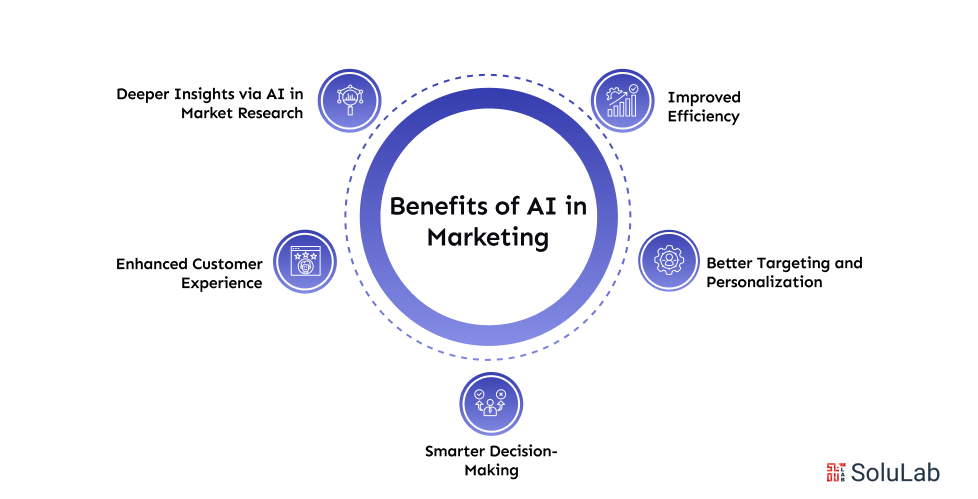
Speed, precision, and personalisation, applied at every stage of the funnel rather than just the top. That is the short version of what changes. Here is where the gains actually show up:
1. Improved Efficiency: The repetitive stuff shrinks. email campaign management services handles precision targeting, automated A/B testing, and performance analytics granular enough to be useful, so a campaign isn’t just shipped, it is built to grow a number you can point at. AI in marketing automationbuys back hours, and those hours go into the creative thinking that moves results.
2. Better Targeting and Personalization: AI reads customer behaviour and preference signals, then aims the message accordingly. Relevant content, more engagement, better retention, more conversions. In that order, usually.
3. Smarter Decision-Making: Predictive analytics and trend forecasting mean AI in sales and marketing lets you decide from data instead of instinct, tune campaigns mid-flight, and pull more out of the same spend.
4. Enhanced Customer Experience: Chatbots, recommendation engines, voice assistants. They answer in real time and they answer in context, which takes a lot of the friction out of the user journey.
5. Deeper Insights via AI in Market Research: AI tools tear through large datasets fast, surfacing patterns, competitor moves, and shifts in what consumers want. You plan with a sharper picture than the competition has.
Practical Use Cases of AI in Marketing
None of this is about owning impressive tools. It is about working smarter with the ones you have. Idea generation through to personalised journeys, here is what marketers reach for on a normal Tuesday:
- Content Ideation and Optimization: Blank page, no idea what to post? AI reads trends, competitor output, and audience interest, then hands you angles worth writing. It will also tidy tone, grammar, and structure so the blog or email or caption actually lands. Per Coschedule, almost 75% of marketers say AI gives them a competitive edge.
- Ad Enhancement and Targeting: Creatives, headlines, body copy. AI studies what your audience clicks and writes toward it, then tightens the targeting so the ad finds the right person at a moment they care. Budget stops leaking into nowhere.
- Scaling A/B Testing: Two variants is fine. Ten is better. AI runs tests at that scale, reads the results as they land, and points at the winning combination without anyone spending a weekend in a spreadsheet.
- Intuitive Customer-Facing Chatbots: The robotic canned-reply era is over. AI-powered chatbots hold context, clear FAQs, suggest products, and upsell, all in something close to normal conversation. Support that works at 3 a.m. and never gets short with anyone.
- SEO: AI tools simplify keyword research, sharpen headlines, and rewrite weak meta descriptions. They also catch the gaps your competitors left open. Think of it as an SEO specialist working quietly in the background while you climb. In practice, though, insights are not strategy, which is why plenty of companies bring in a seasoned SEO agency or hire SEO people who can turn all that output into something worth doing.
- Personalization: Putting a first name in a subject line is not personalisation. AI watches what someone actually does, then adjusts product recommendations, email content, even page layout, until the brand feels like it understands them.
- Market Research: Minutes, not weeks. It reads online reviews, social chatter, and survey responses, then hands back insight fresh enough to act on.
How to Implement AI in Marketing?
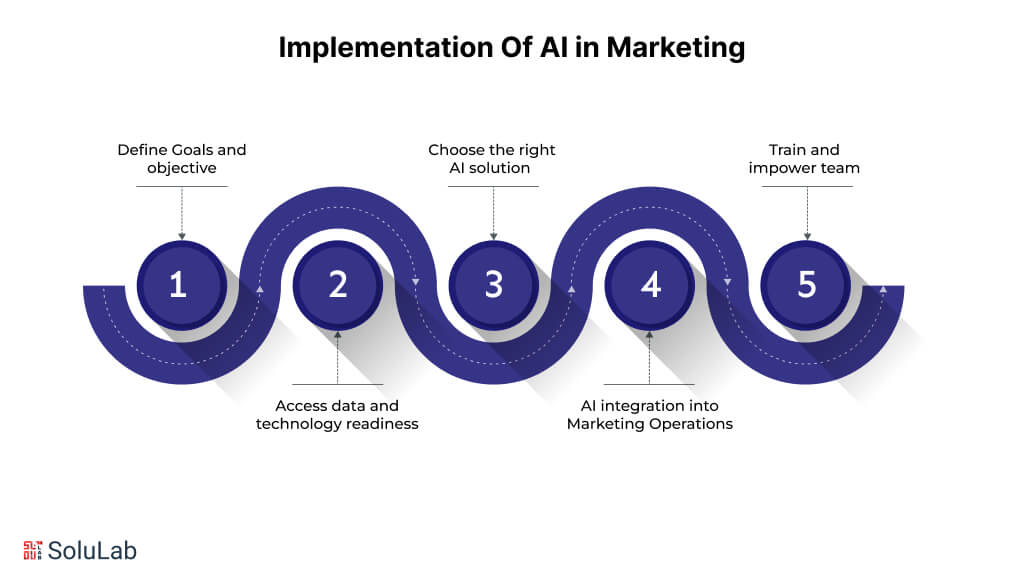
Folding AI into a marketing strategy looks like a huge, intimidating project from the outside. Broken into a handful of steps, it stops being that. Start here.
1. Clarify objectives
Decide what you are after before you buy anything. More customers? Higher sales? A better experience for the people already paying you? Write the goal down in a form you can measure, because that number is the only honest way to tell whether the AI is earning its place. Pick the one or two areas where it moves the needle hardest, prove it there, then widen out.
2. Grant Quality and accuracy of data
AI models only know what you feed them. Messy data in, mediocre output out, every time. Spend on clean data and the insights get worth reading.
3. The right tools should be selected.
Match the tool to the goal you just wrote down, whether that is email automation, content generation, or predictive analytics. Marketers who have been through b2b marketing training tend to pick better platforms and get more out of them, which is not a coincidence. Two things matter in the shortlist: can your team get running without a six-month rollout, and will it still hold up when your audience triples.
4. Make customer experience a priority
Artificial intelligence should add to human interaction, never stand in for it. Use it to tailor campaigns, to see what someone needs before they ask, to cut the wait on a reply. Better experiences compound. Engagement rises, and people stay.
5. Lay down a feedback loop in advance
Build the loop before you launch, not after. Watch live data and let AI flag what is working. Then ask your team and your customers what they are seeing, on a schedule, because that is what keeps the strategy honest and the models current.
Real World Example of AI in Marketing
Three companies you already use. Here is what their AI is doing to you.
Example #1: Zomato – Personalized Push Notifications
Ever noticed how Zomato knows the exact moment your stomach starts to complain? Lunchtime, or well past midnight, and your phone buzzes with something you suddenly want. That is not a copywriter getting lucky. That is AI.
It knows your order history, the hour you usually order, the dishes you keep going back to, and roughly where you are standing. Say you are a butter chicken regular in Delhi who eats at 8 PM. The model has that pattern locked. At 7:45, up pops a deal from the restaurant you like on the dish you always pick.
Timing is only half of it. If it is pouring outside your window, the notification might read: “Perfect weather for samosas and chai?” Hyper-personalised marketing, at its most shameless. Zomato saying the thing you wanted to hear, at the minute you were most likely to hear it.
Example #2: Netflix – Content Recommendations
Netflix suggests your next show and it feels like it has been reading your mind. It hasn’t. It has been reading your machine learning profile.
Crime thriller, rom-com, documentary about deep sea fish, it logs all of it. Say you have been three weeks deep in true crime. Netflix reads the signal and stacks the row with more of the same, wrapped in grim thumbnails, dark palettes, taglines built to unsettle you slightly.
The artwork trick is the clever part. Watch a lot of romance and that same thriller shows up wearing a tender close-up on its cover. Watch action instead, and you get explosions, or a car halfway through a chase. Nothing about that is random. Netflix is rebuilding your experience around whatever makes your thumb press “play.”
Example #3: Amazon – Pricing & Product Suggestions
How does Amazon keep putting things in front of you that you did not know you needed until the page loaded?
You buy a yoga mat. Within a day there are resistance bands on offer, a water bottle, half a wardrobe of athleisure. That is AI, playing the role of a shopping assistant who never clocks off.
Purchases, searches, wish lists, and what people with habits like yours have been buying. It weighs all of that, then rebuilds your home screen around whatever you are most likely to buy next.
Pricing moves too. That mat might cost you ₹899 while someone browsing from another city, or at another hour, sees ₹849. Amazon shifts prices live, reading demand, competitor listings, and yes, how many times you have gone back to stare at the thing.
Future of AI in Marketing
Writing copy and placing ads is the floor, not the ceiling. The shift ahead is that AI will predict what your audience wants before they have worked it out themselves.
Hyper-personalisation is the next thing everyone chases. Picture an email that reads differently depending on the mood a reader is in or what they bought last month. Feed AI a mountain of data and it returns a decision in seconds, which is how brands end up in front of a trend rather than chasing it.
Voice and visual stop being experiments and become routine line items in the plan. The tools quit behaving like automation and start behaving like colleagues who think. Small example, oddly useful: they can strip or swap background elements in an image and give you a cleaner, more professional graphic without a designer in the loop.
And the conversations get better. Expect chatbots that pick up tone, hold context, and read emotion well enough that you forget what you are talking to.
Conclusion
Generative AI has already changed how brands talk to people, customise what they send, and scale a campaign past what a team could do by hand. Calling it optional stopped being credible a while ago. Sharper content, experiences built for one person at a time, that is the baseline now. If you plan to still matter to your audience in two years, AI belongs inside your marketing process, not on a slide about next year.
Doing it alone is slower. Bringing in a fitting AI app development company gets you there faster and with fewer wrong turns. The point of all this is not the technology anyway. It is marketing that is relevant, aimed at the right people, and actually worth their attention.
Digital Quest, a travel business, worked with SoluLab on an AI-powered chatbot built on Generative AI. It gave travellers real-time, personalised recommendations and let them book without the usual back and forth. User feedback fed straight back into it, multi-language support came with it, and both the experience and the ROI improved.
SoluLab, an AI development company, builds and ships AI-driven campaigns and can help you scale what is already working. Contact us today to discuss further.
FAQs
Shipra Garg is a tech-focused content strategist and copywriter specializing in Web3, blockchain, and artificial intelligence. She has worked with startups and enterprise teams to craft high-conversion content that bridges deep tech with business impact. Her work translates complex innovations into clear, credible, and engaging narratives that drive growth and build trust in emerging tech markets.