Key Takeaways
- Dual-Utility Infrastructure: Modern TaaS seamlessly bridges cryptographic data protection (PCI/GDPR mitigation) with blockchain-based Real-World Asset (RWA) fractionalization.
- Capital Efficiency: Eliminates millions in legacy on-premise infrastructure costs, converting complex token deployment into a highly scalable, API-driven operational expense.
- Mitigated Regulatory Risk: Advanced TaaS architectures isolate sensitive liabilities, automating adherence to shifting global frameworks like MiCA, GDPR, and PCI DSS v4.0.
The conversation around Tokenization as a Service (TaaS) has changed dramatically over the past 24 months. What began as a blockchain experiment is now becoming a strategic infrastructure layer for banks, asset managers, private credit funds, real estate investment firms, and treasury operators.
Institutional adoption of RWA tokenization services is accelerating. The value of tokenized real-world assets surpassed $28.9 billion in 2026, while tokenized U.S. Treasury products alone crossed $7 billion in on-chain value. Analysts from major financial institutions project that tokenized assets could represent between $10 trillion and $16 trillion of global asset value by 2030.
The reason is simple: traditional asset infrastructure is expensive, fragmented, and operationally inefficient. Settlement delays, compliance overhead, transfer agent costs, and fragmented ownership records continue to create friction across capital markets.
What Is Tokenization as a Service (TaaS)?
Tokenization as a Service solves these challenges by providing enterprises with ready-to-deploy infrastructure for digital asset tokenization, regulatory automation, smart contract execution, and tokenized asset management.
- Rather than spending years developing blockchain architecture internally, organizations can leverage enterprise tokenization solutions to launch compliant tokenized securities, private credit products, and tokenized U.S.
- Treasuries, real estate investment vehicles, and other real-world assets through a scalable asset tokenization platform.
- For institutions evaluating digital transformation strategies in 2026, the question is no longer whether tokenization will happen.
The question is how quickly organizations can deploy compliant tokenization frameworks while minimizing regulatory and operational risk.
How Is TaaS Different from Traditional Tokenization?
Old methods of tokenization often needed businesses to build their own systems, manage hardware, and keep up with security rules. That took time, money, and technical skill.
Tokenization as a Service, on the other hand, is outsourced and cloud-based. You don’t need to build anything from scratch. It’s easy to set up, works with your existing systems, and keeps up with compliance requirements automatically. That means lower costs and faster results.
| Feature | Tokenization as a Service (TaaS) | Traditional Tokenization |
| Infrastructure | Fully cloud-native, no hardware required | On-premises setup, complex infrastructure |
| Deployment Speed | Rapid deployment with ready-to-use APIs | Slower setup with manual configurations |
| Scalability | Instantly scales with your business | Limited scalability, hardware dependent |
| Cost Efficiency | Lower upfront cost, flexible pricing | High setup and maintenance costs |
| Compliance Updates | Auto-updated to meet the latest regulations | Requires manual audits and updates |
| Maintenance & Support | Handled by expert TaaS providers like SoluLab | Requires in-house teams and expertise |
| Ease of Integration | Simple API/SDK-based integration | Complex and resource-heavy integration |
| Security Standards | Uses modern vaults, encryption, and access controls | Varies, may lack the latest protections |
| Innovation Potential | Built for AI, Web3, and multi-cloud compatibility | Hard to adapt to modern digital needs |
| Long-Term Flexibility | Designed to evolve with your tech stack | Rigid systems, difficult to upgrade |
How Tokenization as a Service Benefits Your Business?
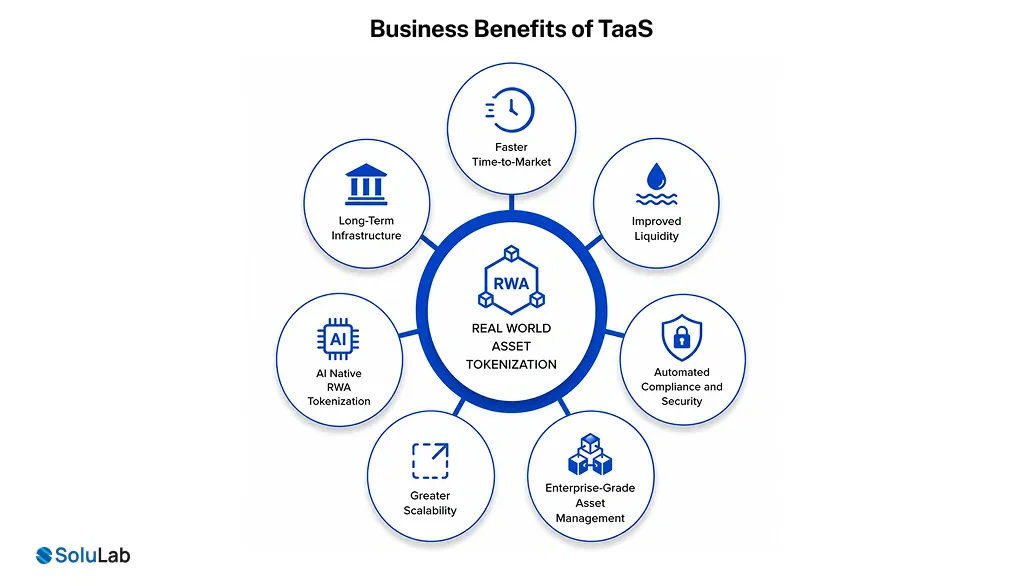
By combining blockchain infrastructure, compliance automation, and digital asset management into a single framework, TaaS helps enterprises reduce operational complexity while unlocking new investment opportunities.
1. Faster Time-to-Market for Digital Assets
Building an asset tokenization platform internally often requires significant investment in smart contract development, compliance systems, custody integrations, and investor management tools. TaaS providers streamline this process through pre-built infrastructure and deployment frameworks.
For example, platforms such as Securitize and Tokeny enable organizations to launch compliant tokenized investment products. These are significantly faster than traditional development cycles, helping businesses reduce implementation timelines from months of custom development to a structured deployment process.
2. Improved Liquidity Through Real World Asset Tokenization
Many traditional assets, including commercial real estate, private credit, commodities, and infrastructure investments, suffer from limited liquidity and restricted investor access.
Through real world asset tokenization, businesses can divide ownership into smaller digital units, allowing broader investor participation and more efficient capital formation.
This model has accelerated adoption across real estate tokenization, private funds, and alternative investment markets.
3. Automated Compliance and Security Tokenization
One of the biggest challenges in managing regulated assets is maintaining compliance across jurisdictions. Modern tokenization frameworks address this by embedding regulatory controls directly into token smart contracts.
Tokenization platforms like Tokeny utilize standards such as ERC-3643 to automate investor verification, transfer restrictions, and ownership controls, making security tokenization more efficient and scalable for enterprises.
4. Enterprise-Grade Tokenized Asset Management
Managing investors, ownership records, distributions, and reporting manually creates operational bottlenecks. TaaS platforms automate these processes through integrated tokenized asset management capabilities.
Solutions such as Securitize provide built-in tools for investor onboarding, ownership tracking, dividend distribution, compliance reporting, and secondary market participation, reducing administrative overhead while improving transparency.
5. Greater Scalability for Finance Tokenization
As financial institutions move toward blockchain-based markets, scalability becomes a critical requirement. Leading blockchain infrastructures such as Polygon, Hedera, and R3 Corda support high-volume transaction processing and institutional-grade settlement environments.
This infrastructure enables enterprises pursuing finance tokenization initiatives to manage large-scale issuance programs involving tokenized funds, private credit products, tokenized U.S. Treasuries, and alternative investment vehicles.
6. Foundation for AI Native RWA Tokenization
The next evolution of tokenization combines blockchain infrastructure with artificial intelligence. Modern enterprise tokenization solutions are increasingly integrating AI-driven valuation monitoring, compliance surveillance, investor analytics, and risk assessment capabilities.
This emerging model of AI native RWA tokenization supports more intelligent asset servicing and creates opportunities for AI tokenization for asset ownership, where ownership verification, governance workflows, and portfolio management can be partially automated through machine-driven systems.
7. Long-Term Infrastructure Flexibility
Organizations must also decide how much control they want over their tokenization environment. Open-source frameworks such as Hyperledger Fabric provide complete infrastructure ownership and customization. Along with the proprietary platforms like Tokeny and Securitize, which offer faster deployment and managed compliance support.
This flexibility allows enterprises to choose the approach that best aligns with their growth strategy, regulatory requirements, and operational goals.
How Tokenization as a Service Works Behind the Curtains?
At first glance, digital asset tokenization may look simple: upload an asset, generate tokens, and start trading.
In reality, enterprise-grade tokenization as a service (TaaS) platforms perform dozens of automated checks before a single token is issued. Every ownership record, investor action, and asset update passes through multiple validation layers designed to protect the asset, investors, and regulatory standing.
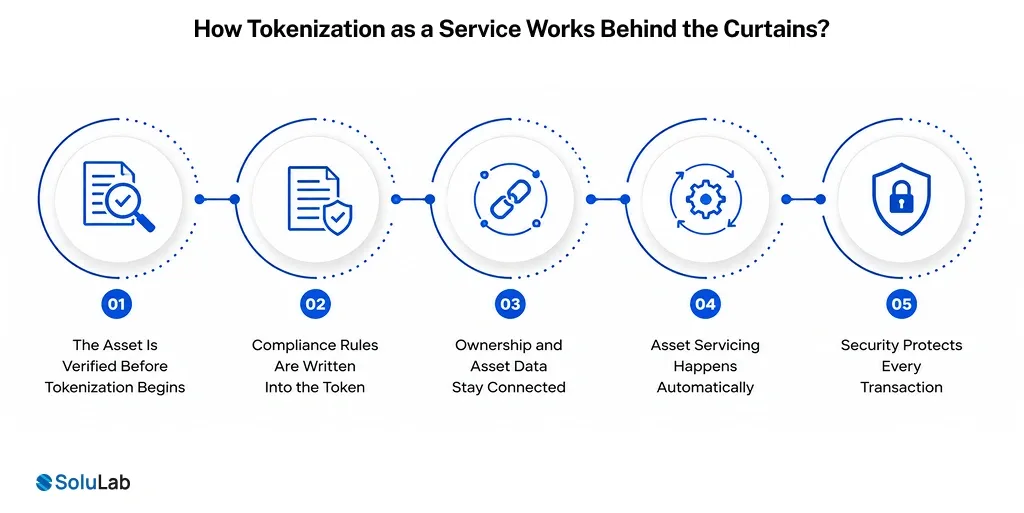
Step 1: The Asset Is Verified Before Tokenization Begins
The process starts with asset verification.
Suppose a company wants to tokenize a commercial property, private credit fund, or infrastructure project. The platform first validates whether the asset can legally be represented as a digital security or ownership unit.
The system checks:
- Ownership documentation
- Legal structure and SPV setup
- Custody arrangements
- Valuation records
- Regulatory classification
If the asset passes validation, the tokenization workflow moves forward.
Validation Result:
- Asset ownership verified? → Yes
- Legal structure approved? → Yes
- Compliance review completed? → Yes
Only then does the asset tokenization platform proceed to issuance.
Step 2: Compliance Rules Are Written Into the Token
This is where most people misunderstand how blockchain tokenization services work.
The platform doesn’t simply create tokens. It creates rules.
For example:
An investor attempts to purchase tokenized shares.
The smart contract immediately checks:
- Is KYC completed?
- Is AML verification approved?
- Is the investor located in an approved jurisdiction?
- Has the investor exceeded ownership limits?
If every answer is Yes, the transaction proceeds.
If even one answer is No, the transaction is automatically rejected before settlement occurs.
No manual review.
No compliance officer intervention.
No post-transaction correction.
This is why modern tokenization frameworks are increasingly described as machine-enforceable compliance systems.
Step 3: Ownership and Asset Data Stay Connected
One of the biggest challenges in real-world asset tokenization is keeping the digital token aligned with the underlying asset.
Imagine a property receives a new valuation.
Or a private credit portfolio changes performance metrics.
Or a fund distributes investor returns.
The platform continuously synchronizes these updates with the token ecosystem.
As asset information changes, ownership records, reporting dashboards, and investor disclosures update automatically.
Step 4: Asset Servicing Happens Automatically
After issuance, the work is far from over.
This is where tokenized asset management becomes critical.
The platform automatically handles:
- Investor onboarding
- Dividend distributions
- Interest payments
- Cap table updates
- Ownership transfers
- Compliance reporting
Instead of managing dozens of disconnected systems, enterprises operate through a unified infrastructure layer.
Step 5: Security Protects Every Transaction
Every transaction request goes through a final verification layer.
Before tokens move, the platform validates:
- Wallet authorization
- Transfer permissions
- Asset restrictions
- Smart contract conditions
- Digital signatures
Transfer Approved?
- Identity verified → Yes
- Regulatory checks passed → Yes
- Ownership rules satisfied → Yes
Only then is the transaction recorded on-chain.
This is what separates an enterprise tokenization service provider from a basic token creation tool. The goal is not simply issuing tokens. The goal is to create a compliant, secure, and scalable operating system for managing digital ownership at scale.
Regulatory Frameworks Driving Enterprise Tokenization
One of the largest misconceptions surrounding digital assets is that blockchain technology changes regulatory obligations.
This significantly reduces legal overhead while helping enterprises maintain continuous regulatory compliance.
1. SEC Compliance and the “Same Asset, Same Law” Principle
In reality, regulators continue to apply the principle of “same asset, same law.” If a traditional asset qualifies as a security, its tokenized version remains subject to the same securities regulations.
Modern tokenization services address this challenge by embedding compliance directly into smart contracts.
- The CLARITY Act Impact: The Digital Asset Market Clarity Act codifies jurisdiction, distinguishing SEC-regulated investment contract assets from CFTC-governed commodities based on operational decentralization.
- Smart Contract Enforcement: Frameworks bake compliance directly into token logic to handle strict federal rules.
- Automated Controls: Smart contracts autonomously lock down transfer restrictions, investor accreditation verifications, mandatory lock-up timelines, jurisdictional barriers, and SEC reporting obligations.
Transfer restrictions, investor accreditation requirements, lock-up periods, jurisdiction controls, and reporting obligations can all be enforced automatically through programmable token logic.
2. MiCA Compliance and Cross-Border Asset Issuance
Europe’s Markets in Crypto-Assets (MiCA) framework has become one of the most influential regulatory developments in digital asset markets.
Organizations issuing tokenized securities, tokenized funds, or asset-backed digital instruments across Europe must now satisfy stricter requirements around custody, transparency, reserve management, and investor protection.
Enterprise-grade tokenization platforms are increasingly integrating:
- Real-time proof of reserves
- Custodian bank connectivity
- Automated compliance monitoring
- Jurisdiction-specific investor controls
- On-chain audit trails
These capabilities reduce operational risk while supporting cross-border asset distribution.
3. Machine-Enforceable Compliance
The next evolution of blockchain tokenization services is machine-enforceable compliance.
Instead of relying on legal teams to manually validate transactions, tokenization frameworks can automatically verify:
- KYC status
- AML screening
- Accredited investor eligibility
- Jurisdictional restrictions
- Ownership thresholds
- Secondary trading permissions
This approach reduces compliance costs while creating a more scalable infrastructure for digital asset tokenization.
High-Growth Enterprise Use Cases for Tokenization as a Service
Tokenization as a Service enables businesses to digitize and trade real-world assets with ease. Common use cases include:
1. Tokenized U.S. Treasuries and Institutional Yield Products
Treasury managers and institutional investors are increasingly adopting tokenized U.S. Treasuries because they provide blockchain-enabled settlement while maintaining exposure to low-risk government-backed assets.
Benefits include:
- Near real-time settlement
- Improved collateral mobility
- Automated yield distribution
- Increased liquidity efficiency
2. Private Credit and Loan Tokenization
The global private credit market has surpassed $2 trillion in assets under management.
Traditional private credit operations rely on manual underwriting, fragmented reporting systems, and lengthy settlement cycles.
Tokenization as a Service enables:
- Fractional loan ownership
- Automated coupon payments
- Smart contract-based servicing
- Real-time portfolio visibility
This improves capital efficiency while expanding investor participation.
3. Real Estate Tokenization
A recent Dubai real estate tokenization initiative highlighted how a blockchain-powered platform was developed to enable
- fractional property ownership,
- digital investor onboarding,
- automated compliance workflows, and
- secure ownership transfers.
Smart contracts streamlined token issuance, transaction execution, income distribution, and governance processes, while AI-assisted monitoring enhanced risk detection and operational oversight.
The platform also introduced real-time investor dashboards, automated KYC/AML verification, transparent ownership records, and secondary transfer capabilities to improve accessibility and liquidity across property-backed investments.
Business Impact
The implementation delivered measurable improvements across the investment lifecycle:
- 5x faster fundraising cycles through streamlined digital onboarding
- 2x improvement in compliance efficiency through automated monitoring and reporting
- 100% automation of core investment workflows, including onboarding, ownership tracking, and distributions
This example demonstrates how real world asset tokenization is transforming traditional property investments into scalable, transparent, and globally accessible digital investment opportunities.
4. Carbon Credits and ESG Asset Infrastructure
Corporate sustainability initiatives increasingly require verifiable environmental reporting.
Modern tokenization development solutions connect IoT infrastructure directly to blockchain networks, enabling organizations to tokenize:
- Carbon credits
- Renewable energy certificates
- Green bonds
- Sustainability-linked assets
This creates immutable ESG reporting frameworks while reducing greenwashing concerns.
5. Gen AI Native RWA Tokenization
A recent implementation in Singapore highlighted how combining Gen AI native real-world asset tokenization can modernize private market investing. The platform was designed to bring together blockchain infrastructure, intelligent automation, and investor intelligence within a single ecosystem.
Key capabilities included:
- AI-powered liquidity and pricing intelligence
- Automated investor onboarding and KYC/AML workflows
- Real-time compliance monitoring and anomaly detection
- Intelligent portfolio analytics and market insights
- Secondary market infrastructure for improved liquidity
Rather than relying on fragmented systems and manual processes, AI continuously analyzed market activity, investor behavior, portfolio performance, and compliance requirements to support faster and more informed decision-making. This created a more scalable environment for tokenized asset management while improving operational efficiency across the investment lifecycle.
The implementation delivered measurable outcomes:
- 2.1x growth in active investors
- 3.2x increase in secondary market participation
- 80% reduction in operational overhead
As adoption accelerates, gen AI in tokenization is expected to become a core capability within enterprise tokenization platforms. This helps issuers and investors manage increasingly complex portfolios through intelligent automation and real-time market intelligence.
How to Choose the Right Tokenization as a Service (TaaS) Provider
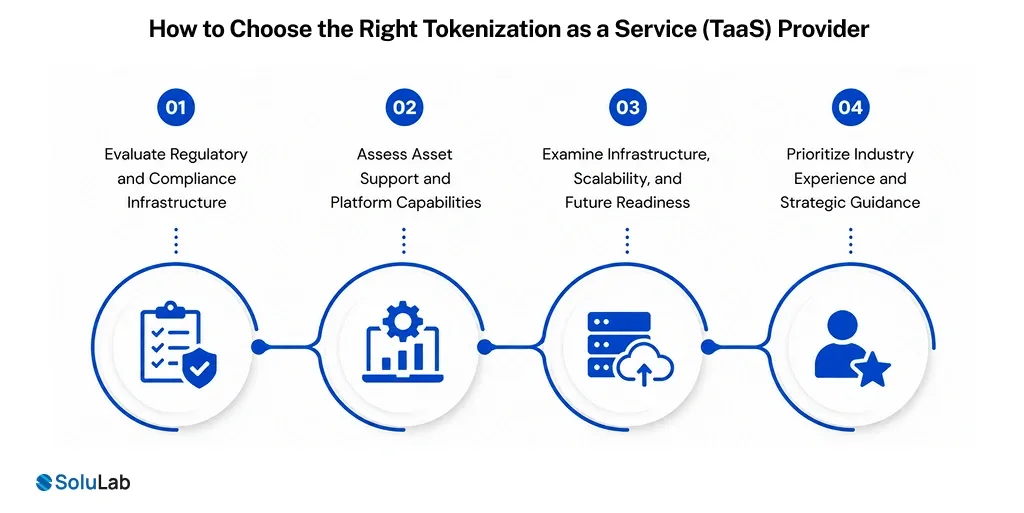
Selecting the right Tokenization as a Service (TaaS) provider can determine whether your tokenization initiative achieves regulatory approval, investor adoption, and long-term scalability.
As enterprises move toward digital asset tokenization, the evaluation process must extend beyond technology and consider compliance architecture, infrastructure flexibility, and asset lifecycle management capabilities. You must ask multiple questions to the tokenization consultancy companies to get a clear idea.
1. Evaluate Regulatory and Compliance Infrastructure
Regulatory readiness should be the first consideration when assessing a tokenization consultancy company or platform provider.
Modern tokenization services must support automated KYC, AML screening, investor accreditation, jurisdiction-based transfer restrictions, and audit-ready reporting.
For organizations pursuing security tokenization or regulated investment products, the platform should be capable of
- embedding compliance rules directly into smart contracts
- adapting to evolving frameworks such as MiCA, SEC regulations, and
- regional financial guidelines.
2. Assess Asset Support and Platform Capabilities
Not every platform is designed for the same asset classes. Enterprises should verify whether the provider supports real world asset tokenization across
- commercial real estate,
- private credit,
- commodities,
- infrastructure projects,
- tokenized funds, and
- tokenized U.S. Treasuries.
A mature asset tokenization platform should also provide
- investor onboarding,
- ownership management,
- dividend distribution,
- cap table management,
- secondary market integrations, and
- comprehensive tokenized asset management capabilities.
3. Examine Infrastructure, Scalability, and Future Readiness
The underlying infrastructure plays a critical role in long-term success. Evaluate
- multi-chain support,
- API and SDK availability,
- custody integrations,
- smart contract security standards, and
- transaction scalability.
As the market evolves, enterprises should also consider providers investing in
- AI native RWA tokenization,
- intelligent compliance monitoring, and
- AI tokenization for asset ownership.
These capabilities can improve operational efficiency, risk monitoring, and portfolio servicing as digital asset ecosystems expand.
4. Prioritize Industry Experience and Strategic Guidance
Beyond technology, the ideal provider should demonstrate proven expertise in
- finance tokenization,
- real estate tokenization, and
- enterprise blockchain deployments.
A partner with experience delivering large-scale tokenization projects can help navigate
- legal structuring,
- compliance requirements,
- infrastructure selection,
- go-to-market execution,
- reduces deployment risks, and
- acceleration adoption.
When a tokenization development company can provide all this they you can partner with them with no second thought.
How SoluLab Can Help You in TaaS Integration?
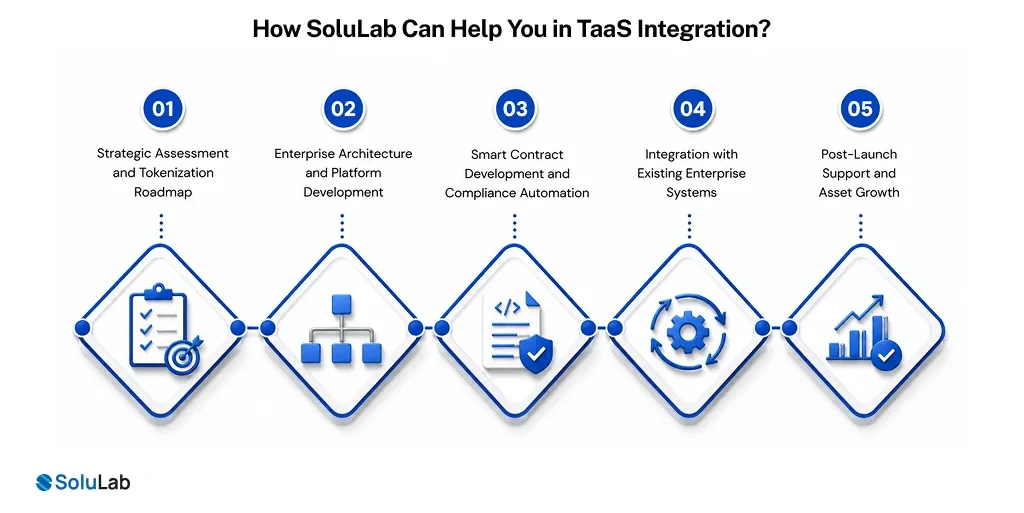
SoluLab is one of the top tokenization development companies across the world. Our team provides your world-class infrastructure to lift your growth 2x and build the platforms and solutions in the least possible time, with advanced features.
1. Strategic Assessment and Tokenization Roadmap
Every project begins with a detailed evaluation of the asset, business model, regulatory environment, and investor requirements.
Our consultants help determine:
- Suitable tokenization models
- Jurisdictional requirements
- Compliance frameworks
- Blockchain selection strategy
- Revenue and liquidity opportunities
This ensures the project is commercially viable before development begins.
2. Enterprise Architecture and Platform Development
Our team designs and develops scalable enterprise tokenization solutions tailored to specific asset classes.
We build:
- Asset issuance platforms
- Investor onboarding portals
- Compliance management systems
- Tokenized asset marketplaces
- Custody and wallet integrations
- Administrative dashboards
Whether you’re launching real estate tokenization, private credit products, or institutional investment platforms, our architecture is designed for long-term scalability.
3. Smart Contract Development and Compliance Automation
SoluLab develops secure smart contracts with built-in compliance controls to support regulated asset issuance.
This includes:
- Transfer restrictions
- Investor verification
- Ownership controls
- Distribution automation
- Governance mechanisms
These capabilities are essential for organizations pursuing security tokenization and regulated investment products.
4. Integration with Existing Enterprise Systems
Tokenization projects rarely operate in isolation.
Our team integrates the platform with:
- Banking infrastructure
- ERP systems
- CRM platforms
- Custody providers
- Fund administration tools
- Compliance monitoring solutions
This creates a unified ecosystem for managing tokenized assets efficiently.
5. Post-Launch Support and Asset Growth
Launching the platform is only the beginning.
SoluLab provides ongoing support for:
- Platform optimization
- Security updates
- Compliance enhancements
- Secondary market integrations
- Tokenized Asset Management workflows
- New asset onboarding
This enables businesses to scale their digital asset tokenization initiatives while adapting to changing market and regulatory conditions.
The Future of Tokenization as a Service
The next phase of Tokenization as a Service (TaaS) is being driven by institutional adoption, regulatory clarity, and capital market modernization. According to industry estimates, tokenized assets could exceed $10 trillion by 2030, transforming how ownership, trading, and asset management operate globally.
1. Machine-Enforceable Compliance
Modern tokenization frameworks are embedding KYC, AML, investor eligibility, and transfer restrictions directly into smart contracts, reducing compliance costs by up to 40-60%.
2. Growth of Tokenized Financial Assets
The market for tokenized U.S. Treasuries has already surpassed $7 billion, while private credit, bonds, and money market funds are rapidly entering blockchain-based ecosystems.
3. Multi-Chain Asset Infrastructure
Enterprises are moving beyond single-chain deployments. Future asset tokenization platforms will support seamless asset issuance and management across multiple blockchain networks.
4. Real-Time Proof-of-Reserves
Institutional investors increasingly demand transparency. Future blockchain tokenization services will provide continuous ownership verification and reserve reporting, improving trust and auditability.
5. Expansion of Real-World Asset Tokenization
Beyond real estate tokenization, the next growth wave includes private credit, infrastructure projects, carbon credits, commodities, and intellectual property, expanding the scope of digital asset tokenization worldwide.
Conclusion
Tokenization as a Service gives you a secure, flexible, and low-cost way to protect sensitive data. It works well for industries like eCommerce, healthcare, and tokenization in financial services, where data security and compliance are a must.
SoluLab, a leading name for tokenization platform development, is a professional service provider with a proven track record. The team of financial and blockchain experts is working 24/7 to render market-driven solutions. Not just development, there are consulting and strategy development experts to analyze your business for successful yet easy integration. We also hold ISO certification, which can build trust across the global market in your platform development.
Looking to add AI agents or smart automation to your online store? SoluLab can help you set up easily! Contact us today.
FAQs
Deepika is a content writer who blends storytelling with strategic thinking. She explores topics across digital innovation, emerging tech, and the evolving blockchain industry. She enjoys breaking down complex ideas into simple, engaging narratives in the growing global markets.