The conversation around real estate has shifted. It’s no longer about “can blockchain work?” but “who is doing it in a compliant, scalable way.” Now, capital is moving toward regulated infrastructure, not experimental platforms.
| In his March 2026 annual letter, BlackRock CEO Larry Fink signaled the end of the experimental era, stating, “The 1996 ‘Internet moment’ for tokenization has passed; we are now building the permanent infrastructure of the global capital markets.” |
Institutional investors are entering with strict requirements around liquidity, reporting, and jurisdictional clarity. That shift is redefining how real estate tokenization platforms are evaluated today. If you’re building or selecting a tokenization service for platforms, the following is the view aligned with real market demand.
Market Reality: Why Tokenized Real Estate Is Scaling Now
The global RWA market is projected toward multi-trillion levels, with real estate forming a major share. But growth is not driven by retail investors buying fractions. It’s driven by funds needing faster exits, better capital rotation, and compliant distribution.
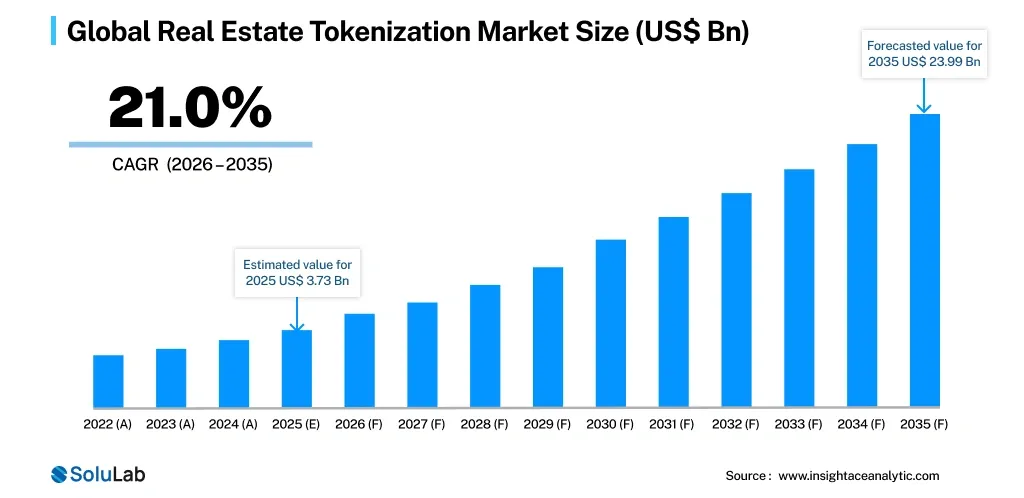
- There are currently over 150+ active platforms globally specializing in or hosting real estate tokenization.
- Approximately 42% of global real estate firms had launched tokenization pilots by late 2024. But now the number is exceeding 50% in 2026 for mid-to-large-scale developers.
This is where tokenized real estate becomes a financial tool, not just a tech concept. That’s exactly why platforms today are being rebuilt from the ground up to support real capital, not just digital ownership.
Why Modern Real Estate Tokenization Platforms Are Built Differently in 2026?
The recent growth in platform adoption is not because of better marketing. It’s because the ecosystem has finally become usable for serious capital. What changed is simple: regulation is clearer, blockchain enables secure transactions, while AI-driven systems improve valuation, compliance monitoring, and investor decision-making.
1. Compliance Is Now Built Into the System
In 2026, platforms won’t handle compliance later. They are designed around it from day one.
- In Europe, MiCA requires identity-linked wallets and controlled access
- In the US, platforms clearly define whether assets are securities or structured instruments
- In Australia, AFSL licensing and digital asset frameworks guide issuance
A strong real estate tokenization company now embeds these rules directly into smart contracts. If a wallet is not verified, transactions simply don’t happen. This reduces risk without slowing down operations.
2. Technology Choices: Now Decide Tokenization Platform Scalability
If you’re evaluating a platform today, the interface matters less than what’s underneath.
- Multi-chain deployment across Ethereum, Polygon, Hedera, and XRP Ledger
- Token standards like ERC-3643 and ERC-7518 to control ownership and transfers
- Oracle integration (Chainlink, Pyth) to bring real-time valuation data
- Cross-chain systems like CCIP and Wormhole to move assets across networks
In a simple way to phrase it, if a platform cannot move assets across ecosystems or adapt to changing regulations, it will not scale. That’s the practical filter enterprises are using when choosing between top real estate tokenization platforms today.
Top Platforms Comparison: What Actually Matters in 2026?
Today, enterprises are evaluating how well a platform can handle asset lifecycle management, improve ROI, and provide real-time liquidity across markets.
Below is a comparison of leading platforms’ integrations based on what investors and businesses evaluate today.
| Platforms | Chain Support (2026 Tech Stack) | Primary Market | 2026 Strategic Focus | Institutional Entry |
| Securitize | Ethereum, Polygon, Avalanche | US / Global | BlackRock BUIDL integration & SEC-regulated ATS. | High |
| Tokeny | Ethereum, Polygon (AggLayer) | EU (MiCA) | ERC-3643 standard for automated MiCA compliance. | Medium |
| Zoniqx | Solana, XRP, Hedera, Polygon | Global | ERC-7518 multi-chain lifecycle; high-speed Solana settlement. | High |
| Propy | Ethereum, Solana | US + Global | On-chain Title Registry; instant escrow via Solana smart contracts. | Medium |
| RealT | Ethereum, Layer-2 (Base/Polygon) | Retail + SME | High-velocity rental yield distribution on low-fee L2s. | Low |
| RedSwan | Ethereum, Polygon | Commercial CRE | Tokenized Class A Commercial Debt and Equity for Family Offices. | High |
| Blocksquare | Polygon, Ethereum | White-label Infra | Platform-as-a-Service for regional RE agencies. | Medium |
| Ondo Finance | Ethereum, Solana, Polygon | DeFi / Inst. | USDY-RE; yield-bearing stablecoins backed by CRE leases. | High |
| Centrifuge | Ethereum, Base | Credit Markets | Real Estate Bridge Loans as collateral in DeFi pools. | High |
| SolidBlock | Ethereum, Polygon | Luxury / ESG | ESG-compliant tracking; Carbon Credit offsets on-chain. | High |
Top Real Estate Tokenization Platforms (2026 Edition)
This list is curated based on real estate tokenization market relevance, regulatory alignment, and technical strength. Not all platforms are equal anymore. What provides a seamless experience to users and provides returns stands out.
1. Securitize
Securitize has become the default choice for regulated digital securities.
- Powers major institutional funds, including large asset managers
- Offers integrated ATS (secondary trading)
- Enables near-instant settlement cycles
Why it stands out: It aligns directly with SEC frameworks, making it a safe entry point for institutional capital.
2. Tokeny Solutions
Tokeny has positioned itself as the backbone of MiCA-ready infrastructure.
- Uses ERC-3643 for programmable compliance
- Built-in identity layer (ONCHAINID)
- Widely adopted across European financial institutions
Why it matters: Compliance is enforced at the token level, reducing legal overhead.
3. Zoniqx
Zoniqx is leading in tokenization lifecycle management for real-world assets.
- TALM platform manages issuance to trading
- Supports XRP Ledger, Hedera, and Polygon
- Introduced ERC-7518 for dynamic compliance
It has already tokenized over $100M in institutional assets and is targeting a significant share of the CRE market.
Why it stands out: It solves the biggest problem, which is managing assets across chains with automated compliance.
4. Propy
Propy has moved beyond transactions into legal tokenization infrastructure.
- Records property titles on-chain
- Integrates with land registries
- Reduces closing timelines significantly
Why it matters: Digital asset ownership verification becomes instant and tamper-proof.
5. RedSwan
RedSwan focuses only on the tokenization of large commercial assets.
- Targets institutional investors
- Tokenizes high-value properties like office towers
- Focus on exit liquidity
Why it stands out: It solves liquidity issues in commercial real estate, not just access.
6. RealT
RealT remains relevant due to consistency and its ability to streamline operations with AI automation-driven workflows.
- 500+ tokenized properties
- Rental income distributed in stablecoins
- Migrated to Layer-2 for cost efficiency
Why it matters: It has survived multiple market cycles without major defaults.
7. Blocksquare
Blocksquare enables businesses to launch their own platforms and is known for its scalable white-label tokenization platform.
- Infrastructure-as-a-service model
- DeFi integrations for additional yield
- Ideal for agencies and developers
Why it stands out: It’s not just a platform; it’s a foundation layer for others.
8. Ondo Finance
Ondo bridges traditional assets with decentralized finance.
- Launching real estate-backed yield products
- Focus on institutional DeFi adoption
- Combines stability with yield
Why it matters: It connects tokenized assets with liquidity pools.
9. Centrifuge
Centrifuge focuses on financing rather than ownership.
- Tokenizes real estate loans
- Integrates with DeFi lending protocols
- Enables collateralization
Why it stands out: It unlocks liquidity from debt markets, not just equity.
10. SolidBlock
SolidBlock targets premium real estate tokenization.
- Focus on hotels and ESG-compliant buildings
- Integrated carbon tracking
- Strong compliance across jurisdictions
Why it matters: ESG alignment is becoming mandatory for large funds.
Key Takeaways from Comparison
We saw how blockchain networks help you build the best real estate tokenization platform. Additionally, you also have the idea of the top tokenization platforms in the market. Therefore, from the details you can say that;
- Compliance-driven platforms dominate the top tier
- Multi-chain capability is becoming standard
- Secondary liquidity access is a key differentiator
- White-label infrastructure is growing fast
For anyone evaluating top real estate tokenization platforms & providers, this table reflects real decision criteria, not marketing claims.
Read Blog: Tokenization of Real Estate in Australia
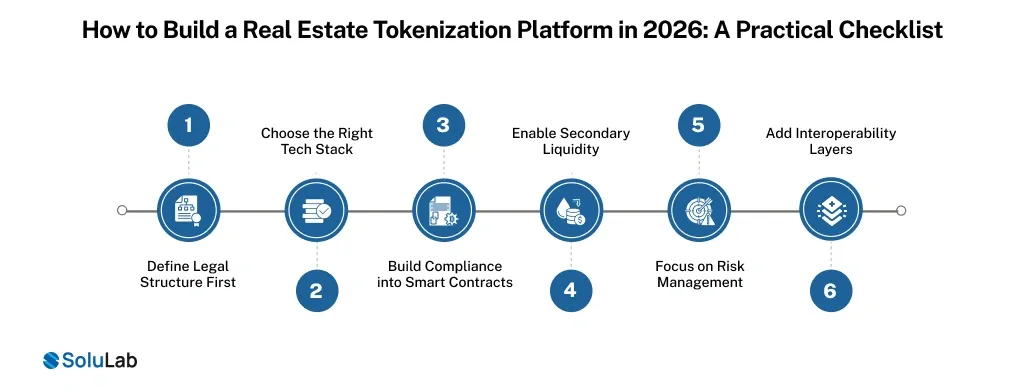
How to Build a Real Estate Tokenization Platform in 2026: A Practical Checklist
If you’re planning to build or scale a real estate tokenization platform, a strong development partner is a must. We at SoluLab help you in customizing tokenization platforms for any asset and build the latest features that can position you at the top in 2026. If you are ready, let’s see what you must confirm with the development partner ahead.
Step 1: Define Legal Structure First
Before writing code, define:
- Asset ownership model (SPV or direct)
- Jurisdiction compliance (MiCA, SEC, etc.)
- Investor eligibility rules
Without this, your platform cannot operate legally.
Step 2: Choose the Right Tech Stack
Your architecture should support:
- Multi-chain deployment
- Compliance-ready token standards
- Oracle integrations for pricing
- AI predictive tools and automation stack
A strong tokenization platform is built for interoperability, not isolation.
Step 3: Build Compliance into Smart Contracts
Instead of external checks:
- Whitelist wallets at the protocol level
- Automate KYC/AML validation
- Restrict transfers based on jurisdiction
This reduces legal risk significantly.
Step 4: Enable Secondary Liquidity
Liquidity is the core selling point.
- Integrate with ATS or secondary exchanges
- Allow peer-to-peer trading
- Ensure pricing transparency
This is what differentiates modern platforms from traditional funds.
Step 5: Focus on Risk Management
Enterprise buyers look for risk control.
- Smart contract audits
- Oracle reliability (Chainlink, Pyth)
- Asset verification layers
Without this, institutional investors will not engage.
Step 6: Add Interoperability Layers
Assets should move across ecosystems.
- Cross-chain bridges
- Token portability
- Multi-network liquidity
This is critical for scaling globally.
Where Development Services Add Value?
A strong development partner typically supports:
- End-to-end platform architecture
- Regulatory alignment across regions
- Custom token standards implementation
- White-label platform deployment
- Ongoing maintenance and upgrades
This is where a professional real estate tokenization company creates real differentiation, not just code delivery.
Note points:
End-to-End Platform Development (3-8 weeks): From legal structuring and smart contracts to multi-chain deployment and investor dashboards, built for compliance from day one.
Compliance + Liquidity Integration (3-6 weeks): KYC/AML automation, MiCA/SEC-ready frameworks, and secondary market or ATS integrations for real trading access.

Final Thoughts
From the above tokenization platforms list, it’s clear that RealIt is a simple platform that provides a seamless experience to users. But to have advanced features, Securitize or Tokeny solutions stand out.
It’s all based on what you need and what technology you wish to adopt. Set your goals and reach out to the tokenization platform development company.
The winners are not platforms that “tokenize properties,” but those that solve liquidity, compliance, and scalability together.
Build your tokenization platform with full-fledged services today!
FAQS
Deepika is a content writer who blends storytelling with strategic thinking. She explores topics across digital innovation, emerging tech, and the evolving blockchain industry. She enjoys breaking down complex ideas into simple, engaging narratives in the growing global markets.