Last updated: August 2026

Blockchain App Development Company

A blockchain app development company builds decentralized applications, smart contracts, and enterprise blockchain systems that replace manual trust between parties with code that enforces the rules automatically. SoluLab builds these applications to solve a specific business problem, not to check a "we have blockchain" box: cutting operational costs, closing off fraud, and opening revenue paths.

  • AI-Powered Blockchain Analytics
  • Bank-Grade Security Architecture
  • Multi-Chain Deployment Expertise

Enterprise-Grade Blockchain App Development Services For High-Growth Businesses

As a blockchain app development company in the USA, we deliver end-to-end blockchain application development services tailored to your business. Our team of blockchain apps developers and domain experts builds across industries and platforms, with speed, security, and scalability in mind. For network-level work such as Layer 1 chains, DAOs, and exchanges, see our blockchain development services.

Custom Blockchain App Development Icon

Custom Blockchain App Development

We build custom blockchain app solutions designed around your workflows, users, and business model, with clean APIs and enterprise-grade performance, including blockchain mobile app development for iOS and Android.

Smart Contract Development Icon

Smart Contract Development

We develop, test, and rigorously audit your smart contracts for accuracy, security, and performance, so processes run automatically and every transaction is tamper-proof.

Blockchain Integration Services Icon

Blockchain Integration Services

We integrate CRMs, ERPs, payment systems, legacy apps, and cloud platforms with blockchain networks through secure APIs for smoother and more transparent business operations.

Enterprise Blockchain Solutions Icon

Enterprise Blockchain Solutions

We build large-scale, secure, and custom private or permissioned blockchain solutions tailored for enterprise needs to support high-volume transactions and multi-party collaboration.

CTA Background

Launch a Future-Ready Blockchain App That Actually Delivers ROI

Blockchain shouldn't be complex, risky, or slow. SoluLab's blockchain app development solutions are scoped to cut operational costs, close off fraud, and open new revenue channels, with a fixed price agreed before build starts.

60% Cost Reduction
10x Stronger Security
99.9% Uptime Reliability
Book a Strategy Call

Powerful Features That Strengthen Every Blockchain Application

As a blockchain application development company, every application we build comes packed with advanced features that enhance security, performance, transparency, and user experience. These features are designed to help your business operate smarter, scale faster, and build long-term trust with every stakeholder.

Basic Features

User Authentication

Secure login and identity verification so only authorized users can access the application and its data.

Transaction Management

Track, log, and manage every on-chain transaction with a clear audit trail from initiation to settlement.

Wallet Integration

Connect MetaMask, WalletConnect, and other major wallets so users can transact without leaving your app.

Role-Based Access Control

Assign permissions by user role, so sensitive actions stay restricted to the people who should be able to take them.

Activity Dashboard

Give users and admins a real-time view of transactions, balances, and account activity in one place.

Notifications & Alerts

Automatically notify users of transaction status, account activity, or actions that need their attention.

Data Encryption

Encrypt sensitive data both in transit and at rest, so information stays protected even if a system is compromised.

Multi-Device Access

Let users pick up where they left off across desktop, mobile, and tablet without losing session data.

Advanced Features

Multi-Sig Wallet Support

Require multiple approvals for high-value transactions, removing single-point-of-failure risk from sensitive operations.

Token Creation & Management

Issue and manage custom tokens with configurable supply, permissions, and transfer rules.

On-Chain/Off-Chain Data Sync

Keep on-chain records consistent with off-chain databases in real time, so no system falls out of sync.

API Integrations

Connect your blockchain layer to existing CRMs, ERPs, and third-party services through secure, documented APIs.

Real-Time Analytics & Monitoring

Track transaction volume, user behavior, and system performance as it happens, not in a next-day report.

Decentralized Storage (IPFS)

Store large files off-chain on decentralized infrastructure while keeping verifiable references on-chain.

Compliance & KYC Modules

Verify user identity and screen transactions automatically, built for the regulatory requirements your platform operates under.

Advanced Security Protocols

Layer smart contract audits, penetration testing, and intrusion detection into the application from day one.

Premium Features

Cross-Chain Interoperability

Let assets and data move between different blockchain networks without users needing to manually bridge them.

Asset Tokenization Engine

Convert real-world or digital assets into tradeable tokens with configurable ownership and transfer logic.

Automated Auditing

Continuously monitor transactions against compliance rules instead of relying on periodic manual audits.

High-Throughput Optimization

Tune contract logic and infrastructure to handle high transaction volume without degrading speed.

AI-Powered Fraud Detection

Flag anomalous transaction patterns in real time using models trained on blockchain transaction behavior.

Private Blockchain Setup

Deploy a permissioned network with controlled access for companies that need privacy alongside blockchain's transparency benefits.

Custom Consensus Mechanism

Design a consensus model suited to your specific throughput, security, and decentralization requirements.

White-Label dApp Marketplace

Launch a branded marketplace for decentralized applications under your own identity, with SoluLab managing the infrastructure.

Expertise Across The Most Powerful Blockchain Development Platforms

The platform you pick sets your fees, speed, privacy, and which wallets your users can connect. We build on Ethereum and its Layer 2s, Hyperledger Fabric, Solana, BNB Smart Chain, Polygon, and more than 20 other networks, and we recommend one only after mapping it against your users, data, and compliance needs.

Ethereum
Solana
Polkadot
Binance
Cardano
Avalanche
Skale
Tron
Cosmos
Corda
Harmony
Tezos
Zetachain
Hyperledger
Near
Klaytn
Telos
Ripple
Boba
ICP
Ton
Polygon
Pirichain

Comparison Table: Ethereum vs Hyperledger Fabric vs Solana vs BNB Smart Chain

Platform
Network type
Smart contract language
Best for
Trade-off

Ethereum

Network type:

Public, proof of stake

Smart contract language:

Solidity

Best for:

DeFi, tokens, public dApps that need the widest wallet support

Trade-off:

Higher fees on the main network

Ethereum Layer 2s

(Arbitrum, Base, Polygon)
Network type:

Public, settle to Ethereum

Smart contract language:

Solidity

Best for:

Consumer dApps that need low fees and Ethereum compatibility

Trade-off:

Depend on each network's sequencer and bridge

Hyperledger Fabric

Network type:

Private, permissioned

Smart contract language:

Go, Java or JavaScript chaincode

Best for:

Supply chain, healthcare and multi-company workflows with private data

Trade-off:

No public token liquidity or open wallet access

Solana

Network type:

Public, proof of stake with proof of history

Smart contract language:

Rust (Anchor)

Best for:

High-volume payments, games, NFTs

Trade-off:

Rust engineers cost more; SoluLab's cost guide puts the premium at 25% to 40%

BNB Smart Chain

Network type:

Public, EVM-compatible

Smart contract language:

Solidity

Best for:

Low-fee retail apps and token launches

Trade-off:

Smaller validator set than Ethereum

How Do dApps, Smart Contracts and Enterprise Blockchain Integration Work Together?

Every blockchain app has three layers, and most failed projects get one of them wrong. Getting all three right is what separates a demo from an app your business can run on.

01

Smart contracts: the rules.

Code on the blockchain that holds assets and enforces terms, such as releasing a payment when a shipment is confirmed. Once deployed, contracts are hard to change, so they're designed for upgrades and audited before launch.

02

The dApp: how people use it.

The web or mobile app your users see. It connects to wallets such as MetaMask or Phantom, reads data from the chain, and asks users to sign transactions, while hiding gas fees and wallet steps where it can.

03

Enterprise integration: how it fits your business.

Integrating blockchain with your ERP, CRM, payment, and identity systems through APIs and event listeners, so an on-chain record updates the tools your teams already use. Sensitive data stays off-chain, with a hash on-chain as proof.

Security requirements we build into every blockchain app:

•

Independent smart contract audit before any contract holds real funds, and a re-audit when logic changes

•

Multi-signature approval and role-based access for admin functions

•

Secure key management, with MPC or hardware security modules for custody

•

Encryption in transit and at rest for off-chain data

•

Transaction monitoring and alerts for unusual activity

•

KYC/AML checks, audit logs and data-residency controls for regulated apps

Empowering Industries Through Custom Blockchain-Powered Solutions

Our Blockchain Success Stories

Here are three blockchain apps we've shipped, with the problem each client started with and what changed after launch.

OborTech

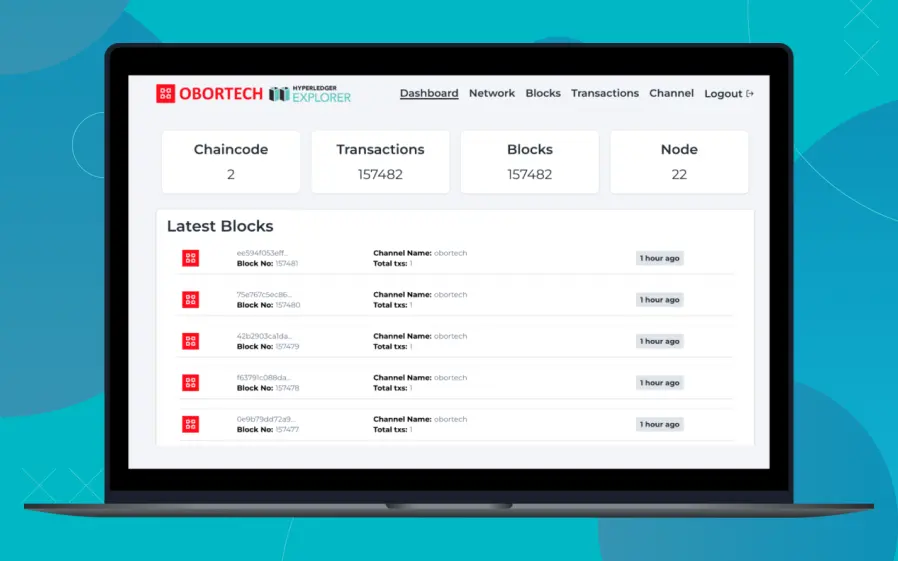
OBORTECH Smart hub leverages the power of Blockchain-as-a-service (BaaS) which involves the third-party setup and management of cloud-based networks for companies in the business of building enterprise blockchain applications.

  • 40% Reduction in Infrastructure Complexity
  • 30% Boost in Transaction Throughput
  • 25% Increased User Engagement
View Case Study
OborTech
Multi-Chain DEX

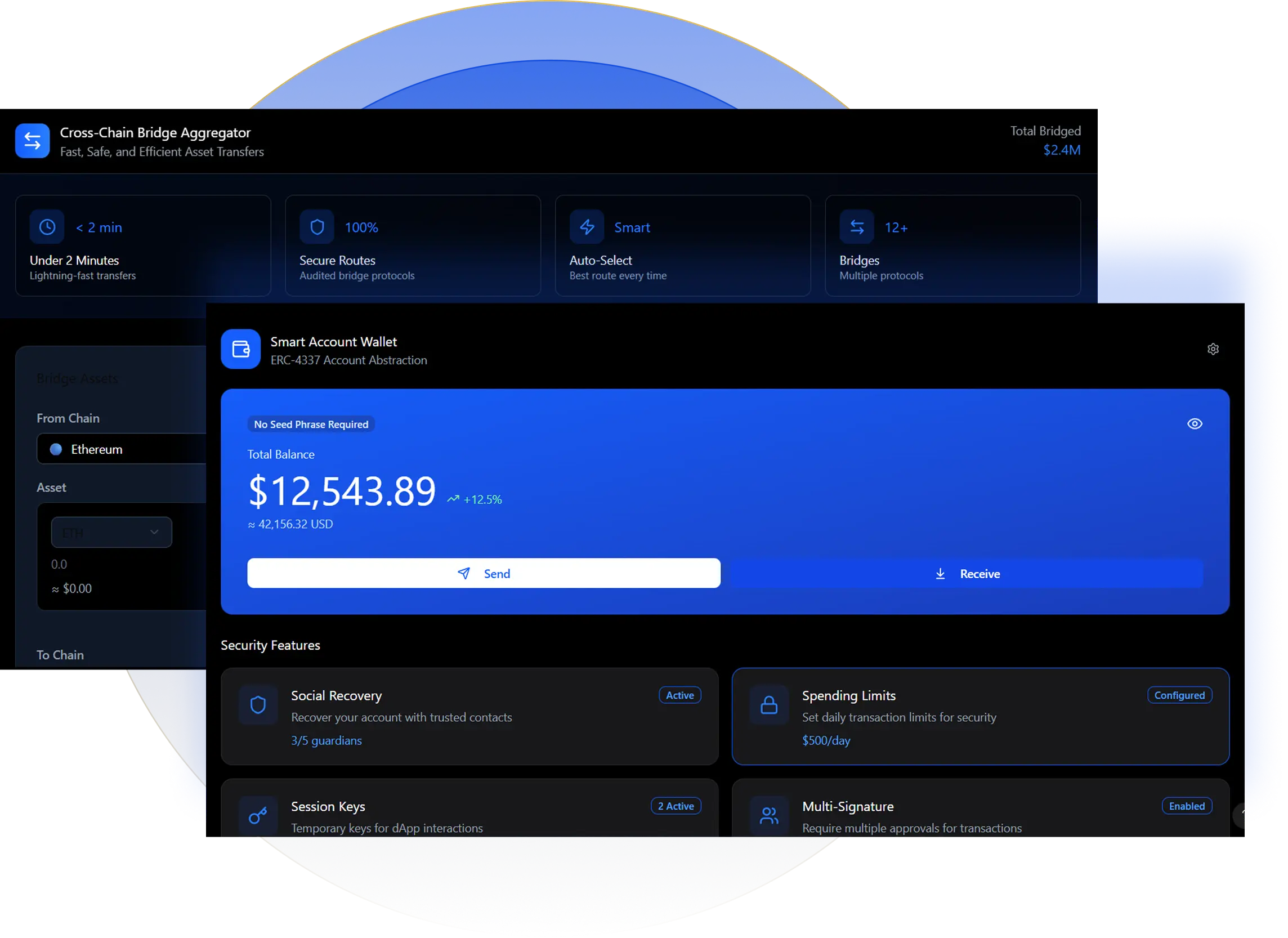
A Gasless, Multi-Chain Decentralized Exchange Built on ERC-4337

SoluLab built a multi-chain DEX letting users trade across Ethereum, Polygon, Arbitrum, Optimism, and Base without holding native gas tokens — using account abstraction and cross-chain liquidity aggregation to remove the friction that causes most DeFi users to drop off mid-trade.

  • 85% Reduction in Failed Trades
  • 95% Lower Transaction Costs
  • 3X Increase in Trading Volume
View Case Study
Multi-Chain DEX

Chichin

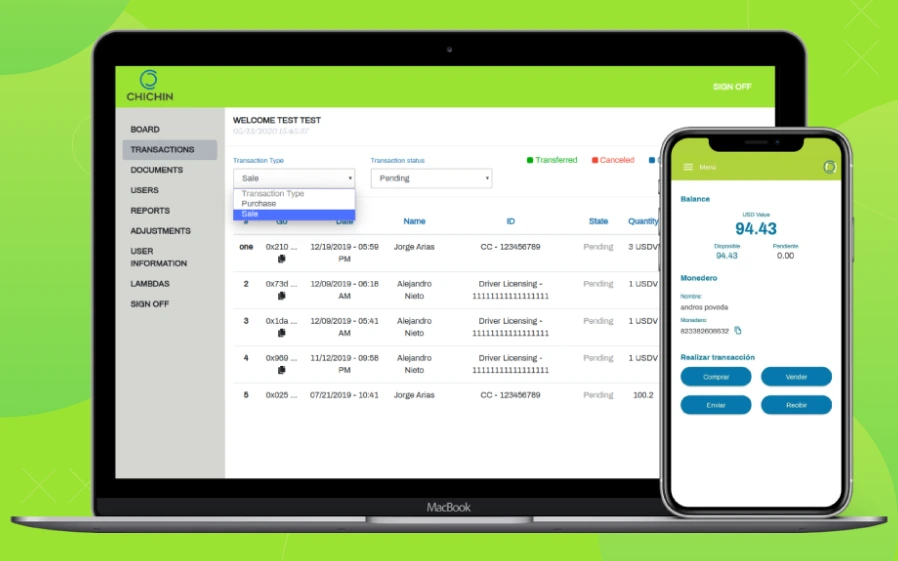
Chichin is a very useful banking and trading platform powered by Ethereum Blockchain. It provides a complete solution that includes a trading app, chichin tokens with an electronic and cold wallet to easily buy/sell coins, send/receive money instantly between app users.

  • PIN‑based Authentication Layer
  • 40% Reduced Transaction Latency
  • Multi-Cloud Deployment (AWS + Infura)
View Case Study
Chichin

Tech Stack Powering Our Blockchain Apps

Your Blockchain Vision Deserves a 4.9-Rated Technology Partner

Quality defines everything we do!

With SoluLab’s top-rated blockchain development team, you get secure architecture, optimized performance, and flawless execution from start to finish. Our solutions are engineered to reduce costs, prevent fraud, and support long-term scalability– trusted by startups, enterprises, and global brands.

Let’s Talk

4.9/5

★★★★★

4.9/5

★★★★★

Blockchain App Engagement Models, Timelines and Budget Ranges

Your budget depends on how far the app needs to go: a proof of concept, an MVP, or a production system with audits and integrations. These are planning figures, not quotes; you get a fixed price after a short scoping call. For a line-by-line breakdown, see our blockchain app development cost guide.

Stage
What you get
Typical timeline
Typical budget

Proof of concept or basic smart contract

What you get:

Core logic validated, minimal interface

Typical timeline:

3 to 8 weeks

Typical budget:

$10,000 to $40,000

MVP or pilot app

What you get:

Core features live, wallet login, limited users

Typical timeline:

2 to 5 months

Typical budget:

$40,000 to $120,000

Full production app

What you get:

Scalable, audited, integrated with your systems

Typical timeline:

4 to 10 months

Typical budget:

$120,000 to $350,000

Enterprise-grade system

What you get:

Permissioned network, compliance integrations

Typical timeline:

8 to 18 months

Typical budget:

$300,000 to $600,000+

How We Build Powerful, Enterprise-Grade Blockchain Applications?

We follow a structured, result-driven process designed to deliver secure, scalable, and high-performance blockchain applications. Every step focuses on reducing risk, improving quality, and ensuring your product meets enterprise standards from day one.

Discovery Icon
01

Discovery & Strategic Consultation

We start by understanding your business goals, technical constraints, and use case, then assess whether blockchain is genuinely the right solution before recommending an approach.

Architecture Icon
02

Technical Architecture & Roadmap

Our architects select the right blockchain network, consensus model, and integration points, and map out a full technical blueprint with realistic milestones before development begins.

Design Icon
03

UI/UX Design & Prototype

We design wireframes and a clickable prototype so you can validate the user experience and catch usability issues before a single line of production code is written.

Development Icon
04

Blockchain & Smart Contract Dev

Development runs in agile sprints, smart contract logic and backend infrastructure built and reviewed incrementally, with working components visible at each milestone.

Integration Icon
05

Integration With Existing Systems

We connect your blockchain application to existing CRMs, ERPs, payment systems, and legacy tools through secure APIs, so it works inside your current operations.

Testing Icon
06

Rigorous Testing & Audits

Every application undergoes functional testing, load testing, and independent smart contract security audits before deployment the review that catches vulnerabilities early.

Deployment Icon
07

Deployment, Optimization & Support

We deploy in controlled phases, monitor performance post-launch, and provide ongoing optimization and support as your usage and requirements grow over time.

Why Choose Us as Your Blockchain App Development Company?

Choosing a blockchain partner decides how secure, scalable, and maintainable your app is long after launch. As an enterprise blockchain app development company, we pair engineering depth with strict review standards, so your application is built for the years after launch day, not only for it.

Proven Track Record

Proven Track Record

A portfolio of shipped blockchain applications across DeFi, tokenization, and enterprise Web3, not prototypes that stalled after the demo.

Industry Experience

Extensive Industry Experience

Delivery experience spanning healthcare, real estate, banking, and more, so we're not learning your industry's compliance requirements on your project.

Faster Time-to-Market

Faster Time-to-Market

Reusable architecture patterns and pre-audited smart contract components mean less time spent building infrastructure that's already been solved.

Enterprise Security

Enterprise-Grade Security

Multi-layered security architecture including smart contract audits, penetration testing, and encrypted data handling as standard, not an upsell.

Client Retention

Client Retention

Most clients return for platform expansion or additional blockchain work rather than switching vendors after their first project.

Rigorous Auditing

Rigorous Security Auditing

Every smart contract goes through independent security review before deployment, and again whenever its logic changes.

Meet your blockchain Specialist

Rajat Lala

"Rajat is a blockchain specialist and technophile who has led enterprise engineering teams at Citrix and InfoStretch before co-founding SoluLab. "

Rajat Lala · Co-Founder & CEO, SoluLab · View full profile

What our clients say

quote-badge

SoluLab took our tokenization concept from whitepaper to a live smart contract deployment faster than we thought possible. Their team handled architecture planning, security audits, and compliance integration with a level of technical clarity that kept our internal stakeholders confident at every milestone.

We needed a partner who actually understood cross-chain interoperability, not just Ethereum basics. SoluLab's handling of multi-chain wallet infrastructure and governance contract design exceeded what we expected, communication stayed sharp through every architecture decision.

Their developers handled our token vesting mechanics, gas optimization, and security workflows with real attention to long-term platform stability, not just getting contracts deployed and moving on. That's rare in this space.

SoluLab delivered a structured roadmap covering smart contract development, security auditing, and regulatory alignment from week one. The transparency in their execution process made this the smoothest blockchain build we've run.

1 / 4
FAQ

Helpful resource to grow your business

A blockchain app development company designs, builds, and maintains applications that run on a blockchain: dApps, smart contracts, wallets, tokenization platforms, and enterprise systems on permissioned networks. The work covers choosing the chain, writing and auditing contracts, building the web or mobile front end, and integrating the app with your existing ERP, CRM, and payment systems.

Blockchain app development companies range from global consultancies such as IBM, Accenture, and Deloitte to specialist firms like ConsenSys and SoluLab. Compare them on shipped blockchain apps in your industry, audit process, chains supported, and pricing model. Our comparison of top blockchain development companies lists 15 firms with rates, locations, and best-fit use cases.

We build dApps, DeFi platforms, NFT marketplaces, crypto wallets, tokenization platforms, supply chain traceability systems, and enterprise applications on private or permissioned blockchains. Recent work includes a gasless multi-chain DEX built on ERC-4337, the OBORTECH blockchain-as-a-service hub, and the Chichin banking and trading app on Ethereum.

An MVP, or minimum viable product, is the smallest version of an app that real users can use to test whether the core idea works. In blockchain app development, an MVP usually means one core smart contract flow, a basic web or mobile interface, and wallet login, deployed to a testnet or a single mainnet before more features are added.

A proof of concept or basic smart contract typically takes 3 to 8 weeks, an MVP 2 to 5 months, a full production app 4 to 10 months, and an enterprise-grade system 8 to 18 months. Security audits, integrations with existing systems, and compliance reviews are the usual reasons timelines stretch, so we plan them from the first week.

Blockchain app development cost typically runs $10,000 to $40,000 for a proof of concept, $40,000 to $120,000 for an MVP, $120,000 to $350,000 for a production app, and $300,000 or more for enterprise systems. Plan another 15% to 25% of the build cost each year for maintenance. See our full blockchain app development cost guide.

Choose Ethereum or an Ethereum Layer 2 for public apps that need wallet and DeFi compatibility. Hyperledger Fabric suits private, permissioned networks between known companies. Solana fits high-volume consumer apps where fees must stay near zero, and BNB Smart Chain offers Ethereum compatibility with low fees and a large retail user base.

Yes. We build on public blockchains such as Ethereum, Solana, and BNB Smart Chain when you need open access and transparency, and on private or permissioned networks such as Hyperledger Fabric when participants must be known and data access controlled. Many enterprise apps use both, anchoring proofs publicly while keeping business data private.

We connect the blockchain layer to your ERP, CRM, payment, and identity systems through APIs and event listeners, so records written on-chain trigger updates in the tools your teams already use. Sensitive data stays off-chain in your databases, with hashes on-chain as proof. Integration planning starts in discovery, because it drives most enterprise timelines.

At minimum: independently audited smart contracts, role-based access control, multi-signature approval for admin actions, encryption in transit and at rest, secure key management, and monitoring for unusual transactions. Regulated apps add KYC/AML checks, audit logs, and data-residency controls. Plan a re-audit whenever contract logic changes after launch.

Generative AI coding assistants speed up front-end work, tests, and boilerplate contract code. They do not replace smart contract security review, though: AI-generated contract code still needs an independent audit before it holds real funds. Use AI to move faster on routine code, then have engineers verify everything that touches money, keys, or permissions.

AI-native app builders get a simple prototype running in days, which is useful for testing an idea. Traditional enterprise development takes longer but gives you audited contracts, custom integrations, and code your team owns and can maintain. For blockchain apps that hold funds or regulated data, most businesses prototype fast, then build the production version properly.

Yes. Every project starts with a discovery workshop where we check whether blockchain is actually the right tool, define the use case, pick the chain, and map integrations. You leave with a scoped architecture, a phased roadmap, and a fixed-price estimate. If a regular database would do the job, we will tell you.

Yes. After launch, we monitor performance, apply security patches, and optimize the application as usage grows. The same team that built your app stays accountable for how it runs in production, rather than handing it to a separate support desk that has never seen your codebase.

Share your email, company, and project stage through the form. Within 48 hours, we send a fixed-price estimate and suggested scope, then book a discovery session to confirm architecture, timeline, and team. If you already have a product, we start with a technical review of your code and infrastructure.

Articles

Latest Insights from Experts