You have probably heard the pitch already. AI will change everything. Blockchain will change everything. Put them together, and your business enters the future.
That pitch is lazy.
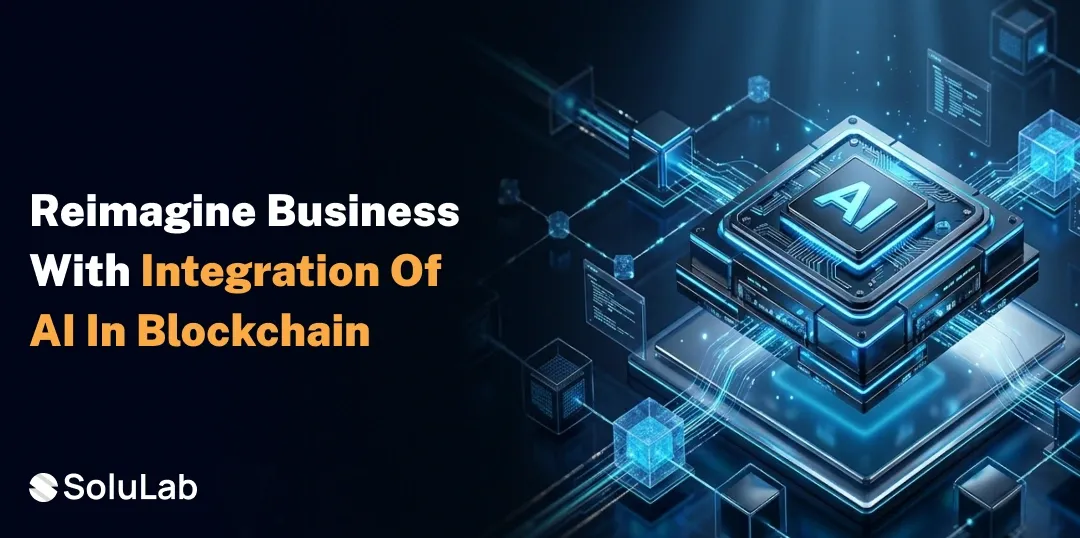
The real opportunity is far more specific, and frankly, far more useful. The integration of AI in blockchain gives you a way to build systems that are not just automated, but accountable. Not just intelligent, but verifiable. That difference matters when you are dealing with money, compliance, identity, supply chains, or any environment where one bad decision can create a very expensive mess. This is why leading organizations increasingly partner with an AI development company to create AI-powered blockchain solutions that combine intelligent decision-making with transparent, tamper-proof records.
If you are a CTO, founder, or business leader, you are not looking for abstract innovation. You want systems that lower risk, speed up execution, remove operational drag, and give customers a reason to trust what you have built. That is where AI and Blockchain Integration start to earn their place. Done right, it can help you detect fraud sooner, automate decisions with more confidence, prove data integrity, and build products that feel more defensible in a market full of copycat software.
Done badly, it becomes another bloated transformation initiative that sounds smart in a pitch deck and quietly burns time, budget, and credibility.
What AI and Blockchain Integration Actually Means?
At the simplest level, the Integration of Blockchain and AI means you are combining two very different strengths. Artificial intelligence helps your systems interpret data, find patterns, make predictions, and automate decisions. Blockchain technology gives your systems trust, traceability, immutability, and shared coordination across multiple parties.
So when people talk about AI and Blockchain, they are really talking about a practical split of responsibilities. AI handles judgment. Blockchain handles verification. AI decides what is likely happening. Blockchain records what actually happened and enforces what should happen next.
That is why Artificial Intelligence and Blockchain work so well together when the stakes are high. If your workflow needs both intelligence and trust, this combination makes sense. If it only needs one, forcing both technologies into the stack is usually overengineering.
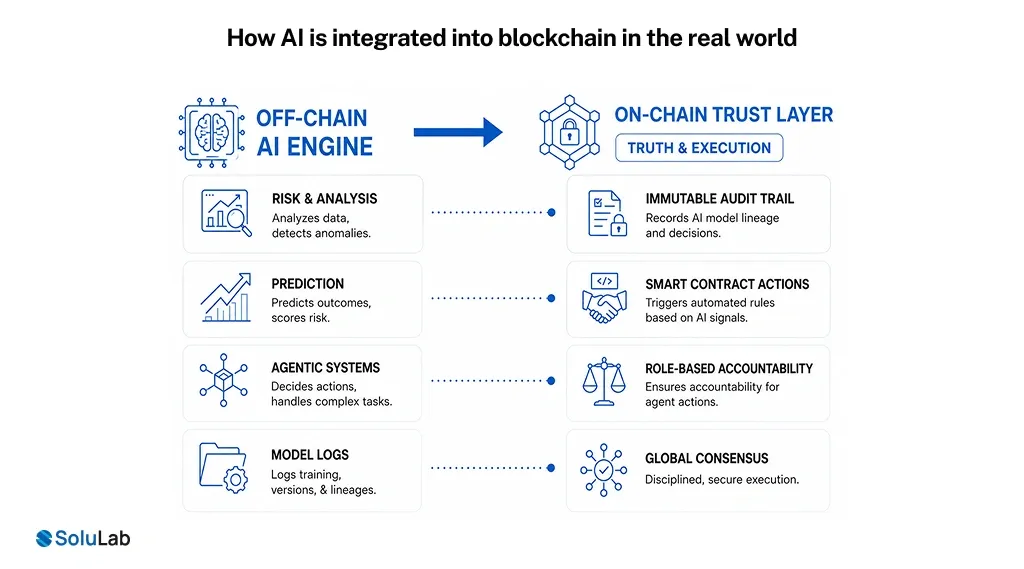
That point is worth emphasizing because a lot of teams still misunderstand how AI is integrated into blockchain. They assume the model itself needs to run on-chain. In most cases, it should not. Heavy AI workloads are usually better off-chain, where you get speed, flexibility, and lower cost. Blockchain then becomes the layer that logs outcomes, verifies actions, anchors provenance, and triggers smart contract logic when needed.
That is the real meaning of AI and Blockchain Technology in 2026. Not buzzword stacking. Division of labor.

Why This Matters To Your Business Now?
You are operating in a market that demands speed and trust at the same time. Customers want smarter experiences. Regulators want cleaner audit trails. Partners want verifiable data. Internal teams want automation that does not create new chaos.
That is exactly why the Benefits of AI in Blockchain matter now.
When you combine these technologies well, you can improve decision quality because your AI is working from better, more trustworthy records. You can improve automation because your smart contracts are no longer blind to changing real-world conditions. You can improve governance because key actions, approvals, and model outputs can be traced instead of being buried in disconnected systems.
There is also a strategic angle here that many leaders miss. AI on its own often creates a trust problem. Blockchain on its own often creates an intelligence problem. Put them together properly, and each one covers the other’s weakness.
That is a much more compelling business case than “two hot technologies are better than one.”
How AI is Integrated Into Blockchain In The Real World?
If you want a clean answer to how AI is integrated into blockchain, here it is: your AI usually works off-chain, and your blockchain usually works as the trust and execution layer.
That structure shows up in several ways.
Off-chain AI, on-chain trust
This is the most practical model for enterprise systems. Your AI engine analyzes data, scores risk, predicts delays, or detects anomalies outside the blockchain platforms. Then the result gets passed into a blockchain-based workflow where it can be logged, validated, or used to trigger a smart contract action.
This approach is common because it respects reality. AI needs compute flexibility. Blockchain needs disciplined execution. Trying to force both into one layer usually creates cost and performance problems you did not need in the first place.
Smart contracts guided by AI
This is where things get more interesting. Instead of treating smart contracts development like static rules, you let AI provide context. If risk goes above a threshold, release is paused. If a shipment is likely delayed, an automated fallback route is triggered. If a wallet looks suspicious, a compliance workflow starts instantly.
This is one of the clearest examples of the role of AI in blockchain technology. Blockchain does not become smarter by itself. It becomes smarter because AI feeds it a signal.
Blockchain for AI provenance
If your business is serious about enterprise AI, you cannot ignore provenance. You need to know where your training data came from, who changed the model, which version produced which output, and whether a decision can be defended later.
That is where blockchain becomes useful in a different way. It can serve as an immutable record for model lineage, policy checkpoints, access logs, and decision trails. This is one of the most underrated applications of AI in blockchain, especially for businesses working in regulated sectors or high-trust environments.
Autonomous agents operating on-chain
This is where the next wave is heading. AI agents are getting more capable. But once an agent can transact, pay, coordinate, or execute actions on behalf of a system, you need rules, identity, and accountability. Blockchain application gives you that infrastructure.
This trend will shape the future of AI and blockchain more than most companies realize today.
Benefits of AI in Blockchain that actually matter
A lot of content on this topic lists the same tired benefits: better security, better efficiency, better transparency. All true. Also incomplete.
What matters to you is whether those benefits change business performance.
Here is where the Benefits of AI in Blockchain become tangible:
- You reduce fraud faster because AI spots patterns while blockchain preserves a reliable record of activity publishing.
- You make compliance less painful because key events are logged automatically and can be audited more easily
- You improve automation quality because AI adds context to rule-based execution
- You strengthen trust in your data because blockchain makes tampering harder and lineage clearer
- You create more defensible AI systems because decisions can be traced back through verified records
- You lower platform fragility over time by exploring decentralized infrastructure options instead of relying entirely on centralized AI vendors
That last point matters more than it gets credit for. The more critical AI becomes to your business, the more dangerous it is to build everything around a small number of opaque providers. Decentralized infrastructure will not replace centralized AI overnight, but it is starting to give businesses a real hedge.
AI and Blockchain Use Cases You Should Actually Care About
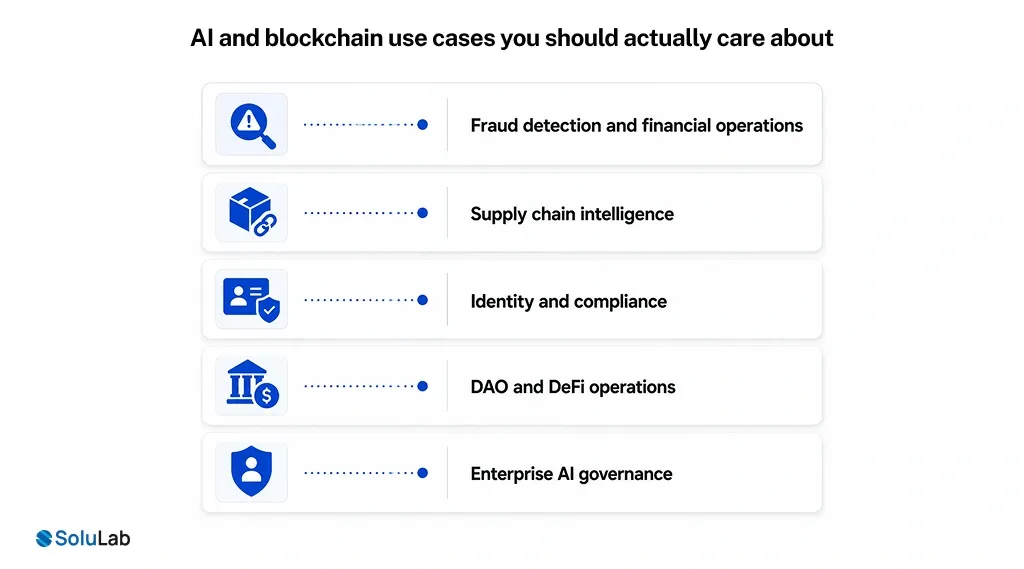
Not every use case deserves your attention. Some are still speculative. Some are technically clever but commercially weak. The best AI and blockchain use cases are the ones where trust, data integrity, and intelligent automation all matter at once.
Fraud detection and financial operations
This is one of the strongest areas for AI-powered blockchain solutions. Blockchain gives you a transparent transaction history. AI helps you detect suspicious wallet behavior, identify abuse patterns, and react before the damage spreads.
If your business touches payments, settlement, lending, digital assets, or treasury flows, this is not a “nice to explore” use case. It is a serious operational advantage.
Supply chain intelligence
This is one of the most commercially mature blockchain use cases today. Blockchain tracks provenance, movement, and custody. AI predicts disruptions, flags inconsistencies, improves routing, and catches fraud patterns that static systems miss.
This is especially useful when your problem is not just visibility. It is visibility plus action.
Identity and compliance
Identity systems break when trust breaks. AI can help verify users, flag anomalies, and streamline onboarding. Blockchain can secure credentials, permissions, consent history, and cross-party verification records.
That makes this one of the most practical applications of AI in blockchain for fintech, healthcare, enterprise software, and regulated digital platforms.
DAO and DeFi operations
AI can help analyze proposals, monitor risk, support treasury decisions, and surface governance patterns. Blockchain keeps the system transparent and enforceable. This is where AI-powered blockchain applications start moving from static DeFi protocols toward more adaptive ecosystems.
Enterprise AI governance
This one deserves much more attention than it gets. As companies scale AI, governance becomes messy fast. Different teams use different models, different datasets, different approval processes, and different logging standards. That fragmentation becomes a legal and operational problem.
Blockchain can help centralize trust without centralizing every system. That is a big deal.
AI-Powered Blockchain Applications and AI Blockchain Automation
This is where the topic becomes commercially interesting.
AI-powered blockchain applications are not just blockchain products with an AI chatbot glued on top. They are systems where intelligence and verifiability are built into the workflow itself.
That includes:
- Smart contracts triggered by AI risk signals
- Fraud detection engines for on-chain ecosystems
- Predictive logistics platforms with immutable traceability
- Identity systems with AI-led anomaly detection and blockchain-backed credential validation
- Agent-driven platforms where autonomous systems transact under programmable rules
This is the real promise of AI blockchain automation. You are not just replacing human effort. You are designing multi-agent systems that can evaluate, decide, and execute while preserving an auditable trail.
That said, this is where companies also make some of their worst mistakes. They automate too much too early. They trust weak models. They skip governance. They assume that if a workflow is technically automatable, it should be fully automated. It should not.
The better approach is controlled automation. High-confidence actions can be automated. Ambiguous or high-risk actions should escalate. That is how mature businesses build trust into automation instead of gambling with it.
Where Most Teams Get This Wrong?
This part needs to be said clearly.
A lot of projects in AI and Blockchain Integration fail because the team starts with the AI technology stack instead of the business bottleneck. They want to “use AI and blockchain” before they can explain which decision needs to improve, which process needs to speed up, or which trust problem needs to be fixed.
That is backward.
The second mistake is assuming blockchain automatically improves AI. It does not. If your source data is poor, if your model is weak, or if your governance is sloppy, putting records on-chain will not save you. It will just make your problems more permanent.
The third mistake is ignoring economics. On-chain computation is expensive. Oracle design is hard. Agentic AI systems need controls. Governance overhead is real. If your architecture looks exciting but the unit economics do not hold, the product will not scale.
This is why a lot of supposedly innovative projects quietly disappear.
The Future of AI and Blockchain
The future of AI and blockchain will not belong to the loudest companies. It will belong to the AI native full stack developer teams that solve real trust and automation problems with discipline.
Three shifts are already shaping that future.
First, enterprise AI governance is becoming non-negotiable. Businesses are moving beyond experimentation, and that means they need traceability, decision accountability, policy controls, and model oversight baked into production systems. Blockchain is increasingly relevant here because it provides a durable trust layer for those controls.
Second, decentralized AI infrastructure is becoming more credible. For years, this sounded theoretical. Now it is starting to look like a real strategic option in parts of the stack, especially where businesses want more openness, stronger provenance, and less dependence on centralized gatekeepers.
Third, autonomous AI agents are going to push this market forward fast. Once agents begin handling tasks, payments, negotiations, and multi-step workflows, they will need a system of record and a system of rules. Blockchain fits that role naturally.
That is why the future of AI and blockchain is not just about smarter apps. It is about building systems that can act without becoming opaque.
Why SoluLab Is The Right Partner For Your Build?
If you are planning to build in this space, you do not need a team that only talks a good game. You need a partner that understands product thinking, technical architecture, governance, and commercial execution.
SoluLab is a strong fit if you need Blockchain Development Services that go beyond generic builds. If you are exploring AI-powered blockchain development, the real value is having a partner that can help you decide what to build, what not to build, and how to avoid expensive design mistakes before they reach production.
That matters because most businesses do not need more experimentation. They need sharper execution.
With SoluLab, you can align your roadmap around:
- custom blockchain development built around your business model
- scalable AI-powered blockchain solutions for enterprise and startup use cases
- strategic support from an AI Development Company that understands real deployment constraints
- experienced AI developers who can connect intelligence, automation, and trust into one product strategy

What should you do next?
If you want to benefit from the integration of AI in blockchain, do not start with a giant transformation plan. Start with one workflow that is critical, repetitive, trust-sensitive, and decision-heavy. That is usually where the first serious win appears.
Then design the stack honestly. Decide where AI should think. Decide where blockchain should verify. Decide where automation should execute and where human review still matters.
That is how you turn AI and Blockchain from a trendy idea into a business advantage that actually holds up.
If you want to explore such a use case, explore our tokenization platform solution recently delivered, explaining how AI and blockchain integration work, makes a difference, and how our experts delivered the finest implementation of AI-powered blockchain technology.
Have another unique idea on your mind? Let’s discuss!
FAQs
Shipra Garg is a tech-focused content strategist and copywriter specializing in Web3, blockchain, and artificial intelligence. She has worked with startups and enterprise teams to craft high-conversion content that bridges deep tech with business impact. Her work translates complex innovations into clear, credible, and engaging narratives that drive growth and build trust in emerging tech markets.