Talk to an Expert

How to Launch a Crypto Exchange in Switzerland?

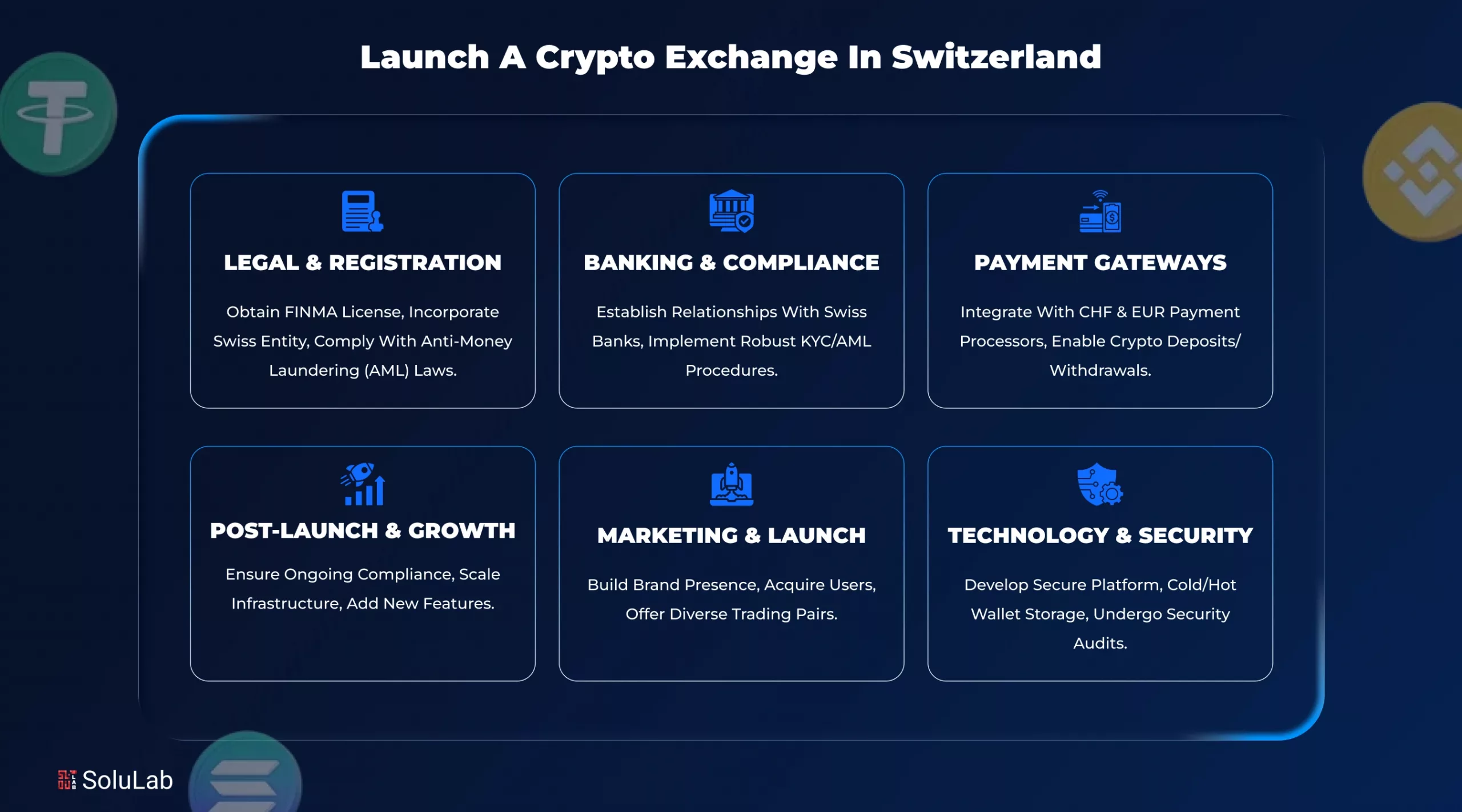
Launch a Crypto Exchange in Switzerland banner

Switzerland has quietly become one of the world’s most attractive places to start a cryptocurrency exchange in Switzerland. Stable politics, a predictable legal framework, deep financial expertise, and the famed “Crypto Valley” in Zug combine to give entrepreneurs runway for launching digital-asset businesses. Market projections show steady growth, with revenue estimates in the hundreds of millions USD and rising retail adoption. This demand, liquidity, and investor interest are all moving in the same direction.

But building the best crypto exchange in Switzerland isn’t just about code or marketing. It’s about blending technical excellence, airtight compliance, and local banking relationships. The following explains why Switzerland matters, and the step-by-step guide to launching a compliant, scalable exchange. 

Why Switzerland is the Global Crypto Hub?

Switzerland’s strength as a crypto-friendly jurisdiction is multi-fold:

  • Regulatory clarity and stability: FINMA applies existing financial and AML laws to digital assets in a technology-neutral way, which reduces legal ambiguity for entrepreneurs and investors alike.
  • Concentrated crypto ecosystem: Crypto Valley (Zug) and Zug-adjacent cantons host startups, experienced advisors, and specialized banks, creating a powerful ecosystem effect.
  • Institutional readiness: A growing slate of licensed banks and institutions offer custody, tokenization, and institutional services, which support exchanges that target high-net-worth and corporate clients.
  • Market momentum: Forecasts show the Swiss crypto market expanding in revenue and adoption, which makes timing favorable for those who launch a crypto business in Switzerland now rather than later.

Together, these elements make Switzerland an ideal base for launching consumer and institutional crypto products, from retail spot exchanges to tokenization platforms.

Legal Requirements for Starting a Crypto Exchange in Switzerland

If you want to run one of the crypto exchanges in Switzerland, you must design operations around Swiss legal obligations from day one. Let’s delve deeper into it:

1. Entity and Corporate Setup

  • Pick a legal form: Stock Corporation (AG) is preferred for exchanges due to capital and governance expectations; GmbH is possible for smaller ventures.
  • Minimum capital: AG typically requires CHF 100,000 (with a portion paid in incorporation); GmbH requires CHF 20,000.
  • Local presence: At least one Swiss-resident director and a registered office are normally required.

2. FINMA Licensing & SRO Registration

  • Activities such as custody, fiat on-ramps, or holding client funds often trigger FINMA oversight or require affiliation with an AML Self-Regulatory Organization (SRO) like VQF.
  • Possible license paths include fintech authorization (for certain deposit-taking models), banking licenses (when offering interest or broad custody), securities firm licenses (for tokenized securities), or direct FINMA approval for more complex models.
  • Expect submission of a detailed business plan, AML/KYC policies, IT security documentation, technical architecture, and proof of adequate capital.

3. AML/KYC and Recordkeeping

  • Swiss AML law applies to VASPs; full KYC, transaction monitoring, suspicious-activity reporting, and annual AML audits are standard requirements.
  • Maintain auditable records and use blockchain analytics tools to trace fund flows.

4. Token classification and investor protection

  • FINMA classifies tokens by function: payment, utility, asset, or debt, with the strictest rules applied to tokens that resemble securities. Legal classification determines disclosure, prospectus, and licensing obligations.

5. Taxation & accounting

  • Crypto assets are treated as movable property; taxation and VAT treatments vary by token type and service. Accurate accounting (mark-to-market valuations, separate ledgers for staking/rewards) and annual audited statements are expected.

Proactive legal planning not only prevents enforcement issues but is also a market differentiator; institutional counterparties will only work with exchanges that demonstrate rigorous compliance.

Benefits of Launching Your Crypto Exchange in Switzerland

Switzerland offers some of the most tangible and reliable advantages for anyone planning to launch a crypto business. Its ecosystem blends regulatory clarity, global credibility, and a sophisticated financial infrastructure that few countries can match.
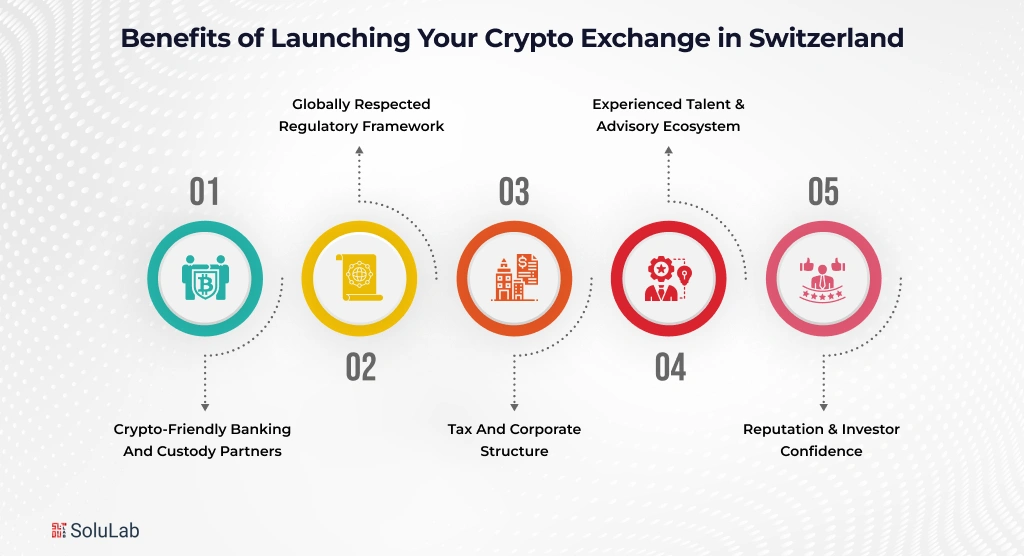
Benefits of Launching Your Crypto Exchange in Switzerland

1. Access to Crypto-Friendly Banking and Custody Partners 

Switzerland is home to more than 20 regulated financial institutions, including SEBA Bank, Sygnum, and Arab Bank (Switzerland), that actively support crypto ventures. This rare level of banking access enables smooth fiat on-ramps, secure custody, and instant settlements between banks and exchanges, reducing operational friction from day one.

2. Globally Respected Regulatory Framework 

The FINMA licensing system is recognized worldwide for its transparency and precision. Over 1,000 blockchain and fintech firms operate legally under FINMA or SRO oversight. A Swiss license instantly signals trust and helps exchanges collaborate with institutional investors, liquidity providers, and global payment partners.

3. Attractive Tax and Corporate Structure 

With corporate tax rates ranging between 11.8% in Zug and 21% in Geneva, Switzerland remains one of the most tax-efficient hubs in Europe. Over 80 double taxation treaties (DTAs) simplify cross-border operations, while IP-box regimes lower taxes on software and technology assets, letting startups reinvest more into innovation and growth.

4. Experienced Talent and Advisory Ecosystem 

The Crypto Valley region alone hosts 1,200+ blockchain companies and more than 6,000 professionals, spanning developers, auditors, and compliance experts. This ecosystem offers founders direct access to specialized advisors, law firms, and development partners well-versed in FINMA standards and crypto infrastructure.

5. Reputation and Investor Confidence 

Operating from Switzerland instantly enhances credibility. A Swiss-registered exchange conveys reliability, security, and sound governance, values synonymous with the country’s financial legacy. This reputation helps attract both retail users and institutional investors, making market entry and scaling far smoother.

Step-by-Step Process to Launch a Crypto Exchange in Switzerland

Launching a crypto exchange in Switzerland is a structured process because the country offers one of the world’s strongest regulatory, banking, and crypto-friendly environments. Here’s how the journey typically unfolds:

1. Define your business model 

Decide whether you build a centralized exchange (CEX), a decentralized exchange (DEX) with a Swiss legal wrapper, or a hybrid. Identify products, spot trading, derivatives, custody, staking, or tokenized assets.

2. Incorporate and structure capital 

Form an AG or GmbH, depending on scale. Secure the minimum paid-in capital and appoint a Swiss-resident director.

3. Legal & compliance design 

Engage Swiss counsel to classify tokens, draft a compliant AML/KYC framework, and prepare FINMA/SRO filings. Prepare business plans and financial projections required for licensing.

4. Build secure, scalable technology 

Develop or license a trading engine capable of high throughput, implement multi-layer security (cold storage, HSMs, 2FA, anti-DDoS), and integrate liquidity APIs. Ensure architecture supports real-time reconciliation and audit trails.

5. Bank and payment integrations 

Partner with crypto-friendly banks in Switzerland to enable fiat on/off ramps, settlement, and treasury services. Establish custody arrangements or integrate with licensed custodians.

6. Audit, testing & independent reviews 

Conduct smart contract and platform security audits, penetration testing, and performance benchmarks. Document results for regulators and partners.

7. Licensing / Registration 

Submit FINMA or SRO applications, respond to queries, and satisfy any capital or governance conditions. Typical review cycles vary; thorough documentation accelerates approval.

8. Launch & ongoing operations 

Roll out KYC flow, liquidity provisioning, market-making, and customer support. Maintain continuous compliance: AML monitoring, periodic audits, and regulatory reporting.

9. Post-launch scaling 

Invest in UX, mobile apps, advanced order types, and additional markets (tokenized securities, institutional desks). Keep iterating on security and compliance posture.

Many entrepreneurs engage a specialized partner for the technical and compliance lift. For example, a local development firm with FINMA experience can accelerate time-to-market while embedding regulatory controls into the product. 

What’s Next for Crypto Exchange Entrepreneurs in Switzerland?

Looking forward, Swiss exchanges that combine regulatory-first governance, institutional-grade security, and product innovation will have the strongest competitive advantage. Key future trends to monitor:

  • Tokenization and RWAs: growing demand for tokenized real estate and fund shares will create new trading venues.
  • DeFi/CeFi convergence: regulated gateways to decentralized liquidity and custody solutions will become a differentiator.
  • Institutional onboarding: exchanges with clear compliance and custody setups will capture institutional order flow.
  • Tech evolution: AI-driven risk controls, advanced analytics, and improved UX will push user expectations higher.
  • Regulatory harmonization: potential alignment with EU frameworks (e.g., MiCA-like standards) could simplify cross-border expansion.

If you plan to launch a crypto business in Switzerland today, prioritize compliance and security from day one, choose partners who understand FINMA obligations and Swiss banking nuances, and scale design. With the right foundations, Switzerland offers not just permission to operate, it offers a platform to become a trusted, long-term market participant in a maturing global crypto economy.
Crypto Exchange development CTA

Conclusion

Through this blog, you might have understood how Switzerland’s regulatory clarity, advanced banking infrastructure, and growing crypto ecosystem. These make it the ideal destination for launching a compliant exchange.

If you’re planning to start a cryptocurrency exchange in Switzerland, ensure your strategy aligns with FINMA’s framework and robust security standards.

We at SoluLab, a top cryptocurrency exchange development company, help businesses build and launch scalable, regulation-ready crypto exchange platforms. We tailor to the Swiss and international markets. Our expert team specializes in end-to-end development. From secure wallet integration and liquidity management to advanced trading engines and AML/KYC compliance.

If you’re ready to launch your crypto business in Switzerland, contact us today. 

FAQs

1. How much does it cost to start a cryptocurrency exchange in Switzerland?

The cost depends on your license type, platform complexity, and compliance needs. On average, setup costs range between CHF 150,000 to CHF 500,000, including legal, technical, and operational expenses.

2. How long does it take to obtain a crypto license in Switzerland?

Typically, FINMA licensing or SRO registration takes 3 to 6 months, depending on documentation, business model complexity, and AML readiness. Proper preparation and expert guidance can significantly shorten this process.

3. Which banks in Switzerland are crypto-friendly?

Some well-known crypto-friendly banks in Switzerland include SEBA Bank, Sygnum, Arab Bank (Switzerland), and Maerki Baumann. These banks support fiat on/off ramps, custody services, and digital-asset businesses.

4. Why choose SoluLab to build your crypto exchange?

SoluLab specializes in cryptocurrency exchange development with a regulatory-first design. Our team builds secure, high-speed, and FINMA-ready platforms, combining blockchain innovation, AML automation, and seamless user experiences for global scalability.

5. What makes Switzerland a top choice for crypto companies?

Switzerland offers clear crypto laws, low taxes, strong investor trust, and access to regulated financial institutions. Its ecosystem, led by Crypto Valley, enables safe, compliant, and scalable crypto exchange growth.

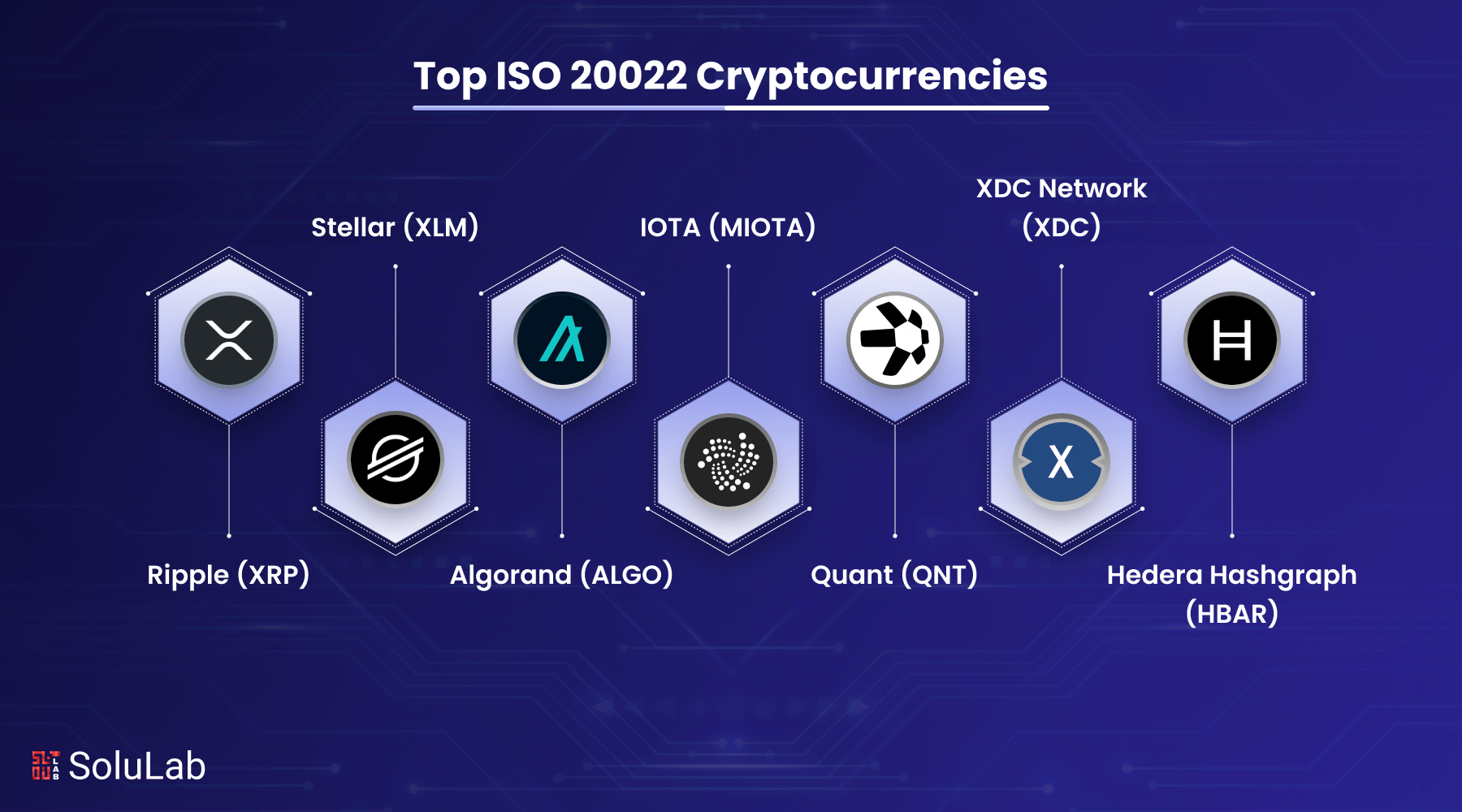
Top 8 ISO 20022 Cryptocurrencies to Look at in 2025

Top 8 ISO 20022 Cryptocurrencies

Ever feel lost trying to figure out which cryptocurrencies have long-term potential beyond hype?
With thousands of coins out there, most won’t survive the next regulatory wave.

Global finance is evolving, and not every crypto is built to survive in a regulated, bank-friendly future. But some are. ISO 20022, the global standard for financial messaging, is becoming the bridge between traditional banking and digital assets. And a select few cryptocurrencies are already aligned with it.

In this blog, we’ll reveal the Top 8 ISO 20022-Compliant Cryptocurrencies you should keep an eye on for 2025 — coins designed to work with the system, not against it.

What is ISO 20022?

ISO 20022 is a standard that facilitates the exchange of financial information between institutions, ensuring a more structured, efficient, and interoperable system for financial transactions. It provides a universal format for messages, including payment instructions, securities transactions, and fund transfers.

In simpler terms, ISO 20022 enables different financial systems to communicate with each other in a standardized manner, thereby improving transparency, reducing errors, and accelerating transactions.

While it’s widely used in traditional finance (banks, payment processors). Adoption of ISO 20022 Coins and Crypto is accelerating global interoperability, aligning with major cross‑border messaging systems like SWIFT and SEPA. This integration improves cross-border payments, regulatory compliance, and real-time processing.

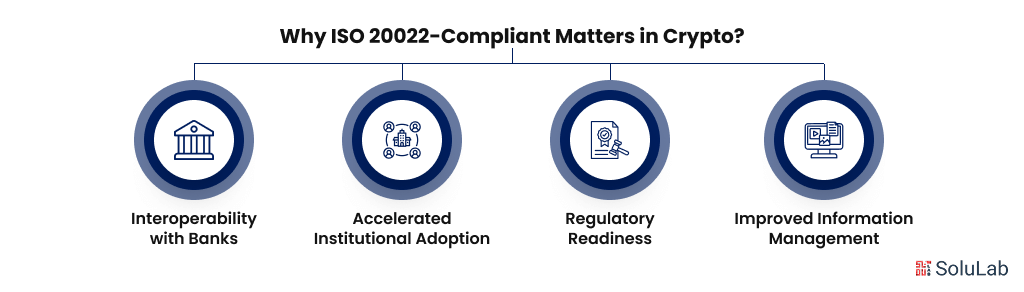
Why ISO 20022-Compliant Matters in Crypto? 

Why ISO 20022-Compliant Matters in Crypto

ISO 20022 is a globally agreed communications standard used by banks and other financial institutions to communicate data-rich, standard, and secure data. ISO 20022-compliant cryptocurrencies will be better off as traditional finance switches to this industry standard.

 This is the reason why it matters:

  • Interoperability with Banks: Regulatory cryptos would be ideal for payments and institutions because they are easy to integrate with global banking systems.
  • Regulatory Readiness: Coins in ISO 20022 are more likely to meet future regulations, and this appeals to governments and other major investors as well.
  • Accelerated Institutional Adoption: Cryptocurrencies that comply with the ISO have a better probability of being the by financial institutions.
  • Improved information management: Additional information on the transaction promotes automation, fraud detection, and compliance.

Top 8 ISO 20022-Compliant Cryptocurrencies of 2025

ISO-aligned coins may become more widely used and trusted, specifically by institutions, as more than 70 countries accept the standard. Here are the Most Popular ISO 20022 20022-compliant cryptocurrencies you should know: 

  • Cardano (ADA)

Cardano (ADA) provides a secure and effective platform for developing smart contracts and dApps. It prioritizes interoperability, sustainability, and scalability while improving upon previous blockchains. 

The Cardano Computation Layer (CCL), which runs smart contracts, and the Cardano Settlement Layer (CSL), which handles cryptocurrency transactions, are the two primary components of this network. Ouroboros, a Proof-of-Stake technique that enables users to receive rewards through staked ADA currency, keeps the network safe.

  • Ripple (XRP)

A cryptocurrency and digital payment system named Ripple (XRP) seeks to make international financial transactions easier. The Ripple Protocol Consensus Algorithm (RPCA), which XRP employs, enables verified nodes to process payments quickly and effectively without the need for energy-intensive mining.

By providing quick, international payments and money transfers, Ripple offers crypto-friendly banks and other financial organizations a more affordable alternative to the conventional SWIFT network. In the Ripple network, XRP serves as a bridge currency that facilitates simple value exchange between various fiat currencies through the XRP / USD pair.

CTA1

  • Stellar (XLM)

Stellar (XLM), a cryptocurrency and decentralized payment network, promotes financial inclusion and low-cost cross-border transactions. This Ripple-based infrastructure connects banks, payment processors, and users globally. Stellar’s Stellar Consensus Protocol (SCP) instantly confirms transactions through a community of authorized nodes, eliminating resource-intensive mining.

Stellar employs Lumens (XLM) to bridge currencies and improve cross-border transactions. Lumens preserve the connection and prevent spam. Stellar focuses on tiny transactions and develops digital assets via its decentralized exchange. It helps uninsured persons use financial services for money transfers and tokenized assets.

  • Algorand (ALGO)

Algorand (ALGO) is a cryptocurrency platform for dApp development. Though decentralized, it’s Just Proof of Stake (PPoS) that validates transactions. Algorand’s PPoS lets users have an equal chance to produce and review newer blocks, keeping the network secure and lower resource-intensive than mining-based systems.

The ALGO network exchanges, confirms, and rewards transactions with Algorand. Algorand is appropriate for financial services, DeFi, and asset tokenization since it processes multiple transactions. The platform’s safe and efficient blockchain makes it a strong contender. 

  • IOTA (MIOTA)

IOTA (MIOTA) is an IoT cryptocurrency and ledger system. The IOTA Foundation proposed “IOTA Rebased” as a major update. This upgrade converts the network from a Layer 1 IOTA blockchain to a Move-based object ledger.

The update aims to scale, decentralize, and program the network. Developers can create dApps straight on the main network. The Move programming language will be used to construct Layer 1 smart contracts in IOTA. This will simplify blockchain applications in supply chain management, asset tokenization, and digital identity.

  • Quant (QNT)

The purpose of Quant (QNT) is to enhance communication between various blockchains and conventional financial institutions. Data distributing, cross-chain operations, and the creation of decentralized applications (dApps) on several blockchains are all made possible by Overledger, the foundational platform. 

By providing safe and effective communication and value exchange between blockchains, this technology improves the scalability, liquidity, and functionality of the whole sector. The native currency, QNT, is used to reward network users who contribute to network maintenance, pay transaction fees, and access Overledger services. The deflationary nature of QNT, which has a fixed supply, increases its value.

  • XDC Network (XDC)

XDC Network (XDC) is a cryptocurrency network for supply chain management, trade financing, and safe and effective cross-border transactions. The XinFin Composite Blockchain, upon which XDC is based, combines elements of publicly and privately managed blockchains to produce an adaptable and interconnected system.

XDC Network maintains the network’s security and decentralization by utilizing XinFin Delegated Proof of Stake, or XDPoS, to guarantee speedy transaction confirmations. Payment for transactions, platform service access, and network decision-making are all accomplished with the XDC token. Practical applications are the main focus of XDC, particularly in logistics and trade finance.

  • Hedera Hashgraph (HBAR)

The Hashgraph consensus technique is used by Hedera Hashgraph (HBAR) to offer great speed, security, and equity. It supports the development and operation of decentralized applications (dApps) in social networking, gaming, supply chain management, and banking.

Hedera uses a directed acyclic graph (DAG) in place of a conventional blockchain to reach consensus, enabling faster transactions with minimal power consumption. The system’s token, HBAR, is used to stake to protect the network, pay transaction fees, and take action in decision-making. Its deflationary method and fixed supply contribute to its value preservation.

Benefits of ISO 20022 Compliance For Crypto

The ISO 20022 is changing traditional finance communications with crypto. Its implementation introduces order, transparency, and universal harmony, and makes digital assets effective, compliant, and reliable in the financial environment.

1. Increased Cross-Border Payment Efficiency: The ISO 20022 simplifies message structures by cutting friction in cross-border payments. Payments with cryptocurrencies are faster, more precise, and cheaper, allowing smooth interoperability between blockchain networks and the rest of the financial institutions across the globe.

2. Regulatory and Institutional Alignment: There is standardization of the messaging, which facilitates the achievement of global compliance standards by crypto platforms. This will open up the space to institutional players who will operate with more confidence, knowing that their operations are within the regulator’s expectations.

3. Trust and Fairness: Transactions can be easily traced and audited when the data is structured and standardized. This brings transparency, minimizes the chances of fraud, and increases the level of trust among the users, regulators, and other financial partners dealing with crypto assets.

4. Improved Compatibility with the Legacy Finance (TradFi): ISO 20022 fulfills the blockchain-to-legacy system communication gap. Through it, crypto users can more easily integrate into bank and financial systems, speeding mainstream adoption and usage of digital currencies.

How will ISO 20022 Impact Crypto Regulation in 2025?

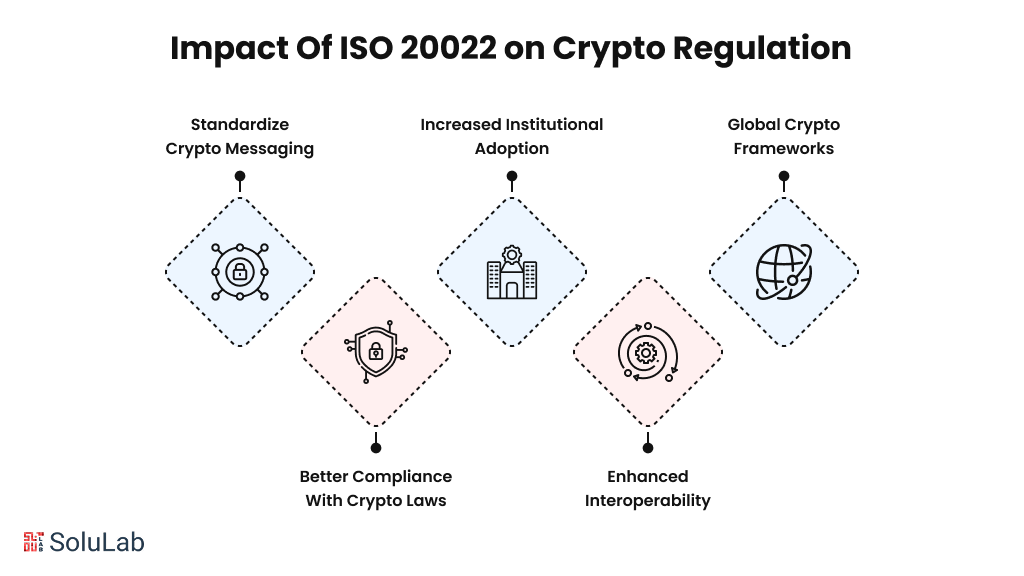
Impact Of ISO 20022 on Crypto Regulation

ISO 20022 might become a game-changer for how cryptocurrencies are regulated and integrated in 2025. Here’s what you need to know:

  • ISO 20022 will standardize crypto messaging: ISO 20022 introduces a universal messaging format for financial institutions. Once applied to cryptocurrency transactions, it can simplify communication, reduce errors, and boost transparency—making it easier for crypto regulations to take shape across global markets.
  • Better compliance with cryptocurrency laws and regulations: With clear transaction metadata and structured information, regulators can track suspicious activities. This helps cryptocurrency development companies stay compliant with cryptocurrency laws and regulations, while building trust.
  • Increased institutional adoption of cryptocurrency: Standardization through ISO 20022 aligns crypto with traditional finance protocols. As a result, banks and large financial institutions may feel more secure entering the cryptocurrency market—helping crypto go mainstream.
  • Enhanced interoperability across platforms: ISO 20022 supports richer data formats, enabling communication between crypto exchanges, banks, and payment providers. This can lead to a more integrated financial system where digital assets move.
  • Encouragement for more global crypto frameworks: As countries adopt ISO 20022, it will push for crypto regulations and help establish a global framework, easing cross-border compliance and launching crypto services globally.

CTA2

Conclusion

As the global financial system moves toward ISO 20022 adoption, cryptocurrencies aligned with this standard are gaining serious attention. From improved interoperability to faster cross-border transactions, these ISO-compliant cryptocurrencies could show how value moves globally. 

For investors, developers, and institutions alike, keeping an eye on this evolving list of ISO 20022-compliant cryptocurrencies in 2025 isn’t just smart, it’s strategic. As innovation accelerates, these coins may become key players in bridging crypto with mainstream financial systems.

NovaPay Nexus partnered with SoluLab to integrate multi-crypto support, enhance security, and build a user-friendly interface. The result? A decentralized, fee-free payment solution empowering businesses with full control and privacy. NovaPay Nexus now drives wider adoption of ISO-compliant cryptocurrencies across industries, redefining how secure digital payments are made.

SoluLab, a top cryptocurrency development company, can help you bring your blockchain vision to life. Have an idea in mind, let’s connect!

FAQ

1. Is ISO 20022 mandatory for cryptocurrency adoption?

Adoption, however, improves compatibility with conventional finance. Cryptocurrencies that are ISO-compliant are better positioned to comply with international cryptocurrency laws and regulations, as well as future ones.

2. How do I buy ISO 20022 coins?

Major exchanges offer ISO 20022 Coins and Crypto for purchase. Before purchasing compliant coins, do extensive research using reputable bitcoin coin market platforms.

3. What is the Future of ISO 20022 and Cryptocurrency Integration?

With ISO 20022 Coins and Crypto enabling safe, standardized messaging and opening up possibilities for greater integration into banking and regulated finance systems, the future is bright.

4. Will other cryptocurrencies adopt ISO 20022?

To stay competitive and follow changing bitcoin rules and regulations globally, many projects may adopt ISO standards as regulatory pressure increases.

5. How does ISO 20022 affect cross-border transactions?

It improves international payments’ efficiency, speed, and transparency. While keeping to international crypto rules and financial messaging standards, ISO-compliant cryptocurrencies can expedite cross-border transactions.