
Banks used to deal in cash and cheques. That was the whole job. Now even the old giants, JP Morgan included, are moving into crypto. Not by turning into exchanges, but by building crypto-friendly services straight into the way they bank.
And here’s the part people miss: you don’t have to be a global giant to get in. Founder, fintech company, infrastructure provider, it matters less than you’d think. If you want to build a crypto-friendly bank designed for this decade rather than the last one, now is the time.
This guide covers what actually makes these banks different, how you’d build one in 2026, and why we think they’re more than a trend. They’re where banking is heading.
Why is There a Need for Crypto-Friendly Banks?
Blockchain and digital assets have moved fast. Most traditional banks haven’t. Plenty of them are still cautious, or flatly resistant: they freeze transactions, block access to exchanges, and file blockchain-based finance under operational risk instead of opportunity.
Demand for regulated crypto banking keeps climbing anyway, in market after market. Individuals, businesses, and institutions want the same thing. One secure, compliant platform that handles fiat and digital assets side by side.
Crypto-friendly banks fill that gap by connecting traditional finance to blockchain. Users manage crypto the way they already manage dollars or euros, inside a licensed, professionally run banking framework. That need is exactly why crypto banks are spreading quickly in places like the USA, Switzerland, and Singapore.
So if you want to build a crypto-friendly bank, the opportunity is easy to describe. Close the gap traditional banks keep leaving open.
What Makes a Bank Truly Crypto-Friendly?
Creating a crypto-friendly bank is not a matter of dropping digital assets into a wallet. You’re building a regulated, trusted institution that has to work in two worlds at once: traditional finance and blockchain-native rails.
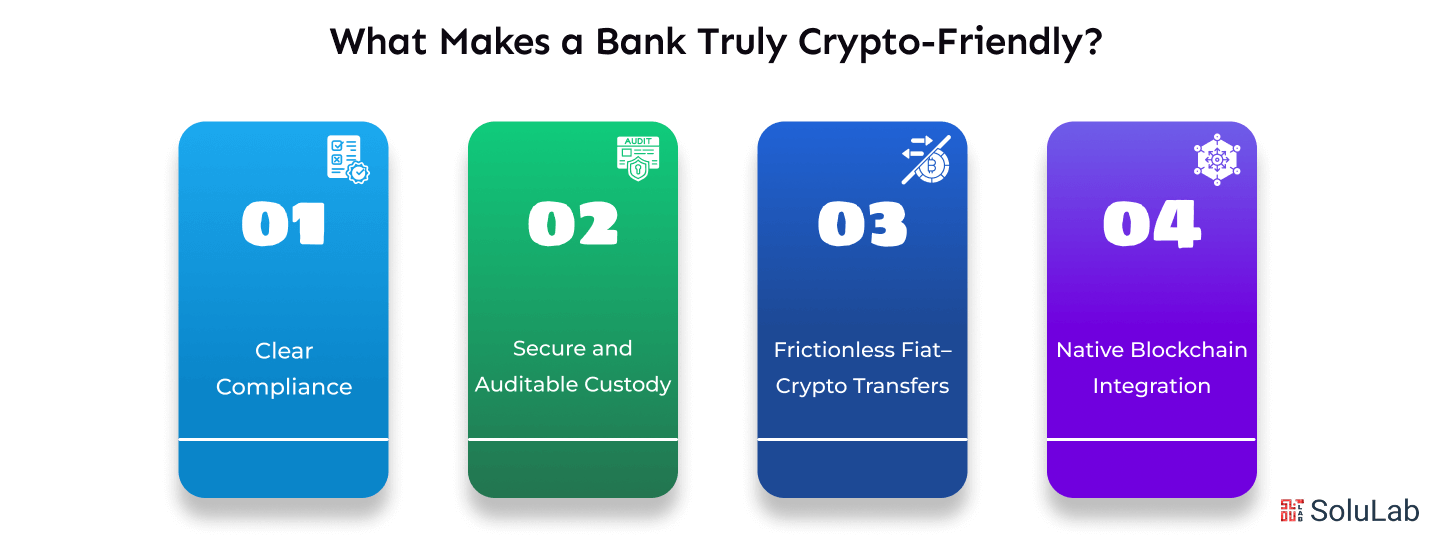
What separates a successful crypto bank in 2026 from the rest? Four things.
1. Clear Compliance
Compliance can’t be an afterthought. Not here. Regulatory clarity is the ground everything else stands on.
US, Europe, somewhere else: wherever you operate, expect to need licenses such as an EMI, a trust charter, or VASP registration. Your compliance stack, meaning KYC, AML, and transaction monitoring, belongs in the infrastructure from day one. Skip it and you can’t operate as a legally recognized, regulated crypto bank. Simple as that.
2. Secure and Auditable Custody
Trust starts with keeping user funds safe.
That means real custody infrastructure. Hot wallets for instant transactions, cold storage for assets that sit for the long haul. Most teams lean on proven third-party providers like Fireblocks or BitGo for this layer rather than building it from scratch. And insure the digital assets, especially if your clients are high-net-worth individuals or institutions.
3. Frictionless Fiat-Crypto Transfers
Users want to hop between fiat and crypto without friction. Any friction.
So you need dependable on-ramps and off-ramps, support for the major stablecoins, and access to local currency rails. Converting ETH to USD? Paying a supplier in USDC? Either way, the transaction should go through fast and with as little friction as possible.
4. Native Blockchain Integration
Storing digital assets is the easy part. A modern crypto bank goes further and uses blockchain technology as part of how it actually works.
Think programmable payments, tokenized deposits, smart contracts for lending, and secure real-world asset custody. Blockchain is not a feature you tack on later. It sits at the core of the banking architecture.

How JP Morgan Is Building a Crypto-Friendly Bank?
Want to see what happens when a traditional bank takes crypto seriously and strategically? Look at JP Morgan.
Through its Onyx platform, the bank runs a live blockchain-based system for institutional payments. Onyx lets large clients move programmable money between each other in real time.
Then there’s JPM Coin, a private, permissioned stablecoin used for daily settlements covering billions in transactions. The clever part is what JP Morgan didn’t do. It didn’t walk away from traditional banking. It embedded blockchain into the systems it already had, and ended up with a hybrid model that is compliant and secure.
For any institution or startup looking to build a crypto bank, JP Morgan’s execution proves something useful: you can modernize finance without undermining trust or compliance.
Read More: Why the UAE Is the Best Location to Launch a Crypto Neo Bank?
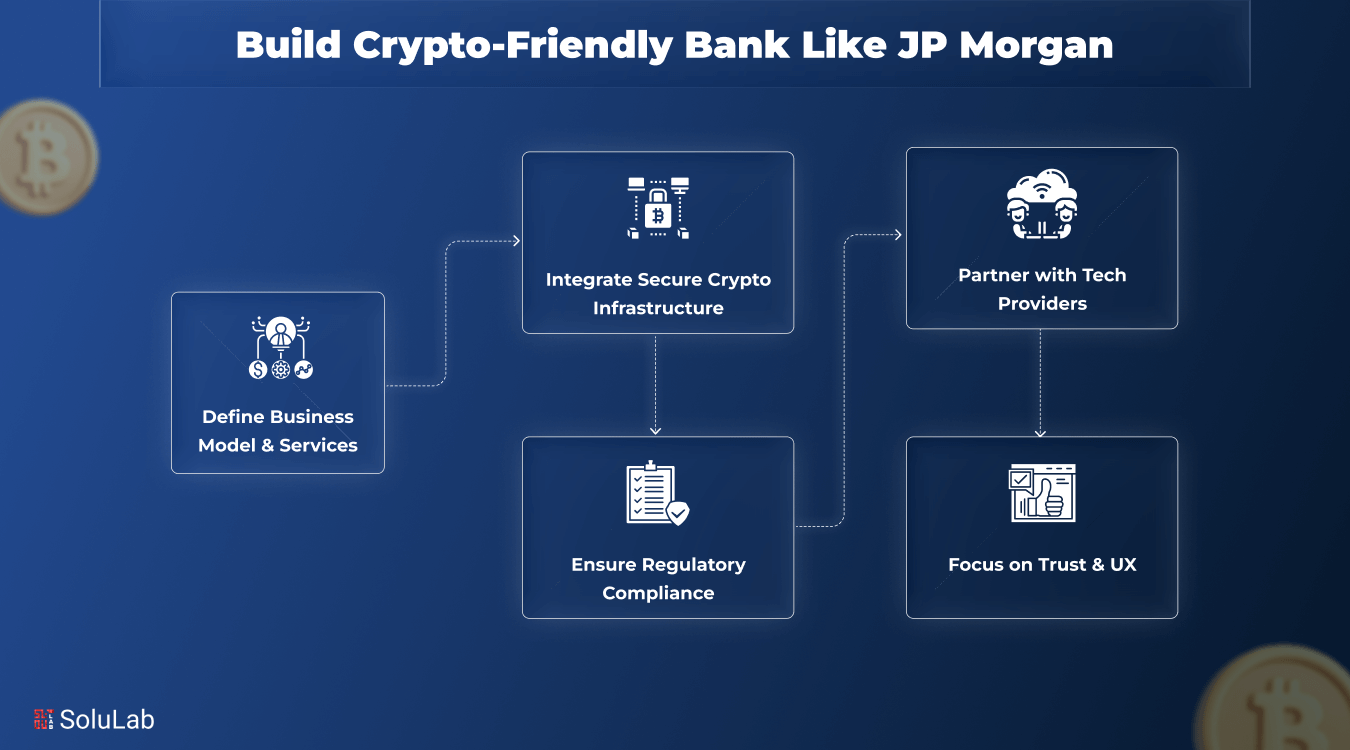
Key Steps to Build a Crypto-Friendly Bank Like JP Morgan in 2026
Offering digital assets is the easy bit. A real crypto-friendly bank needs full integration of blockchain infrastructure, strong compliance, and customers who trust you. Here’s where to start:
1. Define Your Business Model & Services
First, decide what you are. A full-fledged digital bank? A neobank? A traditional bank offering crypto services? Then pick your service mix: crypto wallets, trading, lending, DeFi access, or fiat-crypto conversion.
2. Integrate a Secure Crypto Infrastructure
Build on enterprise-grade blockchain infrastructure. At minimum:
- Multi-chain support (for example Ethereum, Solana, Bitcoin)
- Wallet systems built in, not bolted on
- Cold and hot wallet integrations (Fireblocks, for example)
- Smart contracts that automate transactions and compliance checks
3. Ensure Regulatory Compliance
Keep pace with crypto rules, local and global. You’ll want:
- KYC and AML verification systems
- Licenses (VASP or e-money, for instance)
- Ongoing legal advice as compliance rules change
4. Partner with Technology Providers
Work with fintech or blockchain development specialists to build:
- A clean, Web3-ready UI and UX
- Secure APIs that support real-time trading
- AI-driven tools for risk and fraud detection
5. Focus on Trust & User Experience
Be openly transparent. Offer insured custody, 24/7 customer support, and educational tools that help users feel confident. JP Morgan does its own version of this with Onyx and blockchain-backed settlement.
Real Use Cases of Crypto-Friendly Banks
None of this is theoretical. Crypto-friendly banks already serve real people with very real financial needs. The use cases that matter most:
- Personal Accounts That Support Both Fiat and Crypto
People want all their assets, fiat and digital, in one account. A crypto bank makes payments, conversions, and transfers work across both worlds without the usual juggling.
- Crypto Payment Solutions for Businesses
Web3 companies, DAOs, and digital-first startups have to pay staff, vendors, and contractors, often in stablecoins or native tokens. A crypto bank makes that simple, with compliance and reporting built in.
- Institutional Custody and Asset Management
Users now hold a wider mix of digital assets, from NFTs to tokenized real estate. A crypto bank has to custody every one of them securely, with proper insurance and compliance behind it.
- Crypto-Backed Lending
Borrowing against crypto without selling it is a high-demand service. Banks can also offer stablecoin-based interest accounts and staking, all under a regulated umbrella.
- Treasury Management for Protocols and Funds
DAOs, investment funds, and large crypto-native organizations run hybrid treasuries, and they need serious tools to manage them. Fiat and crypto conversion, reporting, tax documentation, and more.
Benefits of Starting a Crypto Bank in 2026
Right now, opportunity and readiness are showing up at the same time. That doesn’t happen often.
The rules are getting clearer. MiCA in the EU, SEC updates in the US, and more jurisdictions now issuing digital asset licenses. For founders and institutions, the road to launching a regulated crypto bank is far easier to see.
Demand is speeding up too. Individuals want digital-first, crypto-native financial services. Businesses want compliant options they can trust. And institutions want partners who are fluent in both traditional finance and blockchain.
Meanwhile, the field is still fairly open. Most legacy banks haven’t adapted, and competition is thin compared with traditional fintech. Get in now and you’re not just early. You’re ahead.
Types of Crypto Banks You Can Launch
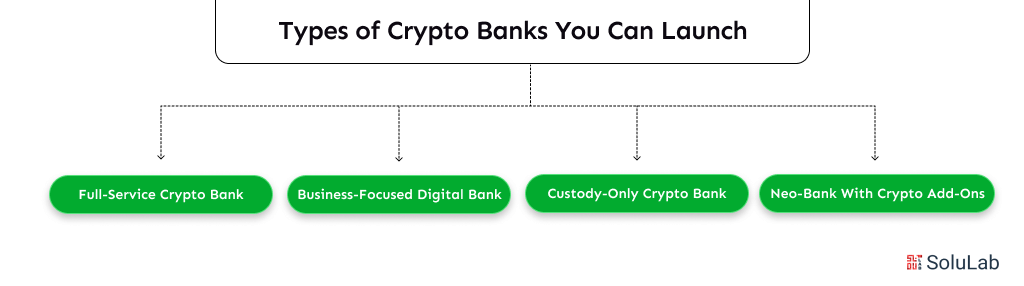
You don’t have to be a financial giant to build something worth having. There are several workable models, and the right one depends on your goals and your market. Here’s how they break down:
1. Full-Service Crypto Bank
The whole package: crypto and fiat accounts, trading, lending, on-ramps, and custody.
Best for:
Founders who want to own the full stack, or who plan to partner with a blockchain development company to build the complete platform.
Why it works:
You become the single login where retail and business users get everything they need.
2. Business-Focused Digital Bank
Built for Web3 startups, DAOs, and crypto-native businesses. It helps them run treasury, payroll, payments, and compliance.
Best for:
B2B fintechs, agencies, or consultants selling white label crypto solutions to startups.
Why it works:
Web3 companies often can’t get even basic banking access. Fix that and you’re solving a real pain that refuses to go away.
3. Custody-Only Crypto Bank
Does one thing only: stores and protects digital assets such as Bitcoin, stablecoins, NFTs, tokenized real estate, and so on.
Best for:
Teams with serious cybersecurity depth, or anyone going after institutional clients.
Why it works:
As more real-world assets move on-chain, demand for secure, compliant custody is rising fast.
4. Neo-Bank with Crypto Add-ons
Feels like an ordinary fintech app, except users can hold, swap, and send crypto right next to their fiat.
Best for:
Startups aiming at mainstream users who are only just dipping a toe into crypto.
Why it works:
Familiar banking lowers the barrier. Crypto sits on top, optional, for whoever wants it.
Every model comes with its own licensing needs, tech stack, and user base. All of them are solid paths. Choose based on your vision, your resources, and your regulatory strategy. Not sure where to begin? That’s where blockchain consulting services can help you map the route forward.

Conclusion
A crypto-friendly bank in 2026 isn’t a far-off idea. It’s a real, tangible opportunity. Regulation is clearer, user demand is climbing, and traditional banks are still behind, which leaves plenty of room to build. Full-service platform, custody-only operation, or business-focused digital bank: the ones that win will nail the basics. Compliance. Security. Blockchain integration. Features designed around users.
At SoluLab, we help founders turn crypto banking ideas into working products. Looking for white label crypto banking solutions, full-scale product development, or strategic blockchain consulting services? We’ve built all of it. Licensing guidance, wallet infrastructure, the lot. We’re the technical team behind the next wave of crypto banks.
Thinking about launching your own digital bank? Let’s build it together!
FAQs
Shipra Garg is a tech-focused content strategist and copywriter specializing in Web3, blockchain, and artificial intelligence. She has worked with startups and enterprise teams to craft high-conversion content that bridges deep tech with business impact. Her work translates complex innovations into clear, credible, and engaging narratives that drive growth and build trust in emerging tech markets.