
Crypto trading stopped being a hobbyist thing a long time ago. Decentralized venues keep pulling attention, and they deserve some of it, but centralized cryptocurrency exchanges (CEXs) still carry most of the volume. Deep liquidity. Interfaces people actually understand. Trades that clear before you finish blinking. That combination is why the beginner and the desk trader end up on the same platform.
Here is the part nobody puts on the pitch deck: you do not build a centralized exchange by installing trading software and flipping a switch. Rules shift country by country. Attackers get better every quarter. Users compare you to Binance on day one, fairly or not. So a CEX launch turns into a planning problem, a security problem, and a compliance problem long before it becomes a coding problem.
This guide walks the build start to finish: the pieces under the hood, the stages a real project moves through, the features users expect, and where a development partner like SoluLab fits when you want the thing to be secure, scalable, and actually profitable.
What is a Centralized Exchange (CEX)?
A Centralized Cryptocurrency Exchange (CEX) is a platform where people buy, sell, and trade crypto through an intermediary, and that intermediary is the exchange. Compare it to decentralized exchanges, where users transact with each other directly. A CEX sits in the middle instead: it runs the order books, custodies the funds, and takes responsibility for matching trades quickly and safely.
Popular examples include Binance, Coinbase, and Kraken. All three run on a centralized structure, which is what lets them offer the liquidity, the support desk, and the advanced trading tools their users take for granted.
The Rise of Centralized Exchanges
Functionally, a CEX behaves a lot like a bank. It holds what belongs to you, moves it when you ask, and keeps enough liquidity on hand that the market does not seize up. Decentralized exchanges (DEXs) get the headlines. Retail and institutional flow still lands mostly on centralized rails, and the reason is not complicated: trust backed by performance.
Why CEXs Still Lead the Pack in 2026?
- Deeper Liquidity: Spreads stay tight, slippage stays small, and fills land close to the price you saw.
- Faster Transactions: A centralized matching engine settles trades in roughly the time it takes to release the mouse button.
- Accessible for All: The interface does not punish you for being new, and it does not bore the professional either.
- Industry Benchmarks: Binance, Coinbase, and Kraken reset what traders consider normal. The lesson buried in that: a working exchange is a great deal more than a token swap screen.
If you are new and planning to take these platforms on, your CEX has to be secure, compliant, and interesting at the same time, in one product that does not feel stitched together. That mix is exactly what top blockchain developers like SoluLab build for a living.
Core Components of a Centralized Crypto Exchange
Matching a buyer to a seller is the easy half. The hard half is everything wrapped around it: security that holds, an interface that explains itself, plumbing that does not fall over on a volatile Tuesday. Four pillars carry the whole thing.
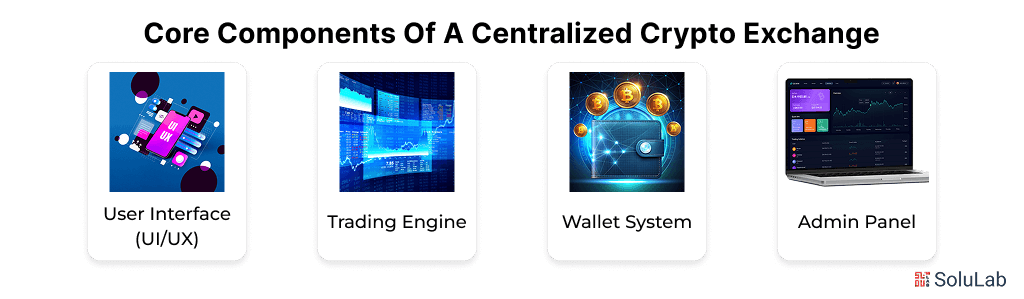
a. User Interface (UI/UX)
The interface is the handshake. People decide whether to fund an account in the first thirty seconds, and they decide on feel. Yours needs:
- Clean, intuitive dashboards where nothing important hides behind a third click.
- Short, obvious workflows so a first trade takes a minute, not a tutorial.
- Mobile responsiveness that keeps the full feature set on a phone screen instead of a stripped-down version of it.
b. Trading Engine
This is the brain. Everything else is decoration if the engine stutters. What it has to do:
- Match buy and sell orders instantly, and correctly, every single time.
- Absorb heavy volume and thousands of people clicking at once without slowing to a crawl.
- Keep latency low, because a slow fill is a wrong price.
- Support market, limit, and stop-limit orders, and push real-time updates to every dashboard watching.
c. Wallet System
Your wallet system is not a number on a screen. It is the vault holding other people’s money. A sane setup covers:
- Hot wallets for the funds that need to move during trades.
- Cold wallets kept offline, out of reach of whatever is scanning your perimeter tonight.
- Multi-currency support where switching assets takes one tap and no thought.
Behind that, a fund management layer shuttles balances between hot and cold automatically. Exposure stays low, withdrawals still clear. Getting that threshold right is where a lot of teams quietly struggle.
d. Admin Panel
Mission control for your own team. From here your staff should be able to:
- Review and approve KYC documents without leaving the tool.
- Set trading limits and tiered access per user level.
- Add, pause, or pull a token listing, with an audit trail a regulator can read later.
Four components, one foundation. Speed, safety, and whether anyone trusts you enough to deposit a second time all trace back to how well these were built.
Development Process of Centralized Crypto Exchange
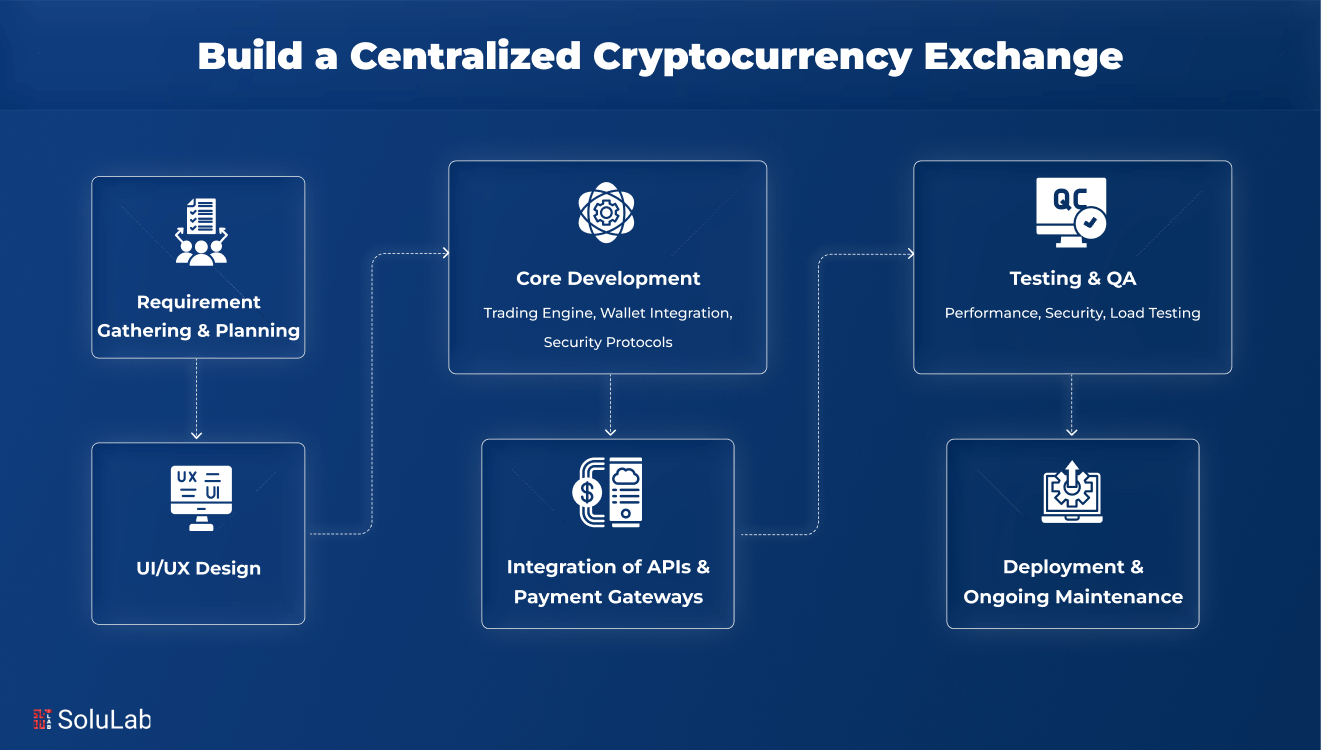
Plenty of moving parts here, and skipping ahead tends to cost you twice. Here is how the work actually sequences.
1. Initial Planning and Research
Nothing gets built yet. The team pins down business goals, who the user is, and which functions ship in version one. Fiat deposits or crypto-to-crypto only? Margin trading on day one or later? And which rules apply in each market you plan to serve, because that answer reshapes everything downstream.
Out of that comes a roadmap: timelines, cost ranges, legal support, milestones. The point is to tie business intent to engineering effort before anyone writes a line of code.
2. Regulatory and Compliance Mapping
Financial law is not a negotiation. Crypto rules differ sharply between countries, so licensing requirements, registration steps, and anti-money laundering (AML) obligations get mapped early rather than discovered late.
That planning covers identity verification (KYC), ongoing transaction monitoring, and AML screening built to satisfy more than one jurisdiction at once.
Bring lawyers and compliance consultants in before development starts. Retrofitting compliance is miserable, expensive, and sometimes impossible.
3. Feature Definition and Exchange Type
Now developers and stakeholders lock the feature set: spot trading, which order types, fiat on-ramp support, where liquidity comes from, how a token gets listed.
This is also the custom-versus-white-label fork in the road. Either way, the output is a product specification document covering every function and integration, APIs and account management included. Vague specs here become change requests later.
4. Tech Stack Selection
The stack is the floor everything else stands on. Backends usually land on Go, Node.js, or Rust for raw throughput. Frontends lean on React or Vue.js so the layout holds up on any screen.
PostgreSQL and Redis handle sessions and trading data. Pick well and the platform stays fast, scales without drama, and is still maintainable two years from now. Pick badly and you rewrite.
5. Blockchain and Token Support
Users expect more than one chain. Blockchain APIs and SDKs connect the exchange to Ethereum, Solana, BNB Chain, and whatever else your audience trades. Wallet modules get wired to handle ERC-20, BEP-20, and native assets.
Done properly, deposits and withdrawals just work, balances reconcile against on-chain confirmations, and gas fees get optimized instead of quietly eating margin.
Read Our Blog Post: How to Launch a Crypto Exchange in Switzerland?
6. Designing User Experience (UI/UX)
Design work targets three things: clarity, accessibility, speed. Wireframes go up for trading views, wallets, and dashboards. A beginner and a ten-year veteran should both find what they need on the same screen, which is harder than it sounds.
Figma or Adobe XD carry the prototypes, tested at web and mobile breakpoints until nothing breaks on a small screen.
7. Trading Engine Development
Core of the system. Matching algorithms pair buy and sell orders at speed, across market, limit, and stop-limit types.
Latency tuning and load balancing come next, because concurrency is where naive engines die. The same layer keeps the order book current and drives price discovery.
8. Wallet Infrastructure Setup
Hot wallets run live transactions. Cold wallets sit offline holding the bulk. Around both sits private key encryption, transaction broadcasting, and balance auto-syncing, plus guards against double-spending and a fast path for moving funds between wallet and exchange.
Multisig setups and hardware wallet integrations add the last layer of protection for platform and customer funds alike.
9. KYC/AML Integration
Sumsub, Shufti Pro, and Jumio are the usual suspects here. A user uploads an ID, takes a live selfie, and clears whatever checks their region demands. Verification happens in real time, so onboarding does not stall out at the worst possible moment.
AML tooling watches behavior afterward and raises flags on anything odd. It runs in the background, permanently, and gets retuned as rules change.
10. Admin and Monitoring Panel
Staff use this to manage users, clear KYC, suspend accounts, adjust trading limits, and watch system health. Activity logs, fraud alerts, and trade flow analytics live here too.
Developers bolt on live performance dashboards so an anomaly or a sudden spike gets a response in minutes rather than the next morning.
11. API Development and Testing
REST and WebSocket APIs open the platform to outside traders, bots, and partners: market data, order placement, account operations. Rate limiting, scoped permissions, and key rotation keep that door from swinging too wide.
Then comes testing. Unit, integration, performance. Load tests simulate thousands of concurrent users, which is the only honest way to find out what breaks first.
12. Deployment and Post-Launch Scaling
After developing the platform is deployed on cloud services such as AWS or GCP using Docker and Kubernetes. The goal at this stage is to prove the system scales. Grafana and Prometheus track uptime, errors, and latency across the platform.
Support handles whatever users run into, developers act on what support hears, and the roadmap fills out from there: staking, referral bonuses, promotions, margin trading.
Read Also: Why White-Label Crypto Exchange Development Makes Sense for UAE Banks?
Must-Have Features for Centralized Cryptocurrency Exchange Development
A bare trading window will not hold anyone’s attention past the first week. Competing with established platforms means shipping a full set of features that are modern, secure, and quick.
Let’s break down the essentials:
1. Seamless Registration, Login, and KYC/AML Integration
Onboarding sets the tone for everything after it. A good one should:
- Move fast. Account created in minutes, not an afternoon.
- Run KYC (Know Your Customer) against government IDs, selfies, and automated checks.
- Meet AML (Anti-Money Laundering) standards and catch suspicious patterns early rather than after a regulator asks.
Sumsub, Shufti Pro, and Jumio automate most of this and keep the friction tolerable. Compliance is not a choice. But the experience shouldn’t feel like applying for a loan.
2. Real-Time Trading Charts, Order Books, and Market Data
People cannot trade well on bad information. Give them the instruments.
Include:
- Live price charts with the indicators traders actually use (candlesticks, moving averages, RSI, and the rest)
- An order book detailed enough to show real bid and ask depth
- Trade history and price movement summaries
- Custom timeframes, drawing tools, and volume overlays
TradingView drops in cleanly, or you build your own chart engine. Either way, understand that serious traders live on this screen. Make it fast, deep, and bendable to their habits.
3. Deposit and Withdrawal System (Crypto + Fiat)
Money that is hard to move in or out is money that goes somewhere else. It really is that simple.
You’ll need:
- Crypto deposits and withdrawals: dependable wallet integrations with visible status and blockchain confirmations.
- Fiat on-ramps and off-ramps: payment gateways such as Stripe, MoonPay, or local banks, covering USD, EUR, INR, and whatever your market uses.
- Controls you own for transaction fees, withdrawal limits, and fraud checks.
Show pending and completed transactions plainly in the dashboard. A user who can see where their money is does not open a support ticket.
4. API Access for Algo Traders and Institutions
Professionals and institutions automate. No API, no institutional flow.
You should offer:
- REST and WebSocket endpoints for market data and order execution
- Documentation with working example calls, not a schema dump
- Higher rate limits for premium accounts
- Key management with permissions granular enough to be useful
Treat the API as a product, not a courtesy. Tiered access, analytics packages, even white-labeled trading bots all become things you can sell.
5. Two-Factor Authentication (2FA), IP Whitelisting, and Session Logs
Good security is felt more than seen.
These tools do just that:
- 2FA via Google Authenticator, SMS, or email, applied to logins, withdrawals, and API calls.
- IP whitelisting so access only comes from approved devices or networks. Institutional desks ask for this by name.
- Session logs showing when and where the account was opened, with a revoke button right there when something looks wrong.
Account takeovers drop sharply once these are in place. Skip them and experienced users will notice immediately.
6. Security Architecture
Security is not a module you add in the final sprint. It is the ground the exchange stands on, and skipping it is an open invitation to anyone looking for one.
So what does securing a Centralized Crypto Exchange properly involve?
- End-to-end encryption on everything sensitive, in transit and at rest. Credentials, transaction history, API keys. Encrypted by default, no exceptions carved out for convenience.
- Secure API frameworks such as OAuth2 and JWT, so only verified apps and users touch critical systems. Pair that with tight access control and permission-based routing.
- DDoS protection, bot filtering, and rate limiting to keep the platform up when traffic spikes, whether that spike is a listing announcement or an attack.
- Cold storage with multi-signature wallets holding the majority of user funds offline. Multi-sig means no single employee can move money alone, which closes off an entire category of insider risk.
- Third-party audits and penetration tests on a schedule. If you are not probing your own system, someone else will, and they will not send you a report.
- Live monitoring and alerting, so a threat surfaces while it is happening instead of during the post-mortem. Automated detection plus a human watching it is the combination that works.
Legal and Regulatory Compliance to Adhere for Crypto Exchanges
Crypto ignores borders. Regulators do not. Every region has its own framework, and treating that as someone else’s problem is how exchanges get shut down.
- Licensing comes first. US operators register as a Money Services Business (MSB) with FinCEN. In the EU, expect a VASP license. In the UAE, VARA and ADGM are the names to know. Each one brings its own paperwork, audits, and reporting cadence.
- AML and KYC are legal safeguards, not boxes to tick. Automated verification through Chainalysis, Sumsub, or ShuftiPro monitors transactions and flags the strange ones without turning signup into a two-day ordeal.
- Privacy rules like GDPR in the EU and CCPA in California come down to being straight with people. What are you collecting, why, and can they export or delete it whenever they want? The answer to that last one needs to be yes.
- Get crypto-literate lawyers involved early. Deciding to “figure it out” after launch is how teams lose licenses, users, and a painful amount of money to fines.
Revenue Model of Centralized Crypto Exchange Platforms
An exchange is a business wearing a tech product’s clothes. Here is where the money actually comes from, and what a serious centralized crypto exchange development company will help you model out:
- Trading fees carry the business. The maker-taker model is standard: makers who add liquidity pay less, takers who remove it pay a bit more. Volume-based discounts are the usual lure for larger traders.
- Deposit and withdrawal fees are quieter but steady, and they add up once you support a range of fiat and crypto assets. Rates can flex with network congestion or asset type.
- Token listing fees bring real money, mostly from new projects hunting for visibility. Tiered listing packages with marketing attached are common.
- Premium products such as margin trading, low-latency APIs, deeper analytics, and pro dashboards convert nicely into subscriptions or membership tiers.
Balance is the whole trick. Spread the revenue across several streams, but stop short of the point where users feel picked at. Pricing people can predict is pricing people stay with.

Final Thoughts
Centralized Cryptocurrency Exchange Development isn’t software work alone. You are asking people to hand over their money and believe it will still be there tomorrow. Day traders, institutions, the next wave of first-time users: whoever you are aiming at, they judge you on execution, not ambition.
At SoluLab, we specialize in Centralized Crypto Exchange Development, from building secure trading engines to deploying compliant, scalable infrastructures. Starting from nothing or rebuilding something that has outgrown itself, we bring the engineering and the blockchain depth to each stage of it.
Our team has worked with leading fintechs and crypto startups across the globe. Let’s build something that actually lasts. Want to launch your own crypto exchange? Let’s talk.
FAQs
Shipra Garg is a tech-focused content strategist and copywriter specializing in Web3, blockchain, and artificial intelligence. She has worked with startups and enterprise teams to craft high-conversion content that bridges deep tech with business impact. Her work translates complex innovations into clear, credible, and engaging narratives that drive growth and build trust in emerging tech markets.