Talk to an Expert

Top 25 Agritech Startups Using Blockchain to Revolutionize the Agricultural Industry

The global Agritech industry is huge and constantly getting bigger in size. Moreover, the demand and the requirement for better agritech solutions are at their peak. Blockchain technologies, however, are set to play a huge role in the agritech industry. Automating, protecting and managing tasks can be done with blockchain-enabled Smart Contracts and IoT-enabled blockchain systems. Undoubtedly, the agritech industry is positive on the agritech industry. 

In this blog post, we’ll be discussing the top 25 Agritech startups using the blockchain industry, improving and automating their process. This discussion will be precise and easy, making sure every point discussed is easily comprehensible. Stay tuned!

1.  AgriChain

AgriChain

AgriChain (previously BlockGrain) is a simple-to-use, secure, independent software platform that automates the integration of all supply chain participants. 

AgriChain’s vision is to be the largest industry-wide platform for managing the agricultural supply chain; connecting sellers and buyers, providing full paddock-to-plate traceability, and allowing bulk logistics companies to manage and grow their operations.

2.  AgriDigital

AgriDigital

AgriDigital is Australia’s leading independent digital grain software. That is building the data and capital infrastructure agricultural businesses depend on. Your inventory, data and access to supply chain finance, are all in one place. AgriDigital connects you with your network, from farmer to consumer. 

3.  AgriLedger

AgriLedger

AgriLedger is transforming the agricultural supply chain with their  advanced enterprise blockchain platform in combination with AI and IoT to increase transparency, fair pricing, and access to capital in every touchpoint in the value chain

It works with financial institutions to track, record, and implement contract information that securely allows for the provision of working capital facilities for communities. The traceability of food from farm to table enables AgriLedger to contribute to the progress of ESG goals.

4.  Ripe.io

Ripe.io

Ripe.io is transforming the food supply chain by enabling data transparency and transfer from farm to fork to answer what our food is, where it has been and what has happened to it. We’re exposing the journey of our food to create new analytics, automation, and business models through blockchain technology and the Internet of Things.

5.  TE-FOOD International

TE-FOOD International

TE-FOOD is a whole-chain traceability solution, covering all logistics and food safety activities and data management of the supply chain. It provides cost-effective software and identification tools to make livestock and fresh food supply information transparent.

Read Also: Top 10 Blockchain Development Companies in 2022

Currently, TE-FOOD implementation in Vietnam is one of the largest traceability systems in Southeast Asia.  

6.  Fyllo

Fyllo

Fyllo brings farms to your palms by installing field devices and actions on top of this data. Based on real-time data and insights, fyllo helps farmers to make precise decisions and increase farm productivity.

7.  POSHN

POSHN

Poshn empowers the producers, mandis, and wholesalers to take their stores online thereby expanding their reach and giving them visibility. Our platform provides seamless discovery of and transactions for the wholesale agri-market. We also assist buyers/sellers with logistics and offer flexible payment solutions.

8.  Otipy

Otipy

Otipy is India’s Fastest Growing Community Group Buying (CGB) player, which delivers handpicked farm-fresh vegetables and fruits directly from the farm to the consumer’s doorstep in about 12 hours, through a community of resellers (mainly women) with only 2 touch points involved. It focuses on harvesting according to predicted demand, to keep minimum wastage through state-of-the-art technology used for procurement, distribution, and delivery.

9.  Arya.ag

Arya.ag

Arya.ag is India’s leading Agritech which has been working at the farmgate to strengthen agriculture value chains through its integrated range of services. Driving technology through a human-centered approach. Arya assists sellers of agri-commodities to avoid distressed sales of produce by extending post-harvest credit.

10.  Covantis

Covantis

Covantis is an initiative to replace outdated, inefficient post-trade processes with modern solutions. We are building a secure digital platform that will minimize your operating risks while increasing market efficiency for the entire commodities trading and shipping industry.

11.  CyStellar

CyStellar

CyStellar is a big-data analytics and decision-support company. Through its cloud-based data fusion platform, CyStellar improves data-driven decision-making and predictive analytics for the precision agriculture, logistics, and insurance sectors. AgTech software solutions for precision agriculture, crop management, variable-rate irrigation and fertilization, and pest management.

12.  Shamba Records

Shamba Records

Shamba Records is an ag-tech company that digitizes the agriculture sector in Sub-Saharan Africa. We do this by providing software and hardware solutions. Its tool is a real-time data collection tool that collects farmer’s production data, links it to the aggregation centers, and finally to the market. Throughout that process, the company automates farmers’ payments, credit scoring, credit issuance, market linkage, and agriculture remote extension services.

13.  Ucrop.it

Ucrop.it

Ucrop.it, agricultural fintech leverages blockchain technology certainty certification to connect medium-sized growers with investors for sharecropping production and achieve improved gross margins by means of commercial scale economies and hectares growth.

14.  Avenews

Avenews

Avenews is building the first financial super app for the agricultural industry. It brings to the 2.5 million agricultural SMBs across Sub-Saharan Africa the tools that allow them to understand their business better, access capital, manage it, and source all the business services they need – all in one place.

15.  Bart Digital

Bart Digital

Bart’s proposal is the use of blocks (the technology behind Bitcoin’s financial transactions) and digital certification (ICP Brasil) to formalize the exchange operations, in a general way and in a more agile and unbureaucratic way, with greater security For the parties involved, because of the traceability that the system allows. (Bitsacas), bringing transparency to the market through an integrated platform between producers, trading, and reselling, and mitigating risks using artificial intelligence, BIGDATA, and market information.

16.  IBISA NETWORK

IBISA NETWORK

IBISA builds, distributes, and operates Climate Insurance Solutions for agriculture in a cost-efficient, scalable and innovative way. With an end-to-end platform for insurance actors built to solve the insurability of smallholder farmers, pastoralists, and breeders in the world.

17.  GREENS

GREENS

GREENS is an agritech startup that is developing meta framing so people can participate in real farming from a metaverse. It is powered by its proprietary GREENS pod (a web3-based indoor cultivation system in a pod – using AI, IoT, and Blockchain).

Vision: Hyperlocal gastronomy everywhere

Mission: Stop food waste and nourish people

Values: People, plants, and planet

18.  Agri 10x

Agri 10x

Agri10x envisions transforming the roots of the global rural economy by integrating the entire agri value chain through a digital cooperative platform by harnessing emerging technologies. Agri10x offers comprehensive digital solutions for every phase of the agricultural value chain and is focused on enhancing the lives of farmers.

19.  NagriTech International Distributors Ltd

NagriTech International Distributors Ltd

Natural Agricultural Technologies (NAgriTech) is an organic and nature-minded approach to modern-day sustainable agriculture. Behind the concept is one simple virtue – good and nutritious food must be plentiful, affordable, and growable. 

20.  AgCode

AgCode

AgCode empowers farming operations with the leading software solution for specialty crops. The company provides the agriculture industry with mission-critical services, delivering unified data and business intelligence to maximize efficiency and productivity. AgCode’s technology and advisors are essential to organizations around the world, serving all high-value specialty crops including vineyards, tree fruit, nuts, berries, and field crops. Relationship-driven since its inception.

21. Agri-TechE

Agri-TechE

Agri-TechE focuses on:

  • Showcasing new research, technology, and innovation that is of relevance to farmers, producers, and processors
  • Creating an entrepreneurial culture that fosters the development of early-stage business ideas in agri-tech and brings in new sources of finance
  • Helping farmers and growers to clearly articulate their priorities and requirements to those within the research and technology communities
  • Generating interest from non-traditional sources to bring in fresh thinking from other disciplines.

22. Terviva

Terviva

Formed in 2010, Terviva is a food and agriculture company that delivers tasty and nourishing plant-based food ingredients from the Pongamia tree. We provide patented high-yielding trees and offer proprietary bean processing to create the world’s most sustainable oil and protein food ingredients. Pongamia trees restore farmland to productive use, helping farmers feed people while taking care of the planet.

Read Also: Top 10 Growing Crypto Fintech Startups to Watch Out

23. Agribazaar

Agribazaar

Agribazaar is India’s leading online marketplace for the trading of agricultural commodities. Our mobile app allows buyers and sellers to directly facilitate trades with full transparency, a secure payment gateway, and zero middlemen interference. 

24. DeHaat

DeHaat

DeHaat is one of the fastest-growing start-ups in the Agri Tech sector and one of the very few companies providing end-to-end solutions and services to the farming community in India. We are building AI-enabled technologies to revolutionize supply chain and production efficiency in the farm sector. Currently, we are operating in eastern India – Bihar, UP, and Odisha – with 2,65,000+ farmers in our service network and our goal is to bring our services to 5 million farmers by 2024.

25. Cropin

Cropin

Cropin is a global Agtech pioneer who has built the world’s first purpose-built industry cloud for Agriculture – Crop In Cloud. Cropin Cloud enables various stakeholders in the agri-ecosystem to leverage digitization and predictive intelligence to make effective decisions that increase farming efficiency, scale productivity, manage risk and environmental changes, and enhance sustainability.

Closing Thoughts

The future with blockchain-enabled Agritech technologies is high, as blockchain development and invention efforts worldwide are constant and ever-improving. These startups can be considered pioneers in the Agritech industry and can open doors to technological solutions the Agritech industry never thought of.


Understanding the Place of Blockchain Technology in Real Estate

Industry experts note blockchain technology will eventually revolutionize all businesses. So far, we have seen undeniable evidence in finance, gaming, logistics, etc. However, news of the influence of blockchain technology on real estate seems to be flying under the radar.

The real estate industry leverages technology but not disruptive measures like others. There is not much that the internet revolution did for real estate compared to other sectors. The situation is almost the same for blockchain technology.

There are empirical paradigm shifts noticeable to the casual audience. So, this article explores between the lines of the news and buzz to comprehensively detail the place of blockchain in real estate.

The current synergies between Blockchain and real estate

Blockchain technology has been in place for a while. However, the technology only became famous in 2009, thanks to Satoshi Nakamoto. Everyone knows the story — of how Bitcoin came to be, subsequently irking the creation of over 2000 cryptocurrencies in existence.

The advent of cryptocurrencies redefined global financial systems, adding an extra payment option to international business. Thanks to cryptocurrencies, transactions are no longer limited to fiat currencies. Instead, you can now make payments in cryptos — to businesses accepting them as payment.

The concept of payments and remittances introduced real estate to the blockchain. The first of such payments was the Texas home bought with Bitcoin in 2017. Several other micro and macro home purchases have leveraged Bitcoin ever since. So far, the largest Real Estate transaction carried out in cryptocurrency was the sale of a Miami building for $22.5 million worth of BTC.

As interesting as these news-worthy activities are, the most significant synergy between blockchain and real estate is Smart Contracts. Yes, more buyers want to pay for homes in bitcoin; however, the surge is only the tip of the iceberg. The several potential Smart-Contract-powered use cases of blockchain in real estate are the real deal.

Read Also: Top 10 Blockchain Development Companies in 2022

Smart Contracts aim to simplify complex processes, and we can deploy them in various ways. Some of these include price negotiations, title transfers, etc. The early signs of synergies between blockchain and real estate promise a revamped industry in the next few years.

Blockchain concepts are bound to influence real estate markets

Not all blockchain-related concepts will directly impact the real estate industry. For instance, it is hard to see how NFTs, on their own, can be valuable in the tangible aspects of the industry. However, other concepts like smart contracts, metaverse, etc., could play a significant role in real estate.

Smart contract

These are programs developed and maintained on the blockchain. Thanks to these contracts, solving complex processes becomes easy. Also, a smart contract facilitates the seamless connection between sellers and buyers. The strengths of smart contracts lie in their self-executing abilities. So, there is no need for an administrator for projects, as there are rules and conditions to follow.

Metaverse

The metaverse is virtual and augmented reality built on the blockchain.

Prospects used virtual reality to view properties before the metaverse became a thing. With the metaverse, activities like property tours, interior décor, etc., are carried out and are subsequently executed immediately across all necessary channels thanks to smart contracts.

The metaverse combines different functionalities, culminating in an exceptional ultimate viewing experience. Moreover, that experience is well leveraged in gaming currently.

Read Also: What is the Virtual Reality Metaverse?

It is absurd that virtual real estate is fast becoming a thing for folks lacking knowledge of the new economy. With virtual real estate, you can own pieces of digital land and sell them at will. However, beyond the viewing experience, we can only wait to see how metaverse real estate relates to physical real estate. An example of blockchain projects focusing on this area is Decentraland.

Decentralization

If you have heard anything about blockchain technology, it is probably decentralization. Blockchain technology by design eliminates central authorities. For instance, blockchain eliminates the main bodies — banks in financial services.

The traditional real estate industry exists with brokers, banks, lawyers, etc. However, when the use of blockchain in the industry goes mainstream, roles and participation will be affected. Hence, you can eliminate intermediaries. That way, buyers and sellers get more value from the transactions, owing to direct interactions.

Furthermore, the decentralized nature of blockchain accounts for its impressive security. Therefore, if blockchain gains ground in the real estate industry, data transparency and immutability will improve the quality of service.

Tokenization

The tokenization of entities in the industry will aid fractional ownership. Hence, rather than not investing because you do not have all the money, tokens help you own a piece.

As a result, premised activities for maintenance and leasing manifest from collective decisions. However, this comes with a disadvantage; no fractional owners can use the property as collateral to access a loan.

Blockchain technology use cases in real estate

Several companies and sellers now accept Bitcoin as a mode of payment. However, asides from paying for a new house in bitcoin, there are some other cases.

Asset management and real estate funds

Tokenization in real estate refers to digitizing securities, alternative assets, and other financial instruments. For instance, building on Ethereum makes it possible to (custom) reconfigure assets. We can program digital assets to include ownership rights, transaction history, and other regulations based on transactional peculiarities. Hence, there could be a standard for every scenario.

Furthermore, tokenization lowers the operational cost required to bolster creation and proceed with issuing while exchanging assets.

Property management

Managing properties on a large scale is grossly ineffective. Hence, the need to leverage the data sharing of blockchain. When accurately deployed, blockchain has the capacity to:

  1. Streamline rental collections and payments to owners
  2.  Provide due diligence across your portfolio.

Urban planning

Many times, during community planning, property development is neglected. Usually, when this happens, the project may be out of place. However, urban community master plans, infrastructure features, educational resources, feedback loops, and other token-powered incentives are simplified when deployed on the blockchain.

So, it becomes easier to drive the community on the same page with these measures in place. On the flip side, personal project owners get to integrate the community’s plans into their projects. By so doing, property value, perception, and sustainability improvements.

Conclusion

Blockchain’s influence on the real estate industry is still developing. However, in a few years, thanks to the number of innovations currently in the works, it’ll be safe to say blockchain rejuvenated the real estate industry.

Blog Credits: Medium

What Could Blockchain Do for Healthcare?

Even the world’s best health systems are typically fragmented. “You have hospitals, community clinics, general practitioners, specialists, diagnostic clinics, and so on,” says Matt Jackson, who leads blockchain research at Canada’s Institute on Governance.

There are many reasons you might want to give someone access to your medical data. Maybe you just moved to a new city and want to give your new doctor access to your medical history, or perhaps you want to nominate a healthcare proxy in case of emergency or have your prescription sent to your pharmacy.

Some places, like the UK or Canada, have viable national systems for exchanging patient records, but those can be vulnerable to hackers.

In the United States, healthcare comes from a patchwork of private companies, which means the handling of patient data is even more fragmented. John Halamka, chief information officer at Beth Israel Deaconess Medical Center in Boston, Massachusetts, told MIT Technology Review last year that there are 26 different electronic medical records systems in his home city alone.

In 2016, Halamka teamed up with a group of scientists at MIT to try to find a solution to the problem using blockchain. They published their white paper on the subject in August 2016, laying out their proposal for a system that would help all those disparate databases exchange data — a project they called MedRec.

Andy Lippman, a senior research scientist at MIT, co-authored the paper with Halamka. The system they outlined was to use Ethereum software — which, unlike bitcoin, can integrate and execute smart contracts — to build a private blockchain, linking healthcare providers together and allowing them to share their data.

On this blockchain, each of these instructions by a patient creates a specific smart contract on the blockchain that only the patient can cryptographically sign.

Security is one benefit: “Distribution makes the system more secure because there isn’t a single place of attack or failure,” Lippman says.

Medical providers run a program module on their computer to access the database, as instructed by the smart contracts, which are initiated by the patient.

That module does three core things: First, it allows the healthcare provider access to the data when the blockchain is instructed to give it. Second, it executes the patient’s instructions as and when needed, sending data to a pharmacy or a specialist for a referral — assuming the patient gives their consent. Third, the module allocates computing resources to maintaining the blockchain.

Taking Back Control

The first, Web 1.0, is characterized by openness, based on a global consensus as to the mechanism for webpages. “Everyone agrees as a community that we are going to use HTML,” Lippman says, “and your browser can display pages from all kinds of different people, as opposed to one company making webpages one way, another their way.” However, as the internet matured, companies like Facebook and Google monopolized some areas of information — search data, and social data — separating them into jealously guarded silos and databases. This is known as Web 2.0.

The era to come — Web 3.0, according to enthusiasts — will use blockchain technology to allow people to take back control of their personal information, returning the internet to its individualistic roots and breaking the database monopolies.

Read Also: Top 10 Startups that are Revolutionizing Healthcare Industry Using Blockchain Technology

“The nice thing about medical records is there is no Facebook for medical records yet,” Lippman says. “So maybe we can, in a timely way, do what we’re doing, which is a universal, open, noncommercial design — almost as if we’re designing a web and HTML for medical records.”

“Web 2.0 is when a central authority essentially tracks you, uses that data to help you — and also monetizes that data for themselves by essentially renting the algorithms that result from it to advertisers,” says Diego Espinosa, CEO of Linnia, a startup that is trying to build an ambitious health and lifestyle data-sharing platform on the Ethereum blockchain.

“All of the Web 2.0 giants do that; that’s their business model. So Web 3.0 is: Now we own our data, we have agency over it, and we need permission for others to see it,” Espinosa continues.

“The reason blockchain makes that possible is we can have decent data that can also be trusted. The blockchain is an immutable database and has other attributes, like being able to have digitally signed attestations about us. Those two things have the ability for individuals to keep their data — but also have that data be trusted by others.”

Top 10 Startups that are Revolutionizing Healthcare Industry Using Blockchain Technology

Blockchain is a term that we get to hear every now and then in recent times. Blockchain technology has been readily adopted by a wide array of industries to harness its benefits in the best possible manner. The healthcare industry is one major industry that has utilized the potential of blockchain technology appropriately to bring about a transformation. In the field of healthcare, blockchain finds a range of applications as well as functions.

Blockchain technology or distributed ledger technology can play a significant role in the easy transfer of records of patients among different health systems globally, enhance the coordination of member health management, reduce transaction costs and risks, proper management of the drug supply chain, and even support medical tourism. Therefore, it becomes pretty clear how blockchain technology can benefit the healthcare industry.

With the sincere efforts and dedication of several blockchain startups, the healthcare industry has been further revolutionized. For a better understanding, here is a list of the top 10 startups that are revolutionizing the healthcare industry by making the best use of blockchain technology.

1.  Avaneer Health 

Avaneer Health

Avaneer Health aims to empower the collaborative action required for the healthcare sector to be interoperable, accomplish data fluidity, and enable data sharing with utmost confidence. The focus is on providing a utility network that enables easy access to secure and shareable data for delivering better outcomes as well as great results.

2.  Medicalchain

Medical Chain

Medicalchain is another startup making the best use of blockchain technology to create a smart medical ecosystem. The focus is on empowering patients to gain complete control over their data and share the most comprehensive version of the same with various organizations in the medical network. This, in turn, makes sure that inefficiencies and inaccuracies in data are taken care of very well. The startup utilizes blockchain technology to manage records in a secure manner, ensuring a collaborative as well as a smart approach to healthcare.


3.  Patientory INC

Patientory INC

Patientory INC enables users to bring health to their fingertips. The startup helps users to get detailed as well as actionable insights from health records or data, thereby facilitating them to gain complete control over their health outcomes. Having a list of essential health-related data makes sure that a proper overview can be obtained and further steps can be taken accordingly.


4.  Burst IQ

Burst IQ

Burst IQ focuses on eliminating the challenges in managing sensitive data of humans to enable building trust via superiorly personalized digital health and life experiences. LifeGraph from Burst IQ brings about digital transformation driven by intelligence with a human-first approach. Life Graph plays a crucial role in bringing about a revolution in the collection, management, and control of sensitive data. It equips healthcare businesses with highly secure, trusted, and intelligence-driven data ecosystems.


5.  Medifakt

Medifakt

Another notable startup aiming to revolutionize the healthcare industry is Medifakt. The startup created a decentralized platform powered by blockchain technology, IoT, and machine learning that aims to bring about an improvement in the care of patients, security of healthcare, transparency of data, and interoperability throughout the healthcare sector. Medifakt focuses on harnessing the potential of blockchain technology to benefit the healthcare industry. The platform created happens to be an enterprise-grade blockchain platform tailor-made according to the operational, regulatory, and market needs of the healthcare sector.


6.  Embleema

Embleema

Embleema is another startup trying to bring about a transformation in the healthcare sector with a focus on providing quicker personalized medicines with its specialized data and bioinformatics platform. The startup’s specialized data-as-a-service or DaaS platform offers quicker evidence and readily expedites regulatory reviews.


7.  FarmaTrust

FarmaTrust

FarmaTrust aims to digitize and innovate the healthcare as well as the pharmaceutical sector by providing top-notch future-proof digital solutions for the existing challenges. FarmaTrust targets to eliminate all counterfeit products, protect patients, enhance efficiency, and offer futuristic tools for appropriate data analysis. Moreover, the startup aims to offer end-to-end transparency as well as visibility through the pharma supply chain.


8.  Chronicled

Chronicled

Chronicled is a renowned startup aiming to build a high level of trust and facilitate automation between companies in the healthcare sector. The transactions are automated between the trading companies via the specialized MediLedger Network. The network happens to be powered by blockchain technology within the healthcare industry. Chronicled offers appropriate administration and develops solutions along with the MediLedger Network to enhance the level of trust as well as facilitate automation between all the trading partners.


9.  Iryo

Iryo

Iryo aims to revolutionize the healthcare industry by providing cloud-based software for the appropriate management of healthcare practices. Iryo focuses on offering simplified digital healthcare solutions with enhanced simplicity for a seamless patient experience. Moreover, the software facilitates communication between patients and healthcare service providers. Additionally, the software helps get data at a glance, thereby playing a significant role in building great relationships. Ideally, the cloud-based software from Iryo saves time, effort, and money and eliminates stress & hassle.


10.  Dentacoin

Dentacoin

Dentacoin utilizes the potential of blockchain technology to provide the appropriate blockchain solution for the dental industry across the world. The focus of Dentacoin is to offer highly secure blockchain infrastructure, patient-centric care, and intelligent prevention collectively to bring about an improvement in long-term health, reduction in costs & pain along with ensuring benefits for all the participants of the global dental industry. Dentacoin aims to shift the paradigm towards a blockchain-based health system that actually cares.

Read Also: Blockchain and Healthcare: Potential and Opportunities

Closing Thoughts

After reading through the post, it is clear about the role of startups in bringing about a beneficial transformation in the healthcare sector. These startups are utilizing the potential of blockchain technology to provide the appropriate solutions to problems that exist in the current healthcare industry, thereby playing a beneficial role in helping the industry transform. Blockchain technology is still in its budding phase, and it is expected to do more wonders in the time to come.

Top 10 Blockchain-Based Startups in New York to Watch Out For

Blockchain technology has taken the world by storm over the past few years. We have seen a massive rate of adoption of blockchain in various business sectors. The popularity of blockchain is major due to the wide array of benefits it offers. It is exactly the reason why businesses belonging to different industry verticals are looking forward to integrating blockchain technology into their business processes to leverage the potential of this emerging technology to the fullest in the best possible manner for their benefit.  

The rise in the adoption of blockchain technology has readily increased the demand for blockchain development and associated services. The increasing demand for blockchain-related services has resulted in the emergence of a number of startups that specialize in offering these services. Over the past few years, we have seen a consistent rise in the number of blockchain-based startups. Therefore, to have a clearer idea about the blockchain services market, here we have listed the top 10 blockchain-based startups in New York that you need to watch out for. 

1.  Hiro Systems

Hiro

Hiro Systems is one of the top blockchain-based startups in New York that specializes in building tools for developers for Stacks, which happens to be the network enabling smart contracts and apps for Bitcoin. The company was founded in the year 2015 with present employee strength of 40 happens to be the core entity within the Stacks Ecosystem, which is a collection of independent entities, developers as well as community members who work together with the common intention of building a user-owned internet on Bitcoin.

2.  Aptos 

Aptos

Aptos is another startup in New York focusing on delivering the safest as well as most scalable Layer 1 blockchain in the world. Within just a year of existence and a mere employee strength of 35, the startup has earned a name for itself in the world of blockchain. The team of Aptos consists of highly experienced members comprising of the original creators, designers, researchers, and builders of Diem, which happens to be the first blockchain that was developed to serve this purpose.

3.  Rift Finance 

RIFT finance

Rift Finance is another of the top blockchain-based startups in New York, founded in the year 2021 with only six employees. However, their services happen to be top-notch. The company helps decentralized autonomous organizations or DAOs to attain sustainable liquidity in decentralized exchanges without making use of any harmful alternatives. Rift happens to be a decentralized protocol that plays a significant role in restructuring incentives to bring about an improvement in liquidity across DeFi.

4.  GBI 

GBI

GBI is another addition to the list of top 10 blockchain-based startups in New York, with a total employee strength of 50. It is one of the rapidly growing fintech companies, focusing on the development of groundbreaking technology at the intersection of alternative assets, including cryptocurrencies as well as precious metals. The core platform of GBI permits the clients to buy, sell, and store digital currencies & precious metals within their existing accounts as well as trading systems.

5.  Pinata

Pinata

Pinata is a well-known startup in the field of blockchain, cloud, and web 3.0, helping build the future of web 3.0 by empowering creators to share their content in the way they prefer. The focus is on building the most accessible NFT platform for creators to conveniently manage, share, as well as monetize their media. Within just four years since its inception and an employee strength of 38, Pinata has gained a lot of popularity in the world of blockchain.

6.  AlphaPoint

Alpha point

AlphaPoint happens to be a fintech startup company powering the exchange of digital assets worldwide. It allows customers to tokenize their assets and launch marketplaces with the help of its secure, scalable, and customizable digital asset platform facilitated by its white label exchange & asset tokenization technology.

7.  Jibrel 

Jibrel network

Jibrel is a startup blockchain development company based out of New York. Since its inception in the year 2017, the company has been offering specialized financial technology products for Tier 1 Banks, non-banking financial institutions, as well as governments, and regulators. The company, with its employee strength of 18, focuses on leveraging the latest innovations in smart contracts and distributed ledger technology to develop decentralized financial networks.

8.  OpenCrowd Inc.

Open crowd

OpenCrowd Inc. is another premium blockchain-based startup in New York crafting high-end digital products for clients making the best use of blockchain technology. The company has a small team of proficient experts who are capable of delivering top-notch solutions to clients.

9.  Horizen Labs 

Horizen

Another of the top ten blockchain-based startups to watch out for is Horizen Labs. The company takes pride in being a leading expert in building web 3.0. Horizen Labs aims to provide the most efficient pathway to build a highly secure as well as scalable blockchain. Founded in the year 2019, the company has earned a name in the blockchain industry, offering premium blockchain development services.

10.  Starlight

Starlight 

The final name in the top ten list of blockchain-based startups in New York is Starlight. The company plays a significant role in helping different companies belonging to different industries appropriately manage their digital or crypto assets. Starlight offers everything required by a business to operate in the crypto economy, starting from setting up crypto wallets to buying crypto and tracking expenses.

Read Also: Top 10 Startups that are Revolutionizing Healthcare Industry Using Blockchain Technology

Closing Thoughts

The emergence of blockchain technology has clearly increased the demand for blockchain-based services. However, it becomes immensely important to make the right choice in this regard to get the best of services and make the best use of blockchain technology in businesses. Therefore, it is recommended that business owners should carefully analyze the credibility of the blockchain development companies and service providers prior to selection. Referring to the above list of top 10 blockchain-based startups in New York can help make a well-informed choice. 

A Brief Guide on Crypto Liquidity Pools

Crypto Liquidity Pools

Crypto liquidity pools are the cornerstone of decentralized finance (DeFi), facilitating essential operations like token exchanges, lending, and yield farming. These pools use smart contracts to manage funds and automate transactions rather than depend on conventional order books, inaugurating a new era of permissionless finance.

As of Q3 2024, the Total Value Locked (TVL) in DeFi protocols had exceeded $160 billion, indicating that liquidity pools are a significant catalyst for development in the blockchain ecosystem.

In this blog, we will discuss the essential aspects of crypto liquidity pools, including their functionality, significance, and the associated risks and rewards of participation. We will look at the mechanics of automated market makers (AMMs), emphasize prominent platforms such as Uniswap and Curve (which possess over $5 billion in total value locked), and offer insights into the provision, incentivization, and management of liquidity in the current DeFi ecosystem.

What are crypto liquidity pools?

Crypto liquidity pools are collectively sourced reserves of cryptocurrency coins and tokens secured under a smart contract. These pools primarily enable automated and permissionless trading of cryptocurrencies and tokens on decentralized exchanges (DEXs). In contrast to conventional exchanges like bybit that utilize order books, decentralized exchanges (DEXs) enable users to exchange one cryptocurrency for another by executing transactions against a liquidity pool, which supplies the requisite liquidity for the transaction.

Fundamental cryptocurrency liquidity pools are often bilateral, necessitating two distinct forms of crypto assets. Liquidity providers (LPs) must contribute equivalent values of both assets to a basic pool on a decentralized exchange (DEX) to furnish liquidity. In exchange, LPs obtain LP tokens, which signify their stake in the liquidity pool and provide them with a percentage of the trading fees accrued.

Difference Between Cryptocurrency Liquidity Pools and Traditional Solutions

Feature Cryptocurrency Liquidity Pools Traditional Liquidity Solutions
Intermediaries No intermediaries; fully decentralized Involves brokers, exchanges, and financial institutions
Trading Mechanism Automated via smart contracts and AMMs Order book-based, with human or algorithmic matching
Access Open to anyone globally with an internet connection Limited to institutions or verified users
24/7 Availability Operates round the clock without downtime Limited to market hours, especially in stock markets
Fees Lower fees, with LPs earning a share Higher fees due to middlemen and operational overhead
Risk Exposure Exposed to smart contract bugs and impermanent loss Exposed to counterparty risk and market manipulation
Liquidity Source Pooled from multiple users (decentralized) Provided by market makers or centralized institutions
Transparency Fully transparent on-chain data Opaque; relies on internal systems and delayed reports
Speed of Settlement Near-instant settlements via blockchain Can take hours or days, especially for cross-border
Customization & Innovation Highly customizable (e.g., yield farming, synthetic assets) Rigid, with slower innovation cycles

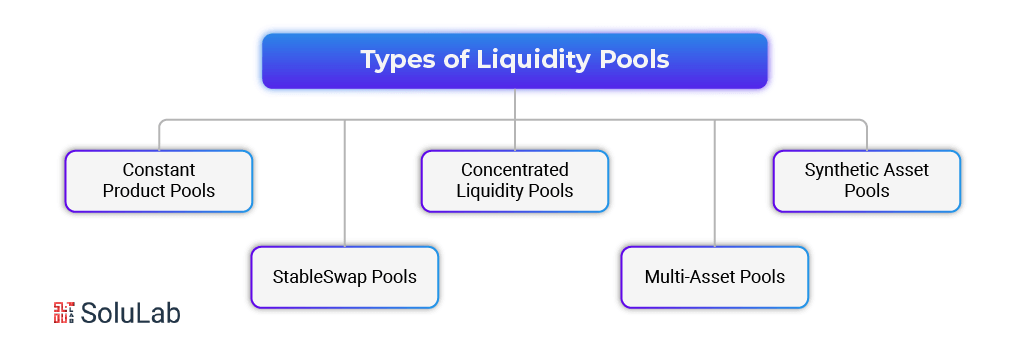
Types of Liquidity Pools

Types of Liquidity Pools

Liquidity pools vary in kind according to their applications, token composition, and pricing methods. Although they serve the fundamental purpose of enabling decentralized trade and financial services, their structures and designs might vary considerably.

Understanding the various forms of liquidity pools helps in selecting the appropriate platform and approach according to objectives such as generating fees, mitigating risk, or facilitating low-slippage transactions.

The primary types of liquidity pools are as follows:

  • Constant Product Pools

These represent the predominant variety popularized by platforms such as Uniswap. The constant product formula (x * y = k) enables individuals to trade against the pool at a price that fluctuates dynamically according to supply and demand.

  • StableSwap Pools

Utilized by platforms such as Curve, these pools are tailored for assets with comparable prices, such as stablecoin pairings (e.g., USDC/DAI). They provide less slippage and superior rates for stable assets owing to their distinctive pricing curve.

  • Concentrated Liquidity Pools

Uniswap V3 introduced the capability for liquidity providers to disperse their money within designated price ranges rather than throughout the full spectrum. This enhances capital efficiency and enables LPs to generate increased fees with reduced capital.

  • Multi-Asset Pools

These pools accommodate many tokens, shown by Balancer pools, which may include up to eight distinct tokens. They employ a generalized AMM formula and permit changeable asset weighting, facilitating tailored portfolio strategies.

  • Synthetic Asset Pools

Platforms such as Synthetix utilize liquidity pools to support synthetic assets that mirror the prices of real-world assets like gold and equities. These pools are essential for sustaining the peg and facilitating synthetic trade.

How do Crypto Liquidity Pools work?

Let’s first understand what is a liquidity pool in crypto. Cryptocurrency liquidity pools are smart contracts that secure tokens to enable decentralized trading and various financial services without requiring a centralized middleman. Fundamentally, they are engineered to address the issue of illiquidity on decentralized exchanges (DEXs), guaranteeing sufficient asset availability for seamless trading. Liquidity providers (LPs) contribute token pairs (such as ETH and USDC) to a pool, thereby earning a portion of the transaction fees and, at times, supplementary incentives.

How they work?

Cryptocurrency liquidity pools are smart contracts that secure tokens to enable decentralized trading and various financial services without requiring a centralized middleman. Fundamentally, they are engineered to address the issue of illiquidity on decentralized exchanges (DEXs), guaranteeing sufficient asset availability for seamless trading. Liquidity providers (LPs) contribute token pairs (such as ETH and USDC) to a pool, thereby earning a portion of the transaction fees and, at times, supplementary incentives.

This is the operational procedure, outlined sequentially:

  • Token Pair Deposits: Liquidity providers contribute equivalent amounts of two tokens (e.g., ETH/DAI) to a liquidity pool. The tokens are retained under a smart contract.
  • Automated Market Maker (AMM): It utilizes a mathematical formula, often the constant product formula (x * y = k), to ascertain the price of tokens in the pool, rather than relying on an order book.
  • Trading Without Order Books: Traders engage directly with the liquidity pool instead of with fellow traders. The price automatically varies according to the ratio of tokens within the pool.
  • Reward Acquisition: Liquidity Providers (LPs) get a fraction of the trading fees (e.g., 0.3% per transaction on Uniswap) commensurate with their stake in the pool. Certain systems further provide incentives, such as governance tokens.
  • Impermanent Loss Risk: Should the price of the deposited tokens fluctuate considerably from the time of their addition, liquidity providers crypto may experience impermanent loss, a transient decline in value relative to merely retaining the tokens.
  • Withdrawal: Limited Partners may withdraw their tokens at any moment, including with accrued fees and benefits, less any transitory loss that may have transpired.

CTA1

What exactly are crypto liquidity pool tokens?

When liquidity providers deposit funds in a pool, they are given a liquidity provider token (LPT) representing their portion of the pool.

Liquidity provider tokens (LPTs) are used to determine the number of funds donated by LPs to a pool as well as their share of transaction fees for providing liquidity. This gives LPs ownership of their assets while they are in the pool.

LPTs can be staked, sold, or transferred to other protocols on the same blockchain because they share the same qualities as other tokens on the blockchain.

A BNB-BUSD LPT, for example, can be staked on PancakeSwap to earn the trading platform’s protocol token, CAKE.

Real-World Examples of Crypto Liquidity Pools

Let’s examine some relative measures from well-known decentralized exchanges, such as UniSwap, Curve Finance, and PancakeSwap to better grasp how these liquidity pools in crypto perform when they are practiced. These systems highlight the variety of performance measures, user incentives, and functionality within the Defi ecosystem.

1. UniSwap Vs Curve Finance: Renowned for its creative contribution to the automated market maker, AMM systems, Anisha preserves liquidity with the constant product formula. ETH/USDC is one of the biggest pools of daily volumes. Average around $300 to $400 with an annual percentage that reels for liquidity providers between 20-30%.

Focusing on stablecoins, finance maximizes liquidity with the little sleep age and creates efficiency. For example, with lesser temporary loss, due to stable asset pairs, the DAI/USDC/USDT pool and curve typically have daily trading volumes passing $200 million, usually falling between 5-10%, APYs for this pool.

2. PancakeSwap: when operated on a finance, smart chain, pancake swap uses its token, CAKE, to incentivize, liquidity and presents the use of a friendly interface for example, depending on marketing conditions and the level of CAKE incentives given the liquidity pool of BNB/CAKE is recorded to produce APYs above 50%

3. Balancer: Multi Token Pools, gives more bestiality than unique swap or curve by letting users build pools with up to 8 different tokens. For instance with a rebalancing system to maximize portfolio management for liquidity providers, the WESH/dai/bAl pool boot NAPY of roughly 15-25%.

Benefits of Crypto Liquidity Pools

Crypto Liquidity Pools Benefits

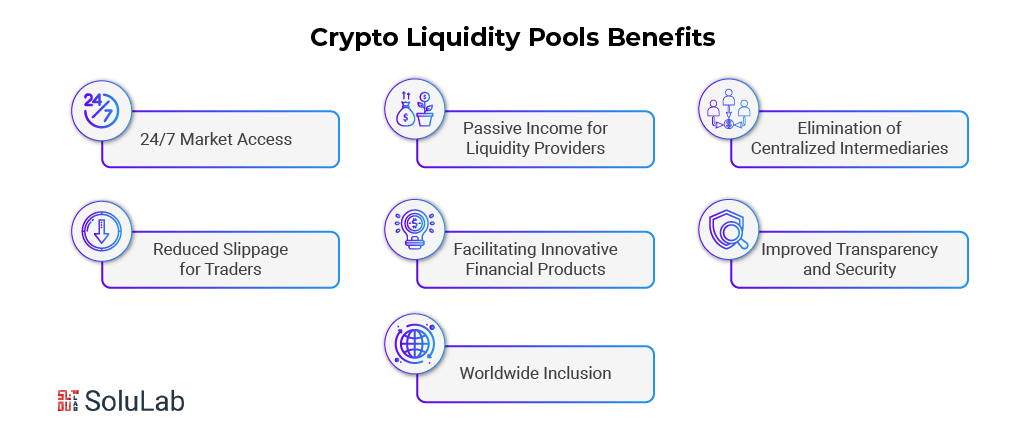
Cryptocurrency liquidity pools have grown as a fundamental component of the decentralized finance ecosystem by facilitating permissionless and efficient trading. In addition to enabling swaps, they provide several advantages for traders, investors, and developers.

Below are a few key benefits of the best crypto liquidity pools:

  • 24/7 Market Access

Liquidity pools function continuously, independent of conventional market hours. This guarantees that consumers may engage in trading or supply liquidity at any moment, from any location globally.

  • Passive Income for Liquidity Providers

Users can earn a portion of the trading fees earned by a liquidity pool by putting tokens into it. Numerous platforms furthermore include supplementary incentives such as governance tokens, enhancing potential rewards.

  • Elimination of Centralized Intermediaries

Liquidity pools eliminate the necessity for brokers or centralized exchanges, facilitating genuinely decentralized trading and asset management, hence diminishing dependence on third-party custodians.

  • Reduced Slippage for Traders

In well-capitalized pools, particularly those employing sophisticated AMM architectures (such as Curve’s StableSwap), transactions may be conducted with negligible slippage, even for substantial orders.

  • Facilitating Innovative Financial Products

Liquidity pools facilitate yield farming, synthetic assets, flash loans, and several other DeFi applications. Their adaptability enables developers to devise innovative financial products unattainable in conventional finance.

  • Improved Transparency and Security

As liquidity pools operate via smart contracts, all transactions and liquidity information are transparently recorded on-chain. This transparency fosters confidence and enables real-time auditing by any individual.

  • Worldwide Inclusion

Individuals possessing a cryptocurrency wallet and internet access can engage, therefore democratizing financial possibilities and equalizing conditions across various regions.

The Role of Crypto Liquidity Pools in DeFi

Crypto liquidity pools are the driving force behind a significant portion of the decentralized finance (DeFi) ecosystem. They establish the fundamental infrastructure that facilitates the operation of a multitude of DeFi applications, including yield farming, lending protocols, and decentralized exchanges (DEXs), without the need for intermediaries.

Here’s how the best crypto liquidity pools play a critical role in DeFi:

  • Enabling Decentralized Trading

By enabling users to exchange tokens directly through smart contracts, liquidity pool crypto supplants conventional order books. This innovation enables the rapid and permissionless trading of tokens, thereby enabling DEXs such as Uniswap, SushiSwap, and Curve

  • Facilitating Yield Generation

By providing liquidity to pools, garnering fees from transactions, and receiving incentives from DeFi protocols, users can generate passive income. Retail and institutional participants have been drawn to the DeFi sector as a result of this yield generation.

  • Borrowing and Lending

Decentralized lending and borrowing services are provided by protocols such as Aave and Compound, which utilize pooled liquidity. User deposits assets into pools, from which others may borrow, with interest rates that are dynamically adjusted in accordance with supply and demand.

  • Complex DeFi Strategies

Advanced DeFi activities, such as yield farming, arbitrage, and rapid loans, are facilitated by liquidity pools. The execution of these strategies is contingent upon the presence of deep, liquid pools.

  • Starting New Projects

Without the necessity of listing on centralized exchanges, new tokens can generate initial liquidity through pools. SushiSwap’s Onsen and Balancer’s Liquidity Bootstrapping Pools (LBPs) are examples of platforms that assist initiatives in establishing visibility and trading volume at the outset.

  • Incentives and Decentralized Governance

Top crypto liquidity providers are granted voting power over protocol decisions by numerous DeFi protocols in exchange for governance tokens. This aligns user interests with platform growth and promotes decentralized ownership.

Yield Farming and Crypto Liquidity Pools

To improve the trading experience, many protocols give additional incentives for users to generate liquidity by distributing more tokens for specific “incentivized” pools. Participating in these incentivized liquidity pools as a provider in order to obtain the most number of LP tokens is referred to as liquidity mining. Liquidity mining is a method used by crypto exchange liquidity providers to maximize their LP token profits on a specific market or platform.

There are numerous DeFi markets, platforms, and incentive pools where you may earn rewards for providing and mining liquidity in exchange for LP tokens. So, how does a cryptocurrency liquidity provider decide where to invest their funds? Here’s where yield farming comes in. Yield farming refers to the process of staking or locking up currency within blockchain technology to produce tokenized incentives. Yield farming is the practice of staking or locking up tokens in various DeFi apps to produce tokenized rewards that help maximize earnings. As a result of their assets being distributed to trading pairs and incentivized pools with the highest trading fee and LP token rewards across several platforms, a crypto exchange liquidity provider might earn significant returns for a slightly higher risk. This type of liquidity investing might direct a user’s funds to the greatest earning asset pairs. Yearn. Finance platforms even automate balance risk selection and returns to move your assets to other DeFi investments that give liquidity.

The Unexpected Value of Crypto Liquidity Pools

In the early phases of DeFi, DEXs suffered from crypto market liquidity problems when attempting to model the traditional market makers. Instead of having a seller and buyer match in an order book, liquidity pools helped solve this problem by incentivizing users to provide liquidity. This provided a robust, decentralized solution to DeFi liquidity, which was critical in accelerating the sector’s growth. Liquidity pools may have been born from necessity, but their innovation brings a fresh new way to provide decentralized liquidity algorithmically through incentivized, user-funded pools of asset pairs.

How to Join Crypto Liquidity Pools?

Joining a crypto liquidity pool is a simple process, but it requires a basic understanding of how DeFi platforms work and a few precautions to keep your assets safe. By providing liquidity, you’re contributing to a protocol’s trading ecosystem and, in return, earning a share of the fees or additional incentives. Here’s a step-by-step guide on how to get started:

1. Choose a DeFi Platform

Select a decentralized exchange (DEX) or protocol with strong credibility and audited smart contracts. Popular options include:

2. Connect Your Wallet

Use a Web3 wallet like MetaMask, Trust Wallet, or Coinbase Wallet. Connect your wallet to the DEX interface by clicking “Connect Wallet.”

3. Select a Token Pair

Choose a liquidity pool pair you want to join (e.g., ETH/USDC or DAI/USDT). Make sure you have an equal value of both tokens in your wallet. Some platforms also support single-sided deposits.

4. Add Liquidity

Navigate to the “Pool” or “Liquidity” section of the DEX and input the amount you want to deposit. The interface will automatically calculate the required amount of the second token based on the pool ratio.

5. Confirm the Transaction

First, you’ll need to approve the token spend, followed by confirming the transaction. Once processed on-chain, you’ll receive LP (Liquidity Provider) tokens, representing your share of the pool.

6. Start Earning Fees

As trades happen in the pool, you’ll earn a share of the transaction fees. On some platforms, you can stake your LP tokens in yield farms to earn additional rewards or governance tokens.

7. Monitor Performance

Keep an eye on your LP position, impermanent loss, and pool performance. You can use tools like Zapper, Debank, or APY.vision for real-time tracking.

By following these steps, you can start participating in the DeFi ecosystem, earn passive income, and contribute to the liquidity of decentralized markets—all while maintaining control over your assets.

Examples of crypto liquidity pools

There are hundreds of liquidity pools in the decentralized trading space, but a handful of trading platforms have emerged as the go-to options for traders and investors looking for decentralized crypto liquidity. They include:

  • Uniswap
  • Balancer
  • Curve Finance
  • PancakeSwap
  • Bancor
  • Convexity Protocol
  • Kyber Network
  • SushiSwap

Liquidity pools exist for a wide range of assets because they can be created by users themselves. The only restriction is that the tradable tokens must be available on the chain that the liquidity pool provider operates.

For example, on Uniswap and SushiSwap, you can only trade Ethereum-based ERC20 tokens, while PancakeSwap is limited to Binance Smart Chain’s BEP20 tokens.

The most popular assets you can find in liquidity pools include ETH, BNB, and stablecoins like DAI, USDT, and USDC. Even popular “meme coins” like SafeMoon can be traded or deposited in liquidity pools.

Final Thought

Crypto liquidity pools play a crucial role in the DeFi ecosystem, enabling seamless token swaps, reducing slippage, and providing passive income opportunities for liquidity providers. Understanding how do crypto liquidity pools work and the strategies to maximize returns, is essential for anyone looking to participate in decentralized finance. As the crypto space evolves, liquidity pools will continue to be a key component in enhancing market efficiency and accessibility.

SoluLab, as a leading crypto development company, has helped projects like Crypto Mining build robust and efficient platforms. Crypto Mining is a specialized mining platform where users can either purchase a miner for their operations or use the available miners to start mining immediately.

SoluLab’s expertise ensured the platform was equipped with all necessary features, providing an intuitive user experience and seamless functionality. From secure transactions to optimized performance, SoluLab’s development capabilities bring real-world solutions to the crypto industry.

If you’re looking to develop a crypto exchange, liquidity pool, or mining platform, SoluLab’s expert team can help you build a secure, scalable, and user-friendly solution. Get in touch today to turn your crypto vision into reality!

FAQs

1. Are cryptocurrency liquidity pools profitable?

Indeed, liquidity pools can provide a foundation for long-term financial commitments. Over time, liquidity providers might generate passive revenue by receiving a portion of incentives and trading fees. 

2. How can a cryptocurrency liquidity pool be started?

Choose a ‘Base Token’ (such as $BNB, $USDC, or $USDT). Select the ‘Quote Token’ for the token you want to introduce. Establish the starting price and match the quantity of the two tokens. Verify the transactions once the ‘Create Liquidity Pool’ has been selected. 

3. Which is preferable, a liquidity pool or staking?

For cryptocurrency investors, staking or liquidity pools provide profitable prospects in 2025. For individuals who prefer a more cautious strategy, staking offers consistent earrings and reduced risk. 

4. Which liquidity pool is the best?

Uniswap is ranked the first among decentralized exchanges offering the greatest DeFi liquidity pools. Uniswap which runs on the Ethereum blockchain, makes it simple for users to exchange. 

5. Are liquidity pools secure?

There are risks associated with planning crypto assets in a liquidity pool. The most frequent threats come from market instability, smart contracts, and dApp developers. DApp developers might waste or steal deposited funds.

Hire a Solidity Developer – Everything You Need to Know

Are you looking forward to hiring Solidity developers? Then it is evident that you must have a project for which you require Solidity developers. Hiring a developer seems to be an easy task, but it is not as easy as it seems. If you are planning to get the best out of your project, it is extremely important to hire the best Solidity developers for the same.

Hiring top-notch developers for your project will provide you with the confidence that the entire task will be taken care of in the best possible manner, assuring you of a hundred percent satisfaction. However, before proceeding with the task of hiring developers, it would be a very good idea to have some understanding of Solidity, its features, its uses, and other important things. A clear concept of these would play a significant role in choosing the right Solidity developer for your project.

What is Solidity?

It is essential to have some knowledge about solidity before hiring a solidity developer for your business. Solidity is essentially a high-level, contract-oriented programming language used to create smart contracts over the Ethereum network. The Ethereum Foundation created it, and the initial iteration was made public in 2014. 

Solidity facilitates inheritance, libraries, and sophisticated user-defined programming, the main language used by the systems that operate blockchain is Solidity. Contracts like voting, crowdsourcing, blind auctions, multi-signature wallets, etc. can be made with solidity.

Who is a Solidity Developer?

Solidity developers are the ones who make use of the object-oriented programming language to create and deploy smart contracts applications based on Ethereum. It is the native language of Ethereum that provides the developers with the complete benefit of launching various projects on the Ethereum blockchain platform. The developers possess comprehensive knowledge of the development of smart contracts via the programming language. They also possess the required skill set as well as the expertise with the language and can make the best use of it in a wide array of projects. Over the past few years, certified developers have been the most sought-after in the blockchain market space.

The Process of Solidity 

A developer’s Solidity smart contract code first undergoes complication into bytecode, a machine-readable, low-level format that may run on the Ethereum Virtual Machine (EVM). The Ethereum blockchain powers the EVM, a kind of computer that is in charge of carrying out smart contracts. 

The smart contract is deployed on the Ethereum blockchain when it has been compiled. The contract can be invoked by additional agreements or external entities like users or dApps after it has been deployed and forms a part of the blockchain.

The EVM runs the code of a smart contract when it is called, this code may include data read and written to the blockchain, transmitting and receiving Ether, and other operations. Additionally, the EVM upholds the limitations and guidelines established in the deal, such as guaranteeing that only the owner of the contract may transfer money. 

Technical Skills That a Solidity Developer Must Possess

To hire a blockchain developer you might require these certain technical skills, without which being successful would prove to be quite difficult in this field. Here are some of the major skills required for Solidity developers.

  • A clear concept of blockchain technology and all the associated or related concepts is important.
  •  A formal understanding of the Ethereum blockchain, its process of working, and the use cases are required.
  •  An understanding of other programming languages proves to be beneficial for dealing with Solidity programming.
  •  An in-depth understanding of smart contracts and associated topics such as the architecture of smart contracts, development of smart contracts, and their applications since Solidity is a smart contract programming language.
  • Core knowledge of different blockchain platforms and their working process.
  • A clear concept of the design or architecture of blockchain projects based on Solidity is extremely helpful.
  • Steady commitment to the web 3.0 landscape and distributed ledger technology or DLT is vital.
  • High enthusiasm for learning more about emerging blockchain technologies and staying updated with the current trends in the industry is needed.
  • Lastly, generalized skills such as the spirit to work in a team that is multidisciplinary in nature, along with very good client as well as project management skills, are essential to being a successful developer.

Advantages of Hiring Dedicated Solidity Developers for Your Project

Once you have a fair idea about Solidity programming and developers, it is time to start with the hiring journey. At the time when you begin the hiring process, you will find developers having specialization in more than one programming language. So, there arises confusion about whether to hire a dedicated Solidity developer or just a skilled developer. Here you should keep in mind that hiring a skilled developer is good to go, but experts recommend hiring dedicated developers for your project. If you are still confused, let us help you with the advantages of hiring dedicated Solidity developers.

Possess Specialized Skills, Expertise, and Knowledge

Hiring a dedicated developer gives you access to their specialized set of skills, expertise, and knowledge to take care of your project in the right way. This, in turn, plays a vital role in the overall success of the project. In addition to this, hiring dedicated developers for the project will readily improve the overall quality of work, infusing the project with an array of Unique and Innovative Ideas. 

You can get flexible models and a proper team structure for the project when you hire dedicated experts. Moreover, the team has in-depth knowledge of the subject and easily understands all the variations in the project to come up with the most suitable solution as per the specific needs of the project.

All Approaches and Strategies are Business Oriented

A Solidity developer has several years of experience in the field and can gain deeper insights into the project along with the complexities involved. At the same time, the expert makes sure that all the approaches to the project are business-oriented so that they can deliver the intended results within the stipulated frame of time.

In addition to this, the developers formulated strategies that are strictly business-oriented. They know exactly what needs to be done, when, where, and how as per the specific needs of the project. Thus, bringing in a dedicated Solidity development team makes sure that there is simply nothing to worry about their professionalism, strategy, approach, and experience. You can be sure to see your project getting completed within the timeline as per the exact requirements.

Better Turnaround Time for the Project

At the time when you hire a dedicated development team for your project, you can certainly expect a much better turnaround time for the project. The team can present you with the highest quality work in the quickest possible period. This, in turn, leads to much faster shipping of the product, quicker time to market, and speedier iterations. For this reason, project owners are always looking forward to hiring a dedicated team of experts for their projects. Moreover, the team would be capable of delivering the project on time, adhering to the delivery KPIs regardless of its size.

The Return on Investment is Better

The market competition is indeed huge. It is precisely the reason why business owners are always looking forward to making wise investments that come with better returns. In this regard, a dedicated Solidity development team helps with the successful completion of the project without any kind of additional investment. Therefore, it proves to be a cost-effective option for business owners. In addition to this, hiring a core Solidity team makes sure that you get all relevant as well as informative content that brings about great results. Thus, it allows you to obtain a much better return on investment or ROI.

Tips to Keep in Mind While Hiring a Solidity Developer

Now, you are clear about the advantages that you get from hiring dedicated Solidity developers for your project. However, before hiring a developer or a team of developers, it is extremely important to remember a few important tips that will help you make the ideal selection. Here are the pointers to follow.

Skip Asking Stereotypic Questions

When you are hiring Solidity developers, it is obvious that you need to ask questions since it is extremely important. However, it would always be great to skip asking any stereotypical questions like the following.

  • What is Solidity Programming?
  • Who first proposed Solidity and its evolution?
  • When was it first launched?

Instead of taking such a type of memory test by asking these stereotypical questions, it would be better to ask relevant questions to gain a better understanding of their technical knowledge and expertise on Solidity. You can ask the following questions that would not only help you gauge the technical knowledge of the developers but also make the most appropriate choice for your project.

  • Is Solidity compiled or interpreted?
  • What is the corresponding JavaScript console.log in Solidity for debugging?
  • What is the usual layout of a Solidity smart contract?

Ask Them to Brief About Their Previous Projects

While hiring Solidity Developers, it is very important to ask them about their previous projects and experiences. It happens to be of great help in obtaining a detailed idea about their skills and particular areas of expertise. You can also ask the developers to share or give a brief about their relevant past projects. The answers to these questions from the developers play a significant role in identifying their suitability for your project. Simply telling the developers to share their portfolios also works well in this regard and helps them make an appropriate choice.

Try to Assess Their Knowledge Base and Skills to Learn

When you decide to narrow down your search for Solidity developers, it is crucial to try and assess their knowledge base, especially technical knowledge. It is one of the primary things to do while hiring a developer for your project. Moreover, it is also necessary to evaluate their skills to learn and speed of learning. You would certainly agree that technology is constantly changing.

So, it becomes necessary to hire a developer who not only has the potential to work on your project but also stays updated with all the latest trends in the field by gathering new skills along the way. Most importantly, your project requirements might change during development. Hence, the developers you select should possess the flexibility to learn and adapt to the changing needs of the project.

Communication Skills of the Developers

Proper communication has always been the stepping stone towards success regardless of the type, size, and complexity of the project. Therefore, it becomes highly important to take into account the communication skills of the Solidity developers before hiring. They should possess the ability to communicate seamlessly without any kind of interruption through various modes of communication such as emails, audio, video, web, etc.

The presence of any kind of gaps in communication can prove to be detrimental to the overall results of the project. Therefore, it becomes very important to have an understanding of the communication skills of developers before hiring from the point of view of successful completion of the project.

Way of Presenting Themselves

Ultimately, you need to have a fair idea about the attitude of the Solidity developers. It is because attitude matters a lot in this regard. It is to be kept in mind that you can train a developer with specific skills required for a particular project but providing training with attitude is impossible since it is the characteristic of a person which cannot be changed easily with training.

You might find a developer who is great at Solidity development but does not possess soft skills, does not have an optimistic mindset, or lacks the attitude to learn; then, it becomes difficult to move ahead with that developer and work together on the project.

Conclusion

Hiring a dedicated Solidity developer is certainly the new future to thrive. The dedicated developers make sure to work on your project with the highest amount of care to maximize the results. At the time when you hire proficient Solidity developers, you get very easy access to the best pool of highly talented developers who possess high-level technical skills.

At the same time, you get very good value for money and hassle-free delivery of the project within the deadline allotted for the same. One of the best parts here is that you are able to get the complete package together at a pocket-friendly price. Hence there is simply no need to worry about the operational expenses of the project.

So, what are you waiting for? You are now all set to hire Solidity developers since you have complete know-how of the entire. Just go ahead and have a seamless hiring journey to make your project a great success!

Metamask Vs Coinbase Wallet: Price, Security & Features

Cryptocurrency is altering our perception of money. Many established models in the financial services sector have been challenged, and it has piqued the interest of government agencies, entrepreneurs, technology professionals, organizations, and the public at large all around the world. The meteoric rise in the popularity of digital currencies like Bitcoin, Ethereum etc. drove the rise in cryptocurrency use. Often cryptocurrency users, however, are curious about where bitcoin is held. In the most basic sense, cryptocurrency would certainly go into a wallet.

How is a blockchain wallet different from a traditional wallet?

Cryptocurrency ownership broadly differs from real cash ownership. Cryptocurrency does not exist in tangible form and is instead thought of as a repository of codes. Cryptocurrency is held on blockchain with a unique address which is the user’s digital wallet address. Users can utilize their public keys to assist other users in delivering crypto assets. At the same time, a private key may be used to unlock the digital currencies and other digital assets such as NFT’s in the wallet.

A crypto wallet can be considered as a regular wallet which is necessary to keep the users assets safe. Having said that, crypto wallets ensure superior security measures as compared to other regular wallets. Crypto wallets, in reality, never hold the actual digital assets. On the contrary, they assure the safekeeping of the crypto assets keys. To secure the protection of the assets, the crypto wallet might store the information needed to connect users to them.

Understanding Crypto Wallets

When users buy cryptocurrency from a cryptocurrency exchange or any other such platform, they may potentially keep it where the transaction was made. If a user buys a small amount of cryptocurrency, it will appear in their accounts at first, much like any other bank account balance. When a user buys a cryptocurrency or any crypto asset, they will be provided with one of the basic crypto wallet types. Most importantly, the wallets on the exchanges will provide additional levels of protection.

For example, financial institutions have insurance coverage in place to protect them against losses. However, these security precautions are not always sufficient to address a user’s worries about holding their crypto assets safely. This is where they would need to look for the appropriate sorts of crypto wallets that can provide adequate security and robust functionality.

Most frequent types of wallets for holding crypto assets

Hot Wallets

These are the most often seen kinds of crypto wallets. In the case of hot wallets, they are those that are directly linked to the internet and, thus, have particular security concerns. Hot wallets are more accessible and feature-rich than traditional wallets because of their internet connection. They are incredibly user-friendly, despite the fact that they are susceptible to fraudsters and hacker assaults.

Types of hot wallets:

Desktop Wallets

Typically a desktop wallet requires downloading a programme to the users desktop or laptop. The programme will aid in the creation of a data file including the users’ keys. Users must additionally generate a password in order to access and use their keys. Desktop wallets provide the users with the custody of their key, but there is a danger of physical damage and is often under the threat of viruses and malwares.

Web Wallets:

They need the installation of a program on your computer or laptop in order to function properly. Using the program, you may aid in the generation of a data file that will include the keys for each of the users. The keys can only be accessed if the user has created and saved a password for them. The benefit of using a desktop wallet is that you have complete control over your key. Physical injury or malware/virus infection, on the other hand, are possible consequences.

Mobile Wallets

Mobile wallets, which have features that are almost identical to those of desktop wallets, are another key crypto wallet within the hot wallets group of devices. To use the network’s hot wallet, users must download and install a mobile application on their phone, which is given by the platform. Despite the fact that mobile wallets provide for more flexibility when it comes to transferring cash, they also represent a huge security risk.

Cold Wallets

The cold wallets are essentially variants of cryptocurrency wallets built for cold storage. Cold storage refers to the offline storing of users’ crypto currencies and other crypto assets by wallets. As a result, they function as vaults for routine transactions. Surprisingly, certain types of cold wallets can connect to the internet while still performing their essential functions and expanding functionality.

As a result, it is obvious that users with a significant quantity of crypto assets would be more convenient using cold wallets as compared to hot wallets. However, a mix of cold and hot wallets may provide better value for crypto currency users and traders. For example, a major portion of assets might be securely held in a cold wallet, while the hot wallet provides greater flexibility for funds and offers more functionality. As a result, a hybrid method that combines the two crypto wallet categories might provide greater security as well as flexibility.

Types of cold wallets:

Paper wallets

If it comes to knowing paper wallets as one of the several types of crypto wallets, the name tells it all. Paper wallets are made up of physical pieces of paper. The paper must include all of the relevant details for the coin to be used. The majority of the time, cold wallets are more secure than hot wallets.

Nevertheless, this is not the case when it comes to paper-based variants. If you misplace the paper document, you face the risk of losing your cryptocurrency holdings. Besides this, paper wallets have the drawback of being unable to transfer partial payments as easily as digital payment. Moreover, the time-consuming nature of paper-based transactions raises substantial impediments to their mass acceptance.

Hardware Wallets:

Hardware crypto wallets, on the contrary, are the pinnacle of cold wallet design principles. They are the most secure way to store cryptocurrency. They offer security by averting private keys from being made public online. In an offline setting, hardware wallets save private keys on a physical device that functions in the same manner as a flash drive. The fact that users may connect them to PCs or any other device that accepts a USB drive makes hardware variants one of the most user-friendly forms of cold wallets.

Even when the gadget is connected to the internet, the private key does not quit the device. In the next step, the device would request transaction details and complete data validation, thereby completing the transaction. The transaction details are subsequently sent to an internet network, where they are recorded. Trezor, Ledger, and a plethora of other hardware wallets from a variety of manufacturers are one of the most preferred options available right now.

Metamask and Coinbase wallet integration and support features

Trust is crucial and very important when giving wallets permission to access the crypto assets, just as it is when choosing a banking institution for physical money transactions. Coinbase Wallet, while a younger establishment and less widely supported than MetaMask, is another alternative for the cryptocurrency wallet. 

Coinbase Wallet is the brainchild of the Coinbase platform, a publicly listed American firm that operates the world’s second-largest cryptocurrency trading platform. In reality, many MetaMask users utilize Coinbase to trade cryptocurrencies before transferring cash to their Metamask wallets.

Coinbase is available on almost all platforms such as the Mac, iPhone, iPad, Android, and Windows. This level of service accessibility makes it perfect for a diverse set of users. Coinbase offers a web browser extension which the users can use to maintain their crypto accounts on their computers and laptops can now connect their wallets on the browser for easier access.

Since Coinbase controls both the exchange and the wallets of users, they can provide a more uniform and persistent user experience and support for asset trading between the two. Furthermore, Coinbase is expanding its service with planned support for the NFT Marketplace, which will provide its users with a more consistent NFT-purchase experience.

While MetaMask only supports networks of the Ethereum Virtual Machine, which are hard clones of the Ethereum blockchain platform, Coinbase Wallet also supports Bitcoin, Dogecoin, Litecoin, and other popular cryptocurrency networks. Depending on the users requirements, expanded network support might be a game changer for some users.

However, MetaMask is available for iPhone, iPad, Android and is also available as SaaS. This means that the users may download it on their phones and use it with any operating system. Furthermore, Metamask users may use it as a browser plugin! MetaMask allows its users to access and manage their account from anywhere and at any time without any restrictions.

Customer Support

Both MetaMask and Coinbase provide online assistance and users may reach out to their customer service specialists via email. While this works for some users, it may benefit from some enhancements in terms of 24/7 live assistance, since it would be preferable for new users to receive rapid responses and solutions on their queries.

Price Comparison and Gas Fee

MetaMask’s website mentions that their service will charge users 0.875% percent of every transaction they make in order for the users to fund the wallet’s future development. Each user should have a little amount of Ethereum to cover the gas fee and other expenses when they make their first transaction. MetaMask wallet has no additional costs and oly charges the users for the transactions they make.

Coinbase Wallet, on the other hand, levies transaction fees depending on Coinbase’s wallet and exchange services. Moving money from one Coinbase wallet to another is entirely free. Furthermore, when users trade on the Coinbase platform they may be charged a variable fee. This variable cost varies depending on the payment option they have selected.

Gas costs are solely determined by the blockchain network on which the transaction is being made and not by the wallet provider itself. Fees on the networks like Polkadot and Solana for example (both of which are supported by Coinbase Wallet), will be cheaper than those on the Ethereum blockchain network.

Standout Features

The Coinbase Wallet’s most notable feature is that it is totally connected with one of the world’s biggest crypto platforms – Coinbase. In addition, Coinbase Wallet has a decentralized app browser, which enables users to create dApps without necessarily having to authorize each transaction.

MetaMask has expanded significantly over the years, considering it was merely a browser extension until 2019. MetaMask is now a full-fledged cryptocurrency wallet with a built-in switching mechanism. In other words, you may exchange Ethereum-based tokens without requiring a connection to a decentralized exchange.

Summing Up

Without the need for a doubt both Coinbase and Metamask wallets are two of the most popular and leading cryptocurrency wallets available today. Overall, both have advantages and disadvantages, and if privacy and anonymity are the users primary concerns they should continue with Metamask. However, if the user wants something more like a full-fledged platform and anonymity is not much of a concern then, Coinbase is a great option to consider.

However, like with everything connected to the Internet, there is always the potential of an outside breach or a malicious attack. So its is recommended that if the user has a significant quantity of cryptocurrency or digital assets in their accounts, one should consider purchasing a hardware wallet. Because hardware wallets are often regarded as the safest and most durable device for storing cryptocurrency and other crypto assets.


-Contact Us-

The World is Upgrading to Blockchain. Don't get confused and take the wrong base technology for your project. Get Free Consultation Now.

What Is Proof Of Stake?

A blockchain is a form of Distributed Ledger Technology (DLT) that is highly protected by cryptographic encryption. Information is combined into blocks that are connected to one another to build an immutable chain of information, which serves as proof of the presence of a transaction or any sort of data at any specific instant in time on the blockchain.

Since there is no centralized authority to govern and regulate the system, user consensus is vital to achieving the system’s security and long-term viability. The development of a consensus mechanism that prescribes the rules by which players should play and obey makes it possible to reach a worldwide agreement on the blockchain.

Proof-of-stake is a digital currency consensus technique that offers an alternative to the proof of work employed in Bitcoin. The absence of costly computations and hence a reduced entry hurdle for block generation rewards are the key claimed benefits of proof of stake systems.

What is Proof of Work?

In the early 1990s, Proof of Work (PoW) was used to prevent email spam.

It was a simple concept in which the computers were forced to do some task before sending emails. This task would be easy for anyone sending a legitimate email. However, sending bulk emails would need a large amount of computational power and other resources.

However, Satoshi Nakamoto, the one who developed Bitcoin, was the first to implement this idea for use in a cryptocurrency system in Bitcoin.

Ordering in the Blockchain

The very first block on the blockchain is termed the genesis block and some even call it as block 0 in a PoW blockchain. It is embedded or in better terms, hardcoded into its operating software. This block does not relate to any prior block by convention. New blocks being added to the blockchain network always link to the previous blocks and also contain a copy of the entire, updated ledger.

Use of Resources and Energy

Through a tough competition in which a handful of players (miners) are encouraged to waste computational and power resources in order to develop new legitimate blocks that meet the network’s regulations, Proof of Work algorithms determine who can make changes to the ledger.


Then, the nodes (a computer operating the Bitcoin blockchain software) confirm transactions, eliminate double-spending (the malicious act of transferring the very same coins to different beneficiaries), and determine whether suggested blocks should be appended to the blockchain.


Miners on the blockchain in a Proof of Work blockchain compete against one another to answer rigorous math equations in a process of complex mathematical problem solving known as hashing in order to generate a new block on the blockchain. These equations are difficult to solve, but the blockchain network should be able to validate the right answer with ease.

Participation

Computational power and resources are used with encryption in Proof of Work to promptly achieve consensus and verify the authenticity and legitimacy of transactions that take place on the blockchain. network

Miners achieve this by working on a series of pseudorandom integer values also known as a hash. This hash, when coupled with a set of data supplied within the block, is processed through cryptographic hashing and this must yield a result that meets the specified requirements.

The successful hash is then published to the network so that the other miners may determine if the answer is correct or not. If it is accurate, the block is uploaded to the blockchain, and the miner receives the block reward.

Earnings and Rewards

The block reward is the cryptocurrency paid to the miner by the blockchain for each complete and approved block by the network.

Cryptocurrencies like Bitcoin, reduce the block reward after a defined number of blocks have been identified. This is done to maintain a deflationary total coin supply on the blockchain network.

What is Proof of Stake?

Proof of Stake is simply a variant of Proof of Work that was created in order to meet its perceived dependence on energy usage as a process of determining blockchain ordering.

Rather than trusting on computers being run by the blockchain miners competing to produce the correct hash, the principle that works behind a Proof of Stake system is that involvement is decided by the amount of coin supply ownership.

The Proof of Stake method selects a participating node (anyone who possesses the coin) to deal with the next transaction on the blockchain using a set of parameters determined by the system.

When a node is chosen, its responsibility is to authenticate  and validate the transaction within the block, and then submit the block to the system for verification.

Ordering in the Blockchain

A Proof of Stake blockchain is very identical to a Proof of Work blockchain network in many ways. This method uses a string of blocks that are aligned in chronological order depending on the order of the transactions.

The genesis block in a Proof of Stake method is embedded into its operating system and is often referred to as block 0. Newer blocks that are created on the blockchain always refer to the previous block and also hold a copy of the entire updated ledger on the blockchain.

It is important to know that in a blockchain developed using the Proof of Stake method there is no contest for who is assigned to contribute new blocks. For this reason, the blocks are usually referred to as “minted” rather than “mined”.

Use of Resources and Energy

Proof of Stake blockchains, unlike Proof of work blockchains, do not select who may propose the blocks simply on processing power and energy use. Proof of Stake proponents frequently touts it as a “more energy efficient” system in which specific nodes are tasked with producing new blocks rather than competing with the other nodes on the blockchain.

Because both Proof of Work mining and Proof of Stake minting require power consumption, both these mining and minting nodes are encouraged to use the cheapest source of energy possible, which is typically generated by renewable energy sources such as hydroelectric power, wind power, or solar rather than greenhouse-emitting natural resources such as coal, etc.

Furthermore, Proof of Stake blockchains necessitate the usage of specialized equipment which are known as the Graphic Processing Units, just like Proof of Work mining equipment known as the Application Specific Integrated Circuits as well as the other computing machines, necessitate the production of resources.

Proof of Stake miners must additionally maintain active internet connections, which necessitates the expenditure of electricity and other recurring cost resources.

Participation

Users who intend to be considered for producing blocks on a PoS blockchain must stake or deposit a particular sum of the blockchain’s cryptocurrency in a unique form of a special contract.

The number of coins invested impacts their chances of being the next block producer. In some circumstances, users that engage in malicious activities may be punished by losing their stake.

Proof of Stake may incorporate various deciding variables in order not to always prefer the wealthier nodes. These can include how long a node has staked their currency as well as pure randomness.

Earnings and Rewards

The block reward in Proof of Stake, like the Proof of Work method, refers to bitcoin granted by the blockchain to the node who submits a valid block.

However, because block selection is determined by currency ownership, exchanges may provide staking services that allow users to stake funds on their account in return for more frequent payment.

Importance of Proof of Stake (POS):

The core database structure for recording transactions in cryptocurrencies such as bitcoin is a decentralized ledger known as the blockchain, which keeps the full transaction history. The term derives from the concept that transactions are grouped into blocks; every block on the blockchain (excluding the first, known as the genesis block) refers to a previous block. Each Bitcoin network node has its own copy of the blockchain, which is synced with other nodes through a peer-to-peer protocol. Any digital currency system must include a method to protect its blockchain against assaults.


For example, a malicious user may spend money and then reverse the transaction by broadcasting his own version of the blockchain that does not include the spending transaction; because blockchain security does not depend solely on one single authority, users have no previous knowledge as to which version of the ledger on the blockchain is valid.


The security of the Bitcoin-like cryptocurrency networks is based on a proof of work (PoW) mechanism in the manner of block mining. To confirm the legitimacy of the newly mined block, any node that wishes to participate in mining must solve a computationally tough problem known as hash; solutions are awarded to these miners with bitcoins. The method is fair in the respect that if a miner with x percent of total processing power may earn the reward and generate a block with x percent probability. 

A malicious user must accomplish the same challenges as the rest of the Bitcoin blockchain; hence, an assault on Bitcoin will be effective only if the attacker can bring considerable computing resources to force.

The Bitcoin protocol operates in such a way that network security is maintained by physically limited resources: 

  •  special hardware required to conduct calculations, and 
  • electricity required to operate the hardware.

As a result, Bitcoin is wasteful in terms of resources. Bitcoin miners are driven to engage in an arms race to continually deploy additional resources for mining in order to raise their share of rewards. While this results in an assault on Bitcoin prohibitively expensive, the Bitcoin protocol’s environmental unfriendliness has resulted in ideas to construct comparable systems that are far less resource hungry.

Proof of stake (PoS) algorithms are one alternative decentralized ledger implementation that does not rely on expensive calculations for security. Instead of mining power, the likelihood of creating a block and receiving the related reward is proportional to a user’s ownership share in the system. With x probability, an individual stakeholder with x proportion of the total number of currency in circulation produces a new block.

The logic behind proof of stake is as follows: users with the strongest holdings in the blockchain ecosystem have the most interest to keep the network safe from malicious users and attackers, since they would suffer the most losses if the cryptocurrency’s reputation and price declines as a result of the assaults or attacks. An outside attacker would need to acquire the majority of the money to launch a successful attack, which would be extremely expensive for a popular system and would not make any logical sense.


Conclusion

The proof of stake model is predicted to grow into a potentially more competitive and peer-to-peer type of crypto-currency on the blockchains than the proof of work methods owing to the removal of dependency on high energy use, resulting in lower asset prices at adequate network security levels.

-Contact Us-

The World is Upgrading to Blockchain. Don't get confused and take the wrong base technology for your project. Get Free Consultation Now.

Cardano Vs Polkadot Vs Solana

Cardano Vs Polkadot Vs Solana

Are you having trouble deciding whether to use the Polkadot, Solana, or Cardano blockchain for your company? According to the block data, 80% out of 100 companies use blockchain technology. Many organizations embrace blockchain technology for its advantages, including increased security and confidentiality. Each blockchain, however, has unique advantages that might or might not be appropriate for a certain project. 

Blockchains like Solana vs. Cardano vs. Polkadat continuously expand as chains add new blockchains, enhancing the ledger’s security. Only users of an approved system can access data on the blockchain, which is distinct because it fosters trust without requiring a reliable third party. 

So, how can you pick the ideal blockchain for your company? To do so, you need to know the main distinctions between Polkadot, Solana, and Cardano, the three well-known blockchains. This detailed guide will explain each blockchain and its features. 

Background of Each Blockchain 

Before deciding you need to have a brief understanding of each of the blockchain platforms to make a better and more informed decision

What is Cardano?

Charles Hoskinson, a co-founder of Ethereum, developed Cardano in 2015. The Cardano blockchain is openly accessible, the system is decentralized and open-source, and consensus is established by proof of stake. According to the ruling in Solana vs Cardano vs Polkadot can utilize its token, ADA to facilitate peer-to-peer (P2P) transactions. As a third-generation platform, Cardano is an improved version as opposed to Polkadot vs Solana.

Additionally, the blockchain platform seeks to provide financial services to unbanked individuals worldwide. Additionally, one intriguing component of Cardano is the way it uses its ‘eras’ to celebrate historical individuals in computer science and poetry. The goal of the Basho scaling and optimization phase is to provide additional functionality to Cardano. 

What is Polkadot?

June 2021 saw the launch of the open-source Polkadt blockchain. It makes blockchains more accessible and connected by permitting distinct chains to securely communicate and carry out transactions. It makes use of the Layer-1 blockchain known as the Kusama parachain. Over 100 para chains are supported by Kusama, and experts predict that number will continue to rise. As a component in your investment strategy, you can sell and buy DOT in addition to SOL, ADA, and DOT. Users can run customized platforms on top of a global network of personal blockchains with Polkadot, a cryptocurrecny. The Polkadot token (DOT), a cryptocurrency, serves two primary purposes inside the Polkadot blockchain network. 

  • With DOT, owners have the power to shape the protocol’s course. 
  • New DOTs are created by the Polkadot cryptocurrency network, which validates transactions by staking its money.  

Blockchain numerous applications are developed by Polkadot’s para-chains and fed into the main blockchain. In comparison to ADA, SOL, and DOT, this offers para-chain interactions utilization of the same amount of security to the main chain. 

CTA1

What is Solana?

Solana (SOL) adds to the discussion of SOL vs ADA vs DOT. An open-source initiative called Solana creates a novel, quick, layer-1 Blockchain without permission. To boost the capacity beyond what is feasible and popular blockchain while maintaining affordable pricing, Anatoly Yakovenko created Solana in 2017.

A synchronized engine, a form of proof of state, and a transforming proof of history technique are both used in Solana’s hybrid consensus model. Therefore, without putting scaling solutions in place, Solana can handle up to 710,000 operations per second. If you create a Solana token, a third-generation blockchain framework to facilitate the development of decentralized apps and smart contracts. The project facilitates a range of Defi systems and non-fungible token exchanges. One of the most influential parties in SOL vs ADA vs Polkadot at the moment is Solana. 

Benefits of Adoption of Each Blockchain

Blockchain technology provides special solutions, and a project’s particular requirement will determine which platform is the best. Let’s examine the advantages of embracing Cardano, Polkadot, and Solana: 

Cardano: Ecological and Research Strictness

Cardano is disconnected by its methodical approach, which is based on a layout design and peer-reviewed research. It is one of the most environmentally sustainable blockchains due to its proof of stake, and voting process, which guarantees energy efficiency. Cardano’s emphasis on formal verification helps developers by reducing errors and vulnerabilities. It is also an excellent candidate for projects needing long-term reliability, like digital identity, management, or supply chain tracking, due to its capacity for growth through Hydra Layer 2 solutions.

Polkadot: Scalability and Interoperability 

Polkadot’s distant embassies, or interoperability make it stand out its chain promotes a real web3 environment by enabling seamless communication and information sharing between numerous blockchains. Polkadot-adopting projects can create customized blockchains (parachains) that are customized for certain use cases, such as gaming or DeFi. Polkadot is perfect for cross-chain solutions and centralized applications that need to communicate between ecosystems because of its shared security paradigm, which lowers individual network liberties while preserving scalability.

Solana: Economical and Quick

Solana token services are a great option for hyper-performance apps because of their lightning-fast transaction rates and low fees. With its proof of history mechanism, it can handle more than 65,000 transactions per second, which makes it ideal for the NFT marketplace and decentralized exchanges. Due to Solana’s affordable prices, developers, and users can access it, enabling projects to grow without being constrained by fees. 

Every Blockchain has its advantages. Polkadot concentrates on interoperability, Cardano emphasizes sustainability, and security, and Solana is superior in terms of speed and cost. The objectives and priorities of the project will determine which one is best.

Technological Comparison of Blockchains

FeaturesCardanoPolkadotSolana
Mechanisms of ConsensusProof of StakeProof of Stake nominatedProof of Stake plus Proof of History
Speed of Transactions250 transactions per second1,000 transactions per second65,000 transactions per second
ScalabilityHydra Layer 2 Solution ScalesThrough parachains scalePoH enabled parallel processing scale
Efficiency of EnergyHigh (PoS included low power consumption)High (PoS mechanism optimized)Moderate (effective but requires more power than Cardano or Polkadot)  
InteroperabilityRestricted, sidechains will be used in plans to support cross-chain.Robust, built with the Relay Chain in mind for multi-chain interaction.Limited, interoperability is less important than sing-chain performance. 
Intelligence ContractsThe Haskell-based Plutus platform prioritizes formal verification. Uses parachains to support smart contracts.C, C++, and Rust are supported by the Solana runtime for high-performance applications. 
LeadershipCommunity vote for decentralized government.Active involvement of stakeholders in on-chain governance. On-chain governance is limited and depends on core developers. 
Ecosystem of DevelopmentCentered on methodical updates and academic rigor. Developer-friendly with substrate architecture for blockchain development. An environment with high performance designed for real-time applications. 
DecentralizationHigh (decentralization that will happen gradually with the addition of nodes)High decentralization is fostered by shared security. Moderate (has comparatively fewer nodes than Polkadot and Cardano)

Uses Cases of Each Blockchain 

1. Cardano

Creating the future of multi-chain, Cardano vs Solana, Polkadot is the foundation of cross-chain solutions and web3 because of its capability and interoperability. Among the notable use cases are:

  • Digital Identification Management: Initiatives, such as Atala PRISM use Cardano to offer, decentralized and safe identification solutions to both individuals and businesses. In developing nations where identification verification is difficult, this is extremely helpful.
  • Defi and Smart Contracts: Cardano offers decentralized finance applications, including stablecoins, lending platforms, and these exchanges through the Plutus smart contract platform.
  • Certification and Education: By enabling the organization to produce veritable certificates, Cardano’s blockchain has been utilized for credential verification, guarantee, authenticity, and blocking fraud.
  • Supply Management: Cardano makes it possible to trace products, transparently, and impenetrably throughout the supply chain because its blockchain guarantees authenticity, and stakeholder trust is increased. 

2. Polkadot

Creating the future of multi-chain, Polkadot is the foundation of cross-chain solutions and web3 because of its capability and interoperability. Among the notable use cases are: 

  • Cross-Chain DeFi: Polkadot facilitates communication between blockchain and decentralized financial systems. Parachains can be used by the project to build specialized training, staking, and lending ecosystems.
  • Development of Web3: Polkadot helps decentralized apps that depend on numerous changes for functionality and data by facilitating smooth communication between them. 
  • NFTs and Gaming: Producing games powered by blockchain and an NFT marketplace, where high performance and connectivity are crucial, is made possible by Polkadot’s scalability and multi-chain capabilities. 
  • Integration of IoT: Polkadot facilitates smooth data, sharing, and automation in sectors, including agriculture, logistics, and healthcare by connecting IoT devices across several networks. 

3. Solana 

Energizing high-efficiency apps, Solana is well known for its quick transactions and lower fees, making it perfect for real-time application applications. Important use cases consist of:

  • NFT Marketplace: Solana provides minimal cost and fast transaction velocity form and trading, powering, well-known MFT platforms, such as Metroplex and Magic Eden.
  • DeFi Solutions: Decentralized exchanges, taking protocols, and lending platforms are among the decentralized finance applications that Solana supports. It is desirable for high-frequency trading due to its low latency.
  • Decentralized Applications: Solana is used by developers to create a variety of dApps, such as data, storage systems, centralized social networking, networks, and payment gateways
  • Metaverse and Gaming: Solana is extensively used in the virtual world and Blockchain-based gaming, where capability and performance are essential for smooth user experiences.

Strengths and Weaknesses of Each Blockchain

BlockchainStrengthWeakness
Cardano

Proof of Stake uses less energy.

High security is guaranteed by rigorous verification and peer-viewed protocols.

Network resilience is improved by progressively increasing the number of active nodes. 

Innovation and updates may be delayed by a research-driven strategy.

In contrast to rivals, dApp and ecosystem adoption is still increasing. 

There is still work to be done on cross-chain communication.

Polkadot

Relay chain makes it possible for several blockchains to communicate with each other easily. 

By enabling parallel processing, parachains increase transaction throughput.

Substrate makes creating unique blockchains easier. 

New developers may find the parachain and architecture model difficult to understand. 

It takes a lot of technological know-how and funding to launch parachains.

Solana

Developers and users may find it appealing because of its low fees. 

Perfect for high-performance applications like Defi, NFTs, and gaming. 

Capable of processing more than 65,000 transactions per second. 

There may be centralization problems if there are fewer validators than rivals. 

Solana has seen outages and stability problems. 

Performance on a single-chain is prioritized over cross-chain capability. 

Investment Perspective

Cardano 

It is viewed as an extended, research-driven initiative from the perspective of investment. Investors looking for stability and steady growth are drawn to its emphasis on sustainability and reviewed by experts in development. Future demand for ADA may be fuelled by Cardano’s enterprise-level adoption because of its strong security capability via Hydra. Short-term gains are at risk, nevertheless, due to its lower rate of development and less active environment than rivals. ADA is valued by investors due to its solid base and promise to address practical issues and supply chain, identity management, and DeFi.

Polkadot

Investors choose Polkadot because of its distinct capability and interoperability, which established it as a major participant in the multi-chain web three future. It is appealing for developers and projects because it encourages creativity through the creation of specific para changes. DOT is an asset that requires a lot of staking and compensates investors for their involvement. Rapid adoption might be constrained by the para-chain’s integrity and great technical entry requirements. Polkadot is a good choice for investors who are looking to the future because of its potential to dominate cross-chain solutions.

Solana

Investors looking to gain exposure to a high-performing blockchain ecosystem, find Solana appealing. It has become the preferred platform for Defi, NFTs, and gaming because of its quick transactions and inexpensive costs. The adoption of SOLN industries with significant demand is linked to its growth potential. However, risk covers investors can be turned off by worries about centralization, risk, and network disruption. SOL provides excellent shot and medium-term investment opportunities for individuals who are interested in ecosystem expansion. 

The Final Word

To sum up, Cardano, Polkadot, and Solana arose from candidates in the blockchain market since they each have special advantages suited to particular use cases, Cardano’s focus on secure and sustainable platforms through research makes it appealing for long-term projects like supply chain, tracking, and digital identity management. Due to its exceptional scalability and interoperability, Polkadot is perfect for decentralized apps, cross-chain solutions, and Internet of Things integration. Meanwhile, Solana is the go-to option for advanced applications such as NFT marketplaces, DeFi, and blockchain-based games due to its speed and inexpensive transaction fees.

Your project goals, whether they are eco-friendly expansion, smooth, cross-chain, communication of blazing, or fast performance will determine which platform is best for you. Businesses and developers may ensure effective deployment and creation in the rapidly changing market by aligning their blockchain decisions with their objectives and knowing the relative benefits of each blockchain platform.

FAQs

1. Which is superior Cardano or Solana?

Solana prioritizes speed and scalability, whereas Cardnao’s Ouroboros emphasizes security. Cardano exhibits strong decentralization by running close to 2,600 validator nodes. Conversely, Solana has more than 1,300 validator nodes, requiring certain performance trade-offs with centralization. 

2. Which cryptocurrency should I buy?

With a staggering 57% of the market capitalization of the whole cryptocurrency industry, Bitcoin (BTC) is the top choice for cryptocurrency investing. Additionally, Bitcoin’s value just rose by an additional 125% to surpass $100,000.

3. Is it worth investing more in Solana?

If you think Solana has the potential to continue growing its ecosystem, accelerating and obtaining more ETF approvals, it could be a wise investment. It is still an inflationary token, though, is far more difficult to value than Bitcoin. 

4. Which is the better choice Cardano or Polkadot?

Polkadot wants the investors to be more involved and dedicated. The infrastructure of Cardano is double-layered, and Polkadot makes it possible to connect several blockchains to a single network. High transaction speed and cheap transaction fees are two of Cardano’s advantages. 

5. Can Polkadot surpass Ethereum?

Leading para-chain-based blockchain project Polkadot (DOT) is about to make a significant advancement that would allow it to overtake rivals like Solana (SOL), Cardano (ADA), and Ethereum (ETH).