![How to Create a Token on Solana? [7 Easy Steps]](https://www.solulab.com/wp-content/uploads/2024/12/Token-on-Solana.webp)
Creating a crypto token no longer requires months of development or deep blockchain expertise. Thanks to the Solana ecosystem, businesses and developers can launch tokens quickly with minimal fees and high network performance.
Some important metrics that explain Solana’s adoption include:
- 65,000+ theoretical transactions per second (TPS) capacity
- 400–800+ real TPS average during normal network usage
- Less than $0.01 transaction fees in most cases
- Hundreds of active dApps across DeFi, NFTs, and gaming
- Millions of daily transactions, often exceeding Ethereum and Polygon combined
Solana has also become a major platform for tokenization and digital asset infrastructure.
Key Takeaways
- Solana allows businesses and developers to build a token on Solana quickly with minimal transaction costs.
- Businesses can create Solana token ecosystems for payments, DeFi platforms, gaming economies, and real-world asset tokenization.
- Partner with a professional Solana token development company to integrate infrastructure like Solana Pay, oracles, liquidity protocols, and scalable blockchain architecture.
What is Solana and Why It Is Ideal for Token Creation?
Tokens on Solana are digital assets built using the SPL Token standard, which is similar to ERC-20 tokens on Ethereum.
These tokens can represent various digital assets, such as:
- Utility tokens used within applications
- Governance tokens for decentralized protocols
- Stablecoins
- Reward tokens for communities
- NFT assets representing ownership of digital items
Tokens play a crucial role in enabling decentralized economies within the Solana ecosystem.
Common uses of Solana tokens include:
Payments: Users can transfer tokens instantly across the network with extremely low fees.
Governance: Token holders may vote on protocol upgrades or project decisions.
Staking and rewards: Projects often reward participants with tokens for contributing to the network.
Solana in DeFi applications: Tokens power lending, borrowing, trading, and liquidity pools.
Because of this performance advantage, many businesses prefer Solana token development instead of building tokens on slower networks.
Read more: Tokenized Agentic Payment System
How to Create a Token on Solana in 7 Steps
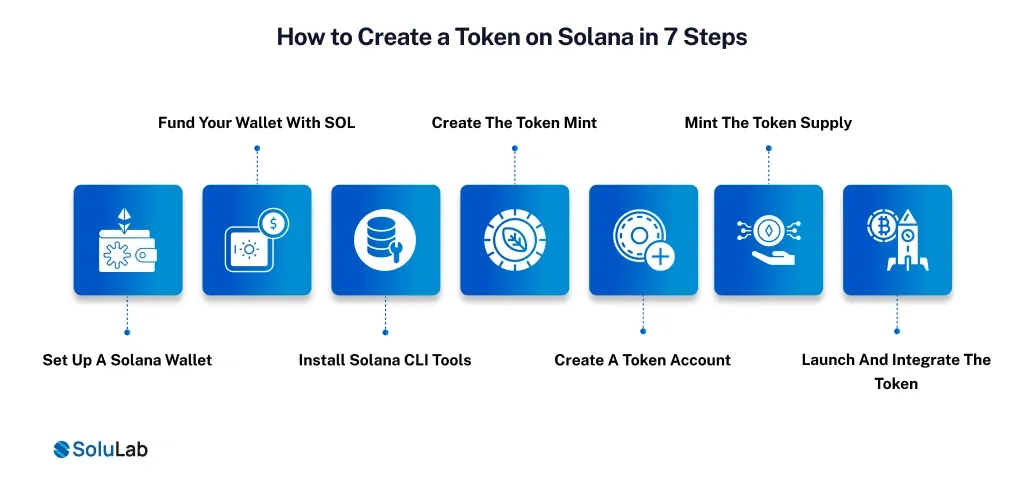
Launching a token on Solana involves several straightforward steps using the SPL token program.
Step 1: Set Up a Solana Wallet
The first step to create Solana token assets is setting up a compatible wallet.
Popular wallets include:
- Phantom
- Solflare
- Sollet
These wallets allow developers and businesses to manage assets, interact with applications, and store tokens securely.
Step 2: Fund Your Wallet With SOL
You need a small amount of SOL to cover network fees when creating and managing tokens.
Even large token operations usually require only a few dollars worth of SOL because transaction costs on Solana are extremely low.
Step 3: Install Solana CLI Tools
Developers typically install the Solana command-line interface to interact with the network.
Required tools include:
- Solana CLI
- Node.js
- Rust toolchain (optional)
- SPL token CLI utilities
These tools allow developers to solana create token assets programmatically.
Step 4: Create the Token Mint
The next step is creating the token contract using the SPL token program.
Example command:
spl-token create-token
This command generates a unique token mint address that represents the newly created token on the blockchain.
Step 5: Create a Token Account
After creating the token mint, you must generate a token account that will hold the tokens.
Example command:
spl-token create-account TOKEN_ADDRESS
This account will store the minted token supply.
Step 6: Mint the Token Supply
Once the token account is ready, developers mint the supply.
Example command:
spl-token mint TOKEN_ADDRESS 1000000
This example mints 1 million tokens into the wallet.
Projects can also configure decimals, supply limits, and distribution structures.
Step 7: Launch and Integrate the Token
The final step is deploying and integrating the token into the ecosystem.
Projects typically:
- list tokens on decentralized exchanges like Raydium
- integrate DeFi utilities
- enable staking or governance
- launch community programs
Once deployed, businesses can launch Solana token ecosystems for payments, gaming platforms, or DeFi protocols.
How Solana’s “Lightning-Level” Framework Offers New Opportunities to Enterprises for Token Building
Over the past two years, Solana has evolved from a fast blockchain into a high-performance financial infrastructure layer for enterprises. Its combination of extremely low fees, high throughput, and enterprise integrations has created what many analysts describe as “lightning-level blockchain performance”.
For organizations looking to build a token on Solana, this infrastructure unlocks opportunities that were previously difficult on slower chains.
1. Why Solana Is Attracting Enterprise Token Builders
Solana currently processes millions of daily transactions, often ranking among the top blockchain networks globally by transaction volume. The network’s architecture allows it to theoretically handle 65,000 transactions per second, with real-world throughput commonly ranging between 400 to 1000 TPS depending on network conditions.
This performance is powered by innovations such as:
- Proof of History (PoH) for timestamping transactions
- Parallel smart contract execution through Sealevel
- Highly optimized validator infrastructure
Because of this architecture, businesses can create Solana token ecosystems that scale to millions of users without the congestion issues often seen on older blockchain networks.
2. Enterprise Adoption Driving the Solana Ecosystem
Several major companies have already integrated Solana infrastructure into their products and payment systems. These partnerships signal growing confidence in the network for enterprise applications.
A. Visa Expands Stablecoin Settlement on Solana
In 2023, Visa announced that it expanded its stablecoin settlement program to include the USDC stablecoin on the Solana network.
According to Visa’s crypto leadership team, the integration enables near-instant settlement with lower costs compared to traditional payment rails.
A statement from Visa’s Head of Crypto noted that the company chose Solana because of its “high throughput and low transaction costs, which make it suitable for modern payment infrastructure.”
For enterprises planning to launch solana token payment systems or stablecoins, this validation from a global payments network significantly strengthens Solana’s credibility.
B. Stripe Supports USDC Payments on Solana
Global fintech platform Stripe also introduced support for USDC payments using Solana, enabling businesses to accept stablecoin transactions globally.
Stripe highlighted that Solana’s infrastructure allows merchants to receive payments within seconds rather than days, dramatically improving cross-border payment efficiency.
This integration demonstrates how companies can create solana token payment systems that operate at internet scale.
C. PayPal Stablecoin Expansion to Solana
In 2024, PayPal expanded its stablecoin PayPal USD (PYUSD) to the Solana network.
The company cited Solana’s speed and cost efficiency as major reasons for the expansion.
According to PayPal’s blockchain leadership:
“Solana provides the scalability needed to support global payment applications.”
This move further strengthens Solana’s position as a major blockchain infrastructure for digital payments and tokenized financial assets.
Explore our case study: DYNK: Solana NFT Wallet Platform Development
Creating Enterprise-Grade Solana Tokens
In 2026, professional Solana tokenization (especially for Real Estate) is built using token extensions (Token-2022). This allows you to hardcode compliance and business logic directly into the token itself.
Here is the “Professional Developer” workflow you should present to your leads:
1. The Professional Technology Stack
Don’t just mention a website; mention the architecture. A professional firm uses:
- Anchor Framework: The industry standard for writing secure Solana smart contracts (programs).
- Solana CLI & Rust: For high-performance, custom-built logic.
- Helius or QuickNode RPCs: Dedicated “nodes” to ensure transactions never fail during high traffic.
- ZK Compression: A 2026 standard that allows you to issue millions of real estate fractional tokens for pennies by compressing on-chain state.
| Feature | “Random Site” Method | SoluLab Method |
| Standard | Basic SPL (Old) | Token-2022 (Modern) |
| Compliance | None (Anyone can buy) | Transfer Hooks (KYC Gated) |
| Recovery | Lost keys = Lost asset | Permanent Delegation (Asset Recovery) |
| Fees | One-time creation fee | Programmed Royalty/Tax (Revenue Stream) |
Advanced Integrations to Your Token on Solana
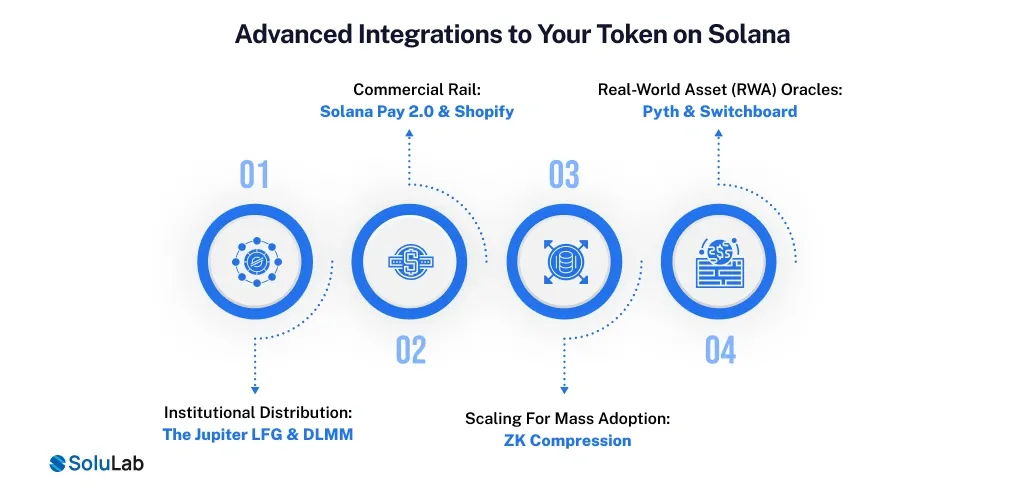
Don’t build “naked” tokens. For real estate or business use, you must integrate native extensions:
1. Institutional Distribution: The Jupiter LFG & DLMM
Forget simple “Listing.” You want to integrate with Jupiter, the “brain” of Solana’s liquidity:
- DLMM (Dynamic Liquidity Market Maker): Instead of a static pool, you integrate with Jupiter’s DLMM. This allows your token to have “infinite depth” at a specific price, preventing massive price crashes when someone sells, a huge selling point for investors.
- Jupiter LFG Launchpad: High-quality projects don’t just “launch”. They integrate with the LFG DAO to gain access to over $1B in community liquidity and instant verification on the “Strict List”.
2. Commercial Rail: Solana Pay 2.0 & Shopify
If your client wants their token to be useful, it must be spendable.
- Shopify Integration: 2026 saw a massive surge in the Solana Pay Shopify Plugin. You can integrate your token so that merchants can accept it directly at checkout, bypassing 3% credit card fees.
- Loyalty Airdrops: You can program the token so that when a customer buys a physical product (via Shopify), a “loyalty NFT” or “reward token” is instantly minted and sent to their wallet.
3. Scaling for Mass Adoption: ZK Compression
This is the “killer feature” of 2026.
- The Problem: Storing data for 1,000,000 token holders on Solana used to be expensive.
- The Integration: By using ZK Compression, your firm can help a company issue millions of fractional real estate tokens for 90% less cost than standard tokens. You are essentially “compressing” the blockchain data into a tiny proof, making mass-scale asset issuance viable for the first time.
4. Real-World Asset (RWA) Oracles: Pyth & Switchboard
For real estate tokenization, the token price shouldn’t just be “market-driven”—it should reflect the property’s actual value.
Oracle Integration: Integrate Pyth Network or Switchboard to pull real-world appraisal data (e.g., from Zillow or specialized property data feeds) directly into the token’s smart contract. This ensures the “Price Floor” of the token stays anchored to the physical asset.
Read more: Tokenization for boutique investment banks
How Much Does it Cost to Create Tokens on Solana?
On Solana, the process of launching a token comprises several processes, each of which has a related cost to create a token on Solana. A breakdown of the most important components and their expenses is as follows.
| Component | Expense |
| Initial Designing | $1,000-$5,000 |
| Token Design | $2,000-$10,000 |
| Development | $10,000-$50,000 |
| Testing and Auditing | $5,000-$20,000 |
| Deployment | $100-$500 |
| Marketing The Token | $5,000-$50,000 |
| Legal Compliance | $5,000-$20,000 |
| Overall Total Cost | $30,000-$150,000 |
Major Requirements for Creating Solana Token
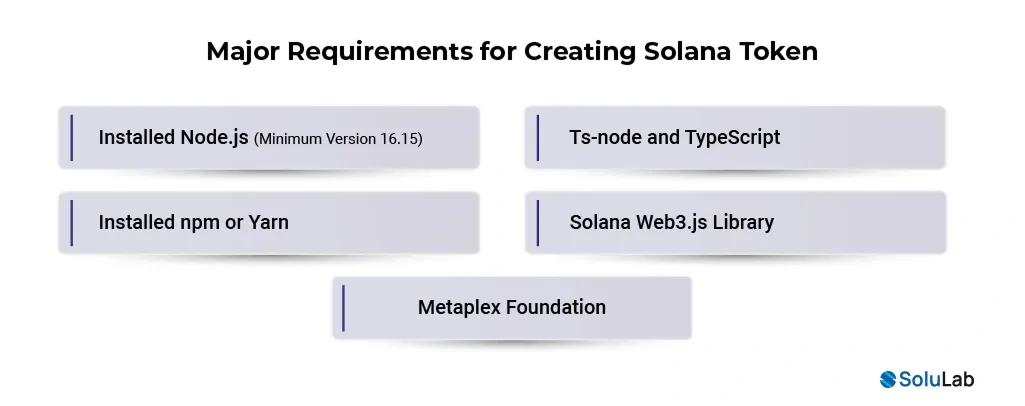
A few key technologies and techniques are needed to create a token on the Solana blockchain. These require the use of Solana to deploy Solana smart contracts, strong infrastructure, and guarantee seemed to be the development process.
- Installed Node.js (Minimum Version 16.15)
Building and executing JavaScript-based applications requires Node.js to ensure compatibility with the most recent libraries and frameworks utilized in Solana development, make sure your system is Node.js 16.15 version or higher.
- Installing npm or Yarn
Installing dependencies and initializing your project requires package management such as npm or yarn. This could be based on your suitability. You can use it at your convenience, the Solana ecology broadly supports both.
- Ts-node and TypeScript
Maintaining and writing code is made easier with installed TypeScrip, particularly when utilizing Solana’s libraries. The ts-node package speeds up development by enabling typescript files to learn instantly without the need for any manual compilation.
- Solana Web3.js Library
The essential features required to communicate with the Solana blockchain are provided by the Solana Web3.js module. It enables developers to communicate with unchain programs, sign transactions, and create accounts.
- Metaplex Foundation
The MPL token metadata Library and the default plug-ins bundle from the Metaplex foundation are required to enable more complex features like integrating plug-ins and managing token metadata. These tools guarantee that you are tokens other than Solana’s token guidelines.
You may establish a scalable and reliable token within the Solana blockchain by getting these tools and resources ready.
Read more: Top RWA Tokenization Questions Answered for Enterprises Ask in 2026
How to Promote The Token?
On the top blockchain platforms, creating a token is just the beginning. A well-thought-out marketing strategy is necessary to draw users, developers, and investors to a project building a community, fostering trust, and encouraging adoption all facilitated by effective promotion. The following are some crucial tactics that you can use to advertise your Solana token.
1. Marketing on Social Media
For interaction with the blockchain community, social media platforms are essential. Announce achievements, provide instructional content and communicate updates on Twitter. It is a great place for in-depth conversations, question answering and raising awareness with Discord. You can create a community around it and communicate with investors and users in real-time, visibility is also increased by actively participating in pertinent crypto forums and the Solana community.
2. Partnerships and Cooperation
Working along with other initiatives within the Solana ecosystem can greatly increase the visibility of your coin. To incorporate your cryptocurrency into their services, collaborate with decentralized finance platforms, NIFT marketplace, or decentralized apps. Reaching new audiences can also be facilitated by organizing joint events running across promotions, or providing incentives for teamwork.
3. Incentive Plans
Offering incentives is a tried and true strategy to draw interest and foster loyalty. Through airdrops, you can give out early adopters free tokens, a particular use group, spark, interest, and grow the number of token holders. By locking those tokens, taking rewards gives users the chance to generate passive income while promoting long-term holding and lowering cell pressure. Other strategies to draw consumers include referral schemes and giving rewards.
You can successfully market your Solana coin, build a vibrant community, and set up your project toward success in blockchain technology by combining these tactics.
Growing With SoluLab and Understanding Solana Blockchain
One effective approach to using Blockchain-as-a-Service for your project businesses is to create your own token on Solana. With its high-speed network, low transaction fees, and scalable infrastructure, Solana provides the ideal foundation for launching blockchain solutions that can thrive in the evolving digital economy.
At SoluLab, our 250+ blockchain experts help businesses build innovative Solana-based solutions, including NFT-powered ownership systems, cryptocurrency wallets, digital asset management platforms, and custom blockchain applications.
- Our portfolio includes innovative blockchain solutions across digital asset management and Web3 ecosystems, including our work with DYNK.
- We helped DYNK develop a Solana-based platform where NFTs function as ownership keys for fully operational cryptocurrency wallets, redefining how users manage digital assets.
- This involved building secure wallet infrastructure, NFT-powered ownership mechanisms, seamless Solana blockchain integration, and a scalable architecture that delivers secure, efficient, and user-friendly digital asset management.
Are you ready to build your own Solana token and unlock new business opportunities? Contact SoluLab today and turn your vision into reality.
FAQs
Shipra Garg is a tech-focused content strategist and copywriter specializing in Web3, blockchain, and artificial intelligence. She has worked with startups and enterprise teams to craft high-conversion content that bridges deep tech with business impact. Her work translates complex innovations into clear, credible, and engaging narratives that drive growth and build trust in emerging tech markets.