Talk to an Expert

Top 11 Blockchain Trends to Follow in 2026

Blockchain Trend 2026

2026 is becoming a major turning point for digital money and enterprise blockchain. Big businesses, banks, global payment networks, and even governments are no longer testing blockchain. They are now using it for real financial operations, tokenized assets, and on-chain finance. The change is fast and happening across every major industry.

The global blockchain market size is estimated at $33 billion in 2026 and expected to grow at a compound annual growth rate (CAGR) of over 43% to reach nearly $393 billion by 2030. Meanwhile, over 137 countries are exploring CBDC, with 49 currently in pilot or launch stages.

If you are a founder, investor, or decision-maker, these trends matter. They tell you where the market is moving, what customers will expect, and how companies will use blockchain solutions to cut costs, move money faster, and unlock new business models. This guide gives you a clear view of the biggest Blockchain Trends for 2026 and shows how they will impact global finance, technology, and business growth.

How the Blockchain World Will Change from 2026 to 2030?

Before we talk about specific blockchain technology trends, it helps to zoom out and understand the size and direction of the market you are building for.

Analyst reports place the global blockchain market in the mid-tens of billions of dollars. By 2030, many expect it to reach hundreds of billions, or even low trillions, depending on what is counted, like crypto assets, tokenization, DeFi, and core infrastructure, but a few signals matter more than the big headline number:

  • Institutional finance is moving fast. Tokenized Treasuries, tokenized funds, and regulated institutional DeFi pilots are no longer small tests. They are becoming part of real financial systems.
  • The number of countries testing or exploring CBDCs has now crossed into triple digits. These pilots are also shifting from small local tests to real cross-border payment corridors.
  • Real-world asset tokenization (RWA) has grown from an idea into a multi-billion-dollar segment. Many now project it to reach double-digit trillions by 2030.

For you, this means the blockchain projects you build in 2026 are not side projects. They should be connected to where global liquidity, regulation, and infrastructure are heading over the next 5–10 years.

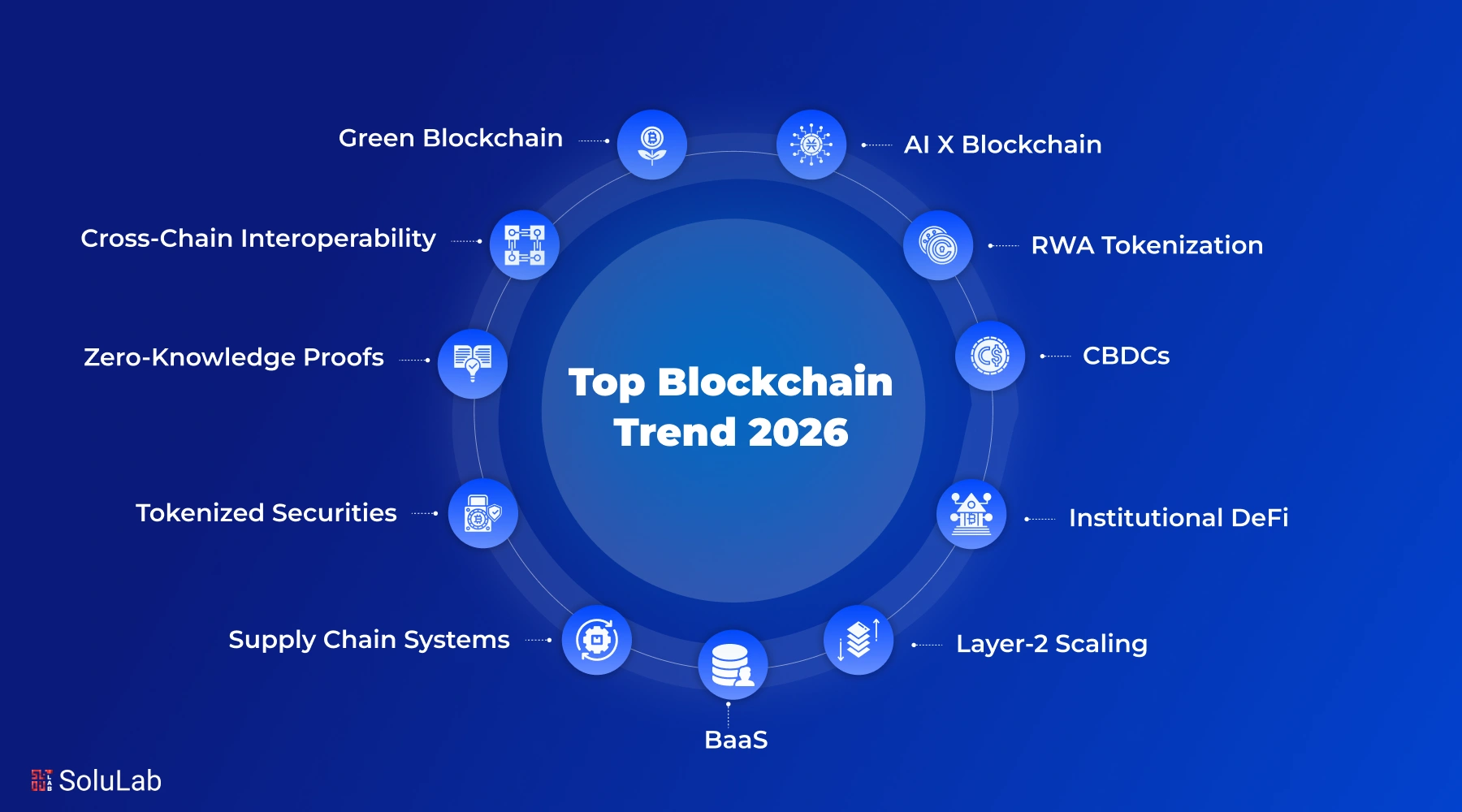
11 Big Blockchain Trends That Will Change 2026

Here are the 11 most important blockchain trends you should watch in 2026. These trends matter if you are building real products, raising money, or upgrading your tech systems. In all, these blockchain future trends will shape how money, data, and digital ownership move in 2026 and the years ahead.

1. Real-World Asset (RWA) Tokenization

If you follow only one blockchain trend in 2026, let it be this one. Real-world asset tokenization is already moving tens of billions of dollars of real estate, private credit, Treasuries, and other assets on-chain. RWA platforms let you break a building, a fund, or invoices into digital units that trade 24/7 with instant settlement and built-in compliance. Here is why you should care:

  • You can unlock liquidity from assets that were stuck in files and manual paperwork.
  • You can offer smaller ticket sizes to more investors without changing your whole system.
  • You can test new revenue ideas like streaming yields or auto-rebalancing that old banking systems can’t support.

From a business point of view, if something on your balance sheet is big, slow, and hard to move, tokenization will enter that market in the next 3–5 years. For example 

  • By late 2025, BlackRock’s BUIDL alone crossed $500M in tokenized Treasuries, becoming the world’s largest on-chain fund. 
  • Franklin Templeton and Ondo Finance together manage billions in tokenized real estate and private credit. Even JPMorgan is running tokenized private credit pilots on-chain.

This is one of the clearest blockchain predictions for 2026, and it’s already live in real products.

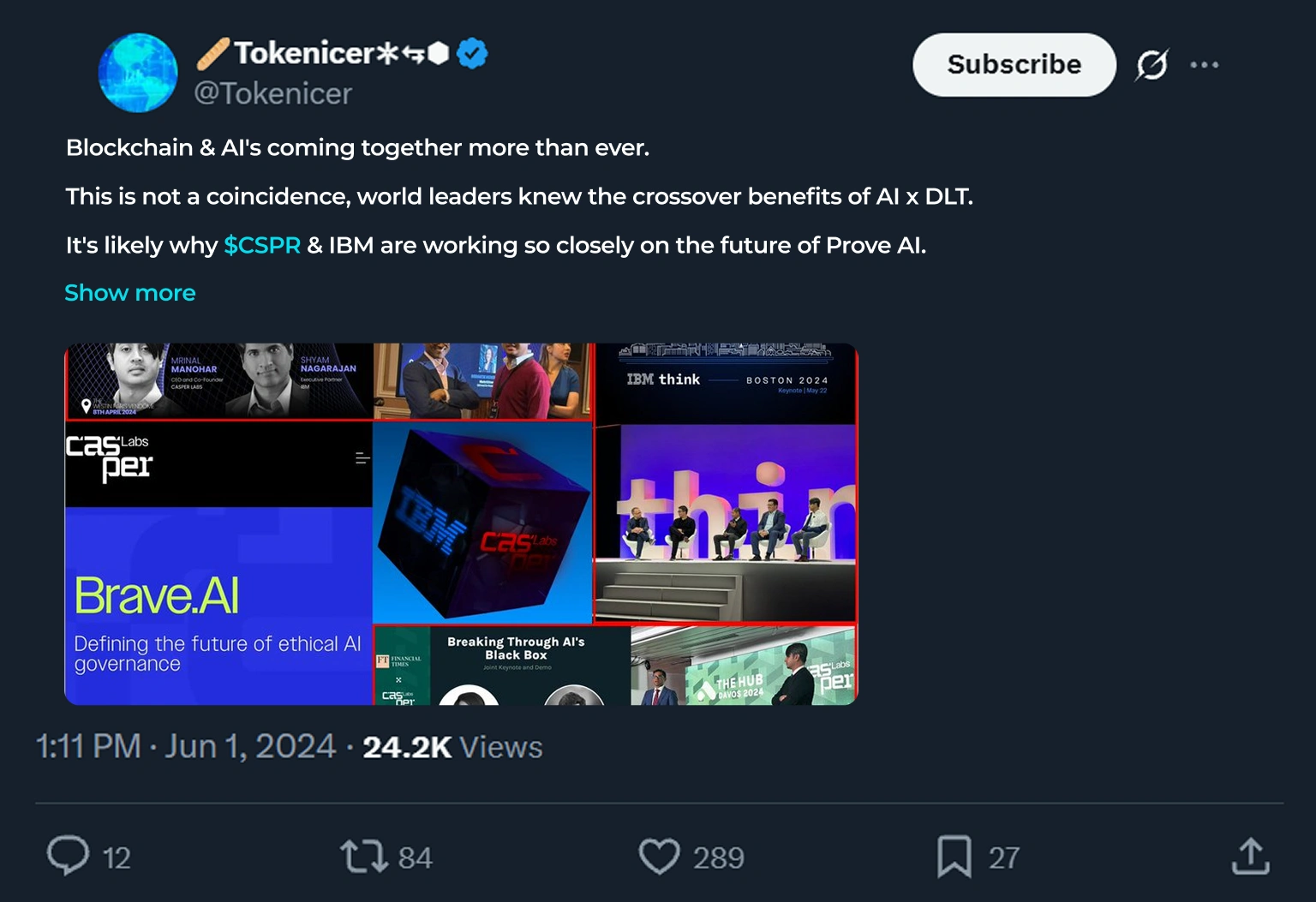
2. AI x Blockchain Convergence  
AI x Blockchain Convergence

From 2023 to 2025, everyone was busy with AI, but in 2026, founders finally started asking, that How do I make my AI safer, more transparent, and easier to monetize. That is where AI with blockchain becomes one of the biggest blockchain trends for real businesses. Blockchain for AI helps with:

  • data provenance (proving where training data came from)
  • on-chain audit logs for AI models
  • clear royalty and attribution flows

AI for blockchain helps with smarter risk engines, better fraud detection, automated governance, and dynamic settings for on-chain systems.

For example, Projects like SingularityNET, Fetch.ai, and Ocean Protocol have already proven working AI × Blockchain models. Enterprises now integrate these systems for regulated AI deployments where audits and traceability are required.

If you run any AI product today, adding even a small on-chain layer for provenance or billing can move you closer to the latest blockchain development trends, instead of looking like another black-box AI tool with a Stripe payment link.

3. Central Bank Digital Currencies (CBDCs)

Central Bank Digital Currencies (CBDCs)

Central Bank Digital Currencies (CBDCs) are no longer ideas on paper. In 2026, many countries will have strong pilots or small-scale launches, and some will run CBDCs at a large scale. CBDCs matter for businesses because they change how you:

  • Settle cross-border payments
  • Handle compliance and reporting
  • Build your wallet, treasury, or payment systems

CBDCs sit at the middle of blockchain technology trends, digital identity, and regulated finance.  For example – 

  • China’s e-CNY surpassed $986B in transactions, making it the largest CBDC pilot in the world.
  • Countries like the Bahamas, Jamaica, and Nigeria have already launched retail CBDCs.
  • The EU Digital Euro pilot is underway with a 2027 launch window.

If you ignore CBDCs while building any payment, banking, or treasury product for 2026, it will be like ignoring mobile apps in 2010.

4. Institutional DeFi
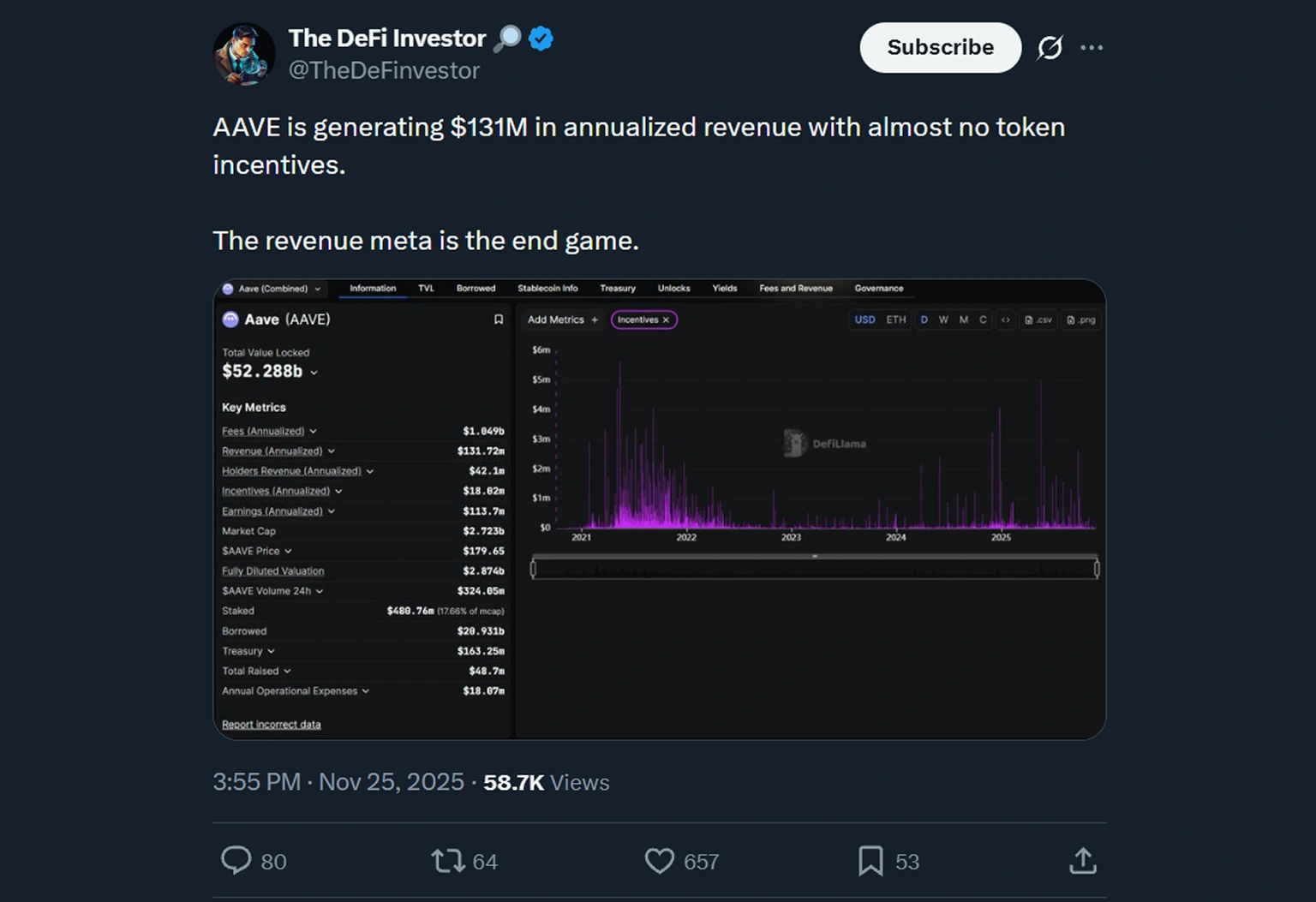
Institutional DeFi didn’t die after the early hype; it simply grew up. Now, large banks, asset managers, and regulated companies are testing on-chain finance with KYC, verified identities, and permissioned pools. They are running pilots in tokenized repo, tokenized collateral, on-chain FX, and even digital syndicated loans.

For a founder, institutional DeFi is not about yield farms anymore. It is about:

  • Cutting back-office costs with faster, automated systems
  • Building new on-chain product lines with transparent and programmable rules
  • Opening access to new markets, new users, and new capital flows

This is where enterprise blockchain trends start to matter. For example – 

  • JPMorgan’s Onyx and MAS’s Project Guardian have run institutional pools with verified identities since 2023.
  • Aave Arc and Syndicate Protocol provide institutional lending rails.
  • BlackRock and Securitize are issuing tokenized funds accessible through DeFi.

If your industry begins settling transactions on public blockchains with permissioned layers, then the tech stack, vendors, and architecture you choose in 2026 will shape your business for years.

5. Layer-2 Scaling Solutions
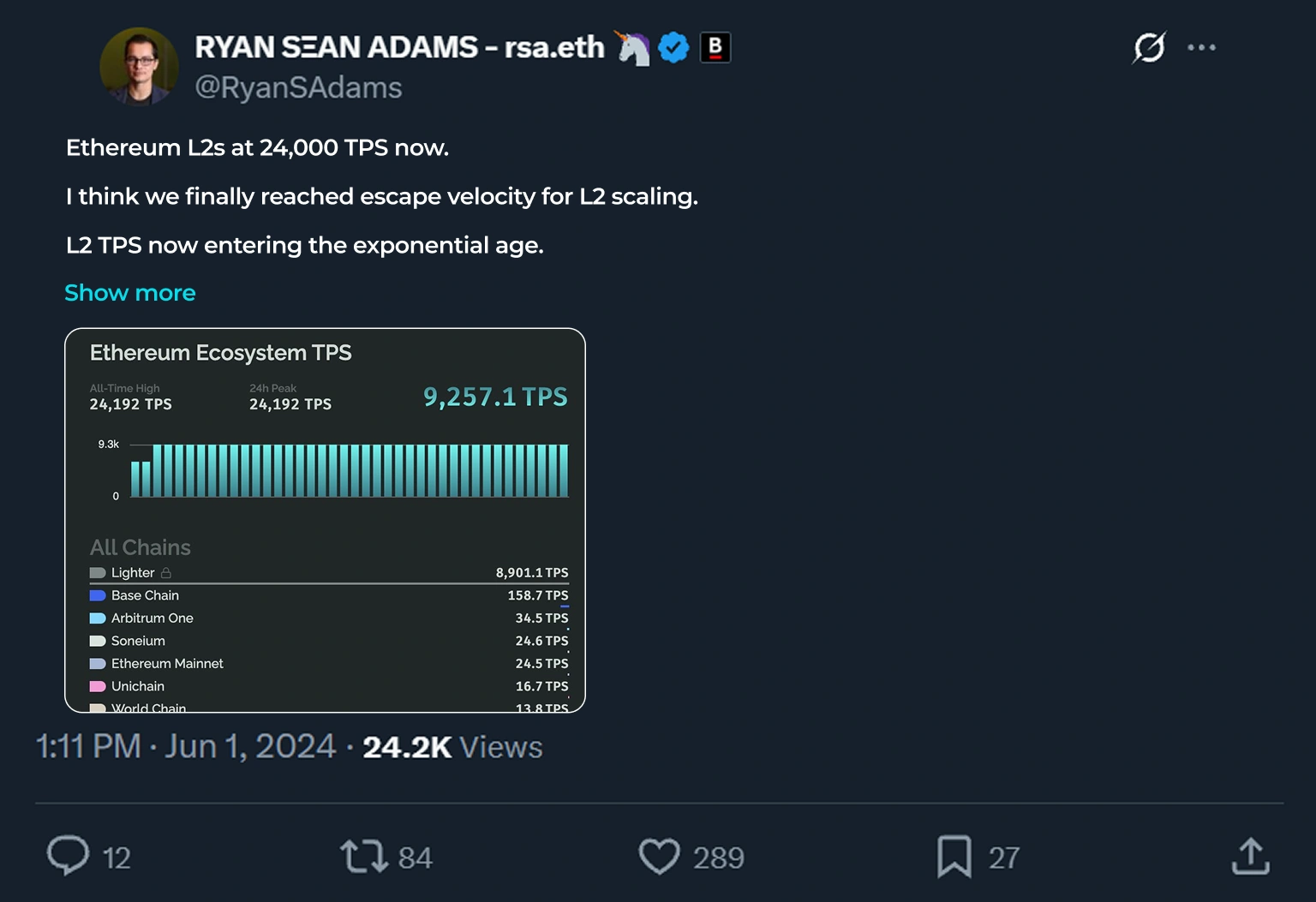
You can’t talk about blockchain future trends without talking about scaling. Layer-2 networks (L2s) on Ethereum and Bitcoin are now handling most real transactions. These include rollups, optimistic systems, zero-knowledge L2s, and payment channels.

  • Fees drop from dollars to a few cents
  • Speed goes from a few transactions per second to thousands
  • You still keep the security of a major Layer-1 chain

If you are building in payments, gaming apps, micro-transactions, IoT systems, or AI-powered agents space, you will almost always use an L2 instead of an L1. Here are the Real adoption numbers:

  • Arbitrum: $15B+ TVL, largest L2 ecosystem
  • Optimism: Backed by Coinbase integrations
  • Base: Fastest-growing consumer L2
  • StarkNet: Enterprise-trusted zkRollup

This is one of the most important blockchain development trends for founders, architects, and CTOs today.

6. Blockchain-as-a-Service (BaaS)

Blockchain-as-a-Service (BaaS)

Most teams today don’t want to run their own nodes, build custom explorers, or manage security systems. They want simple tools, managed hosting, and ready-made blockchain infrastructure.

That’s why Blockchain-as-a-Service (BaaS) is becoming one of the most important blockchain industry trends. Big cloud companies and Web3 infra providers now offer hosted nodes, fast indexers, strong APIs, monitoring dashboards, testing tools, and full turnkey setups. 

With BaaS, businesses can build blockchain apps without worrying about servers, uptime, or heavy DevOps work. Here are a few enterprises like AWS, Azure, IBM, and Oracle that now dominate BaaS, and over 90% of enterprise blockchain deployments use BaaS to reduce cost and ship faster.

BaaS also helps with scaling, multi-chain support, security audits, RPC load balancing, and easy upgrades. Teams can focus on their product while the BaaS platform handles all the hard technical work in the background. For many companies, this means faster launches, fewer risks, better performance, and lower long-term costs.

7. Supply Chain & Provenance Systems
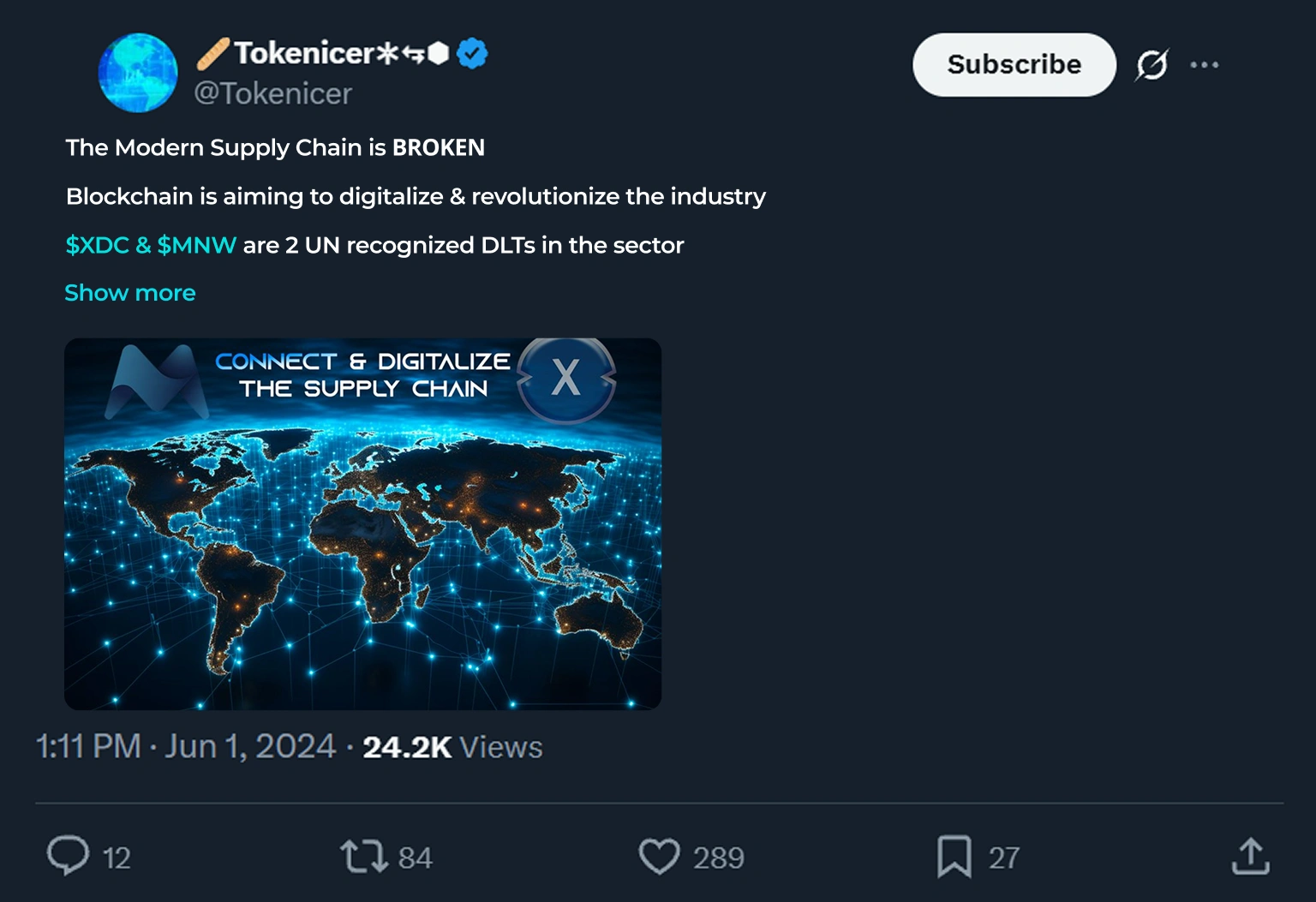
Supply chain and provenance tools were hyped early, but today they are becoming one of the strongest enterprise blockchain use cases. Real value is now clear in:

  • Lot-level tracking for food and pharma
  • Anti-counterfeit checks for luxury goods and key components
  • Carbon and ESG reporting linked to real product movement

It’s no longer about putting everything on a blockchain; it’s about adding just enough cryptographic proof in the right places so regulators, partners, and customers can trust what a company claims. For example – 

  • Walmart reduced traceability time from 7 DAYS to 2.2 SECONDS using blockchain.
  • De Beers tracks diamonds end-to-end to eliminate counterfeiting.

For many mid-market manufacturers, logistics teams, and retailers, this will be their first real step into blockchain development and supply chain blockchain systems in 2026.

8. Tokenized Securities & Treasury Bills

Tokenized Securities & Treasury Bills

In 2026, tokenized Treasuries quietly crossed several billion dollars in AUM. In 2026, this entire category will grow even more and expand into new asset classes. Today, you already see:

  • Tokenized government bonds
  • On-chain money market funds
  • Tokenized private credit and real estate portfolios

These tokenized assets are now used for yield products, treasury operations, and daily cash-management tools. The biggest shift is how tokenized securities bring faster settlements, better liquidity, transparent audits, and easy global access. Here are a few live examples:

  • BlackRock BUIDL & Franklin Templeton Utilize Securities and created $7.3B+ AUM
  • Ondo Finance is running corporate repo and credit products
  • JPMorgan is testing tokenized money market workflows

Banks, asset managers, and fintechs are now exploring on-chain versions of T-Bills, corporate bonds, repo markets, and credit products because tokenization cuts costs, reduces errors, and speeds up the entire workflow.

9. Zero-Knowledge Proofs (ZK-Tech)

Zero-Knowledge Proofs (ZK-Tech)

Zero-knowledge proofs are no longer just research. Today, ZK-tech is used in privacy Layer 2s, digital identity tools, and even compliance systems. ZK-tech is important because it lets you:

  • Prove something about your data, like age, KYC, or solvency, without sharing the data
  • Follow privacy rules while still giving partners or regulators verified proof
  • Build safer finance apps, health systems, public tools, and consumer products

As global rules around data get tighter, zero-knowledge proofs are becoming one of the most important blockchain innovations for businesses to understand. zkSync, Polygon ID, and Aztec Network are already used globally by banks, fintechs, and enterprises. 
CTA1

10. Cross-Chain Interoperability

Cross-Chain Interoperability

By 2026, no serious company can depend on only one blockchain. The market moves too fast, and users expect smoother, bigger networks. That’s why bridges, messaging layers, and interoperability protocols are becoming core parts of Web3, and Chainlink CCIP, LayerZero, Wormhole, and Cosmos IBCare are now the base layer for real products. For founders and teams, this means:

  • Build with multi-chain support from day one
  • Make the chain invisible to users
  • Plan for future liquidity, rules, and ecosystems, not just today’s trends

11. Green & Sustainable Blockchain 
Green & Sustainable Blockchain

This is one of the key blockchain technology trends that will decide if your app feels stuck on one chain or works smoothly across the full Web3 world. It’s a major factor in long-term product success and user trust.

Today, regulators, investors, and large companies want clear answers about energy use, carbon impact, and sustainability. This is pushing people to think in a more serious way about how blockchain platforms affect the environment.

You will see:

  • More chains sharing audited energy reports
  • More companies are asking for proof-of-stake or other low-energy systems
  • More use of on-chain carbon tracking and digital carbon offset tools

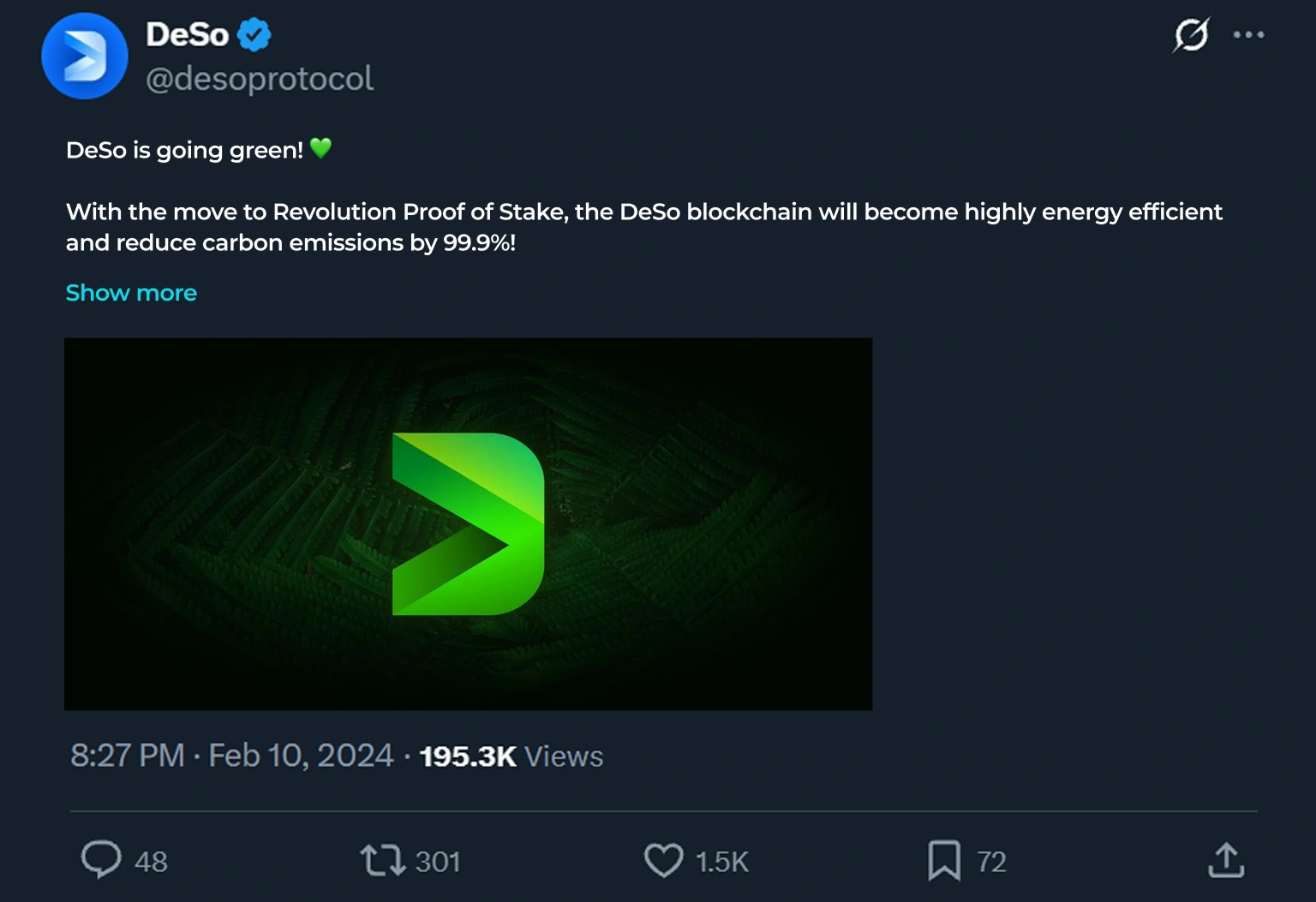
If you sell blockchain solutions to enterprises, staying aligned with these sustainability-focused blockchain trends will help you close deals faster. Big companies now ask clear questions about energy use, carbon footprint, and long-term environmental impact, and they are already using Ethereum, Polygon, Deso, and Solana to publish verified energy usage reports.

They prefer green blockchain systems that run on proof-of-stake, use low-power nodes, and offer real data on how much energy the network uses. You will also see more interest in on-chain carbon tracking, digital carbon credits, and blockchain-based offset tools. These help companies meet ESG targets and report their climate numbers with confidence. 

How Enterprises Will Actually Use Web3 in 2026?

2026 is the year Web3 becomes a real enterprise tool, not just a crypto space. Because companies will start using it only where it truly helps their business. Here’s what you’ll see:

  • Finance: RWA tokenization, DeFi payment rails, CBDCs, and on-chain KYC
  • Supply chain: provenance tracking, real-time compliance, and ESG reporting
  • Healthcare: secure data, medical record integrity, and drug tracking
  • Media & gaming: digital ownership, loyalty systems, and assets that work across platforms

Most people won’t even call it Web3. They’ll just feel the benefits like faster settlement, better rewards, and smoother digital experiences. But behind the scenes, these are real blockchain future trends finally being used in day-to-day business operations.

How SoluLab Can Build Any of These 11 Use Cases in Just 4 Weeks?

If you want to turn your idea into a real Web3 product, SoluLab can help you build any of these 11 use cases in only 4 weeks. Our team works with blockchain, smart contracts, CBDC solutions, tokenization platforms, DeFi apps, and enterprise blockchain development. We follow a fast, reliable, and transparent system:

1. Week 1 — Plan & Architect

We map your idea, pick the right tech, and prepare the full flow for your crypto, tokenization, or CBDC-based system.

2. Week 2 — Smart Contracts & Backend Development

We develop secure smart contracts, set up all backend logic, and integrate major chains like Ethereum, Polygon, BNB Chain, or a private blockchain.

3. Week 3 — Frontend & Dashboard

We design a clean UI and link your user dashboard to the on-chain with backend logic.

4. Week 4 – 5 — Test & Launch

We run audits, QA, security checks, and prepare your product for launch.

CTA2

Conclusion  

The real value of learning about blockchain development trends is using them to make smarter business decisions. The biggest opportunities now sit in real assets, compliance, and efficiency. As a founder or leader, your edge comes from choosing one or two clear bets and executing well. 

Let’s turn your 2026 blockchain vision into a real MVP. Book a discovery call and get feedback in days, not months. A strong blockchain development company like SoluLab, should guide you with solid business outcomes, not noise. 2026 can be the year you watch these trends or the year you build with them.

FAQs

1. How do I decide which blockchain use case is right for my startup or company?

Start by looking at your biggest pain points around data trust, asset liquidity, and operational delays. Then check if tokenization, supply chain tracking, or compliant DeFi systems can solve them. Working with a skilled blockchain development company helps you map your real needs to the right solution, ensuring measurable ROI without guesswork.

2. Why should I consider working with a blockchain development agency instead of building in-house?

Agencies bring deep expertise, faster execution, and tried-and-tested frameworks that prevent costly mistakes. They help you pick the right architecture, meet compliance standards, and scale safely. For founders focused on growth and product-market fit, a blockchain development agency makes adoption smoother without adding extra internal load.

3. What are the typical timelines and costs involved in building blockchain-based solutions like tokenization or DeFi?

Timelines depend on complexity, but an MVP usually takes 4–6 weeks, costing around $75K–$250K. Full enterprise builds for tokenization or institutional DeFi take 6–10 months and can cross $500K. A reliable agency will give clear estimates that match your goals, scope, and compliance needs.

4. How can I ensure compliance and security when integrating blockchain into my product?

You need to align your solution with rules like MiCA, OFAC, and strong KYC/AML checks. Security means smart contract audits, safe key management, and penetration testing. Agencies with regulated-industry experience build these controls into the product from day one, lowering risk and supporting innovation in areas like asset tokenization services or compliant DeFi.

5. What ongoing support do blockchain development agencies provide after product launch?

A good agency offers continuous monitoring, updates, smart contract improvements, and help adjusting to new regulations. They support scaling, infrastructure upgrades, and new feature rollouts. With ongoing partnership, your solution stays secure, compliant, and ready for future trends like RWA tokenization and advanced payment systems.
 

The Future of Finance: Role of Blockchain Development in DeFi Ecosystem

The Future of Finance: Role of Blockchain Development in DeFi Ecosystem

The traditional financial system, despite its long-standing dominance, has shown glaring limitations that have prompted the search for a more inclusive, efficient, and transparent alternative. This archaic system, characterized by intermediaries, lengthy processing times, and restricted access, has left many individuals and businesses underserved, particularly in emerging economies. As technological innovation continues to reshape industries, the financial sector is no exception, giving rise to the phenomenon of Decentralized Finance (DeFi).

One of the primary limitations lies in the presence of intermediaries, which often result in cumbersome processes, increased transaction costs, and extended processing times. This not only contributes to inefficiencies but also excludes a significant portion of the global population from accessing financial services due to stringent requirements and geographical barriers. Furthermore, the lack of transparency within the traditional financial system has led to issues of hidden fees, unfair lending practices, and a general lack of accountability.

Read Also: Building Trust in a Digital World: The Power of Blockchain Development

At its core, DeFi represents a departure from the traditional financial system’s centralized control and intermediaries, replacing them with transparent, autonomous, and secure transactions enabled by blockchain. The crucial role played by Blockchain Development in shaping DeFi cannot be overstated, as it is the vehicle through which the principles of decentralization, automation, and security are realized.

What are the Core Principles of Decentralized Finance?

Decentralized Finance (DeFi) is a revolutionary concept that seeks to reshape the traditional financial landscape by leveraging blockchain technology and smart contracts to create an open, transparent, and permissionless financial ecosystem. At its core, DeFi envisions a world where financial services are accessible to anyone with an internet connection, eliminating the need for intermediaries and centralized authorities. This democratization of finance is underpinned by a set of core principles:

  • Decentralization

DeFi operates on decentralized networks like Ethereum, where transactions are validated by a distributed network of nodes rather than a central authority. This eliminates single points of failure and promotes censorship resistance.

  • Interoperability

DeFi aims to create a seamless environment where various applications and protocols can interact and complement each other, fostering a rich ecosystem of interconnected services.

  • Transparency

All transactions, agreements, and data on DeFi platforms are recorded on public blockchains, making them transparent and auditable by anyone. This transparency helps build trust among participants.

  • Accessibility

DeFi is designed to be accessible to a global audience, allowing individuals from all walks of life to engage in financial activities without the need for traditional banking infrastructure.

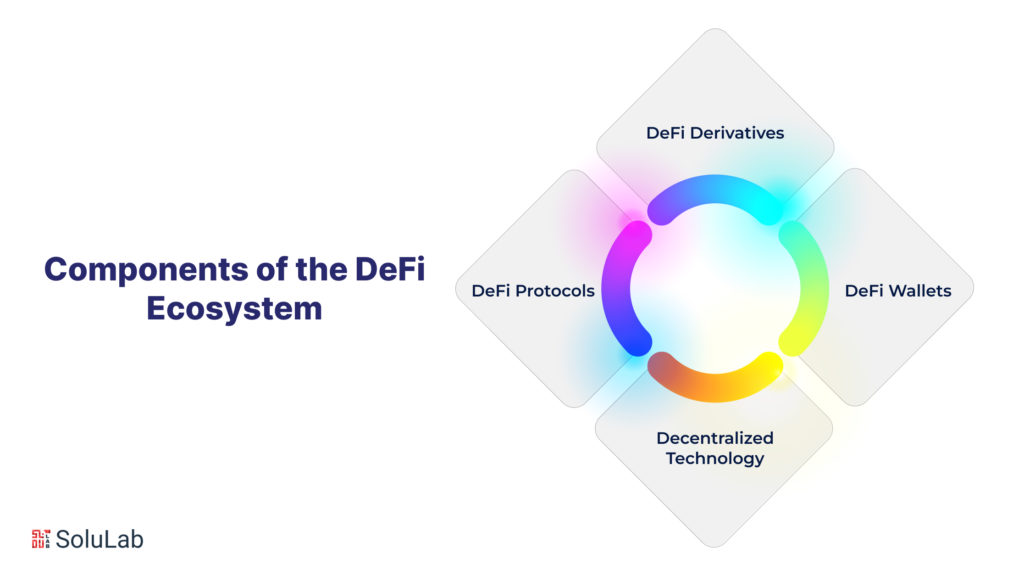
What are the Components of the DeFi Ecosystem?

What are the Components of the DeFi Ecosystem?

1. DeFi Protocols

DeFi protocols are the building blocks of the ecosystem, governing various financial activities through automated smart contracts. These protocols enable a wide range of functionalities, including decentralized exchanges (DEXs), lending and borrowing platforms, yield farming, and more. 

For instance, Uniswap and SushiSwap are popular DEX protocols that allow users to trade tokens directly without relying on centralized exchanges. Aave and Compound, on the other hand, facilitate lending and borrowing by allowing users to lend their assets and earn interest or borrow assets against collateral.

2. DeFi Derivatives

DeFi derivatives represent a realm of innovation within the ecosystem, offering ways to manage risk and speculate on various assets. Synthetic assets, for instance, allow users to gain exposure to traditional financial instruments like stocks, commodities, or indices without actually owning them. 

These assets are created through the use of smart contracts, which track the value of the underlying asset and replicate its price movements. This opens up new avenues for diversification and investment strategies within the DeFi ecosystem.

Read Our Blog: Top 10 Defi Lending Platforms in 2023

3. DeFi Wallets

DeFi wallets play a pivotal role in the ecosystem, serving as the gateway for users to interact with various DeFi protocols and applications. These wallets are often non-custodial, meaning users retain control over their private keys and funds. 

They enable users to seamlessly manage their assets, participate in liquidity provision, stake tokens for rewards, and execute transactions on DeFi platforms. By integrating with different protocols, DeFi wallets provide a unified and user-friendly interface for engaging with the ecosystem.

4. Decentralized Technology

Decentralized technology, primarily blockchain, forms the bedrock upon which the entire DeFi ecosystem is built. The immutability and transparency of blockchain enable secure and trustless transactions, while smart contracts automate the execution of agreements without the need for intermediaries. 

The adoption of decentralized technology allows DeFi to function seamlessly across borders, providing users with a level of control, security, and accessibility that traditional financial systems struggle to offer.

In the subsequent sections of this exploration, we will delve deeper into the evolution of DeFi protocols, the disruptive potential of DeFi derivatives, the role of DeFi wallets in enhancing user experience, and the challenges and prospects presented by decentralized technology within the DeFi landscape. As we unravel the intricate layers of the DeFi ecosystem, the transformative potential of blockchain technology becomes increasingly evident in reshaping the future of finance.

CTA1

How Does Blockchain Technology Play a Pivotal Role in Enabling the Functioning and Growth of the Decentralized Finance (DeFi) Ecosystem?

At the heart of the DeFi revolution lies the groundbreaking capabilities of blockchain technology. Blockchain serves as the foundational technology that underpins the entire DeFi ecosystem, providing the tools necessary to reshape traditional financial systems. One of the most significant contributions of blockchain to DeFi is its ability to eliminate intermediaries, promoting transparency, security, and efficiency in financial transactions.

By leveraging blockchain’s decentralized architecture, DeFi platforms can ensure that transactions are verified and recorded on a distributed ledger. This approach eliminates the need for traditional financial intermediaries, reducing costs and potential points of failure. Additionally, the immutability of blockchain ensures that once a transaction is recorded, it cannot be altered or tampered with, adding a layer of security and trust.

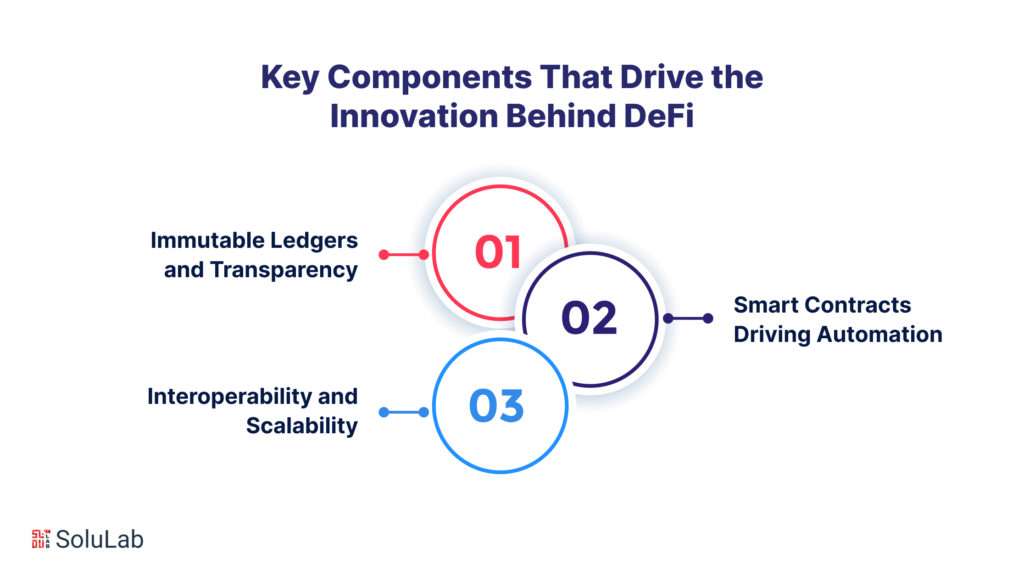
What are the Key Components That Drive the Innovation Behind DeFi?

What are the Key Components That Drive the Innovation Behind DeFi?

  • Immutable Ledgers and Transparency

At the core of blockchain’s value proposition is its ability to create immutable ledgers. Transactions are grouped into blocks, linked sequentially, and cryptographically sealed. This chain of blocks, or blockchain, forms a transparent and tamper-proof record of all transactions. In the context of DeFi, this transparency is crucial as it allows participants to independently verify transactions and activities, fostering trust within the ecosystem.

  • Smart Contracts Driving Automation

Smart contracts are self-executing contracts with code that automatically enforces the terms of an agreement. These contracts eliminate the need for intermediaries, as they execute actions based on predefined conditions being met. In DeFi, smart contracts enable various financial activities such as lending, borrowing, trading, and yield farming. This automation not only increases efficiency but also reduces the potential for human error and manipulation.

Read Also: 10 Best Defi Exchanges 2023

  • Interoperability and Scalability

Blockchain’s interoperability and scalability are essential for the expansion of DeFi. Interoperability allows different blockchain networks to communicate and share data, enabling users to access a wider range of services. Scalability, on the other hand, ensures that blockchain networks can handle a large number of transactions without congestion. As DeFi applications gain popularity, blockchain development focuses on enhancing these aspects to support the growing demand for efficient and seamless financial services.

In the subsequent sections of this exploration, we will delve deeper into the evolution of specific DeFi protocols, the innovative realm of DeFi derivatives, the significance of DeFi wallets, and the challenges and opportunities posed by decentralized blockchain technology. As we uncover the intricate layers of this transformative landscape, the indispensable role of blockchain development in shaping the future of finance becomes abundantly clear

Who are the Pioneers Of DeFi Protocols, and How Have They Transformed Decentralized Finance?

Top DeFi Protocols: A Closer Look at Pioneers

1. Uniswap

Uniswap stands as a trailblazer in the realm of decentralized exchanges (DEXs). By introducing an automated market maker (AMM) model, Uniswap enables users to trade tokens without relying on traditional order books. Instead, liquidity providers lock up assets in smart contracts, facilitating trading through algorithmic price adjustments. This innovation enhances liquidity and accessibility, paving the way for a new era of peer-to-peer token trading.

Read Our Blog Post: List of Top 10 Defi Savings Accounts

2. Compound

Compound has redefined the way individuals lend and borrow digital assets within the DeFi ecosystem. It introduced the concept of algorithmic interest rates, where lending and borrowing rates are dynamically determined based on supply and demand. This dynamic model ensures efficient capital allocation and has become a cornerstone of the DeFi lending landscape.

3. MakerDAO

MakerDAO has revolutionized stablecoins through its creation of DAI, a decentralized stablecoin pegged to the US Dollar. MakerDAO’s decentralized autonomous organization (DAO) governance model empowers users to participate in decision-making, ensuring the stability of DAI’s value. This fusion of stablecoins and governance exemplifies the democratic potential of blockchain technology in financial systems.

Advancements and Innovations in DeFi Protocols

  • Yield Farming and Liquidity Mining

Yield farming and liquidity mining represent groundbreaking mechanisms that incentivize users to contribute liquidity to DeFi platforms. Users can lock up their assets in liquidity pools, earning rewards in the form of additional tokens. These rewards act as a yield on their deposited assets, creating an ecosystem where users actively participate in protocol governance and growth while earning returns on their investments.

  • Flash Loans and Composability

Flash loans have introduced a new dimension to DeFi by allowing users to borrow assets without collateral as long as the loan is repaid within a single transaction block. This innovation has enabled complex financial operations, such as arbitrage and collateral swapping, within the DeFi ecosystem.  Composability, the ability of DeFi protocols to seamlessly interact with each other, further enhances the possibilities for creating intricate and efficient financial strategies.

Read Also: Top 10 Defi NFT Games to Look for in 2023

As we delve deeper into the innovative landscape of DeFi, it becomes evident that these protocols are not only redefining traditional financial paradigms but also pushing the boundaries of what is achievable in the digital realm. The subsequent sections will continue to explore the dynamic facets of DeFi, including the transformative potential of DeFi derivatives, the significance of DeFi wallets, and the role of decentralized technology in fostering this evolution.

What Role Do Blockchain Development Companies Play in the DeFi Ecosystem?

What Role Do Blockchain Development Companies Play in the DeFi Ecosystem?

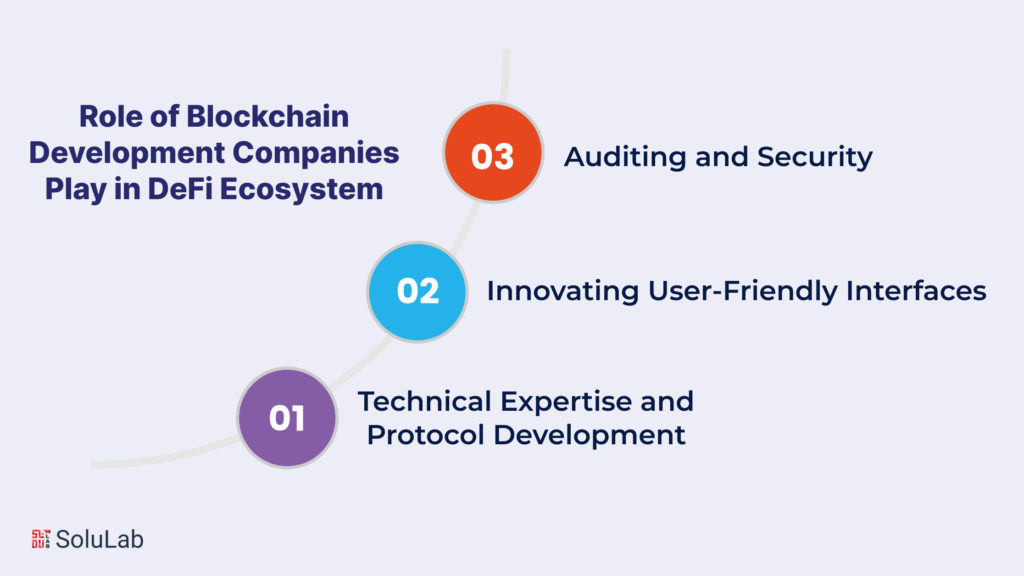
Blockchain Development Companies stand at the forefront of driving innovation within the DeFi ecosystem. These companies possess the technical expertise and experience necessary to build, deploy, and enhance the protocols, smart contracts, and platforms that constitute the DeFi landscape. Their role is multifaceted and crucial for the continued growth and success of DeFi.

Technical Expertise and Protocol Development

Blockchain Development Companies contribute their technical prowess to create the protocols that underpin various DeFi functionalities. These protocols, including decentralized exchanges, lending platforms, and yield farming mechanisms, rely on intricate smart contracts and innovative design. These companies ensure that these protocols are not only secure but also efficient, scalable, and user-friendly.

Innovating User-Friendly Interfaces

Usability is a critical aspect of DeFi adoption. Blockchain Development Companies design user interfaces that make it easier for individuals, regardless of technical expertise, to interact with DeFi platforms. By offering intuitive and user-friendly interfaces, they lower the entry barriers and encourage broader participation in the DeFi ecosystem.

Read Our Blog: What are the Benefits of Using Digital Identity with Blockchain in the Future?

Auditing and Security

The DeFi space demands a robust security framework due to the potential financial risks associated with smart contracts and protocol vulnerabilities. Blockchain Development Companies perform security audits to identify and rectify vulnerabilities in smart contracts, enhancing the overall safety of DeFi platforms and protecting users from potential risks.

How Do Collaborations and Partnerships Shape the Future of DeFi?

How Do Collaborations and Partnerships Shape the Future of DeFi?

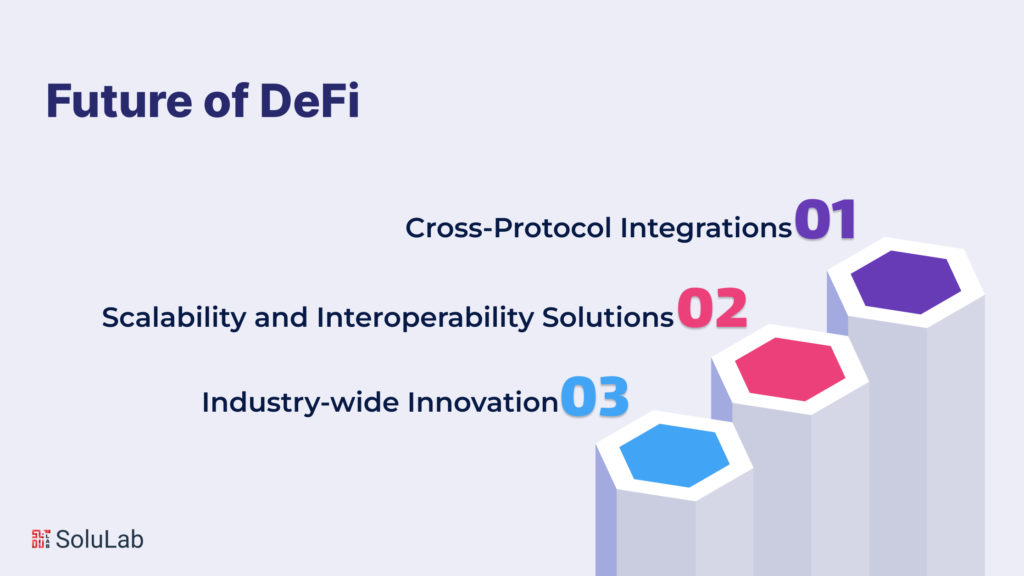
Collaborations and partnerships within the DeFi ecosystem are instrumental in driving innovation, expanding services, and fostering a more interconnected financial landscape.

  • Cross-Protocol Integrations

Blockchain Development Companies collaborate with other projects and protocols to create seamless integrations. These integrations enable protocols to interact and share data, creating a more holistic and interconnected DeFi ecosystem. For instance, a lending platform might collaborate with a decentralized exchange to provide users with convenient access to liquidity.

  • Scalability and Interoperability Solutions

Blockchain Development Companies play a pivotal role in developing solutions to address the scalability challenges faced by DeFi platforms. By working on layer 2 scaling solutions or cross-chain interoperability frameworks, these companies enable DeFi to accommodate a growing user base and diverse set of assets.

Read Also: DeFi Development – Use Cases, Challenges & Future

  • Industry-Wide Innovation

Collaboration within the DeFi ecosystem allows for the cross-pollination of ideas and expertise. This collaborative approach fosters industry-wide innovation, where projects learn from each other’s successes and failures, ultimately driving the evolution of DeFi to new heights.

As we explore the intersection of Blockchain Development Companies and the DeFi ecosystem, it becomes evident that these companies are not only the architects of DeFi’s infrastructure but also the catalysts for its growth and expansion. The subsequent sections will delve into the dynamic realm of DeFi derivatives, the innovative features of DeFi wallets, and the broader challenges and opportunities that lie ahead for this transformative financial landscape.

What are the Regulatory Challenges Faced by DeFi, and How Do They Impact its Growth and Adoption?

The rapid rise of Decentralized Finance (DeFi) has ignited a paradigm shift in the financial landscape, offering a decentralized and borderless alternative to traditional financial systems. However, as the DeFi ecosystem continues to expand, it encounters a complex web of regulatory challenges that have the potential to significantly influence its growth and adoption.

Uncertainty in Regulatory Frameworks

One of the key challenges faced by DeFi is the lack of clarity in existing regulatory frameworks. DeFi operates in a decentralized and cross-border manner, making it challenging for regulatory authorities to define the jurisdiction and establish rules that apply uniformly. The absence of clear guidelines leaves DeFi participants uncertain about the legality of their activities and exposes them to potential legal risks.

Conflict with Traditional Regulations

DeFi’s decentralized nature contradicts the traditional regulatory approach that relies on intermediaries for oversight. Concepts like pseudonymous transactions and smart contract automation, while central to DeFi’s innovation, may clash with traditional anti-money laundering (AML) and know-your-customer (KYC) regulations. This conflict between the DeFi ethos and traditional regulations can hinder adoption, particularly by institutions and risk-averse users.

Consumer Protection and Investor Risks

The decentralized nature of DeFi platforms can make it challenging to enforce consumer protection measures and address investor risks. Scams, hacks, and vulnerabilities can lead to significant financial losses for users. The absence of intermediaries means that users may have limited recourse in case of disputes or fraudulent activities.

Read Our Blog: 7 Best Defi Trading Platforms in 2023

Impact on Innovation and Development

Overly stringent regulations could stifle the innovative spirit of DeFi and deter developers from exploring new possibilities. Regulatory hurdles might lead to a fragmented ecosystem with projects either avoiding compliance or relocating to jurisdictions with more favorable regulatory environments. This could potentially limit the growth of the DeFi ecosystem and curtail the benefits it offers.

Fragmented International Approach

The global nature of DeFi exacerbates regulatory challenges, as different countries have varying approaches to blockchain and digital assets. A lack of harmonization in regulations can lead to confusion for global users and impede cross-border participation.

Impacts on Growth and Adoption

The regulatory challenges facing DeFi can significantly impact its growth trajectory and user adoption in several ways:

Read Also: 9 Best Defi Staking Platforms in 2023

  • Deterrence for Institutional Investors

Traditional financial institutions and institutional investors often prioritize regulatory compliance and legal certainty. Uncertainty surrounding DeFi’s regulatory status might discourage its entry into the ecosystem, limiting the influx of capital and expertise.

  • Reduced Retail User Participation

Regulatory concerns can discourage retail users from entering the DeFi space, especially those who are risk-averse or less familiar with the intricacies of blockchain technology. A lack of regulatory clarity may make potential users hesitant to engage with DeFi platforms.

  • Inhibited Innovation

Overly restrictive regulations might discourage developers from creating new and innovative DeFi protocols. This could limit the diversity of services offered within the ecosystem and hinder its overall development.

  • Geographical Fragmentation

Disparate regulatory approaches across jurisdictions can lead to fragmented services and platforms. Users might have limited access to certain DeFi services based on their geographical location, hampering the vision of a globally accessible financial ecosystem.

CTA2

Conclusion 

In the ever-evolving landscape of finance, the role of blockchain development in shaping the future cannot be overstated. As we’ve journeyed through the intricacies of the DeFi ecosystem and its reliance on blockchain technology, one name that stands out for its potential to drive transformative change is SoluLab.

SoluLab, a leading blockchain development company, showcases its prowess in blockchain development, placing it at the forefront of the DeFi revolution. With a deep understanding of the nuances of blockchain architecture, smart contracts, and decentralized applications, SoluLab, as a dedicated blockchain development company, is poised to shape the DeFi landscape in profound ways.

In a world where innovation and collaboration are paramount, SoluLab’s expertise becomes an invaluable asset. By crafting robust and secure protocols, they empower DeFi platforms to operate seamlessly while ensuring the safety of users’ assets. SoluLab’s contributions extend beyond just code; they are instrumental in creating user-friendly interfaces that break down barriers to entry, making DeFi accessible to a broader audience.

SoluLab, a leading deFi development company, places a strong emphasis on security and audit practices, bolstering the credibility of DeFi projects. In an arena where vulnerabilities carry significant repercussions, their meticulous approach and thorough testing effectively minimize potential hazards, cultivating an atmosphere of assurance and dependability. Furthermore, SoluLab’s commitment to innovation harmonizes seamlessly with the ever-changing realm of DeFi. As the landscape progresses, their proficiency equips them to adeptly craft and implement solutions tackling new obstacles, whether linked to scalability, interoperability, or regulatory adherence. To embark on a secure and forward-looking deFi journey, contact SoluLab today.

FAQs

1. What is the significance of blockchain development in the DeFi ecosystem?

Blockchain development plays a pivotal role in the DeFi ecosystem by enabling the creation of secure, transparent, and decentralized financial applications and protocols.

2. How does blockchain technology contribute to the growth of DeFi protocols?

Blockchain technology provides the underlying infrastructure for DeFi protocols, ensuring trustless transactions, immutability, and tamper-proof records, thereby fostering the growth of the DeFi ecosystem.

3. What is the role of a blockchain development company in the DeFi space?

A blockchain development company specializes in creating and optimizing the technology stack required for DeFi applications. They design, build, and maintain the decentralized architecture that powers DeFi protocols.

4. Can you explain the concept of DeFi derivatives and its relationship with blockchain development?

DeFi derivatives are financial contracts whose value is derived from an underlying asset. Blockchain development facilitates the creation and execution of smart contracts that enable the trading, settlement, and management of DeFi derivatives in a transparent and automated manner.

5. What are some of the top DeFi protocols that showcase the impact of blockchain development?

 Top deFi protocols like Aave, Compound, Uniswap, and MakerDAO exemplify the influence of blockchain development. These protocols utilize decentralized blockchain technology to offer lending, borrowing, decentralized exchanges, and stablecoin issuance.

6. How do decentralized blockchain technologies contribute to the security of DeFi ecosystems?

Decentralized blockchain technology enhances the security of DeFi ecosystems by eliminating single points of failure, reducing the risk of hacks, and ensuring that transactions and smart contracts are executed without the need for intermediaries.

Building Trust in a Digital World: The Power of Blockchain Development

Building Trust in a Digital World: The Power of Blockchain Development

Understanding the concept of a Digital Trust Ecosystem

A digital trust ecosystem refers to a network of entities that use technology like Blockchain development to establish trust and enable secure transactions without third-party intermediaries. At its core, a digital trust ecosystem aims to remove the need for centralized authorities and middlemen by distributing trust among network participants.

In a digital trust ecosystem, trust is established through cryptographic techniques like digital signatures, hashing, and encryption. Entities can directly interact with each other without needing to go through banks, governments, or other institutions. This enables faster, cheaper, more transparent, and more secure transactions.

Digital trust ecosystems have applications in many industries. For example, a supply chain system can use Blockchain Development to track goods and payments between suppliers, manufacturers, distributors, retailers, and consumers. This establishes trust between entities that may not know or trust each other otherwise.

Read Also: What are the Benefits of Using Digital Identity with Blockchain in the Future?

Importance of Blockchain Technology in Building a Digital Trust Ecosystem

Blockchain technology is critical for constructing digital trust ecosystems. Blockchain Development provides a decentralized, distributed ledger that is immutable and transparent. This serves as the foundation for establishing trust between entities.

Key features of blockchain app development that enable trust include:

  • Decentralization – No single entity controls the network
  • Transparency – All participants can view transactions
  • Transactions are unchangeable and cannot be deleted.
  • Cryptography – Encryption and digital signatures enable trustless interactions
  • Consensus – Agreement on the network state without a central authority
  • Provenance – Goods and assets can be traced through the supply chain

By leveraging these attributes, Blockchain Development facilitates the creation of digital trust ecosystems. Participants can exchange assets and data peer-to-peer with confidence that transactions are valid and permanent.

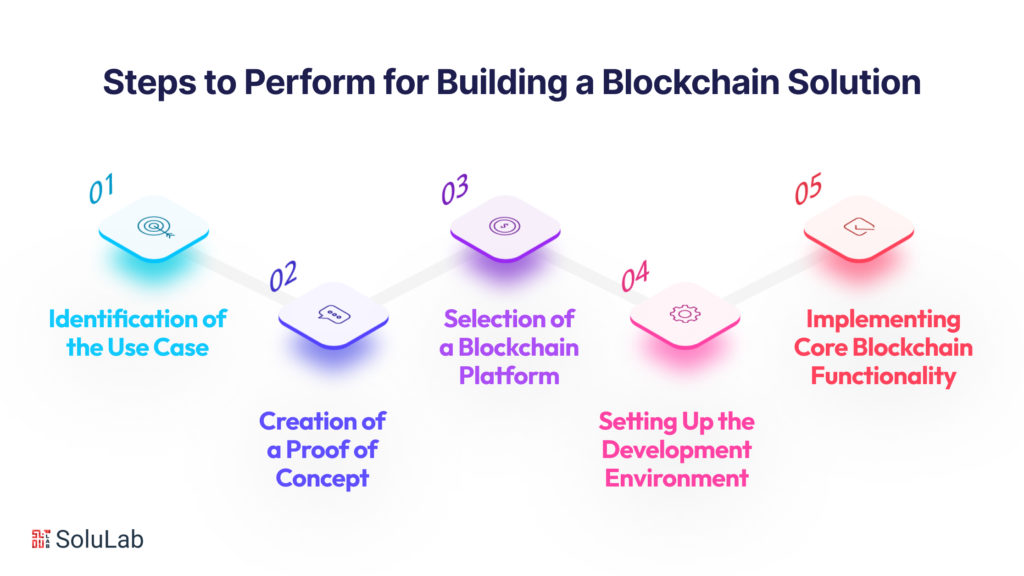
Steps to Perform for Building a Blockchain Solution

Steps to Perform for Building a Blockchain Solution

Step 1: Identification of the Use Case

Definition and Examples

A use case refers to a specific application of blockchain technology to solve a real-world problem or provide new functionality. Clearly identifying the use case is a critical first step in constructing a digital trust ecosystem.

Some examples of blockchain use cases include:

  • Supply chain tracking – Improving transparency and efficiency in supply chains
  • Digital identity – Securely establishing identity and credentials
  • Healthcare records – Enabling patients to control access to medical data
  • Digital voting – Conducting secure and transparent elections
  • Cross-border payments – Facilitating faster and cheaper money transfers

The use case should be clearly defined in terms of the problem being solved, the entities involved, and how blockchain adds value. This guides the overall design of the digital trust ecosystem.

Read Our Blog: Top 10 Blockchain Development Companies in 2023

Assessing if Blockchain is necessary or if a Centralized Platform is more suitable.

Not every use case requires a blockchain-based solution. Centralized platforms may be more suitable if:

  • There are no multiple distrusting parties
  • Intermediaries like banks already establish trust sufficiently
  • Transaction speeds and volumes are very high
  • Privacy is more important than transparency

On the other hand, blockchain app development is advantageous when:

  • Establishing trust between strangers is important
  • Disintermediation brings significant benefits
  • Permanent and tamper-proof records are critical
  • Transparency and provenance are required

Carefully evaluating the specific use case guides the decision on whether blockchain is truly necessary or if a centralized platform is better suited.

CTA1

Step 2: Creation of a Proof of Concept

Meaning and Importance of a Proof of Concept

A proof of concept (PoC) is a small-scale implementation of the blockchain use case to validate its feasibility. Building a PoC is important for several reasons:

  • Tests technical viability of the use case
  • Identifies any flaws in the concept
  • Demonstrates value to stakeholders
  • Provides a benchmark for assessing solutions
  • Reduces risk before full-scale development

The PoC focuses only on the core functionality needed to demonstrate the use case. It serves as an invaluable tool for gathering feedback and preventing wasted effort on ideas that may not work.

Read Also: Best Companies to Hire Blockchain Developers in 2023

Steps to Creating a Proof of Concept

Key steps involved in building a blockchain PoC include:

1. Defining the scope and objectives

2. Designing system architecture and workflows

3. Selecting the Blockchain Development services and tools

4. Implementing core features and functionality

5. Developing a basic UI for interaction

6. Testing transactions and use case scenarios

7. Documenting results and gathering feedback

8. Assessing feasibility and making improvements

The PoC provides the foundation for full-scale blockchain software development implementation. Lessons learned can inform the final solution design and technology choices.

Step 3: Selection of a Blockchain Platform

Overview of different Blockchain Platforms

There are many blockchain software development platform options to choose from when building a digital trust ecosystem. Some leading platforms include:

  • Ethereum – Decentralized blockchain with support for smart contracts
  • Hyperledger Fabric – Private Blockchain Development services framework focused on enterprise use
  • Corda – Distributed ledger platform designed for regulated industries
  • EOS – Infrastructure for decentralized apps with high scalability
  • Stellar – Payment-focused Blockchain Development services that connect financial institutions

Read Also: Top 10 Blockchain Platforms of 2023

Factors like use case requirements, transaction speeds, consensus model, governance, and tooling support guide the choice of a blockchain development solutions platform.

Choosing the Right Consensus Protocol and Overall Architecture

  • Understanding Consensus Mechanism

Consensus mechanisms allow blockchains to maintain a single state of records without a central authority. Different models like proof-of-work, proof-of-stake, and delegated proof-of-stake have unique tradeoffs.

The consensus model should be chosen based on factors like scalability needs, security guarantees, and energy efficiency.

  • Selecting Data Structures

Blockchain data structures organize data into blocks and chains. Alternatives like directed acyclic graphs provide greater flexibility. The data model impacts factors like scalability and transaction speeds.

  • Defining Network Protocols

Network communication protocols like gossip protocol and RAFT enable node-to-node messaging to share transactions and blocks. The right protocols need to be chosen based on performance needs and network assumptions.

Step 4: Setting Up the Development Environment

Importance of the Development Environment in Blockchain Implementation

The development environment provides the tools and frameworks for building and testing blockchain applications. Setting up a robust environment facilitates rapid iteration and deployment. Key elements include:

  • Blockchain technology platforms and libraries
  • Consensus algorithms and cryptography
  • Programming languages and frameworks
  • Wallets and accounts
  • Development and testing tools
  • Simulators and emulators

Read Our Blog: Top Blockchain Technology Companies in 2023

Having the necessary environment reduces development effort, enables debugging, and allows comprehensive testing before launch.

Choosing the right Programming Language

Popular blockchain programming languages include:

  • Solidity – For writing Ethereum smart contracts
  • Golang – For building Hyperledger Fabric applications
  • JavaScript/TypeScript – For developing client apps and web interfaces
  • Rust – For high performance and security
  • C++/Java – General purpose languages with Blockchain technology libraries

The language choice depends on the platform, performance needs, available skills, and integration requirements.

Installing and familiarizing with necessary Development Tools

Useful blockchain development tools include:

  • Truffle – Development framework for Ethereum
  • Ganache – Ethereum emulator for testing
  • Remix – Browser-based Solidity IDE
  • Metamask – Ethereum wallet browser extension
  • Postman – API testing toolchain

Becoming familiar with these tools creates a robust environment for building and testing blockchain applications.

Read Also: Top 25 Blockchain-Based Identity Management Startups

Step 5: Implementing Core Blockchain Functionality

Components of a Blockchain Network

Core components of a Blockchain technology network include:

  • Peer-to-peer communication between nodes
  • Transaction creation, propagation, and validation
  • Cryptographic identities and signing of transactions
  • A consensus protocol for block creation and confirmation
  • Data replication across nodes through a shared ledger
  • Scripting language for implementing business logic
  • Wallets for managing keys and transacting

These underlying components need to be implemented to establish blockchain developer network functionality.

Developing Smart Contracts

Smart contracts encapsulate business logic and programmatically enforce agreements on the blockchain developer. Developing smart contracts involves:

  • Defining contract terms, rules, and workflows
  • Writing code in a language like Solidity
  • Implementing functions for executing transactions
  • Deploying contracts to the blockchain network
  • Interacting with contracts through wallets or applications

CTA2

Conclusion

In a rapidly evolving digital landscape, building trust has become a cornerstone of successful interactions. As we navigate through a world heavily reliant on digital transactions and data sharing, blockchain technology emerges as a game-changer in establishing trust and transparency. Through its immutable and decentralized nature, blockchain development addresses the challenges of data security, provenance verification, and fraud prevention.

Incorporating blockchain into various industries showcases its potential to revolutionize processes, enhance efficiency, and foster collaboration. From supply chain management to finance and beyond, the power of blockchain is undeniable. SoluLab stands at the forefront of this transformation, offering blockchain software development services that empower businesses to harness the technology’s full potential.

As organizations seek to build trust with their customers, partners, and stakeholders, hiring a dedicated blockchain development agency becomes essential. SoluLab boasts a team of the best blockchain developers who are skilled in creating customized solutions tailored to unique business needs. Through their expertise, businesses can integrate blockchain solutions that enhance security, traceability, and accountability.

Blockchain’s impact goes beyond technology; it reshapes the way industries operate by reducing intermediaries, minimizing errors, and increasing efficiency. As you venture into the world of blockchain development solutions, SoluLab’s experience and commitment to excellence can guide your journey. Their blockchain development services extend a helping hand in harnessing blockchain’s transformative power, ensuring you stay ahead in the digital age.

In conclusion, as the digital landscape expands, trust becomes a currency of paramount importance. Blockchain development emerges as a beacon of trust, offering solutions that reshape industries and redefine the way we conduct transactions. SoluLab’s expertise in blockchain software development services empowers businesses to embrace this transformative technology. As you navigate the digital world, remember that building trust begins with innovative solutions, and blockchain development paves the way for a future where transparency and security reign supreme.

FAQs

1. What is blockchain’s role in building trust in the digital world?

Blockchain technology serves as a secure and transparent ledger that records transactions in an immutable and decentralized manner. This inherent nature of blockchain ensures data integrity, eliminates the need for intermediaries, and enhances trust among parties involved in digital interactions.

2. How does blockchain development impact various industries?

Blockchain development brings transformative benefits across industries such as finance, supply chain, healthcare, and more. By providing secure, traceable, and tamper-proof records, blockchain minimizes fraud, streamlines processes, and fosters collaboration among stakeholders.

3. Why is hiring a blockchain development agency crucial for businesses?

A specialized blockchain development agency, like SoluLab, offers expertise in crafting tailored solutions that align with your business needs. These agencies hire the top blockchain developers who understand the nuances of blockchain technology, ensuring optimal implementation and maximizing its benefits.

4. Can blockchain technology enhance data security?

Absolutely. Blockchain’s decentralized and cryptographic nature ensures that data is stored securely and can only be accessed by authorized parties. This heightened security significantly reduces the risk of data breaches and unauthorized alterations.

5. What distinguishes SoluLab in the blockchain development landscape?

SoluLab stands out for its comprehensive approach to blockchain software development services. With a team of experienced developers and a track record of successful projects, SoluLab offers end-to-end solutions that empower businesses to leverage blockchain’s potential effectively.

6. How can blockchain development contribute to transparency and accountability?

Blockchain’s transparency stems from its ability to provide an unalterable record of transactions accessible to all parties involved. This shared ledger ensures accountability as every transaction is verifiable, promoting trust and collaboration in digital interactions.

7. Is blockchain development limited to financial applications?

No, blockchain applications extend far beyond finance. It finds utility in supply chain management, healthcare records, identity verification, and more. The underlying principle of trust and data integrity applies across various sectors, making blockchain a versatile solution.

Blockchain in Automotive and Health Insurance

Blockchain in Automotive and Health Insurance

Blockchain technology has emerged as a revolutionary force across various industries, transforming traditional systems and unlocking new opportunities for innovation. In the automotive and health insurance sectors, blockchain’s potential to enhance transparency, security, and efficiency is garnering significant attention. Both industries face challenges related to data management, fraud prevention, and complex transactions, and blockchain solutions are poised to address these issues head-on.

Similarly, in the health insurance domain, blockchain holds immense promise in revolutionizing the way data is managed and shared. With patient information scattered across various healthcare providers and insurers, interoperability and data security become paramount concerns. Blockchain technology provides a unified and secure platform, allowing authorized stakeholders to access patients’ health records in a tamper-proof and privacy-preserving manner. 

In this era of digital transformation, blockchain’s potential in the automotive and health insurance industries is undeniable. As these sectors embrace this disruptive technology, they are set to witness a profound shift towards greater efficiency, transparency, and trust in their operations, ultimately benefiting both businesses and consumers alike.

Read Also: What are the Benefits of Using Digital Identity with Blockchain in the Future?

What are the Benefits of a Blockchain Healthcare Development Company?

What are the Benefits of a Blockchain Healthcare Development Company?

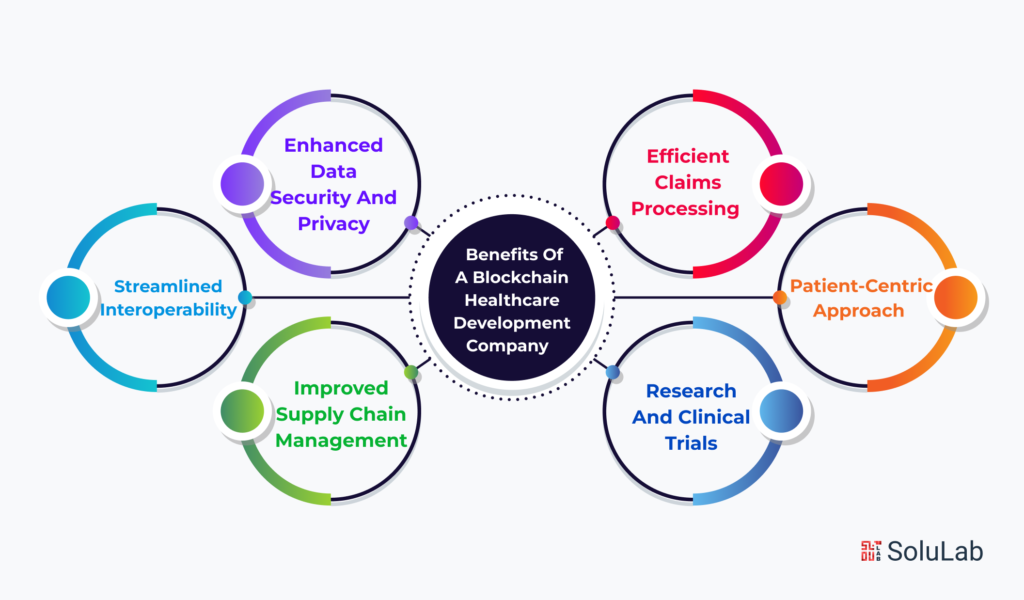
Blockchain technology has made significant strides in various industries, and the healthcare sector is no exception. As healthcare organizations seek more secure, transparent, and efficient ways to manage patient data and streamline processes, blockchain solutions offer a wide array of benefits. Engaging a specialized blockchain healthcare development company can prove to be a game-changer for healthcare providers, patients, and other stakeholders. Here are some key advantages of opting for a blockchain healthcare development company:

  • Enhanced Data Security and Privacy

One of the most significant benefits of blockchain technology in healthcare is its ability to ensure data security and privacy. Traditional healthcare systems often face security breaches and data leaks, exposing sensitive patient information. Blockchain’s decentralized and encrypted nature makes it extremely difficult for unauthorized individuals to access or tamper with data. Every transaction is recorded in a secure and immutable manner, providing healthcare providers and patients with peace of mind knowing that their data is safeguarded against cyber threats.

  • Streamlined Interoperability

Blockchain promotes interoperability by creating a single, unified platform for sharing and accessing patient data across different healthcare providers and facilities. This seamless exchange of information enhances care coordination and eliminates data silos, enabling healthcare professionals to make better-informed decisions and deliver more personalized and efficient care to patients. It also reduces administrative burden and redundant paperwork, leading to cost savings for healthcare organizations.

Read Our Blog: Top 10 Startups that are Revolutionizing Healthcare Industry Using Blockchain Technology

  • Improved Supply Chain Management

Blockchain technology can play a vital role in managing pharmaceutical supply chains. By tracking the entire journey of medications, vaccines, and medical devices through the supply chain, blockchain ensures the authenticity and integrity of these products. This level of transparency helps combat counterfeit drugs and ensures that patients receive safe and legitimate medications.

  • Efficient Claims Processing

For health insurers, blockchain streamlines claim processing and fraud detection. By automating claim verification and eliminating intermediaries, blockchain reduces the time and cost involved in settling claims. The immutability of blockchain records also facilitates fraud detection, as any suspicious activity or duplicate claims can be quickly identified and flagged.

CTA 1

  • Patient-Centric Approach

Blockchain healthcare solutions empower patients to take control of their health data. Through blockchain-based platforms, patients can grant and revoke access to their medical records, ensuring that only authorized individuals or entities can view their information. This patient-centric approach fosters trust between healthcare providers and patients, leading to improved patient engagement and satisfaction.

  • Research and Clinical Trials

Blockchain technology can also enhance medical research and clinical trials. By creating a secure and transparent platform for sharing research data, researchers can collaborate more effectively and accelerate medical discoveries. Smart contracts on blockchain networks can automate the execution of clinical trial protocols, ensuring compliance and accuracy throughout the process.

What are the Top Use Cases for Blockchain in Healthcare?

What are the Top Use Cases for Blockchain in Healthcare?

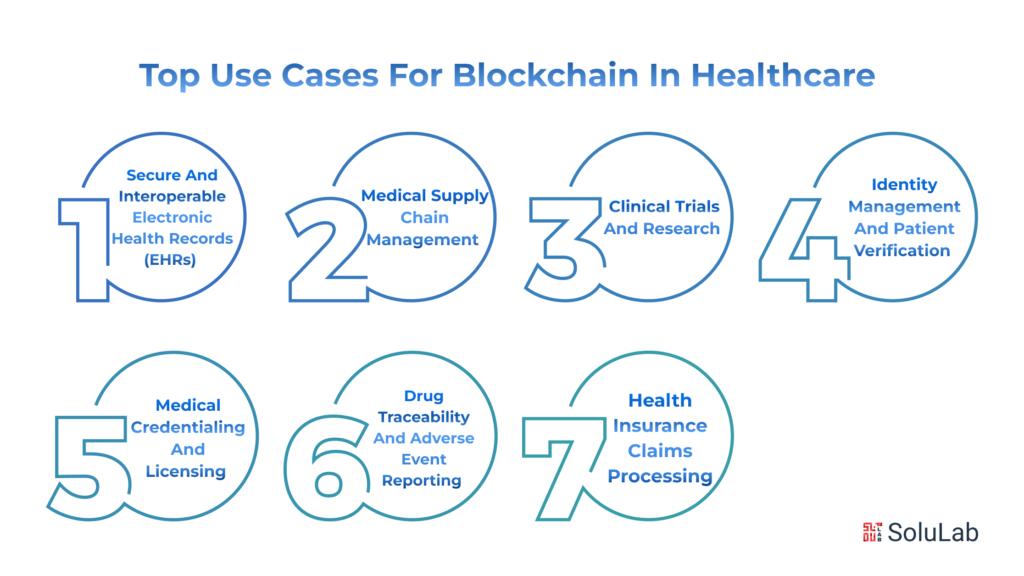
Blockchain technology has emerged as a transformative force in the healthcare industry, presenting numerous use cases that address critical challenges and revolutionize traditional processes. The immutability, security, and decentralized nature of blockchain make it an ideal fit for enhancing data management, interoperability, and patient care. Here are some of the top use cases for blockchain in healthcare:

  • Secure and Interoperable Electronic Health Records (EHRs)

Blockchain enables the creation of a secure and interoperable EHR system by providing a decentralized and tamper-proof platform for storing patient health records. Patients can grant permission to healthcare providers and institutions to access their EHRs, ensuring seamless data exchange without compromising privacy. This enhanced interoperability streamlines care coordination and allows medical professionals to access up-to-date patient information, leading to more accurate diagnoses and personalized treatment plans.

Read Our Blog Post: How Blockchain provides opportunities for healthcare?

  • Medical Supply Chain Management

Blockchain can significantly improve the management of pharmaceutical and medical supply chains. By creating an unalterable record of each step in the supply chain, from manufacturing to distribution, blockchain ensures the authenticity and quality of medications and medical devices. This transparency helps combat counterfeit drugs, reduce the risk of medical errors, and enhance patient safety.

  • Clinical Trials and Research

Blockchain simplifies the process of conducting clinical trials and medical research. Smart contracts on blockchain networks can automate consent management, data sharing, and compliance with trial protocols. This automated approach streamlines data collection, analysis, and verification, accelerating the pace of medical research and improving the efficiency of clinical trials.

  • Identity Management and Patient Verification

Blockchain offers a secure solution for managing patient identities and verifying patient information. Patients can have a unique digital identity on the blockchain, ensuring that their medical history and personal data remain protected and verified. This reduces the risk of medical identity theft and fraud, allowing healthcare providers to deliver better-targeted care.

  • Medical Credentialing and Licensing

Blockchain simplifies the process of medical credentialing and licensing for healthcare professionals. Credentials, licenses, and certifications can be securely stored on the blockchain, and verification of these qualifications becomes more efficient and accurate. This helps healthcare organizations ensure that their staff members are qualified and compliant with regulatory requirements.

  • Drug Traceability and Adverse Event Reporting

Blockchain technology can facilitate the tracking and tracing of pharmaceuticals throughout the supply chain. It enables the recording of every transaction involving a drug, from manufacturing to dispensing, providing an auditable record of the drug’s journey. Additionally, adverse event reporting can be improved by utilizing blockchain to capture and share real-time data on drug reactions, enabling faster responses and improved drug safety.

Read Also: Top Healthcare Blockchain Companies 

  • Health Insurance Claims Processing

Blockchain streamlines health insurance claims processing, reducing administrative overhead and enhancing fraud detection. Smart contracts can automate claim verification and settlement processes, making the system more efficient and reducing the time taken to process claims. The transparency and immutability of blockchain records also aid in identifying fraudulent claims and mitigating risks.

What are the Constraints of Utilizing Blockchain in Health Insurance?

While blockchain technology offers a plethora of benefits for the healthcare industry, including health insurance, certain constraints, and challenges need to be carefully considered. As with any emerging technology, there are hurdles to overcome to ensure successful implementation and integration. Here are some of the key constraints of utilizing blockchain in health insurance:

  • Regulatory and Compliance Issues

The healthcare industry is highly regulated, and the introduction of blockchain technology must navigate various legal and compliance challenges. Data privacy and security regulations, such as the Health Insurance Portability and Accountability Act (HIPAA) in the United States, impose stringent requirements on handling sensitive patient data. Integrating blockchain in health insurance must align with these regulations to protect patient privacy while enabling secure data sharing and accessibility.

  • Data Standardization and Interoperability

Blockchain’s potential in health insurance lies in creating a decentralized and interoperable system for sharing patient data across different providers and insurers. However, achieving true interoperability requires the standardization of data formats and protocols. The lack of standardized data in the healthcare sector may hinder the seamless exchange of information, making it challenging to fully leverage the benefits of blockchain technology.

Check Out Our Press Release: SoluLab Bridging the Gap Between Technology And Innovation

  • Scalability and Transaction Throughput

Blockchain networks, especially public ones, often face scalability issues and limited transaction throughput. In the context of health insurance, where numerous transactions occur daily, a blockchain’s capacity to handle a high volume of data becomes crucial. Scalability solutions, such as sharding or off-chain processing, need to be implemented to ensure that blockchain networks can accommodate the demands of the health insurance industry effectively.

  • Data Onboarding and Integration

Migrating existing data and systems to a blockchain-based infrastructure can be a complex process. Health insurers have vast amounts of historical data that need to be carefully onboarded onto the blockchain while maintaining data integrity and accuracy. Additionally, integrating blockchain with legacy systems and electronic health record (EHR) platforms can present technical challenges that require meticulous planning and execution.

  • Cost and Resource Investment

Implementing blockchain technology in health insurance requires significant investment in terms of time, resources, and expertise. Developing and maintaining a robust blockchain network necessitates specialized skills, including blockchain development, cybersecurity, and data management. The initial costs and ongoing operational expenses can be substantial, and healthcare organizations must weigh these expenditures against the potential benefits.

  • Resistance to Change

The healthcare industry is traditionally conservative when it comes to adopting new technologies. Embracing blockchain may encounter resistance from stakeholders who are skeptical of the technology’s efficacy or who are accustomed to conventional systems. Overcoming this resistance requires effective education, communication, and demonstration of the tangible advantages that blockchain can bring to health insurance operations.

What Steps can we take to Introduce Blockchain in Automotive Industry?

What Steps can we take to Introduce Blockchain in Automotive Industry?

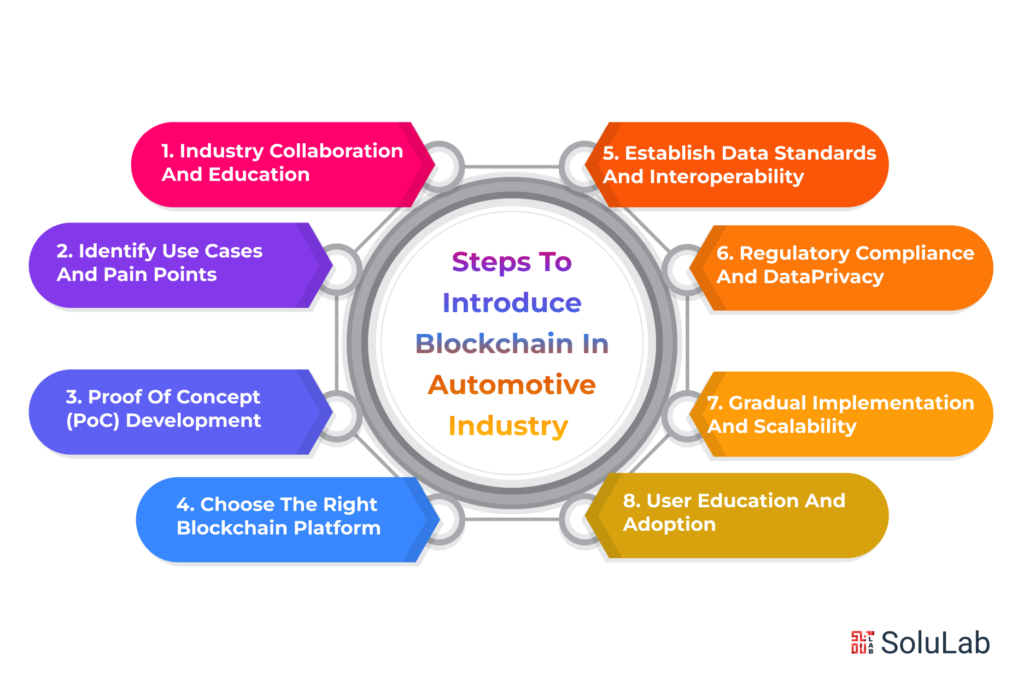
Blockchain in the automotive industry is ripe for disruption, and blockchain technology has the potential to revolutionize various aspects, including supply chain management, vehicle history tracking, and digital identity verification. To successfully introduce blockchain in the automotive sector, several key steps must be taken. Let’s explore the critical measures that can pave the way for the seamless integration of blockchain technology:

Read Also: Top 14 Blockchain-Based Automotive Startups

  • Industry Collaboration and Education

The first step is to foster collaboration among stakeholders in the automotive industry. This includes automakers, suppliers, dealerships, and other key players. Industry-wide cooperation can help create a shared understanding of blockchain’s potential and the specific challenges it can address. Additionally, organizing workshops, conferences, and educational sessions to familiarize participants with blockchain technology and its applications will be instrumental in driving adoption.

  • Identify Use Cases and Pain Points

Understanding the pain points and inefficiencies in the automotive industry is crucial in determining the most appropriate use cases for blockchain in the automotive industry. Conducting thorough research and analysis to identify areas where blockchain can bring the most significant benefits, such as tracking vehicle parts authenticity, improving supply chain transparency, or enabling secure and efficient peer-to-peer vehicle sales, is essential.

  • Proof of Concept (PoC) Development

Developing a Proof of Concept (PoC) is an effective way to validate the feasibility of blockchain applications in the automotive sector. A PoC allows stakeholders to test the technology on a smaller scale, identify potential challenges, and assess the impact of blockchain on existing processes. It provides valuable insights before making substantial investments in full-scale implementation.

  • Choose the Right Blockchain Platform

Selecting the top blockchain platform is a critical decision. Public or private blockchain networks may be suitable depending on the specific use case and requirements. Factors to consider include scalability, security, governance, and consensus mechanisms. Collaborating with experienced blockchain development firms can aid in making the right technology choices.

  • Establish Data Standards and Interoperability

For blockchain to deliver its full potential, standardizing data formats and protocols is crucial. This promotes interoperability and ensures seamless data exchange between different participants in the automotive ecosystem. Defining data standards and adhering to industry-wide best practices will facilitate smooth integration with existing systems.

  • Regulatory Compliance and Data Privacy

Addressing regulatory compliance and data privacy concerns is paramount when introducing blockchain in the automotive industry. Given the sensitivity of personal and vehicle-related data, ensuring compliance with regional data protection laws, such as the General Data Protection Regulation (GDPR), is essential to gain customer trust and maintain legal compliance.

Read Our Blog: How Will Blockchain Transform Insurance Companies?

  • Gradual Implementation and Scalability

Rather than attempting a complete overhaul of existing systems, a gradual and phased approach to blockchain integration is recommended. Starting with pilot projects and expanding progressively allows stakeholders to learn from early successes and address any challenges that arise. As blockchain applications gain traction, scaling up to larger projects becomes more manageable.

  • User Education and Adoption

Finally, educating end-users, including customers, dealerships, and service centers, about the benefits of blockchain technology and its impact on their daily interactions with the automotive industry is crucial. By fostering awareness and demonstrating the enhanced security, transparency, and efficiency that blockchain brings, user adoption can be accelerated.

CTA 2

Conclusion

In conclusion, Blockchain technology has emerged as a game-changer in the automotive and health insurance industries, revolutionizing the way data is managed, transactions are processed, and trust is established. As a leading provider of cutting-edge blockchain solutions, SoluLab recognizes the immense potential of this transformative technology and its ability to bring transparency, efficiency, and security to these critical sectors.

In the automotive industry, blockchain’s decentralized and immutable ledger ensures that vehicle histories, maintenance records, and ownership details are securely stored and easily accessible to all relevant stakeholders. This enhances trust and transparency, reduces the risk of fraud, and streamlines processes, ultimately benefiting manufacturers, dealers, insurers, and consumers alike. SoluLab’s expertise in custom blockchain development services empowers automotive companies to harness this technology’s full potential and drive innovation within their operations.

At SoluLab, we are committed to pushing the boundaries of what blockchain can achieve in the automotive and health insurance sectors. Our team of experts works tirelessly to deliver innovative, scalable, and user-friendly solutions that empower our clients to stay ahead in an increasingly digital world. As these industries continue to evolve, we remain dedicated to staying at the forefront of blockchain innovation and providing our clients with the tools they need to succeed in this transformative era. 

FAQs

1. What is Blockchain technology, and how is it applied in the automotive industry?

Blockchain is a decentralized and immutable ledger technology that records transactions securely and transparently. In the automotive industry, Blockchain is utilized to enhance supply chain management, vehicle data sharing, and ownership verification. By creating a tamper-proof record of vehicle history, Blockchain fosters trust and efficiency, reducing fraud and ensuring the authenticity of parts and components.

2. How does Blockchain benefit the health insurance sector?

Blockchain in health insurance revolutionizes the way medical data is managed. Patients have better control over their health records, and insurers can efficiently access verified information, streamlining the claims process. This technology improves data privacy and security, reducing instances of fraud and unauthorized access to sensitive medical information.

3. Can you recommend a blockchain healthcare development company?

Sure! If you’re looking for a reputable blockchain healthcare development company, you can explore leading firms specializing in healthcare solutions like SoluLab. Companies like SoluLab offer tailored Blockchain applications to healthcare providers, insurers, and patients, ensuring seamless integration and secure data management.

4. What are some common Blockchain healthcare solutions in the market?

Blockchain healthcare solutions encompass Electronic Health Records (EHR) management, drug supply chain tracking, clinical trials management, and patient identity verification. These solutions enhance interoperability, data accuracy, and collaboration among stakeholders, leading to improved healthcare outcomes.

5. How do Blockchain development services contribute to innovation in various industries?

Blockchain development services play a pivotal role in fostering innovation across sectors. By providing expertise in building and implementing decentralized applications, smart contracts, and consensus mechanisms, Blockchain developers help businesses harness the full potential of this transformative technology.

Top 10 Layer 1 Blockchains in 2026

Top Layer 1 Blockchains

The blockchain landscape is evolving rapidly, and a layer 1 crypto list is at the forefront of this transformation. These blockchains are responsible for processing transactions and securing the network, and they are becoming increasingly sophisticated and scalable. As a result, a layer 1 crypto list is becoming increasingly attractive to developers and businesses looking to build decentralized applications (dApps).

There are a number of factors driving the growth of Layer 1 blockchains. One factor is the increasing demand for decentralized applications. DApps offer a number of advantages over traditional, centralized applications, including security, transparency, and immutability. As the demand for dApps grows, so too does the demand for Layer 1 blockchains that can support them. A Layer 1 crypto list can help identify the top blockchains that are leading this growth.

Another factor driving the growth of Layer 1 blockchains is the increasing sophistication of these blockchains. Layer 1 blockchains are becoming more scalable, secure, and efficient. This makes them more attractive to developers and businesses who need a blockchain platform that can handle large volumes of transactions and data.

As Layer 1 blockchains continue to evolve, they are becoming increasingly capable of supporting a wide range of decentralized applications. This is making them an increasingly attractive option for developers and businesses who want to build dApps. The question arise here what is layer 1 blockchain.

Understanding Layer 1 Blockchains

Venture into the foundational layer of blockchain technology. This section explores the core principles and functionalities that define Layer 1 blockchains, which establish the groundwork for decentralized ecosystems.

What is a Layer 1 Blockchain?

Before we delve into the top performers, let’s unravel the essence of Layer 1 blockchains. A Layer 1 blockchain is the foundational layer of a blockchain network, the primary blockchain where transactions are directly recorded. It serves as the base blockchain ecosystem protocol, defining the core rules and consensus mechanisms of the network. Layer 1 blockchains are responsible for the security, scalability, and interoperability of the network.

They are typically built on a Proof-of-Work (PoW) or Proof-of-Stake (PoS) consensus mechanism. PoW blockchains, such as Bitcoin and Ethereum, use a computationally intensive process to verify transactions and add new blocks to the chain. PoS blockchains, such as Cardano and Solana, use a more energy-efficient process to verify transactions and add new blocks to the chain. Top layer 1 blockchains are often limited in their scalability, as they can only process a certain number of transactions per second.

This can lead to congestion and high transaction fees. To address this issue, some Layer 1 blockchains are implementing Layer 2 scaling solutions, such as sidechains and rollups. A Layer 1 blockchains list is the foundation of the blockchain ecosystem. They are responsible for securing the network, validating transactions, and storing data. When comparing Layer1 vs Layer2 solutions, Layer 1 blockchains will need to evolve to meet the demands of a larger and more complex network as the blockchain industry continues to grow.

CTA2

Top 10 Layer 1 Blockchains

1. Ethereum

Ethereum, often referred to as the “world computer” of blockchain technology, stands tall as one of the most influential and significant Layers 1 blockchain in the decentralized ecosystem. In 2026, Ethereum’s significance lies in its transition to Ethereum 2.0, a major upgrade aiming to address its scalability and sustainability challenges.

With the shift to a PoS consensus mechanism, Ethereum 2.0 promises greater energy efficiency, reducing its carbon footprint while enhancing its transaction throughput and overall network capacity. This upgrade is crucial to accommodate the growing demand for Ethereum-based applications, providing a seamless and cost-effective experience for users and developers alike.

2. Solana

Solana has emerged as a prominent player in the blockchain space, earning its place among the top 10 Layer-1 blockchain. Scalability is the key highlight of Solana’s design. Leveraging a combination of Proof-of-History (PoH) and a modified version of Proof-of-Stake (PoS), Solana can achieve blazing-fast speeds and high throughput.

PoH acts as a timekeeper, providing historical data to nodes and enabling them to process transactions with more accuracy and efficiency. This unique approach ensures that network nodes have consistent, verifiable information, reducing the risk of conflicts and enhancing scalability. Another standout feature of Solana is its sub-second block times.

3. Astar

In the ever-expanding landscape of blockchain technology, Astar has emerged as a rising star among the top 10 Layer-1 blockchains. Astar is a unique and promising platform that combines innovative features, scalability, and a strong focus on developer-friendly tools. As the decentralized ecosystem continues to evolve, Astar is making significant strides in establishing itself as a top-tier blockchain network.

Astar is built with scalability in mind, leveraging a unique consensus mechanism known as Consensus Algorithm for REal-time Transaction (CARET). This innovative approach enables high throughput and near-instant finality, making it ideal for applications that require fast and efficient transaction processing.

4. Cronos

In the rapidly evolving world of blockchain technology, Cronos has emerged as a promising contender among the best layer 1 blockchains. Launched by the Crypto.com ecosystem, Cronos has garnered attention for its innovative approach to scalability, interoperability, and adoption. As Layer-1 blockchain continues to shape the future of decentralized technology, let’s explore what sets Cronos apart and why it deserves a spot among the industry’s leading platforms.

One of Cronos’s key strengths lies in its scalability. The blockchain harnesses the power of Tendermint’s Byzantine Fault-Tolerant (BFT) consensus, allowing for faster and more efficient block confirmations. This feature enables Cronos to process a high number of transactions per second, making it suitable for DeFi applications, NFT marketplaces, and other high-throughput use cases.

5. Kadena

As the blockchain landscape continues to evolve, Kadena stands out as a prominent Layer 1 blockchain that has been making waves in the decentralized technology space. Kadena is an ambitious and innovative platform that combines scalability and security, positioning itself among the top 10 Layer-1 blockchains of the future.

The backbone of Kadena’s hybrid consensus, ScalableBFT, offers a novel solution to the scalability trilemma, a challenge faced by many blockchain networks. ScalableBFT ensures that the network remains secure, scalable, and decentralized, a rare combination in the blockchain world. This allows Kadena to cater to enterprise-level use cases while maintaining the principles of decentralization and security.

6. Injective Protocol

Injective Protocol has emerged as a powerful player in the blockchain space, positioning itself as one of the best layer 1 blockchains. As a decentralized exchange (DEX) platform, Injective Protocol focuses on providing a high-performance, secure, and user-friendly ecosystem for decentralized finance (DeFi) applications. Its unique design and innovative features set it apart from other Layer-1 blockchains, making it a force to be reckoned with in the evolving blockchain landscape.

Injective Protocol leverages Layer 2 scaling solutions, such as Optimistic Rollups, to enhance transaction throughput and reduce gas fees. By integrating Layer 2 technology, the platform can achieve a high degree of scalability without compromising security or decentralization. The platform allows the creation of custom markets and synthetic assets, offering unparalleled flexibility and enabling the trading of both traditional and crypto assets on a single platform.

7. Cosmos

As one of the top 10 layer one blockchain, Cosmos has emerged as a powerful force in the decentralized technology landscape, revolutionizing how blockchain networks interact and collaborate. Founded on the principles of interoperability and scalability, Cosmos aims to overcome the challenges of siloed blockchains and foster a more interconnected and efficient ecosystem.

At the heart of Cosmos lies the Inter-Blockchain Communication (IBC) protocol, which enables secure and trustless communication between independent blockchains. IBC facilitates the transfer of assets and data across different chains, allowing seamless interoperability and collaboration. This unique feature empowers developers to build dApps that can interact with various blockchains, unlocking new possibilities for cross-chain DeFi, asset swaps, and decentralized exchanges.

8. Avalanche

Avalanche, an innovative blockchain platform, has emerged as one of the top 10 Layer-1 blockchains, revolutionizing the decentralized finance (DeFi) space. Built to address the limitations of existing blockchains, Avalanche brings scalability, security, and high-throughput capabilities to the forefront of decentralized technology. Its groundbreaking consensus protocol and unique features have positioned it as a driving force in the blockchain ecosystem.

Avalanche’s versatility is another defining feature that sets it apart from other layer 1 blockchains list. The platform is designed to support custom subnets, providing developers with the flexibility to create and deploy their own blockchain applications within the Avalanche ecosystem. This capability encourages innovation and fosters a diverse range of use cases, from decentralized exchanges and automated market makers to gaming and non-fungible token (NFT) platforms.

9. BNB Chain

In the ever-expanding realm of blockchain technology, BNB Chain has emerged as a prominent player, solidifying its position as a top 10 layer one blockchain. Developed by Binance, one of the world’s largest cryptocurrency exchanges, BNB Chain brings innovation and efficiency to the forefront, offering a robust foundation for various decentralized applications (dApps) and token ecosystems.

BNB Chain stands out for its remarkable transaction throughput, capable of processing thousands of transactions per second. This high-speed performance is instrumental in catering to the ever-growing demand of users and dApps, ensuring a seamless experience for participants on the network. In addition to its impressive throughput, BNB Chain boasts remarkably low transaction fees, making it a cost-effective platform for users and developers.

10. Near

Near Protocol has swiftly emerged as a top-tier Layer 1 blockchain, garnering attention for its innovative approach to scalability, usability, and developer-friendliness. Near’s cutting-edge design has positioned it among the top 10 Layer-1 blockchains, making it a promising platform for decentralized applications (dApps) and the broader blockchain ecosystem.

Near Protocol has attracted a wide array of real-world applications, spanning from decentralized finance (DeFi) to gaming and NFT platforms. These use cases demonstrate the platform’s versatility and potential to revolutionize multiple industries. Near’s commitment to regulatory compliance sets a strong foundation for its long-term growth and adoption. By adhering to regulatory standards, Near aims to ensure a secure and compliant environment for businesses and users alike.

Conclusion

In conclusion, the top 10 Layer 1 blockchains of 2026 represent a dynamic and transformative force in the decentralized landscape. As we’ve explored the unique features, applications, and advancements of these blockchains, it becomes evident that blockchain technology plays a crucial role in shaping the future of digital innovation. These Layer 1 blockchains, including Bitcoin, Ethereum, Binance Smart Chain, Cardano, Solana, Avalanche, Polkadot, Tezos, Algorand, and NEAR Protocol, showcase diverse approaches to scalability, consensus mechanisms, and governance. Each platform brings its own strengths, contributing to the rich tapestry of blockchain use cases within the decentralized ecosystem.

As the blockchain space continues to evolve, SoluLab stands at the forefront, providing cutting-edge solutions in blockchain development. With a commitment to innovation, security, and scalability, SoluLab empowers businesses to navigate the complexities of Layer 1 crypto list technologies and harness the full potential of decentralized platforms. As we navigate the intricate landscape of top Layer 1 blockchains, it is SoluLab’s mission to guide and support organizations in adopting these transformative technologies. Embrace the future of decentralization with confidence, knowing that SoluLab is your trusted partner on the journey towards blockchain innovation and success.

FAQs

1. What makes a blockchain a Layer 1 blockchain?

A Layer 1 blockchain refers to the base protocol of a blockchain network where transactions are directly recorded. It serves as the foundational layer, defining the core rules and consensus mechanisms.

2. How were the top 10 Layer 1 blockchains selected?

The selection was based on a comprehensive analysis of each blockchain’s unique features, consensus mechanisms, scalability solutions, smart contract functionalities, and overall impact on the decentralized ecosystem.

3. What advantages do Layer 1 blockchains offer over other layers?

List of layer 1 blockchains provides direct access to the blockchain network, ensuring security, transparency, and decentralized consensus. Their primary advantage lies in serving as the foundational layer without relying on other protocols.

4. Can Layer 1 blockchain be used for applications beyond cryptocurrencies?

Yes, Layer 1 blockchains have diverse applications beyond cryptocurrencies. They are employed in decentralized finance (DeFi), supply chain management, healthcare, and various other industries, offering a broad spectrum of use cases.

5. How do Layer 1 blockchains contribute to global financial inclusion?

Layer 1 blockchains break down geographical barriers, enabling global access to financial services. Their decentralized nature ensures that individuals worldwide can participate in the financial ecosystem without traditional banking constraints.

6. What are the emerging trends in Layer 1 blockchain technology for 2026?

Emerging trends include increased collaboration among blockchain networks, integration with traditional finance, and technological advancements such as improved scalability solutions, interoperability, and enhanced consensus mechanisms.

7. How can businesses leverage SoluLab’s expertise in Layer 1 blockchain development?

SoluLab offers cutting-edge solutions in blockchain development, guiding businesses through the complexities of Layer 1 blockchains. Whether it’s for creating decentralized applications (DApps), implementing smart contracts, or navigating blockchain governance, SoluLab is your trusted partner for blockchain innovation.

Beginners’ Guide 101 to Outsourcing Blockchain Development

Beginners’ Guide 101 to Outsourcing Blockchain Development

The global admiration of blockchain technology is on top of the mountain. Businesses have started understanding its capability to make business efforts more efficient, so the worldwide blockchain infusion rate in business processes is increasing. Outsourcing blockchain technology with advanced technology can alter the traditional loopholes in business procedures, making our future more effective. 

Blockchain development requires big-budget resources, so it’s hard for companies to have an in-house in-house development team. So, numerous development agencies provide blockchain development services to businesses to fill up this scarcity. However, the complex process is to choose a blockchain development outsourcer, as many factors are involved. 

Outsourcing blockchain development has become a popular choice for businesses looking to leverage the benefits of this transformative technology while reducing costs and accessing specialized expertise. If you’re a beginner considering outsourcing blockchain development, this guide will provide you with a 101 overview of the process and essential factors to consider.

Read Our Blog: Beginner’s Guide to Understand Blockchain Technology

  • Understand Your Requirements: Before outsourcing blockchain development, clearly define your project requirements and objectives. Determine the specific features, functionalities, and outcomes you expect from your blockchain solution. This clarity will help you communicate effectively with potential outsourcing partners.
  • Research and Select a Reliable Outsourcing Partner: Conduct thorough research to identify reputable outsourcing partners with expertise in blockchain development. Look for companies with a proven track record, positive client testimonials, and a portfolio showcasing successful blockchain projects. Consider factors such as technical expertise, industry knowledge, and cultural compatibility.
  • Define the Scope of Work: Work closely with your outsourcing partner to define the scope of work for your blockchain development project. Communicate your expectations, timelines, and deliverables. This will ensure both parties have a shared understanding of the project and minimize potential misunderstandings or scope creep.
  • Ensure Transparent Communication: Establish effective communication channels with your outsourcing partner. Regularly scheduled meetings, progress updates, and open lines of communication are vital for mag transparency and addressing any concerns or challenges that may arise during the development process.
  • Emphasize Security and Data Protection: Blockchain development often involves working with sensitive data and confidential information. Ensure your outsourcing partner has robust security measures in place to protect your data and maintain strict confidentiality. Consider their data protection policies, adherence to industry standards, and any relevant certifications they may have.
  • Quality Assurance and Testing: Verify that your outsourcing partner has a robust quality assurance and testing process in place. Rigorous testing is crucial to identify and resolve any bugs, vulnerabilities, or performance issues in the blockchain solution. Discuss their testing methodologies, protocols, and how they ensure the reliability and security of the developed solution.
  • Consider Long-term Support and Maintenance: Blockchain development is not a one-time endeavor. It requires ongoing support, maintenance, and updates to ensure the solution remains secure and functional. Discuss post-development support options with your outsourcing partner and ensure they have a plan for addressing future upgrades, bug fixes, and scalability needs.
  • Legal and Contractual Considerations: Before entering into a contract, carefully review the legal and contractual aspects of the outsourcing engagement. Ensure that intellectual property rights, confidentiality agreements, liability clauses, and dispute resolution mechanisms are clearly defined and protect your interests.
  • Manage Expectations and Milestones: Set realistic expectations and define milestones throughout the development process. Regularly monitor progress against these milestones to ensure the project stays on track. Clear communication and alignment of expectations will help build a strong working relationship with your outsourcing partner.
  • Leverage Blockchain Expertise: Take advantage of the expertise and insights of your outsourcing partner. Blockchain technology is evolving rapidly, and experienced developers can guide you in making informed decisions regarding frameworks, consensus mechanisms, and industry best practices.

Outsourcing blockchain development can be a strategic decision to accelerate your project’s timeline and access specialized skills. By following this beginner’s guide and working closely with your outsourcing partner, you can maximize the benefits of blockchain technology and achieve your business objectives.

In this blog, we’ll discuss the essential steps for businesses to outsource veteran blockchain developers for their projects. After going through this guide, any business will become clear to strategize and implement their outsourcing strategy. Let’s start!

1. Specify Your Business Requirements

Before consulting a blockchain development company, it’s crucial to clarify the core requirements of your business.

Today’s businesses are more consumer-centric than the last decade’s. So, providing customers with advanced back-end procedures with user-friendly front-end features is important. Thus, defining the efficiency of a blockchain development outsourcer to meet customer-centric business is the most important thing.

When considering outsourcing blockchain development, it is essential to specify your business requirements clearly. Today’s companies are increasingly focused on providing exceptional customer experiences, which require advanced back-end procedures and user-friendly front-end features. Defining the efficiency of a blockchain development outsourcer to meet these customer-centric business needs is crucial for a successful collaboration.

Read Also: Things To Consider And Evaluate When You Hire Blockchain Development Company

  • Identify Your Objectives: Before consulting a blockchain development company. Determine what you aim to achieve through blockchain technology implementation. Whether it’s enhancing security, streamlining processes, improving transparency, or creating new business models, having a clear vision will help you communicate your requirements effectively to the outsourcing partner.
  • Understand Your Industry: Each industry has its unique characteristics and challenges. Selecting a blockchain development company with experience in your specific industry is essential. They should know the regulations, standards, and practices relevant to your business sector. This industry knowledge will enable them to understand your requirements better and develop tailored solutions.
  • Evaluate Technical Expertise: When outsourcing blockchain development, assess the technical expertise of potential partners. Look for companies with a proven track record of successfully delivering blockchain projects. Review their portfolios, case studies, and client testimonials to gain insights into their capabilities. Consider their experience in developing blockchain solutions using different platforms, programming languages, and frameworks.
  • Consider UX/UI Design Skills: User experience (UX) and user interface (UI) design play a crucial role in the success of any blockchain solution. A well-designed and intuitive interface enhances usability and ensures a positive user experience. Evaluate the outsourcing partner’s expertise in UX/UI design to ensure they can create visually appealing and user-friendly interfaces that align with your brand and target audience.
  • Scalability and Performance: Scalability and performance are key considerations for blockchain solutions, especially if you anticipate significant growth or a high volume of transactions. Discuss their approach to scalability with the outsourcing partner, including network capacity, transaction throughput, and consensus mechanisms. Ensure they can design and develop a solution to handle your anticipated workload and accommodate future growth.
  • Security and Data Privacy: Security is paramount in blockchain development. Evaluate the outsourcing partner’s approach to security and data privacy. Look for companies that follow best practices in encryption, data protection, access control, and vulnerability management. Inquire about their experience in implementing secure smart contracts and ensuring the integrity and confidentiality of sensitive data.
  • Collaboration and Communication: Effective collaboration and communication are crucial for successful outsourcing engagements. Evaluate the outsourcing partner’s communication channels, project management methodologies, and reporting mechanisms. Ensure they have a structured approach to inform you about project progress, address concerns, and provide regular updates. Clear and transparent communication will foster a strong working relationship and ensure alignment with your business goals.
  • Regulatory Compliance: Depending on your industry, regulatory compliance may be a critical requirement for your blockchain solution. Discuss with the outsourcing partner their understanding of relevant regulations with the outsourcing partner and experience developing compliant solutions. They should be able to address any specific compliance requirements and guide you through the necessary steps to ensure adherence to applicable laws and regulations.
  • Support and Maintenance: Blockchain solutions require ongoing support and maintenance to ensure their smooth operation and security. Inquire about the outsourcing partner’s post-development support and maintenance services. Understand their response time for resolving issues, handling updates and upgrades, and providing technical support. A reliable support system is essential to address any unforeseen challenges and keep your blockchain solution current.
  • Budget and Cost Considerations: While outsourcing blockchain development can be cost-effective, defining your budget and considering the cost implications is important. Discuss pricing models, payment terms, and any additional costs associated with maintenance, upgrades, or ongoing support costs. Evaluate the value proposition of the outsourcing partner and ensure that the costs align with the quality and expertise they offer.

By specifying your business requirements, you can effectively communicate your needs to the blockchain development company and ensure a successful outsourcing engagement. Consider factors like industry expertise, technical capabilities, user experience design, security measures, and ongoing support. A thorough evaluation will help you find the right outsourcing partner who can deliver a tailored blockchain solution that meets your business objectives.

Everything in software and application development requires user orientation, from UI/UX to payment gateway and back-end optimization. Blockchain mostly covers the back-end part; the front-end remains similar to any software development. So, defining business requirements is important to understand the technicalities or blockchain development strategies that will be required.

CTA

2. Understanding The Blockchain Essentials 

Though it’s not for the outsourcing company to understand complex blockchain development processes, still that’s what can make an outsourcing company more profitable with their resources.

To distinguish between a qualified developer and a Roorkee, blockchain essentials can be greatly helpful. Let’s understand a few blockchain development facts –

Whether blockchain development looks advanced and out of the world, the majority uses everyday programming languages. Some of the blockchain development programming languages are C++, Python, Java, JS, etc. Solidity programming language is an exception that is made of basic programming languages to implement Smart Contracts.

Understanding the essentials of blockchain development is crucial, even if you are outsourcing the task to a specialized company. While it may seem like a complex and advanced field, knowing the basics can help you distinguish between a qualified blockchain developer and someone who lacks the necessary skills. Let’s delve deeper into some key facts about blockchain development.

  • Programming Languages: Contrary to popular belief, blockchain development primarily utilizes everyday programming languages. Some commonly used languages include C++, Python, Java, and JavaScript. These languages provide the foundation for developing various blockchain components. However, one notable exception is Solidity, a programming language specifically designed for implementing smart contracts on the Ethereum blockchain. Understanding the programming languages used in blockchain development can help you assess the proficiency and expertise of potential outsourcing partners.
  • Smart Contracts: Smart contracts are self-executing contracts with predefined rules and conditions encoded within them. They automatically execute transactions and agreements without the need for intermediaries. Solidity, a high-level programming language, is used to write smart contracts on blockchain platforms like Ethereum. Smart contracts enable automation, transparency, and trust in various industries, such as supply chain management, finance, and healthcare. Understanding the concept of smart contracts and their role in blockchain development can help you evaluate the capabilities of blockchain developers.
  • Blockchain Platforms: Blockchain development involves working with top blockchain platforms that offer varying functionalities and features. The most well-known platform is Ethereum, which supports the development of decentralized applications (dApps) and smart contracts. Other popular platforms include Hyperledger Fabric, Corda, and EOS. Each platform has its strengths and limitations, and understanding the characteristics of different blockchain platforms can help you determine which one best suits your business requirements.
  • Consensus Mechanisms: Consensus mechanisms are algorithms used in blockchain networks to achieve agreement on the validity of transactions and maintain the integrity of the ledger. Some commonly used consensus mechanisms include Proof of Work (PoW), Proof of Stake (PoS), and Delegated Proof of Stake (DPoS). Each mechanism has its advantages and considerations, such as energy efficiency, scalability, and decentralization. Familiarizing yourself with these consensus mechanisms can help you make informed decisions when discussing blockchain development with outsourcing companies.
  • Security Considerations: Security is a critical aspect of blockchain development. Blockchain networks are designed to be secure and immutable, but vulnerabilities can still exist. Understanding the security considerations in blockchain development, such as encryption, cryptographic hash functions, and private key management, will help you assess the expertise of potential outsourcing partners in ensuring the integrity and confidentiality of your blockchain-based solutions.
  • Scalability and Performance: Scalability is a significant challenge in blockchain development. As the number of transactions increases, the network must be able to handle the load efficiently. Evaluating the scalability and performance capabilities of outsourcing companies is crucial to ensure that the blockchain solutions they develop can scale effectively and meet your business requirements. Consider factors such as transaction throughput, network capacity, and the ability to handle concurrent users.
  • Integration with Existing Systems: If you have existing systems or databases in your organization, integrating them with blockchain-based solutions may be necessary. Understanding the process of integrating blockchain technology with your existing systems will help you assess the outsourcing company’s ability to seamlessly integrate blockchain solutions into your current infrastructure. This includes considerations such as data migration, interoperability, and API integrations.

Read Our Blog Post: A Beginner’s Guide To Hyperledger Blockchain

By familiarizing yourself with these blockchain essentials, you can effectively communicate your requirements to outsourcing companies and evaluate their expertise. This knowledge will enable you to make informed decisions and choose a reliable partner who can deliver high-quality blockchain solutions that align with your business goals. So, it’s important to understand the blockchain essentials before outsourcing blockchain developers.

3. Visit Outsourcer’s Portfolio

Every blockchain development outsourcer available on the planet definitely has a portfolio; that’s how they get clients.

Getting a suitable developer heavily depends on various factors, and a portfolio contains all clear-cut factors about the developer.

Website portfolio comes under the most practiced form of portfolio making, where developers jot down their expertise, hall of fame, awards and appraisals, and different case study projects on a website. 

Every element of a portfolio has its value; researching and verifying them is important. Editing and overbrushing achievements in portfolios is a common practice, and you must be careful with your portfolio investigation to get one truly qualified blockchain developer.

One of the essential steps in outsourcing blockchain development is to carefully review the portfolio of potential service providers. Every reputable blockchain development company maintains a portfolio showcasing its expertise, achievements, and past projects. Examining their portfolio is crucial for evaluating their capabilities and finding a developer that aligns with your specific requirements. Let’s explore why the portfolio is important and what elements to consider during your evaluation.

  • Website Portfolio: A website portfolio is one of the most common forms of showcasing a blockchain developer’s capabilities. It provides a comprehensive overview of their expertise, achievements, and notable projects. When reviewing a website portfolio, pay attention to the following key elements:
  • Expertise and Specialization: Look for information on the blockchain platforms they are proficient in, such as Ethereum, Hyperledger Fabric, or Corda. Assess their experience in developing specific blockchain solutions like smart contracts, decentralized applications (dApps), or permission networks. Consider whether their expertise aligns with your project requirements.
  • Hall of Fame and Awards: Check if the developers have received any industry recognition, awards, or certifications. This indicates their level of competence and commitment to delivering high-quality blockchain solutions.
  • Case Studies and Project Showcase: Analyze the case studies and projects featured in the portfolio. Look for projects that are similar in scope or complexity to your own. Assess the types of solutions they have developed, the industries they have worked with, and the challenges they have overcome. This will give you an idea of their problem-solving abilities and their ability to deliver successful blockchain implementations.
  • Client Testimonials and References: Consider the feedback and testimonials from their previous clients. Positive testimonials and references indicate client satisfaction and can provide insights into their professionalism, communication skills, and ability to meet project deadlines.
  • Verification and Due Diligence: While reviewing a developer’s portfolio, it’s important to conduct thorough verification and due diligence. Here are a few steps you can take:
  • Cross-Check Projects: If possible, verify the information provided in the portfolio by cross-checking the details of the showcased projects. You can reach out to the clients mentioned in the portfolio and inquire about their experience working with the developer. This will help you gain a more accurate understanding of the developer’s capabilities and the quality of their work.
  • Online Presence and Reputation: Research the developer’s online presence, including their website, social media profiles, and online reviews. Look for any red flags or negative feedback that might indicate potential issues. Pay attention to their engagement with the blockchain community and their participation in relevant forums, conferences, or open-source projects.
  • Team Composition and Expertise: Evaluate the expertise and qualifications of the developer’s team members. Check if they have a dedicated team of blockchain developers, architects, and consultants who can handle the complexity of your project. Consider the team’s experience, certifications, and educational background to ensure they have the necessary skills to deliver a successful blockchain solution.

By thoroughly reviewing a developer’s portfolio and conducting proper verification, you can mitigate the risks associated with outsourcing blockchain development. This process enables you to identify qualified developers who have a track record of delivering successful projects in your desired technology stack. It also helps you assess their compatibility with your project requirements, ensuring a higher chance of project success and client satisfaction

CTA 1

4. Researching Developer’s Portfolio 

In the previous step, we discussed the importance of a portfolio and its elements. Now, there is the necessary thing to research from a portfolio –

Awards and certifications prove the viability of the developers that they serve with expertise and experience worth praising.

Outsourcers can also add their previous work experience and mention businesses where they’ve provided blockchain solutions. If those mentions justify their prowess, they should be consulted for your blockchain projects.

Case studies explain how a company has provided various development services to other companies. The general format of the case study includes a precise customer overview, development challenges, providing solutions, and post-development benefits. Developers also provide client testimonials with case studies for generating social proof and value.

Check Out Our Press Release: SoluLab Honored By GoodFirms as Winner of the Trusted Choice Award 2023

When researching a developer’s portfolio for outsourcing blockchain development, it’s important to delve deeper into certain elements to make an informed decision. While the overall portfolio provides an overview, focusing on specific aspects can give you valuable insights into their expertise and capabilities. Let’s explore some key areas to research within a developer’s portfolio.

  • Awards and Certifications: Awards and certifications are a testament to the developer’s expertise and industry recognition. Look for any accolades they have received, such as industry awards, hackathon wins, or certifications from reputable organizations. These achievements demonstrate their commitment to excellence and their ability to deliver high-quality blockchain solutions.
  • Previous Work Experience: Check if the developer has mentioned their previous work experience and the businesses they have provided blockchain solutions to. This information can help you gauge their industry experience and the types of projects they have worked on. If they have served reputable companies and successfully delivered blockchain solutions, it reflects their prowess and makes them a worthy candidate for your project.
  • Case Studies: Case studies provide detailed insights into how the developer has successfully served other companies with their blockchain development services. These studies typically follow a structured format, including:
  • Customer Overview: Understand the customer’s background, industry, and specific requirements. This helps you assess if the developer has experience in your industry or similar use cases.
  • Development Challenges: Identify the challenges faced during the project, such as scalability, security, or interoperability. Assess how the developer addressed these challenges and provided effective solutions.
  • Provided Solutions: Evaluate the solutions implemented by the developer to overcome the identified challenges. Look for innovative approaches, the use of appropriate blockchain platforms, and the integration of relevant technologies.
  • Post-Development Benefits: Learn about the positive outcomes achieved after implementing the blockchain solution. This can include increased efficiency, cost savings, improved transparency, or enhanced security. Assess if these benefits align with your project goals.

Case studies provide real-world examples of the developer’s capabilities, problem-solving skills, and ability to deliver successful blockchain implementations. They also demonstrate their understanding of specific industries and use cases, making it easier for you to assess their suitability for your project.

  • Client Testimonials: Client testimonials add social proof and provide insights into the developer’s professionalism, communication skills, and ability to meet project deadlines. Pay attention to any testimonials or feedback from their previous clients included in the portfolio. Positive testimonials indicate client satisfaction and can further validate the developer’s capabilities.

Check Out Our Client Testimonial Video: https://www.youtube.com/watch?v=etpMR6XJwtc

By thoroughly researching these portfolio elements, you can gain a deeper understanding of the developer’s track record and their ability to meet your project requirements. However, it’s important to exercise caution during your research. Sometimes, portfolios may be embellished or overemphasize certain achievements. To mitigate this risk, consider the following steps:

  • Cross-Check Information: If possible, cross-check the details mentioned in the portfolio. Contact the businesses or clients mentioned and inquire about their experience working with the developer. This firsthand feedback can provide a more accurate picture of the developer’s capabilities and the quality of their work.
  • Online Presence and Reputation: Research the developer’s online presence, including their website, social media profiles, and online reviews. Look for any red flags, negative feedback, or inconsistencies that may warrant further investigation. Engage with the blockchain community to gather insights and recommendations about the developer’s reputation and expertise.

Other portfolio elements are helpful, but the case study ultimately helps you decide whether to enlist a blockchain development outsourcer.

CTA 2

5. Visit Their Online Review 

Client testimonials are great, but looking for client reviews can be more beneficial to understanding the actual expertise and worth of any blockchain developer.

Websites like Clutch provide a great platform for businesses and service providers to create rapport between them. Companies make their account in Clutch, and clients are requested to post their genuine reviews on the Clutch platform. That’s how the system works.

Social media platforms like LinkedIn are tremendously helpful, as LinkedIn provides all the benefits of a business-related environment. From there, your business can understand the credibility of any blockchain developer.

In addition to client testimonials, another valuable source of information for evaluating a blockchain development outsourcer is online reviews. These reviews can provide insights into the actual expertise and worth of the developer. Let’s explore two platforms where you can find online reviews and assess the credibility of blockchain developers.

  • Clutch: Clutch is a renowned online platform that facilitates the creation of rapport between businesses and service providers. Companies create their accounts on Clutch, and clients are encouraged to post genuine reviews about their experience with the service provider. The platform maintains transparency and helps potential clients make informed decisions based on real feedback.

When researching a blockchain development company on Clutch, pay attention to the following:

  • Overall Rating: Check the company’s overall rating based on client reviews. A higher rating indicates a higher level of client satisfaction and can be a positive indicator of the developer’s expertise and professionalism.
  • Client Reviews: Read through the client reviews to understand their specific experiences. Look for details about the developer’s communication, technical skills, adherence to deadlines, and overall project management. Positive reviews that align with your project requirements can provide reassurance about the developer’s capabilities.
  • Case Studies and Projects: Explore the developer’s case studies and projects listed on their Clutch profile. This allows you to gain a deeper understanding of their expertise, the types of projects they have undertaken, and their success stories.

Clutch serves as a trusted platform for authentic reviews, providing valuable insights into the credibility and performance of blockchain development companies.

  • Social Media Platforms: Social media platforms, especially LinkedIn, can be tremendously helpful in assessing the credibility of a blockchain developer. LinkedIn provides a business-oriented environment where professionals can showcase their skills, expertise, and accomplishments. Here’s how you can leverage social media platforms for your research:
  • Company Profiles: Visit the company’s LinkedIn profile to gain insights into its size, team composition, and industry connections. Assess their level of engagement, the content they share, and their participation in relevant discussions. A strong and active LinkedIn presence can indicate a reputable and committed developer.
  • Recommendations and Endorsements: Pay attention to the recommendations and endorsements on the developer’s LinkedIn profile. These endorsements provide validation from other professionals and can give you a sense of the developer’s skills and capabilities. Recommendations from clients or colleagues add further credibility.
  • Engage with the Community: Participate in relevant LinkedIn groups or forums focused on blockchain development. Engage with the community by asking questions or seeking recommendations. This allows you to gather insights, opinions, and experiences from others who may have worked with the developer or have knowledge about their reputation.

By exploring online reviews and leveraging social media platforms, you can gain a more comprehensive understanding of a blockchain developer’s reputation and credibility. However, it’s important to approach online reviews with caution and consider the following:

  • Multiple Sources: Don’t rely solely on one platform or source of reviews. Explore multiple platforms, industry forums, and online communities to gather a variety of perspectives and opinions. This helps ensure a well-rounded assessment.
  • Verification: While online reviews provide valuable insights, verify the information wherever possible. Look for patterns or common themes in the reviews and consider reaching out to reviewers directly for more information or clarification.
  • Balance: Take both positive and negative reviews into account. It’s natural to find a mix of reviews but pay attention to the overall sentiment and any recurring issues or concerns raised by clients. This helps you make a balanced judgment about the developer’s capabilities.

6. Have a Conversation With the Developers

After checking all the previous steps, it’s time to connect with those selected outsourcers. Websites and case studies are a thing, but delving into the actual depth requires real-time communication. Whether it’s a video call or phone call, try to engage in a deep conversation on detailed development packages. As you understand their services, working style, and price structure, the next step is to select the payment structure.

Read Also: Best Companies to Hire Blockchain Developers in 2025

7. Negotiate a Suitable Engagement Model

A suitable engagement model determination is crucial for a hassle-free development process. Whether paying hourly or at a fixed rate, the goal should be reaching the highest possible efficiency in development.

For startups, a fixed-rate payment contract is best, as project development is the only thing they’ve to focus on.

Hourly rate engagement models are based on proper time allocation on development projects. This engagement structure is entry-level developer friendly, bringing out the best product quality possible with this model.

A dedicated Development team is a great option for businesses with a high budget. Hiring veteran blockchain developers, programmers, designers, and QA teams for dedicated projects requires high funding but rewards light-speed and effective project development.

CTA 3

Conclusion

By following this blockchain development outsourcing guide, businesses can understand their core requirements and find a detailed professional way to end up with an outsourcer. This guide is composed of reminding the necessity of quality developers, so ending up with someone veteran is obvious. 

In the context of outsourcing blockchain development, SoluLab is a reputable company that offers a range of services. As a blockchain development company, SoluLab has a team of experienced blockchain developers who can assist with various aspects of blockchain projects. Whether you need to hire blockchain developers or require blockchain consulting services, SoluLab can provide tailored solutions to meet your specific requirements.

Overall, outsourcing blockchain development can offer numerous benefits, including access to specialized skills, cost savings, and faster time-to-market. By following this beginner’s guide, businesses can navigate the outsourcing process effectively and find a reliable partner to bring their blockchain projects to life.

FAQs

1. What is outsourcing in the context of blockchain development?

Outsourcing in blockchain development refers to the practice of hiring external experts or development companies to handle the design, coding, and implementation of blockchain-based solutions for your business. It allows you to leverage the expertise and resources of specialized teams while focusing on your core business activities.

2. Why should I consider outsourcing blockchain development?

Outsourcing blockchain development offers several advantages, including access to specialized skills and knowledge, cost savings, faster time-to-market, scalability, and reduced operational overhead. It allows you to tap into the experience and expertise of professionals who are well-versed in blockchain technologies.

3. How do I choose the right outsourcing partner for blockchain development?

To choose the right outsourcing partner, consider factors such as their experience in blockchain development, portfolio of previous projects, technical expertise, industry knowledge, communication skills, scalability, and reputation. Conduct thorough research, read client testimonials, and engage in discussions to assess their suitability for your specific project requirements.

4. What are the key considerations before outsourcing blockchain development?

Before outsourcing blockchain development, it’s important to define your business requirements, understand the basics of blockchain technology, have a clear budget and timeline, ensure data security and confidentiality, and establish effective communication channels with the outsourcing partner.

5. How can I ensure the security of my blockchain project when outsourcing?

To ensure the security of your blockchain project, choose an outsourcing partner with a proven track record in security practices. Implement strict confidentiality agreements, conduct regular code audits, define access controls and permissions, and use secure communication channels. It’s also essential to have a robust security strategy in place.

6. How can I manage communication and collaboration with the outsourcing team?

Establishing effective communication channels is crucial for successful outsourcing. Use project management tools, conduct regular meetings, and maintain open and transparent communication. Define clear project goals, milestones, and deliverables, and encourage feedback and collaboration throughout the development process.

7. How do I ensure the quality of the outsourced blockchain development?

To ensure the quality of outsourced blockchain development, define clear quality standards and requirements from the beginning. Implement thorough testing and quality assurance processes, conduct code reviews, and set up regular progress reviews with the outsourcing team. Clearly define acceptance criteria and conduct user acceptance testing.

8. What are the typical pricing models for outsourcing blockchain development?

Common pricing models for outsourcing blockchain development include fixed-price, time and material, and dedicated team models. Each model has its advantages and considerations. Choose a pricing model that aligns with your project requirements and budget.

9. How can I mitigate risks when outsourcing blockchain development?

To mitigate risks when outsourcing blockchain development, perform due diligence on the outsourcing partner, clearly define project scope and expectations, have a well-defined contract in place, ensure intellectual property protection, and establish regular progress reporting and monitoring mechanisms.

10. What ongoing support and maintenance services should I expect from the outsourcing partner?

When outsourcing blockchain development, discuss and clarify the scope of ongoing support and maintenance services. This may include bug fixing, system upgrades, security patches, performance monitoring, and continuous improvement. Ensure that the outsourcing partner has a clear understanding of your support requirements and can provide timely assistance when needed.

SoluLab Bridging the Gap Between Technology And Innovation

SoluLab - Badge

Today, Blockchain development is one of the fastest-growing technologies in the era of information technology. The requirement for blockchain developers is increasing, especially with the rise in decentralization-based financial services and the critical integration of blockchain technology into various industries.

Cutting-edge technologies such as blockchain, Web3, Meraverse, artificial intelligence (AI), ChatGPT development, custom software development, and the Internet of Things (IoT) are becoming essential for businesses to implement in this competitive environment. When it comes to providing such emerging technologies-based IT solutions, SoluLab comes into the picture!

Let’s discover what SoluLab offers and how it works in blockchain development and other cutting-edge technologies!

From Idea Generation to Implementation

SoluLab was founded in 2014 by two friends, Chintan Thakkar, and Rajat Lala, enthusiastic entrepreneurs in providing high-tech solutions globally, with headquarters in Los Angeles, California. Their other offices are in the United States and India.

The company’s vision is to supply cutting-edge technology solutions that bring opportunities to aspiring and inspiring professionals seeking knowledge-sharing and innovative environments in the organization.

They have completed blockchain and many other latest emerging technology-based projects with sheer persistence and unmatched professionalism. This has helped them to achieve a prominent position in the list of the top blockchain development companies in California on GoodFirms – a trusted reviews & ratings platform.

facts

SoluLab is an ISO 9001:2015 and CMMI level 3 certified company. The company serves diversified clients with more than 50M active users of their created applications. They partner with Fortune 500 companies to growth-driven startups, including Walt Disney, Goldman Sachs, Mercedez Benz, the University of Cambridge, and Georgia Tech.

SoluLab Offers Software Solutions Based On Trending Technologies

Generative AI Development, ChatGPT Development, Blockchain, Web3, AI, IoT, and custom software development are the trending technologies that are capturing the attention of many big brands, transforming their business platform into more digitally advanced systems.

Blockchain Development

Today, blockchain technology has become an integral part of startups, large enterprises, and businesses globally. This trending technology offers secure, decentralized, and immutable app solutions that transform businesses into more efficient and effective automotive versions of their products.

SoluLab’s blockchain experts ensure that the traceability and security of applications are improved by creating customized blockchain app development solutions.

A broad range of blockchain solutions by SoluLab:

  • Blockchain Technology Consulting
  • Blockchain Protocol Development
  • Enterprise Blockchain Development
  • dApps Development
  • NFT Marketplace Development
  • Blockchain-Powered Metaverse Development
  • Smart Contracts Development
  • Smart Contracts Audit
  • Cryptocurrency Exchange
  • Cryptocurrency Wallets
  • Blockchain & NFT Games
  • Decentralized Finance
  • Cryptocurrencies & Tokenisation
  • DAO Development
  • Web3 Application Development

Generative AI Development

The company provides various digital solutions using generative artificial intelligence development. Generative AI models are inspired by many trending technologies like ChatGPT, DALL-E, and Midjurney, implemented by generative AI experts with years of experience and extensive knowledge in AI-powered solutions.

SoluLab’s mission is to increase customer satisfaction and bring value to their businesses with AI-based software solutions.

Custom Web Design & Development

They possess experienced and skilled professional web developers who create custom software solutions based on various technologies, including PHP development, WordPress, Ruby On Rails, Node.js, Angular JS, Python, Mean Stack, and enterprise web browser integration.

The team focuses on creating innovative design and development that helps clients distinguish from their competitors globally.

IoT Integration And Development

The company’s Internet of Things (IoT) development service helps improve their clients’ business ROI by implementing automotive business processes with Hi-end IoT applications. This technology works well in terms of providing full-stack IoT business solutions.

Most essential IoT solutions offered by SoluLab:

  • Smart Heating
  • Smart Gardening
  • Video Doorbells
  • Personal Assistants

Metaverse Development

SoluLab’s Metaverse development team helps their clients with comprehensive consulting that helps them reach their full potential with sustainable solutions. They have experience working with various industries and capabilities to provide the most in-demand eCommerce shopping solutions using Metaverse-based virtual reality and augmented reality technologies that deliver an extraordinary experience to consumers.

SoluLab’s Metaverse Solutions:

  • Metaverse Consulting
  • Metaverse Gaming
  • Metaverse Marketplaces
  • Social Metaverse
  • Metaverse eCommerce
  • Real Estate Metaverse
  • Metaverse NFTs
  • Decentralized Spaces
  • Metaverse DeFi
  • Three-Dimensional Spaces
  • Metaverse Integration Services
  • Metaverse Application Development

Web3 Development

Web3 is a new concept to the Internet world that is decentralized, secure, and transparent, unlike Web2 which few tech companies govern the Internet. Today, the current version is Web2, and Web3 has become a benchmark of digital business security by offering a reliable policy allowing users to control their data and digital assets.

SoluLab’s Web3 experts are determined to create a bright future for the internet community by providing solutions based on Web3 ethos. The team has years of experience in customized Web3 development solutions that provide users with more secure communication and safe transitions that help make the world a better place.

The company provides various Web3 solutions:

  • Web3 Platform Development
  • Web3 Integration Services
  • Web3 Application Development
  • Web3 Real Estate Platform Development
  • Web3 Games Development
  • Web3 eCommerce Services
  • Web3 NFTs
  • Web3 Social Media
  • Web3 Enterprise Solutions
  • Exchange Development
  • Defi Development
  • Smart Contract Development

The below-mentioned client reviews elucidate Solulab’s top-notch blockchain development services and excellent customer service.

SoluLab - review 1

SoluLab -review 2

SoluLab review 3

Click for more reviews.

Why Does GoodFirms Think SoluLab is the Most Reliable and Professional Blockchain Solutions Provider?

SoluLab specializes in many cutting-edge technologies, and blockchain development is one of their most in-demand services that offer a wide range of blockchain solutions that helps businesses globally. They have helped various startups and large enterprises with more efficiency and productivity of their businesses by providing result-orientated blockchain services.

The company’s motto is to make businesses valuable with maximum return on investment through a comprehensive approach towards blockchain development with transparency and unmatched professionalism.

This technology bridges the gap between a decentralized network and a fully independent digital application, eliminating the need for any dedicated authority or central server. SoluLab’s professionals believe that using their best-in-class customized blockchain solutions helps their client’s businesses grow faster.

Check Out the Article: SoluLab Honored By GoodFirms as the Winner of the Trusted Choice Award 2023

Blockchain network that SoluLab supports:

  • Ethereum
  • Polygon
  • Cardano
  • Avalanche
  • Near
  • Optimum
  • Chronos
  • Telos EVM
  • Binance
  • Solana
  • EOS
  • Fantom
  • MoonBeam
  • Aurora
  • XinFin
  • xDai/Gnosis

Awards & Recognition Achieved By SoluLab

Awards & Recognition  

Conclusion

The power of technology is growing daily due to its incredible contribution to providing great ease in business that can create more opportunities for small to medium enterprises and large organizations to develop and grow rapidly and firmly. SoluLab is one of the IT companies which has proved that cutting-edge technologies are the future of the most sustainable world economy and inspire people to take advantage of its unmatched support in business globally.

About GoodFirms

GoodFirms is a trusted B2B research, review, and listing platform helping businesses accelerate their digital journey and maximize modern technology’s value. The company connects service providers with service seekers through a comprehensive and thoroughly researched fact-based list of the best services and solutions. Recognized as the most reliable source for the B2B market, GoodFirms has world-class experience with partners across the globe.

What is Immutable Ledger in Blockchain and Its Benefits

What is Immutable Ledger in Blockchain and Its Benefits

An immutable ledger in blockchain refers to any records that can remain unchanged. It cannot be altered, so the data cannot be easily changed. Immutability means that it’s easier to make changes with collusion. The central idea is the security of data and proof that data has not been changed. Let us delve into the topic to understand blockchain immutability and its benefits.

Understanding Blockchain Immutability

Immutability is defined as the ability of a blockchain ledger to remain unchanged, unaltered, and memorable. Each of the blocks of information, like facts or transaction details, is carried out with the help of a cryptographic principle or a hash value. Now, this hash value has an alphanumeric string generated by each block individually. Each block contains a hash value or digital signature for itself and the previous one. This, in turn, ensures that the blocks are retroactively coupled and unrelenting. Blockchain technology functionality ensures no one can interfere with the system or change the already saved data in the league.

It knows that blockchain is distributed, and decentralization is also quite essential. Here a consensus is made among the different storing a copy of the data. It is this consensus that makes sure the originality of data is righty maintained. Immutability is undoubtedly one of the most outstanding features of blockchain technology and also brings out the best use cases of smart contracts that can be deployed. The concept can redefine the entire process of auditing data to make it much more efficient and cost-effective, bringing about more trust and integrity in the data.

How to Achieve Immutability?

As explained above, the hash value helps secure each code block separately. To understand how to achieve immutability, clarification of the concept of cryptographic hashing is essential. Nowadays, the generation of a cryptographic is not a manageable task. It is because modern programming languages come with an array of hash functions. With the help of these hash functions, passing a set of bytes is required, and the process will return a checksum signature. These functions always generate a length of 64 characters, and we always get the fixed string length regardless of the input size, which is referred to as a digital signature.

The digital signature points to the exact data that the user input. But hash cannot be reverse-engineered, which means that the users cannot use this output string to find the input data. This, in turn, results in the immutability of the blockchain ledger. In this system, each of the transactions is verified with the help of a blockchain network. It includes blocks of information embedded with timestamps and is secured by a hashing process. It links together and incorporates the hash of the last block. This mechanism plays a major role in developing the chronological chain, which helps join each block.

The meta-data of the last block is always included by hashing when generating a new hash for it. This, in turn, helps create a link between the union and the chain, making it unbreakable. Once this is done, none can alter or delete the block’s data placed in the blockchain. It is because whenever anyone attempts to make a change, the modification is rejected by the subsequent block since the hash of the league would no longer be valid.

Read Our Blog: Top Blockchain Technology Companies

Understanding the Challenges to Blockchain Immutability!

Understanding the Challenges to Blockchain Immutability!

The entire blockchain mechanism is indeed quite robust but there are a few challenges that the mechanism requires to overcome. Let us understand the challenges in detail.

  • 51 Percent Attack – The major challenge for this mechanism is the possibility of a “51 Percent Attack” where an attacker can acquire enormous computing power over the other network members. A blockchain is a decentralized network; no single entity is in charge here. But the miners can still spell death for the blockchain system’s immutability by creating hashing power. Now, because of the rapid rise in mining marketplaces and the accessibility to renting mining capacity, it is not at all challenging for people to carry out such an attack. This, in turn, makes it easy for the attackers to change the transaction data that is supposed to be “immutable” first. With the help of this facility, the attackers can reverse the high-value transaction, spend the money the second time, and make the profit secure.
  • Scalability: Blockchain networks face scalability challenges as the number of transactions increases. The current design of many blockchain systems limits the transaction processing capacity, leading to slower transaction times and higher fees.
  • Energy Consumption: The energy consumption of blockchain networks, especially proof-of-work-based systems like Bitcoin, is a significant challenge. The computational power required for mining and maintaining the blockchain can result in substantial energy consumption and environmental impact.
  • Interoperability: Interoperability between different blockchain networks and traditional systems is a challenge. The lack of standardization and compatibility hinders seamless communication and transfer of assets between other blockchain platforms.
  • Governance and Regulation: Blockchain technology’s decentralized nature poses management and regulation challenges. Determining legal frameworks, resolving disputes, and ensuring compliance with existing laws can be complex in a decentralized environment.
  • Privacy and Security: While blockchain technology offers inherent security through its cryptographic mechanisms, protecting user privacy and securing sensitive data can still be challenging. The immutability of blockchain also means that once data is recorded, it cannot be easily altered or deleted, raising concerns about data privacy.
  • User Experience: Blockchain technology is often associated with complex user experiences and technical barriers. Improving the user interface and making blockchain technology applications more user-friendly is crucial for wider adoption.
  • Education and Awareness: Lack of awareness and understanding about blockchain technology is a significant challenge. Widespread adoption requires education and awareness initiatives to help individuals and businesses understand blockchain technology’s potential benefits and use cases.
  • Quantum Computing – Another major challenge in blockchain mechanism is quantum computing. It is threatening the immutable nature of blockchain. Several studies from experts have brought to light that quantum computing has the potential to reverse-engineer the public key of the blockchain network, which in turn, can find the private keys for breaking into the system. It is undoubtedly a real challenge and can affect almost 50 percent of the blockchain.

CTA 1

Overcoming the Challenges

Overcoming the challenges mentioned above is of immense importance in this regard. Studies from experts suggest that the “51 percent attack” can be dealt with in the right way by the creation of a powerful protocol and by making use of a consensus algorithm like delegated “proof-of-stake” or simply “proof-of-stake” algorithm. It is quite difficult to stake numbers of tokens on a network instead of renting out the power of computing. But it is still quite hard to ascertain that these solutions can be completely trusted for a threat like this.

To overcome the common challenges faced by blockchain technology, the following approaches can be taken:

  • Implementing sharding, off-chain transactions, or layer-two protocols can enhance scalability. These techniques allow for increased transaction throughput and improved network performance.
  • Exploring alternative consensus mechanisms, such as proof-of-stake or proof-of-authority, can significantly reduce energy consumption. Transitioning to more energy-efficient blockchains or utilizing renewable energy sources for mining operations can also address this challenge.
  • Developing standardized protocols and frameworks that enable interoperability between different blockchain networks can facilitate seamless communication and transfer of assets. Initiatives like cross-chain bridges and interoperability-focused projects aim to bridge the gap between disparate blockchains.
  • Establishing clear governance models, self-regulatory organizations, and legal frameworks specific to blockchain technology can address management and regulatory challenges. Collaborative efforts between industry stakeholders, governments, and regulatory bodies are essential to create a conducive regulatory environment.
  • Implementing privacy-enhancing technologies like zero-knowledge proofs or secure multi-party computation can protect user privacy and secure sensitive data on the blockchain. Adhering to best practices in cybersecurity and conducting regular security audits can strengthen the overall security posture of blockchain systems.
  • Improving the user interface and simplifying blockchain applications’ functionality can enhance user experience. Creating intuitive wallets, user-friendly dApps, and providing clear instructions and educational resources can help users easily navigate the blockchain ecosystem.
  • Promoting blockchain education and awareness initiatives can address the need for more understanding and knowledge. Offering training programs, hosting workshops, and collaborating with educational institutions can empower individuals and businesses to leverage blockchain technology effectively.

Integrating quantum cryptography into the core of blockchain is recommended to deal with the challenge of quantum computing. In the future, the blockchain architecture developed with quantum particles will have the potential to record all history more securely. The solutions to overcome the challenges are still quite futuristic. Thus, it is essential to be cautious while adopting blockchain to deal with the challenges.

Benefits of Immutable Ledger in Blockchain

Benefits of Immutable Ledger in Blockchain

Let us now understand the benefits of the immutable ledger on the blockchain.

  • Security is Tight in Blockchain: The immutable ledger on the blockchain is quite secure. We already know that blockchain is distributed ledger. It means that no central point of authority can control it. Thus, at any point in time, hackers try to compromise the data, and it is just next to impossible to do the same when it is managed with more than two servers or nodes. Additionally, each action made on a digital ledger is encrypted with a unique hash code to which most nodes must agree upon the activity. This, in turn, ensures a free and transparent flow of data and protects the information from being corrupted.
  • Ensures Authenticity and High Quality: It is known that an immutable ledger on blockchain benefits the users with its high level of security and traceability. These features play a significant role in effectively dealing with the fraudulent market. Every year counterfeit goods cost authorized brands a huge sum of money, but blockchain could be the revolutionary solution. It works by registering different items on the blockchain system, where the manufacturers can very easily provide all the required information to their customers regarding the origins of the products, their historical records, and current and previous owners. By tagging the items on a blockchain, the buyers can understand whether the thing is authentic.
  • Immutable and Tamper-Proof: The immutable ledger ensures that once data is recorded on the blockchain, it cannot be altered or tampered with, providing high data integrity and preventing unauthorized changes.
  • Enhanced Security: Blockchain’s distributed nature and consensus mechanisms make it highly secure. The decentralized network eliminates single points of failure and reduces the risk of hacking or data manipulation. The use of cryptographic techniques adds an extra layer of security.
  • Transparency and Traceability: Blockchain enables transparent and auditable transactions by recording every transaction on a public ledger. This transparency fosters trust and accountability as anyone can verify and trace the history of transactions or assets, promoting transparency in various sectors.
  • Improved Efficiency and Cost Reduction: Blockchain streamlines processes by eliminating intermediaries, automating workflows, and reducing paperwork. This leads to increased efficiency, faster transactions, and cost savings by eliminating the need for third-party verification or reconciliation.
  • Enhanced Supply Chain Management: Blockchain enables end-to-end visibility and traceability in supply chains. It allows participants to track the movement of goods, verify authenticity, and ensure compliance with regulations. This reduces fraud and counterfeiting and improves inventory management.
  • Decentralization and Resilience: Blockchain operates on a decentralized network, making it highly resilient to failures or attacks. The absence of a single point of control ensures that the system continues functioning even if some nodes or participants go offline.
  • Improved Data Integrity: Blockchain’s consensus mechanisms ensure that data entered into the blockchain is accurate and consistent. The decentralized nature of the network makes it difficult for malicious actors to manipulate or corrupt data.
  • Fast and Efficient Settlements: Blockchain enables speedier settlement of transactions by eliminating intermediaries and automating processes. Smart contracts, self-executing contracts stored on the blockchain, allow automatic and instantaneous payments based on predefined conditions.

Read Blog: What Are The Benefits of Hiring a Blockchain Developer?

  • Cross-Border Transactions: Blockchain facilitates faster and more cost-effective cross-border transactions by removing the need for multiple intermediaries, reducing fees, and eliminating delays associated with traditional banking systems.
  • Empowering Individuals: Blockchain empowers individuals by giving them control over their data. Users can securely manage their digital identities, selectively disclose information, and retain data ownership, leading to increased privacy and autonomy.
  • Readily Benefits Supply Chain Management: Supply chain management is another area where the immutable blockchain ledger proves immensely beneficial. The entire process of exchanging goods must be handled with much responsibility. There are chances of loss, stealing, misplacing, or damage when transporting items. Considering this, several logistics companies have already started using blockchain to avail the benefits.
    On the other hand, some companies are experimenting with blockchain before using it in their mainstream. With blockchain technology, the parties are allowed to share data very quickly. Most importantly, even the slightest inconvenience caused at the time of a shipment would be registered. In this regard, a digital ledger plays a crucial role in providing very tight security by enhancing transparency and traceability of goods in the supply chain.
  • Higher Level of Privacy: The information we share or put online is always vulnerable to outside harm, like leaks, hacks, and personal threats. We treat the data as private and ensure privacy is not easily compromised. The use of blockchain is beneficial here since it differs from the standard database, ensuring privacy is much better for the users. Blockchain is anonymous, and each user is protected with encrypted codes, making it next to impossible to detect any users’ account information. But it is to be kept in mind that levels of privacy depend on a specific blockchain and its security features.

What is the Future of Immutable Ledger in Blockchain?

Immutable ledger in blockchain readily benefits brands in a wide range of industries. It helps transform the overall business landscape and create new distribution methods of goods and information. The benefits mentioned above clearly indicate a revolutionary change and, simultaneously, have an enormous scope that will be utilized in the future. With more and more industries and brands starting to integrate blockchain into their business, its popularity is on the rise. Using blockchain plays a significant role in solving an array of authenticity, security, and traceability issues.

In 2017, the blockchain market was valued at 708 million dollars. Studies conducted by experts forecast that by the year 2025, the value of the call will reach about 60 billion dollars. This forecast gives an unambiguous indication of the growth of the blockchain market. Several market giants such as Walmart, IBM, Microsoft, Huawei Technologies, MasterCard, and many more are successfully implementing blockchain technology in their regular business operations. The entire picture tends to change when the reputed and leading brands start depending on technologies that were rated negatively before.

CTA 2

Conclusion

Blockchain, a distributed electronic ledger system, was developed due to the previous limitations imposed by traditional databases. The primary objective of disseminating and synchronizing data among multiple independent players is to democratize information. In the end, blockchain and immutable ledger technology will be a good alternative to all database applications for businesses. The trust in the data businesses use daily can be increased to an unprecedented level with blockchain implementations. Immutability ensures that fundamental and technical definitions are complete. Blockchain technology makes the verification process more effective, meaningful, and cost-effective, demonstrating that the information presented and utilized by stakeholders has yet to be altered.

As a leader in blockchain development services, SoluLab emphasizes the importance of trust and transparency in organizational operations. By leveraging blockchain’s inherent characteristics, such as immutability and decentralization, SoluLab enables businesses to establish a higher level of trust within their ecosystem. Blockchain solutions provided by SoluLab enhance transparency by maintaining an immutable record of transactions and ensuring that information is securely shared among relevant parties.

If you are seeking to distinguish yourself in the competitive field of Blockchain development, SoluLab offers a solution worth considering. By hiring skilled blockchain developers from SoluLab, companies can stand out in this crowded space. SoluLab’s team sets itself apart by prioritizing agile development methodologies and a strong dedication to delivering exceptional business outcomes. Through its unique approach, SoluLab strives to differentiate itself from other companies operating in the same industry.

FAQs

1. What does immutability mean?

Immutability is the capacity of an object to remain intact, unaltered, and indestructible. This feature of blockchain technology ensures that no one can tamper with the system or change the data that has already been saved into the block.

2. How does blockchain immutability work?

Blockchain Immutability = Cryptography + Hashing Process.

Each information block, such as facts or transaction details, is created using cryptographic principles or hashes. Cryptographic hashing is key to blockchain immutability, and the most common hash function is SHA-256. The algorithm is a subset of the parameters that connect all of the network’s blocks, resulting in immutability. These blocks cannot be altered and are sequentially secure.

3. What is the benefit of an immutable ledger in blockchain?

Blockchain immutable ledgers offer consumers a high level of security and traceability. These characteristics are crucial for effectively combating the counterfeit industry. Similarly, a digital catalog is necessary for the supply chain industry to improve commodity transparency and privacy to guarantee extremely high levels of security.

4. How can we use an immutable blockchain? 

A permanent record in blockchain helps brands in many businesses. It helps change the general business scene and makes strategies. The blockchain exchanges’ permanent trademark eliminates the reliance on extra review. It gives proof to members who execute on a carefully designed network.

5. Can data on the blockchain be deleted or modified?

No, one of the fundamental characteristics of blockchain technology is immutability. Once data is recorded on the blockchain, it becomes nearly impossible to delete or modify it. This ensures the integrity and trustworthiness of the information stored on the blockchain.

6. Is blockchain technology only applicable to cryptocurrencies?

No, blockchain technology has applications beyond cryptocurrencies. While cryptocurrencies like Bitcoin were the first use case of blockchain, the technology has evolved to be used in various industries such as supply chain management, healthcare, finance, and more. Blockchain can securely record and manage any transaction or data exchange where transparency, security, and immutability are desired.

7. Is blockchain technology energy-efficient?

The energy efficiency of blockchain technology depends on the specific consensus algorithm used. Some blockchain networks, like Bitcoin’s proof-of-work, have been criticized for their high energy consumption. However, newer blockchain platforms are adopting more energy-efficient consensus mechanisms, such as proof-of-stake, which require significantly less computational power. Additionally, ongoing research and development focus on making blockchain technology more environmentally friendly and sustainable.


Best Companies to Hire Blockchain Developers in 2023

Best Companies to Hire Blockchain Developers in 2023

Recent studies show that over the past several years, demand for blockchain engineers has been rising substantially. In fact, since 2018, the number of job posts for blockchain-related roles has grown by more than 200%. Finding and employing blockchain engineers may take much work for any organisation. The popularity of blockchain technology has boosted the need for qualified and seasoned developers.

Have you ever been curious about the origins of blockchain technology? It was developed by someone or a group of people using the name Satoshi Nakamoto. However, the true identity of the creator(s) remains a mystery.

A decentralised ledger technology called the blockchain enables safe and open transactions. In order to design blockchain-based apps, it is imperative to hire developers that have a thorough grasp of blockchain technology. This post will examine the important elements and leading companies for hiring blockchain engineers.

Check Out Our Blog: What Are The Benefits of Hiring a Blockchain Developer?

How Did We Assess the Top 15 Blockchain Development Companies for Hiring Developers?

Finding someone who comprehends the business use cases for blockchain technology is crucial when searching for skilled blockchain engineers. Make sure they have a proven track record of completing projects on schedule and under budget and take into account their capacity to collaborate on projects that are decentralised.

We compiled the following list of top companies for hiring blockchain developers by keeping these considerations in mind.

  • Size, expertise, and expansion, including earnings and personnel, expansion of the clientele, and expansion
  • Conducted in-depth research on the best firms for blockchain engineers to work at
  • Examined recruiting practises, job listings, and employee feedback
  • Assessed technological stack, industry alliances, and blockchain community involvement
  • Companies who have been shortlisted have a strong commitment to blockchain innovation and a distinct vision for blockchain initiatives.
  • Selected businesses with promise for creating cutting-edge blockchain solutions and offering intriguing career opportunities.
  • Considered a supportive work environment, reputation, financial stability, and development potential.

CTA 1

Interested? Here are the Best Companies to Hire Blockchain Developers in 2023.

1. SoluLab

Over nine years, SoluLab has made a name for itself as a trustworthy pioneer in the blockchain technology sector. Customised blockchain solutions, the creation of decentralised apps, the creation of smart contracts, blockchain consulting services, and blockchain integration services are all part of their service offering.

They also provide blockchain-based tools for other industries, including supply chain management, healthcare, and finance. Their team of highly qualified developers thoroughly understands all facets of blockchain technology. They are the finest firm to hire blockchain developers for blockchain solutions because they are fully aware of the regulatory environment and can create solutions specifically designed for financial organisations.


$25-49


50-249


2014


Los Angeles, CA, USA


Disney, Mercedes Benz, Goldman Sachs

2. ConsenSys

In the blockchain industry, ConsenSys is a pioneer, providing solutions for everything from decentralised banking to digital identification. Their team of professionals is committed to creating a future that is more decentralised and sustainable.

ConsenSys is a well-known business that specialises in building private blockchain networks for business customers. They have in-depth understanding of the particular challenges and demands encountered by huge organisations and are adept at tailoring solutions to meet those needs. Their team of blockchain experts is highly qualified and committed to providing clients with top-notch services.


$50-99


250-999


2014


Brooklyn, NY


JPMorgan Chase, ING, EY

3. Chain

When searching for blockchain engineers to employ, Chain is another excellent organisation to take into account. They also specialise in building private blockchain networks for business clients and have a tonne of expertise dealing with the particular problems that big companies encounter. They are renowned for their great attention to detail and customer care, and their team of developers is dedicated to producing cutting-edge solutions that satisfy the demands of their clients.

Delivering enterprise-grade solutions for companies wishing to innovate and simplify operations is the primary objective of Chain’s blockchain development. Their platform provides scalable and secure solutions for anything from asset tracking to supply chain management.


$40


500


2012


NY, New York


Walmart, State Street, Amazon Web Services

4. IBM

In the field of blockchain development, IBM is a significant participant. They are experts in offering large-scale blockchain solutions for companies of various sizes. Businesses may fully use blockchain technology and promote innovation in their sector with the aid of their skilled developers.

You can rely on IBM’s blockchain technology to keep your data safe and unaltered. Their system offers a clear and effective method for managing intricate supply chains and streamlining company processes.


$99+


345,000


1911


Armonk, New York


ABN AMRO, Walmart, Maersk, Indian State Bank

5. Circle

In the world of cryptocurrencies, Circle is a reputable brand that provides a variety of goods and services for both consumers and companies. Their technology facilitates the sending and receiving of digital payments, and their OTC desk offers institutional clients liquidity.

Circle has created a complete platform for managing digital assets and offers solutions for managing digital assets. They are the ideal organisation to hire blockchain developers for digital asset management solutions since they can provide businesses customised solutions.


$100


500


2013


Boston, Massachusetts


Coinbase, BitPay, Poloniex

6. Microsoft

If you’re seeking experience creating blockchain apps, Microsoft advises employing blockchain developers. Microsoft has many tools and services accessible to help the development process, and it has a wealth of knowledge in this field.

Microsoft can assist you in creating blockchain applications that satisfy your business requirements, from training and education to development tools and support services. Businesses wishing to take use of this game-changing technology can choose from a number of options provided by Microsoft’s blockchain development. Their Azure Blockchain platform offers safe and scalable solutions and makes it simple to integrate with current systems.


$110


180,000


1975


Redmond, Washington


Financial institutions, governments, and businesses

The financial industry’s blockchain technology is the focus of R3, another top blockchain development business. They are a group of more than 200 financial institutions, and their Corda platform aims to offer safe and effective financial transactions. Because of this, banks and other financial organisations frequently choose it. Companies may fully utilise the potential of blockchain technology and advance their industry by working with professional developers.


$60


1,000


2013


Boston, MA


Bank of America, Santander, CIBC, Natixis

8. Kraken

In the world of cryptocurrencies, Kraken is a well-known brand that provides both individual investors and institutional clients with a variety of goods and services. On their site, you may pick from a variety of digital assets and powerful trading capabilities. Kraken is a fantastic choice if you’re searching for a business that specialises in blockchain development.

Kraken can assist you in developing unique blockchain solutions for your company with the support of a team of skilled blockchain developers. Kraken provides the knowledge and resources to support your endeavours, whether you want to build a decentralised application or launch a new cryptocurrency.


$90


200


2011


San Francisco, California


Individuals and businesses

9. Bitfury

With an emphasis on security and scalability, Bitfury is a major provider of blockchain infrastructure and technology. Governments and businesses all across the world utilise their solutions to increase confidence in digital systems.

The security and infrastructure of blockchains are areas of competence for Bitfury. They are the perfect firm to employ top blockchain developers for secure blockchain solutions since they have created cutting-edge security solutions to safeguard blockchain networks and data.


$50


100


2014


Tel Aviv, Israel


Samsung, Fidelity Digital Assets, Northern Trust

10. BitGo

Blockchain security expert BitGo provides solutions for companies wishing to protect their digital assets. Your valuables are always protected thanks to their multi-signature technology.

In order to safeguard blockchain networks and assets, BitGo offers secure blockchain solutions and has created cutting-edge security solutions. As a result, they are the ideal business to hire blockchain developers for secure blockchain solutions.


$100


400


2013


Palo Alto, CA


Coinbase, Galaxy Digital, Bitfinex, Kraken

11. Blockstream

Blockstream is a pioneer in the blockchain industry and has helped to create numerous significant standards and protocols. They are the perfect business to employ/hire best blockchain developers for cutting-edge blockchain solutions since they have a thorough grasp of the technology.

Building the foundation for the financial and data management industries of the future is the primary goal of Blockstream’s blockchain development. Both companies and consumers may conduct transactions quickly and securely using their Liquid Network.


$120


100


2014


New York City, New York


Individuals and businesses

12. Ripple

Blockchain firm Ripple is dedicated to transforming international payments. Their technology makes it a preferred choice for companies wishing to grow internationally since it enables quick and safe transactions in any currency.

Cross-border payment solutions are Ripple’s area of expertise. They are the right firm to employ blockchain developers for cross-border payment solutions since they have created a special blockchain technology that enables quick and safe cross-border payments.


$130


300


2012


San Francisco, California


Financial institutions and banks

13. Bitmain

In terms of blockchain architecture and technology, Bitmain is a market leader with an emphasis on mining and hardware solutions. Some of the most effective and potent mining rigs on the market belong to their Antminer series.

Bitmain has a thorough grasp of technology relevant to cryptocurrency mining. The ideal firm to hire blockchain developers for mining-related blockchain solutions is because they can create blockchain solutions that are optimised for mining and offer advice on mining techniques.


$140


10,000


2013


Shenzhen, China


Miners and cryptocurrency enthusiasts

14. Coinbase

A well-known brand in the digital currency sector, Coinbase provides an easy-to-use platform for purchasing, trading, and storing digital assets. Both private investors and institutional clients like them because of their dedication to security and compliance.

Their blockchain development services are intended to assist organisations in scaling their operations, integrating blockchain technology, and generating new income sources. Blockchain solutions from Coinbase are safe, dependable, and scalable, enabling companies to develop and prosper in the quickly changing cryptocurrency market.


$150


3,000


2012


San Francisco, California


Individuals and businesses

15. Binance

One of the biggest cryptocurrency exchanges in the world, Binance provides a variety of trading pairs and reasonable costs. Their platform is simple to use and provides a variety of sophisticated trading options for seasoned traders. Binance can provide businesses with the resources they need to thrive in the digital economy because of its extensive knowledge of the cryptocurrency sector.

The goal of Binance’s blockchain development services is to assist businesses in developing unique, specialised blockchain solutions. They collaborate closely with customers to pinpoint their problems’ pain areas, create solutions to address those issues, then quickly and effectively deploy those solutions.


$160


5,000


2017


Shanghai, China


Individuals and businesses

Conclusion

The top blockchain development firms we’ve mentioned are a wonderful place to start, but it’s essential to remember that the field of blockchain technology is continuously developing, so there may be more reputable businesses that aren’t included. To identify the solution that best suits your needs, we urge you to consider all of your alternatives and conduct independent research.

SoluLab is the best option for a business owner looking for a blockchain development team. It covers all of your blockchain development demands because of its large pool of knowledgeable and talented developers, QAs, PMs, and business analysts. Working collaboratively around shared goals is the foundation of IT outsourcing at SoluLab. SoluLab is the best choice if you need blockchain development because of its capacity to scale up and down rapidly, seamless connectivity, and round-the-clock assistance.

FAQs

1. What is a blockchain developer?

A software developer that focuses on building apps that utilise blockchain technology is known as a blockchain developer. Decentralised apps (dApps), smart contracts, and other blockchain-based solutions are all included in this.

2. How much do blockchain developers earn in the US?

A blockchain developer’s pay may differ based on their level of expertise, where they live, and the kind of projects they are working on. However, the average salary for a blockchain developer is around $150,000 per year, making it a highly lucrative career choice in the tech industry.

3. What are some common blockchain development tools?

Ethereum, Hyperledger Fabric, Corda, and EOSIO are some of the most popular blockchain development tools. These tools give programmers the foundations and infrastructure they need to create blockchain-based apps.

4. What types of projects can blockchain developers work on?

Decentralised finance (DeFi) platforms, supply chain management systems, blockchain-based games, and social networks are just a few of the many projects that blockchain developers may work on.

Central Bank Digital Currency (CBDC)- The Future of Money

Central Bank Digital Currency

Image Source- https://nextbigwhat.com/

For a century now, as part of their public policy objectives, Central banks have been providing trusted money to the public. Trusted cash is a public good. It offers a standard unit of account, store of value, and medium of exchange to settle the financial transaction and sell goods and services. Providing cash for public use is a vital role of Central Banks.

Central Bank’s core responsibility is providing cash to the public and for the public good. The Central Bank will continue to commit to contributing as long as there is public demand for banknotes. A Central Bank Digital Currency (CBDC) supports a unique and more resilient home payment system providing complementary central bank money to the public. It might also offer golden opportunities not possible with banknotes while supporting the revolution. To diversify and consummate their public policy objectives in a digital world, central banks actively research the pros and cons, contributing to a digital currency to the general public.

 WHAT IS CENTRAL BANK DIGITAL CURRENCY (CBDC)? 

Central Bank Digital Currency (CBDC)

Image Source- https://www.etoro.com/

Central Bank money is in digital form that is different from balances in settlement accounts or traditional reserves. The recent international exploration into Central Bank money’s future is complex as it is interrelated with two equally dynamic entities: Digital currencies and Blockchain technology. 

A blockchain-based token represents the digital form of a fiat currency of a particular nation or region. CBDC is issued and regulated by the qualified monetary authority of the country as CBDC is centralized. No country hasn’t officially launched any such money. Still, several governments are looking into the feasibility of issuing and creating CBDCs. Bitcoin is a decentralized cryptocurrency, whereas a CBDC is centralized and regulated by a country’s monetary authority.

The limelight on CBDC is undeniable, and we believe it is here to stay. The development in the financial ecosystem, including significant shifts in the payment industry, helps in the upsurge in scrutiny. Ensuring that each CBDC unit will act as a secure digital instrument equitable to banknotes and, therefore, payment mode, a store of value, and an official unit of accounts can be used. Each CBDC unit will be distinguishable to prevent resemblance, like for banknotes with a unique serial number. The central bank’s money supply will be a part of it. It will be working alongside other forms of regulated money, like bills, coins, bonds, and notes. The main aim of CBDC being is to bring in the best of both worlds- the security and convenience of digital forms like cryptocurrencies and the reserved backed banknotes of the traditional banking system. The particular central bank or other qualified monetary authority of the country will be entirely liable for its operations.

CBDC’s general purpose is to require an underlying system to provide and distribute it conveniently to the public. This system would comprise the central bank, operators, banks, and participating payment service providers. A broader ecosystem supporting the system could then include companies providing and maintaining applications, data service providers, and providers of point of sale devices to initiate and accept payments.

TYPES OF CBDC

CBDC for Wholesale Payments 

CBDC for wholesale payment would offer leading cases made available only to clearinghouses and commercial banks for utilization in the wholesale interbank market, consisting of amplifying efficiency in domestic or international interbank payments. CBDC for wholesale payment would offer leading cases made available only to clearinghouses and commercial banks for use in the wholesale interbank market, consisting of amplifying efficiency in domestic or international interbank payments. Payments to be conducted in central bank’s money across various platforms, conveying faith that token-based platforms can offer settling conditions similar to prevailing platforms. Today, some countries’ processes can be uneconomical and entail costs, time, and counterparty risks to banks.

CBDC tokens help overcome network complications and control access and assist in merging trading and payment processes. CBDC also contributes as a financial instrument for transfer and payments. If financial instruments were available in a tokenized format, CBDC would allow an end-to-end settlement in tokens. This end-to-end settlement in tokens would take the form of token-for-token exchange on token-based financial market’s economic-development to conduct prompt delivery versus payment transactions.

CBDC for Retail Payments 

CBDC for retail would offer leading cases made primarily available to the public, with the ability to increase financial inclusion potentially or serve as a strategic alternative to physical cash in economies where cash dwindles. CBDC can do the settlement between the point of sale and digital transactions online. In a digital environment, the central bank’s money would help the non-bank public in making payments. The decline in cash use has prompted some central banks to consider allocating a retail CBDC to give the public continued admission to central bank money if cash no longer readily available or vanishes absolutely.

Retail CBDC relates to serving as a strategic alternative to physical cash or potentially increasing financial inclusion in economies where cash dwindles. CBDC can act as an alternative for banknotes and a substitute to traditional bank deposits. One of the functions of CBDC is that it would rely on the existing payment infrastructure to a large extent. Therefore, the need to integrate it with core banking arises to allow payment at the time of sale without installing a new payment infrastructure.

Financial inclusion is a strong case of CBDC and largely depends on banking services like lending that central banks are unlikely to offer. The utilization of mobile services will play an essential role for the central bank in issuing CBDC directly to the public. Therefore, the need for partnership to install the infrastructure required with mobile phone operator would arise.

Central banks from various countries comprehend the ability of CBDC in the form of digital currency and their potential in the banking sector with the ability to improve Know-Your-Customer(KYC) functionalities and improve overseas payment infrastructure to suppress unlawful practices. In regions with diminishing banknotes utilization, CBDC for retail could be an essential counterweight to retail payment implementation developed by the private sector. To counterweight retail payment applications development, CBDC could do an indispensable part for the private sector.

Time To Act

The boost in CBDC from the past few months. From conceptual abstraction to an urgent question for the central banks around the world. Dependence on the bank and other financial institutions will shrink because of CBDC, which can also act as a medium that facilitates financial inclusion for the country’s non-bank population. Here, it becomes crucial for other countries to launch a proof of concept experiment to test and implement CBDC, which may or may not consist of blockchain technology

CBDC is an innovative and exciting solution to the digital transformation happening around the world. By approaching it with an imaginative mindset while keeping focused on security and functions, central banks can ensure its money will remain significant. Thus, participants in the banking sector should analyze potential implications, benefit from their development, anticipate possible failures, and figure out which role will help maximize the value of the digital currency.

SoluLab is one of the top 3 blockchain developers in the world. Reach out to us today for your project’s free consultation.