Key Takeaways
- The Problem: Most enterprises still run on legacy infrastructure with T+2 settlement cycles, 3–7% cross-border payment fees, fragmented audit trails, and zero process automation. This results in billions of dollars lost annually due to avoidable friction.
- The Solution: Blockchain provides a programmable, transparent, and tamper-resistant layer that plugs directly into existing business operations by cutting costs in payments, capital markets, supply chains, and AI infrastructure.
- How SoluLab Helps: As a trusted blockchain solution provider since 2014, SoluLab delivers end-to-end strategy, architecture, and deployment by helping businesses go from concept to production-ready systems that generate measurable ROI.
Most founders do not wake up thinking about blockchains; they wake up thinking about margins, delays, reconciliation issues, and why money and data still move more slowly than their product teams. What is changing quietly is that a growing number of companies have stopped trying to optimize those problems inside legacy systems and have started rebuilding the rails underneath them.
That shift is why the blockchain market is compounding toward $469.49 billion by 2030, according to Grand View Research. Not because of speculation but because enterprises are chasing structural cost and speed advantages that do not show up in dashboards until it is too late to ignore.
The uncomfortable part is timing. As early blockchain use cases were optional experiments, that phase is over. The companies developing blockchain solutions now are doing it because the operational gap between blockchain-native workflows and traditional systems is starting to surface directly on the P&L.
The World Economic Forum estimates that up to 10% of global GDP could be stored or transacted on blockchain infrastructure by 2027. That is not a future trend; that is a competitive shift already being budgeted for, whether most leadership teams realize it yet or not.
Why Blockchain Still Matters in 2026 for Enterprises Evaluating Real-World Blockchain Solutions?
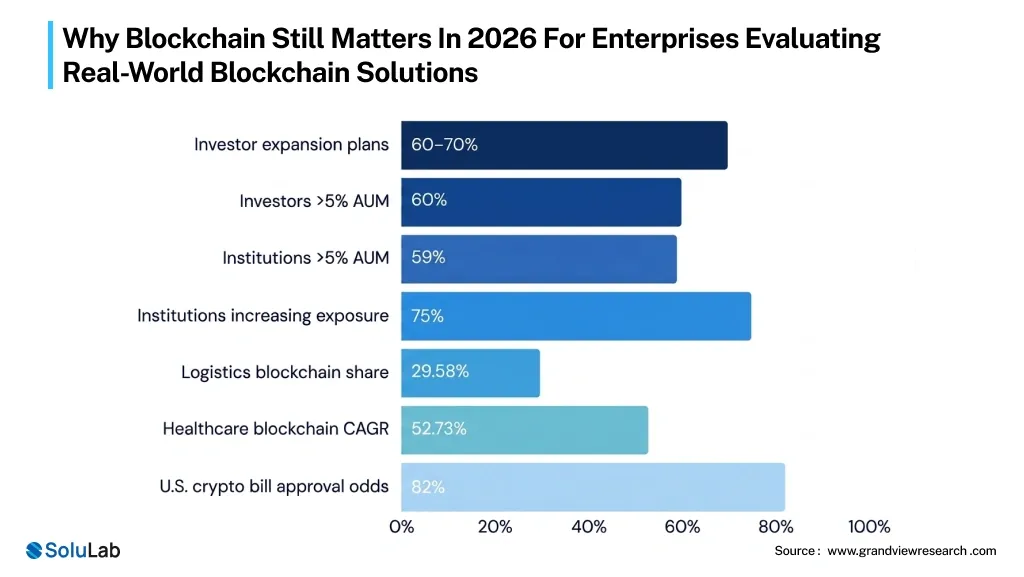
You’ve heard blockchain is the future more times than you can count. In 2026, it’s no longer a future story; it’s running in live production environments at companies you’ve heard of, handling real transaction volume every day.
- Stripe and PayPal are settling international volume on stablecoin rails.
- BlackRock’s tokenized money market fund, BUIDL, crossed $500M in assets within weeks of launch.
- Visa routes portions of cross-border settlement through public blockchain infrastructure.
These are operational decisions, made by companies that simply can’t afford to get it wrong.
- Statista data shows global enterprise blockchain spending crossed $19 billion in 2024, on track to exceed $60 billion by 2028.
- The WEF estimates blockchain adoption in trade finance alone could eliminate $15–20 billion in annual friction costs.
- Forbes has consistently ranked blockchain among the top five enterprise technology priorities for CFOs through 2026.
The shift isn’t coming, it’s already here. The only real question is whether your business is building capability around blockchain use cases now or spending the next few years playing catch-up.
I suggest you to explore the latest top blockchain trends shaping enterprise strategy and investment in 2026.
Core Blockchain Mechanisms Powering Real-World Enterprise Use Cases
Before diving into specific blockchain use cases and applications, it’s worth being clear on why blockchain is uniquely suited to certain business problems because that’s what separates the use cases that generate ROI from the ones that die in a pilot.
At its core, blockchain is a distributed ledger where every transaction is verified by multiple independent nodes. No single party controls the record. Once written, it can’t be changed without network consensus. That immutability is the foundation everything else builds on.
Three things drive enterprise value for Blockchain PoC:
- Programmability — Smart contracts encode business logic directly into the protocol. Payments are released when conditions are met. Compliance checks run in real-time. No human approvals, no delays, no disputes about contract interpretation.
- Interoperability — Modern protocols connect to each other, to legacy banking infrastructure, and to AI platforms. Integration with existing enterprise systems is more practical now than it’s ever been.
- Auditability — Every transaction carries a permanent, timestamped record. Regulatory audits that once took weeks now take only hours. Fraud detection that relied on post hoc analysis becomes real-time.
Understanding how to implement blockchain in business starts here, not with the technology stack, but with identifying where these three properties solve real operational pain. That mapping exercise is what separates a successful deployment from an expensive learning experience.
For a detailed picture of blockchain development costs and what drives them from PoC to production, see our full breakdown.
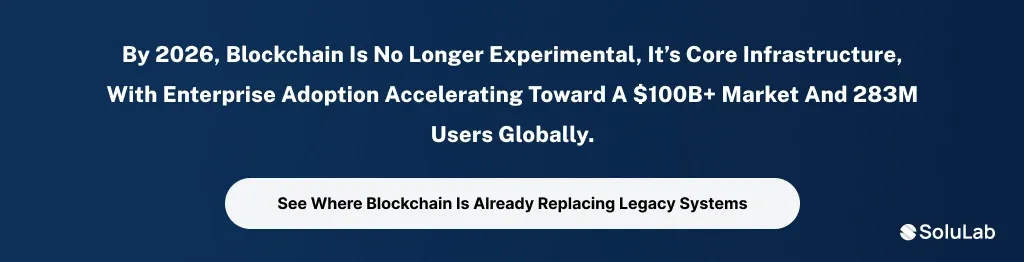
Core Blockchain Mechanisms Behind Real-World Enterprise Blockchain Use Cases
The applications of blockchain technology generating real business value today span well beyond cryptocurrency. Here’s where live deployments are producing measurable outcomes:
- Smart Contract Automation — Self-executing contracts trigger payments, delivery confirmations, or compliance actions automatically. Widely deployed in insurance claims processing, trade finance, and real estate closings.
- Asset Tokenization — Physical and financial assets converted into on-chain digital tokens, opening liquidity in markets that were previously inaccessible or illiquid.
- Supply Chain Provenance — End-to-end product tracking creates an immutable history by reducing fraud, accelerating recalls, and cutting compliance overhead significantly across manufacturing, food, and pharma.
- Digital Identity & Credentialing — Verified, portable identities that individuals and institutions control, removing reliance on centralized databases that remain high-value targets for attackers.
- Decentralized Finance Infrastructure — Lending, yield generation, and settlement operating 24/7 without traditional banking intermediaries, with far lower overhead cost structures.
These are live, scaled deployments generating documented ROI, not concept papers. Let’s delve into the specific enterprise blockchain use cases that are creating real competitive advantages right now.
Enterprise Blockchain Use Cases That Deliver Measurable Business Outcomes
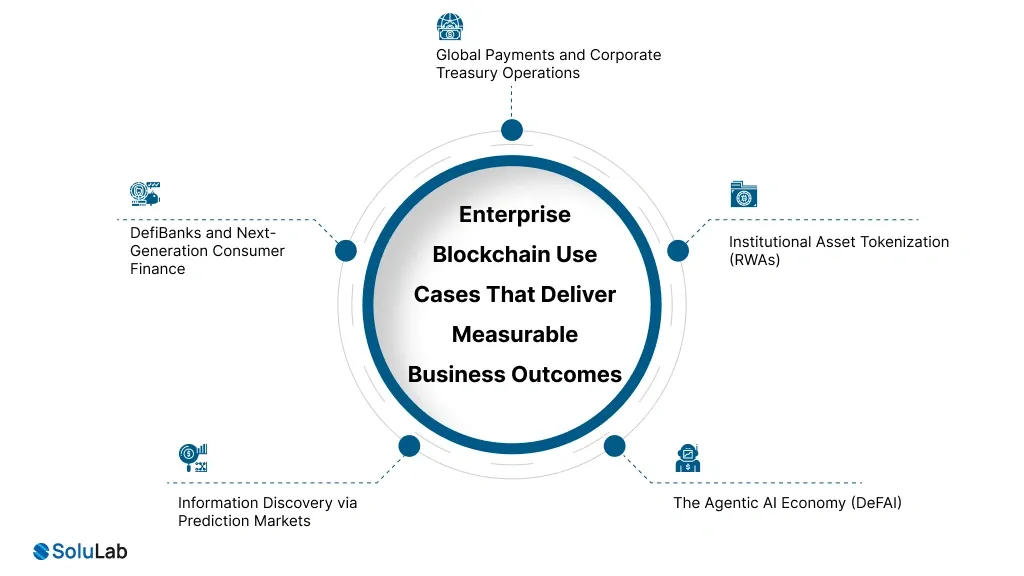
1. Global Payments and Corporate Treasury Operations
Stablecoins have transitioned from speculative trading tools into the foundational settlement layer of the internet, driving massive efficiencies for enterprises
a. Cross-Border Settlement & B2B Payments:
Multinational corporations, global e-commerce platforms (like Amazon and Walmart), and major payment processors (such as Stripe and PayPal) are utilizing stablecoins to avoid traditional correspondent banking. This eliminates T+2 settlement delays and executes near-instant, low-cost global payroll and supplier payments.
b. Card Network Integration:
Major global card networks are routing significant portions of their cross-border net settlement volume through public-chain stablecoins behind the scenes, reducing prefunding requirements and correspondent banking risk.
c. Corporate Treasuries:
Traditional financial institutions are utilizing tokenized money-market instruments and stablecoins for programmable cash-management and intraday repo transactions, allowing corporate treasuries to move funds between global entities faster and cheaper.
See what a full Enterprise blockchain solution for treasury and payments modernization looks like in practice.
2. Institutional Asset Tokenization (RWAs)
The tokenization of Real-World Assets (RWAs) is projected to surpass half a trillion dollars by 2026, fundamentally rewiring capital markets by bringing traditional balance sheets on-chain.
a. Private Credit and Lending:
Blockchains are actively being used to originate Home Equity Lines of Credit (HELOCs) and SME loans. This transparent, on-chain marketplace reduces origination times and passes significant cost savings (averaging 1.25%) directly down to borrowers.
b. Tokenized Treasuries as Core Collateral:
Tokenized U.S. Treasuries (such as BlackRock’s BUIDL) are replacing traditional fiat as the base collateral for on-chain lending protocols and derivatives exchanges. This allows institutional capital to earn yield rather than sitting idle during trade settlements.
c. InfraFi (Infrastructure Finance):
Crypto rails are unlocking decentralized debt financing for capital-intensive physical infrastructure. This allows retail and institutional capital to directly fund revenue-generating distributed energy resources, such as residential solar networks, battery systems, and EV chargers.
3. The Agentic AI Economy (DeFAI)
Blockchain is providing the missing financial, coordination, and verification layer required for Artificial Intelligence to scale.
a. Machine-to-Machine (M2M) Commerce:
Using protocols like x402 and ERC-8004, autonomous AI agents can hold on-chain identities and execute instant, frictionless micropayments to purchase API access, data, and compute time entirely without human intervention.
b. Decentralized Data Foundries:
As public web data dries up, crypto-economic networks are being used to globally crowdsource the specialized, multimodal data (e.g., dashcam footage, sensor logs, teleoperation data) required to train robotics and physical AI models much faster than centralized data collection.
c. Compute Derivatives:
With GPU compute becoming a critical macroeconomic input, blockchain-based derivative markets are emerging to allow AI companies to hedge against the extreme price volatility and availability risks of AI hardware.

d. Solving AI’s Trust Problem:
Enterprises are deploying blockchain provenance protocols to verify AI content, trace intellectual property rights, and detect deepfakes or synthetic bots through cryptographic Proof of Personhood.
Engaging experienced Blockchain consultants who understand both AI architecture and blockchain protocol design is increasingly critical to executing effectively in this space.
4. Information Discovery via Prediction Markets
Prediction markets have evolved from niche betting platforms into massive, highly calibrated forecasting utilities that process billions in volume.
a. Corporate Hedging:
Institutions and traders are increasingly using economy-linked event contracts to hedge against specific macroeconomic releases, such as inflation data, employment figures, or central bank rate cuts.
b. Media Monetization:
As traditional advertising models struggle, media and data firms are adopting prediction markets as a core survival strategy. By integrating live odds and event contracts directly into broadcasts and news ecosystems, publishers can drive deeper audience engagement and create new streams of revenue.
Building Enterprise risk detection platforms that incorporate on-chain market signals is already giving early adopters a meaningful edge in risk visibility and management.
5. DefiBanks and Next-Generation Consumer Finance
Blockchain is stripping the overhead from traditional consumer banking, allowing platforms to capture higher margins while offering better yields.
a. Self-Custodial Neobanking:
DeFi banks are emerging to challenge legacy neobanks by bundling saving, spending, and borrowing into a single mobile interface. By underwriting loans against on-chain collateral and routing deposits into high-yield DeFi protocols, these platforms bypass legacy banking fees entirely.
b. Yield-Bearing Dollars:
Passive, zero-yield stablecoins are being displaced by tokens backed by exogenous real-world cash flows (such as private credit or energy revenue). This provides consumers and businesses with direct, borderless access to institutional-grade yields.
How to Determine the Right Blockchain Use Cases for Enterprise Adoption?
Not every business problem needs blockchain, and the honest answer is that it adds the most value when you have multiple parties who don’t fully trust each other, need a shared record, and want to automate transactions or compliance.
If all three are true, blockchain should be a serious strategic priority.
Start with these questions:
- Do we have intermediaries in our process who add cost but not real strategic value?
- Do we need a shared, auditable record across multiple organizations or counterparties?
- Are settlement delays, manual reconciliation, or compliance overhead causing measurable financial losses?
- Is data integrity and provenance critical to our customers or our regulators?
Two or more yes answers mean blockchain is worth a structured evaluation. The next step is scoping the cost to develop a blockchain solution against the value you expect to recover, and that analysis is what separates well-executed projects from ones that stall after six months of build.
The strongest real-world deployments start with one focused problem, prove value, and then scale.
How SoluLab Delivers Top-Notch Blockchain Solutions?
Knowing which sectors benefit from blockchain helps orient the discussion, but industry alone is not the decision factor. What matters is whether your operations have the friction blockchain is designed to remove.
For teams with complex integrations or compliance constraints, custom blockchain development often makes more sense than off-the-shelf tools. A well-scoped blockchain PoC can validate architecture in 6–8 weeks and make the internal business case clear, or you can hire blockchain developers. Just as important is knowing when not to build; sometimes, integrating into an existing network is a smarter move.
Building Enterprise-grade blockchain solutions requires a team that has solved the hard problems before regulatory compliance, multi-chain architecture, institutional security standards, and post-launch support at scale.
Conclusion
Blockchain app development is no longer a future bet. In 2026, it is already be live across payments, capital markets, AI infrastructure, and consumer finance, and the companies deploying now are locking in advantages that will be hard to unwind later.
The most valuable blockchain use cases share a simple trait: they cut costs, increase speed, or unlock revenue that legacy systems cannot. Enterprise adoption is accelerating because deployment is getting easier, not harder. Programmable money, tokenized assets, autonomous AI agents, and on-chain compliance are becoming core infrastructure.
The real question is not if blockchain fits your business, but where it creates the clearest ROI and whether you have a partner who can execute in production, not just theory. The competitive gap created by waiting is far more expensive than the cost of building it right.
FAQs
Shipra Garg is a tech-focused content strategist and copywriter specializing in Web3, blockchain, and artificial intelligence. She has worked with startups and enterprise teams to craft high-conversion content that bridges deep tech with business impact. Her work translates complex innovations into clear, credible, and engaging narratives that drive growth and build trust in emerging tech markets.