Talk to an Expert

Why are Startups, Businesses, and Governments Looking for DePIN Development?

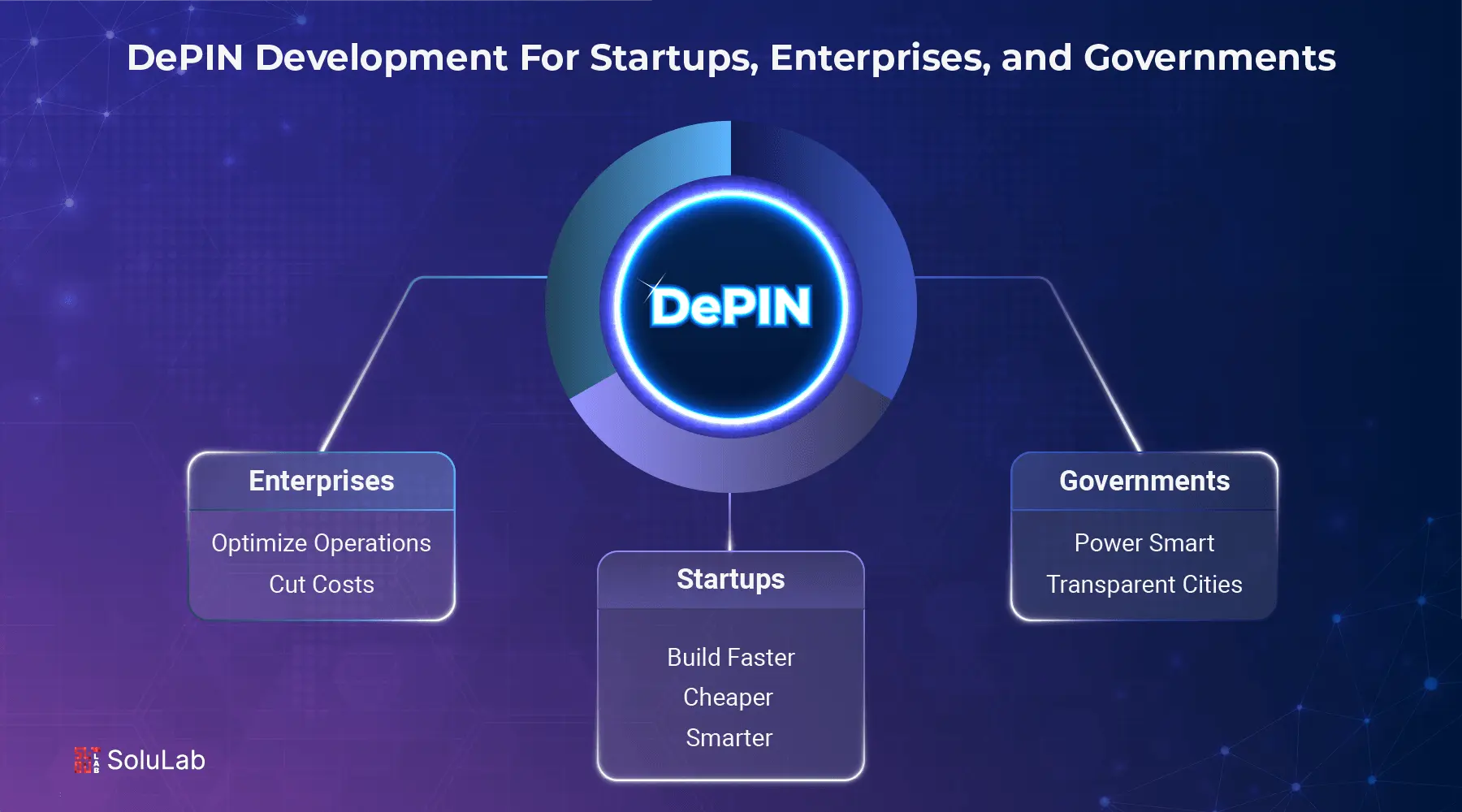
DePIN Development For Startups

Decentralized infrastructure is opening up new possibilities in a number of industries, and companies are starting to take notice. Startups, businesses, and governments are increasingly exploring DePIN (Decentralized Physical Infrastructure Networks) to build more scalable, transparent, and efficient solutions. 

The DePIN industry is projected to attain $3.5 trillion by 2028, indicating that decentralized models are vital to future-oriented plans.

This transition is propelled by the increasing benefits that DePIN provides – enhanced cost-effectiveness, augmented autonomy, and heightened community involvement. A new McKinsey survey indicates that 45% of company executives choose decentralized solutions to enhance smarter, more sustainable operations. Emerging opportunities are arising to construct infrastructure that is both dynamic and robust, ranging from decentralized wireless networks to shared energy systems.

Governments are also adopting the potential of decentralized systems to enhance contemporary infrastructure projects. The World Economic Forum indicates that 70% of smart city initiatives initiated post-2023 have used decentralized frameworks to augment innovation and community engagement. The ongoing DePIN development is fostering a future characterized by cooperation, transparency, and collective advancement.

In this blog, we take a closer look at how DePIN is reshaping opportunities for startups, businesses, and governments. As DePIN for startups continues to gain momentum, it’s opening new paths for innovation, growth, and collaboration.

Why Startups are Embracing DePIN?

Startups are now turning more and more towards DePIN (Decentralized Physical Infrastructure Networks) since it empowers them to build, grow, and innovate without the old constraints of centralized infrastructure. With speed, trust, and adaptability being the success drivers in a market, DePIN presents a new ground for startups to develop more robust and community-based solutions. Partnering with an experienced DePIN development company often becomes a strategic move, allowing these startups to tap into decentralized models efficiently and future-proof their growth.

Here are some reasons why startups are using DePIN technology:

  • Lower Barriers to Entry: DePIN allows startups to access and build infrastructure without the heavy upfront costs typically associated with physical assets. Instead of owning everything, they can tap into decentralized networks, making it easier and faster to launch new services or platforms.
  • Faster Market Expansion: By taking advantage of decentralized infrastructure, companies can scale their operations to new markets without the need to establish conventional facilities. This ease makes it easy to pilot markets, reach worldwide audiences, and fine-tune services according to real-world needs.
  • Enhanced Transparency and Trust: Today’s users are more aware of how their data and resources are managed. DePIN models offer visible, verifiable systems where ownership and participation are clear, helping startups earn early trust and stand out in competitive markets.
  • Community-Driven Growth: Startups using DePIN frameworks can invite users to become stakeholders. Not only does this method ease funding and sharing resources, but it also creates greater loyalty and commitment, making users organically brand champions.
  • Access to Alternative Funding Models: Aside from conventional venture capital, startups are able to raise money through tokenized incentives, crowdsourcing, and decentralized governance systems. This makes it easier to align financial interests with community growth from the very beginning.
  • Built-In Resilience: Decentralized networks minimize the risk of single points of failure. For startups, this translates to fewer interruptions, improved uptime, and more resilient operational continuity, even as they scale fast and encounter volatile challenges.
  • Opportunities for Innovation: DePIN doesn’t just replicate traditional systems — it creates entirely new models. Startups working with decentralized networks often find new ways to deliver value, whether through token economies, shared resource marketplaces, or peer-to-peer infrastructure systems.

CTA1

Why Enterprises and Traditional Businesses are Adopting DePIN?

For decades, large businesses and traditional enterprises have relied on centralized systems to manage everything from supply chains to customer operations. It worked — for a time. But today, things are shifting. The pace of technology, rising security risks, and changing customer expectations are pushing companies to rethink how they build and run their infrastructure. That’s where DePIN, or Decentralized Physical Infrastructure Networks, is starting to make a real difference. It’s not just another tech buzzword; it’s becoming a serious strategy for companies that want to stay competitive, scale smarter, and build systems that last.

Here’s a closer look at why DePIN is becoming part of enterprise playbooks:

1. Reducing Operational Costs

Running large centralized systems isn’t cheap — maintaining servers, managing security, scaling data centers — the costs stack up fast. With DePIN, businesses can tap into shared, decentralized networks. It means spreading the load, reducing upfront investments, and trimming ongoing operational costs without losing control.

2. Stronger Security and More Resilience

Centralized setups often have a weak spot — one breach, one outage, and everything can grind to a halt. DePIN changes that. By distributing infrastructure across many nodes, businesses build systems that can survive attacks, hardware failures, or even localized disasters without skipping a beat.

3. Boosting Transparency and Customer Trust

Trust is harder to earn and easier to lose than ever before. DePIN frameworks create transparent, tamper-proof records that customers, partners, and regulators can verify independently. For sectors like finance, healthcare, or supply chain, that kind of trust isn’t just nice to have — it’s critical.

4. Faster and Easier Market Expansion

Traditionally, expanding into a new market meant massive infrastructure investment. DePIN makes it easier. Companies can plug into decentralized infrastructure already operating locally, roll out services faster, and adjust on the fly, without the long timelines and heavy costs they used to face.

5. New Ways to Deliver Value

DePIN doesn’t just optimize old systems, it opens the door to completely new business models. We’re seeing enterprises launch decentralized identity services, loyalty programs powered by token economies, and peer-to-peer marketplaces that wouldn’t have been practical before.

6. Better, More Dynamic Partnerships

In a decentralized model, partnerships aren’t limited to two companies signing a contract. DePIN ecosystems allow multiple stakeholders, vendors, customers, and even competitors to participate, share value, and innovate together. It’s collaboration at a different level.

7. Positioning for Long-Term Success

Enterprises that move early on DePIN aren’t just fixing today’s problems, they’re setting themselves up for a more adaptable, future-proof foundation. Whether it’s scaling faster, handling future tech shifts, or responding to regulatory changes, a decentralized backbone puts them ahead of the curve.

Government and Public Sector Involvement in DePIN

Across the world, governments and public sector organizations are beginning to take decentralized infrastructure seriously. They are no longer just watching from the sidelines — many are now actively piloting or adopting DePIN to make their systems more resilient, cost-effective, and citizen-friendly. With growing interest around DePIN use cases, public bodies are seeing that decentralized models offer practical solutions to challenges that centralized infrastructure simply can’t solve anymore.

Here’s how the public sector is starting to put DePIN into action:

  • Building Smarter Cities: Urban centers are under constant pressure to deliver better services with fewer resources. Governments are turning to DePIN to create decentralized energy grids, public Wi-Fi networks, and smarter transport systems, giving communities more direct access to essential services without depending on a few centralized providers.
  • Modernizing Identity Systems: A number of governments are experimenting with decentralized digital identity frameworks. Instead of relying on central databases vulnerable to breaches, DePIN models give individuals more control over their information while still meeting national security and compliance standards.
  • Redesigning Energy Networks: Energy independence has become a major focus. Through custom DePIN solutions, local and regional authorities are working on decentralized renewable energy grids, where citizens can generate, trade, and consume clean energy within their own neighborhoods.
  • Strengthening Disaster Response: When natural disasters strike, centralized infrastructure often fails. Some governments are testing decentralized communication systems and emergency service networks that can stay functional even when parts of a city lose power or internet access.
  • Increasing Transparency in Procurement: Corruption and inefficiency in government procurement are long-standing problems. With decentralized ledgers and smart contracts, agencies are finding new ways to make bidding, contracting, and public spending more transparent and accountable.
  • Promoting Citizen Participation: Instead of being passive recipients, citizens are becoming active stakeholders in infrastructure projects. DePIN models allow for shared ownership, more community-driven innovation, and a greater sense of participation in public service delivery.
  • Protecting Critical Systems: Cybersecurity threats are pushing governments to rethink how they secure vital systems. Decentralized models are offering a stronger, more resilient approach by spreading risk across nodes rather than concentrating it in one place.

Business Benefits of DePIN Development
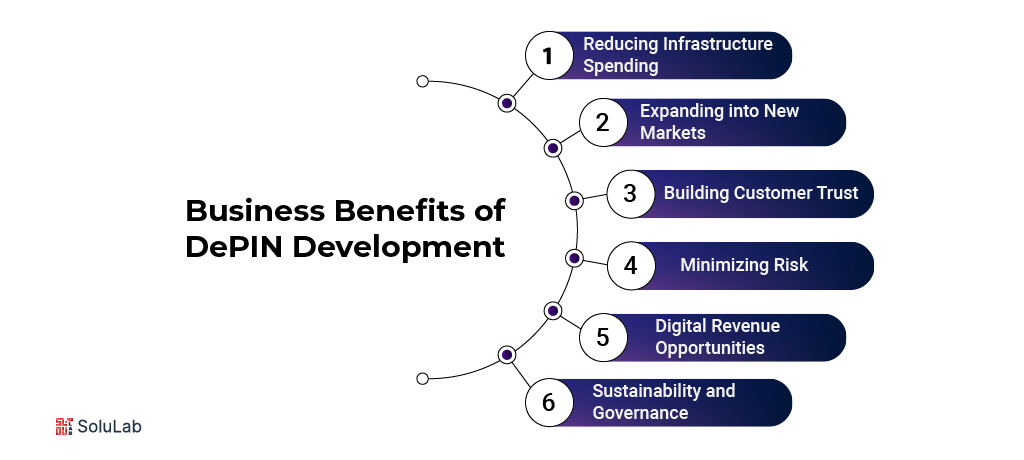
Business Benefits of DePIN Development

Decentralized Physical Infrastructure Network is no longer just a concept discussed by blockchain enthusiasts. It’s becoming a serious tool for businesses looking to rethink how they manage operations, engage users, and scale infrastructure without the traditional bottlenecks. Companies that invest early in decentralized physical infrastructure network solutions are positioning themselves for a future where transparency, resilience, and flexibility are essential, not optional.

Here’s why businesses of all sizes are starting to look seriously at DePIN:

  • Reducing Infrastructure Spending Without Compromising Growth
    Traditional infrastructure demands huge capital for building, maintaining, and upgrading, and those costs only rise as companies scale. DePIN offers a way to share resources across a distributed network, helping businesses control costs without sacrificing performance or reach.
  • Expanding into New Markets with Greater Agility
    Because DePIN solutions are decentralized, businesses aren’t tied to fixed locations or rigid rollout schedules. They can enter new markets quickly, adapt offerings to local needs, and scale operations on demand, something traditional models struggle to support.
  • Building Customer Trust Through Verifiable Systems
    In decentralized environments, service records and transactions can be independently verified. This transparency strengthens trust with customers, partners, and regulators, a competitive edge in industries where credibility is everything.
  • Minimizing Risk Through Distributed Infrastructure
    Rather than concentrating systems in one vulnerable location, DePIN spreads operations across many nodes. That structure helps businesses stay operational even in the face of technical failures, cyberattacks, or localized disruptions.
  • Unlocking New Digital Revenue Opportunities
    DePIN models create space for new services like shared asset platforms, decentralized marketplaces, and token-based incentive systems. Companies can innovate faster and capture value in emerging digital economies.
  • Meeting Sustainability and Governance Expectations
    As ESG initiatives become more central to business strategy, decentralized infrastructure offers meaningful advantages. Shared networks can reduce environmental impact, promote digital inclusion, and support more ethical technology deployment.

That’s why working with a trusted DePIN development company in the USA can make a real difference. The right partner doesn’t just deliver technical solutions; they help build infrastructure that grows with the business, adapts to the market, and stands the test of time.

Read Also: DePIN In the Telecom Industry

Future Trends in DePIN Development

The world of DePIN (Decentralized Physical Infrastructure Networks) is still taking shape, but one thing is clear: it’s evolving fast. What started as a niche idea is now becoming a serious foundation for how industries might build and operate in the coming years. As adoption grows, both startups and enterprises are finding new ways to unlock the value of decentralized systems. Whether it’s about reducing costs, creating more resilient infrastructure, or building communities around shared ownership, the next wave of DePIN development will look very different from what we see today. The role of DePIN for startups is expected to be especially important, as early movers continue to drive innovation and reshape industries from the ground up.

Here are some of the key trends shaping the future of DePIN:

1. Specialized Networks Focused on Specific Industries

Instead of broad, generalized platforms, we’ll see DePIN networks designed to meet the unique needs of industries like supply chain, healthcare, energy, and transportation. Focused networks will allow for faster innovation and better performance by addressing very specific challenges.

2. Cross-Network Interoperability

As more decentralized systems launch, the need for them to communicate and share resources will grow. Future DePIN platforms will focus on interoperability, making it easier for businesses and users to move assets and data across different decentralized environments without friction.

Read Also: Blockchain Interoperability for Enterprise Adoption

3. Community-Owned Infrastructure Models

Ownership is shifting away from corporations and moving toward communities. Many future DePIN projects will be built around shared ownership models, where users contribute resources and help govern the network, gaining real economic incentives for their participation.

4. DePIN as a Backbone for Startups

Early-stage companies are already seeing the benefits of building on decentralized networks. Going forward, DePIN models will offer startups faster routes to market, lower operational costs, and the ability to create entirely new service categories that weren’t possible with traditional centralized models.

5. More Clarity Around Regulation

Governments and regulatory bodies are starting to pay closer attention to DePIN. We’ll likely see the creation of regulatory frameworks designed to support secure, resilient decentralized infrastructure without stifling innovation or community ownership.

6. Integration of AI and Machine Learning

Intelligent DePIN networks are coming. AI-driven management and optimization of decentralized infrastructure will make these systems more efficient, self-healing, and capable of making real-time adjustments based on network conditions.

CTA2

The Bottom Line

The rise of DePIN marks a major shift in how businesses, governments, and communities approach infrastructure. Instead of relying solely on centralized systems, organizations are embracing decentralized models that offer greater flexibility, transparency, and resilience. From startups to enterprises, the movement toward DePIN is opening new pathways for growth, innovation, and collaboration across industries.

At SoluLab, we have been at the forefront of delivering real-world decentralized solutions. Our work with Morpheus.Network, a blockchain-powered SaaS platform designed to streamline and secure global logistics, is a strong example of how DePIN models are already reshaping traditional industries. Morpheus.Network brings together blockchain, IoT, SMS notifications, and legacy technologies to create smarter, more secure supply chains. Through projects like this, SoluLab continues to build DePIN solutions that bridge the gap between emerging tech and existing business ecosystems, helping our clients lead confidently into a decentralized future.

If you’re exploring how DePIN could transform your business, now is the time to act. Connect with SoluLab today to learn how we can help you build decentralized systems that are practical, scalable, and ready for what’s next.

FAQs

1. What industries can benefit the most from DePIN solutions?

DePIN solutions aren’t limited to any one sector. Industries like supply chain management, energy distribution, telecommunications, healthcare, and even agriculture are already seeing value. Anywhere that infrastructure needs to be more resilient, transparent, or distributed, DePIN can create opportunities to rethink the way services are delivered and managed.

2. How is DePIN different from traditional blockchain networks?

While traditional blockchain networks often focus on financial transactions or digital assets, DePIN is about connecting physical infrastructure — things like data centers, wireless networks, or energy grids — through decentralized coordination. It’s about linking the physical and digital worlds in a way that removes centralized control and distributes both responsibility and benefit more evenly across participants.

3. Is DePIN development only suitable for startups and tech companies?

Not at all. While startups are quick to adopt DePIN because of its flexibility, larger enterprises and even public sector organizations are exploring DePIN to modernize infrastructure, reduce operational costs, and offer new services. It’s not about company size — it’s about how willing an organization is to adapt to more open, decentralized models.

4. What skills and technologies are needed to build a DePIN network?

Developing a strong DePIN network typically requires expertise in blockchain architecture, IoT integration, cybersecurity, and decentralized governance models. It’s not just about coding; it’s about designing systems that can function independently, stay secure, and scale over time without relying on central points of control.

5. How can companies future-proof their investment in DePIN technology?

The smartest approach is to design systems that are flexible and adaptable from day one. Rather than locking into a single platform or standard, businesses should focus on open architectures, interoperability, and community-driven governance models. It’s also critical to stay engaged with the evolving DePIN ecosystem, as the technology, standards, and best practices will continue to mature over the next few years.

 

Use Cases of DePIN in 2025

Decentralized Physical Infrastructure Networks

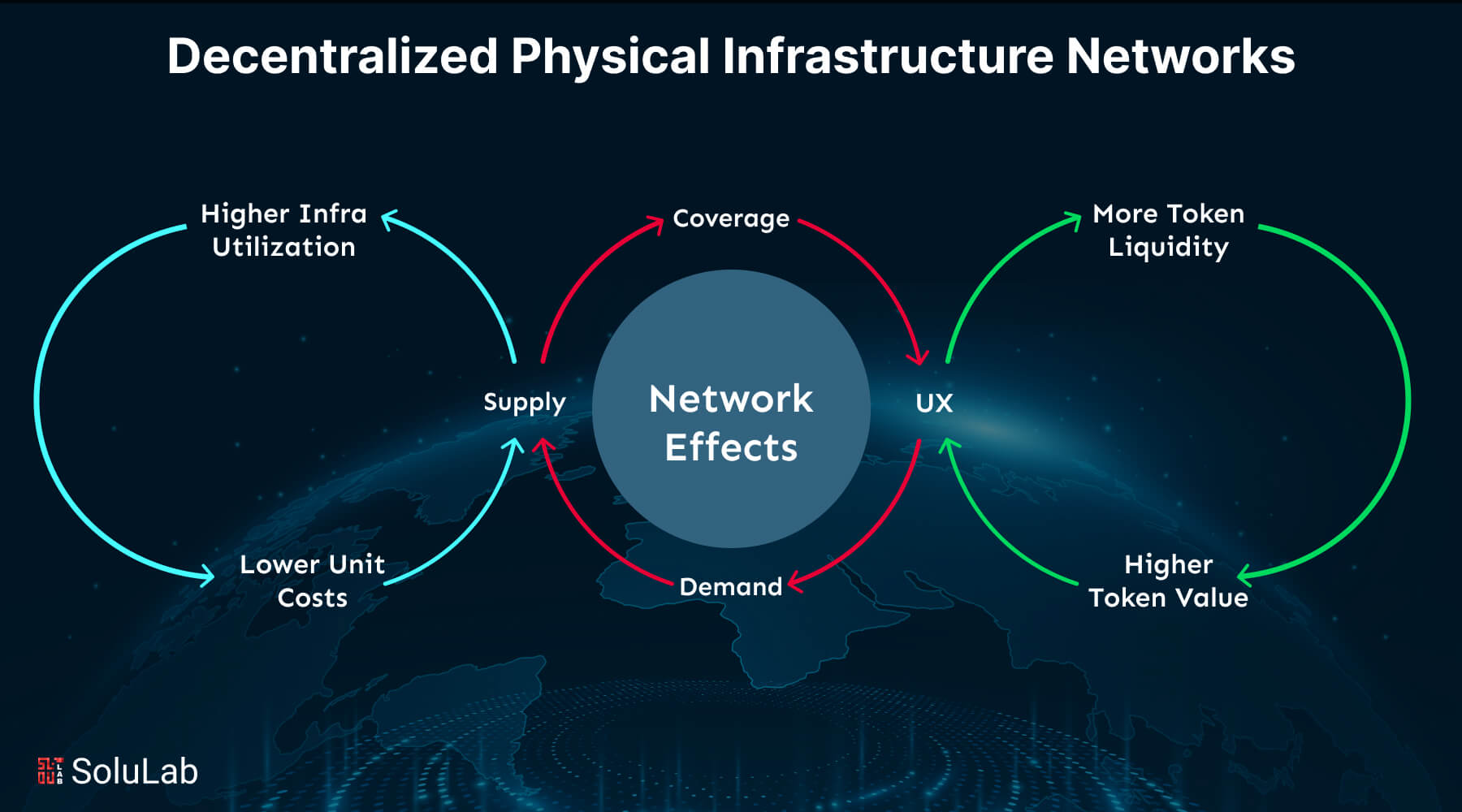
Decentralized Physical Infrastructure Networks, or DePINs, are gaining popularity among enterprises that recognize DePIN’s potential to handle actual hardware services in a decentralized manner.

DePIN integrates blockchain and artificial intelligence (AI), two transformative modern technologies. By combining these latest technologies, DePIN seeks to improve access to vital resources and systems, promoting equality and transparency for all. This innovative approach can transform a wide range of sectors and significantly impact our daily lives by changing how we interact with digital and physical objects. Over 650 projects were developing these DePIN solutions last year, according to Messari’s“The DePIN Sector Map” publication. 

This explains why DePIN’s market value reaches $25 billion. So, if you want to learn more about DePIN, how it works, and why it is essential, this blog is worth reading!

In this blog, we will discuss DePIN (decentralized physical infrastructure network) and the use cases of decentralized physical infrastructure networks. So, without any further ado, let’s get started!

What is DePIN?

DePIN, an abbreviation for Decentralized Physical Infrastructure Networks, is a novel concept for developing and managing physical infrastructure using decentralized technologies. It blends blockchain technology alongside physical assets in order to create a more effective, transparent, and secure approach to infrastructure development, operation, and maintenance.

Traditionally, huge organizations or centralized entities take care of physical infrastructure such as data centers, telecommunications networks, and energy grids. These systems may suffer from inefficiencies, excessive costs, and a lack of transparency. DePIN shifts this paradigm by enabling individuals and organizations to contribute resources, which allows people and organizations to give resources to a decentralized network, such as processing power, storage space, or even renewable energy. In exchange, players are rewarded with tokens or other types of incentives, resulting in a more collaborative and efficient method.

DePIN’s major characteristic is its capacity to assure trust and transparency. Blockchain technology records all transactions and activity inside the network in a tamper-proof ledger. This not only guarantees that resources are used properly, but also enables the seamless connection of scattered assets over a worldwide network.

As the world shifts toward digital transformation, DePIN has an opportunity to redefine the way we think about and engage with physical infrastructure. By decentralizing crucial system management, it provides a viable alternative to traditional methods that may be sluggish, expensive, and prone to central points of failure. DePIN improves infrastructure resilience, flexibility, and accessibility to a greater spectrum of people, resulting in a more inclusive and sustainable future.

Benefits of DePIN

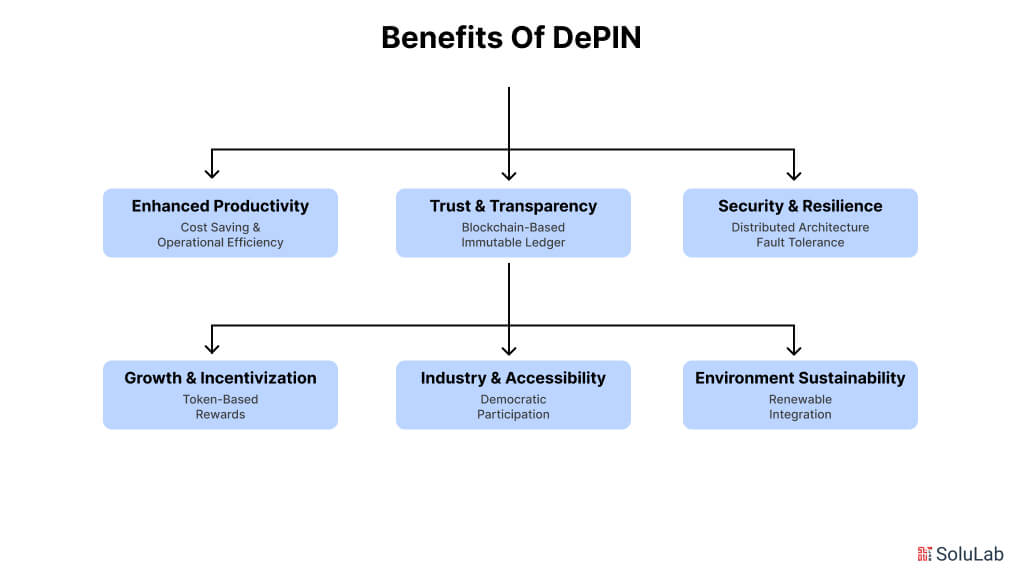
Benefits of DePIN

The many benefits of Decentralized Physical Infrastructure Networks (DePIN) transform the way we design and maintain infrastructure. Besides only making systems more effective, decentralized physical infrastructure can also promote innovation, improve accessibility, and promote long-term sustainability. Here are some of the top benefits of DePIN:

1. Enhanced Productivity and Cost Savings

DePIN’s ability to streamline infrastructure operations is among its primary benefits. Multiple levels of management are frequently used in traditional centralized systems, which can result in inefficiencies and increased expenses. DePIN, on the other hand, eliminates needless middlemen and lowers operational overhead by enabling direct communication among participants. Both suppliers and customers benefit from more affordable solutions as a result.

2. Trust and Transparency

DePIN makes use of blockchain technology to guarantee that every activity and transaction within the network is documented in a safe, unchangeable ledger. Since every action made within the network can be confirmed by all members, this transparency increases participant trust. Additionally, it removes the possibility of fraud or resource abuse, increasing the dependability and accountability of decentralized infrastructure.

3. Security and Resilience

Decentralized physical infrastructure also has the important advantage of being less susceptible to single points of failure. Cyberattacks, natural catastrophes, and other disturbances that could impact significant swaths of the infrastructure are common threats to centralized systems. By distributing resources and operations among numerous participants, DePIN’s decentralized architecture, on the other hand, produces a more resilient system that is more difficult to hack or disable.

4. Growth and Incentivization

DePIN gives people and organizations the chance to get involved in infrastructure development and upkeep in ways that were previously impossible with conventional procedures. It promotes broad participation and creativity by giving participants tokens or other rewards. In addition to encouraging community-driven solutions, this guarantees that infrastructure develops to satisfy the many demands of its users.

5. Inclusivity and Accessibility

No matter their size or location, participants can contribute resources to decentralized infrastructure. This makes it possible for smaller actors to join and profit from the network, democratizing access to vital infrastructure. Anyone with the required resources can participate in DePIN’s more inclusive model, whether they are giving storage capacity, processing power, or renewable energy.

6. Sustainability of the Environment

Another significant advantage is the integration of renewable energy sources into decentralized infrastructure networks. To run more sustainably, many DePIN projects seek to use resources like hydroelectric, solar, or wind power. In addition to lessening infrastructure’s negative environmental effects, this emphasis on sustainability promotes the wider use of green technologies.

Related: Why are Startups, Businesses, and Governments Looking for DePIN Development?

How Does the DePIN Network Work?

Many components work together to create a cooperative, blockchain-based physical infrastructure, which is what makes a Decentralized Physical Infrastructure Network (DePIN) successful and effective. These contributions, which vary from human users to technological elements, are all essential to the smooth and successful operation of the network.

1. Participants and Providers of Resources

Participants—individuals, companies, and organizations that provide resources—are the backbone of every DePIN network. Depending on the particular DePIN use cases, these resources might vary greatly and could include physical assets like infrastructure gear or renewable energy sources, as well as processing power, storage capacity, and bandwidth. Anyone may engage in a decentralized system, allowing for a more diversified ecosystem where the network as a whole is shaped by a range of inputs.

Participants may provide extra energy from solar panels, empty data center storage space, or idle computer resources, for instance, in blockchain-based physical infrastructure initiatives. DePIN networks can build bigger, more effective systems without depending on conventional centralized authority by combining these contributions.

2. The Use of Blockchain Technology

Blockchain technology, which guarantees security, transparency, and immutability, is the foundation of any DePIN network. Blockchain is the distributed ledger that keeps track of every activity and transaction that takes place on the network. It fosters confidence among participants by guaranteeing that each activity, trade, and contribution is authenticated and unchangeable. The blockchain’s decentralized structure also eliminates the need for a central authority, enabling the network to function independently by established standards.

Blockchain not only protects transactions but also makes asset tokenization easier. In return for their efforts, members of a DePIN network might get tokens or other digital rewards. The network becomes more dynamic and sustainable as a result of the incentives provided by this token-based economy.

3. Physical Assets and Infrastructure

The actual assets are essential to a DePIN network’s operation, even though blockchain technology is also quite important. These can include energy grids, sensor networks, data storage facilities, and telecommunications infrastructure. Underutilized or dispersed physical infrastructure that can be decentralized and improved for increased efficiency is what DePIN networks rely on to function well.

For example, persons or companies with solar panels can provide extra energy to the network in DePIN use cases linked to energy grids, and people with extra hard drives can donate space for distributed storage systems in data storage networks. The secret is in the way these tangible assets are linked together and controlled by blockchain protocols, which enable resource sharing and coordination in real-time.

4. Automation and Smart Contracts

Another essential component of the DePIN network is smart contracts, which are self-executing agreements encoded in the blockchain. These contracts eliminate the need for manual intervention by automatically executing and enforcing provisions when specific conditions are satisfied. They guarantee that donors receive just and timely payment for their contributions, which builds confidence and promotes further involvement.

In a decentralized energy network, for instance, a smart contract may automatically move tokens to a user’s wallet each time they supply the grid with more solar energy. The network becomes more efficient as a result of this smooth automation, which simplifies the procedure and lowers transaction friction.

Use Cases for DePIN in 2025

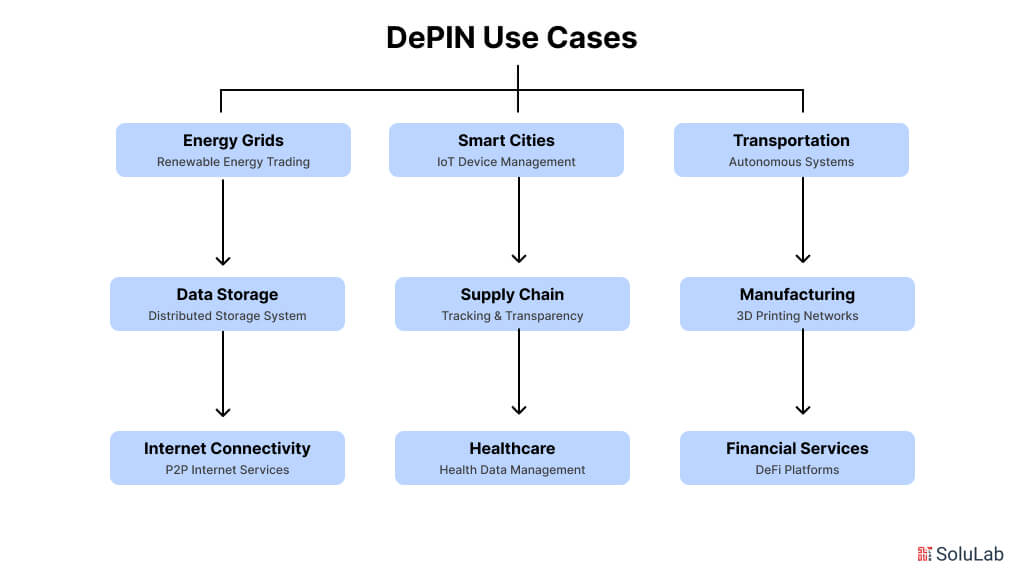
DePIN Use Cases

The power of decentralized physical infrastructure networks (DePIN) to transform businesses and alter conventional systems is becoming more and more apparent as they develop. DePIN use cases are anticipated to significantly grow by 2025 in a number of industries, including telecommunications and energy, providing cutting-edge solutions that promote inclusivity, sustainability, and efficiency. Here are a few of the most important DePIN use cases that will be relevant in 2025.

  • Decentralized Energy Grids

The energy industry is expected to be one of the most significant DePIN application examples. Decentralized energy systems will make it possible for residences and commercial buildings to pool excess energy produced by renewable resources like wind turbines and solar panels by 2025. Blockchain-based systems will enable participants to purchase and sell energy effectively, boosting the usage of sustainable energy and decreasing reliance on conventional centralized networks.

  • Decentralized Data Storage

Use cases for decentralized networks in the form of distributed storage systems will be driven by the increasing demand for safe, scalable, and easily available data storage. Participants can establish an international storage network by providing unused storage space from devices like SSDs or hard disks. This concept lowers costs, gives customers more control over their data, and lessens the need for central cloud providers.

  • Peer-to-Peer Internet Connectivity

Decentralized networks will improve internet access worldwide by 2025, especially in underprivileged areas. By providing peer-to-peer services, anyone with extra bandwidth will be able to support a worldwide decentralized network use case. By giving low-income or distant areas access to dependable and reasonably priced internet, this solution will lessen the digital divide.

  • Smart Cities Infrastructure

Decentralized systems will be essential to the creation of smart cities. Managing IoT devices, such as sensors for trash management, pollution monitoring, and traffic control, is one use case for DePIN in smart cities. Utilizing decentralized networks, these gadgets will exchange information and communicate, enhancing urban living’s sustainability and efficiency.

  • Decentralized Telecommunications Networks

Top DePIN use cases will also flourish in the telecommunications infrastructure sector. Underutilized network hardware, including routers or signal towers, might be donated by people and companies by 2025 to increase global connectivity. A more robust, economical, and adaptable telecommunications system will be made possible by this example of DePIN applications.

  • Supply Chain Monitoring and Transparency

Supply chains will use blockchain technology to track and validate transactions, giving customers and companies real-time visibility into the origin and path of commodities. By ensuring that items are supplied lawfully and ethically, this use case for decentralized networks will increase transparency, lower fraud, and foster more sustainable behaviors.

  • Decentralized Management of Health Data

Another industry that will be transformed by DePIN in 2025 is healthcare. Patients may have more control over their medical records if health data management is decentralized. Applications for DePINs include enhancing privacy, accessibility, and interoperability while safely storing and exchanging health data across a decentralized network.

  • Self-Driving Cars and Transportation Systems

The evolution of autonomous transportation networks will be significantly influenced by decentralized infrastructure. Through a decentralized system, vehicles will interact with the infrastructure around them and with each other, enabling safer, more effective transportation as well as real-time traffic control and route optimization. The shift to autonomous vehicles and intelligent transportation systems will heavily rely on this DePIN use case.

  • 3D Printing and Distributed Manufacturing

One of DePIN’s most popular applications in the manufacturing sector will be the decentralized 3D printing of items. By using 3D printers, people and companies may participate in a distributed manufacturing network, which eliminates the need for massive, centralized factories by creating goods or parts as needed.

  • Decentralized Financial Services (DeFi)

Platforms for decentralized finance (DeFi) will keep growing in their capacity to offer financial services in 2025. Without depending on conventional banks, anyone can lend, borrow, or exchange assets using instances of DePIN apps. Users will have easier access to financial tools as a result, especially in areas with weak banking infrastructure.

Thus, DePIN will have a wide range of applications in 2025 that will affect every facet of contemporary life. The prospective uses of decentralized infrastructure in fields like energy distribution, healthcare, and transportation will not only improve current systems but also give rise to whole new paradigms for resource sharing and teamwork. A more equitable, environmentally friendly, and secure future where physical infrastructure is more easily available and effectively controlled by a worldwide network of contributors is what the top DePIN use cases offer.

Challenges in the Usage of DePIN

While decentralized physical infrastructure networks (DePIN) provide various benefits, their broad acceptance and deployment present some obstacles that must be solved. These challenges span technological, regulatory, and operational dimensions, all of which can have an impact on DePIN systems’ effectiveness and scalability. The following are some of the major challenges that might impede the use of blockchain-based physical infrastructure.

1. Scalability and Network Efficiency: One of the most significant issues for DePIN networks is to make sure that they can grow efficiently. As the network expands, so does the number of participants and the volume of transactions, which can cause congestion and sluggish processing times. It is critical in blockchain-based physical infrastructure networks to ensure that the underlying blockchain can manage a huge number of transactions while maintaining speed and dependability. This problem becomes considerably more complicated when different forms of physical infrastructure—from energy grids to telecommunications—demand varying degrees of transaction speed and data storage.

2. Interoperability Between Networks: DePIN systems frequently rely on a broad set of devices and resources that must function flawlessly. Getting separate blockchain-based physical infrastructure networks to connect and exchange resources with one another is a huge difficulty. A decentralized energy grid, for example, may require connectivity to a decentralized data storage network or a telecommunications network. Without common protocols and procedures for interoperability, these networks may function in isolation, limiting the potential of DePIN applications and diminishing their overall efficacy.

3. Security and Privacy Concerns: While blockchain offers a high degree of security, DePIN systems’ decentralized structure introduces additional security vulnerabilities. Because these networks rely on a large number of players, each providing resources and information, vulnerabilities in one portion of the system have the potential to harm the entire network. Privacy is another issue, particularly when dealing with sensitive data. In areas such as healthcare and banking, protecting personal information while retaining transparency is a tricky balancing. To avoid these dangers, appropriate encryption methods and secure protocols must be implemented.

4. Regulatory and Legal Issues: DePIN networks, being relatively fresh, are not generally properly defined under existing legal and regulatory systems. This creates a substantial difficulty, particularly in areas with strong regulations such as energy, healthcare, and telecommunications. Governments and regulatory agencies are still figuring out how to categorize and govern decentralized infrastructure. Legal uncertainty may hinder adoption, as organizations may be hesitant to invest in or operate within a system that lacks clear legal guidance. Furthermore, questions of accountability, taxes, and intellectual property in decentralized contexts must be addressed to support the long-term growth of DePIN networks.

Read Blog: How DePIN Transforms Web3 Space

5. Adoption & Trust: To survive, every DePIN network requires widespread engagement and confidence from a varied range of stakeholders. Convincing individuals, organizations, and enterprises to donate resources to a decentralized network can be difficult, especially in industries traditionally dominated by centralized authority. Overcoming cynicism regarding the security, dependability, and utility of decentralized systems is a serious challenge. Furthermore, new users may struggle to use blockchain systems, which might provide a barrier to wider adoption.

6. Energy Consumption and Environmental Impact: Despite increased interest in employing blockchain-based physical infrastructure for decentralized energy grids and other systems, the environmental effect of blockchain technology is still a worry. Certain blockchains, particularly those based on proof-of-work consensus algorithms, require massive amounts of energy. This may negate the potential sustainability benefits of DePIN systems, particularly if they are used in energy-intensive industries. Discovering energy-efficient blockchain alternatives, such as proof-of-stake or hybrid models, will be critical in meeting this problem.

7. Maintenance and Reliability: DePIN’s decentralized structure implies that no central authority oversees the system’s maintenance and functioning. In classic centralized infrastructure arrangements, a single organization manages maintenance and system changes, resulting in seamless operations. However, in a DePIN system, maintenance responsibilities are split among several players, which might result in variable performance and dependability. Ensuring that the system stays robust and resilient in the face of resource restrictions or system failures is a significant problem.

8. Financial and Incentive Structures: Tokenization of resources is a key component of DePIN networks, in which players are paid for their efforts. However, developing equitable and sustainable funding mechanisms for these networks might be difficult. Token values vary, creating uncertainty for those who rely on the system for pay. Furthermore, because token-based incentive systems are complicated, new users may struggle to grasp and trust the network’s economic architecture.

Connect with Experts

Final Words

Finally, DePIN use cases in 2025 have the potential to change industries throughout the world by providing a more decentralized, effective, and sustainable approach to managing physical infrastructure. As industries such as energy, data storage, telecommunications, and healthcare experiment with decentralized models, the promise for increased accessibility, openness, and resilience becomes obvious. DePIN’s most popular use cases, such as decentralized energy grids, peer-to-peer internet access, and distributed manufacturing, are only the beginning of a more connected and collaborative future.

SoluLab helped Spherium Finance create an all-in-one decentralized finance platform that consolidates a wide range of DeFi products and services, making them easily accessible. With the launch of this platform, Spherium is now empowering users outside of core IT enthusiasts to achieve high positive returns on their DeFi investments. By integrating multi-asset, cross-chain swaps, and crypto financing solutions, the platform offers low-risk, high-reward investment management.

SoluLab specializes in designing blockchain-based physical infrastructure solutions that are suited to the specific requirements of each business. As a leading decentralized physical infrastructure and blockchain development company,  we can assist businesses in harnessing the potential of DePIN to create more efficient and scalable solutions. If you want to incorporate blockchain technology into your energy network, enhance data storage, or create a decentralized telecoms platform, SoluLab has the skills to make it happen. Want to transform your infrastructure with decentralized solutions? Contact SoluLab today to start building the future.

FAQs

1. What is DePIN and how does it work?

DePIN stands for Decentralized Physical Infrastructure Networks, where resources like energy, storage, and computing power are shared across a decentralized network rather than being controlled by a single organization. By using blockchain technology, DePIN ensures that transactions and contributions are secure, transparent, and efficient, allowing participants to contribute and earn rewards in a decentralized ecosystem.

2. How will DePIN impact the energy sector in 2025?

In the coming years, DePIN will impact the energy sector by allowing individuals and businesses with renewable energy sources, such as solar panels or wind turbines, to share excess energy through decentralized energy grids. This will make energy distribution more efficient, sustainable, and accessible, as participants can trade energy directly with each other, reducing reliance on traditional energy companies.

3. What are the benefits of decentralized data storage in DePIN?

Decentralized data storage through DePIN offers enhanced security and privacy by distributing data across multiple participants rather than relying on a single centralized provider. This approach reduces the risk of data breaches, offers greater control over personal data, and makes storage more affordable. Plus, it enables scalable solutions that can grow with the increasing demand for data.

4. How does DePIN contribute to smart cities?

DePIN will be instrumental in building smart cities by decentralizing the management of critical urban infrastructure, such as traffic systems, waste management, and pollution monitoring. IoT devices will be connected through decentralized networks, allowing real-time data sharing and decision-making. This will lead to more efficient, sustainable, and responsive urban environments, improving the quality of life for city residents.

5. What challenges might hinder the adoption of DePIN in 2025?

Although DePIN offers tremendous potential, challenges such as scalability, integration between different decentralized systems, regulatory uncertainties, and security concerns could slow its adoption. To fully realize the benefits of decentralized infrastructure, it will be essential to overcome issues related to interoperability, user trust, and the need for clear regulatory frameworks that can guide its development.