
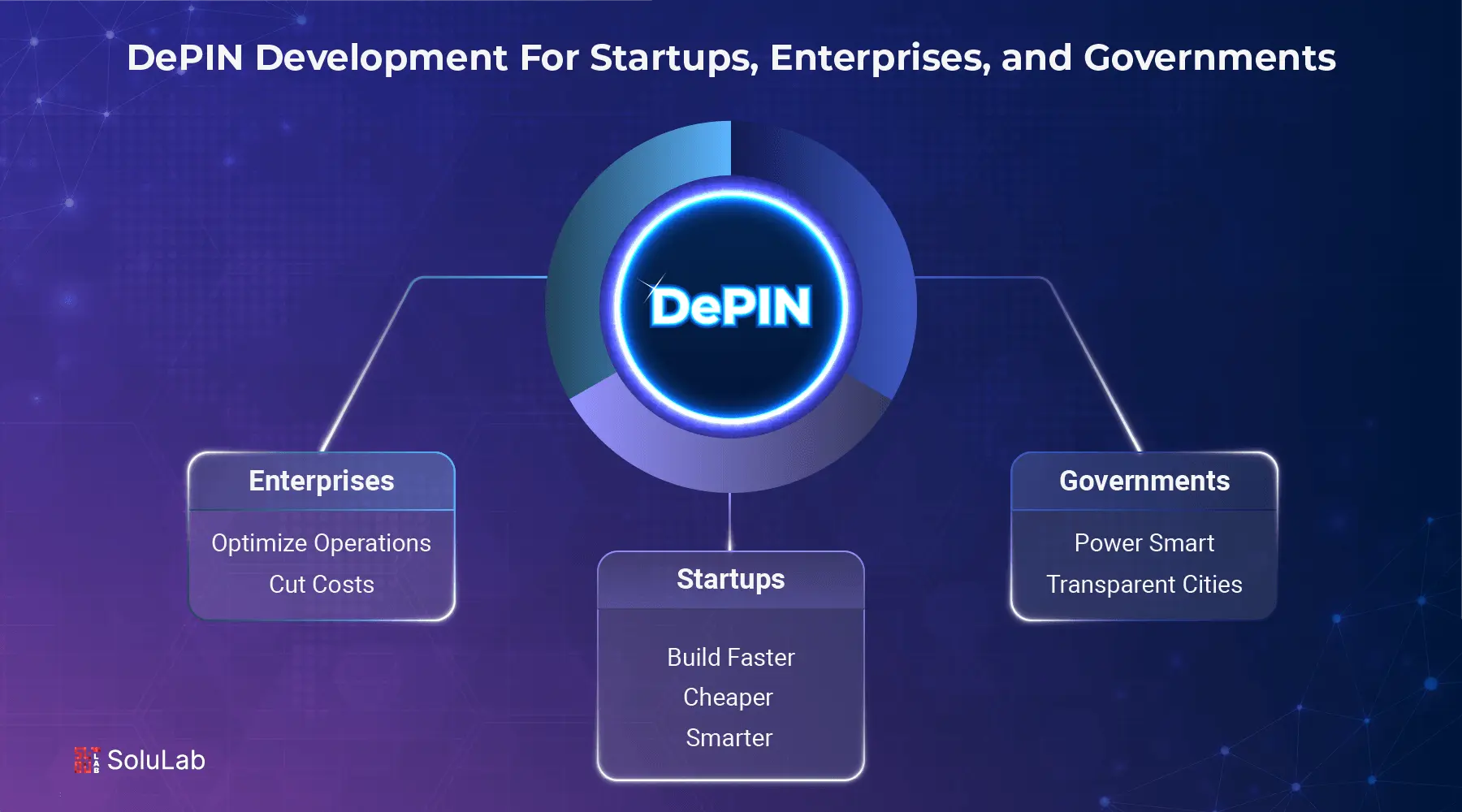
Decentralized infrastructure is quietly changing what’s possible across a lot of industries. Companies have noticed. Startups, established businesses, and governments are all looking hard at DePIN (Decentralized Physical Infrastructure Networks) as a way to build systems that scale further, show their workings, and waste less.
The DePIN industry is projected to attain $3.5 trillion by 2028. That number alone tells you decentralized models have moved from side project to planning document.
Why the shift? Mostly because the payoff keeps getting clearer: lower costs, more autonomy, and a community that actually shows up. A new McKinsey survey indicates that 45% of company executives choose decentralized solutions to run smarter, more sustainable operations. And the openings are everywhere, from decentralized wireless networks to shared energy systems, for anyone who wants to build infrastructure that bends instead of breaking.
Governments are paying attention too. The World Economic Forum indicates that 70% of smart city initiatives launched after 2023 used decentralized frameworks to push innovation and pull residents into the process. Put simply, DePIN development is nudging public projects toward cooperation, openness, and progress that gets shared rather than hoarded.
Below, we look at what DePIN is actually changing for startups, businesses, and governments. DePIN for startups in particular keeps picking up speed, and it’s creating real room for new products, growth, and partnerships.
Why Startups are Embracing DePIN?
More and more startups are turning to DePIN (Decentralized Physical Infrastructure Networks) because it lets them build and grow without the old handcuffs of centralized infrastructure. Speed matters. So do trust and the ability to pivot on short notice. DePIN gives young companies fresh ground to build sturdier, community-backed products. Many of them bring in an experienced DePIN development company early, which is a sensible call: it gets them onto decentralized models quickly and keeps their growth from hitting a wall later.
So what’s pulling startups toward DePIN technology? A few things:
- Lower Barriers to Entry: Physical assets are expensive to buy up front. DePIN lets startups use and build infrastructure without that bill. They plug into decentralized networks instead of owning every piece, so launching a new service or platform happens faster and costs less.
- Faster Market Expansion: With decentralized infrastructure, a company can move into a new market without first putting up conventional facilities. That makes it cheap to test a region, reach customers abroad, and adjust the service once real users start poking at it.
- Enhanced Transparency and Trust: People now care how their data and resources are handled. They ask. DePIN models give them systems they can see and check, where ownership and participation are obvious, and that helps a startup earn trust early and look different from the crowd.
- Community-Driven Growth: With a DePIN framework, users can become stakeholders. That helps with funding and resource sharing, sure. But the bigger win is loyalty: people who hold a stake tend to talk the product up without being asked.
- Access to Alternative Funding Models: Venture capital isn’t the only door. Startups can raise money through tokenized incentives, crowdsourcing, and decentralized governance systems, which ties the money side of the business to community growth from day one.
- Built-In Resilience: Decentralized networks cut down the risk of a single point of failure. For a startup, that means fewer interruptions and better uptime, and the business keeps running even while it’s scaling fast and getting hit by surprises.
- Opportunities for Innovation: DePIN doesn’t just copy traditional systems. It makes room for models that didn’t exist before. Teams building on decentralized networks keep finding new ways to deliver value: token economies, shared resource marketplaces, peer-to-peer infrastructure.

Why Enterprises and Traditional Businesses are Adopting DePIN?
For decades, big companies ran everything, from supply chains to customer operations, on centralized systems. It worked. For a while. Now the ground is moving: technology changes faster, security threats keep growing, and customers expect more, so companies are being pushed to rethink how they build and run infrastructure. This is exactly where DePIN, or Decentralized Physical Infrastructure Networks, starts to earn its keep. Forget the buzzword angle. For companies that want to stay competitive, scale sensibly, and build systems that last, it’s turning into a serious strategy.
Here’s why DePIN keeps showing up in enterprise planning:
1. Reducing Operational Costs
Big centralized systems are expensive to keep alive. Servers need maintenance, security needs staff, data centers need to grow, and the invoices pile up quickly. DePIN lets a business tap into shared, decentralized networks instead. The load gets spread out. Upfront investment drops, running costs shrink, and the company still keeps control.
2. Stronger Security and More Resilience
Centralized setups usually have one soft spot. One breach or one outage, and the whole thing can stall. DePIN takes that soft spot away. Spread infrastructure across many nodes and you get systems that ride out attacks, hardware failures, even local disasters, and keep going like nothing happened.
3. Boosting Transparency and Customer Trust
Trust is slow to earn and quick to lose. DePIN frameworks produce transparent, tamper-proof records that customers, partners, and regulators can check on their own, without taking anyone’s word for it. In finance, healthcare, or supply chain, that kind of trust isn’t a bonus. It’s the price of entry.
4. Faster and Easier Market Expansion
Entering a new market used to mean pouring money into infrastructure first. Not anymore. Companies can hook into decentralized infrastructure that’s already running locally, launch services sooner, and change course as they go, skipping the long timelines and heavy costs that used to come with the move.
5. New Ways to Deliver Value
DePIN does more than tune up old systems. It makes whole new business models workable. We’re watching enterprises roll out decentralized identity services, loyalty programs that run on token economies, and peer-to-peer marketplaces, things that simply weren’t practical a few years back.
6. Better, More Dynamic Partnerships
A partnership in a decentralized model isn’t just two companies and a signed contract. On a DePIN network, many parties can take part at once: vendors, customers, even competitors, all sharing value and building together. That’s a different kind of collaboration altogether.
7. Positioning for Long-Term Success
Enterprises that get into DePIN early aren’t only patching today’s problems. They’re laying a foundation that can flex with whatever comes next. Scaling faster, absorbing the next technology shift, reacting to new regulation: a decentralized backbone gives them a head start on all three.
Government and Public Sector Involvement in DePIN
Governments and public agencies around the world have started treating decentralized infrastructure as a real option. They’re off the sidelines. Plenty of them are now piloting or rolling out DePIN to make their systems tougher, cheaper to run, and easier for citizens to use. As interest in DePIN use cases grows, public bodies are realising that decentralized models can fix problems centralized infrastructure just can’t handle anymore.
What does that look like on the ground? Here’s how the public sector is putting DePIN to work:
- Building Smarter Cities: Cities are always being asked to do more with less. Governments are using DePIN to set up decentralized energy grids, public Wi-Fi networks, and smarter transport, so residents get more direct access to essential services instead of depending on a handful of central providers.
- Modernizing Identity Systems: Several governments are trying out decentralized digital identity frameworks. Central databases are a magnet for breaches. DePIN models hand people more control over their own information, while still meeting national security and compliance standards.
- Redesigning Energy Networks: Energy independence is now a big priority. Using custom DePIN solutions, local and regional authorities are working on decentralized renewable grids where residents can generate, trade, and use clean energy right in their own neighbourhoods.
- Strengthening Disaster Response: Natural disasters are exactly when centralized infrastructure tends to give out. Some governments are testing decentralized communication and emergency networks that keep working even after parts of a city lose power or internet.
- Increasing Transparency in Procurement: Government procurement has struggled with corruption and waste for a long time. Using decentralized ledgers and smart contracts, agencies are finding ways to make bidding, contracts, and public spending easier to see into and easier to hold to account.
- Promoting Citizen Participation: Citizens don’t have to sit back and receive services anymore. They can own a piece of them. DePIN models make shared ownership possible, invite more community-led ideas, and give people a real hand in how public services get delivered.
- Protecting Critical Systems: Cyber threats are forcing governments to rethink how they guard essential systems. Decentralized models offer a sturdier approach, because the risk is spread across many nodes instead of piled up in one place.
Business Benefits of DePIN Development
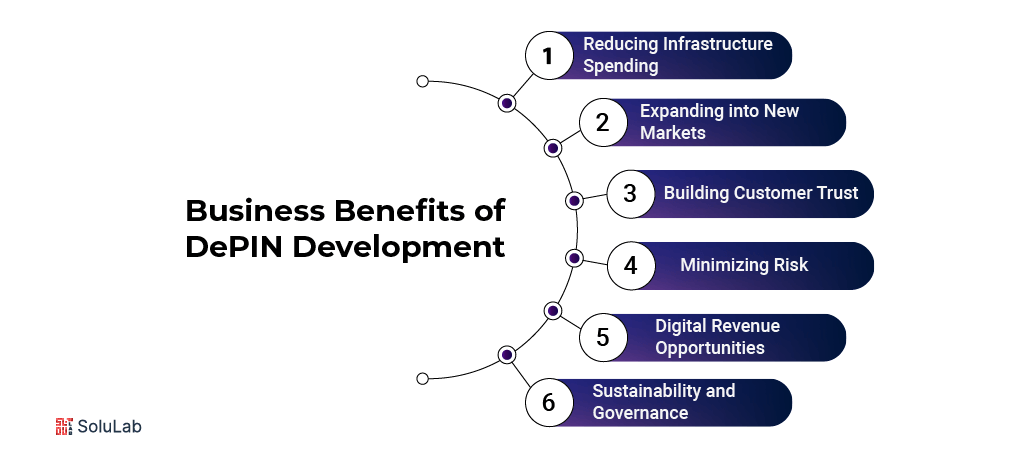
Decentralized Physical Infrastructure Networks aren’t just a talking point for blockchain fans anymore. Businesses are picking them up as a practical tool for rethinking how they run operations, engage users, and grow infrastructure without the usual bottlenecks. The companies putting money into decentralized physical infrastructure network solutions now are betting on a future where transparency, resilience, and flexibility are table stakes. Not extras.
Here’s why businesses both small and large are giving DePIN a serious look:
- Reducing Infrastructure Spending Without Compromising Growth
Traditional infrastructure eats capital: you pay to build it, pay to maintain it, pay again to upgrade it, and the bill only climbs as you grow. DePIN spreads resources across a distributed network, so a business can keep costs in check without giving up performance or reach. - Expanding into New Markets with Greater Agility
Since DePIN solutions are decentralized, a business isn’t pinned to fixed locations or a rigid rollout plan. It can enter a market quickly, shape the offer around local needs, and scale up or down as demand moves. Traditional models have a hard time doing that. - Building Customer Trust Through Verifiable Systems
In a decentralized setup, service records and transactions can be checked by anyone involved. That openness builds trust with customers, partners, and regulators. In industries that live or die on credibility, it’s a real edge. - Minimizing Risk Through Distributed Infrastructure
DePIN doesn’t park everything in one exposed location. It spreads operations over many nodes, which keeps the business running through technical failures, cyberattacks, or local disruptions. - Unlocking New Digital Revenue Opportunities
DePIN models open space for new services: shared asset platforms, decentralized marketplaces, token-based incentive systems. Companies can ship ideas faster and grab value in digital economies that are only now forming. - Meeting Sustainability and Governance Expectations
ESG is moving closer to the centre of business strategy, and decentralized infrastructure has something real to offer here. Shared networks can cut environmental impact, widen digital access, and support more ethical ways of rolling out technology.
This is why the choice of a DePIN development company in the USA matters so much. A good partner does more than hand over code. They help you build infrastructure that grows with the business, adjusts to the market, and still holds up years later.
Read Also: DePIN In the Telecom Industry
Future Trends in DePIN Development
DePIN (Decentralized Physical Infrastructure Networks) is still finding its shape. One thing isn’t in doubt, though: it’s moving fast. What began as a niche idea is becoming a serious base for how industries could build and operate over the next few years. As more people adopt it, startups and enterprises alike keep discovering new ways to get value out of decentralized systems, whether that’s cutting costs, making infrastructure harder to knock over, or building communities around shared ownership. The next wave of DePIN development won’t look much like today’s. Expect startups to matter most here, since early movers tend to set the pace and rebuild industries from the bottom up.
These are the trends we expect to shape where DePIN goes next:
1. Specialized Networks Focused on Specific Industries
Broad, one-size-fits-all platforms will give way to DePIN networks built around a single industry’s needs: supply chain, healthcare, energy, transportation. Narrow focus pays off. These networks will move faster and perform better because they’re solving very specific problems.
2. Cross-Network Interoperability
Every new decentralized system raises the same question: how does it talk to the others? The pressure to communicate and share resources will only grow. Future DePIN platforms will put interoperability first, so businesses and users can move assets and data between decentralized environments without friction.
Read Also: Blockchain Interoperability for Enterprise Adoption
3. Community-Owned Infrastructure Models
Ownership is drifting away from corporations and toward communities. A lot of upcoming DePIN projects will run on shared ownership, where users supply resources, help govern the network, and earn real economic rewards for taking part.
4. DePIN as a Backbone for Startups
Early-stage companies already feel the benefit of building on decentralized networks. That will only grow. DePIN models will give startups quicker paths to market, lower running costs, and the chance to invent service categories that centralized models never allowed.
5. More Clarity Around Regulation
Regulators are watching DePIN more closely now. Our guess is that frameworks will follow, ones built to support secure, resilient decentralized infrastructure without choking off innovation or community ownership.
6. Integration of AI and Machine Learning
Smarter DePIN networks are on the way. AI-driven management and tuning of decentralized infrastructure will make these systems more efficient and able to repair themselves, adjusting in real time as network conditions change.

The Bottom Line
DePIN is a big change in how businesses, governments, and communities think about infrastructure. Centralized systems are no longer the only option. Organizations are moving to decentralized models because they bend more easily, show more of what’s happening inside, and hold up under stress. Startups and enterprises alike are finding that the move opens fresh routes to growth, new products, and partnerships across industries.
At SoluLab, we’ve spent a long time building decentralized solutions that run in the real world. Take our work with Morpheus.Network, a blockchain-powered SaaS platform built to simplify and secure global logistics. It shows how DePIN models are already changing traditional industries. Morpheus.Network combines blockchain, IoT, SMS notifications, and legacy technologies to make supply chains smarter and safer. Through projects like this, SoluLab keeps building DePIN solutions that connect new technology with the business systems companies already run, so our clients can step into a decentralized future with confidence.
Wondering what DePIN could do for your business? Don’t wait on it. Talk to SoluLab today and we’ll help you build decentralized systems that are practical, scalable, and ready for what comes next.
FAQs
Shipra Garg is a tech-focused content strategist and copywriter specializing in Web3, blockchain, and artificial intelligence. She has worked with startups and enterprise teams to craft high-conversion content that bridges deep tech with business impact. Her work translates complex innovations into clear, credible, and engaging narratives that drive growth and build trust in emerging tech markets.