Talk to an Expert

Building Trust in a Digital World: The Power of Blockchain Development

Building Trust in a Digital World: The Power of Blockchain Development

Understanding the concept of a Digital Trust Ecosystem

A digital trust ecosystem refers to a network of entities that use technology like Blockchain development to establish trust and enable secure transactions without third-party intermediaries. At its core, a digital trust ecosystem aims to remove the need for centralized authorities and middlemen by distributing trust among network participants.

In a digital trust ecosystem, trust is established through cryptographic techniques like digital signatures, hashing, and encryption. Entities can directly interact with each other without needing to go through banks, governments, or other institutions. This enables faster, cheaper, more transparent, and more secure transactions.

Digital trust ecosystems have applications in many industries. For example, a supply chain system can use Blockchain Development to track goods and payments between suppliers, manufacturers, distributors, retailers, and consumers. This establishes trust between entities that may not know or trust each other otherwise.

Read Also: What are the Benefits of Using Digital Identity with Blockchain in the Future?

Importance of Blockchain Technology in Building a Digital Trust Ecosystem

Blockchain technology is critical for constructing digital trust ecosystems. Blockchain Development provides a decentralized, distributed ledger that is immutable and transparent. This serves as the foundation for establishing trust between entities.

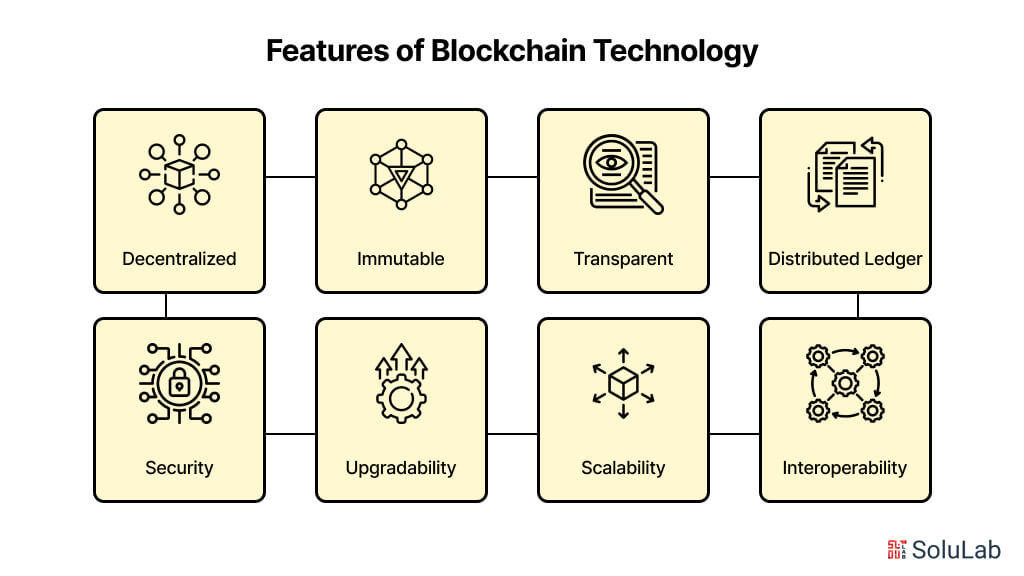
Key features of blockchain app development that enable trust include:

  • Decentralization – No single entity controls the network
  • Transparency – All participants can view transactions
  • Transactions are unchangeable and cannot be deleted.
  • Cryptography – Encryption and digital signatures enable trustless interactions
  • Consensus – Agreement on the network state without a central authority
  • Provenance – Goods and assets can be traced through the supply chain

By leveraging these attributes, Blockchain Development facilitates the creation of digital trust ecosystems. Participants can exchange assets and data peer-to-peer with confidence that transactions are valid and permanent.

Steps to Perform for Building a Blockchain Solution
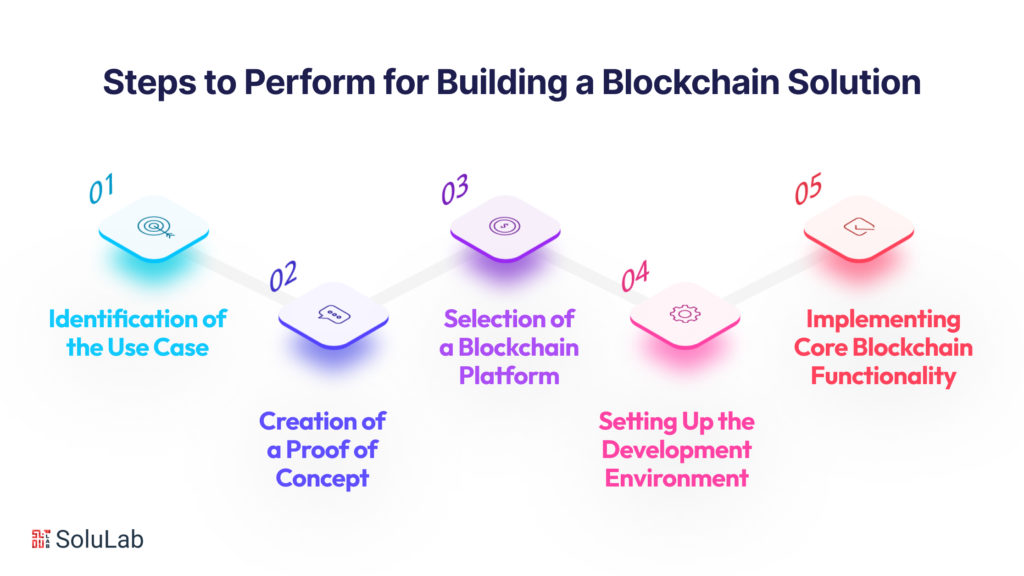
Steps to Perform for Building a Blockchain Solution

Step 1: Identification of the Use Case

Definition and Examples

A use case refers to a specific application of blockchain technology to solve a real-world problem or provide new functionality. Clearly identifying the use case is a critical first step in constructing a digital trust ecosystem.

Some examples of blockchain use cases include:

  • Supply chain tracking – Improving transparency and efficiency in supply chains
  • Digital identity – Securely establishing identity and credentials
  • Healthcare records – Enabling patients to control access to medical data
  • Digital voting – Conducting secure and transparent elections
  • Cross-border payments – Facilitating faster and cheaper money transfers

The use case should be clearly defined in terms of the problem being solved, the entities involved, and how blockchain adds value. This guides the overall design of the digital trust ecosystem.

Read Our Blog: Top 10 Blockchain Development Companies in 2023

Assessing if Blockchain is necessary or if a Centralized Platform is more suitable.

Not every use case requires a blockchain-based solution. Centralized platforms may be more suitable if:

  • There are no multiple distrusting parties
  • Intermediaries like banks already establish trust sufficiently
  • Transaction speeds and volumes are very high
  • Privacy is more important than transparency

On the other hand, blockchain app development is advantageous when:

  • Establishing trust between strangers is important
  • Disintermediation brings significant benefits
  • Permanent and tamper-proof records are critical
  • Transparency and provenance are required

Carefully evaluating the specific use case guides the decision on whether blockchain is truly necessary or if a centralized platform is better suited.
CTA1

Step 2: Creation of a Proof of Concept

Meaning and Importance of a Proof of Concept

A proof of concept (PoC) is a small-scale implementation of the blockchain use case to validate its feasibility. Building a PoC is important for several reasons:

  • Tests technical viability of the use case
  • Identifies any flaws in the concept
  • Demonstrates value to stakeholders
  • Provides a benchmark for assessing solutions
  • Reduces risk before full-scale development

The PoC focuses only on the core functionality needed to demonstrate the use case. It serves as an invaluable tool for gathering feedback and preventing wasted effort on ideas that may not work.

Read Also: Best Companies to Hire Blockchain Developers in 2023

Steps to Creating a Proof of Concept

Key steps involved in building a blockchain PoC include:

1. Defining the scope and objectives

2. Designing system architecture and workflows

3. Selecting the Blockchain Development services and tools

4. Implementing core features and functionality

5. Developing a basic UI for interaction

6. Testing transactions and use case scenarios

7. Documenting results and gathering feedback

8. Assessing feasibility and making improvements

The PoC provides the foundation for full-scale blockchain software development implementation. Lessons learned can inform the final solution design and technology choices.

Step 3: Selection of a Blockchain Platform

Overview of different Blockchain Platforms

There are many blockchain software development platform options to choose from when building a digital trust ecosystem. Some leading platforms include:

  • Ethereum – Decentralized blockchain with support for smart contracts
  • Hyperledger Fabric – Private Blockchain Development services framework focused on enterprise use
  • Corda – Distributed ledger platform designed for regulated industries
  • EOS – Infrastructure for decentralized apps with high scalability
  • Stellar – Payment-focused Blockchain Development services that connect financial institutions

Read Also: Top 10 Blockchain Platforms of 2023

Factors like use case requirements, transaction speeds, consensus model, governance, and tooling support guide the choice of a blockchain development solutions platform.

Choosing the Right Consensus Protocol and Overall Architecture

  • Understanding Consensus Mechanism

Consensus mechanisms allow blockchains to maintain a single state of records without a central authority. Different models like proof-of-work, proof-of-stake, and delegated proof-of-stake have unique tradeoffs.

The consensus model should be chosen based on factors like scalability needs, security guarantees, and energy efficiency.

  • Selecting Data Structures

Blockchain data structures organize data into blocks and chains. Alternatives like directed acyclic graphs provide greater flexibility. The data model impacts factors like scalability and transaction speeds.

  • Defining Network Protocols

Network communication protocols like gossip protocol and RAFT enable node-to-node messaging to share transactions and blocks. The right protocols need to be chosen based on performance needs and network assumptions.

Step 4: Setting Up the Development Environment

Importance of the Development Environment in Blockchain Implementation

The development environment provides the tools and frameworks for building and testing blockchain applications. Setting up a robust environment facilitates rapid iteration and deployment. Key elements include:

  • Blockchain technology platforms and libraries
  • Consensus algorithms and cryptography
  • Programming languages and frameworks
  • Wallets and accounts
  • Development and testing tools
  • Simulators and emulators

Read Our Blog: Top Blockchain Technology Companies in 2023

Having the necessary environment reduces development effort, enables debugging, and allows comprehensive testing before launch.

Choosing the right Programming Language

Popular blockchain programming languages include:

  • Solidity – For writing Ethereum smart contracts
  • Golang – For building Hyperledger Fabric applications
  • JavaScript/TypeScript – For developing client apps and web interfaces
  • Rust – For high performance and security
  • C++/Java – General purpose languages with Blockchain technology libraries

The language choice depends on the platform, performance needs, available skills, and integration requirements.

Installing and familiarizing with necessary Development Tools

Useful blockchain development tools include:

  • Truffle – Development framework for Ethereum
  • Ganache – Ethereum emulator for testing
  • Remix – Browser-based Solidity IDE
  • Metamask – Ethereum wallet browser extension
  • Postman – API testing toolchain

Becoming familiar with these tools creates a robust environment for building and testing blockchain applications.

Read Also: Top 25 Blockchain-Based Identity Management Startups

Step 5: Implementing Core Blockchain Functionality

Components of a Blockchain Network

Core components of a Blockchain technology network include:

  • Peer-to-peer communication between nodes
  • Transaction creation, propagation, and validation
  • Cryptographic identities and signing of transactions
  • A consensus protocol for block creation and confirmation
  • Data replication across nodes through a shared ledger
  • Scripting language for implementing business logic
  • Wallets for managing keys and transacting

These underlying components need to be implemented to establish blockchain developer network functionality.

Developing Smart Contracts

Smart contracts encapsulate business logic and programmatically enforce agreements on the blockchain developer. Developing smart contracts involves:

  • Defining contract terms, rules, and workflows
  • Writing code in a language like Solidity
  • Implementing functions for executing transactions
  • Deploying contracts to the blockchain network
  • Interacting with contracts through wallets or applications
CTA2

Conclusion

In a rapidly evolving digital landscape, building trust has become a cornerstone of successful interactions. As we navigate through a world heavily reliant on digital transactions and data sharing, blockchain technology emerges as a game-changer in establishing trust and transparency. Through its immutable and decentralized nature, blockchain development addresses the challenges of data security, provenance verification, and fraud prevention.

Incorporating blockchain into various industries showcases its potential to revolutionize processes, enhance efficiency, and foster collaboration. From supply chain management to finance and beyond, the power of blockchain is undeniable. SoluLab stands at the forefront of this transformation, offering blockchain software development services that empower businesses to harness the technology’s full potential.

As organizations seek to build trust with their customers, partners, and stakeholders, hiring a dedicated blockchain development agency becomes essential. SoluLab boasts a team of the best blockchain developers who are skilled in creating customized solutions tailored to unique business needs. Through their expertise, businesses can integrate blockchain solutions that enhance security, traceability, and accountability.

Blockchain’s impact goes beyond technology; it reshapes the way industries operate by reducing intermediaries, minimizing errors, and increasing efficiency. As you venture into the world of blockchain development solutions, SoluLab’s experience and commitment to excellence can guide your journey. Their blockchain development services extend a helping hand in harnessing blockchain’s transformative power, ensuring you stay ahead in the digital age.

In conclusion, as the digital landscape expands, trust becomes a currency of paramount importance. Blockchain development emerges as a beacon of trust, offering solutions that reshape industries and redefine the way we conduct transactions. SoluLab’s expertise in blockchain software development services empowers businesses to embrace this transformative technology. As you navigate the digital world, remember that building trust begins with innovative solutions, and blockchain development paves the way for a future where transparency and security reign supreme.

FAQs

1. What is blockchain’s role in building trust in the digital world?

Blockchain technology serves as a secure and transparent ledger that records transactions in an immutable and decentralized manner. This inherent nature of blockchain ensures data integrity, eliminates the need for intermediaries, and enhances trust among parties involved in digital interactions.

2. How does blockchain development impact various industries?

Blockchain development brings transformative benefits across industries such as finance, supply chain, healthcare, and more. By providing secure, traceable, and tamper-proof records, blockchain minimizes fraud, streamlines processes, and fosters collaboration among stakeholders.

3. Why is hiring a blockchain development agency crucial for businesses?

A specialized blockchain development agency, like SoluLab, offers expertise in crafting tailored solutions that align with your business needs. These agencies hire the top blockchain developers who understand the nuances of blockchain technology, ensuring optimal implementation and maximizing its benefits.

4. Can blockchain technology enhance data security?

Absolutely. Blockchain’s decentralized and cryptographic nature ensures that data is stored securely and can only be accessed by authorized parties. This heightened security significantly reduces the risk of data breaches and unauthorized alterations.

5. What distinguishes SoluLab in the blockchain development landscape?

SoluLab stands out for its comprehensive approach to blockchain software development services. With a team of experienced developers and a track record of successful projects, SoluLab offers end-to-end solutions that empower businesses to leverage blockchain’s potential effectively.

6. How can blockchain development contribute to transparency and accountability?

Blockchain’s transparency stems from its ability to provide an unalterable record of transactions accessible to all parties involved. This shared ledger ensures accountability as every transaction is verifiable, promoting trust and collaboration in digital interactions.

7. Is blockchain development limited to financial applications?

No, blockchain applications extend far beyond finance. It finds utility in supply chain management, healthcare records, identity verification, and more. The underlying principle of trust and data integrity applies across various sectors, making blockchain a versatile solution.


Blockchain in Automotive and Health Insurance

Blockchain in Automotive and Health Insurance

Blockchain technology has emerged as a revolutionary force across various industries, transforming traditional systems and unlocking new opportunities for innovation. In the automotive and health insurance sectors, blockchain’s potential to enhance transparency, security, and efficiency is garnering significant attention. Both industries face challenges related to data management, fraud prevention, and complex transactions, and blockchain solutions are poised to address these issues head-on.

Similarly, in the health insurance domain, blockchain holds immense promise in revolutionizing the way data is managed and shared. With patient information scattered across various healthcare providers and insurers, interoperability and data security become paramount concerns. Blockchain technology provides a unified and secure platform, allowing authorized stakeholders to access patients’ health records in a tamper-proof and privacy-preserving manner. 

In this era of digital transformation, blockchain’s potential in the automotive and health insurance industries is undeniable. As these sectors embrace this disruptive technology, they are set to witness a profound shift towards greater efficiency, transparency, and trust in their operations, ultimately benefiting both businesses and consumers alike.

Read Also: What are the Benefits of Using Digital Identity with Blockchain in the Future?

What are the Benefits of a Blockchain Healthcare Development Company?

What are the Benefits of a Blockchain Healthcare Development Company?

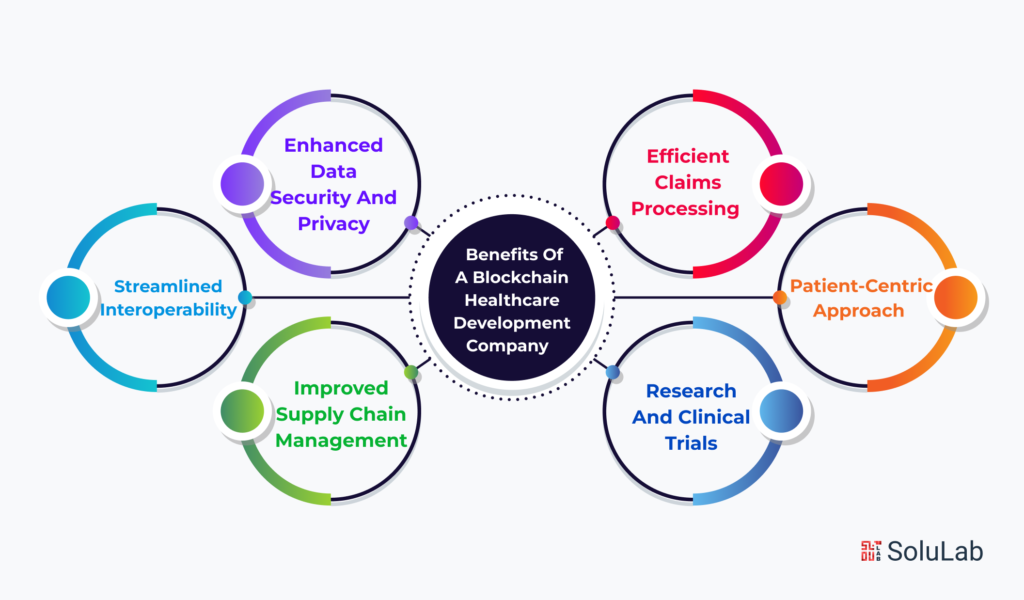
Blockchain technology has made significant strides in various industries, and the healthcare sector is no exception. As healthcare organizations seek more secure, transparent, and efficient ways to manage patient data and streamline processes, blockchain solutions offer a wide array of benefits. Engaging a specialized blockchain healthcare development company can prove to be a game-changer for healthcare providers, patients, and other stakeholders. Here are some key advantages of opting for a blockchain healthcare development company:

  • Enhanced Data Security and Privacy

One of the most significant benefits of blockchain technology in healthcare is its ability to ensure data security and privacy. Traditional healthcare systems often face security breaches and data leaks, exposing sensitive patient information. Blockchain’s decentralized and encrypted nature makes it extremely difficult for unauthorized individuals to access or tamper with data. Every transaction is recorded in a secure and immutable manner, providing healthcare providers and patients with peace of mind knowing that their data is safeguarded against cyber threats.

  • Streamlined Interoperability

Blockchain promotes interoperability by creating a single, unified platform for sharing and accessing patient data across different healthcare providers and facilities. This seamless exchange of information enhances care coordination and eliminates data silos, enabling healthcare professionals to make better-informed decisions and deliver more personalized and efficient care to patients. It also reduces administrative burden and redundant paperwork, leading to cost savings for healthcare organizations.

Read Our Blog: Top 10 Startups that are Revolutionizing Healthcare Industry Using Blockchain Technology

  • Improved Supply Chain Management

Blockchain technology can play a vital role in managing pharmaceutical supply chains. By tracking the entire journey of medications, vaccines, and medical devices through the supply chain, blockchain ensures the authenticity and integrity of these products. This level of transparency helps combat counterfeit drugs and ensures that patients receive safe and legitimate medications.

  • Efficient Claims Processing

For health insurers, blockchain streamlines claim processing and fraud detection. By automating claim verification and eliminating intermediaries, blockchain reduces the time and cost involved in settling claims. The immutability of blockchain records also facilitates fraud detection, as any suspicious activity or duplicate claims can be quickly identified and flagged.

CTA 1

  • Patient-Centric Approach

Blockchain healthcare solutions empower patients to take control of their health data. Through blockchain-based platforms, patients can grant and revoke access to their medical records, ensuring that only authorized individuals or entities can view their information. This patient-centric approach fosters trust between healthcare providers and patients, leading to improved patient engagement and satisfaction.

  • Research and Clinical Trials

Blockchain technology can also enhance medical research and clinical trials. By creating a secure and transparent platform for sharing research data, researchers can collaborate more effectively and accelerate medical discoveries. Smart contracts on blockchain networks can automate the execution of clinical trial protocols, ensuring compliance and accuracy throughout the process.

What are the Top Use Cases for Blockchain in Healthcare?

What are the Top Use Cases for Blockchain in Healthcare?

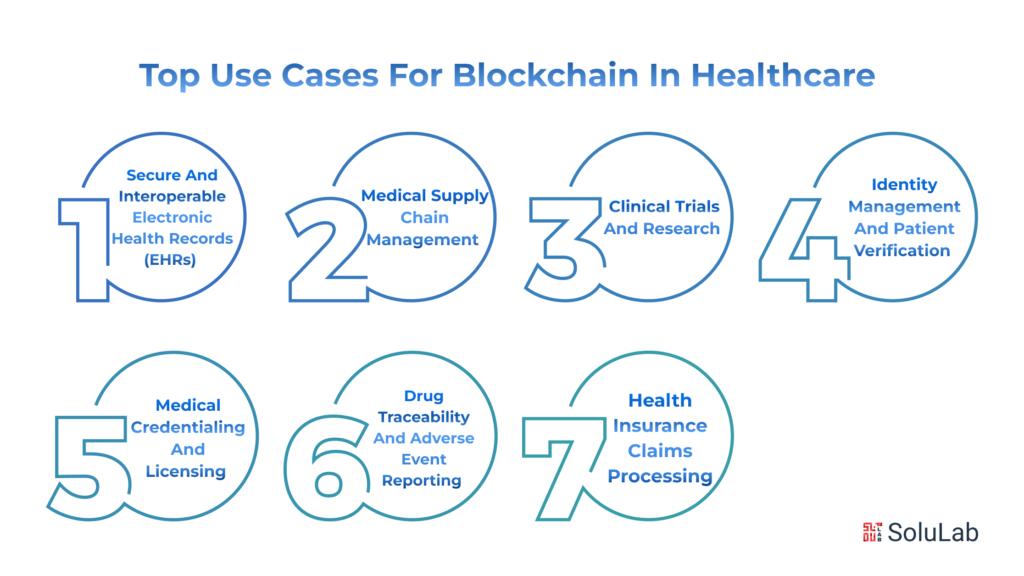
Blockchain technology has emerged as a transformative force in the healthcare industry, presenting numerous use cases that address critical challenges and revolutionize traditional processes. The immutability, security, and decentralized nature of blockchain make it an ideal fit for enhancing data management, interoperability, and patient care. Here are some of the top use cases for blockchain in healthcare:

  • Secure and Interoperable Electronic Health Records (EHRs)

Blockchain enables the creation of a secure and interoperable EHR system by providing a decentralized and tamper-proof platform for storing patient health records. Patients can grant permission to healthcare providers and institutions to access their EHRs, ensuring seamless data exchange without compromising privacy. This enhanced interoperability streamlines care coordination and allows medical professionals to access up-to-date patient information, leading to more accurate diagnoses and personalized treatment plans.

Read Our Blog Post: How Blockchain provides opportunities for healthcare?

  • Medical Supply Chain Management

Blockchain can significantly improve the management of pharmaceutical and medical supply chains. By creating an unalterable record of each step in the supply chain, from manufacturing to distribution, blockchain ensures the authenticity and quality of medications and medical devices. This transparency helps combat counterfeit drugs, reduce the risk of medical errors, and enhance patient safety.

  • Clinical Trials and Research

Blockchain simplifies the process of conducting clinical trials and medical research. Smart contracts on blockchain networks can automate consent management, data sharing, and compliance with trial protocols. This automated approach streamlines data collection, analysis, and verification, accelerating the pace of medical research and improving the efficiency of clinical trials.

  • Identity Management and Patient Verification

Blockchain offers a secure solution for managing patient identities and verifying patient information. Patients can have a unique digital identity on the blockchain, ensuring that their medical history and personal data remain protected and verified. This reduces the risk of medical identity theft and fraud, allowing healthcare providers to deliver better-targeted care.

  • Medical Credentialing and Licensing

Blockchain simplifies the process of medical credentialing and licensing for healthcare professionals. Credentials, licenses, and certifications can be securely stored on the blockchain, and verification of these qualifications becomes more efficient and accurate. This helps healthcare organizations ensure that their staff members are qualified and compliant with regulatory requirements.

  • Drug Traceability and Adverse Event Reporting

Blockchain technology can facilitate the tracking and tracing of pharmaceuticals throughout the supply chain. It enables the recording of every transaction involving a drug, from manufacturing to dispensing, providing an auditable record of the drug’s journey. Additionally, adverse event reporting can be improved by utilizing blockchain to capture and share real-time data on drug reactions, enabling faster responses and improved drug safety.

Read Also: Top Healthcare Blockchain Companies 

  • Health Insurance Claims Processing

Blockchain streamlines health insurance claims processing, reducing administrative overhead and enhancing fraud detection. Smart contracts can automate claim verification and settlement processes, making the system more efficient and reducing the time taken to process claims. The transparency and immutability of blockchain records also aid in identifying fraudulent claims and mitigating risks.

What are the Constraints of Utilizing Blockchain in Health Insurance?

While blockchain technology offers a plethora of benefits for the healthcare industry, including health insurance, certain constraints, and challenges need to be carefully considered. As with any emerging technology, there are hurdles to overcome to ensure successful implementation and integration. Here are some of the key constraints of utilizing blockchain in health insurance:

  • Regulatory and Compliance Issues

The healthcare industry is highly regulated, and the introduction of blockchain technology must navigate various legal and compliance challenges. Data privacy and security regulations, such as the Health Insurance Portability and Accountability Act (HIPAA) in the United States, impose stringent requirements on handling sensitive patient data. Integrating blockchain in health insurance must align with these regulations to protect patient privacy while enabling secure data sharing and accessibility.

  • Data Standardization and Interoperability

Blockchain’s potential in health insurance lies in creating a decentralized and interoperable system for sharing patient data across different providers and insurers. However, achieving true interoperability requires the standardization of data formats and protocols. The lack of standardized data in the healthcare sector may hinder the seamless exchange of information, making it challenging to fully leverage the benefits of blockchain technology.

Check Out Our Press Release: SoluLab Bridging the Gap Between Technology And Innovation

  • Scalability and Transaction Throughput

Blockchain networks, especially public ones, often face scalability issues and limited transaction throughput. In the context of health insurance, where numerous transactions occur daily, a blockchain’s capacity to handle a high volume of data becomes crucial. Scalability solutions, such as sharding or off-chain processing, need to be implemented to ensure that blockchain networks can accommodate the demands of the health insurance industry effectively.

  • Data Onboarding and Integration

Migrating existing data and systems to a blockchain-based infrastructure can be a complex process. Health insurers have vast amounts of historical data that need to be carefully onboarded onto the blockchain while maintaining data integrity and accuracy. Additionally, integrating blockchain with legacy systems and electronic health record (EHR) platforms can present technical challenges that require meticulous planning and execution.

  • Cost and Resource Investment

Implementing blockchain technology in health insurance requires significant investment in terms of time, resources, and expertise. Developing and maintaining a robust blockchain network necessitates specialized skills, including blockchain development, cybersecurity, and data management. The initial costs and ongoing operational expenses can be substantial, and healthcare organizations must weigh these expenditures against the potential benefits.

  • Resistance to Change

The healthcare industry is traditionally conservative when it comes to adopting new technologies. Embracing blockchain may encounter resistance from stakeholders who are skeptical of the technology’s efficacy or who are accustomed to conventional systems. Overcoming this resistance requires effective education, communication, and demonstration of the tangible advantages that blockchain can bring to health insurance operations.

What Steps can we take to Introduce Blockchain in Automotive Industry?

What Steps can we take to Introduce Blockchain in Automotive Industry?

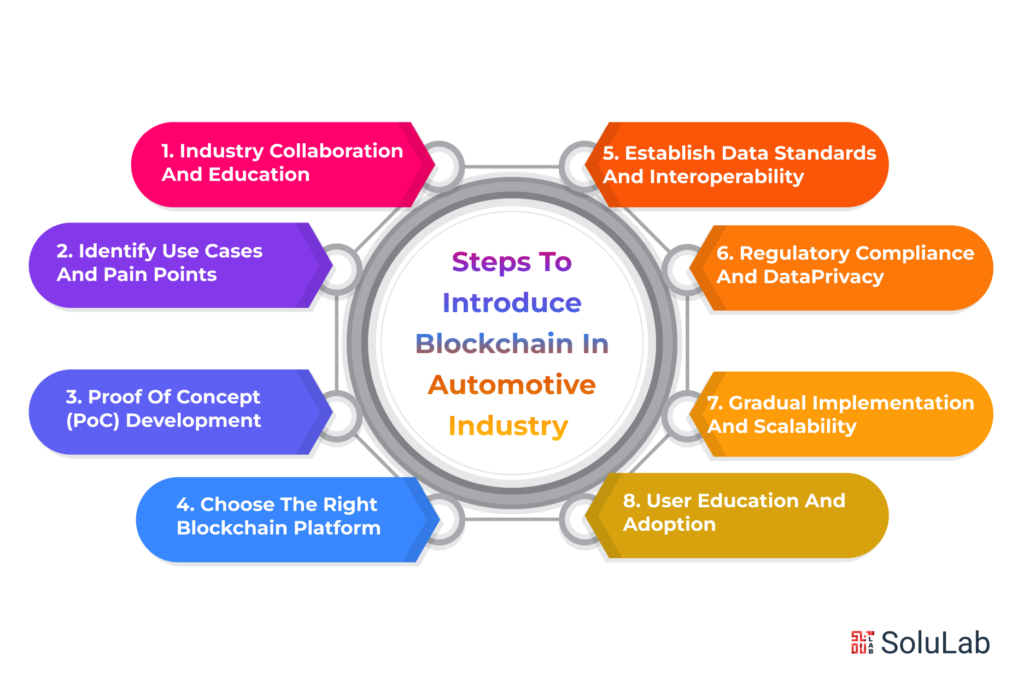
Blockchain in the automotive industry is ripe for disruption, and blockchain technology has the potential to revolutionize various aspects, including supply chain management, vehicle history tracking, and digital identity verification. To successfully introduce blockchain in the automotive sector, several key steps must be taken. Let’s explore the critical measures that can pave the way for the seamless integration of blockchain technology:

Read Also: Top 14 Blockchain-Based Automotive Startups

  • Industry Collaboration and Education

The first step is to foster collaboration among stakeholders in the automotive industry. This includes automakers, suppliers, dealerships, and other key players. Industry-wide cooperation can help create a shared understanding of blockchain’s potential and the specific challenges it can address. Additionally, organizing workshops, conferences, and educational sessions to familiarize participants with blockchain technology and its applications will be instrumental in driving adoption.

  • Identify Use Cases and Pain Points

Understanding the pain points and inefficiencies in the automotive industry is crucial in determining the most appropriate use cases for blockchain in the automotive industry. Conducting thorough research and analysis to identify areas where blockchain can bring the most significant benefits, such as tracking vehicle parts authenticity, improving supply chain transparency, or enabling secure and efficient peer-to-peer vehicle sales, is essential.

  • Proof of Concept (PoC) Development

Developing a Proof of Concept (PoC) is an effective way to validate the feasibility of blockchain applications in the automotive sector. A PoC allows stakeholders to test the technology on a smaller scale, identify potential challenges, and assess the impact of blockchain on existing processes. It provides valuable insights before making substantial investments in full-scale implementation.

  • Choose the Right Blockchain Platform

Selecting the top blockchain platform is a critical decision. Public or private blockchain networks may be suitable depending on the specific use case and requirements. Factors to consider include scalability, security, governance, and consensus mechanisms. Collaborating with experienced blockchain development firms can aid in making the right technology choices.

  • Establish Data Standards and Interoperability

For blockchain to deliver its full potential, standardizing data formats and protocols is crucial. This promotes interoperability and ensures seamless data exchange between different participants in the automotive ecosystem. Defining data standards and adhering to industry-wide best practices will facilitate smooth integration with existing systems.

  • Regulatory Compliance and Data Privacy

Addressing regulatory compliance and data privacy concerns is paramount when introducing blockchain in the automotive industry. Given the sensitivity of personal and vehicle-related data, ensuring compliance with regional data protection laws, such as the General Data Protection Regulation (GDPR), is essential to gain customer trust and maintain legal compliance.

Read Our Blog: How Will Blockchain Transform Insurance Companies?

  • Gradual Implementation and Scalability

Rather than attempting a complete overhaul of existing systems, a gradual and phased approach to blockchain integration is recommended. Starting with pilot projects and expanding progressively allows stakeholders to learn from early successes and address any challenges that arise. As blockchain applications gain traction, scaling up to larger projects becomes more manageable.

  • User Education and Adoption

Finally, educating end-users, including customers, dealerships, and service centers, about the benefits of blockchain technology and its impact on their daily interactions with the automotive industry is crucial. By fostering awareness and demonstrating the enhanced security, transparency, and efficiency that blockchain brings, user adoption can be accelerated.

CTA 2

Conclusion

In conclusion, Blockchain technology has emerged as a game-changer in the automotive and health insurance industries, revolutionizing the way data is managed, transactions are processed, and trust is established. As a leading provider of cutting-edge blockchain solutions, SoluLab recognizes the immense potential of this transformative technology and its ability to bring transparency, efficiency, and security to these critical sectors.

In the automotive industry, blockchain’s decentralized and immutable ledger ensures that vehicle histories, maintenance records, and ownership details are securely stored and easily accessible to all relevant stakeholders. This enhances trust and transparency, reduces the risk of fraud, and streamlines processes, ultimately benefiting manufacturers, dealers, insurers, and consumers alike. SoluLab’s expertise in custom blockchain development services empowers automotive companies to harness this technology’s full potential and drive innovation within their operations.

At SoluLab, we are committed to pushing the boundaries of what blockchain can achieve in the automotive and health insurance sectors. Our team of experts works tirelessly to deliver innovative, scalable, and user-friendly solutions that empower our clients to stay ahead in an increasingly digital world. As these industries continue to evolve, we remain dedicated to staying at the forefront of blockchain innovation and providing our clients with the tools they need to succeed in this transformative era. 

FAQs

1. What is Blockchain technology, and how is it applied in the automotive industry?

Blockchain is a decentralized and immutable ledger technology that records transactions securely and transparently. In the automotive industry, Blockchain is utilized to enhance supply chain management, vehicle data sharing, and ownership verification. By creating a tamper-proof record of vehicle history, Blockchain fosters trust and efficiency, reducing fraud and ensuring the authenticity of parts and components.

2. How does Blockchain benefit the health insurance sector?

Blockchain in health insurance revolutionizes the way medical data is managed. Patients have better control over their health records, and insurers can efficiently access verified information, streamlining the claims process. This technology improves data privacy and security, reducing instances of fraud and unauthorized access to sensitive medical information.

3. Can you recommend a blockchain healthcare development company?

Sure! If you’re looking for a reputable blockchain healthcare development company, you can explore leading firms specializing in healthcare solutions like SoluLab. Companies like SoluLab offer tailored Blockchain applications to healthcare providers, insurers, and patients, ensuring seamless integration and secure data management.

4. What are some common Blockchain healthcare solutions in the market?

Blockchain healthcare solutions encompass Electronic Health Records (EHR) management, drug supply chain tracking, clinical trials management, and patient identity verification. These solutions enhance interoperability, data accuracy, and collaboration among stakeholders, leading to improved healthcare outcomes.

5. How do Blockchain development services contribute to innovation in various industries?

Blockchain development services play a pivotal role in fostering innovation across sectors. By providing expertise in building and implementing decentralized applications, smart contracts, and consensus mechanisms, Blockchain developers help businesses harness the full potential of this transformative technology.

Beginners’ Guide 101 to Outsourcing Blockchain Development

Beginners’ Guide 101 to Outsourcing Blockchain Development

The global admiration of blockchain technology is on top of the mountain. Businesses have started understanding its capability to make business efforts more efficient, so the worldwide blockchain infusion rate in business processes is increasing. Outsourcing blockchain technology with advanced technology can alter the traditional loopholes in business procedures, making our future more effective. 

Blockchain development requires big-budget resources, so it’s hard for companies to have an in-house in-house development team. So, numerous development agencies provide blockchain development services to businesses to fill up this scarcity. However, the complex process is to choose a blockchain development outsourcer, as many factors are involved. 

Outsourcing blockchain development has become a popular choice for businesses looking to leverage the benefits of this transformative technology while reducing costs and accessing specialized expertise. If you’re a beginner considering outsourcing blockchain development, this guide will provide you with a 101 overview of the process and essential factors to consider.

Read Our Blog: Beginner’s Guide to Understand Blockchain Technology

  • Understand Your Requirements: Before outsourcing blockchain development, clearly define your project requirements and objectives. Determine the specific features, functionalities, and outcomes you expect from your blockchain solution. This clarity will help you communicate effectively with potential outsourcing partners.

  • Research and Select a Reliable Outsourcing Partner: Conduct thorough research to identify reputable outsourcing partners with expertise in blockchain development. Look for companies with a proven track record, positive client testimonials, and a portfolio showcasing successful blockchain projects. Consider factors such as technical expertise, industry knowledge, and cultural compatibility.
  • Define the Scope of Work: Work closely with your outsourcing partner to define the scope of work for your blockchain development project. Communicate your expectations, timelines, and deliverables. This will ensure both parties have a shared understanding of the project and minimize potential misunderstandings or scope creep.
  • Ensure Transparent Communication: Establish effective communication channels with your outsourcing partner. Regularly scheduled meetings, progress updates, and open lines of communication are vital for mag transparency and addressing any concerns or challenges that may arise during the development process.
  • Emphasize Security and Data Protection: Blockchain development often involves working with sensitive data and confidential information. Ensure your outsourcing partner has robust security measures in place to protect your data and maintain strict confidentiality. Consider their data protection policies, adherence to industry standards, and any relevant certifications they may have.
  • Quality Assurance and Testing: Verify that your outsourcing partner has a robust quality assurance and testing process in place. Rigorous testing is crucial to identify and resolve any bugs, vulnerabilities, or performance issues in the blockchain solution. Discuss their testing methodologies, protocols, and how they ensure the reliability and security of the developed solution.


  • Consider Long-term Support and Maintenance: Blockchain development is not a one-time endeavor. It requires ongoing support, maintenance, and updates to ensure the solution remains secure and functional. Discuss post-development support options with your outsourcing partner and ensure they have a plan for addressing future upgrades, bug fixes, and scalability needs.
  • Legal and Contractual Considerations: Before entering into a contract, carefully review the legal and contractual aspects of the outsourcing engagement. Ensure that intellectual property rights, confidentiality agreements, liability clauses, and dispute resolution mechanisms are clearly defined and protect your interests.
  • Manage Expectations and Milestones: Set realistic expectations and define milestones throughout the development process. Regularly monitor progress against these milestones to ensure the project stays on track. Clear communication and alignment of expectations will help build a strong working relationship with your outsourcing partner.
  • Leverage Blockchain Expertise: Take advantage of the expertise and insights of your outsourcing partner. Blockchain technology is evolving rapidly, and experienced developers can guide you in making informed decisions regarding frameworks, consensus mechanisms, and industry best practices.

Outsourcing blockchain development can be a strategic decision to accelerate your project’s timeline and access specialized skills. By following this beginner’s guide and working closely with your outsourcing partner, you can maximize the benefits of blockchain technology and achieve your business objectives.

In this blog, we’ll discuss the essential steps for businesses to outsource veteran blockchain developers for their projects. After going through this guide, any business will become clear to strategize and implement their outsourcing strategy. Let’s start!

1. Specify Your Business Requirements

Before consulting a blockchain development company, it’s crucial to clarify the core requirements of your business.

Today’s businesses are more consumer-centric than the last decade’s. So, providing customers with advanced back-end procedures with user-friendly front-end features is important. Thus, defining the efficiency of a blockchain development outsourcer to meet customer-centric business is the most important thing.

When considering outsourcing blockchain development, it is essential to specify your business requirements clearly. Today’s companies are increasingly focused on providing exceptional customer experiences, which require advanced back-end procedures and user-friendly front-end features. Defining the efficiency of a blockchain development outsourcer to meet these customer-centric business needs is crucial for a successful collaboration.

Read Also: Things To Consider And Evaluate When You Hire Blockchain Development Company

  • Identify Your Objectives: Before consulting a blockchain development company. Determine what you aim to achieve through blockchain technology implementation. Whether it’s enhancing security, streamlining processes, improving transparency, or creating new business models, having a clear vision will help you communicate your requirements effectively to the outsourcing partner.
  • Understand Your Industry: Each industry has its unique characteristics and challenges. Selecting a blockchain development company with experience in your specific industry is essential. They should know the regulations, standards, and practices relevant to your business sector. This industry knowledge will enable them to understand your requirements better and develop tailored solutions.
  • Evaluate Technical Expertise: When outsourcing blockchain development, assess the technical expertise of potential partners. Look for companies with a proven track record of successfully delivering blockchain projects. Review their portfolios, case studies, and client testimonials to gain insights into their capabilities. Consider their experience in developing blockchain solutions using different platforms, programming languages, and frameworks.
  • Consider UX/UI Design Skills: User experience (UX) and user interface (UI) design play a crucial role in the success of any blockchain solution. A well-designed and intuitive interface enhances usability and ensures a positive user experience. Evaluate the outsourcing partner’s expertise in UX/UI design to ensure they can create visually appealing and user-friendly interfaces that align with your brand and target audience.

  • Scalability and Performance: Scalability and performance are key considerations for blockchain solutions, especially if you anticipate significant growth or a high volume of transactions. Discuss their approach to scalability with the outsourcing partner, including network capacity, transaction throughput, and consensus mechanisms. Ensure they can design and develop a solution to handle your anticipated workload and accommodate future growth.
  • Security and Data Privacy: Security is paramount in blockchain development. Evaluate the outsourcing partner’s approach to security and data privacy. Look for companies that follow best practices in encryption, data protection, access control, and vulnerability management. Inquire about their experience in implementing secure smart contracts and ensuring the integrity and confidentiality of sensitive data.
  • Collaboration and Communication: Effective collaboration and communication are crucial for successful outsourcing engagements. Evaluate the outsourcing partner’s communication channels, project management methodologies, and reporting mechanisms. Ensure they have a structured approach to inform you about project progress, address concerns, and provide regular updates. Clear and transparent communication will foster a strong working relationship and ensure alignment with your business goals.
  • Regulatory Compliance: Depending on your industry, regulatory compliance may be a critical requirement for your blockchain solution. Discuss with the outsourcing partner their understanding of relevant regulations with the outsourcing partner and experience developing compliant solutions. They should be able to address any specific compliance requirements and guide you through the necessary steps to ensure adherence to applicable laws and regulations.

  • Support and Maintenance: Blockchain solutions require ongoing support and maintenance to ensure their smooth operation and security. Inquire about the outsourcing partner’s post-development support and maintenance services. Understand their response time for resolving issues, handling updates and upgrades, and providing technical support. A reliable support system is essential to address any unforeseen challenges and keep your blockchain solution current.
  • Budget and Cost Considerations: While outsourcing blockchain development can be cost-effective, defining your budget and considering the cost implications is important. Discuss pricing models, payment terms, and any additional costs associated with maintenance, upgrades, or ongoing support costs. Evaluate the value proposition of the outsourcing partner and ensure that the costs align with the quality and expertise they offer.

By specifying your business requirements, you can effectively communicate your needs to the blockchain development company and ensure a successful outsourcing engagement. Consider factors like industry expertise, technical capabilities, user experience design, security measures, and ongoing support. A thorough evaluation will help you find the right outsourcing partner who can deliver a tailored blockchain solution that meets your business objectives.

Everything in software and application development requires user orientation, from UI/UX to payment gateway and back-end optimization. Blockchain mostly covers the back-end part; the front-end remains similar to any software development. So, defining business requirements is important to understand the technicalities or blockchain development strategies that will be required.
CTA

2. Understanding The Blockchain Essentials 

Though it’s not for the outsourcing company to understand complex blockchain development processes, still that’s what can make an outsourcing company more profitable with their resources.

To distinguish between a qualified developer and a Roorkee, blockchain essentials can be greatly helpful. Let’s understand a few blockchain development facts –

Whether blockchain development looks advanced and out of the world, the majority uses everyday programming languages. Some of the blockchain development programming languages are C++, Python, Java, JS, etc. Solidity programming language is an exception that is made of basic programming languages to implement Smart Contracts.

Understanding the essentials of blockchain development is crucial, even if you are outsourcing the task to a specialized company. While it may seem like a complex and advanced field, knowing the basics can help you distinguish between a qualified blockchain developer and someone who lacks the necessary skills. Let’s delve deeper into some key facts about blockchain development.

  • Programming Languages: Contrary to popular belief, blockchain development primarily utilizes everyday programming languages. Some commonly used languages include C++, Python, Java, and JavaScript. These languages provide the foundation for developing various blockchain components. However, one notable exception is Solidity, a programming language specifically designed for implementing smart contracts on the Ethereum blockchain. Understanding the programming languages used in blockchain development can help you assess the proficiency and expertise of potential outsourcing partners.
  • Smart Contracts: Smart contracts are self-executing contracts with predefined rules and conditions encoded within them. They automatically execute transactions and agreements without the need for intermediaries. Solidity, a high-level programming language, is used to write smart contracts on blockchain platforms like Ethereum. Smart contracts enable automation, transparency, and trust in various industries, such as supply chain management, finance, and healthcare. Understanding the concept of smart contracts and their role in blockchain development can help you evaluate the capabilities of blockchain developers.
  • Blockchain Platforms: Blockchain development involves working with top blockchain platforms that offer varying functionalities and features. The most well-known platform is Ethereum, which supports the development of decentralized applications (dApps) and smart contracts. Other popular platforms include Hyperledger Fabric, Corda, and EOS. Each platform has its strengths and limitations, and understanding the characteristics of different blockchain platforms can help you determine which one best suits your business requirements.
  • Consensus Mechanisms: Consensus mechanisms are algorithms used in blockchain networks to achieve agreement on the validity of transactions and maintain the integrity of the ledger. Some commonly used consensus mechanisms include Proof of Work (PoW), Proof of Stake (PoS), and Delegated Proof of Stake (DPoS). Each mechanism has its advantages and considerations, such as energy efficiency, scalability, and decentralization. Familiarizing yourself with these consensus mechanisms can help you make informed decisions when discussing blockchain development with outsourcing companies.

  • Security Considerations: Security is a critical aspect of blockchain development. Blockchain networks are designed to be secure and immutable, but vulnerabilities can still exist. Understanding the security considerations in blockchain development, such as encryption, cryptographic hash functions, and private key management, will help you assess the expertise of potential outsourcing partners in ensuring the integrity and confidentiality of your blockchain-based solutions.
  • Scalability and Performance: Scalability is a significant challenge in blockchain development. As the number of transactions increases, the network must be able to handle the load efficiently. Evaluating the scalability and performance capabilities of outsourcing companies is crucial to ensure that the blockchain solutions they develop can scale effectively and meet your business requirements. Consider factors such as transaction throughput, network capacity, and the ability to handle concurrent users.
  • Integration with Existing Systems: If you have existing systems or databases in your organization, integrating them with blockchain-based solutions may be necessary. Understanding the process of integrating blockchain technology with your existing systems will help you assess the outsourcing company’s ability to seamlessly integrate blockchain solutions into your current infrastructure. This includes considerations such as data migration, interoperability, and API integrations.

Read Our Blog Post: A Beginner’s Guide To Hyperledger Blockchain

By familiarizing yourself with these blockchain essentials, you can effectively communicate your requirements to outsourcing companies and evaluate their expertise. This knowledge will enable you to make informed decisions and choose a reliable partner who can deliver high-quality blockchain solutions that align with your business goals. So, it’s important to understand the blockchain essentials before outsourcing blockchain developers.

3. Visit Outsourcer’s Portfolio

Every blockchain development outsourcer available on the planet definitely has a portfolio; that’s how they get clients.

Getting a suitable developer heavily depends on various factors, and a portfolio contains all clear-cut factors about the developer.

Website portfolio comes under the most practiced form of portfolio making, where developers jot down their expertise, hall of fame, awards and appraisals, and different case study projects on a website. 

Every element of a portfolio has its value; researching and verifying them is important. Editing and overbrushing achievements in portfolios is a common practice, and you must be careful with your portfolio investigation to get one truly qualified blockchain developer.

One of the essential steps in outsourcing blockchain development is to carefully review the portfolio of potential service providers. Every reputable blockchain development company maintains a portfolio showcasing its expertise, achievements, and past projects. Examining their portfolio is crucial for evaluating their capabilities and finding a developer that aligns with your specific requirements. Let’s explore why the portfolio is important and what elements to consider during your evaluation.

  • Website Portfolio: A website portfolio is one of the most common forms of showcasing a blockchain developer’s capabilities. It provides a comprehensive overview of their expertise, achievements, and notable projects. When reviewing a website portfolio, pay attention to the following key elements:
  • Expertise and Specialization: Look for information on the blockchain platforms they are proficient in, such as Ethereum, Hyperledger Fabric, or Corda. Assess their experience in developing specific blockchain solutions like smart contracts, decentralized applications (dApps), or permission networks. Consider whether their expertise aligns with your project requirements.
  • Hall of Fame and Awards: Check if the developers have received any industry recognition, awards, or certifications. This indicates their level of competence and commitment to delivering high-quality blockchain solutions.
  • Case Studies and Project Showcase: Analyze the case studies and projects featured in the portfolio. Look for projects that are similar in scope or complexity to your own. Assess the types of solutions they have developed, the industries they have worked with, and the challenges they have overcome. This will give you an idea of their problem-solving abilities and their ability to deliver successful blockchain implementations.


  • Client Testimonials and References: Consider the feedback and testimonials from their previous clients. Positive testimonials and references indicate client satisfaction and can provide insights into their professionalism, communication skills, and ability to meet project deadlines.
  • Verification and Due Diligence: While reviewing a developer’s portfolio, it’s important to conduct thorough verification and due diligence. Here are a few steps you can take:
  • Cross-Check Projects: If possible, verify the information provided in the portfolio by cross-checking the details of the showcased projects. You can reach out to the clients mentioned in the portfolio and inquire about their experience working with the developer. This will help you gain a more accurate understanding of the developer’s capabilities and the quality of their work.
  • Online Presence and Reputation: Research the developer’s online presence, including their website, social media profiles, and online reviews. Look for any red flags or negative feedback that might indicate potential issues. Pay attention to their engagement with the blockchain community and their participation in relevant forums, conferences, or open-source projects.
  • Team Composition and Expertise: Evaluate the expertise and qualifications of the developer’s team members. Check if they have a dedicated team of blockchain developers, architects, and consultants who can handle the complexity of your project. Consider the team’s experience, certifications, and educational background to ensure they have the necessary skills to deliver a successful blockchain solution.

By thoroughly reviewing a developer’s portfolio and conducting proper verification, you can mitigate the risks associated with outsourcing blockchain development. This process enables you to identify qualified developers who have a track record of delivering successful projects in your desired technology stack. It also helps you assess their compatibility with your project requirements, ensuring a higher chance of project success and client satisfaction

CTA 1

4. Researching Developer’s Portfolio 

In the previous step, we discussed the importance of a portfolio and its elements. Now, there is the necessary thing to research from a portfolio –

Awards and certifications prove the viability of the developers that they serve with expertise and experience worth praising.

Outsourcers can also add their previous work experience and mention businesses where they’ve provided blockchain solutions. If those mentions justify their prowess, they should be consulted for your blockchain projects.

Case studies explain how a company has provided various development services to other companies. The general format of the case study includes a precise customer overview, development challenges, providing solutions, and post-development benefits. Developers also provide client testimonials with case studies for generating social proof and value.

Check Out Our Press Release: SoluLab Honored By GoodFirms as Winner of the Trusted Choice Award 2023

When researching a developer’s portfolio for outsourcing blockchain development, it’s important to delve deeper into certain elements to make an informed decision. While the overall portfolio provides an overview, focusing on specific aspects can give you valuable insights into their expertise and capabilities. Let’s explore some key areas to research within a developer’s portfolio.

  • Awards and Certifications: Awards and certifications are a testament to the developer’s expertise and industry recognition. Look for any accolades they have received, such as industry awards, hackathon wins, or certifications from reputable organizations. These achievements demonstrate their commitment to excellence and their ability to deliver high-quality blockchain solutions.
  • Previous Work Experience: Check if the developer has mentioned their previous work experience and the businesses they have provided blockchain solutions to. This information can help you gauge their industry experience and the types of projects they have worked on. If they have served reputable companies and successfully delivered blockchain solutions, it reflects their prowess and makes them a worthy candidate for your project.
  • Case Studies: Case studies provide detailed insights into how the developer has successfully served other companies with their blockchain development services. These studies typically follow a structured format, including:
  • Customer Overview: Understand the customer’s background, industry, and specific requirements. This helps you assess if the developer has experience in your industry or similar use cases.
  • Development Challenges: Identify the challenges faced during the project, such as scalability, security, or interoperability. Assess how the developer addressed these challenges and provided effective solutions.
  • Provided Solutions: Evaluate the solutions implemented by the developer to overcome the identified challenges. Look for innovative approaches, the use of appropriate blockchain platforms, and the integration of relevant technologies.
  • Post-Development Benefits: Learn about the positive outcomes achieved after implementing the blockchain solution. This can include increased efficiency, cost savings, improved transparency, or enhanced security. Assess if these benefits align with your project goals.

Case studies provide real-world examples of the developer’s capabilities, problem-solving skills, and ability to deliver successful blockchain implementations. They also demonstrate their understanding of specific industries and use cases, making it easier for you to assess their suitability for your project.

  • Client Testimonials: Client testimonials add social proof and provide insights into the developer’s professionalism, communication skills, and ability to meet project deadlines. Pay attention to any testimonials or feedback from their previous clients included in the portfolio. Positive testimonials indicate client satisfaction and can further validate the developer’s capabilities.

Check Out Our Client Testimonial Video: https://www.youtube.com/watch?v=etpMR6XJwtc

By thoroughly researching these portfolio elements, you can gain a deeper understanding of the developer’s track record and their ability to meet your project requirements. However, it’s important to exercise caution during your research. Sometimes, portfolios may be embellished or overemphasize certain achievements. To mitigate this risk, consider the following steps:

  • Cross-Check Information: If possible, cross-check the details mentioned in the portfolio. Contact the businesses or clients mentioned and inquire about their experience working with the developer. This firsthand feedback can provide a more accurate picture of the developer’s capabilities and the quality of their work.
  • Online Presence and Reputation: Research the developer’s online presence, including their website, social media profiles, and online reviews. Look for any red flags, negative feedback, or inconsistencies that may warrant further investigation. Engage with the blockchain community to gather insights and recommendations about the developer’s reputation and expertise.

Other portfolio elements are helpful, but the case study ultimately helps you decide whether to enlist a blockchain development outsourcer.

CTA 2

5. Visit Their Online Review 

Client testimonials are great, but looking for client reviews can be more beneficial to understanding the actual expertise and worth of any blockchain developer.

Websites like Clutch provide a great platform for businesses and service providers to create rapport between them. Companies make their account in Clutch, and clients are requested to post their genuine reviews on the Clutch platform. That’s how the system works.

Social media platforms like LinkedIn are tremendously helpful, as LinkedIn provides all the benefits of a business-related environment. From there, your business can understand the credibility of any blockchain developer.

In addition to client testimonials, another valuable source of information for evaluating a blockchain development outsourcer is online reviews. These reviews can provide insights into the actual expertise and worth of the developer. Let’s explore two platforms where you can find online reviews and assess the credibility of blockchain developers.

  • Clutch: Clutch is a renowned online platform that facilitates the creation of rapport between businesses and service providers. Companies create their accounts on Clutch, and clients are encouraged to post genuine reviews about their experience with the service provider. The platform maintains transparency and helps potential clients make informed decisions based on real feedback.

When researching a blockchain development company on Clutch, pay attention to the following:

  • Overall Rating: Check the company’s overall rating based on client reviews. A higher rating indicates a higher level of client satisfaction and can be a positive indicator of the developer’s expertise and professionalism.
  • Client Reviews: Read through the client reviews to understand their specific experiences. Look for details about the developer’s communication, technical skills, adherence to deadlines, and overall project management. Positive reviews that align with your project requirements can provide reassurance about the developer’s capabilities.
  • Case Studies and Projects: Explore the developer’s case studies and projects listed on their Clutch profile. This allows you to gain a deeper understanding of their expertise, the types of projects they have undertaken, and their success stories.

Clutch serves as a trusted platform for authentic reviews, providing valuable insights into the credibility and performance of blockchain development companies.

  • Social Media Platforms: Social media platforms, especially LinkedIn, can be tremendously helpful in assessing the credibility of a blockchain developer. LinkedIn provides a business-oriented environment where professionals can showcase their skills, expertise, and accomplishments. Here’s how you can leverage social media platforms for your research:
  • Company Profiles: Visit the company’s LinkedIn profile to gain insights into its size, team composition, and industry connections. Assess their level of engagement, the content they share, and their participation in relevant discussions. A strong and active LinkedIn presence can indicate a reputable and committed developer.
  • Recommendations and Endorsements: Pay attention to the recommendations and endorsements on the developer’s LinkedIn profile. These endorsements provide validation from other professionals and can give you a sense of the developer’s skills and capabilities. Recommendations from clients or colleagues add further credibility.
  • Engage with the Community: Participate in relevant LinkedIn groups or forums focused on blockchain development. Engage with the community by asking questions or seeking recommendations. This allows you to gather insights, opinions, and experiences from others who may have worked with the developer or have knowledge about their reputation.

By exploring online reviews and leveraging social media platforms, you can gain a more comprehensive understanding of a blockchain developer’s reputation and credibility. However, it’s important to approach online reviews with caution and consider the following:

  • Multiple Sources: Don’t rely solely on one platform or source of reviews. Explore multiple platforms, industry forums, and online communities to gather a variety of perspectives and opinions. This helps ensure a well-rounded assessment.
  • Verification: While online reviews provide valuable insights, verify the information wherever possible. Look for patterns or common themes in the reviews and consider reaching out to reviewers directly for more information or clarification.
  • Balance: Take both positive and negative reviews into account. It’s natural to find a mix of reviews but pay attention to the overall sentiment and any recurring issues or concerns raised by clients. This helps you make a balanced judgment about the developer’s capabilities.

6. Have a Conversation With the Developers

After checking all the previous steps, it’s time to connect with those selected outsourcers. Websites and case studies are a thing, but delving into the actual depth requires real-time communication. Whether it’s a video call or phone call, try to engage in a deep conversation on detailed development packages. As you understand their services, working style, and price structure, the next step is to select the payment structure.

Read Also: Best Companies to Hire Blockchain Developers in 2025

7. Negotiate a Suitable Engagement Model

A suitable engagement model determination is crucial for a hassle-free development process. Whether paying hourly or at a fixed rate, the goal should be reaching the highest possible efficiency in development.

For startups, a fixed-rate payment contract is best, as project development is the only thing they’ve to focus on.

Hourly rate engagement models are based on proper time allocation on development projects. This engagement structure is entry-level developer friendly, bringing out the best product quality possible with this model.

A dedicated Development team is a great option for businesses with a high budget. Hiring veteran blockchain developers, programmers, designers, and QA teams for dedicated projects requires high funding but rewards light-speed and effective project development.

CTA 3

Conclusion

By following this blockchain development outsourcing guide, businesses can understand their core requirements and find a detailed professional way to end up with an outsourcer. This guide is composed of reminding the necessity of quality developers, so ending up with someone veteran is obvious. 

In the context of outsourcing blockchain development, SoluLab is a reputable company that offers a range of services. As a blockchain development company, SoluLab has a team of experienced blockchain developers who can assist with various aspects of blockchain projects. Whether you need to hire blockchain developers or require blockchain consulting services, SoluLab can provide tailored solutions to meet your specific requirements.

Overall, outsourcing blockchain development can offer numerous benefits, including access to specialized skills, cost savings, and faster time-to-market. By following this beginner’s guide, businesses can navigate the outsourcing process effectively and find a reliable partner to bring their blockchain projects to life.

FAQs

1. What is outsourcing in the context of blockchain development?

Outsourcing in blockchain development refers to the practice of hiring external experts or development companies to handle the design, coding, and implementation of blockchain-based solutions for your business. It allows you to leverage the expertise and resources of specialized teams while focusing on your core business activities.

2. Why should I consider outsourcing blockchain development?

Outsourcing blockchain development offers several advantages, including access to specialized skills and knowledge, cost savings, faster time-to-market, scalability, and reduced operational overhead. It allows you to tap into the experience and expertise of professionals who are well-versed in blockchain technologies.

3. How do I choose the right outsourcing partner for blockchain development?

To choose the right outsourcing partner, consider factors such as their experience in blockchain development, portfolio of previous projects, technical expertise, industry knowledge, communication skills, scalability, and reputation. Conduct thorough research, read client testimonials, and engage in discussions to assess their suitability for your specific project requirements.

4. What are the key considerations before outsourcing blockchain development?

Before outsourcing blockchain development, it’s important to define your business requirements, understand the basics of blockchain technology, have a clear budget and timeline, ensure data security and confidentiality, and establish effective communication channels with the outsourcing partner.

5. How can I ensure the security of my blockchain project when outsourcing?

To ensure the security of your blockchain project, choose an outsourcing partner with a proven track record in security practices. Implement strict confidentiality agreements, conduct regular code audits, define access controls and permissions, and use secure communication channels. It’s also essential to have a robust security strategy in place.

6. How can I manage communication and collaboration with the outsourcing team?

Establishing effective communication channels is crucial for successful outsourcing. Use project management tools, conduct regular meetings, and maintain open and transparent communication. Define clear project goals, milestones, and deliverables, and encourage feedback and collaboration throughout the development process.

7. How do I ensure the quality of the outsourced blockchain development?

To ensure the quality of outsourced blockchain development, define clear quality standards and requirements from the beginning. Implement thorough testing and quality assurance processes, conduct code reviews, and set up regular progress reviews with the outsourcing team. Clearly define acceptance criteria and conduct user acceptance testing.

8. What are the typical pricing models for outsourcing blockchain development?

Common pricing models for outsourcing blockchain development include fixed-price, time and material, and dedicated team models. Each model has its advantages and considerations. Choose a pricing model that aligns with your project requirements and budget.

9. How can I mitigate risks when outsourcing blockchain development?

To mitigate risks when outsourcing blockchain development, perform due diligence on the outsourcing partner, clearly define project scope and expectations, have a well-defined contract in place, ensure intellectual property protection, and establish regular progress reporting and monitoring mechanisms.

10. What ongoing support and maintenance services should I expect from the outsourcing partner?

When outsourcing blockchain development, discuss and clarify the scope of ongoing support and maintenance services. This may include bug fixing, system upgrades, security patches, performance monitoring, and continuous improvement. Ensure that the outsourcing partner has a clear understanding of your support requirements and can provide timely assistance when needed.

Blockchain Verification Process: Explained

Blockchain Verification Process: Explained

The blockchain verification feature (of transactions) is that there is security, permanent records, irreversible, and maintained as a public ledger. One of the greatest features is that they have zero interference from any third party. All these characteristics have made blockchain so readily adaptable.

How can We Achieve Blockchain Verification?

Blockchains constitute code blocks linked together and depend on the agreement between parties where the transaction occurs. There are numerous nodes of such continuous blockchains on the blockchain network. It operates as a decentralized ledger. Whenever a new block is created, the transaction receives a digital signature fingerprint that cannot be changed and is comprised of hashtag functions from the preceding block with a unique output. When the outcome is altered without being checked, the transaction holds no validity and becomes unverified. This implies that all network nodes must get the same result when executing the hash. The transaction is validated if the modification passes this test.

The primary characteristics of blockchains are security, unchangeable records, and verification. The various blocks are linked by linking hashtags, and each block contains the hash code of the previous block, which is derived from the values produced when the new alliance comes up.

Each transaction that is initiated requires the connected nodes to validate the following;

  • The history of the transaction is irrelevant. Also, the balance of the sender’s wallet address is verified.
  • The recipient’s address is also validated.

If all of these criteria are fulfilled, the request is granted. The demand and the transaction’s private keys combine to create a digital authentication signature. Next, all this is transmitted and confirmed across all network nodes for key and signature matching using an output complicated hashing algorithm. Nodes fight with one another to solve the hash, guaranteeing the blockchain verification process twice.

The nodes are linked and are tiny high-end setups that can answer the code mentioned above for the correct result. They also broadcast the outcome to the network’s other transacting miner nodes to verify that the solution is right. This guarantees that all nodes continuously monitor the transactions and that they are publicly validated.

CTA 1

It should be kept in mind that a block may include a large number of transactions. Only the transacting node that verifies the transaction gets paid miners, establishing a fool-proof blockchain verification mechanism with healthy mining completion. Any error in computation will invalidate the transaction propagated across all linked nodes. For example, mining rewards on the Bitcoin blockchain network are often Bitcoin or Ethereum. After all, nodes mine the information and get their reward, and a transaction becomes confirmed, validated, and finished.

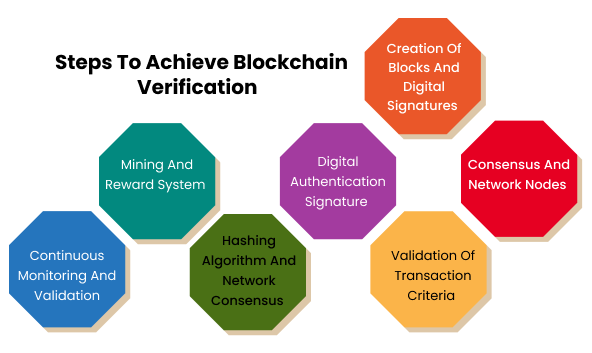
To Achieve Blockchain Verification, the Following Steps are Involved:

Steps To Achieve Blockchain Verification

1. Creation of Blocks and Digital Signatures:

Blockchains consist of blocks of code linked together and rely on the parties’ agreement in a transaction. Each new block created in the blockchain receives a unique digital signature fingerprint that cannot be altered. This digital signature is generated using hash functions from the previous block, ensuring a chain of interconnected blocks.

  • Blocks are created by bundling multiple transactions to form a single data unit.
  • The transactions within a block are combined and processed using cryptographic hash functions.
  • Hash functions generate a fixed-length alphanumeric string (hash) that uniquely represents the block’s data.
  • Each block’s hash includes the previous block’s hash, creating a chain-like structure that ensures the integrity and immutability of the blockchain Technology.
  • Digital signatures are cryptographic mechanisms that provide proof of authenticity and integrity for each transaction within a block.
  • They are generated by encrypting the transaction data with the sender’s private key, ensuring that only the sender can create a valid signature.

2. Consensus and Network Nodes:

Blockchains operate as decentralized ledgers, meaning multiple nodes are distributed across the network. When a new block is created, it receives a digital signature. All network nodes must obtain the same result when executing the hash function for verification. This consensus ensures the integrity and validity of the transaction.

  • Consensus mechanisms determine how nodes in the blockchain network agree on the state of the blockchain and validate transactions.
  • In Proof of Work (PoW), miners compete to solve complex mathematical puzzles, requiring significant computational power.
  • Once a miner finds a solution, it is verified by other nodes in the network before the block is added to the blockchain.
  • Proof of Stake (PoS) allocates the right to create a new block based on the number of tokens a participant holds, promoting energy efficiency.
  • Other consensus algorithms include Practical Byzantine Fault Tolerance (PBFT), Delegated Proof of Stake (DPoS), and more.
  • Network nodes participate in the consensus process by verifying transactions, maintaining a copy of the blockchain, and reaching an agreement on the validity of new blocks.

In a PoW-based blockchain, miners compete to solve a complex mathematical problem, with the first miner to find a solution broadcasting it to the network. Once the key is verified, the block is added to the blockchain, and the miner receives a reward. This consensus mechanism ensures that all nodes in the network can independently verify and agree on the validity of transactions.

3. Validation of Transaction Criteria:

Connected nodes in the blockchain network validate specific criteria for each initiated transaction. These criteria include: 

  • Verification of the Sender’s Wallet Address: The sender’s wallet address balance is checked to ensure they have sufficient funds for the transaction.
  • Validation of the Recipient’s Address: The recipient’s address is verified to ensure it is a valid and existing address within the blockchain network.

If all the criteria are met precisely, the transaction request is granted.

Specific criteria must be validated to ensure the integrity and validity of transactions. This includes verifying the sender’s wallet address and checking the balance to ensure they have sufficient funds for the transaction. Additionally, the recipient’s address is validated to ensure it is valid and exists within the blockchain network. These validation checks help prevent double-spending and ensure that only legitimate transactions are added to the blockchain.

  • Certain criteria are validated before they are added to the blockchain to ensure the integrity of transactions.
  • The sender’s wallet address is verified to ensure it is legitimate within the blockchain network.
  • The balance of the sender’s wallet address is checked to ensure sufficient funds for the transaction.
  • The recipient’s address is validated to ensure it is valid within the blockchain network.
  • Other criteria, such as transaction timestamps or additional transaction-specific requirements, may be validated depending on the blockchain’s design.

4. Digital Authentication Signature:

A digital authentication signature is generated by combining the transaction request and unique private keys to enhance security further. This signature serves as proof of authenticity and integrity for the transaction. Digital authentication signatures prove a transaction is genuine and has not been tampered with. They are generated by combining the transaction data with the sender’s private key and applying cryptographic algorithms. The resulting signature serves as a unique identifier for the transaction and can be used to verify its authenticity.

  • Digital authentication signatures provide a way to prove the authenticity and integrity of a transaction.
  • Cryptography algorithms create them by combining the transaction data with the sender’s private key.
  • The resulting signature is unique to the transaction and can be used to verify that the transaction has not been tampered with.
  • Verifying the signature requires the transaction data, the sender’s public key, and the signature itself.
  • Digital signatures ensure that transactions cannot be altered or forged without detection.

5. Hashing Algorithm and Network Consensus:

The digital authentication signature and the transaction request are transmitted and confirmed across all network nodes. A complex hashing algorithm, generated with the request and a nonce, is used for key and signature matching. Nodes within the network compete with each other to solve the hash function, ensuring the verification process is performed twice. Hashing algorithms play a crucial role in blockchain verification. They convert transaction data into fixed-size strings of characters, commonly referred to as hashes. Any slight change in the transaction data will result in a completely different hash. This property ensures the immutability of transactions and allows for easy integrity verification.

Network consensus is achieved by ensuring that all nodes in the network agree on the validity of transactions. In the case of PoW, nodes compete to solve a hash function associated with a block, and the first one to find a solution broadcasts it to the network. Other nodes then verify the resolution, and once consensus is reached, the block is added to the blockchain.

  • Hashing algorithms convert transaction data into fixed-length alphanumeric strings called hashes.
  • Commonly used hashing algorithms include SHA-256 (used in Bitcoin) and Keccak-256 (used in Ethereum).
  • Hash functions have the property that even a small change in the input data will result in a significantly different output hash.
  • This property ensures the integrity and immutability of transactions because any modification to a transaction would change its hash and break the chain of blocks.
  • Network consensus is achieved by agreeing on the valid block through various mechanisms such as PoW, PoS, or other consensus algorithms.
  • Consensus algorithms ensure that all network nodes agree on the order of transactions and prevent double-spending or other malicious activities.

6. Mining and Reward System:

In many blockchain networks, miners play a crucial role in verifying transactions. When a block contains multiple transactions, only the miner who successfully verifies the transaction within the block receives the mining reward. This reward can be in Bitcoin, Ethereum, or other cryptocurrencies. Mining helps maintain the integrity of the blockchain by incentivizing miners to validate transactions accurately.

Mining is the process of verifying and adding new blocks to the blockchain. Miners use computational power to solve complex mathematical problems, which requires significant computational resources and energy. The mining process verifies transactions and provides security to the blockchain by making it computationally expensive to alter past transactions.

Miners are incentivized to participate in the verification process through mining rewards. These rewards can include newly minted coins, transaction fees, or a combination. By offering tips, the blockchain network encourages miners to dedicate their resources to secure and validate transactions, ensuring the system’s overall integrity.

7. Continuous Monitoring and Validation:

Network nodes, typically high-end setups, continuously monitor and validate transactions. They broadcast the verified outcomes to other miner nodes in the network to ensure consensus and validation across all connected nodes. Any computational errors would invalidate the transaction and propagate the invalidity to all linked nodes.

In conclusion, achieving blockchain verification involves the interplay of digital signatures, consensus mechanisms, validation criteria, complex hashing algorithms, and mining rewards. This process ensures the security, immutability, and transparency of transactions within the blockchain network.

CTA 2

How are Blockchain Transactions Validated?

A Blockchain Validator is someone in charge of validating transactions on a blockchain. Every participant may become a blockchain validator by operating a full node on the Bitcoin Blockchain. However, the main reason to perform a complete node is to improve security. Unfortunately, this is an intangible incentive, so persuading someone to operate an entire node is insufficient. As a result, Blockchain Validators are mostly miners and mining pools that work complete nodes.

Differentiating Between Blockchain Validation and Blockchain Consensus

Understanding that “validation” and “consensus” are not synonymous is critical. A Blockchain Validator validates transactions by ensuring they are lawful (not malicious, double-spends, etc.).

On the other hand, the consensus defines the ordering of events on the blockchain — and reaches an agreement on that order.

Consensus essentially entails agreeing on the sequence of verified transactions. The validation comes before the consensus.

Related: Blockchain Use Cases

How are Blockchain Transactions Validated?

Whenever a transaction takes place, it is broadcast to the whole network. Miners take several transactions, verify “genuine,” and place them into a block after hearing the broadcasts.

However, miners “hear” various transactions at different times (due to latency issues, etc.). Furthermore, they may choose various transactions to put in their block depending on transaction costs. As a result, each miner is constructing their block. As a result, his block may be entirely different from the rest of the network’s miners.

Isn’t it true that everyone is constructing with various blocks? Then how are we going to agree on a single shared ledger!?”

That’s one of the protocol’s most appealing features. Miners are not required to construct the same global block. They may each create their partnership and reach a “consensus” on which block will be added next.

A miner may have a block that contains all legitimate transactions, yet his block may still need to reach a network agreement. If another person is chosen, he will build a new league and try again.

Methods for Determining Mining Reward: PoW and PoS

Mining may be very lucrative. That is why a blockchain network has more than one miner. Rather, many miners compete for the mining prize. As a result, blockchain networks must include a consensus mechanism that determines which miner will get the reward. Many approaches may be taken:

  • Proof-of-Work

The PoW reward mechanism is widely utilized in Bitcoin networks. Furthermore, poW is used by both the Bitcoin and Ethereum networks. When a new block is required, all miners on the network begin working on the hash problem. The mining reward is given to the miner who solves it first. It’s as easy as first come, first served.

  • Proof-of-Stake

PoS and PoW have the same goal: to validate transactions by generating a new hash. In a PoS system, however, nodes are not vying for the mining reward. Instead, just one node is chosen to verify the next hash. The richness of the node – or, in other words, its stake in the network – is the selection criterion. As a result, since only one node is engaged in solving the mathematical issue in a PoS-based network, energy usage will be considerably lower.

Furthermore, the incentive in a PoS system needs to be paid in freshly created currencies. Instead, the chosen node will be paid a transaction charge. When the network is established, all coins are already issued. As a result, nodes that discover a new hash in a PoS system are referred to as “forgers” rather than “miners.”

There are other methods for validating transactions, such as Proof-of-Authority, Proof-of-Burn, Proof-of-Capacity, and Proof-of-Elapsed Time. In theory, all of these systems have the same goal: to validate new data on the network. Only how the miners are chosen will vary.

CTA 3

Conclusion

As you can see, consensus techniques mainly concern consensus on sequencing events/transactions (and who gets to add them). The miner validates the transactions before they are included in the block. When a block winner is chosen, the remainder of the Blockchain Validators votes again. The miners create the league, while the Blockchain Validators ensure it is legitimate. If consensus is achieved, the network may proceed to the next block. 

In addition to understanding the blockchain verification process, it’s worth mentioning that some companies, like SoluLab, offer comprehensive services in blockchain technology. SoluLab is a leading blockchain development company that creates blockchain solutions for various industries.

Their team of top-skilled blockchain developers can assist businesses in leveraging the benefits of blockchain technology by developing custom blockchain applications tailored to specific needs. Whether creating decentralized applications (DApps), implementing smart contracts, or building private or public blockchains, SoluLab has the expertise to deliver cutting-edge solutions.

Additionally, SoluLab provides blockchain consulting services, where their experts work closely with clients to analyze their business requirements and identify the most suitable blockchain solutions. Through consulting, businesses can gain insights into the potential applications of blockchain technology and devise strategies for its successful implementation. Contact SoluLab to get a free consultation now!

FAQs

1. What is blockchain verification?

Blockchain verification is validating and confirming transactions on a blockchain network. It involves verifying the sender’s wallet balance and the recipient’s address and ensuring the transaction is secure and tamper-proof. Through consensus algorithms and cryptographic techniques, blockchain verification ensures the integrity and immutability of the transactions.

2. How does blockchain verification ensure security?

Blockchain verification achieves security through decentralization and cryptographic techniques. The distributed nature of blockchain networks ensures that transactions are validated by multiple nodes, making it difficult for malicious actors to tamper with the data. Additionally, cryptographic algorithms provide digital signatures and hash functions that secure the authenticity and integrity of the transactions.

3. Why is blockchain verification considered trustworthy?

Blockchain verification is considered trustworthy because it operates on a decentralized network of nodes that collectively validate and verify transactions. The consensus mechanism ensures that all nodes agree on the validity of transactions, eliminating the need for intermediaries and making it difficult for fraudulent activities to go unnoticed. The transparency of blockchain also allows participants to audit and verify transactions independently.

4. Can blockchain verification be tampered with?

Blockchain verification is designed to be tamper-proof. Once a transaction is verified and added to a block, it becomes virtually immutable due to the cryptographic link with previous blocks. Altering a transaction’s data would require modifying subsequent blocks, which is computationally infeasible and highly improbable due to the consensus mechanism and the network’s distributed nature.

5. How long does blockchain verification take?

The time taken for blockchain verification depends on various factors, including the specific blockchain protocol, network congestion, and the complexity of the transaction. In general, blockchain networks aim to achieve fast and efficient verification. For example, Bitcoin aims to confirm transactions within an average of 10 minutes, while other top blockchain platforms may have different verification times based on their consensus algorithms and network conditions.

Top 25 Blockchain Identity Management Startups

Top Blockchain Based Identity Startups

Blockchain technology may be used for identity applications in a range of non-financial contexts, including digital identities, passports, e-residency, birth certificates, marriage certificates, IDs, online account logins, etc. People can have more control over who has access to and who possesses their personal information by establishing an identity on the blockchain. A digital ID that can be linked to any online asset transaction and used as a digital watermark may be made by fusing the decentralized identity verification blockchain concept with identity verification.

Identity management has been difficult since the main risk is data theft or leaking. With its distributed trust architecture, blockchain technology can assist in restoring total power to consumers. Recently, there has been a significant demand for blockchain development businesses.

A number of businesses are joining the market in response to the growing need for identity verification blockchain management services. These entrepreneurs have been putting a lot of effort into addressing the market’s need for services and providing suitable solutions based on the particular needs of companies. In this blog, we will have a look at the top 25 blockchain digital identity companies that have had an impact on the market.

So, let’s get started!

Evaluation Criteria

Several criteria should be considered when evaluating top blockchain identity verification blockchain companies to make an informed decision. Here are some evaluation criteria to help you choose the right blockchain-based startups:

1. Security and Privacy: Assess the startup’s security measures and privacy protocols. Look for features like encryption, decentralized storage, and user-controlled data sharing. Strong security measures should protect users’ personal information from unauthorized access and ensure data integrity.

2. Scalability and Performance: Evaluate the scalability and performance capabilities of the startup’s identity verification blockchain solution. Consider factors such as transaction throughput, network latency, and the ability to handle a growing user base. A robust and scalable infrastructure is crucial for managing large-scale identity management operations.

3. Interoperability: Determine the startup’s approach to interoperability, which refers to the ability to connect and interact with other systems and platforms. An ideal blockchain for identity management solution should be able to seamlessly integrate with existing identity frameworks and standards, ensuring compatibility and smooth data exchange.

4. User Experience: Consider the user experience offered by the startup’s identity management solution. A user-friendly interface, intuitive workflows, and easy access to identity-related functions are essential for widespread adoption. Look for identity on the blockchain startups that prioritize user-centric design and provide a seamless onboarding process.

5. Governance and Compliance: Evaluate how the startup addresses governance and compliance requirements. Check if they adhere to relevant regulations, such as data protection laws like GDPR, and have mechanisms to ensure compliance. Transparent governance models and clear accountability frameworks are crucial for establishing trust in the identity management ecosystem.

6. Partnerships and Ecosystem: Assess the startup’s partnerships and engagement within the broader blockchain identity verification and identity management ecosystem. Consider if they collaborate with other industry players, such as technology providers or government organizations, to enhance their solution’s functionality and credibility. A strong ecosystem presence indicates a startup’s commitment to driving industry-wide innovation and adoption.

Interested? Here are the Top 25 Blockchain-Based Identity Management Startups in 2026.

1. SoluLab

SoluLab stands at the forefront of decentralized identity companies, pioneering innovative solutions in blockchain-based identity management. Leveraging its deep expertise in blockchain technology, the company offers secure and decentralized platforms that address the limitations of traditional identity management systems. By harnessing the inherent qualities of blockchain such as immutability and transparency, SoluLab’s experienced developers and consultants craft robust solutions that ensure data integrity and user privacy.

SoluLab’s advanced approach not only mitigates security risks but also enhances user control over their personal information. Its commitment to innovation empowers businesses and individuals alike with resilient identity management solutions, fostering trust and reliability in the digital landscape. Through their dedication to leveraging blockchain’s potential, SoluLab continues to lead the charge in revolutionizing identity management for a more secure and decentralized future.


$25-$49


50-249


2014


Los Angeles, CA, USA


Morpheus, NovaPay Nexus

2. Hu-manity.co

Hu-manity.co stands as a frontrunner among digital identity companies, offering advanced software driven by artificial intelligence. This innovative technology enables the creation, comprehension, and comparison of legal language within data-related contracts, facilitating clear governance of data practices across multiple entities. By leveraging AI capabilities, Hu-manity.co’s software ensures a thorough understanding of complex legal terms, empowering institutions to establish transparent and trustworthy data agreements.

Institutions worldwide rely on Hu-manity.co’s software to restore faith in digital technologies, fostering a climate of transparency and accountability. With a focus on enhancing data governance and privacy, Hu-manity.co enables organizations to maneuver through the intricacies of data-related contracts with confidence. By providing robust tools for legal comprehension and comparison, Hu-manity.co advances the mission of establishing ethical and secure data practices in the digital age.


$50-$70


10-49


2018


Princeton, USA


Forbes, Fox

3. Evernym

Evernym is a pioneering blockchain identity management startup dedicated to empowering organizations in cultivating trusted digital relationships globally. Through their software and applications, Evernym facilitates the development of secure and reliable connections, underpinned by blockchain technology. The company’s mission extends beyond mere transactions, aiming to establish decentralized human rights and sovereign laws on the blockchain, fostering a paradigm shift in digital governance.

Central to Evernym’s ethos is the protection of personal data from unauthorized access and exploitation. Whether it’s sensitive geospatial data, spending habits, or medical history, Evernym prioritizes safeguarding individuals’ privacy and ensuring data integrity. By leveraging blockchain’s inherent properties, Evernym equips organizations with the tools needed to uphold ethical data practices and combat illicit data propagation, thereby laying the foundation for a more secure and transparent digital ecosystem.


$55-$90


50-249


2013


Salt Lake City, USA


T-Mobile, SITA, World Wide Web Consortium (W3C)

4. Edge

As one of the leading blockchain digital identity companies, Edge offers a robust platform for users to engage in cryptocurrency transactions securely and privately. Through their mobile app, users can easily buy, sell, and trade various cryptocurrencies, ensuring high levels of security and privacy throughout the process. With support for leading cryptocurrencies, Edge provides a diverse selection of assets for trading, catering to the needs of both novice and experienced traders alike.

Beyond cryptocurrency transactions, Edge empowers individuals to take control of their online data through the development of proprietary tools, software, and systems. By prioritizing data security and privacy, Edge equips users with the means to safeguard their information in an increasingly digital world. Through its commitment to innovation and user-centric design, Edge continues to redefine the standards for secure and private cryptocurrency transactions, establishing itself as a trusted partner in the blockchain space.


$150-$199


10-49


2013


San Diego, USA


Atari, Ethereum Classic, Ravencoin

5. Fractal

Fractal is an open-source zero-margin protocol that defines a basic standard to exchange user information fairly and openly, ensuring a high-quality free internet version. They’ll automate critical mechanisms using blockchain technology from know-your-client (KYC) and anti-money laundering (AML) processes to data protection, security, and identity management.


$100-$149


250-999


2000


New York City, USA


Google, Disney, Spotify

6. Metadium Technology

Metadium is a next-generation blockchain protocol designed to create a decentralized identity ecosystem with the real-world introduction of Self-Sovereign Identity, the concept that individuals own all aspects of their identity offline and online.


$150-$199


50-249


2018


San Francisco, CA


Pepsi, CEAT

7. Civic Technologies

Civic stands out as a top-tier provider among decentralized identity companies, offering innovative identity management tools tailored for the Web3 environment. Their platform empowers individuals to seamlessly and privately manage their identities across multiple blockchain networks, incorporating an on-chain representation of their reusable identity. With Civic’s solutions, users gain unprecedented control over their digital identities, ensuring privacy and security in an increasingly decentralized world.

Central to Civic’s suite of offerings is their flagship product, Civic Pass, which serves as an integrated per-missioning tool. Designed to meet the needs of business customers, Civic Pass enables secure access to on-chain assets, providing a streamlined and trustworthy solution for identity verification. By leveraging blockchain technology, Civic is at the forefront of revolutionizing identity management in the Web3 era.


$70-$80


50-249


2015


San Francisco, USA


TokenSoft, Ankr, TradeBlock

8. Validated ID

Validated ID brings real identities to the digital world by helping businesses send and sign documents online and identify users and clients with maximum efficiency, security, trust, and legal compliance. With VIDsigner, we offer a SaaS multichannel electronic signature platform that combines the security of cryptographic technology, biometrics, and easy use from email certification to website and mobile integrations, smartcards, and handwritten in-person signing.


$50-$65


10-49


2012


Barcelona, Spain


Ministry of Defense (Spain), European Space Agency

9. TheKey

THEKEY revolutionizes identity verification with its blockchain-powered tool, leveraging Blockchain-based dynamic multidimensional identification (BDMI) to authenticate individuals’ identities. By harnessing the power of blockchain technology, THEKEY ensures a robust and secure authentication process, providing assurance that individuals are indeed who they claim to be. This innovative approach to identity management aligns seamlessly with the stringent requirements of government agencies, offering a level of authentication that meets and exceeds regulatory standards.

Through BDMI, THEKEY establishes a dynamic and comprehensive framework for identity verification, bolstering trust and security in online interactions. By incorporating blockchain technology into identity management, THEKEY not only enhances the efficiency of authentication processes but also ensures the integrity and immutability of identity data. With its blockchain for identity management solution, THEKEY sets a new standard for secure and reliable identity verification in the digital age, paving the way for enhanced trust and transparency in online transactions and interactions.


$45-$55


50-249


2016


Beijing, China


Chinese Government, Alibaba, China Mobile

10. Nuggets

Nuggets stand out as a multi-award-winning platform at the forefront of blockchain identity management, offering a self-sovereign verified digital identity and payment solution. This innovative platform provides users with a reusable and interoperable ID, transcending traditional boundaries to seamlessly navigate across Web 2.0, Web3, and the Metaverse. Nuggets’ merit-based identity travels with individuals, offering proof of identity and access rights in various digital environments.

Beyond identity verification, Nuggets also serves as a non-custodial cache for users’ digital assets, ensuring security and control over their valuable possessions. By leveraging blockchain technology, Nuggets empowers users to manage their identities and assets with autonomy and confidence, ushering in a new era of trust and convenience in the digital landscape. With its comprehensive suite of features, Nuggets sets a new standard for secure and user-centric blockchain identity management solutions.


$75-$90


10-49


2016


London, UK


Zara, H&M

11. Hub

Hub is a blockchain-based trust protocol that aims to make user reputations deployable across the web. On the freewheeling internet, opinions are spat out at no cost to the speaker’s reputation. Hub wants to bring accountability back to the digital world. By decentralizing reputation data using blockchain, the idea is to establish greater value for users whose opinions warrant greater trust.


$100-$149


50-249


2014


San Francisco, USA


Netflix, Target, Slack

12. Vetty

Vetty stands as a leading force in the realm of blockchain identity management startups, leveraging advanced technology to transform digital interactions for businesses and individuals alike. With a steadfast commitment to innovation, Vetty pioneers solutions that empower users to seize control of their identities and revolutionize the recruitment process. By harnessing the power of blockchain, Vetty establishes a secure and transparent ecosystem where identity verification and background screening are streamlined, enhancing trust and efficiency for all stakeholders involved.

At the forefront of blockchain identity management, Vetty’s platform offers unparalleled features and capabilities, facilitating seamless integration of identity verification and background screening processes. Through its user-centric approach, Vetty ensures compliance and security while fostering a more inclusive and equitable recruitment environment. As a top startup in the field, Vetty continues to push boundaries, driving forward the evolution of digital identity solutions for the modern age.


$45-$65


10-49


2015


Los Angeles, USA


Trestle Labs, Nokia

13. 1Kosmos

Kosmos emerges as a pioneering force in the identity management blockchain companies, spearheading innovative solutions to combat the vulnerabilities of traditional identification systems. At the core of their offerings lies BlockID, an advanced identity management platform driven by blockchain technology. Unlike conventional identification methods prone to duplication and manipulation, BlockID revolutionizes the approach by providing a secure digital locker for individuals’ identifiers, housed within their mobile devices.

By harnessing blockchain’s immutable and transparent nature, 1Kosmos revolutionizes the way identities are managed, ensuring heightened security and privacy for users. Through BlockID, the company shifts the paradigm away from physical copies of identification towards a digital-first approach, safeguarding against identity theft and unauthorized access. With its forward-thinking solutions, 1Kosmos sets a new standard for identity management, paving the way for a more secure and trustworthy digital ecosystem.


$90-$130


50-249


2016


Somerset, USA


Google, Facebook

CTA 2

14. Velix.ID

Velix.ID is a platform to enable frictionless identity verification across the globe. The contemporary identity verification methods take too long to process, incur a massive financial loss for both businesses & individuals, and often compromise the user’s personal information.


$78-$150


11-50


2017


Singapore


Accenture, Deloitte, PwC

15. DIW

DIW presents a decentralized identification infrastructure designed to enable users to access various dApps securely without compromising their identity. Within the DIW ecosystem, users can store a wide range of identifying information and documents, including passwords, banking details, wills, and other crucial digital data, all encrypted and securely maintained as a digital locker for their most important information.

As part of the identity management blockchain companies, DIW emphasizes security and privacy, granting users complete control over their digital identities. Leveraging blockchain technology, DIW ensures transparency and immutability, fostering trust and reliability in managing sensitive information. With its innovative solution, DIW provides a secure and decentralized platform for accessing dApps while upholding user privacy and security.


$147-$369


11-50


2017


Limassol, Cyprus


Siemens, Bosch, Daimler

16. Blockchain HELIX

Blockchain Helix strives to establish itself as the cornerstone of digital identity, aiming to streamline and enhance digital Know Your Customer (KYC) processes. By leveraging blockchain technology, Blockchain Helix endeavors to reduce costs and enhance the quality of digital KYC procedures. Accredited institutions can securely share KYC data through the Blockchain Helix platform, thereby minimizing the time and expenses typically associated with client authentication.

An exemplary demonstration of Blockchain Helix’s capabilities lies in its Trust Provider Network, where two banks can seamlessly exchange KYC data. This network facilitates secure data sharing among accredited institutions, promoting efficiency and trust in the digital identity ecosystem. As a leading player among blockchain digital identity companies, Blockchain Helix paves the way for a more seamless and secure digital identity verification process, benefiting both institutions and individuals alike.


$45-$63


11-50


2018


Frankfurt, Germany


Deutsche Bank, Commerzbank, Allianz

17. Persona

Persona represents the solution for identity management, aligned with the latest data protection regulations. Its scope is to empower individuals and grant them control over their data and the means to secure access to their private details. Persona is a zero-knowledge identity management system built on the blockchain.


$120-$200


11-50


2017


San Francisco, USA


Apple, Microsoft, Intel

18. NuID

NuID is a pioneer in trustless authentication and decentralized digital identity. The NuID platform leverages zero-knowledge cryptography to eliminate businesses needing to store passwords and other authentication credentials. They aim to end mass credential breaches by returning data ownership to the individual.


$72-$450


11-50


2017


Boston, USA


Visa, American Express, Mastercard

19. SelfKey Foundation

SelfKey is a blockchain-based self-sovereign identity ecosystem that empowers individuals and companies to find more freedom, privacy, and wealth through fully owning their digital identity. SelfKey enables an identity wallet with which individuals and companies can control and manage their data, securely manage their cryptocurrency portfolio, and easily and painlessly onboard onto financial, immigration, and cryptocurrency-related services.


$54-$85


11-50


2017


Singapore


HSBC, Standard Chartered, Barclays

20. Bureau

Bureau is a first-of-its-kind trust network that delivers unprecedented trust and security to businesses and consumers. Think of a one-stop platform that helps companies to automate their decisions, prevent fraud, and power seamless user experiences. Bureau provides an accurate and comprehensive picture of your customers so you can confidently transact without fear of fraud.


$14-$54


11-50


2014


London, UK


Meta, Apple

21. AyanWorks

AyanWorks specializes in offering Blockchain Consulting & Solutions, Outsource Product Engineering, and UI/UX Modernization services to clients across diverse domains worldwide. With a global footprint, AyanWorks caters to the evolving needs of businesses by providing tailored solutions that leverage cutting-edge technologies.

The company’s focus on emerging technologies, particularly around Blockchain, underscores its commitment to staying at the forefront of innovation. As one of the leading blockchain digital identity companies, AyanWorks enables clients to harness the power of blockchain technology to enhance security, transparency, and efficiency in various processes. By offering comprehensive services that span consulting, product engineering, and UI/UX modernization, AyanWorks empowers businesses to adapt to the digital age and thrive in an increasingly interconnected world.


$71-$85


11-50


2012


Pune, India


Netflix, Amazon

22. TRM Labs

TRM Labs stands as a leading blockchain intelligence company, dedicated to assisting financial institutions, crypto businesses, and government agencies in detecting and investigating crypto-related financial crimes and fraud. Leveraging advanced technologies and expertise in data engineering, data science, and threat intelligence, TRM Labs tackles challenges daily to advance its mission of building a safer financial system for billions of people.

With a focus on enhancing security and trust within the blockchain ecosystem, TRM Labs plays a pivotal role in combating financial crimes and fraud. As decentralized identity companies continue to navigate the evolving landscape of digital finance, TRM Labs remains at the forefront, providing essential tools and insights to safeguard against illicit activities. By empowering stakeholders with robust solutions and actionable intelligence, TRM Labs contributes to fostering a more secure and transparent financial environment for all.


$45-$89


11-50


2018


San Francisco, USA


Binance, Coinbase, Kraken

23. Solidus Labs

Solidus Labs’ solution utilizes machine learning to detect, address, investigate and report market manipulation in digital asset trading. Its features include collaborative and customizable alert management, regulatory reporting, and compliance management. Its clients include digital asset broker-dealers, market makers, hedge funds, and centralized and decentralized exchanges.


$20-$30


11-50


2017


New York City, USA


Gemini, Bitstamp, Bitso

24. Casa

Casa provides an innovative app and cloud-based platform tailored for private key management in the digital age. With a multi-signature approach, Casa offers robust protection against various threats, including theft, natural disasters, accidents, and more, ensuring the safety and security of users’ savings. By leveraging blockchain for identity management, Casa enhances the integrity and reliability of its key management solutions, providing users with peace of mind knowing that their assets are safeguarded against potential risks.

Moreover, Casa’s key recovery service further strengthens its offerings, providing an added layer of protection in case of unforeseen circumstances. As blockchain for identity management continues to gain prominence in the digital realm, Casa remains at the forefront, delivering innovative solutions that prioritize security, accessibility, and convenience for users seeking to protect their digital assets.


$70-$80


11-50


2018


Denver, USA


Grayscale, Unchained Capital, BitPay

25. CipherTrace

CipherTrace stands as a leading developer of cryptocurrency Anti-Money Laundering (AML), cryptocurrency forensics, and blockchain threat intelligence solutions. Trusted by top exchanges, banks, investigators, regulators, and digital asset businesses, CipherTrace enables users to trace transaction flows and adhere to regulatory AML requirements effectively. By leveraging advanced technologies and expertise in blockchain identity management, CipherTrace empowers stakeholders to combat financial crimes and ensure compliance with regulatory standards.

Through its comprehensive suite of solutions, CipherTrace fosters trust in the cryptocurrency economy by providing essential tools and insights to mitigate risks associated with money laundering and illicit activities. As blockchain identity management continues to play a critical role in enhancing security and transparency in digital transactions, CipherTrace remains committed to delivering innovative solutions that safeguard the integrity of the cryptocurrency ecosystem and promote trust among participants.


$20-40


51-200


2013


Menlo Park, USA


Binance, Kraken, Bitstamp

Closing Thoughts

The growth of blockchain identity verification technologies is significantly changing the way identity management is handled across various industries. These blockchain identity management startups are paving the way for secure, decentralized systems that protect user data while offering efficient and reliable identity verification blockchain development solutions. By leveraging the power of blockchain for identity, businesses can enhance trust, reduce fraud, and streamline verification processes in areas like finance, healthcare, and government services. As more organizations adopt identity on the blockchain, we can expect a future where digital identities are more secure, transparent, and user-controlled, reshaping the landscape of identity management globally.

Suppose you’re looking to incorporate blockchain technology into your business. In that case, SoluLab provides the opportunity to hire top blockchain developers who possess in-depth knowledge and expertise in various blockchain platforms such as Ethereum, Hyperledger, and Corda. Their developers can assist you in building robust and secure blockchain solutions that enhance transparency, efficiency, and trust within your organization.

CTA 3

FAQs

1. What is blockchain-based identity management?

Blockchain-based identity management refers to using blockchain technology to manage and authenticate digital identities securely. It leverages the decentralized nature of blockchain to store and verify identity information, ensuring privacy, security, and control over personal data.

2. How does blockchain improve identity management?

Blockchain improves identity management by providing a transparent and immutable ledger for storing and verifying identities. It eliminates the need for intermediaries, enhances data security through encryption and consensus mechanisms, and gives individuals more control over their personal information.

3. Are blockchain-based identity management systems secure?

Yes, blockchain-based identity management systems are inherently secure. The decentralized nature of blockchain makes it difficult for hackers to manipulate or alter identity data. Additionally, using cryptographic techniques ensures personal information’s privacy and integrity.

4. Can blockchain-based identity management be used across industries?

Absolutely! Blockchain-based identity management has applications across various industries, including finance, healthcare, supply chain, and government. It can streamline processes, reduce fraud, enhance data privacy, and enable seamless identity verification in different sectors.

5. What are the advantages of blockchain-based identity management?

Blockchain-based identity management offers increased security, data integrity, and user control. It reduces the risk of identity theft, provides a tamper-proof record of identity transactions, and enables individuals to manage and share their identities securely and selectively.

What is Immutable Ledger in Blockchain and Its Benefits

What is Immutable Ledger in Blockchain and Its Benefits

An immutable ledger in blockchain refers to any records that can remain unchanged. It cannot be altered, so the data cannot be easily changed. Immutability means that it’s easier to make changes with collusion. The central idea is the security of data and proof that data has not been changed. Let us delve into the topic to understand blockchain immutability and its benefits.

Understanding Blockchain Immutability

Immutability is defined as the ability of a blockchain ledger to remain unchanged, unaltered, and memorable. Each of the blocks of information, like facts or transaction details, is carried out with the help of a cryptographic principle or a hash value. Now, this hash value has an alphanumeric string generated by each block individually. Each block contains a hash value or digital signature for itself and the previous one. This, in turn, ensures that the blocks are retroactively coupled and unrelenting. Blockchain technology functionality ensures no one can interfere with the system or change the already saved data in the league.

It knows that blockchain is distributed, and decentralization is also quite essential. Here a consensus is made among the different storing a copy of the data. It is this consensus that makes sure the originality of data is righty maintained. Immutability is undoubtedly one of the most outstanding features of blockchain technology and also brings out the best use cases of smart contracts that can be deployed. The concept can redefine the entire process of auditing data to make it much more efficient and cost-effective, bringing about more trust and integrity in the data.

How to Achieve Immutability?

As explained above, the hash value helps secure each code block separately. To understand how to achieve immutability, clarification of the concept of cryptographic hashing is essential. Nowadays, the generation of a cryptographic is not a manageable task. It is because modern programming languages come with an array of hash functions. With the help of these hash functions, passing a set of bytes is required, and the process will return a checksum signature. These functions always generate a length of 64 characters, and we always get the fixed string length regardless of the input size, which is referred to as a digital signature.

The digital signature points to the exact data that the user input. But hash cannot be reverse-engineered, which means that the users cannot use this output string to find the input data. This, in turn, results in the immutability of the blockchain ledger. In this system, each of the transactions is verified with the help of a blockchain network. It includes blocks of information embedded with timestamps and is secured by a hashing process. It links together and incorporates the hash of the last block. This mechanism plays a major role in developing the chronological chain, which helps join each block.

The meta-data of the last block is always included by hashing when generating a new hash for it. This, in turn, helps create a link between the union and the chain, making it unbreakable. Once this is done, none can alter or delete the block’s data placed in the blockchain. It is because whenever anyone attempts to make a change, the modification is rejected by the subsequent block since the hash of the league would no longer be valid.

Read Our Blog: Top Blockchain Technology Companies

Understanding the Challenges to Blockchain Immutability!

Understanding the Challenges to Blockchain Immutability!

The entire blockchain mechanism is indeed quite robust but there are a few challenges that the mechanism requires to overcome. Let us understand the challenges in detail.

  • 51 Percent Attack – The major challenge for this mechanism is the possibility of a “51 Percent Attack” where an attacker can acquire enormous computing power over the other network members. A blockchain is a decentralized network; no single entity is in charge here. But the miners can still spell death for the blockchain system’s immutability by creating hashing power. Now, because of the rapid rise in mining marketplaces and the accessibility to renting mining capacity, it is not at all challenging for people to carry out such an attack. This, in turn, makes it easy for the attackers to change the transaction data that is supposed to be “immutable” first. With the help of this facility, the attackers can reverse the high-value transaction, spend the money the second time, and make the profit secure.
  • Scalability: Blockchain networks face scalability challenges as the number of transactions increases. The current design of many blockchain systems limits the transaction processing capacity, leading to slower transaction times and higher fees.
  • Energy Consumption: The energy consumption of blockchain networks, especially proof-of-work-based systems like Bitcoin, is a significant challenge. The computational power required for mining and maintaining the blockchain can result in substantial energy consumption and environmental impact.
  • Interoperability: Interoperability between different blockchain networks and traditional systems is a challenge. The lack of standardization and compatibility hinders seamless communication and transfer of assets between other blockchain platforms.
  • Governance and Regulation: Blockchain technology’s decentralized nature poses management and regulation challenges. Determining legal frameworks, resolving disputes, and ensuring compliance with existing laws can be complex in a decentralized environment.
  • Privacy and Security: While blockchain technology offers inherent security through its cryptographic mechanisms, protecting user privacy and securing sensitive data can still be challenging. The immutability of blockchain also means that once data is recorded, it cannot be easily altered or deleted, raising concerns about data privacy.
  • User Experience: Blockchain technology is often associated with complex user experiences and technical barriers. Improving the user interface and making blockchain technology applications more user-friendly is crucial for wider adoption.
  • Education and Awareness: Lack of awareness and understanding about blockchain technology is a significant challenge. Widespread adoption requires education and awareness initiatives to help individuals and businesses understand blockchain technology’s potential benefits and use cases.
  • Quantum Computing – Another major challenge in blockchain mechanism is quantum computing. It is threatening the immutable nature of blockchain. Several studies from experts have brought to light that quantum computing has the potential to reverse-engineer the public key of the blockchain network, which in turn, can find the private keys for breaking into the system. It is undoubtedly a real challenge and can affect almost 50 percent of the blockchain.

CTA 1

Overcoming the Challenges

Overcoming the challenges mentioned above is of immense importance in this regard. Studies from experts suggest that the “51 percent attack” can be dealt with in the right way by the creation of a powerful protocol and by making use of a consensus algorithm like delegated “proof-of-stake” or simply “proof-of-stake” algorithm. It is quite difficult to stake numbers of tokens on a network instead of renting out the power of computing. But it is still quite hard to ascertain that these solutions can be completely trusted for a threat like this.

To overcome the common challenges faced by blockchain technology, the following approaches can be taken:

  • Implementing sharding, off-chain transactions, or layer-two protocols can enhance scalability. These techniques allow for increased transaction throughput and improved network performance.
  • Exploring alternative consensus mechanisms, such as proof-of-stake or proof-of-authority, can significantly reduce energy consumption. Transitioning to more energy-efficient blockchains or utilizing renewable energy sources for mining operations can also address this challenge.
  • Developing standardized protocols and frameworks that enable interoperability between different blockchain networks can facilitate seamless communication and transfer of assets. Initiatives like cross-chain bridges and interoperability-focused projects aim to bridge the gap between disparate blockchains.
  • Establishing clear governance models, self-regulatory organizations, and legal frameworks specific to blockchain technology can address management and regulatory challenges. Collaborative efforts between industry stakeholders, governments, and regulatory bodies are essential to create a conducive regulatory environment.
  • Implementing privacy-enhancing technologies like zero-knowledge proofs or secure multi-party computation can protect user privacy and secure sensitive data on the blockchain. Adhering to best practices in cybersecurity and conducting regular security audits can strengthen the overall security posture of blockchain systems.
  • Improving the user interface and simplifying blockchain applications’ functionality can enhance user experience. Creating intuitive wallets, user-friendly dApps, and providing clear instructions and educational resources can help users easily navigate the blockchain ecosystem.
  • Promoting blockchain education and awareness initiatives can address the need for more understanding and knowledge. Offering training programs, hosting workshops, and collaborating with educational institutions can empower individuals and businesses to leverage blockchain technology effectively.

Integrating quantum cryptography into the core of blockchain is recommended to deal with the challenge of quantum computing. In the future, the blockchain architecture developed with quantum particles will have the potential to record all history more securely. The solutions to overcome the challenges are still quite futuristic. Thus, it is essential to be cautious while adopting blockchain to deal with the challenges.

Benefits of Immutable Ledger in Blockchain

Benefits of Immutable Ledger in Blockchain

Let us now understand the benefits of the immutable ledger on the blockchain.

  • Security is Tight in Blockchain: The immutable ledger on the blockchain is quite secure. We already know that blockchain is distributed ledger. It means that no central point of authority can control it. Thus, at any point in time, hackers try to compromise the data, and it is just next to impossible to do the same when it is managed with more than two servers or nodes. Additionally, each action made on a digital ledger is encrypted with a unique hash code to which most nodes must agree upon the activity. This, in turn, ensures a free and transparent flow of data and protects the information from being corrupted.
  • Ensures Authenticity and High Quality: It is known that an immutable ledger on blockchain benefits the users with its high level of security and traceability. These features play a significant role in effectively dealing with the fraudulent market. Every year counterfeit goods cost authorized brands a huge sum of money, but blockchain could be the revolutionary solution. It works by registering different items on the blockchain system, where the manufacturers can very easily provide all the required information to their customers regarding the origins of the products, their historical records, and current and previous owners. By tagging the items on a blockchain, the buyers can understand whether the thing is authentic.
  • Immutable and Tamper-Proof: The immutable ledger ensures that once data is recorded on the blockchain, it cannot be altered or tampered with, providing high data integrity and preventing unauthorized changes.
  • Enhanced Security: Blockchain’s distributed nature and consensus mechanisms make it highly secure. The decentralized network eliminates single points of failure and reduces the risk of hacking or data manipulation. The use of cryptographic techniques adds an extra layer of security.
  • Transparency and Traceability: Blockchain enables transparent and auditable transactions by recording every transaction on a public ledger. This transparency fosters trust and accountability as anyone can verify and trace the history of transactions or assets, promoting transparency in various sectors.
  • Improved Efficiency and Cost Reduction: Blockchain streamlines processes by eliminating intermediaries, automating workflows, and reducing paperwork. This leads to increased efficiency, faster transactions, and cost savings by eliminating the need for third-party verification or reconciliation.
  • Enhanced Supply Chain Management: Blockchain enables end-to-end visibility and traceability in supply chains. It allows participants to track the movement of goods, verify authenticity, and ensure compliance with regulations. This reduces fraud and counterfeiting and improves inventory management.
  • Decentralization and Resilience: Blockchain operates on a decentralized network, making it highly resilient to failures or attacks. The absence of a single point of control ensures that the system continues functioning even if some nodes or participants go offline.
  • Improved Data Integrity: Blockchain’s consensus mechanisms ensure that data entered into the blockchain is accurate and consistent. The decentralized nature of the network makes it difficult for malicious actors to manipulate or corrupt data.
  • Fast and Efficient Settlements: Blockchain enables speedier settlement of transactions by eliminating intermediaries and automating processes. Smart contracts, self-executing contracts stored on the blockchain, allow automatic and instantaneous payments based on predefined conditions.

Read Blog: What Are The Benefits of Hiring a Blockchain Developer?

  • Cross-Border Transactions: Blockchain facilitates faster and more cost-effective cross-border transactions by removing the need for multiple intermediaries, reducing fees, and eliminating delays associated with traditional banking systems.
  • Empowering Individuals: Blockchain empowers individuals by giving them control over their data. Users can securely manage their digital identities, selectively disclose information, and retain data ownership, leading to increased privacy and autonomy.
  • Readily Benefits Supply Chain Management: Supply chain management is another area where the immutable blockchain ledger proves immensely beneficial. The entire process of exchanging goods must be handled with much responsibility. There are chances of loss, stealing, misplacing, or damage when transporting items. Considering this, several logistics companies have already started using blockchain to avail the benefits.
    On the other hand, some companies are experimenting with blockchain before using it in their mainstream. With blockchain technology, the parties are allowed to share data very quickly. Most importantly, even the slightest inconvenience caused at the time of a shipment would be registered. In this regard, a digital ledger plays a crucial role in providing very tight security by enhancing transparency and traceability of goods in the supply chain.
  • Higher Level of Privacy: The information we share or put online is always vulnerable to outside harm, like leaks, hacks, and personal threats. We treat the data as private and ensure privacy is not easily compromised. The use of blockchain is beneficial here since it differs from the standard database, ensuring privacy is much better for the users. Blockchain is anonymous, and each user is protected with encrypted codes, making it next to impossible to detect any users’ account information. But it is to be kept in mind that levels of privacy depend on a specific blockchain and its security features.

What is the Future of Immutable Ledger in Blockchain?

Immutable ledger in blockchain readily benefits brands in a wide range of industries. It helps transform the overall business landscape and create new distribution methods of goods and information. The benefits mentioned above clearly indicate a revolutionary change and, simultaneously, have an enormous scope that will be utilized in the future. With more and more industries and brands starting to integrate blockchain into their business, its popularity is on the rise. Using blockchain plays a significant role in solving an array of authenticity, security, and traceability issues.

In 2017, the blockchain market was valued at 708 million dollars. Studies conducted by experts forecast that by the year 2025, the value of the call will reach about 60 billion dollars. This forecast gives an unambiguous indication of the growth of the blockchain market. Several market giants such as Walmart, IBM, Microsoft, Huawei Technologies, MasterCard, and many more are successfully implementing blockchain technology in their regular business operations. The entire picture tends to change when the reputed and leading brands start depending on technologies that were rated negatively before.

CTA 2

Conclusion

Blockchain, a distributed electronic ledger system, was developed due to the previous limitations imposed by traditional databases. The primary objective of disseminating and synchronizing data among multiple independent players is to democratize information. In the end, blockchain and immutable ledger technology will be a good alternative to all database applications for businesses. The trust in the data businesses use daily can be increased to an unprecedented level with blockchain implementations. Immutability ensures that fundamental and technical definitions are complete. Blockchain technology makes the verification process more effective, meaningful, and cost-effective, demonstrating that the information presented and utilized by stakeholders has yet to be altered.

As a leader in blockchain development services, SoluLab emphasizes the importance of trust and transparency in organizational operations. By leveraging blockchain’s inherent characteristics, such as immutability and decentralization, SoluLab enables businesses to establish a higher level of trust within their ecosystem. Blockchain solutions provided by SoluLab enhance transparency by maintaining an immutable record of transactions and ensuring that information is securely shared among relevant parties.

If you are seeking to distinguish yourself in the competitive field of Blockchain development, SoluLab offers a solution worth considering. By hiring skilled blockchain developers from SoluLab, companies can stand out in this crowded space. SoluLab’s team sets itself apart by prioritizing agile development methodologies and a strong dedication to delivering exceptional business outcomes. Through its unique approach, SoluLab strives to differentiate itself from other companies operating in the same industry.

FAQs

1. What does immutability mean?

Immutability is the capacity of an object to remain intact, unaltered, and indestructible. This feature of blockchain technology ensures that no one can tamper with the system or change the data that has already been saved into the block.

2. How does blockchain immutability work?

Blockchain Immutability = Cryptography + Hashing Process.

Each information block, such as facts or transaction details, is created using cryptographic principles or hashes. Cryptographic hashing is key to blockchain immutability, and the most common hash function is SHA-256. The algorithm is a subset of the parameters that connect all of the network’s blocks, resulting in immutability. These blocks cannot be altered and are sequentially secure.

3. What is the benefit of an immutable ledger in blockchain?

Blockchain immutable ledgers offer consumers a high level of security and traceability. These characteristics are crucial for effectively combating the counterfeit industry. Similarly, a digital catalog is necessary for the supply chain industry to improve commodity transparency and privacy to guarantee extremely high levels of security.

4. How can we use an immutable blockchain? 

A permanent record in blockchain helps brands in many businesses. It helps change the general business scene and makes strategies. The blockchain exchanges’ permanent trademark eliminates the reliance on extra review. It gives proof to members who execute on a carefully designed network.

5. Can data on the blockchain be deleted or modified?

No, one of the fundamental characteristics of blockchain technology is immutability. Once data is recorded on the blockchain, it becomes nearly impossible to delete or modify it. This ensures the integrity and trustworthiness of the information stored on the blockchain.

6. Is blockchain technology only applicable to cryptocurrencies?

No, blockchain technology has applications beyond cryptocurrencies. While cryptocurrencies like Bitcoin were the first use case of blockchain, the technology has evolved to be used in various industries such as supply chain management, healthcare, finance, and more. Blockchain can securely record and manage any transaction or data exchange where transparency, security, and immutability are desired.

7. Is blockchain technology energy-efficient?

The energy efficiency of blockchain technology depends on the specific consensus algorithm used. Some blockchain networks, like Bitcoin’s proof-of-work, have been criticized for their high energy consumption. However, newer blockchain platforms are adopting more energy-efficient consensus mechanisms, such as proof-of-stake, which require significantly less computational power. Additionally, ongoing research and development focus on making blockchain technology more environmentally friendly and sustainable.


How Does the Blockchain Work?

How does Blockchain Work

Blockchain technology has transformed the way we handle digital transactions and data storage. It serves as a secure and decentralized platform that records and verifies information without intermediaries. 

Imagine a digital ledger that’s shared among a network of computers, where each transaction is securely recorded, transparently visible, and impossible to alter. That’s the core idea behind blockchain—a revolutionary concept with the potential to reshape how we interact online. In this blog, we’re here to break down the basics of blockchain in simple terms. We will learn about how does blockchain work and the intricacies involved in blockchain technology! But first, let’s get to know what blockchain is all about!

What is Blockchain Technology?

Blockchain is a technique for storing data that makes it difficult or impossible for outside parties to alter, hack, or manipulate the system. A distributed ledger, or blockchain, is a network of computers that replicates and disperses transactions between itself.

Blockchain technology is a framework that uses many databases, referred to as the “chain,” connected by peer-to-peer nodes, to store public transactional records or blocks. This type of storage is commonly known as a “digital ledger.”

The digital signature of the owner authorizes each transaction in this ledger, ensuring its authenticity and preventing any manipulation. Because of this, the data in the digital ledger is extremely safe.

To put it another way, the digital ledger is essentially a network of several computers sharing a Google spreadsheet where transactional data are kept according to real purchases. The intriguing aspect is that while everyone may view the data, it cannot be altered.

How Does the Blockchain Technology Work?

You may have seen that a growing number of companies worldwide have been utilizing Blockchain technology in recent years. But how does the blockchain work specifically? Is this a little addition or a big change? Let’s start by dispelling some of the myths surrounding Blockchain technology, as these developments are still in their infancy and might become revolutionary in the future.

Blockchain combines three innovative technologies:

  • Cryptographic keys
  • A distributed ledger on a peer-to-peer network
  • A kind of computation that stores the network’s records and transactions

The two keys used in cryptography are the public key and the private key. These keys facilitate the effective completion of transactions between two parties. These two keys belong to each person, and they are used to create a safe digital identity reference. Perhaps the most significant feature of Blockchain technology is this encrypted identification. This identification, known as a “digital signature” in the context of cryptocurrencies, is used to authorize and manage transactions.

The peer-to-peer network and the digital signature are combined, and a lot of people who function as authorities use the digital signature to agree on transactions and other matters. A mathematical verification confirms their approval of a contract, leading to a successful safe transaction between the two network-connected parties.

Types of Blockchain

Types of Blockchain

There are different types of blockchain. They are as follows.

  • Private Blockchain Networks

Private blockchains run on closed networks and are best suited for private corporations and organizations. Companies may utilize private blockchains to tailor their access and permission preferences, network characteristics, and other critical security features. A private blockchain network is managed by just one authority.

  • Public Blockchain Networks

Bitcoin and other cryptocurrencies evolved from public blockchains, which also helped popularize distributed ledger technology (DLT). Public blockchains also assist to avoid some obstacles and issues, such as security weaknesses and centralized control. DLT distributes data throughout a peer-to-peer network rather than storing it in a single location. A consensus technique is used to verify information validity; proof of stake (PoS) and proof of work (PoW) are two popular consensus approaches. 

  • Permissioned Blockchain Networks

Permissioned blockchain networks, also known as hybrid blockchains, are private blockchains that provide unique access to approved persons. Organizations generally build up these sorts of blockchains to obtain the greatest of both worlds, as it allows for better organization when determining who may join the network and in which transactions.

Read Blog: Permissionless Blockchain: An Overview

  • Consortium Blockchains

Consortium blockchains, like permissioned blockchains, feature both public and private components, but they are managed by numerous organizations. Although these sorts of blockchains are initially more difficult to set up, once operational, they can provide superior security. Furthermore, consortium blockchains are ideal for collaboration across various enterprises.

  • Hybrid Blockchains

Hybrid blockchains combine both public and private blockchains. In a hybrid blockchain, certain sections of the blockchain are public and transparent, but others are private and only available to authorized members. This makes hybrid blockchains excellent for applications that demand a mix of openness and secrecy. For example, in supply chain management, numerous parties can view some information but sensitive data is kept secret.

  • Sidechains

Sidechains are parallel blockchains that provide extra features and scalability. Sidechains allow developers to get creative with new features and apps without compromising the main blockchain’s integrity. Sidechains can also be utilized to manage transactions of the main blockchain, reducing congestion and enhancing scalability.

  • Blockchain Layers

Building several blockchain layers on top of one another is referred to as “blockchain layers.” Every layer can have its own rules, functionality, and consensus mechanism that can communicate with other levels. Due to the capacity to handle transactions concurrently across many levels, this guarantees increased scalability. As an illustration, the Lightning Network is a second-layer solution that facilitates quicker and less expensive transactions by opening up payment channels between users and is built on top of the Bitcoin blockchain.

Read Our Blog: Layer-1 Vs. Layer-2: The Blockchain Scaling Solutions

What is Blockchain as a Service? 

Blockchain as a Service (BaaS) is a cloud-based service that allows users to develop, host, and deploy blockchain applications without the complexity of building and maintaining the underlying infrastructure typically associated with blockchain technology.

Similar to other “as a Service” models like Software as a Service (SaaS) or Platform as a Service (PaaS), BaaS provides users with access to blockchain capabilities on a pay-as-you-go or subscription basis. This means that users can leverage the benefits of blockchain technology, such as decentralization, transparency, and immutability, without needing to invest in hardware, software, or specialized expertise.

Blockchain Development Company

Here’s how it works:

1. Cloud-Based Infrastructure: Blockchain as a Service (BaaS) providers offer blockchain infrastructure hosted on their cloud platforms. This infrastructure typically includes all the necessary components for deploying, managing, and scaling blockchain networks.

2. Pre-Built Solutions: BaaS platforms often provide pre-built blockchain solutions and templates tailored for specific use cases, such as supply chain management, identity verification, or financial transactions. These solutions come with predefined smart contracts, consensus mechanisms, and other necessary features.

3. Development Tools: BaaS platforms offer a range of development tools, APIs, and SDKs that enable developers to easily build, test, and deploy blockchain applications. These tools abstract away much of the complexity associated with blockchain development.

4. Scalability and Flexibility: BaaS platforms typically offer scalability features, allowing customers to easily scale their blockchain networks based on demand. They also provide flexibility in terms of choosing the underlying blockchain protocol, consensus mechanism, and other configuration options.

5. Managed Services: BaaS providers handle various operational aspects of the blockchain infrastructure, such as security, maintenance, and upgrades. This allows customers to focus on developing and deploying their applications without worrying about the underlying infrastructure.

How is Blockchain Used?

Blockchain technology has found applications across various industries, revolutionizing processes and enhancing security and transparency. Let’s explore how blockchain is utilized in different sectors:

1. Finance

In the financial industry, blockchain is widely used for secure and transparent transactions. It has facilitated faster cross-border payments, reduced transaction costs, and minimized the need for intermediaries. Smart contracts powered by blockchain technology automate processes such as loan approvals and trade settlements, streamlining operations and reducing the risk of fraud.

2. Healthcare

Blockchain is transforming the healthcare sector by improving data management and patient care. Electronic health records stored on blockchain platforms ensure data integrity and confidentiality, enabling secure sharing of information among healthcare providers. Additionally, blockchain in healthcare facilitates drug traceability, ensuring the authenticity of pharmaceutical products and combating counterfeit drugs in the market.

3. Supply Chain Management

Blockchain technology is reshaping supply chain management by enhancing transparency and traceability. By recording every step of a product’s journey on a of transparency builds trust among stakeholders and improves overall supply chain efficiency.

4. Real Estate

In the real estate industry, blockchain is revolutionizing property transactions and ownership records. Smart contracts on blockchain platforms enable secure and transparent real estate transactions, eliminating the need for intermediaries such as brokers and lawyers. Blockchain-based property registries ensure accurate and tamper-proof records of ownership, reducing the risk of fraud and disputes in real estate transactions.

Read Blog: Revolutionizing Real Estate With Blockchain Technology

5. Energy

Blockchain technology is being leveraged in the energy sector to enable peer-to-peer energy trading and enhance grid management. Through blockchain-based platforms, energy producers can sell excess energy directly to consumers, creating a decentralized energy market. Smart meters integrated with blockchain technology enable real-time monitoring of energy consumption and transactions, promoting energy efficiency and sustainability.

These examples showcase the diverse applications of blockchain technology across industries, highlighting its potential to revolutionize processes, enhance security, and drive innovation in various sectors.

Features of Blockchain Technology

Features of Blockchain Technology

Here are the key features of blockchain technology:

1. Decentralized: Blockchain is a decentralized system, meaning that there is no single central authority controlling the network. Instead, it is maintained by a network of nodes (computers) that work together to validate transactions.

2. Immutable: Once a transaction is recorded on the blockchain, it cannot be altered or deleted. This is because each block is linked to the previous block through a unique code, making it impossible to change or manipulate the data.

3. Transparent: All transactions on the blockchain are transparent, meaning that anyone can view the entire history of transactions on the network.

4. Distributed Ledger: Blockchain is a distributed ledger technology, meaning that multiple nodes on the network maintain a copy of the entire blockchain, ensuring that all parties have access to the same information.

5. Security: Blockchain technology uses advanced cryptography and encryption techniques to ensure that all transactions are secure and tamper-proof.

6. Upgradability: Many blockchain networks are designed to be upgradable, allowing for changes to be made to the protocol or underlying code without disrupting the network.

7. Scalability: While blockchain technology has made significant progress in terms of scalability, some networks still face limitations in terms of transaction speed and capacity.

8. Interoperability: Blockchain technology is being developed to enable interoperability between different networks, allowing for seamless communication and data exchange between different ecosystems.

Bitcoin vs. Blockchain

Since its first release in 2009, Bitcoin has grown to become the most well-known and prosperous virtual currency to date. Due to its decentralized nature—that is, the lack of a central bank or body overseeing its supply—Bitcoin has become extremely popular. This implies that utilizing Bitcoin entails no transaction costs and anonymous transactions.

Blockchain is a database of past transactions between two parties. As new transactions occur, blocks of data containing details about them are added to the chain in chronological order. The amount of blocks generated following a record makes it harder to modify over time, therefore the Blockchain is always expanding as new blocks are added to it.

Applications of Blockchain

Blockchain technology has the potential to revolutionize various industries and sectors beyond its original use case in cryptocurrency. The decentralized and secure nature of blockchain makes it an attractive solution for a wide range of applications, including:

  • Financial Services: Blockchain can be used to create secure and transparent financial instruments, such as smart contracts, digital identities, and decentralized exchanges. Banks and financial institutions are exploring blockchain technology to improve efficiency and reduce costs.
  • Voting Systems: Blockchain-based voting systems can increase transparency and security in elections. Countries such as Australia and Switzerland are exploring blockchain-based voting systems.
  • Cybersecurity: Blockchain can be used to create secure and decentralized cybersecurity solutions, such as decentralized blockchain identity management and encrypted data storage.
  • Intellectual Property: Blockchain can help protect intellectual property rights by creating a tamper-proof record of ownership and provenance.
  • Gaming: Blockchain can be used to create decentralized gaming platforms, allowing for secure and transparent transactions, and enabling players to own their digital assets.
  • Identity Verification: Blockchain-based identity verification solutions can help create secure and decentralized digital identities, reducing the risk of identity theft and improving security.
  • Food Safety: Blockchain can help track the origin and movement of food products, reducing the risk of food contamination and improving transparency.
  • Education: Blockchain-based education platforms can help create secure and transparent digital credentials, reducing the risk of degree fraud and improving accessibility.
  • Government Services: Blockchain can be used to create secure and transparent government services, such as voting systems, taxation systems, and identity verification.

Benefits of Blockchain Technology

Blockchain technology has numerous benefits that make it an attractive solution for various industries and sectors. Some of the key benefits of blockchain technology include:

1. Increased Transparency: Blockchain technology provides a transparent and tamper-proof record of transactions, making it easier to track and verify the authenticity of data.

2. Improved Security: Blockchain technology uses advanced cryptography and encryption techniques to ensure that data is secure and tamper-proof, making it difficult for hackers to access or manipulate data.

3. Reduced Costs: Blockchain technology can reduce costs by automating processes, eliminating intermediaries, and increasing efficiency.

4. Enhanced Efficiency: Blockchain technology can automate processes, reduce the need for manual intervention, and increase speed and accuracy, making it an attractive solution for industries that require fast and efficient processing.

5. Increased Trust: Blockchain technology can increase trust between parties by providing a secure and transparent record of transactions, making it easier to establish trust in digital transactions.

6. Decentralized Control: Blockchain technology allows for decentralized control, giving individuals and organizations more control over their data and transactions.

7. Improved Data Accuracy: Blockchain technology can improve data accuracy by providing a single source of truth, reducing the risk of errors and inconsistencies.

8. Reduced Risk of Fraud: Blockchain technology can reduce the risk of fraud by providing a secure and transparent record of transactions, making it difficult for fraudsters to manipulate data.

9. Increased Accessibility: Blockchain technology can increase accessibility by providing a secure and transparent way for individuals and organizations to access and share data.

10. Scalability: Blockchain technology can scale to meet the needs of growing industries and sectors, providing a secure and transparent way to manage large amounts of data.

11. Improved Compliance: Blockchain technology can improve compliance by providing a secure and transparent record of transactions, making it easier to meet regulatory requirements.

12. Reduced Counterfeiting: Blockchain technology can reduce counterfeiting by providing a secure and transparent way to track the origin and movement of goods.

13. Improved Supply Chain Management: Blockchain technology can improve supply chain management by providing a secure and transparent way to track the movement of goods.

14. Enhanced Customer Experience: Blockchain technology can enhance customer experience by providing a secure and transparent way to manage customer data and transactions.

15. Increased Value: Blockchain technology can increase value by providing a secure and transparent way to manage digital assets, such as cryptocurrencies.

Overall, blockchain technology has the potential to bring significant benefits to various industries and sectors, from improved security and transparency to increased efficiency and accessibility. As the technology continues to evolve, we can expect to see even more innovative applications of blockchain emerge.

Leading Blockchain Platforms

There are a lot of blockchain platforms out there. The Ethereum blockchain, Hyperledger Fabric, and OpenChain are the three most well-known.

1. Ethereum: Ethereum stands as one of the most widely utilized and respected blockchain platforms in the industry. It is celebrated for its open-source nature and adaptability, making it a preferred choice for various enterprise applications. One of Ethereum’s groundbreaking contributions to the blockchain space is the introduction of smart contracts and decentralized applications (dApps). These innovations have significantly expanded the potential use cases of blockchain technology beyond simple transactions. Ethereum boasts a robust and expansive developer community, fostering continuous innovation and development within its ecosystem. Its native cryptocurrency, Ether, serves as the fuel for executing operations on the platform.

2. Hyperledger Fabric: Hyperledger Fabric caters to specific industry needs, particularly in the finance and manufacturing sectors. It is an open-source blockchain platform designed primarily for permissioned networks. However, it can also support decentralized hosting and storage of applications leveraging smart contracts. Hyperledger Fabric offers a modular framework that empowers organizations to build private blockchains customized to their unique business requirements. This flexibility, combined with its support for smart contracts, enables diverse applications across various industries.

3. OpenChain: OpenChain addresses the requirements of organizations looking to efficiently manage and safeguard digital assets. As an open-source blockchain platform, it allows administrators to establish the rules governing the ledger. Users can then engage in value exchange on the ledger while adhering to these predefined rules. OpenChain’s focus on providing a customizable and scalable solution makes it suitable for a wide range of use cases, from supply chain management to digital asset issuance and tracking.

Hire Blockchain Developers

Conclusion

In conclusion, the blockchain represents a revolutionary technology with the potential to transform numerous industries by providing secure, transparent, and decentralized solutions for various applications. Its underlying principles of immutability, decentralization, and cryptographic security make it a robust and reliable platform for storing and exchanging digital assets and information. From financial transactions and supply chain management to identity verification and decentralized applications, the blockchain offers endless possibilities for innovation and disruption.

As businesses and organizations continue to explore the benefits of blockchain technology, partnering with an experienced blockchain development company becomes crucial. SoluLab stands out as a leading provider of blockchain solutions, offering expertise in developing custom blockchain applications tailored to specific business requirements. With a team of skilled developers and blockchain specialists, SoluLab empowers businesses to harness the full potential of blockchain technology. Whether it’s creating decentralized finance (DeFi) platforms, supply chain tracking systems, or secure digital identity solutions, SoluLab delivers reliable, scalable, and innovative blockchain solutions. Contact us today to embark on your blockchain journey and unlock new opportunities for growth and innovation.

FAQs

1. What exactly is blockchain technology?

Blockchain technology is a decentralized digital ledger that records transactions across a network of computers in a secure and transparent manner. Each block in the chain contains a cryptographic hash of the previous block, creating a chronological and immutable record of transactions.

2. How does blockchain ensure security and trust?

Blockchain ensures security and trust through its decentralized nature and cryptographic mechanisms. Transactions on the blockchain are verified and recorded by multiple participants in the network, making it extremely difficult for any single entity to tamper with the data. Additionally, cryptographic techniques like hashing and digital signatures provide further security by encrypting and authenticating transactions.

3. What are smart contracts, and how do they work on the blockchain?

Smart contracts are self-executing contracts with the terms of the agreement directly written into code. These contracts automatically execute and enforce themselves when predetermined conditions are met, eliminating the need for intermediaries. Smart contracts run on blockchain platforms like Ethereum, leveraging the platform’s decentralized infrastructure to ensure transparency and security.

4. Is blockchain only useful for cryptocurrencies like Bitcoin?

While blockchain technology gained prominence with the rise of cryptocurrencies like Bitcoin, its utility extends far beyond digital currencies. Blockchain can be applied to various industries and use cases, including supply chain management, healthcare, finance, voting systems, and identity verification. Its decentralized and immutable nature makes it suitable for any scenario requiring secure and transparent record-keeping.

5. How can businesses leverage blockchain technology?

Businesses can leverage blockchain technology in numerous ways to streamline operations, enhance security, and drive innovation. Some common applications include supply chain tracking to improve transparency and traceability, digital identity management to securely verify user identities, and decentralized finance (DeFi) platforms for efficient and transparent financial transactions. By incorporating blockchain into their operations, businesses can gain a competitive edge and unlock new opportunities for growth and efficiency.

5 Growing Startups Using Blockchain to Drive Transparency in Supply Chain Industry


5 Growing Startups Using Blockchain to Drive Supply Chain Transparency

Blockchain technology has far-reaching effects on a wide array of industries, and the supply chain industry is not an exception. Blockchain technology has the potential to benefit the supply chain industry significantly in numerous ways. Blockchain can be used to bring about an improvement in the transparency in the supply chain as well as traceability, along with cutting down administrative costs. In addition to this, blockchain helps build trust among all the members involved in the supply chain industry.

With the help of blockchain technology and the use of smart contracts, there is complete transparency from the source to the destination in the entire supply chain. Moreover, tracking of assets becomes accurate, and accurate licensing of all products, services, & software. The use of blockchain technology keeps a record of everything that goes on in the supply chain industry. Most importantly, the records cannot be altered, modified, or changed, which proves to be extremely beneficial. Several startups are working towards a common cause which is to transform the supply chain industry by leveraging the potential of blockchain technology. 

So, let us have a look at these top 5 startups that are looking forward to transforming the supply chain industry.

 1.  Everledger

Everledger

Everledger is a well-known startup offering a specialized platform powered by blockchain. The platform happens to be the place where the supply chain and blockchain meet. Everledger aims to bring about transparency by providing appropriate technological solutions to enhance the level of transparency in the global supply chain industry.

Read Also: Top 10 Growing Crypto Fintech Startups to Watch Out

The purpose here is to contribute much better clarity as well as confidence in the supply chain marketplace where transparency happens to be a strategic imperative. Moreover, Everledger offers sustainability and compliance, thereby helping to build trust in every purchase. 

2.  SyncFab

SyncFab

SyncFab is another reputed startup focusing on end-to-end supply chain traceability with the help of blockchain technology. The startup offers OEM & NPI parts production procurement for supply chain management as well as parts pedigree with blockchain cyber security and digital thread compliance. The specialized enterprise middleware platform from SyncFab permits OEM Procurement as well as NPI Engineering Departments to suitably plan, source, procure, track, secure, and pay for precision parts.

3.  Skuchain

Skuchain

Another name in the list of top startups is Skuchain which offers currency agnostic blockchain for the purpose of giving a liquid supply chain. The specialized currency agnostic blockchain connects procurement & contract management, direct enterprise control of corporate payments, financing arrangements, and tracking inventory in a buildable manner. This, in turn, results in a liquid supply chain, where early payments flow upstream, and data flows downstream in real-time in a manner that has less risk from new pools of capital.

4.  Ripe.io

Ripe io

Ripe.io is a popular startup focusing on the blockchain of food. The startup aims to develop long-lasting trust as well as confidence in the food supply chain via a specialized platform powered by blockchain where everyone can very easily access transparent and reliable information on the origin, journey, and quality, along with the sustainability of food. Ripe.io is bringing about a transformation in the food system narrative by working with each of the participants in the system along the food supply chain for the purpose of building a world where access to data is equal to brand integrity, transparency, security, and better food for all.

5.  CargoCoin

Cargo Chain

CargoCoin is a famous startup that connects the physical world of trade, transport & logistics with blockchain, which in turn helps replace paper documents with smart contracts and offers highly secure escrow payments throughout the entire process. CargoCoin makes use of the transport platform as an entirely secure transfer as well as storage method by means of smart contracts and a payment provider for transport services & cargoes. The platform appropriately utilizes the power of cryptocurrencies for the purpose of acting as an extremely interactive way of receiving, sending, rejecting, approving, and signing documents via the process.

Closing Thoughts

Reading through the post gives a clear indication of the potential of blockchain technology in benefiting the global supply chain industry. In addition to this, the significant contributions made by the top 5 startups in this field have further elevated the overall utilization of the prowess of blockchain technology in an effective way. Their contributions have played a vital role in enhancing the efficiency of the overall industry. 

Importance Of Tokenization Of Assets

New models are popping up day by day around blockchain technology. One of its largest propagandists is asset tokenization that can play a vital role in entirely transforming the way we look at the financial industry. At present, there are about trillions of dollars locked in assets that cannot be exploited or to which there is very little access.


Different markets like art, real estate, scarce IP, and valuable resources, are primarily owned by institutional investors, thereby allowing very little scope for investment in these markets by the retail investors. Therefore, the retail investors have the only possibility of investing in either debt or equity markets, where there’s high volatility and risk. It is precisely the situation where tokenization of assets comes to the rescue.

Concept of Tokenization OF Assets

Tokenization of assets refers to the process by which an issuer develops digital tokens on a blockchain that represents either digital or physical assets. Blockchain in this regard guarantees that the tokens representing an asset, once bought by any individual, their ownership cannot be erased or changed by any single authority, thereby ensuring that the ownership of that asset remains completely immutable.

By tokenization, any real-world asset both tangible and intangible can be easily digitized. Then they are broken down into minute parts that take the form of tokens. Speaking in a broader sense, a token represents something else, and in this case, each of the tokens represents a proportional part of the digitized asset. It also means that the owner of the token has the associated ownership rights or other types of rights.

Different Types of Tokenized Assets

Tokenized assets are of three types.
  1. Fungible Asset Tokenization –

    Each of the tokenized fungible assets is interchangeable and has the same market value as well as validity. Moreover, a fungible asset can be divided into an infinite number of decimal points as per the configuration during their issuance with each of the units having the same value and validity.
  2. Non-Fungible Asset Tokenization –

    Non-fungible asset tokens are non-interchangeable, hence cannot be replaced with the same type of tokens because each of them represents a unique value. These assets are usually not divisible. Each of the tokens differs from the other of the same type and possesses unique information as well as attributes.
  3. Tangible Asset Tokenization –

    Tangible asset tokens refer to the collection of assets that possess specific monetary value in addition to the general availability in the physical form.

Need of Tokenization of Assets to Deal with the Issues in Traditional Asset Management System

Asset management is the process of producing, procuring, storing, as well as managing all documents related to different assets before, during, and after the procedure of transferring ownership. Distributed ledger technology or blockchain technology could play a crucial role in serving as a single source of truth for reducing mismatches in information. It is an extremely dependable instrument for trading real estate, equities, stocks, bonds, and a number of similar types of assets.

Asset tokenization came into existence because of the current asset management scenario. The current asset management ecosystem consists of different stakeholders, including a number of intermediaries like brokers, investors, auditors, and custodians, thereby bringing about a substantial increase in the overall cost of the process. The traditional asset management system is very much vulnerable to fraud and errors. Additionally, the need for tokenization of assets is to appropriately deal with the following issues in the current asset management system.

  • The present asset management system is dependent on approaches that tend to create a lot of difficulties in accurately identifying the source of error when it occurs. Moreover, the complexity of the management of assets with traditional tokenization also creates hindrances to ensure accountability.
  • Fragmented data storage with the existing mechanisms for tokenization gives rise to the requirement of blockchain tokenization. Each of the parties associated with the transactions of asset management with traditional tokenization has its own data versions due to which difficulties are created incorrectly identifying error sources that tend to rise with the increasing complexity of the processes.
  • Another major issue that is present in the current asset management system is the highly complicated onboarding process. Spiteful agents could support the prolonged duration and slow speed of conventional processes of tokenization. This could give hackers the chance to exploit the vulnerabilities as a result of the complications in the overall process and make use of forged documents or identities for getting on board without any kind of difficulties.

Importance of Tokenization OF Assets

The importance of tokenization of assets is two-fold that is from the point of view of the asset owners as well the investors.

Benefits for the Asset Owners

  • The liquidity of the asset is increased to a significant extent.
  • Liquidated assets ensure that the prices are fair.
  • The cost of asset management is readily reduced which proves to be quite advantageous.

Benefits for the Investors

  • Reduced paperwork for a tokenized property makes it possible for investors to invest smaller amounts in property and hence can benefit from enhanced liquidity via tokenization.
  • Lock-up periods are shorter in the case of tokenization of assets which allows investors to sell the assets with ease in a liquid market.
  • The entire process is completely transparent since blockchain is the technology behind the tokenization of assets where investors can see the detailed history of a holding for making a more informed decision.
  • Identity is secure with the ownership and decentralized identity details kept on the blockchain.

Future of Tokenization OF Assets

Tokenization of assets is all set to transform the entire asset management scenario that exists today. It democratizes ease of access to the markets yet keeping fairness and security intact. The only obstacle at present is the legal boundaries. The creation of a legal bridge between the assets and blockchain or distributed ledger technology requires legal professionals to deal with tax-related as well as cross-jurisdictional problems. Nonetheless, new solutions are quite certain to come into the market, which will eradicate these problems in the time to come.

Quick Read: Tokenization Nlp – Methods, Types and Challenges

- Contact Us -

SoluLab being the top 3 Blockchain developers can help you build the perfect Blockchain Platforms.

What is Argo Blockchain and How Do I Invest In Argo Blockchain?

Argo Blockchain is nothing but a publicly traded blockchain technology company that focuses on large-scale cryptocurrency mining. The company has its headquarters in the United Kingdom in London and it takes pride in being the only cryptocurrency mining company to be listed on the London Stock Exchange. Blockchain technology is all set to revolutionize the world’s future and Agro Blockchain is a hundred percent committed to sustainably taking it forward. The company has highly energy-efficient, and powerful mining operations which are strategically spread across North America.

How Agro Blockchain is Climate Friendly?

Argo Blockchain PLC addressed its own emissions of greenhouse gas for becoming carbon neutral and by the appropriate mitigation of emissions via the support of projects that are outside the group for becoming friendly to the environment. This, in turn, made the company the first publicly-traded cryptocurrency miner to become climate positive from scope one, two, and emissions of greenhouse gas from the value chain associated with its mining operations.

The company claimed this development as a significant milestone in its climate strategy which not only includes the ongoing initiatives in energy efficiency but also the future initiatives. The initiatives include reduction of e-waste, use of waste heat in partnership with the municipalities locally, and appropriately support the industry by maintaining the sustainability standards.

Understanding Cryptocurrencies

Cryptocurrencies are digital or virtual currencies that are secured by cryptography. They are a digital value system functioning as a medium of exchange. Being secured by cryptography, they are almost impossible to be counterfeited or double-spent. Cryptocurrencies are binary data designed to be used for properly facilitating transparent, secure, and fast transactions between users throughout the world.

In cryptocurrency, the individual coin ownership records are stored in a ledger that exists in the form of a computerized database. Moreover, the use of strong cryptography makes all the transaction records completely secure, appropriately controlling the creation of additional coins, and for the correct verification of the transfer of ownership of the coin. Cryptocurrencies such as Bitcoin are bringing about a revolution in the way we exchange goods as well as money throughout the economy on a global scale.

What is Crypto Mining?

Crypto mining refers to the process of gaining cryptocurrencies by solving different cryptographic equations by using computers. The process involves the validation of the blocks of data and the addition of records of the transaction to a public record or ledger referred to as a blockchain. To state in technical terms, it would be ideal to say that crypto mining is a transactional process involving the use of computers as well as cryptographic processes for the purpose of finding solutions to complex functions and recording the data on a blockchain. It is the entire network of computers that are involved in the process of crypto mining and keep shared records through those blockchains.

Crypto Mining Process and Its Working

Here are a few steps to clarify the crypto mining process and gain a better understanding of its working.

  1. Nodes, that is the individuals and the devices involved in the creation of a blockchain verify whether the transactions are legitimate or not.
  2. In the next step, separate transactions are added to a list of other transactions that help in the formation of a block.
  3. Then a hash or other types of data are added to the block that is still unconfirmed.
  4. The crypto miners then verify the hash of the block to make sure that the block so formed is legitimate.
  5. After the confirmation of the block, it gets published in the blockchain.

All the transactions for the ledger are encrypted with the help of public-key cryptography. Now, for the blocks to be accepted, they should make use of a hash that the crypto miner nodes on the blockchain for the purpose of verification of each block and ensure that each of them is genuine as well as unaltered.

Facts and Myths About Cryptocurrencies

Here are a few facts about cryptocurrencies.

  • The most fascinating fact about cryptocurrencies is that they are not controlled by any central authority or other third parties.
  • They run on a distributed blockchain network that is operated by the users themselves.
  • No individual entity has the power to alter the data in any blockchain.
  • Transferring money is easy, instant, secure, and cheap with blockchain.

Let us now check out the common myths about cryptocurrencies.

  • Cryptocurrencies do not have real monetary value but the fact is that they are digital currencies carrying monetary value. For example, Bitcoin, one of the most popular
  • cryptocurrencies, has exceeded the market size of about 150 billion dollars in recent years.
  • Cryptocurrencies cannot be used for buying things but the fact is that they serve as a medium of exchange.
  • Cryptocurrencies are illegal but the fact is that it has been accepted by several developed countries of the world including the United Kingdom, United States of America, Australia, Japan, and almost the entire Europe.

Crypto Mining on Agro Blockchain PLC

Agro Blockchain PLC has brought about clean power and superior efficiency to crypto mining. The cryptocurrency mining infrastructure at Agro Blockchain PLC has the highest ratio of petahash or PH to megawatt MW as compared to all the publicly traded companies available in the market. The unmatched energy efficiency as well as output results in much cheaper mining operations along with appropriate optimization for overall higher margins. Join Agro Blockchain to invest in the future of money.

Future of Crypto Mining

Crypto mining is undoubtedly an interesting alternative to the traditional systems that are centralized in nature operating majorly across the globe. With cryptocurrencies on the rise along with steady innovation and development of blockchain technology, crypto mining certainly has a huge scope in the future. Slowly and steadily, the utility of cryptocurrencies would undoubtedly become more widely recognized by the mainstream which in turn, ensures that the cryptocurrencies are here to stay. It certainly cannot be denied that cryptocurrencies are sure to shake the foundation of the existing concept of money and how we exchange goods, values as well as across the world.

- Contact Us -

SoluLab being the top 3 Blockchain developers can help you build the perfect blockchain applications.