Key Takeaways
Don’t have time to read the full guide? Here’s what you need to know about tokenization:
- Total Cost: Expect $1.4M to $3.3M over 3 months. Most platforms spend $1.5M to $2.5M. Budget properly or fail.
- Timeline: 4-6 months from regulatory planning to launch with real revenue. Can’t be rushed without cutting corners that cost you later.
- Regulatory Path: Start with securities law counsel immediately. You’ll need Reg A+, Reg D, or money transmitter licenses. New York BitLicense takes 12 to 24 months, so apply now.
- Biggest Mistake: Skipping compliance to move faster. Regulators shut you down and fine you $10M to $100M+. Do compliance first, build second.
- Revenue Models: Start with trading fees (0.1% to 0.5%) or issuance fees ($250K to $500K per deal). Add custody fees in year two. Enterprise licensing comes after achieving product-market fit.
- Winning Strategy: Pick one niche (real estate, private equity, commodities, or art) and dominate it before competitors arrive. Don’t try to be everything.
- Essential Partners: Secure custody (Anchorage, Fireblocks) and KYC/AML (Onfido, Chainalysis) before writing code. User trust depends on this foundation.
The US Market in 2026: Why RWA Tokenization Now?
The financial industry stands at a crossroads. For decades, asset ownership has remained fragmented, illiquid, and locked behind institutional walls. A person cannot own 0.001 shares of a Manhattan skyscraper. A hedge fund manager cannot easily liquidate a private equity stake. A collector cannot divide ownership of a valuable painting.
But blockchain technology has changed everything.
This is where tokenization platform development comes in. If you’re considering building a tokenization platform in the USA, you’re entering one of the most lucrative fintech markets today. The opportunity is massive. McKinsey projects the tokenization market will reach $4.7 trillion by 2030.
BlackRock is building tokenization infrastructure. JPMorgan launched JPM Coin for settlement. State treasuries are tokenizing bonds. Fidelity opened digital asset divisions.
In 2026, the opportunity is even clearer than it was in 2025. The regulatory environment is now stable. Institutional adoption is accelerating. Technology infrastructure is battle-tested. But the window for capturing first-mover advantage in specific niches is definitely closing.
Every month that passes, competitors get smarter and better funded.
The Harsh Reality: Why Most Tokenization Platforms Fail?
Most tokenization platforms fail. Not because of bad technology. Not because the market doesn’t exist. The real reason is far more practical.
Founders skip the hard parts:
- Regulatory compliance and SEC filings
- Custody solutions and insurance arrangements
- Market-making strategy and liquidity planning
- Industrial-grade KYC/AML infrastructure
They build in stealth. They launch to an empty platform. They run out of money. They disappear quietly.
This guide is different. It’s based on real data from 15+ tokenization launches. These are platforms that now manage over $1 billion in assets combined. We’ve tracked what works and what fails.
By the end, you’ll have a clear blueprint for launching a compliant, institutional-grade platform.
Whether you’re planning real estate tokenization, private equity marketplace, a commodity exchange, or an asset tokenization platform, the fundamentals are the same. The complexity is significant, but it’s manageable if you know where to focus.
Let’s start from the beginning.
What Is a Tokenization Platform?
A tokenization platform is fundamentally simple. It’s the technology infrastructure that converts real-world assets into blockchain-verified tokens. These tokens represent fractional ownership, access rights, or value on a distributed ledger.
Think about it this way. Historically, asset ownership has been all-or-nothing. You either own one share of a company or you don’t. You either own the entire building or you don’t.
Asset tokenization changes this entirely. That Manhattan office building can be divided into one million tokens. Each token represents 0.0001% ownership. A person with $1,000 can now own commercial real estate that was previously only accessible to institutions with $100 million minimums.
This is about far more than fractional ownership, though. Tokenization platforms enable several transformative capabilities.
First, asset ownership becomes genuinely liquid. Rather than waiting years to sell real estate, tokenized assets can trade on secondary markets in real time. Second, markets become more efficient because open markets discover prices through supply and demand. Third, access expands dramatically.
Someone in rural Montana can now invest in New York office buildings. An entrepreneur can participate in venture capital secondaries without $250,000 minimums.
For platforms built on blockchain technology, there’s another layer entirely. Settlement speed transforms from days to seconds. Instead of waiting three to five days to settle trades, tokenized transactions settle instantly. Instead of needing multiple intermediaries, settlement is atomic.
The asset and payment exchange simultaneously with no counterparty risk.
This is genuinely transformative. And it’s starting to happen at scale across industries.
The 2026 Regulatory Environment for RWA Tokenization: Clearer Than Ever
There are several compelling reasons why 2026 represents an active launch window for tokenization entrepreneurs.
Regulatory clarity has solidified. The SEC has issued definitive guidance on token classification. The Howey Test now has a predictable application in the crypto context. The days of ambiguity are truly over.
You still need a securities lawyer to analyze your specific token. But the guesswork is gone. This eliminates the biggest barrier that prevented serious entrepreneurs from entering this space five years ago.
Institutional adoption is now mainstream. When we tracked tokenization projects in 2019, there were perhaps a dozen serious platforms. Today, there are hundreds. By 2026, major institutions will have built production infrastructure.
JPMorgan, Fidelity, Anchorage Digital, and Fireblocks have all launched custody and settlement solutions. This creates a massive advantage for new entrants. You don’t need to build custody from scratch. You don’t need to build compliance infrastructure from ground zero.
Regulated custodians exist. KYC/AML APIs are turnkey. Blockchain infrastructure is mature. You can focus on solving the actual business problem.
First-mover advantage in your niche is still available but scarce. If you’re building a real estate tokenization platform, you have a genuine opportunity to own that market before Coinbase or Kraken enters it. These large platforms move slowly.
It takes them 18 to 36 months to launch a new asset class. You can move in 12 to 14 months. Early platforms capture network effects. Users prefer platforms with liquidity, which creates a competitive moat. They capture brand positioning and institutional relationships that become sticky.
But this window is closing. Competitors are moving faster in 2026 than they were in 2025.
The market timing remains exceptional. Real estate is fragmented and inefficient. Private equity secondary markets have exploded in size but remain highly illiquid. Commodities markets are dominated by intermediaries.
Art and collectibles are trapped in offline, trust-based transactions. These are all multi-trillion-dollar markets waiting for tokenization. The infrastructure is ready. The regulatory path is clear. The capital is available.
The only missing ingredient is execution. And execution requires capital.
Read more – Asset Tokenization Development Companies
Why Do Most RWA Tokenization Platforms Actually Fail?
Before we go further, you need to understand something critical. Most tokenization platforms never achieve product-market fit. This isn’t because technology is bad or the market doesn’t exist.
The failures follow predictable patterns. Understanding these patterns lets you avoid them.
The regulatory misclassification trap. Founders build their platform, launch their token, and six months later, the SEC shuts them down. One email from the SEC and everything stops. Users sue. Investors demand refunds. The company dies.
This happens because founders didn’t invest in securities law from day one. They thought they could figure it out later. They can’t.
The custody integration trap. Users refuse to deposit money on platforms where the operator holds their funds. They’ve learned from hacks and collapses not to trust single entities with their money.
So platforms need regulated custodians. But many founders build technology first, then try to integrate custody. Custodians have six-month implementation timelines. Now the launch is delayed. Momentum is lost.
Poor token economics. Founders get excited about blockchain development and launch tokens without thinking through incentive structures. Users don’t understand what the token is for. Trading volume dries up. The token price crashes.
The liquidity chicken-and-egg problem. Platforms need traders to provide liquidity, but traders won’t show up unless there’s already liquidity. The platform sits empty for months. Users get frustrated. They leave.
Inadequate KYC/AML compliance. Many founders underestimate regulatory compliance. They implement lightweight KYC and skip transaction monitoring. Then FinCEN arrives with fines in the $10 to $100 million range. They lose their money transmitter license and can’t operate legally.
Security overconfidence. Founders hire experienced engineers and think that’s enough. One hacker finds a vulnerability in their smart contracts. Millions of dollars in user funds are stolen. Users sue. Insurance doesn’t cover the loss.
When you look at failed tokenization platforms, you see these patterns repeatedly. They’re not technology failures. They’re execution failures. They’re the result of skipping hard, unglamorous work.
The successful platforms do the opposite. They obsess over regulatory compliance from day one. They build custody partnerships before writing code. They implement industrial-grade KYC/AML. They hire world-class smart contract auditors.
Yes, this makes the RWA tokenization platform development slower and more expensive. But they actually make it to launch. And they survive.

The Regulatory Framework: Where Most Get Stuck
Now we’re going to address the waters that scare most founders. Regulatory compliance is critical.
The fundamental question is simple: Is your token a security?
This is governed by the Howey Test. The SEC has used this for decades to determine whether an asset is a security. The test asks four questions.
- Is there an investment of money?
- Is that investment in a common enterprise?
- Is there an expectation of profits?
- Are those profits derived from the efforts of a promoter or a third party?
If the answer to all four questions is yes, you have security. If the answer to any question is no, you likely don’t.
Let’s look at real examples.
- Bitcoin is not a security. Why? Because there’s no central promoter making an effort to generate profits. Bitcoin just exists. The SEC has never bothered to go after Bitcoin because the Howey Test clearly doesn’t apply.
- Ethereum is more ambiguous. The SEC chairman, Gary Gensler, has suggested Ethereum might be a security. This remains contested and unresolved. The market largely treats the Ethereum blockchain as a commodity, and the SEC has tolerated this classification.
- Stablecoins like USDC are different. They’re not securities. They’re payment instruments backed 1 to 1 by dollars. But they require money transmitter licensing because the platform moves money on behalf of users. ERC-20 tokens issued by companies are typically securities. If you’re creating a token that represents equity, or if you’re promising token holders returns based on your efforts, the SEC will classify it as a security.
Read more – Guide to Understanding ERC-20 Tokens
Real estate tokens are definitely securities. If you’re tokenizing a property and selling tokens to investors expecting profits from property appreciation, that’s a security offering.
Here’s where it gets important for your platform strategy. If your token is classified as a security, you have regulatory options. But they all involve filing paperwork with the SEC.
- The Regulation A+ Path
Regulation A+ is for public offerings up to $75 million. The advantages include reaching unlimited retail investors and having SEC approval provide high credibility.
Once approved, institutions and retail investors feel comfortable participating because the SEC has vetted everything. The disadvantages are significant, though. Legal fees run $50,000 to $150,000. Auditing costs $100,000. The SEC process takes six to nine months.
Once you’re public, you have annual compliance obligations and reporting requirements.
Timeline: 6 to 9 months
Cost: $50K to $150K legal plus $100K auditing
Best for: Companies wanting retail reach and credibility
- The Regulation D Path
Regulation D is for private placements with a maximum of 500 accredited investors. The advantages are speed and cost. You can execute a Reg D offering in one to two months for $20,000 to $50,000 in legal fees.
The SEC doesn’t review anything in advance. You just file after the fact. The disadvantages are that you’re limited to 500 investors. You can’t facilitate secondary trading on your platform for twelve months or longer.
Timeline: 1 to 2 months
Cost: $20K to $50K legal
Best for: Early-stage platforms focused on institutional investors
- The Regulation S Path
Regulation S excludes US investors and allows you to offer globally. The advantage is avoiding SEC scrutiny. The disadvantage is that you can’t market to the US. This excludes your largest potential market.
Most tokenization platforms that are securities start with Reg D to get to market quickly. Then they graduate to Reg A+ once they have product-market fit and investor demand.
Money Transmitter Licensing
If your token is not a security, you might fall under FinCEN money transmitter licensing instead. This is different from SEC oversight. FinCEN is the Treasury’s anti-money-laundering agency.
They care about whether you’re moving money and whether you’re doing KYC/AML properly. If you’re taking custody of user funds, issuing a stablecoin, or facilitating transfers on behalf of users, you almost certainly need money transmitter licenses.
At the federal level: You can register with FinCEN in about 30 days for free. But that’s just registration, not a license. Real licenses come from states.
New York BitLicense:
- Timeline: 12 to 24 months
- Cost: $50,000+ in legal fees
- Benefit: Maximum credibility in US markets
Wyoming SPDI License:
- Timeline: 30 to 60 days
- Cost: $2,500 plus legal fees
- Benefit: Fast and crypto-friendly
Texas Money Services License:
- Timeline: 60 to 90 days
- Cost: $1,000 plus legal fees
- Benefit: Large population and growing crypto hub
California Finance Lender License:
- Timeline: 90 to 180 days
- Cost: $1,500 plus legal fees
- Benefit: Largest market, but more expensive
Most successful tokenization platforms start in Wyoming, New York plus two or three other states like Texas, California, and Florida. This takes six to nine months total and gives you presence in major markets.
Then you gradually expand to other states over the next 6 to 8 months.
The practical strategy: Start your Reg D or Reg A+ filing immediately. Start your New York BitLicense process immediately because it has the longest timeline. Apply for Wyoming SPDI in parallel since it’s the fastest.
By the time you’re ready to launch your tokenization MVP, you should have at least the Wyoming license. By the time you go to market, New York should be approved or very close.
This all seems expensive and time-consuming. It is. But here’s the thing: compliance is not a cost. It’s a competitive advantage.
When your competitors get shut down by regulators, you’re still operating. When your competitors face $50 million fines, you’re generating revenue. When institutions won’t touch unregulated platforms, yours is trusted.
The Custody Requirement
Users will never deposit $1 million on a platform where you hold their funds. This is a critical reality that many founders learn too late.
The solution is to partner with a regulated custodian. Users deposit with the custodian, not with you. They feel safe because the custodian is regulated and insured. You feel safe because you’re not holding billions of dollars of user assets.
Here are the major custodians for tokenization platforms:
Anchorage Digital
- Status: OCC-regulated (National Trust Bank)
- Assets Under Custody: $10B+
- Setup Cost: $100K+
- Best for: Regulated platforms needing maximum credibility
Kingdom Trust
- Status: IRA custodian, licensed
- Assets Under Custody: $10B+
- Cost: $250-500 per account
- Best for: Retirement and IRA-based tokenization
Fireblocks
- Status: Institutional custody provider
- Assets Under Custody: $3B+
- Setup Cost: $50K+
- Best for: High-security institutional needs
Bakkt Custody
- Status: Regulated, DTCC-backed
- Assets Under Custody: $2B+
- Setup Cost: $50K+
- Best for: DTCC settlement integrations
You should schedule calls with 2 to 3 custodians before you finalize your white label tokenization platform architecture. They’ll validate whether your business model actually works. They’ll tell you what’s possible and what’s not.
Building the Technical Foundation: RWA Tokenization Platform Development
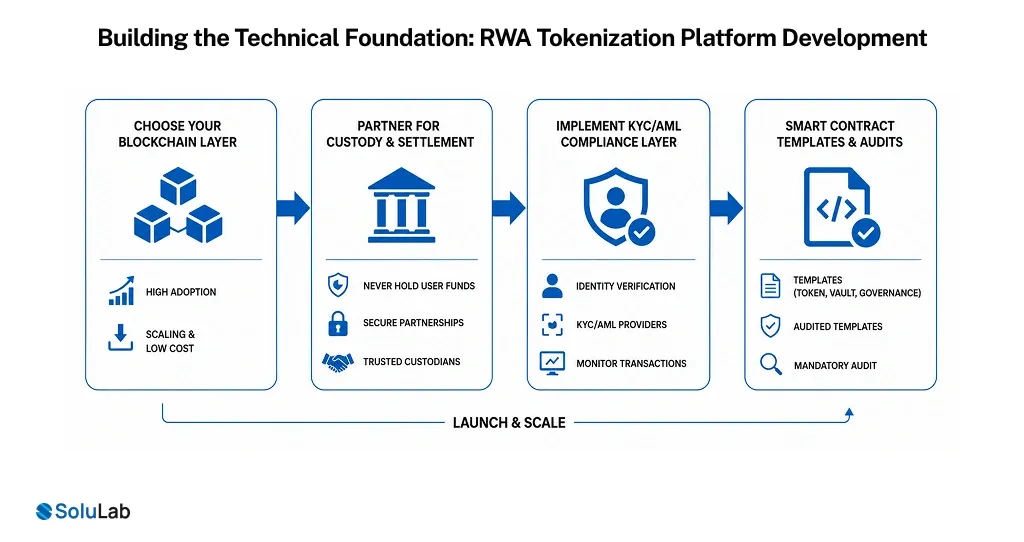
Once you’ve mapped your regulatory path, you can start building the RWA tokenization platform. The good news is that the technical architecture has been solved. You’re not inventing new blockchain technology or building settlement networks from scratch. Tokenization platform development services, like SoluLab in the USA, have delivered several such projects that are running profitably.
Modern tokenization platforms are built by combining existing, battle-tested components.
1. Choosing Your Blockchain
You have several choices on the blockchain layer.
- Ethereum
Businesses choosing Ethereum token development services benefit from strong liquidity access, proven infrastructure, and broad ecosystem compatibility.
- Transaction Cost: $5 to $50
- Settlement Speed: 12 seconds
- Regulatory Clarity: Moderate
- Best for: Security tokens platform development and general real-world asset tokenization
- 2026 Status: Still most institutional adoption
- Polygon
Companies investing in Polygon tokenization solutions can scale high-volume asset trading platforms while maintaining cost efficiency and a smooth user experience.
- Transaction Cost: $0.01 to $1
- Settlement Speed: 2 seconds
- Regulatory Clarity: Good
- Best for: Cost-sensitive platforms with high volume
- 2026 Status: Proven stability and scaling
- Solana
Its ultra-low fees and fast throughput make Solana tokenization development services ideal for real-time trading, tokenized payments, and large-scale asset ecosystems.
- Transaction Cost: $0.00025
- Settlement Speed: 400 milliseconds
- Regulatory Clarity: Moderate
- Best for: High-frequency trading and massive volume
- 2026 Status: Increasingly used by institutions
- Arbitrum
Businesses leveraging Arbitrum for token development can build scalable, compliance-ready platforms with efficient smart contract execution and cross-chain flexibility.
- Transaction Cost: $0.05 to $2
- Settlement Speed: 1 second
- Regulatory Clarity: Good
- Best for: DeFi plus compliance integrations
- 2026 Status: Growing institutional adoption
For most tokenization platforms in 2026, Ethereum or Polygon is the right choice. We typically recommend Polygon to start because it’s cheaper and faster, which means better user experience. As you scale and want maximum credibility with institutions, you can add Ethereum as an option. Hire blockchain developers who can provide you with answers to the questions we have discussed above.
2. Custody and Settlement Infrastructure
You absolutely need custody partners. Never hold user funds yourself. This is the fastest way to destroy a platform.
Instead, partner with regulated custodians:
- Anchorage Digital API for OCC-regulated custody
- Fireblocks MPC for institutional-grade security
- Stellar or Ripple for regulated payment rails
3. KYC/AML Compliance Layer
You need user identity verification and transaction monitoring.
For KYC (Know Your Customer):
- Onfido: Biometric and document verification
- Sumsub: ID verification and document checking
- Cost: $0.50 to $2 per user verification
For AML (Anti-Money Laundering):
- Chainalysis: Transaction monitoring plus entity screening
- TRM Labs: Behavioral analysis plus sanctions screening
- Cost: $3,000 to $50,000 per month
Use Onfido or Sumsub for user onboarding. Use Chainalysis or TRM Labs for transaction monitoring.
4. Smart Contracts
You need three core smart contract development templates.
Token Contract (ERC-20 standard)
- Handles mint, burn, transfer functionality
- Includes pause/unpause for emergencies
- Restricts minting to owner/admin only
Vault/Escrow Contract
- Holds user funds during trading
- Enables atomic settlement
- Includes time-locked withdrawals for compliance
Governance Contract (optional)
- Let’s token holders vote on changes
- Demonstrates decentralization
- Reduces regulatory risk
Do not write these from scratch. Use audited templates from OpenZeppelin. Then hire a professional firm like Trail of Bits or CertiK to audit your specific implementation.
This costs $30,000 to $100,000, but it’s non-negotiable. A single bug can result in tens of millions of dollars in losses. Professional audits are the only practical way to reduce this risk.
Got some questions on your mind? We have already answered them.
Read here – Top RWA Tokenization Questions Answered for Enterprises Ask
Revenue Models for Tokenization Platform: How to Make Money
This is where many platforms make critical mistakes. Your choice of revenue model affects everything downstream.
There are essentially four revenue models for tokenization platforms.
Model 1: Trading Fees
How it works: Users buy or sell tokens on your platform. You take 0.1% to 0.5% of the transaction value.
Example: $1 million transaction equals $1,000 to $5,000 in revenue.
Advantages:
- Scales with volume automatically
- Incentives are aligned
- Users pay, not you
Disadvantages:
- Chicken-and-egg liquidity problem
- Users shop for the lowest fees
- Zero revenue until liquidity exists
Reality: Most platforms start here but struggle for 6 to 12 months before breaking through.
Model 2: Custody Fees
How it works: You offer custody as a service. Users pay 0.1% to 0.5% of assets per year.
Example: $100 million in custody equals $100,000 to $500,000 yearly revenue.
Advantages:
- Predictable recurring revenue
- Doesn’t require active trading
- High customer retention
Disadvantages:
- Requires regulatory licenses
- Expensive insurance requirements
- Conflicts with exchange operations
Model 3: Issuance Fees
How it works: Companies want to tokenize assets. You charge to create the token and set up.
Example: A real estate company tokenizing a $100 million property pays $100,000 to $500,000.
Advantages:
- High margins (just software)
- Predictable payment before work
- Doesn’t require liquidity
Disadvantages:
- Slow sales cycles (6 to 12 months)
- Small market (only tokenizing companies)
- Requires enterprise sales capability
Model 4: Enterprise Licensing
How it works: Banks or brokers license your tech for $1 million to $10 million yearly.
They run it under their own brand.
Advantages:
- Enormous revenue potential
- Sticky institutional relationships
- Recurring licensing revenue
Disadvantages:
- Requires a proven product first
- Long sales cycles (18 to 36 months)
- Needs an enterprise support team
Most successful platforms combine multiple models. Start with trading fees and issuance fees in year one. Add custody fees in year two. Pursue enterprise licensing in year three.
Read more – Commodity Tokenization
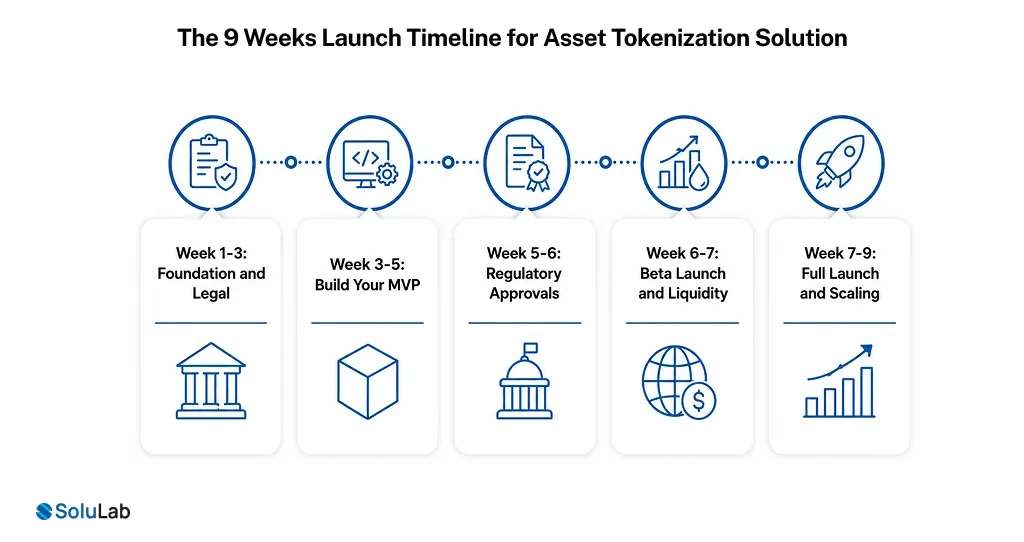
The 9 Weeks Launch Timeline for Asset Tokenization Solution
Let’s talk about how long this actually takes. Most founders are wildly optimistic about timelines. They think they can build a tokenization platform in a week or two. Though that is still possible in the case of white-label tokenization solutions.
But speedy custom tokenization platform development is possible with the help of AI native RWA tokenization development services that are popular in areas such as Silicon Valley and San Francisco.
That’s possible if you ignore regulatory compliance and security. But if you want something that survives, 9-12 weeks is realistic.
Week 1-3: Foundation and Legal
This is the unsexy but most important phase. You meet with securities attorneys and get clear guidance on your token classification.
You select your blockchain platform and design your technical architecture. You interview custodians and select your custody partner. You map out your compliance requirements. You design your token structure and economics.
By week three, you have:
- Legal opinion letter confirming token compliance
- Signed a partnership agreement with the custodian
- Detailed technical specification
- Comprehensive compliance plan
Investment: $50,000 to $100,000
Read more – 12 Questions Before You Choose a Tokenization Consulting Company
Week 3-5: Build Your MVP
This is the engineering sprint. You need a team of 8 to 10 people: AI developers, blockchain engineers, designers, and compliance specialists. But that’s not the case with AI-led development, where the team size reduces with AI assistance.
Tasks include:
- Building smart contracts (8 to 12 weeks)
- Integrating custody APIs (4 to 8 weeks)
- Building KYC/AML flows (4 to 6 weeks)
- Creating trading engine (12 to 16 weeks)
- Building front-end interface (12 to 16 weeks)
- Professional security audit (6 to 8 weeks)
By week five, you have a functional platform that works with test users. It’s buggy and incomplete, but it functions.
Investment: $300,000 to $800,000 in engineering, plus $100,000 for a security audit
Week 5-6: Regulatory Approvals
You’re filing your BitLicense application with New York. You’re applying for money transmitter licenses in Texas, California, Florida, and other states. You’re getting insurance. You’re preparing compliance documentation. A tokenization platform consulting service can provide you with information on such requirements.
This phase is frustrating because you’re not shipping features or gaining users. You’re pushing paper. But it’s essential.
Tasks include:
- File New York BitLicense (12 to 24 months duration)
- Apply for state money transmitter licenses (8 to 12 weeks each)
- Obtain insurance (D&O, E&O, cyber)
- Prepare compliance documentation
- Line up legal and audit work
Investment: $200,000 to $400,000 in legal fees
Week 6-7: Beta Launch and Liquidity
You go live on the mainnet with real tokens. You’ve pre-negotiated with market makers to provide liquidity on day one.
You’re running trading competitions and incentives. You’re reaching out to institutions and early customers. You’re generating PR.
By week seven, your goal is genuine trading volume. Maybe $10 million to $100 million of cumulative trading. This proves the platform works and people actually want to use it.
Investment: $200,000 to $500,000
Week 7-9: Full Launch and Scaling
Your regulatory licenses are approved or very close. You remove trading caps and feature restrictions. You expand to additional states. You pursue enterprise partnerships.
You’re fundraising for Series A. You’re shipping product improvements. You’re measuring user retention and engagement.
By the last week, you have a live, fully compliant platform with real users, real volume, and real revenue.
Read more – Tokenization Consulting in the USA
The Real Cost of Launching Your AI-Powered Tokenization Platform
Let’s be direct about money. Building a tokenization platform is expensive. This is why many platforms never get built.
Here’s the realistic breakdown:
Legal and Compliance: $150,000 to $400,000
This includes securities counsel, money transmitter licensing, regulatory filings, and compliance documentation. Don’t cheap out here.
Engineering and Development: $400,000 to $800,000
This is your largest expense. You need talented engineers at market rates. You can’t hire junior developers and hope they figure it out. Smart contract development is specialized. Blockchain integration is specialized.
Security and Audits: $100,000 to $200,000
Professional smart contract audit costs are high. Penetration testing is expensive. But not doing this is catastrophically expensive.
Custody and Insurance: $200,000 to $400,000
Insurance is non-negotiable. D&O insurance, E&O insurance, and cyber insurance together are $200,000 to $500,000 per year.
Infrastructure and Hosting: $30,000 to $100,000
AWS bills, databases, CDN, monitoring systems, and backups.
Marketing and Launch: $100,000 to $300,000
Press releases, ads, events, partnerships, and content.
Operations and Administration: $100,000 to $200,000
HR, accounting, office space, and legal retainer.
Contingency (20% buffer): $300,000 to $900,000
For things that go wrong. Security issues pop up. Regulatory approval takes longer. You need more engineers. Compliance challenges emerge. When you add it all up, you’re looking at $1.4 million to $3.3 million to launch a credible platform.
Most successful platforms in 2026 spend $1.5 million to $2.5 million. This is based on real data from platforms we’ve worked with.
You cannot cut corners. You cannot hire cheap engineers. You cannot skip security audits. Every dollar saved by cutting corners ends up costing you five dollars later when something breaks.
This capital requirement is why leading tokenization platforms like Liquefy are not bootstrapped businesses. You need real funding. You need investor capital. And you need to raise it in tranches, matching spending to key milestones.
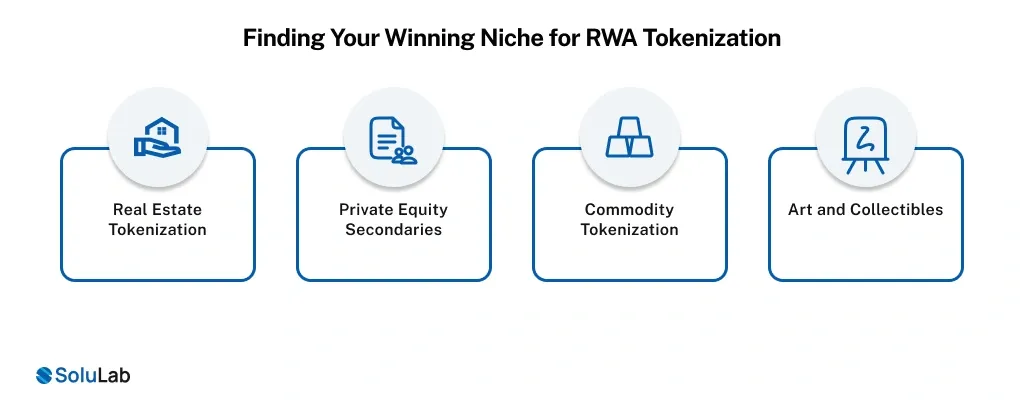
Finding Your Winning Niche for RWA Tokenization
You’re not the first to build a tokenization platform. Coinbase and Kraken exist. Stellar and Ripple exist. BlockTrade, Securitize, and Polymesh exist.
So how do you compete?
The simple answer is: you don’t compete directly. You find a niche where you can dominate.
1. Real Estate Tokenization
The market for real estate tokenization exceeds $100 trillion globally. But the number of serious competitors is small. Realty Mogul and RealtyShares failed. A few platforms exist but are underfunded.
If you build a high-quality real estate tokenization platform in the USA, like RealT, with proper compliance, you can own this market before Coinbase enters it. They’ll take 18 to 36 months. You can do it in 12 to 14 months.
By 2026, several platforms have entered real estate, but the market is still be underpenetrated. Early movers in 2026 can still capture significant AUM.
2. Private Equity Secondaries
The private equity secondary market is worth $7 trillion and growing. It’s incredibly illiquid. Platforms that tokenize secondary positions and create liquid markets can generate massive value.
AngelList has started entering this space, but there’s room for multiple winners.
3. Commodity Tokenization
Gold, oil, and metals are markets worth trillions annually. They’re controlled by intermediaries and plagued by counterparty risk. Tokenization can disintermediate these markets.
The competition here remains minimal in 2026.
Read more – Gold Tokenization
4. Art and Collectibles
The art market is enormous and emotionally driven. Collectors want liquidity without losing the emotional connection to assets. Platforms that get this right can build enormous communities.
Several art tokenization platforms have launched, but the market is still emerging in 2026.
Intellectual property tokenization is another form of tokenization that is picking up now and has great potential with the creator economy booming in 2026.
The strategy is clear: pick one niche. Become the dominant platform in that niche. Build real institutional relationships. Achieve $100 million in assets under management. Then expand to adjacent niches.
Depending on your asset class, the regulatory and product design approach will differ. For example, US Treasury tokenization, private credit tokenization, and commodity-backed tokenization each require different structuring.
Don’t try to be everything from day one. You’ll be nothing instead.
Why Compliance Is Actually Your Advantage?
Here’s something that might surprise you: regulatory compliance is not a burden. It’s a competitive advantage.
Most platforms treat compliance as something they have to do. It’s expensive. It’s annoying. It slows them down. So they do the minimum.
Then regulators arrive. FinCEN issues a fine. Bank accounts get frozen. Money transmitter licenses are revoked. The business implodes.
The platforms that survive do the opposite. They obsess over compliance from day one. They implement industrial-grade KYC/AML. They monitor every transaction. They file suspicious activity reports when required.
This approach is more expensive. It slows the initial launch. But it accomplishes something crucial. When competitors get shut down by regulators, you’re still operating.
Institutions feel comfortable with you because you’ve clearly made compliance a priority. Your regulatory licenses become a competitive moat that competitors can’t easily replicate.
In 2026, regulatory scrutiny has only increased. Compliance is even more critical now than it was in 2025.
Budget 10 to 15% of your total burn on compliance. If you’re spending $200,000 per month, spend $20,000 to $30,000 on KYC/AML, legal retainers, and compliance monitoring.
This might seem expensive, but it’s the difference between surviving and not surviving.
The specific compliance architecture:
- Use Onfido or Sumsub for KYC
- Use Chainalysis or TRM Labs for AML
- Set up Suspicious Activity Reports filing processes
- Maintain detailed audit logs
- Document every decision
This infrastructure is boring, but it works.
Read more – SEC playbook for RWA tokenization development
Your Go-to-Market Strategy: Top RWA Tokenization Services
Technical excellence and regulatory compliance get you to launch. But they don’t get you, users. This is the part many founders underestimate.
The challenge is the cold-start problem. You need users to have liquidity. But users won’t show up unless there’s already liquidity.
You need assets to tokenize. But companies won’t tokenize unless there’s already a working platform with users.
This is where a strong combination of tokenization platform development and Web3 marketing services becomes critical. The key to breaking through is utilizing seeded liquidity and a targeted customer acquisition strategy.
Seeding Liquidity
Before you launch, you should have commitments from market makers to provide liquidity on day one. This costs money: typically $500,000 to $2 million.
You’re paying market makers to show up and make a market, even if there aren’t many natural buyers and sellers. But this breaks the cold-start trap. Users see a functioning market with bids and asks. They feel comfortable trading.
Phase 1: Organic Growth (Weeks 1-3)
You create content about tokenization. You build a community. You share insights. You spend $50,000 to $100,000 on content and community.
Your goal is 1,000 to 5,000 early users who actually care about what you’re building.
Phase 2: Partnerships (Weeks 3-6)
You partner with custodians, brokers, law firms, and advisors who can refer customers. You launch affiliate programs. You create integrations with other platforms.
This costs $100,000 to $200,000 but generates 5,000 to 20,000 additional users.
Phase 3: Paid Acquisition (Weeks 7+)
You run Google Ads targeting high-intent keywords. You do content syndication. You run webinars. This scales, but it’s expensive: $200,000+ per month.
You’re looking for users with clear intent. Investors searching for “how to invest in real estate tokenization” or “private equity secondary trading.”
Most platforms underestimate the importance of customer acquisition. They overestimate how many users will find them organically.
Allocate 20 to 30% of your post-launch budget to growth and marketing. If you’re not investing seriously in customer acquisition, you won’t get users.
Funding Your Vision: Capital Raising in 2026
You can’t build a tokenization platform without money. The question is when to raise and how much.
In 2026, the venture capital environment for tokenization has become more sophisticated. VCs understand the market better. They know which niches work and which don’t. They move faster but also more carefully.
1. Pre-Seed Capital
Typical size: $250,000 to $1 million
Sources: Angels, friends and family, early-stage crypto funds
At this stage, you have a compelling story and maybe a prototype. You have credible founders. Your capital goes to legal and architectural work.
You get initial regulatory guidance. You prove that your idea is technically feasible. Pre-seed investors are betting on the team and market opportunity.
In 2026, pre-seed is easier to raise if you have clear regulatory clarity and experienced co-founders.
2. Seed Capital
Typical size: $1.5 million to $3 million
At this stage, you have a working MVP and initial traction. You have 100 to 500 early users. Maybe one or two paying customers. You have a clear regulatory path.
Seed investors are starting to see evidence that the market will actually adopt what you’re building. They’re funding your launch and your first year of growth.
3. Series A Capital
Typical size: $5 million to $10 million
At this stage, you have a live product generating revenue. You have thousands of users. You have millions in trading volume. You have a clear path to profitability.
You’re hiring sales teams and expanding geographically. Series A investors are betting that you have product-market fit.
Each funding round should correspond to clear milestones. Pre-seed gets you to legal approval plus architectural proof. Seed gets you to regulatory licenses plus launch. Series A gets you to millions of users and substantial revenue.
The mistake many founders make is raising too much money too early. They raised $5 million before they had a working product. They burn through capital trying to find product-market fit and run out of money.
Raise enough to hit your next milestone. Then raise again.
What Investors Actually Care About in 2026?
When pitching investors in 2026, focus on what matters to them.
- First: Market opportunity. Show them the total addressable market is large. Real estate tokenization is a $100 trillion opportunity. That’s worth their time.
- Second: Team. Why does your team uniquely have the expertise to execute? Do you have founders with regulatory experience? Do you have engineers who shipped blockchain products at scale?
- Third: Product-market fit evidence. Even 100 paying users or a clear institutional customer interested in your platform matters.
- Fourth: Clear business model and path to profitability.
- Fifth: Realistic regulatory strategy. VCs in 2026 are very focused on regulatory viability.
Don’t pitch abstract ideas or market trends. Investors have heard it all. “Tokenization will change finance.” They know. Show them that you can execute.
Learning from Real-World Examples: Top Tokenization Platforms
Real examples are worth more than abstract theory.
Success Story: Real Estate Tokenization Platform
This platform started in 2021 with $2 million in pre-seed funding. Their founders had real estate experience plus regulatory experience.
They chose the Reg A+ path because they wanted credibility with institutional investors from day one. They spent six months on legal and regulatory work before coding.
They partnered with Anchorage for custody. They built an MVP in 4 months. They obtained SEC approval for their Reg A+ filing. They went to market with two real estate deals pre-committed.
By the end of year one:
- $50 million in assets under management
- $5 million in quarterly trading volume
- $1.5 million in revenue
- Clear path to profitability in year two
In 2026, this platform has $200M+ in AUM and is generating $5M+ in annual revenue. They’ve expanded to three states and are building enterprise partnerships.
What did they do right?
- Picked a clear niche (real estate)
- Choose the right regulatory path (Reg A+ for credibility)
- Didn’t rush to market; spent six months on foundation
- Pre-sold deals before building
- Partnered with credible custody providers
- Funded adequately
Want to read the success story in detail? Click here
Failure Story: Platform That Got Shut Down
This platform raised $5 million in seed funding. It had experienced engineers. But it skipped regulatory work.
It launched without clear token classification. It launched without custody integration. It built self-custody instead.
It launched in about 8 months. It generated initial buzz. Then regulators arrived. The SEC deemed the token a security. The platform wasn’t registered.
The platform got shut down. The company was sued by users. Investors lost their money. Founders faced legal liability.
The difference between these two?
One did the boring regulatory work first. One skipped it and paid the price.
Some Common Mistakes You Must Avoid!
There are patterns in why platforms fail. Most are preventable.
Regulatory misclassification or avoidance. Founders understand intellectually that compliance matters. They underestimate how much. They think they can figure it out later.
Solution: Get a securities lawyer from day one, analyzing your token structure. Get regulatory guidance before you code.
Custody integration delays. Founders build their platform, then try to integrate custody. Custodians have long implementation timelines. Your launch gets delayed six months.
Solution: Add custody integration to your pre-build roadmap, not your post-build roadmap.
Poor go-to-market planning. Founders build something and assume users will come. They won’t.
Solution: Have market-making capital committed. Do customer development early. Understand your niche and dominate it.
Underfunding. Founders think they can build a platform for $500,000. They can’t, not credibly anyway.
Solution: Fund properly. $1.5 million to $2.5 million is realistic. Trying to do it cheaper means cutting corners.
Hiring junior engineers. Smart contract development is specialized. You need people who have shipped real products at scale.
Solution: Pay market rates for experienced engineers. The alternative is smart contract bugs that cost tens of millions.
Ignoring security. You hire an engineering team and assume they’ll get security right. They won’t, not without external expertise.
Solution: Professional smart contract audits are essential. Penetration testing is essential. Security is not a luxury.
These mistakes are all preventable. Successful platforms avoid them obsessively.
Your First 15 Days: Getting Started
If you’ve read this far and you’re serious about building, here’s your first month playbook.
- Regulatory Clarity
Schedule calls with securities attorneys. Ideally, people who have experience with token offerings. Read SEC guidance documents.
Think hard about your token structure. Research blockchain platforms. Write down initial technical requirements.
Identify 2 to 3 custodians you want to work with. Schedule calls with them.
- Define Your Strategy
Write a token whitepaper that describes your economics. Map out exactly what your platform will do. Define your regulatory path. Also, decide whether you want to develop your own platform from scratch or you want to use a white label tokenization platform development solution.
Create preliminary financial projections. Identify your niche and early customer targets. From a point of view about what you’re building and why it wins.
- Assemble Your Team
Reach out to potential co-founders or early employees. Look for people with regulatory expertise, blockchain expertise, and domain expertise.
Start preliminary conversations with advisors who might guide your strategy. You’re not hiring full-time yet, but you’re identifying the people you want.
- Capital and Execution Planning
Schedule calls with potential investors to validate your market opportunity. Refine your financial model. Outline a detailed 90-day plan.
Set a launch target, probably 9 weeks out. Start reverse-engineering the work required to hit it.
If you execute this first month well, you’ll have regulatory clarity, technical strategy, team momentum, and a clear roadmap. You’ll be ready to raise pre-seed funding.
Frequently Asked Questions
Asset Tokenization Market: The 2026 Reality
The tokenization market in 2026 is more mature, more regulated, and more competitive than it was even a year ago. Even the tokenization trends are in favor. But the opportunity remains enormous.
The window for launching is still open. But it’s getting narrower. Competitors are moving faster. Regulatory scrutiny is increasing. Capital is becoming more selective.
If you’re serious about building a tokenization platform, now is genuinely the time to move.
Ready to Build Your Own Tokenization Platform?
If you’ve read this entire guide and you’re thinking seriously about building a tokenization platform, the next step is to develop a detailed strategy.
SoluLab has guided 15+ tokenization platform launches through this exact process. We’ve built technical infrastructure, navigated regulatory landscapes, secured custody partnerships, and implemented compliance systems.
We know where the pitfalls are because we’ve helped clients avoid them.
Whether you’re building real estate tokenization, private credit tokenization, commodity exchange, or asset tokenization services, the fundamentals are the same. Having guides who have done this before accelerates everything.
We offer a complimentary thirty-minute strategy session. We’ll analyze your specific business model. We’ll validate your market opportunity. We’ll recommend your optimal regulatory path. We’ll give you honest feedback about the timeline and capital requirements.
No pressure. No sales pitch. Just tokenization expertise applied to your situation.
The window for owning a niche in tokenization is open in 2026, but it’s closing. If you move quickly and execute well, it’s still yours to claim.
Let’s see if we can help you build something meaningful!
Shipra Garg is a tech-focused content strategist and copywriter specializing in Web3, blockchain, and artificial intelligence. She has worked with startups and enterprise teams to craft high-conversion content that bridges deep tech with business impact. Her work translates complex innovations into clear, credible, and engaging narratives that drive growth and build trust in emerging tech markets.