Key Takeaways
- SEC-aligned tokenization requires compliance-first architecture integrating identity, custody, and transfer restrictions directly into smart contract infrastructure.
- Issuer-sponsored models offer control and flexibility but demand higher regulatory responsibility and operational maturity for sustainable tokenized asset management.
- Third-party platforms accelerate deployment but introduce dependencies, requiring careful evaluation of compliance standards, scalability, and long-term cost implications.
- Token standards, cross-chain interoperability, and oracle integrations are critical for building scalable and institution-ready RWA tokenization ecosystems in 2026.
- Choosing the right tokenization model impacts investor trust, regulatory alignment, and the long-term viability of digital asset strategies.
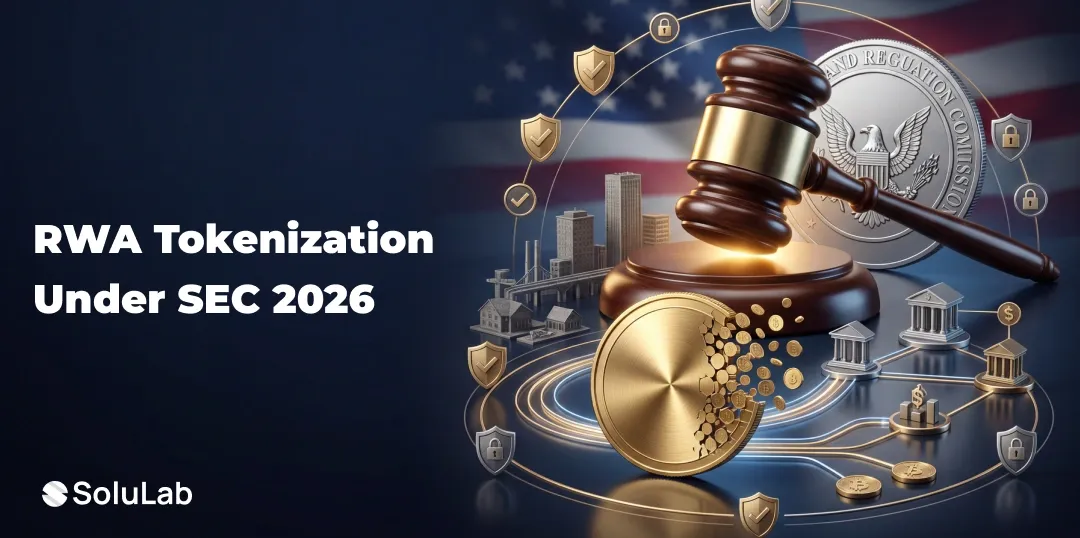
The latest SEC RWA tokenization guidance, January 28, 2026, Joint Staff Statement, brings clarity to how tokenized securities are defined, issued, and traded. For enterprises, this is a turning point.
Following the 2026 guidance, major exchanges like Nasdaq have received approval to trade tokenized versions of select stocks (e.g., Russell 1000 index), proving that tokenization is now part of the core US financial plumbing.
The real question is not whether to invest in tokenization platform development. It is how to do it in a compliant and scalable way. The distinction between issuer-sponsored vs third-party tokenization now defines the success or failure of RWA platforms.
Does the SEC 2026 Guidance Change the “Security” Definition for Tokenized Assets?
The SEC has made one thing clear: tokenization does not change the nature of a security.
1. What stays the same
- If an asset qualifies as a security under the Howey Test, tokenization does not alter that classification
- Blockchain technology is treated as infrastructure, not a regulatory loophole
2. What changes in 2026
The SEC now recognizes models where the blockchain serves as the official “master security holder file.” In this setup, an on-chain transfer is the legal act of transferring ownership, not just a digital mirror of an off-chain ledger.
- Clear taxonomy for tokenized securities compliance
- Defined roles for issuers, intermediaries, and platforms
- Increased scrutiny on custody, settlement, and investor protection
Formal “Category 1” vs “Category 2” Taxonomy: The guidance distinguishes between “Category 1” (Issuer-Sponsored), which is favored for providing true equity ownership, and “Category 2” (Third-Party), which is viewed with caution due to intermediary risks.
3. Market Insight
- The global RWA tokenization market is expected to cross $16 trillion by 2030, per the BCG and ADDX estimate
- Over 10% of global GDP could be tokenized assets by 2027
This explains why SEC tokenized securities rules are becoming stricter yet clearer.
How Does the SEC Classify “Issuer-Sponsored” vs. “Third-Party” Tokenization?
This is the core of the new regulatory framework.
1. Issuer-Sponsored Tokenized Securities
For a token to be truly “Issuer-Sponsored” under the 2026 playbook, it requires formal corporate resolutions and, in many cases, a “Certificate of Designation.” It must be filed with state authorities to ensure the tokenized class has a verified legal standing.
- The SEC emphasizes that even in decentralized models, issuers should utilize SEC-registered transfer agents.
- This is to maintain the integrity of the master security holder file and ensure that “lost” tokens can be recovered through traditional legal processes.
Key Characteristics
- Direct issuer involvement
- Regulatory filings aligned with existing securities laws
- Transparent investor rights
Advantages
- Strong compliance positioning
- Easier institutional adoption
- Lower enforcement risk
2. Third-Party Tokenized Securities
A third party creates tokenized representations of existing assets without issuer participation.
Key Characteristics
- No direct link to the underlying issuer
- Often structured via derivatives or wrappers
- Increased reliance on smart contracts
Challenges
- Regulatory uncertainty
- Limited investor protection clarity
- Higher scrutiny under the SEC tokenized securities guidance 2026

What Are the Compliance Risks of “Synthetic Tokenized Securities” in 2026?
Synthetic tokenized securities are becoming a major concern.
1. What are they?
- Blockchain-based representations of assets without direct ownership
- Often backed by derivatives, not actual assets
2. Key Risks
The 2026 guidance warns that third-party entities issuing synthetic tokens may inadvertently be classified as “Investment Companies.”
- This is triggering heavy registration and compliance burdens that most DeFi platforms are not equipped to handle.
- Many synthetic RWAs are now explicitly classified as “security-based swaps.”
- This means they cannot be offered to retail (non-eligible) contract participants unless they are registered and traded on a national securities exchange.
1. Regulatory Risk
- May be classified as unregistered securities
- Potential enforcement actions from the SEC
2. Counterparty Risk
- Dependence on intermediaries or off-chain agreements
3. Transparency Issues
- Lack of clear asset backing
- Difficulty in auditing
4. Real Impact
In 2025–2026, several platforms faced scrutiny for offering synthetic exposure to equities without proper disclosures.
This is why enterprises are moving toward issuer-sponsored tokenized securities.
Read more – Blockchain-Powered Hotel Tokenization Is Changing Hospitality
Can an Issuer Maintain Both Traditional and Tokenized Formats for the Same Class?
Yes, but with strict conditions.
1. SEC Position
The SEC allows dual-format issuance, provided:
- Investor rights remain identical
- Clear disclosure is provided
- No market manipulation occurs between formats
2. Practical Implementation
Enterprises can:
- Issue traditional shares
- Mirror them as blockchain-based tokens
- Maintain synchronized ownership records
3. Benefits
- Improved liquidity
- Faster settlement cycles
- Access to global investors
4. Technical Requirements
- Custody integration
- Smart contract governance
- Regulatory reporting systems
Why Does the SEC’s Taxonomy Accelerate Institutional RWA Adoption?
Clarity reduces hesitation.
Before 2026
- Regulatory ambiguity
- High legal risk
- Limited institutional participation
After 2026 Guidance
- Defined RWA tokenization regulatory framework
- Standardized compliance pathways
- Increased confidence among institutions
Market Shift
- Banks and asset managers are building tokenization infrastructure
- Enterprises are investing in internal tokenization platforms
Business Impact
- Faster deal execution
- Lower operational costs (up to 30–40% reduction in settlement costs)
- New revenue models through fractional ownership
Choosing the Right Approach
Enterprises should prioritize:
- Issuer-sponsored tokenization models
- Built-in compliance architecture
- Scalable infrastructure
This is where working with an experienced asset tokenization development company becomes critical.
How to Choose the Right Model in 2026?
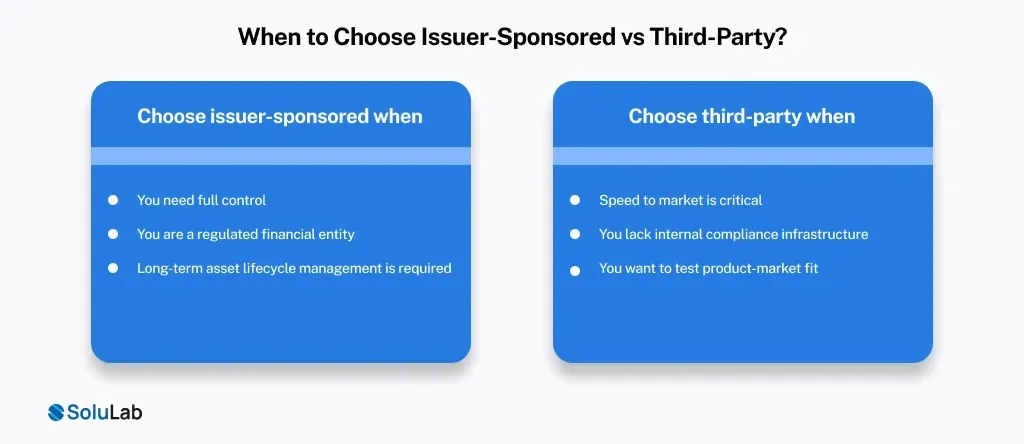
Choosing between issuer-sponsored and third-party tokenization is less about preference and more about fit. The right model depends on your asset class, regulatory exposure, internal capabilities, and how fast you need to enter the market.
- Based on Asset Type
Different asset classes demand different levels of control and compliance. Real estate tokenization and private equity deals often benefit from issuer-sponsored models, where direct investor relationships and tighter compliance controls are critical. On the other hand, tokenized funds or diversified asset portfolios can leverage third-party platforms for faster structuring and distribution.
- Based on Regulatory Exposure
If you’re targeting US investors, regulatory expectations are significantly stricter, making issuer-sponsored models more viable due to direct oversight and control. For global or cross-border offerings, third-party platforms with built-in compliance layers can simplify multi-jurisdictional requirements and reduce legal complexity.
- Based on Internal Capabilities
Organizations with strong legal, compliance, and technical teams are better positioned to adopt issuer-sponsored models. It allows full ownership of infrastructure and processes. However, if your team lacks deep expertise in blockchain or regulatory frameworks, third-party platforms provide a ready-to-deploy foundation, reducing execution risk.
- Based on Go-to-Market Urgency
Speed plays a major role. If your priority is to launch quickly and test market demand, third-party tokenization platforms offer faster deployment cycles. Issuer-sponsored models, while more robust, typically require longer timelines due to custom development, compliance structuring, and audits.
- Hybrid Models Are Emerging
In 2026, many businesses are no longer choosing between the two. Hybrid approaches are gaining traction, where issuers retain control over compliance and investor relationships while leveraging third-party infrastructure for scalability and speed. This model balances control with efficiency, making it a practical choice for enterprises aiming to scale without delays.
How SoluLab Supports SEC-Aligned RWA Tokenization Development?
Building a tokenization platform in 2026 is no longer just about smart contracts. It requires aligning legal structures, compliance workflows, and scalable blockchain infrastructure from day one. This is where SoluLab steps in.
- End-to-End Tokenization Development
From asset structuring to platform deployment, SoluLab builds complete RWA tokenization ecosystems tailored to issuer-sponsored and third-party models.
- Compliance-Ready Architecture
Solutions are designed with SEC-focused considerations, including investor onboarding (KYC/AML), transfer restrictions, and audit-ready smart contracts to reduce regulatory risk.
- Custom Token Standards & Smart Contracts
Implementation of advanced token standards like ERC-3643 and ERC-1400 to enable permissioned transfers, identity checks, and automated compliance at the protocol level.
- Integrated Tech Stack for Scale
Seamless integration with oracles (Chainlink, Pyth), custodians, and cross-chain protocols to ensure accurate asset valuation, liquidity movement, and interoperability.
- Faster Go-to-Market Without Compromising Compliance
Whether you choose an issuer-sponsored model or a third-party platform approach, SoluLab helps you launch faster with a structured, compliance-first roadmap.

Conclusion
The SEC tokenized securities guidance 2026 is not a limitation. It is a clear direction for building compliant, scalable RWA ecosystems. It shifts the focus from simple asset digitization to rethinking ownership, liquidity, and compliance within regulated markets.
- Issuer-sponsored tokenization is quickly becoming the standard for enterprises aiming to operate within US frameworks, while third-party models face tighter scrutiny.
- For businesses, the opportunity is significant, but execution matters. Building a secure, regulator-aligned platform from day one is critical to long-term success.
SoluLab supports enterprises in developing SEC-compliant RWA tokenization platforms development services, helping improve liquidity potential, streamline settlement processes, and accelerate go-to-market with confidence.
Contact us today to build your SEC-ready tokenization services!
FAQs
Deepika is a content writer who blends storytelling with strategic thinking. She explores topics across digital innovation, emerging tech, and the evolving blockchain industry. She enjoys breaking down complex ideas into simple, engaging narratives in the growing global markets.