Key Takeaways
- By 2026, tokenization stopped being a side project at firms like HSBC and BlackRock. It runs.
- Static smart contracts were step one. AI agents now price assets in real time and run compliance checks without a human in the loop.
- Big enterprises are quietly ripping out middle-office infrastructure and wiring core banking straight into automated payment and collateral management.
According to BCG, there’s a $16 trillion opportunity sitting out there by 2030. Roughly 10% of the global economy, moving on-chain. Why would it? Because the friction that traditional finance treats as normal, the T+2 settlement wait, the stack of intermediary fees, the capital that sits locked while paperwork clears, now reads as a liability on the balance sheet rather than a cost of doing business.
For enterprises the ask is blunt: efficiency, at scale.
- Real estate, private credit, gold, it doesn’t much matter which. You need secure, self-running systems underneath, because that plumbing is what a faster and smarter financial stack actually rests on.
- Which is the point: asset tokenization in finance has become the new global plumbing for institutional liquidity.
We stopped “digitizing” assets a while ago. We’re making them programmable.
How Should You Approach Tokenized Finance Infrastructure?
If you run a financial institution or a large enterprise, innovation is not the metric to chase here. Operational efficiency is.
Sit down with your tokenization development partners and watch where the conversation goes. It rarely stays on “what is a token?” for long. Within twenty minutes someone asks the real question: how do we bolt tokenization finance services onto the core banking systems we already run, without breaking them?
“Traditional Finance” is turning into a legacy burden. Here’s what shifted for the modern enterprise.
1. From Legacy Friction to Programmable Flow
Moving an asset used to mean paperwork and a queue of middlemen, each one taking a cut and a day. Now compliance lives in the code itself. That is a different thing from digitizing a certificate. The asset gets smart.
2. Institutional Adoption in Action
BlackRock and HSBC are past the pilot stage. Both are running tokenization in production, using it as the plumbing under their global transaction flows so they don’t end up playing catch-up.
3. Traditional vs. Tokenized: The 2026 Change
Why is this shift close to mandatory? Look at what happened to the mechanics of a single transaction.
| Feature | Traditional Finance (The Old Way) | Tokenized Finance (The 2026 Standard) |
| Settlement Speed | T+2 or T+3 (Days of waiting) | Atomic & Instant (Seconds) |
| Market Access | Monday to Friday, 9 to 5 (Bank hours) | 24/7/365 (Global & Borderless) |
| Asset Entry Point | High barriers (Thousands to Millions) | Fractional (Invest from $10) |
| Reporting & Auditing | Manual, Periodic, Error-prone | Real-time, Immutable, Transparent |
| Compliance | Human-heavy KYC/AML checks | Smart Contract-driven (Auto-compliance) |
| Operational Cost | High (Middle-office heavy) | Lean (Automated by AI & Code) |
Institutional Integration of Tokenization in Finance Enabling High ROI
The return here doesn’t come from shaving a few basis points. It comes from deleting dead time out of the financial cycle entirely. Here’s where tokenization of financial assets actually pays you back.
1. MMFs, Bonds, and the Secondary Market
Idle capital is expensive capital. By tokenizing Money Market Funds (MMFs) and Bonds, institutions get atomic settlement instead of the T+2 wait, which means collateral can be moved and liquidated in seconds.
- Secondary Market Vitality: Assets that used to sit stuck start trading. Enterprises can run 24/7 markets in private credit or real estate and collect the transaction fees and spreads that market friction previously kept off the table.
- Stock Market Evolution: Tokenized equities make dividends and corporate actions programmable, so the middle-office reconciliation grind mostly disappears.
2. The IMF Perspective: Stability Through Transparency
The International Monetary Fund has made the point that programmable money and programmable assets can cut settlement risk and take friction out of cross-border flows.
Adopt those standards and you line up with a global push toward a steadier, more transparent financial architecture.
Which lowers the risk premium attached to institutional cross-border investment. That’s not a small line item.
3. ROI and Growth in the AI-Driven Tokenization Market
In 2026 the real growth lever is AI sitting on top of RWAs, or Real World Assets. AI agents run tokenized portfolios themselves, rebalancing at high frequency off live market sentiment rather than a Monday morning committee.
- Lower OpEx: Push compliance and auditing into smart contracts and operational costs drop by as much as 40%.
- Revenue Expansion: Fractionalization opens a global retail-proxy audience, and with it tranches of capital you couldn’t reach before.
- Data-Driven Alpha: AI-driven tokenization platforms hand you granular asset performance data. You pivot strategy on evidence instead of instinct, which is what keeps a platform scalable and in front.
Lifecycle of Asset Tokenization in Modern Banking
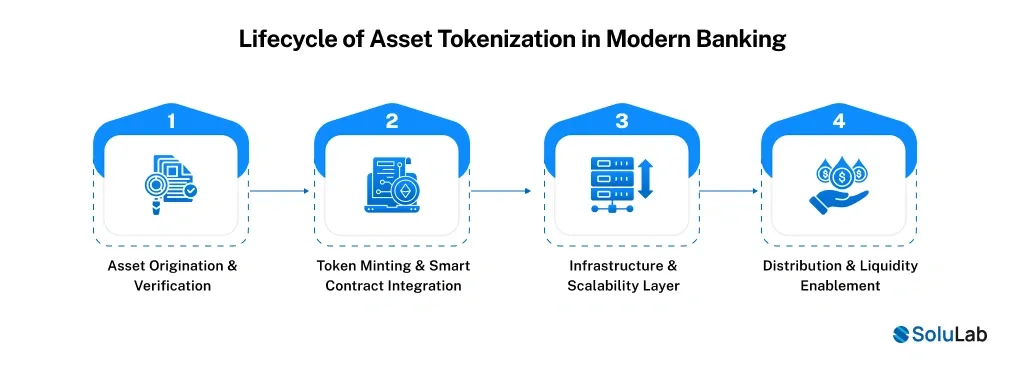
Asset tokenization in banking has moved past digitizing things. What you’re building now is an intelligent, programmable financial instrument, with blockchain and AI doing different halves of the job.
1. Asset Origination & Verification
- It starts with picking the real-world asset: real estate, bonds, or commodities such as gold, silver, copper and diamond.
- That asset gets a legal wrapper, usually an SPV, so the compliance story holds up.
- AI verification tools then check ownership, history and valuation on the spot.
- Fewer manual errors, and trust established before a single token exists. In practice this stage is where deals stall, so getting it clean matters.
2. Token Minting & Smart Contract Integration
- Verified asset goes on-chain as digital tokens.
- Smart contracts run the KYC and AML checks themselves, so only verified participants ever touch the asset.
- Intermediaries drop out, and you get programmable behaviour on top: dividends that pay themselves, fractional ownership, settlement in real time.
3. Infrastructure & Scalability Layer
- Tokenization in finance runs on a multi-layer blockchain architecture, not a single chain.
- Layer 1 carries the security. Layer 2 and Layer 3 handle speed and cost.
- Blockchain-as-a-Service (BaaS) platforms cut the deployment work down, letting banks and enterprises launch tokenized markets without writing every piece themselves.
4. Distribution & Liquidity Enablement
- Tokens go out across digital marketplaces and exchanges.
- AI agents keep reading demand, tuning price, and deepening liquidity.
- An investor anywhere can trade a fraction of the asset and settle almost immediately.
Run that full lifecycle and tokenized financial assets end up more reachable, more legible, and cheaper to operate. Modern banking is being rebuilt around it.
Read More: Top RWA Tokenization Questions Answered for Enterprises Ask in 2026
How Tokenization Enables Fractional Ownership and Global Access?
Commercial real estate and venture capital used to have a velvet rope in front of them. You needed serious money to get past it. Finance tokens took the rope away: $10 buys you a slice of the same asset.
That’s fractional ownership. It does three useful things:
- It puts the opportunity in front of ordinary investors, not only wealthy ones.
- It stops you parking everything in one asset.
- It gives you somewhere to sell, through secondary markets.
A lot of white label tokenization platform providers are building exactly this plumbing, so fractional ownership works the same in Lagos as it does in London.
Some of them run AI agents in asset tokenization too, handling the day-to-day management of those digital assets and taking the load off customer service.
Real-World Use Cases of Financial Tokenization
This isn’t theory anymore. Large incumbents and small startups alike are using tokenization in financial services to change how assets get managed.
Two quick examples:
- The European Investment Bank has issued bonds straight onto a blockchain.
- HSBC created a platform to trade tokenized gold, which makes the metal far easier to buy and sell than a bar in a vault ever was.
GenAI in Tokenized RWAs- Opening Up Global Liquidity
A common enterprise brief right now: build a GenAI-powered tokenized RWA platform. Investors should be able to buy compliant fractional ownership in high-value assets without friction, move those positions across borders, and find liquidity on day one rather than year three.
To pull that off, tokenization development companies wire in the following:
- GenAI Market Intelligence Copilot
- GenAI Investor Analytics and Dashboard
- GenAI Compliance Monitoring
- On-Chain Tokenization Engine
- Regulated Investor Onboarding
- Primary Offering Workflows
- Secondary Trading Marketplace
- Real-Time Settlement System
- Compliance Rules Engine
- Multi-Wallet & Custody Support
Put together properly, that stack is what takes a platform to 2x ROI.
What these cases show is that real world asset tokenization and tokenization of assets have gone mainstream.
Asset tokenization development companies aren’t shipping slideware. They’re shipping platforms that put real liquidity and real transparency into traditional finance.
Read more – Oil tokenization
Best Platforms for Investing in Tokenized Assets
You no longer need a Bloomberg terminal or a seven-figure account to buy into tokenized investment. Plenty of platforms now give you a route into real world asset tokenization, covering real estate, stocks, bonds, even private equity.
They’re built to drop the entry barrier, show you what you actually own, and give you a way out when you want it, which is how an ordinary investor gets to benefit from asset tokenization in finance. A few worth looking at:
1. Token World
Token World is a crypto launchpad built for scale and for security, and it takes most of the pain out of tokenizing an asset. Blockchain startups use it to raise capital; investors use it to reach projects that have been vetted first. Smart contract security is built in, regulatory compliance support comes with it, and multilingual handling means the same flow works across markets. It runs real world asset tokenization for real estate, DeFi and healthcare. Fold in an AI agent in asset tokenization on top of that blockchain infrastructure and you get a Web3 experience that stays transparent and doesn’t fight the investor.
2. RealT
RealT is one of the better-known asset tokenization platforms, and it lives squarely in real estate. You buy fractional shares of rental properties. Physical buildings turned into digital tokens for investors anywhere: that’s real world asset tokenization in its clearest form.
3. tZERO
tZERO trades tokenized financial assets, digital stocks in particular. It was among the first to build against U.S. SEC guidelines, which is why regulated-first investors gravitate to it when they look at tokenization in financial services.
4. Securitize
Securitize sits on the institutional side, tokenizing bonds, funds and equity. As an asset tokenization company it supplies the secure infrastructure so a business can get into tokenization of assets without assembling the stack itself.
Read more – Top 7 White-Label Tokenization Development Partners
How Compliance, Standards & Security in Tokenized Finance Play the Key Role in 2026
Strip tokenization in finance back and you hit one thing: trust. It rests on hard rules, systems that hold, and standards everyone agrees on. Tokenization doesn’t get rid of compliance. It automates it. And with governments worldwide tightening up on privacy and trust, that distinction is the whole ballgame.
1. Token Standards
Standards are the floor everything else stands on. Finance tokens, NFTs, whatever the asset, most of them follow a known protocol such as ERC-20, ERC-721, and ERC-1400. What standards buy you:
- Tokens that behave the same across systems
- Protection for the investor
- Wallets and exchanges that integrate without custom work
If you sell asset tokenization platform development services, or build tooling for the tokenization of assets, this is non-negotiable ground.
2. Regulatory Considerations
Tokenized investment is digital. The law governing it is not. Singapore and the UAE are out in front with clear digital asset rules, and the space keeps maturing around a few specific questions:
- Security Token Offerings
- The difference between ICO vs. STO
- Rules for who can invest and how tokens are traded
You don’t get to opt out of any of it. Which is why most teams bring in a blockchain consulting company rather than guess.
3. Security & Privacy in Tokenized Systems
Data safety carries the same weight as compliance. Three blockchain features do the heavy lifting:
- Role-based access: decide who can see or move a digital asset
- Zero-knowledge proofs: prove the private detail without showing it
- End-to-end encryption: every transaction stays sealed
Retrofitting any of this later is painful and expensive, so build it right on day one. We do smart contract development that keeps the security and the automation working together.
Read Also: Why Dubai, London & New York Lead in Real Estate Tokenization?
The Future of Tokenization in Finance
Tokenization is becoming the backbone of finance rather than a concept people argue about at conferences.
- Decentralized finance tokens will let assets move freely between blockchains
- An AI agent for finance tools will take over risk scoring and KYC
- Fresh layers of trust will form across decentralized Web3 rails
- Real-time asset tokenization development company services will get an asset on-chain in days, not months
And it’s moving quickly. Major institutions are already in, using real-world asset tokenization to open markets, cut cost, and grow faster than their old rails allowed.
With tokenization in DeFi asset management, a person or a company can trade at 3am, wire money across the world in minutes, and start with far less capital. Decentralized finance tokens, real estate tokenization, gold tokenization: none of it is a passing trend. It’s a change in how money and investments move.

Conclusion
Tokenization in financial services is rewriting how assets get stored, traded and grown. Real estate, gold, stocks, it lands the same way: tighter security, faster transactions, a market that doesn’t stop at your border.
Smart contracts bring the transparency and the automation with them, and your compliance position stays intact.
Starting from zero? Work with an expert Tokenization Platform Development Company like SoluLab. Token World is one of ours, a plug-and-play platform that has businesses tokenizing assets inside a few days.
Established firm or first-year startup, the engineering support is the same. Contact us today!
FAQs
Deepika is a content writer who blends storytelling with strategic thinking. She explores topics across digital innovation, emerging tech, and the evolving blockchain industry. She enjoys breaking down complex ideas into simple, engaging narratives in the growing global markets.