Most companies have started using AI, yet they do not know how to see the actual difference. The systems are still slow, and the decisions are still manual. This is further expanded by competitors shifting towards smarter, quicker, AI-driven operations.
The real problem is not AI itself, but how it is built and used. Traditional approaches treat AI like an add-on instead of the core of the system, leading to poor performance and limited scalability.
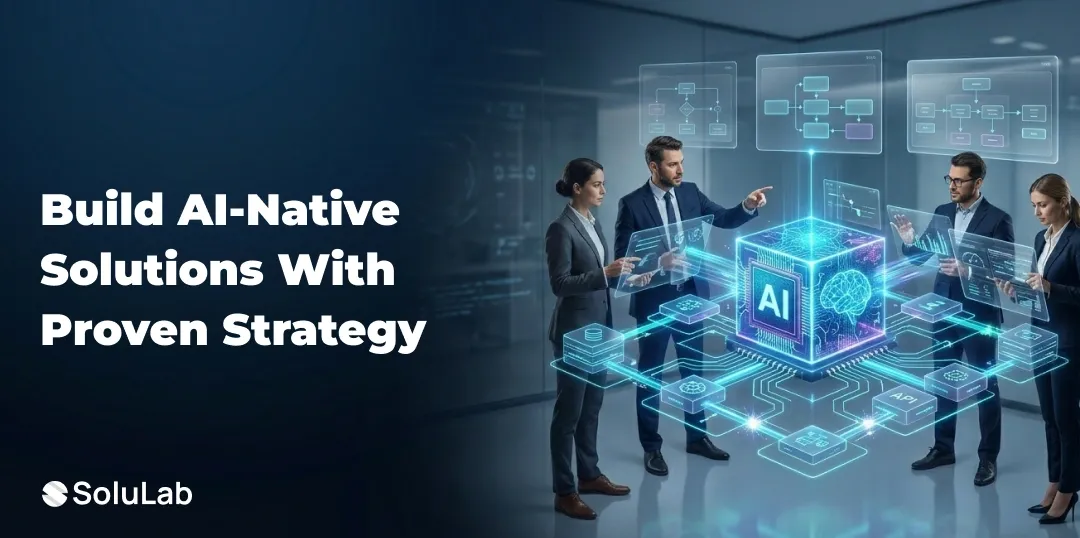
That is where an AI-native solution consulting changes everything. With purposeful structures of making AI to make decisions, businesses will be able to develop solutions that are faster, adaptive, and that continue to learn, improve, and produce meaningful results in 2026 and beyond.
In this blog, we’ll explore why businesses are moving to ai-native models and more.
AI Summary
- The problem: AI is still being viewed primarily as an add-on by most businesses. This contributes to slow systems, poor performance, high cost, and tools that are not made better over time or make smarter decisions.
- The solution: To be AI-native, create systems that revolve around data, ongoing learning, and decision-making to make products faster, smarter, and better as they are used.
- How SoluLab helps: SoluLab is an AI-based firm that uses AI in our workflows to create and deliver solutions with speed, lower the cost of development, and assist businesses in introducing smarter systems without the needless complexity.
From AI-Assisted to AI Native: What’s the Difference?
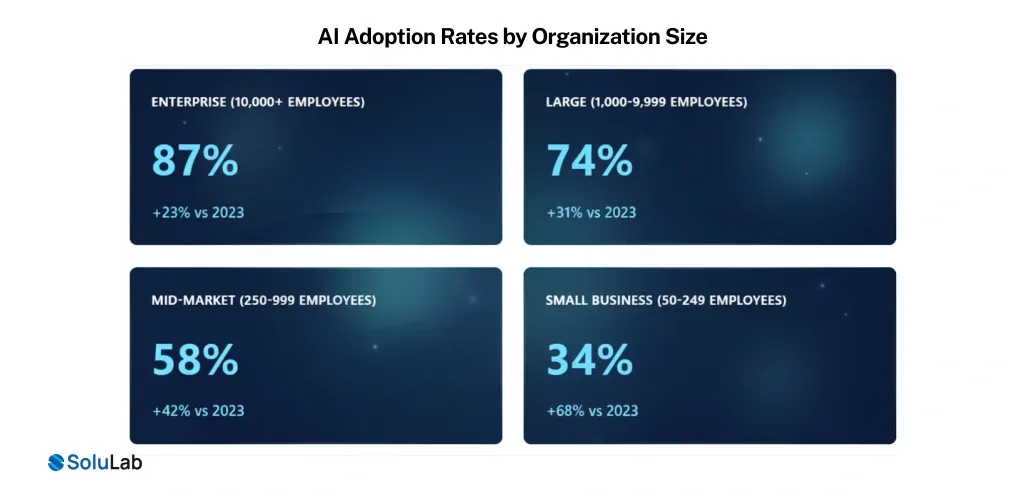
At first, Artificial Intelligence was like a helper inside software, suggesting things or automating small tasks. This is called AI-assisted systems, where humans still make most decisions, and AI plays a supporting role. But now, things are changing. With an AI-native development strategy, AI is no longer just an add-on; it becomes the core of how the system works. In fact, 87% of large enterprises have implemented AI solutions, indicating a strong enterprise-level commitment.
This shift brings us to AI-native solutions, where every part of the system is designed around intelligence from the beginning. These systems are built using an AI-native architecture, meaning data, models, and decision-making are deeply connected and continuously learning from each interaction.
The result is smarter, faster, and more adaptive software. Unlike older systems, AI applications don’t just follow rules; they learn patterns, make predictions, and improve over time, almost like they’re getting better with experience, just like humans do.

Why Businesses Are Moving to AI-Native Models?
Businesses are not just adopting AI as an adjunct but as a core part of their computing systems so that they can have smarter systems, continuous education, and scalable intelligence that have a direct impact on speed, efficiency, and future competitive advantage.
- Quick decision-making: In AI-native systems, large-scale data can be processed in real-time, which means that insights are immediately available and save reliance on manual analysis, which is expected to significantly increase the speed, accuracy, and responsiveness of business-critical decisions.
- Automation at scale Enterprise: AI-native applications enable organizations to automate intricate workflows in different departments, reduce human participation and stay consistent, increase operational throughput, and allow teams to work on more valuable strategic projects.
- Efficiency of costs through smart systems: AI-native designs are more efficient in distributing resources by cutting down on redundant tasks, operational overhead, and efficiency in systems through predictive analytics, which eventually lead to a higher ROI and cost sustainability.
- Real-time personalization: AI-native models process user behavior in real-time, enabling businesses to provide consumers with highly tailored experiences, recommendations, and interactions, which result in higher engagement, customer satisfaction, and conversion rates.
- Competitive moat through proprietary data: Organizations that have proprietary data available in AI-native systems develop defendable advantages because continuous training on proprietary data improves their model performance and develops barriers that competitors cannot easily imitate.
Core Pillars of AI-Native Solution Development Strategy
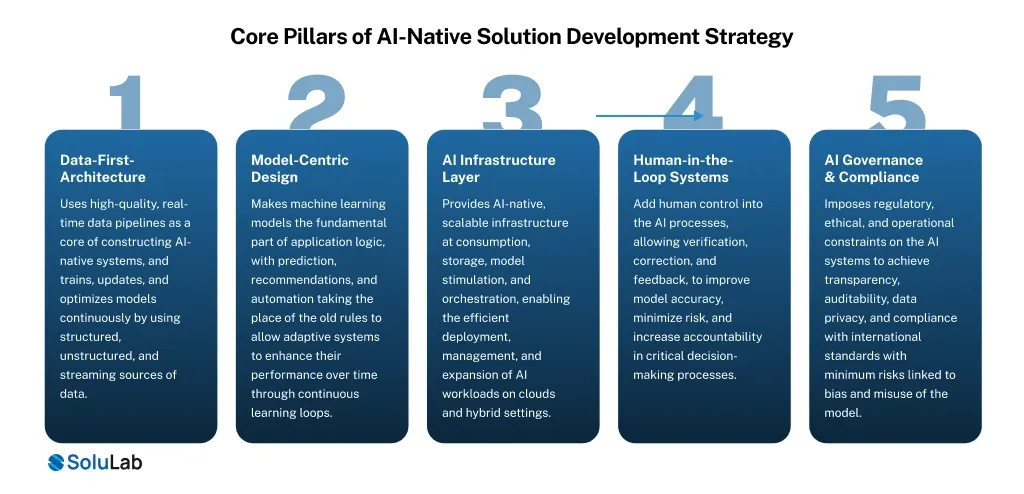
The AI-native applications are transforming the way software is created and are focusing less on fixed logic and more on active and learning systems that are intelligent, adaptive, and can also make decisions faster and more accurately.
- Data-First-Architecture: Uses high-quality, real-time data pipelines as a core of constructing AI-native systems, and trains, updates, and optimizes models continuously by using structured, unstructured, and streaming sources of data.
- Model-Centric Design: Makes machine learning models the fundamental part of application logic, with prediction, recommendations, and automation taking the place of the old rules to allow adaptive systems to enhance their performance over time through continuous learning loops.
- AI Infrastructure Layer: Provides AI-driven, scalable infrastructure at consumption, storage, model stimulation, and orchestration, enabling the efficient deployment, management, and expansion of AI workloads on clouds and hybrid settings.
- Human-in-the-Loop Systems: Add human control into the AI processes, allowing verification, correction, and feedback, to improve model accuracy, minimize risk, and increase accountability in critical decision-making processes.
- AI Governance & Compliance: Imposes regulatory, ethical, and operational constraints on the AI systems to achieve transparency, auditability, data privacy, and compliance with international standards with minimum risks linked to bias and misuse of the model.
Step-by-Step AI-Native Development Strategy
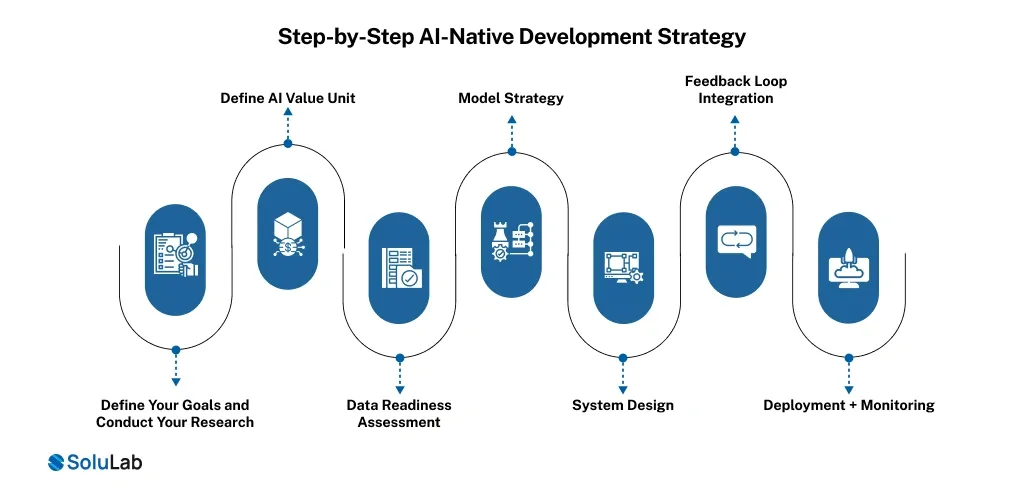
AI-led development requires a structured, decision-first approach where data, models, and systems evolve together. Here’s a practical step-by-step strategy to build scalable, intelligent AI-driven solutions effectively.
Step 1: Define Your Goals and Conduct Your Research
Start by identifying clear business objectives and mapping high-impact decision points. Research industry benchmarks, competitors, and workflows to understand where AI can drive measurable value rather than implementing it for experimentation or trend alignment.
Step 2: Define AI Value Unit
Break down your solution into core AI capabilities such as prediction, classification, recommendation, or generation. Defining this value unit ensures clarity in how AI contributes to outcomes, forming the foundation for building AI-native systems effectively.
Step 3: Data Readiness Assessment
Evaluate data availability, quality, and structure across sources. This includes identifying gaps, ensuring compliance, and preparing pipelines. Strong data readiness is critical since AI-native systems rely on continuous, high-quality data flows for performance and adaptability.
Read More: AI Readiness in Dubai
Step 4: Model Strategy
Decide whether to use pre-trained models, fine-tune existing ones, or build custom models. Balance cost, latency, and accuracy while aligning model choice with business goals and scalability requirements within your AI-native infrastructure.
Step 5: System Design
Design modular, event-driven architectures where AI models sit at the core of decision-making. Focus on integrating APIs, orchestration layers, and real-time processing to ensure flexibility, scalability, and seamless interaction between components.
Step 6: Feedback Loop Integration
Incorporate continuous feedback mechanisms to capture user interactions, model outputs, and corrections. These loops enable retraining and optimization, ensuring the system improves over time rather than remaining static after deployment.
Step 7: Deployment + Monitoring
Deploy AI models with proper observability, tracking performance, latency, and drift. Implement monitoring tools to manage costs, maintain accuracy, and ensure reliability, making AI systems production-ready and continuously optimized.
Cost of Building AI-Native Solutions (2026 View)
Here’s the cost of building AI driven solutions as per each solution type:
| AI‑solution type | Approx. cost range (USD) | Key drivers of cost |
| Basic AI / simple chatbot | $15,000 – $20,000 | Pre‑trained models, small data, light infrastructure |
| Intermediate ML systems | $20,000 – $35,000 | Custom ML/NLP, moderate data, and GPU infra |
| Advanced/generative AI apps | $30,000 – $45,000 | LLMs, RAG, fine‑tuning, strong ops |
| Enterprise AI platforms | $50,000 + | Multi‑model systems, governance, long‑term TCO |
Metrics That Actually Matter in AI-Native Systems
AI-native systems move the emphasis on output measures to the performance of the decision and focus on real-time intelligence, flexibility, and quantifiable business impact in continuously learning and data-centric environments and processes.
- Reduced time to decision-making: AI-native systems save a lot of time taken by input and actionable output.
- Improvement in decision accuracy: AI models are used to improve the accuracy of prediction in a continuous feedback loop.
- Reduction in time-to-decision: The automated pipelines reduce the analysis cycles in the complex business processes.
- Model latency vs business impact: Striking a balance between the speed of response and quantifiable result improvements and efficiency.
- Cost per inference: Minimise the cost of model use to get the cost of outputs of the model per decision output.
- Feedback loop efficiency: Systems are enhanced through continuous feedback of real-time data and interaction with users.
- AI-first versus AI-native system: AI-first systems appear to apply the concept of intelligence at a shallow level, whereas AI-native implementations make it a fundamental component of the system.
Future Trends in AI-Native Development
The process of AI-native development is reaching a decisive stage as systems no longer provide assistance but become autonomous, transforming how business is conducted, decisions are made, and how it is constantly refined through intelligent, data-driven systems.
- AGI systems: AGI systems are goal-oriented in their autonomy and will integrate various models and tools to execute tasks in an end-to-end manner, allowing AI software development to transition to a proactive mode of operation.
- Autonomous businesses: The business is becoming an independent ecosystem in which decisions, operations, and optimization occur with limited human participation and are driven by AI-native systems that are strongly integrated and continuously learning.
- Increased adoption of edge AI: AI models are being deployed further into data sources, as well as minimizing latency and improving real-time decision-making, particularly in areas of IoT, healthcare, and mobility, where the use of AI-based localized intelligence is essential.
- Smaller domain-specific models: Organizations are focusing on small, highly refined models specific to particular industries or tasks and enhancing efficiency and cost-reducing, as well as providing more precise results than large, generalized AI systems.

Conclusion
AI-driven development is no longer just a technical upgrade; it is a smarter way of building systems that think, learn, and improve over time. By focusing on data, clear decision points, and continuous feedback, businesses can create solutions that adapt as needs change.
The real advantage comes from designing systems that are simple to use but powerful underneath, making technology work naturally for people. Whether you are starting small or scaling fast, the right strategy makes all the difference.
SoluLab, an AI development company, can help your business build scalable, intelligent, and future-ready AI-native solutions with the right approach and expertise. Book a free discovery call!
FAQs
Neha is a curious content writer with a knack for breaking down complex technologies into meaningful, reader-friendly insights. With experience in blockchain, digital assets, and enterprise tech, she focuses on creating content that informs, connects, and supports strategic decision-making.