Key Takeaways
- Tokenizing a property lets an owner pull cash out of it without selling the whole thing. Ownership gets split, but the regulator still sees who holds what.
- The better platforms fold three things into one flow: digital sign-up, compliance checks that run on their own, and ownership records that are hard to forge.
- As more real estate moves onto blockchain rails, the paperwork shrinks and the barrier to getting in drops. That is happening in a lot of markets at once.
- Sponsors raise money faster this way. Investors, meanwhile, get a piece of property that actually pays income.
- Build the platform right and the whole experience changes: distributions run themselves, reporting is live, and managing investors stops being a chore.
Real estate is the biggest asset class on the planet. More than $634 trillion sits in it. And yet most of that market is closed to ordinary buyers, because the entry price is high, deals drag on, and once your money is in, getting it back out is slow. Institutional appetite for asset tokenization development keeps climbing anyway.
Some forecasts put tokenized real-world assets at $10 to $16 trillion by 2030. Real estate is expected to be one of the biggest slices of that.
As AssetMarketCap stated, you can see the shift playing out market by market.
- The United States is moving digital asset rules forward under UCC Article 12,
- India rolled out the SM REIT framework, which covers fractional ownership of commercial property worth ₹50 crore to ₹500 crore.
- The UAE and Singapore are backing tokenized securities and digital investment plumbing.
- Luxury builds in the Maldives, Trump-branded projects among them, have looked at blockchain fundraising to pull in overseas money and open up fresh capital sources.
So companies are building real estate tokenization platforms to split ownership, run compliance automatically, widen investor access, and put a liquid market around assets that were never easy to sell.
What Is Tokenized Real Estate?
Closing a commercial property deal can eat up weeks, sometimes months. And usually only people who can write a very large check get to play.
tokenization of real estate chips away at both problems. It turns ownership rights, or the economic interest in a property, into digital securities that live on a blockchain. You do not buy the whole building. You buy real estate tokens, each one a legally enforceable slice of the asset underneath.
These tokens come out of regulated structures like
- Special Purpose Vehicles (SPVs),
- Real Estate Funds, or
- Real Estate Investment Trusts (REITs).
Who owns what, how tokens move, what compliance demands, how money gets paid out: all of it is written into smart contracts. The result is an investment framework you can actually audit.
This is not a speculative coin. A tokenized property is backed by something you can walk into: apartment blocks, office towers, industrial sheds, hotels, mixed-use developments. Each token can stand for:
- Equity ownership in a property-holding entity
- Rights to rental income distributions
- Voting and governance privileges
- Participation in future property appreciation
- Access to secondary market liquidity
That is why institutional firms keep circling blockchain-based real estate models. They want more investors in the room without letting go of regulatory control.
Why Does Traditional Real Estate Investing Face Structural Limitations?
Three walls have hemmed in real estate investing for decades:
| Challenge | Traditional Model | Tokenized Model |
| Capital Requirement | Often $100,000+ to enter premium opportunities | Fractional ownership can significantly lower entry thresholds |
| Liquidity | Assets may remain locked for years | Secondary trading opportunities can improve liquidity |
| Accessibility | Limited to local or accredited investors | Global investor participation through compliant onboarding |
The bigger the deal, the sharper these problems get. Commercial builds, luxury hotels, institutional-grade assets. Entry checks run into the millions, and daily swings in local currency pile on cost.
How do Real Estate Tokens Represent Ownership?
People assume they are buying the property outright. They are not. Ownership almost always runs through an SPV, and the SPV holds the actual title.
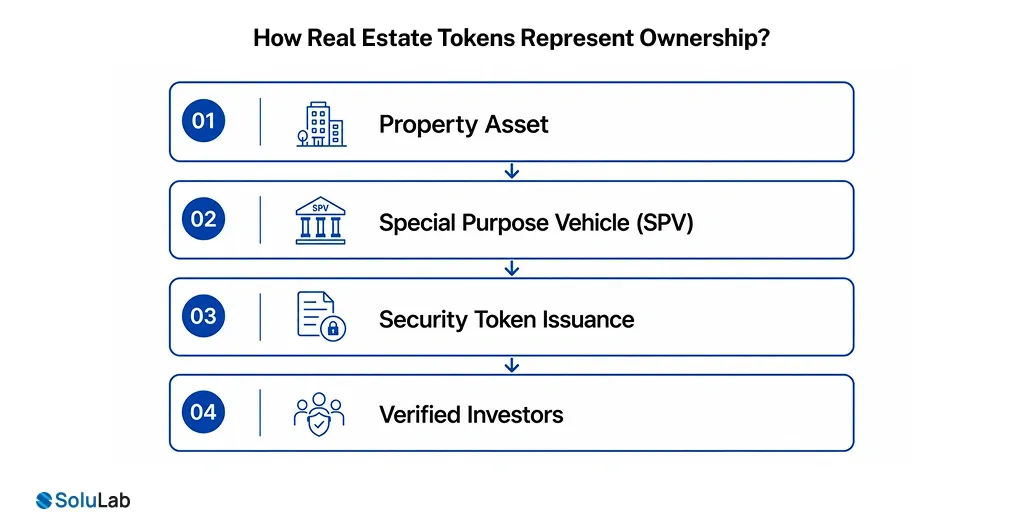
Buy tokens in a tokenized property and what you get is ownership rights in the SPV, not the bricks. Odd as it sounds, that makes everything downstream easier: compliance, governance, tax, and any later transfer.
Newer security token frameworks like ERC-3643 and ERC-1400 push compliance further by baking in:
- KYC verification requirements
- AML controls
- Jurisdiction restrictions
- Transfer approvals
- Investor eligibility checks
Try to send tokens to a wallet that has not been verified? The smart contract can just refuse the transfer.
Types of Real Estate Tokenization Models Used by Institutional Investors
Not every tokenized property works the same way. The structure you pick when you tokenize real estate sets everything else in motion: what investors are entitled to, what compliance you owe, how distributions flow, how liquid the secondary market is, and how much you can raise.
Which is exactly why the sharper teams in real estate tokenization companies in USA, Dubai, Singapore, and the UAE nail down the legal architecture before anyone writes a line of smart contract code.
These days, institutional-grade platforms lean on three models: Single-Asset SPVs, Tokenized REIT structures, and real estate debt securities.
1. Single-Asset SPV
Most companies getting into tokenized real estate investing start with a Single-Asset Special Purpose Vehicle (SPV).
Here is the setup. One LLC or Limited Company owns exactly one property, nothing more. Investors do not hold the building. They hold membership interests in the entity that holds the title.
It has become the go-to for real estate token investors for one reason: it draws a clean line between the ownership record on the blockchain and the actual property rights.
Typical Asset Classes
- Multifamily residential portfolios
- Office developments
- Industrial warehouses
- Student housing
- Hospitality projects
Why Enterprises Prefer SPVs
- Bankruptcy-remote asset protection
- Simplified compliance management
- Faster fundraising execution
- Automated rental distributions
- Digital cap table management
For a company that wants to tokenize real estate assets, the SPV route is the shortest hop from buying the asset to onboarding investors.
2. Digital REITs
Once a portfolio grows, companies tend to graduate from single-property deals to tokenized funds and REITs.
Now the token no longer maps to one building. It gives you a stake in a spread of income-producing properties.
The shape mirrors an old-school REIT. What is new is the blockchain ownership record, the distributions that pay themselves, and compliance you can program.
Why does institutional capital prefer digital REITs?
Concentration risk. That is the weak spot in ordinary real estate investing.
One vacancy can knock a hole in your returns.
Tokenized REIT structures spread the bet across:
- Commercial office space
- Logistics facilities
- Apartment communities
- Retail developments
- Hospitality assets
- Data centers
Plenty of real estate investors care more about spreading their risk than about owning any one thing outright.
And that is part of why regulators around the world keep pushing fractional ownership frameworks forward.
India’s SM REIT rules now cover commercial property portfolios between ₹50 crore and ₹500 crore, giving digital and fractional ownership a formal home.
3. Tokenized Real Estate Debt
Not everyone wants equity.
A lot of institutional money would rather have a yield it can count on.
That appetite has pushed tokenized debt, backed by commercial and residential property, into faster growth.
You are not buying ownership. You are buying a debt instrument secured against the asset.
Common Structures
- Construction financing
- Bridge loans
- Mortgage participation
- Mezzanine financing
- Commercial property debt
For a developer, this can free up capital far faster than going to a bank.
For the investor, the return rides on a repayment schedule, not on whether the market goes up.
Why Is Debt Tokenization Growing?
The global private credit market is now larger than $2 trillion.
Tokenization opens a door to that pool. Developers can issue digitally and still stay inside the compliance lines.
A number of large hospitality and luxury builds, including some in the Maldives, have weighed blockchain fundraising to reach more investors and lean less on the usual financing channels.
4. Trophy Asset Tokenization
A stake in a premium hotel, a landmark tower, a luxury resort? That used to be the exclusive territory of institutions and the ultra-wealthy.
Fractional real estate investing has cracked that open. Now you can get exposure to trophy assets through regulated digital securities.
Think:
- Luxury resorts
- Prime hospitality developments
- Branded residences
- Mixed-use megaprojects
- Landmark commercial properties
It has caught on as developers hunt for new ways to raise capital. Marquee projects in Dubai, Singapore, New York, London, and the Maldives are increasingly looking at tokenized ownership to draw in international money.
Which Model Is Right for Your Real Estate Tokenization Platform?
It comes down to what you are trying to raise, and from whom.
| Model | Best For | Investor Profile |
| Single-Asset SPV | Individual properties | Retail + Institutional |
| Digital REIT | Portfolio diversification | Institutional |
| Debt Securities | Yield-focused offerings | Credit Investors |
| Trophy Asset Tokenization | Premium developments | Global Investors |
The platforms that win usually run several of these at once. One compliant infrastructure layer, and a sponsor can raise equity, debt, and fractional ownership capital all through it.
How does Investing in Tokenized Real Estate Works?
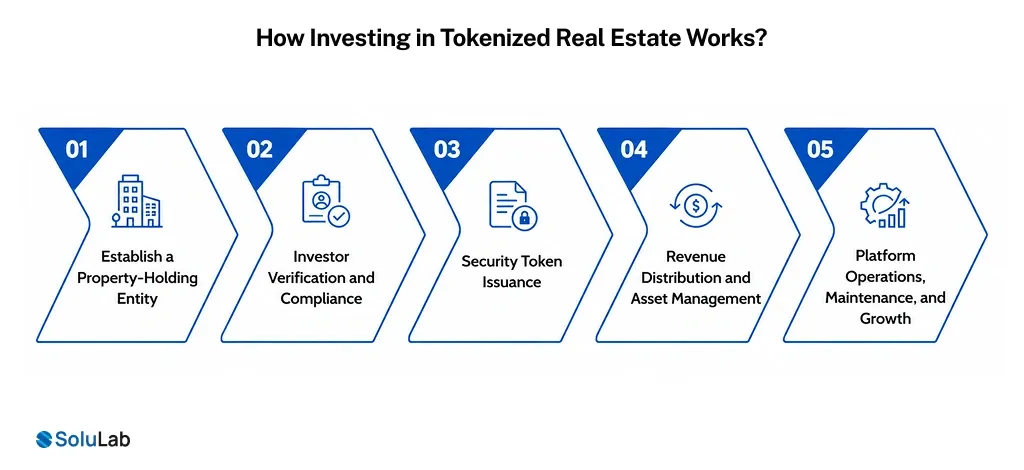
Investing in tokenized real estate is a lot more than minting digital ownership units on a chain. A real offering needs legal structuring, regulatory compliance, investor onboarding, smart contract deployment, payment plumbing, and asset management that never really stops.
For a company building a real estate tokenization platform, the point was never just to issue real estate tokens. The point is a compliant investment product, one that lets people own a piece of a property while the offering stays legal across every jurisdiction it touches.
Step 1: Establish a Property-Holding Entity
Before any real estate tokenization development starts, the property has to sit inside a legally recognized ownership structure.
Most issuers reach for:
- Special Purpose Vehicles (SPVs)
- Limited Liability Companies (LLCs)
- Trust Structures
- Real Estate Funds
- Tokenized REIT Frameworks
That legal entity is what issues the digital securities, and it is what holds title to the property.
To get the offering ready, you typically need:
- Property title documentation
- Independent valuation reports
- Private Placement Memorandum (PPM)
- Subscription agreements
- Investor rights agreements
- Regulatory disclosures
- Tax and compliance documentation
This stage usually swallows 20-30% of the timeline and runs 2-6 weeks, depending on the jurisdiction, how tangled the legal side is, and how the asset is put together.
For any real estate tokenization company, the legal work is the foundation, full stop. Blockchain does not override property law, securities rules, or the protections investors are owed.
Step 2: Investor Verification and Compliance
With the legal framework locked, investors start onboarding through the platform.
And this is the part that makes or breaks it. The experience has to feel effortless.
A modern real estate tokenization platform walks the investor through onboarding in a clean line:
- Account creation
- Identity verification
- Accreditation checks
- Wallet registration
- Investment subscription
- Payment processing
Behind that tidy interface, several compliance systems are all running at the same time.
Things like:
- Know Your Customer (KYC) verification
- Anti-Money Laundering (AML) screening
- Sanctions monitoring
- Politically Exposed Person (PEP) checks
- Jurisdiction validation
Once an investor clears, they land on an on-chain whitelist before any tokens get allocated.
Depending on where you are selling, the compliance list can include:
- SEC Regulation D
- Regulation S
- MiCA
- MiFID II
- SEBI SM REIT
- FATF Travel Rule
Putting compliance first protects the issuer and the real estate investors both, and it cuts regulatory risk when tokens change hands on the secondary market later.
Step 3: Security Token Issuance
After investors are approved and their capital clears, the issuance engine mints the ownership tokens and hands them out.
Plenty of blockchain projects still lean on ERC-20 contracts. Institutional-grade real estate tokenization solutions usually do not. They reach for security token standards built for the job, such as:
- ERC-3643
- ERC-1400
- ERC-1404
These standards carry serious compliance controls, among them:
- Transfer restrictions
- Geographic limitations
- Investor caps
- Holding periods
- Asset recovery mechanisms
- Forced regulatory transfers
By now the investor holds real estate tokens that stand for ownership, revenue rights, a debt position, or fund units, whichever the chosen structure calls for.
A proper issuance system also wires in:
- Investor dashboards
- Digital document vaults
- Transaction reporting
- Portfolio analytics
- Ownership certificates
Compare that to paper-based ownership and the difference in the real estate investment experience is not subtle.
Step 4: Revenue Distribution and Asset Management
Fundraising closes, and the job changes. Now it is about running the asset, not raising for it.
Property managers keep doing what they do: leasing, maintenance, tenants, the operating bills.
The blockchain layer, meanwhile, handles:
- Investor records
- Ownership updates
- Dividend calculations
- Governance voting
- Distribution reporting
Rent comes in, expenses come out, reserves get set aside, and whatever is left as net income goes to the token holders who qualify for it.
Most enterprise-grade blockchain-based real estate platforms run claim-based distributions, so investors pull their earnings straight from the platform or a connected wallet.
Once the portfolio is big, automation reaches well past distributions and picks up:
- Digital cap table management
- Tax reporting
- Corporate actions
- Proxy voting
- Secondary market settlement
Step 5: Platform Operations, Maintenance, and Growth
Here is where a lot of teams get caught out. They underestimate everything that starts once the platform is live.
A production-ready real estate tokenization platform needs ongoing:
- Smart contract monitoring
- Security audits
- Compliance updates
- Investor support
- Cloud infrastructure management
- Regulatory reporting
- Marketplace maintenance
And as more investors pile in, operators tend to bolt on extras like:
- Secondary trading modules
- AI-powered investor analytics
- Automated risk monitoring
- Portfolio performance dashboards
- Multi-chain asset support
Which is why so many companies bring in a partner offering end-to-end real estate tokenization services instead of juggling the legal, technical, and operational pieces on their own.

Timeline and Cost Considerations
How long it takes depends on how complex the platform is, how much regulatory ground it covers, and what it has to integrate with.
| Platform Type | Estimated Timeline | Estimated Cost |
| MVP Tokenization Platform | 8-12 Weeks | $15,000 – $35,000 |
| Commercial Launch Platform | 3-6 Months | $35,000 – $50,000 |
| Enterprise Multi-Asset Platform | 6-12 Months | $50,000 – $60,000 |
Add AI in real estate, secondary trading infrastructure, multi-chain deployment, institutional custody, or heavy compliance automation, and both the budget and the timeline stretch.
Read more – Real Estate Tokenized Hotel Projects in the Maldives
Building a Scalable Real Estate Tokenization Platform: Enterprise Considerations in 2026
Standing up a single tokenized offering is not hard. The hard part, and where most projects fall over, is building a white-label real estate tokenization platform that can carry multiple jurisdictions, asset classes, investor groups, and whatever regulations show up next.
Token issuance is rarely the thing that trips up an enterprise. The real question is whether the infrastructure is still running, still compliant, and still worth the money five years out.
1. Asset Strategy Comes Before Technology
Too many teams open by picking a blockchain. Wrong order. Define the asset strategy first.
Questions worth answering up front:
- Will the platform support residential, commercial, or mixed portfolios?
- Will investors receive equity, debt, or revenue-sharing rights?
- Will assets be offered individually or through fund structures?
- Will secondary trading be permitted?
- What investor categories will be targeted?
Every technical and regulatory call that comes after flows from those answers.
2. Design for Multi-Asset Growth From Day One
Early platforms are often built around one property.
But the ones that last usually grow into:
- Apartment portfolios
- Commercial real estate funds
- Hospitality projects
- Industrial assets
- Real estate debt products
So the architecture needs to take on new asset structures without a rebuild every time a new offering lands.
A platform that runs one building and a platform that runs 500 are not the same product. Not even close.
3. Jurisdiction Expansion Strategy
The tokenization businesses that pull ahead are not boxed in by geography.
A property might sit in Dubai, be run by a company in Singapore, and be owned by investors scattered across Europe, Asia, and North America.
So map out a plan for:
- Cross-border fundraising
- Multi-currency support
- Local regulatory adaptation
- Regional investor onboarding
- International tax reporting
Skip that planning and expansion turns expensive and messy in a hurry.
4. Revenue Model Selection
A lot of projects fixate on raising the capital and forget to ask how the business makes money afterward.
A white-label real estate tokenization platform that intends to survive needs a clear answer to how it earns once the launch is over.
The usual suspects:
- Asset onboarding fees
- Token issuance fees
- Investor subscription fees
- Secondary trading commissions
- Asset management fees
- Distribution processing fees
- White-label licensing
The strongest businesses earn something recurring. They do not live launch to launch.
5. Data Transparency and Investor Confidence
Institutional investors now want to see the numbers in real time, not wait for a quarterly PDF.
Modern platforms are wiring in:
- Property performance dashboards
- Occupancy analytics
- Rental income reporting
- Asset valuation updates
- Governance records
- Historical distribution tracking
Transparency stopped being a box to tick. It is now an edge over the competition.
6. AI-Powered Asset Intelligence
The next crop of real estate tokenization solutions is picking up integrating AI capabilities.
Instead of poring over every property by hand, platforms can put AI to work on:
- Rent forecasting
- Property valuation modeling
- Occupancy prediction
- Market sentiment analysis
- Portfolio risk monitoring
This is the point where AI in real estate stops being a line on a pitch deck and starts producing operational value you can measure.
7. Liquidity Planning Is More Important Than Tokenization
Plenty of tokenization projects launch just fine, then struggle to keep any investor activity going.
The truth is blunt:
A tokenized property with no buyers and no sellers is still an illiquid investment.
Work out your liquidity strategy before launch, not after. That means:
- Investor acquisition campaigns
- Market-maker relationships
- Secondary trading incentives
- Broker partnerships
- Institutional distribution channels
More than anything else, liquidity is what decides whether a platform makes it.
8. Future-Proofing the Platform
Rules shift. Investor expectations shift. The digital asset infrastructure underneath keeps shifting too.
So real estate tokenization development should put flexibility near the top of the list.
The things worth future-proofing:
- Multi-chain compatibility
- Modular architecture
- Upgradeable smart contracts
- API-first infrastructure
- Third-party integration capabilities
- Emerging compliance requirements
Build only for what today needs and you are often looking at a costly rebuild inside a couple of years.
The Enterprise Reality
What separates a real estate tokenization company that works from one that dies is almost never the blockchain.
The winners are built on asset strategy, investor experience, liquidity planning, revenue generation, operational scale, and the ability to bend as regulations change.
Technology makes tokenization possible. The business underneath decides whether it scales.
The Future of Real Estate Tokenization: From Early Adoption to Institutional Infrastructure
Not long ago, talk about real estate tokenization circled around fractional ownership and blockchain experiments. Now the conversation is about regulatory frameworks, institutions coming in, and digital asset infrastructure that can actually scale.
Governments, banks, and property owners have stopped asking whether tokenization works. The question now is how fast they can fold it into what they already do.
Watch investor behavior, because that is one of the loudest signals. Industry research suggests investors expect to put 7% to 9% of their portfolios into tokenized assets by 2027. And inside the alternatives bucket, real estate keeps landing near the top.
Among institutions, 56% named tokenized property their first or second pick among tokenized alternatives. High-net-worth individuals are close behind, with 49% ranking it among their top interests.
For real estate investors, that says something: growing trust in digital ownership backed by a real asset, not a speculative one.
1. Regulation Is Catching Up With Innovation
Regulatory uncertainty was one of the biggest things holding adoption back. That is shifting fast.
In December 2024, Luxembourg passed Blockchain Law IV. It allows equity securities to be administered digitally and sets up a framework for tokenizing physical assets. The law gives issuers and investors firmer legal footing and widens the use of distributed ledger tech inside regulated markets.
You see similar moves across:
- United States
- United Arab Emirates
- Singapore
- Switzerland
- India
As the rules get clearer, more organizations can tokenize real estate assets with confidence, staying inside securities law and keeping investor protections intact.
2. Why Institutional Capital Is Moving Toward Tokenized Assets
Owning property the old way is still capital-heavy.
The premium deals ask for big commitments, long closing cycles, and a mountain of admin.
Tokenization takes the edge off all three by making ownership easier to reach and lighter to run.
The tokenized share of property portfolios is projected to climb from roughly 1.3% in 2023 to around 6% by 2027 and beyond.
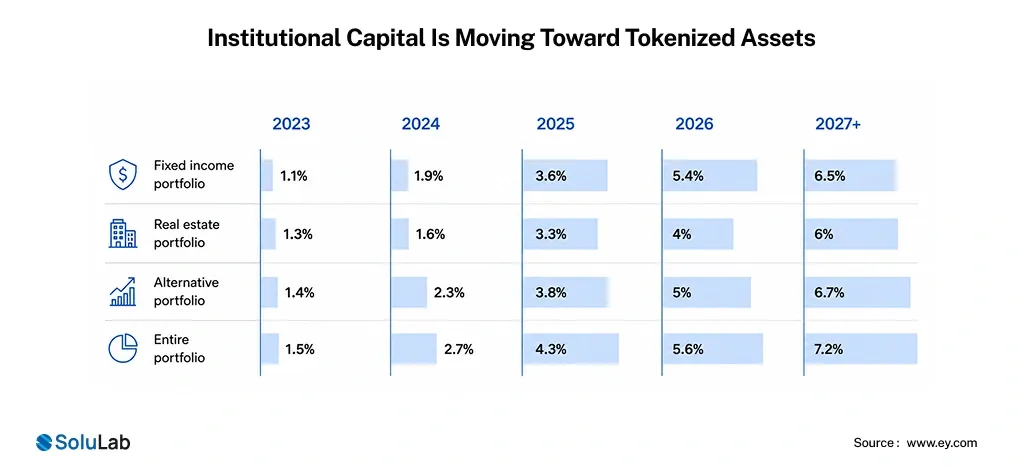
For anyone running large real estate projects, that is a new way to raise capital, keep investors engaged, and spread a portfolio out.
There is another pattern worth noting: investors will trade control for access.
Research shows 63% of investors would buy tokenized property interests with no voting rights, as long as it lowered the minimum and made getting in simpler.
That demand keeps feeding fractional real estate investing, especially among younger investors and people abroad who want a foot in premium properties.
3. The Rise of Digital REITs and Hybrid Ownership Models
The next wave probably will not be about single buildings.
Institutional firms are looking harder at:
- Portfolio tokenization
- Private real estate funds
- Digital debt issuance
- Revenue-sharing structures
- Tokenized real estate investment trusts (REITs)
These give you more diversification while keeping the transparency and automation that blockchain brings.
Investors get wider access to income-producing assets. Issuers get fundraising options that are more flexible than traditional capital markets on their own.
4. How AI Is Accelerating Adoption
AI is turning into a bigger and bigger layer inside tokenization platforms.
Rather than doing everything by hand, teams can hand off to AI:
- Investor verification
- Risk assessment
- Property categorization
- Compliance monitoring
- Fraud detection
- Portfolio analytics
As this spreads, pairing blockchain and AI should sharpen operational efficiency and take some of the admin load off issuers.
How SoluLab Built an AI-Powered Real Estate Tokenization Platform?
SoluLab teamed up with a Dubai-based property management company that wanted to open up access to its residential and commercial assets using blockchain and smart automation.
The brief was a secure platform that could bring in investors from anywhere while making ownership, compliance, and transactions simpler to handle.
The platform covered:
- Asset tokenization infrastructure
- Smart contract engineering
- Wallet and custody integrations
- AI-assisted compliance workflows
- Investor onboarding automation
- Custom UX/UI design
A handful of familiar industry problems were in the way.
High entry barriers kept many investors out of the premium deals. Manual onboarding slowed down how fast they could bring investors in. Property records were scattered across different systems. And transaction costs plus compliance overhead just kept climbing.
To fix that, SoluLab built an intelligent platform that could issue real estate tokens while automating the operational work that used to eat time.
What went in:
- Fractional ownership capabilities
- AI-assisted KYC and AML verification
- Compliance-ready smart contracts
- Digital investor dashboards
- Automated reporting
- Secondary market readiness
- AI-powered risk monitoring
The numbers showed how far a modern tokenization platform can move the needle on efficiency and access:
- 5x faster fundraising cycles
- 40% lower transaction costs
- 2x improvement in regulatory confidence
- 100% automated investment workflows
For any real estate investing company weighing tokenization, results like these make the case: pair blockchain with smart automation. Do not treat tokenization as a bolt-on tech project sitting off to the side.
Final Words
Technology alone will not decide where tokenization goes. What will: regulatory alignment, investor trust, the liquidity infrastructure underneath it, and whether the operation can actually scale.
As more institutions step in and the legal frameworks keep maturing, tokenized ownership looks set to become a normal part of global real estate investments, opening up new room for issuers, developers, fund managers, and investors alike.
Contact us today and get your real estate assets tokenized with an expert in your corner.
FAQs
Deepika is a content writer who blends storytelling with strategic thinking. She explores topics across digital innovation, emerging tech, and the evolving blockchain industry. She enjoys breaking down complex ideas into simple, engaging narratives in the growing global markets.