According to Gartner, 30% of generative AI projects fail after the proof-of-concept stage due to poor data quality, high costs, and unclear business value. This makes the initial 90 days of an AI program a mess and slows down the development process, making the project even more expensive.
The majority of teams begin to develop models without setting specific business objectives, evaluating the quality of the data, or considering how the AI system will fit into the existing workflows.
This gives an outcome misalignment and poor adoption within the organization. The answer lies in a well-planned solution where strategy, data infrastructure, and AI deployment planning are put into alignment at the outset.
Properly executed and designed AI Solutions and scalable Enterprise AI Solutions can no longer remain in the experimentation phase and can provide a quantifiable, production-level business value.
Continue reading this blog to know common mistakes and how to fix them.
Key Takeaways
- The issue: Due to insufficient focus on business objectives and overemphasis on technology, inadequate data preparedness, and the absence of a detailed roadmap on how AI can be transferred to actual production settings, many AI projects fail within the initial 90 days.
- The fix: AI implementation begins with an effective roadmap, solid infrastructure, scalable architecture, and early integration design to guarantee the AI initiatives have quantifiable business returns.
- How SoluLab Helps: SoluLab provides its services to business enterprises to support their end to end AI strategy, development, and deployment, enabling companies to create production-ready and reliable AI systems that can scale effectively and lead to actual business value creation.
Why Most Enterprise AI Initiatives Fail Before They Start?
Numerous enterprise AI projects fail even before they can be developed in reality. It is not the technology most of the time, but rather strategy gaps, lack of data preparedness, internal dissonance, and unrealistic expectations of AI functions.
- Lack of a clear problem statement: Numerous organizations are launching AI projects because it is being done by their competition is doing so, or it is desired by their leaders to apply AI. The absence of a well-defined business problem causes the teams to develop experiments as opposed to solutions that bring about quantifiable value.
- Inadequate data infrastructure: AI models require huge amounts of clean, structured, and available data. Most businesses have disjointed systems, old databases, and data formats that are not consistent, which complicate the process of reliable model training.
- Unrealistic expectations: Some leaders have unrealistic expectations of AI delivering to them overnight or substituting complicated workflows. As a matter of fact, effective AI development is an experiment and fine-tuning of a model, testing, and gradual enhancement before providing a stable business response.
- Absence of cross-team alignment: AI initiatives need to involve product, engineering, data science, and business executives. In cases where such teams work in isolation, priorities are not clear, and no development efforts are directed in the same way.
- Complexity of integration: Some companies do not realize how much work it takes to make AI functional within the context of the existing systems, APIs, and workflows to work in a real business setting.
Mistakes Teams Overlook in the First 90 Days
When adopting AI at its early developmental stage, numerous teams are in a hurry to launch their development without considering basic planning gaps. Such initial errors in the first 90 days tend to define the difference between an AI project going large and the project halting.
Mistake 1: Not Identifying Business Problems
Most of the time, teams start by selecting AI tools or models without having a clear understanding of what the business problem is. The development strategy of strong AI must always begin with the identification of quantifiable business results and operational issues that can be addressed by AI in the real sense.
Mistake 2: Negligence of Data Preparation
AI models require well-structured, clean, and available data. Data preparation, labeling, and governance are often not taken into account by organizations, slowing the implementation of the AI project and causing untrustworthy outputs or erroneous model performance.
Mistake 3: Not Estimating AI Infrastructure Requirements
The initial testing can be very misleading about the actual infrastructure requirements of production AIs. Teams fail to consider the needs of the GPU requirements, cloud architecture, and scalability that are needed to deal with the real-world implementation of AI in the enterprise world.
Read More: AI Infrastructure as a Service [AIaaS]
Mistake 4: Failure to Collaborate with Already Experienced AI Developers
Companies occasionally strive to develop complicated AI systems in-house with insufficient knowledge. The result is slow development, not designing models efficiently, and failing to make architectural choices that are usually considered by developers of AI systems at an early stage.
Mistake 5: Construction of Models without Plans for Integration
The creation of AI models that are not based on the ways of integrating them with existing platforms, APIs, and workflows is a significant bottleneck in operational terms. Any successful AI has to be part of actual business processes to be able to provide quantifiable value.
How to Set Your Team Up for Success in the First 90 Days?
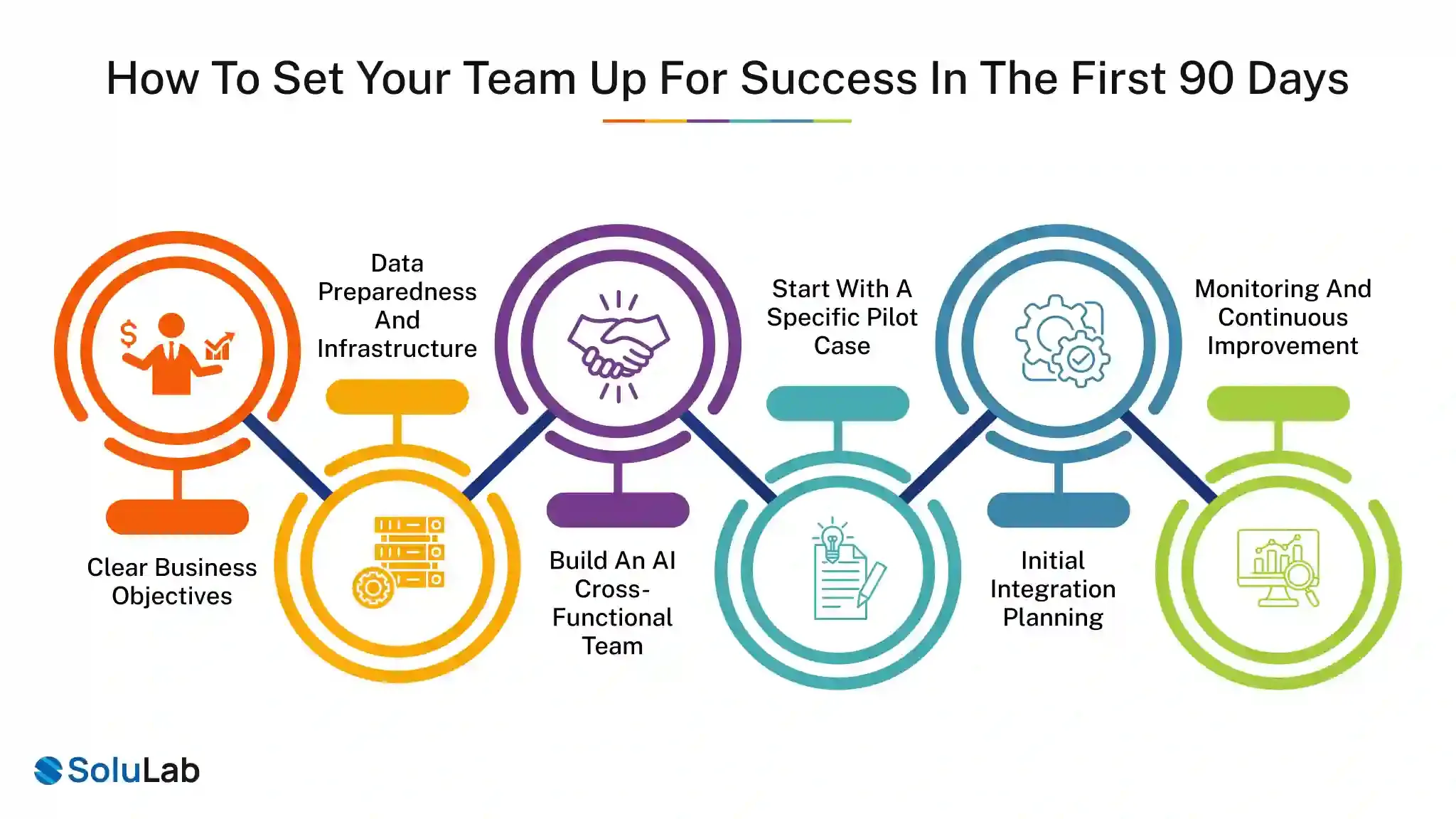
The first 90 days of an AI project generally determine the distinction between a successful scaling project and a successful halting project. The more strategically the team plans to align the stakeholders and work on real business results, the stronger they have the foundation of sustainable development of AI.
- Clear business objectives: To make sure that AI programs are implemented in the way that they are supposed to fulfill business needs, the teams have to identify the quantifiable results, operational improvement, and user contribution to make sure that the AI programs do not become an experiment.
- Data preparedness and infrastructure: The creation of reliable models will require high-quality data, efficient labeling, and scalable pipelines, especially those that will be used to create AI-powered software development services for enterprise systems and digital platforms.
- Build an AI cross-functional team: Collaboration involving engineers, data scientists, product leaders, and business stakeholders improves quicker decision-making, model design, and implementation throughout the departments.
- Start with a specific pilot case: Firstly, a clear project will allow teams to test their assumptions, model, and demonstrate business worthiness, and finally, scale AI capabilities to bigger applications.
- Initial integration Planning: AI models should be used in real workflows, APIs, and platforms such as CRM systems, enterprise, and ai driven web developer environments.
- Monitoring and continuous improvement: To ensure the reliability of AI systems and control their positive influence on the business in the long term, performance evaluation, retraining, and compliance control should be conducted on a regular basis.
Read more: AI Development Cost
How to Choose the Right AI Partner or Vendor for Enterprise Projects?
The selection of the AI consulting and development partner is among the most significant decisions that enterprises implementing AI have to make because the appropriate expertise directly influences the scalability, performance, and overall success of the project.
1. Assess the technical skills and experience of AI
The businesses are to evaluate the experience of the vendor to create production-grade AI systems with data pipelines, model deployment, and enterprise architecture necessary to develop scalable AI-driven applications.
2. Look through industry-specific knowledge and Cases
An effective AI ally is an individual who has insight into industry issues and regulations. The vendors who have experience in the domain can develop more realistic solutions based on the enterprise workflows, business goals, and compliance requirements.
3. Capability to Integrate Check AI and system compatibility.
Businesses ought to consider that the vendor is able to incorporate AI models into existing systems like CRM, enterprise applications, cloud systems, and internal applications without interfering with the current business processes.
4. Review compliance practices, governance, and security.
Artificial intelligence systems need to be properly governed, ensure data privacy, and control systems. Businesses must ensure that the company has effective security measures and compliance guidelines on responsible AI utilization.
5. Find long-term collaboration and support capacity.
The AI systems will have to be improved continuously, retrained, and optimized. The appropriate vendor offers continuous service, performance reporting, and updates to make sure that the AI solution keeps on generating value in the long term.
How SoluLab Helps Enterprises Build Production-Ready AI Solutions?
SoluLab assists companies in transitioning the model of trial to practical AI adoption by creating scalable and production-ready models in line with business objectives. Our team works closely with organizations to identify high-impact AI use cases, prepare reliable data pipelines, and design robust AI architectures that support long-term growth. We help businesses across industries in:
- AI consulting
- LLM development
- AI integration services
- enterprise AI deployment
- scalable AI architecture
As an example, Aman Bank collaborated with SoluLab to create a mobile banking platform with chatbots and Voice AI agents based on generative AI. The platform facilitated 24/7 support, automated onboarding, and digital banking. Here’s what we’ve achieved:
- Growth in customer satisfaction by 30 percent.
- 40% faster response times
- Onboarding and operational effectiveness 60% increased.
To achieve similar results with your business, make a consultation call with us and discuss with our experts.

Conclusion
AI projects tend to either turn the project into a scalable solution or halt the project after some initial testing. Most of the teams are so preoccupied with models and tools and consequently fail to recognize important areas such as data readiness, integration planning, governance, and clear business objectives.
Organizations that take a well-organized approach that represents the right combination of technology, data, and actual operational requirements. Enterprises can open the potential power of AI by preventing typical early-stage errors and developing it in accordance with long-term business performance.
SoluLab, an AI development company, can help your business design, build, and deploy production-ready AI solutions aligned with your long-term goals.
FAQs
Neha is a curious content writer with a knack for breaking down complex technologies into meaningful, reader-friendly insights. With experience in blockchain, digital assets, and enterprise tech, she focuses on creating content that informs, connects, and supports strategic decision-making.