Key Takeaways
- RWA tokenization is projected to capture up to 10% of global GDP by 2030, fundamentally altering how exchanges source liquidity.
- Tokenized treasuries and bonds act as a “risk-free rate” for the crypto ecosystem, buffering exchanges against extreme volatility.
- Traditional matching engines require significant updates to handle the specific compliance and settlement needs of regulated RWAs.
The rise of real-world assets (RWA) in crypto is adding a new layer of stability and capital depth to exchanges. With the RWA crypto market already crossing $24 billion and projections pointing toward a $16 trillion opportunity by 2030, the question is no longer if but how fast this shift will play out.
However, as centralized exchanges (CEXs) face maturing markets, tokenized treasuries, real estate, and private equity offer a non-correlated risk-free rate. This stabilizes exchange reserves against crypto-native volatility.
This transition is less about adopting new tokens and more about upgrading the settlement layer of global finance. By institutionalizing liquidity through blockchain-based asset tokenization, CEXs are positioning themselves to capture a projected market growth.
| Metric | Current Value (2026 Est.) | Projected Value (2030) |
| Total RWA Market Cap | ~$31.2 Billion | $16.1 Trillion |
| Dominant Asset Class | Tokenized U.S. Treasuries | Private Equity & Real Estate |
| CEX Liquidity Share | 14.5% of total volume | 55% – 65% of total volume |
| Institutional On-ramps | 480+ Active CASPs | Global Unified Ledger adoption |
How Tokenized Assets Protect Exchange Reserves From Crypto-Native Volatility?
Centralized exchanges have long suffered from correlated risk. When Bitcoin drops, the entire market usually follows, leading to massive liquidations and a sudden evaporation of liquidity. RWAs introduce decorrelation.
1. Building a Foundation of “Stable Value”
By holding a portion of reserves in tokenized U.S. Treasuries or investment-grade corporate bonds, an exchange ensures that its underlying capital is not tied solely to the speculative cycles of the crypto market.
In 2025, we saw the RWA market grow by over 260% because institutions realized that $1 in a tokenized treasury is functionally safer than $1 in a volatile altcoin during a flash crash.
2. Enhancing Proof-of-Reserves (PoR)
- Real-Time Attestation: Unlike traditional audits, tokenized RWAs allow for on-chain proof of backing.
- Counterparty Risk Reduction: Using assets like BlackRock’s BUIDL or Franklin Templeton’s FOBXX allows exchanges to offload custodial risk to regulated traditional giants while maintaining 24/7 on-chain availability.
- Collateral Efficiency: Traders can use tokenized gold or bonds as margin, which doesn’t liquidate as easily as high-beta crypto tokens.

What New Revenue Streams Are Unlocked By Offering Fractionalized Private Equity And Bonds?
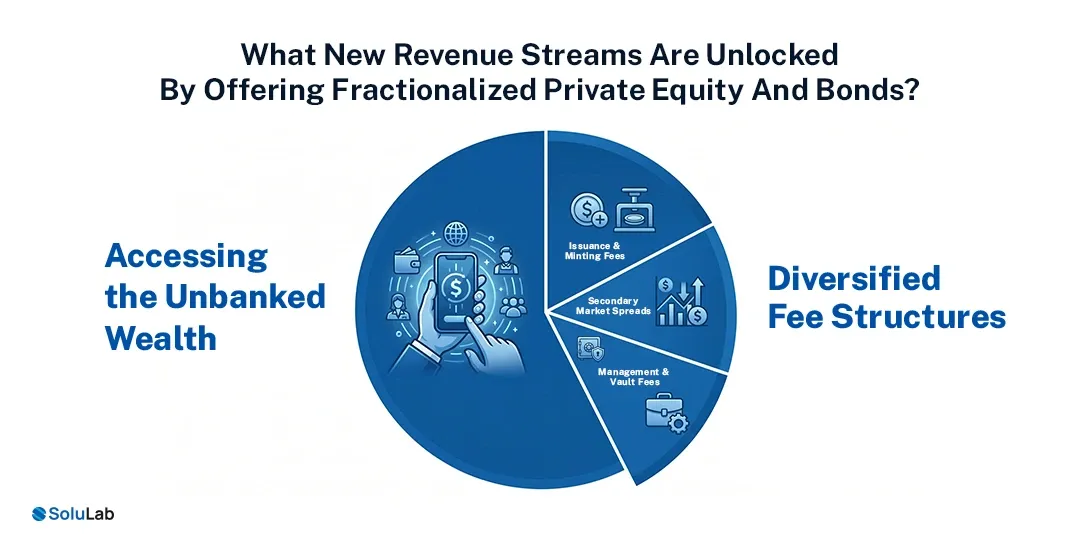
The “retailization” of high-entry-barrier investments is the most significant revenue opportunity for CEXs since the invention of the perpetual swap.
1. Accessing the “Unbanked” Wealth
Private equity has historically been the playground of accredited investors with millions in liquidity. Through fractionalization, a CEX can allow a user with $100 to own a piece of a Pre-IPO company or a commercial real estate project.
2. Diversified Fee Structures
- Issuance & Minting Fees: Exchanges can partner with an RWA tokenization development company to act as the primary issuance platform, taking a percentage of the total raised.
- Secondary Market Spreads: Traditional private equity is notoriously illiquid. By providing a secondary market on a CEX, platforms earn trading fees on assets that previously sat idle for years.
- Management & Vault Fees: Much like an asset manager, exchanges can charge small carry or management fees for maintaining the “tokenized wrapper” and ensuring legal compliance.
Why RWA Tokenization Integration Requires a Complete Overhaul Of Legacy Matching Engines?
You cannot simply list an RWA the way you list a meme coin. The technical and legal requirements are fundamentally different.
1. The Challenge of Gated Liquidity
Most RWA tokens are not permissionless. They often contain “whitelist” logic within the smart contract itself. A traditional CEX matching engine is designed for high-speed, anonymous execution. For RWAs, the engine must check:
- KYC/AML Status: Is the buyer authorized to hold this specific security in their jurisdiction?
- Investor Limits: Does this purchase exceed the maximum allowable concentration for a retail investor under local laws?
2. Settlement Latency vs. Legal Finality
While crypto settles in seconds, the legal transfer of a real-world deed or bond might involve a slight delay to ensure the off-chain registry is updated.
Leading crypto exchanges are now implementing hybrid settlement layers where the trade is matched instantly, but the final token transfer is gated by a compliance oracle.
How Smart Contracts Replace The Back-Office Overhead Of Traditional Clearinghouses?
In traditional finance, clearing and settlement depend on centralized entities like the DTCC, often taking days to finalize trades and involving multiple intermediaries and costs. With smart contracts, this process becomes code-driven, reducing delays and manual dependencies.
1. Instant, Risk-Free Settlement
Smart contract development enables both the asset and payment to be exchanged at the same time. This removes the gap where one party delivers and the other might default, cutting down settlement risk significantly.
2. Built-In Corporate Actions
Processes like dividend payouts, bond interest distribution, or shareholder voting are handled automatically. Once conditions are met, the system executes them without requiring large operational teams.
3. Clear and Verifiable Records
Every transaction is recorded on-chain, creating a transparent and easily auditable history. Instead of compiling reports manually, regulators and auditors can access real-time data directly from the ledger.
How Authorized CASPs Leverage MiCA And US Clarity To Dominate The RWA Tokenization Market?
Regulation was once seen as a hurdle; in 2026, it is the ultimate competitive advantage.
The MiCA “Passport”
Under the EU’s MiCA (Markets in Crypto-Assets) regulation, an authorized Crypto-Asset Service Provider (CASP) can offer its services across all 27 EU member states. This creates a massive, unified market for tokenized assets.
- Platforms like KuCoin and Bitstamp have moved toward full MiCA compliance to capture the “institutional-grade” retail market in Europe.
- The joint SEC-CFTC rulings in early 2026 provided the “rules of the road” for US-based exchanges, allowing them to offer tokenized securities without the fear of retroactive enforcement.
The Upcoming CLARITY ACT Effect
Designed to codify the SEC-CFTC taxonomy into federal statutory law, the CLARITY Act is set to institutionalize blockchain-based asset tokenization at scale.
- Across the Atlantic, the long-standing fog of regulatory ambiguity cleared significantly following the joint SEC-CFTC interpretation issued on March 17, 2026.
The Safe Harbor for Tokenized Securities: The joint ruling explicitly categorized tokenized real-world instruments, such as fractionalized stocks, corporate bonds, and U.S. Treasuries, as Digital Securities.
- The bill establishes a clear, statutory token taxonomy. Pure digital commodities (like Bitcoin or Ether) fall under the CFTC, while investment contract tokens remain with the SEC.
- For RWA development platforms, this statutory clarity eliminates the threat of retroactive enforcement actions.
These compliance-first tech stacks development satisfies both European passporting rules and US market structure laws, while maintaining the liquidity in authorized CEXs development.

Conclusion
By 2030, the distinction between a crypto exchange and a full-scale digital asset exchange will fade as RWA tokenization becomes core infrastructure for liquidity scaling. Exchanges that align legal frameworks with programmable settlement layers will capture institutional capital and long-term volume.
At SoluLab, a tokenization development company, execution is focused on building production-ready systems:
- Design compliance-first architectures aligned with MiCA and US frameworks
- Develop tokenization layers for bonds, funds, and real estate with on-chain controls
- Upgrade matching engines to support gated liquidity and hybrid settlement
- Integrate custody, KYC/AML, and on-chain proof-of-reserves modules
- Enable secondary markets for fractionalized assets with real-time liquidity flows
This is where exchanges move from listing assets to structuring global liquidity. Contact us today to integrate CEX tokenization services.
FAQs
Deepika is a content writer who blends storytelling with strategic thinking. She explores topics across digital innovation, emerging tech, and the evolving blockchain industry. She enjoys breaking down complex ideas into simple, engaging narratives in the growing global markets.