Key Takeaways
- Trillion-Dollar Market Potential: The shift toward tokenized assets is no longer theoretical. Efficiencies in trading and settlement are projected to drive trillions in global economic gains, particularly in sectors that have historically been hard to trade.
- Embedded Regulatory Compliance: The best asset tokenization services now bake KYC/AML and jurisdictional rules directly into the smart contract layer, so compliance isn’t a checklist item you handle separately, it’s always on.
- Institutional-Grade Liquidity: Real World Asset (RWA) tokenization connects traditional finance to digital markets, making fractional ownership and around-the-clock secondary trading a practical reality for high-value physical assets.
In 2026, RWA tokenization has moved past the proof-of-concept stage. Fast. The total value of tokenized assets is on track to clear the $100 billion mark this year, and the conversation has shifted from “should we do this” to “how do we build it at scale.”
For global enterprises, blockchain is no longer just about digital currencies. The real action is in tokenizing assets like real estate, private credit, and government bonds, opening up liquidity and fractional ownership that traditional structures simply can’t match.
Picking the right real-world asset tokenization platform development company is now a strategic decision for any institution trying to bridge the gap between traditional finance (TradFi) and decentralized finance (DeFi).
The Industrial Evolution: How RWA Tokenization is Reshaping Markets in 2026
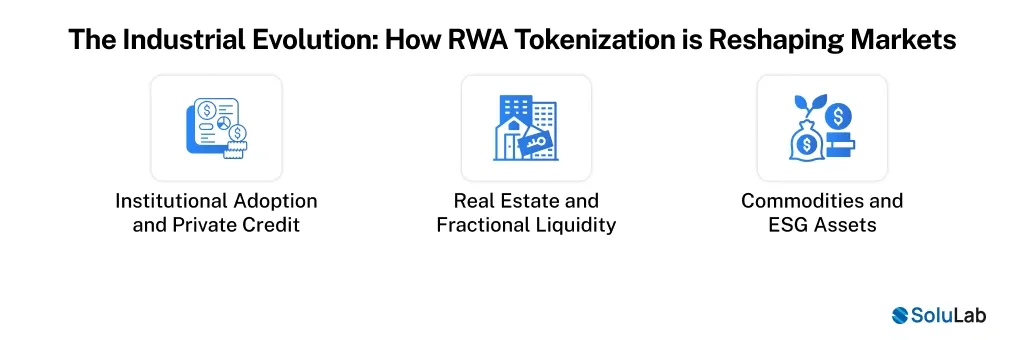
RWA tokenization has grown up. What started as a niche experiment is now a production-grade infrastructure play, with industries from private credit to commodities running real money through these systems.
1. Institutional Adoption and Private Credit
Financial institutions are using RWA tokenization platform development to turn illiquid debt pools into instruments that can actually be traded across borders.
Tokenized U.S. Treasuries have become a cornerstone of this shift, hitting $9.6 billion in value as institutions look for yield-bearing digital collateral they can actually use.
2. Real Estate and Fractional Liquidity
Real estate is still the biggest use case by volume. Tokenize a commercial property, split it into thousands of units, and you’ve unlocked a global retail investor base overnight.
Secondary market trading and instant settlement become possible. Those are things traditional real estate simply can’t offer. That gap is where the real competitive advantage lives.
3. Commodities and ESG Assets
From precious metals to carbon credits, asset tokenization services are bringing a level of transparency that commodity markets haven’t seen before.
In the ESG space, RWA tokenization lets companies trade verifiable carbon offsets with an immutable audit trail baked in. For firms trying to hit 2026 sustainability mandates, that’s not a nice-to-have; it’s the whole mechanism.
This matters for any B2B decision-maker evaluating a tokenization partner: the conversation shouldn’t start with “what does development cost.” It should start with capital efficiency. The right partner doesn’t just ship code; they change what your balance sheet is capable of.
Maximizing Capital Efficiency: The ROI of Choosing a Top-Tier RWA Partner
In 2026, the “cost” of building an asset tokenization platform is almost always eclipsed by the opportunity cost of slow market entry or fragmented liquidity. A serious real-world asset tokenization platform development company doesn’t just write code. They engineer financial advantages that move your Internal Rate of Return.
1. Reducing Operational OpEx through Smart Contract Automation
Traditional asset management carries heavy administrative overhead: distributions, cap table management, reporting. All manual. All slow.
- The ROI Factor: Choosing a partner that builds on the ERC-3643 (T-Rex) standard means compliance is automated at the token level. Legal and administrative costs drop by up to 40% over the asset’s lifecycle.
- The Tech Advantage: Automating corporate actions, like dividend payouts or voting, cuts out manual intermediaries entirely. The result is instant settlement and lower operational risk.
2. Lowering the “Cost of Capital” via Global Fractionalization
A strong RWA tokenization company opens up a borderless capital pool that most businesses have never had access to before.
- The ROI Factor: Instead of taking out high-interest institutional loans, you can raise from a global mix of retail and accredited investors. Lower entry barriers often translate to a 15 to 20% lift in asset valuation due to the liquidity premium that tokenization commands.
3. Future-Proofing with Interoperability Standards
One of the most common mistakes teams make is building on a closed-loop system. The best asset tokenization development companies build for cross-chain from day one.
- The ROI Factor: The 2026 updates to the Cross-Chain Interoperability Protocol (CCIP) now let tokenized assets move between private bank ledgers and public DeFi protocols.
- That means your assets can be used as collateral across the broader digital finance space, no capital siloing, no walled garden.
A security flaw or a missed compliance requirement in your tokenized assets can trigger total capital loss. Investing in a top-tier RWA tokenization development company is risk mitigation. It protects your brand’s reputation and your investors’ trust.
Top 10 Asset Tokenization Development Companies to Look for in 2026
The regulatory and technical terrain here is genuinely complex. Businesses that are moving fast in this space are doing it by locking in the right partner early. Here are the ten firms delivering the most credible RWA tokenization work this year.

1. SoluLab
 $25 – $49 / hr
 50 – 249
 2014
2014
 Los Angeles, CA, USA
 Disney, Microsoft, Georgia Tech
SoluLab has built proprietary AI agents into its RWA tokenization platform development to handle real-time regulatory monitoring and automated risk scoring. Platforms built on their stack adapt to shifting global legal frameworks without manual intervention.
Their 2026 framework ships with “DeFi-ready” modules out of the box. Tokenized assets can be put up as collateral across major decentralized lending protocols while strict institutional permissions remain intact.
Services cover real estate tokenization, equity tokenization, and utility tokens. Cross-chain compatibility and thorough KYC/AML integration are standard, not add-ons, which makes them a dependable partner for businesses entering the digital asset space.

2. PixelPlex
$50-$200
101-250
2007
New York, United States
PixelPlex has been building blockchain products for over a decade. They know the tokenization space well and have helped businesses across real estate, art, and equity digitize assets with real regulatory compliance baked in, not bolted on after the fact.
One of their notable offerings is Tokensoft, a platform built for secure digital asset issuance, management, and transfer. Their work covers the full cycle: token design, smart contract development, and platform integration. Strong KYC/AML compliance and cross-chain interoperability make them a solid choice for any tokenization project that needs to run in multiple jurisdictions.

3. BlockchainX
$25 to $50
150+
2017
Coimbatore, Tamil Nadu, India
BlockchainX converts both tangible and intangible assets into highly liquid digital tokens. Their solutions are regulation-compliant and cover fractional ownership, cross-chain compatibility, and secondary market trading for better asset liquidity.
They work across real estate, art, and commodities, providing support from initial ideation through to deployment. With hands-on experience across Ethereum, Solana, and NEAR, they handle smart contract development and post-launch support without handoffs to a third team. What sets them apart is a genuine commitment to transparency and building solutions that hold up under global regulatory scrutiny.

4. Blocktunix
$25 – $49 / hr
100 – 249
2014
Mohali, Punjab, India
Blocktunix builds AI-powered asset tokenization solutions for enterprises that need to digitize physical and financial assets. Their infrastructure is designed with high scalability, secure ownership transfers, and real-time compliance management in mind.
They develop white label tokenization platforms that cover NFT-backed assets, fractional investment models, and cross-chain interoperability. DeFi functionality and Web3 gaming integrations are part of their tokenization architecture, which extends the utility of assets beyond basic issuance.
Their service offering includes smart contract development, token launch support, wallet integration, exchange connectivity, and blockchain consulting.

5. 4IRE Labs
$50 – $99 / hr
50 – 249
2010
Tallinn, Estonia
4IRE Labs concentrates on enterprise blockchain transformation and AI-native asset tokenization infrastructure. Their work spans renewable energy assets, real estate, commodities, and institutional investment products.
Their tokenization framework includes automated compliance verification, investor management systems, and multi-chain deployment. They also build tokenization standard platforms with DeFi integrations and analytics dashboards that give operators actual visibility into asset performance.
Services include token architecture consulting, smart contract engineering, blockchain integration, and decentralized finance development.

6. Suffescom Solutions
$25 – $49 / hr
250 – 999
2013
California, USA
Suffescom Solutions has moved fast into the asset tokenization development space, building AI-powered blockchain products for startups and enterprises alike. Their tokenization work covers real estate, commodities, intellectual property, and private investment funds.
Their infrastructure includes white label tokenization platforms, automated investor onboarding, and multi-chain token issuance frameworks built for institutional-grade scale. NFT utilities, DeFi lending compatibility, and AI-based fraud monitoring are integrated directly into their token infrastructure rather than being third-party add-ons.
They offer token development, marketplace creation, smart contract auditing, wallet integration, and post-deployment optimization.

7. Blockchain App Factory
$25 – $49 / hr
250 – 999
2010
Chennai, Tamil Nadu, India
Blockchain App Factory has built a credible position as an asset tokenization development company by offering AI-native tokenization products for enterprises, startups, and institutional investors. Their solutions cover tokenized real estate, commodities, private equity, and revenue-sharing assets across multiple chains.
They are known for white label tokenization platforms with automated compliance modules, smart liquidity routing, and institutional-grade custody frameworks. Web3 gaming, NFT-backed assets, and DeFi-enabled yield systems extend the utility of their token infrastructure well beyond basic issuance.
Their services include smart contract engineering, STO development, fractional ownership platforms, secondary marketplace creation, and end-to-end token lifecycle management.

8. Bitdeal
$25 – $49 / hr
100 – 249
2015
Dublin, Ireland
Bitdeal delivers asset tokenization development services with a focus on helping businesses digitize physical and financial assets at scale. Their blockchain infrastructure handles tokenized real estate, commodities, equities, and digital collectibles, with AI-driven automation built into the operational layer.
They build white-label tokenization platforms with multi-chain compatibility, automated smart contract execution, and integrated KYC/AML verification. Their solutions extend into Web3 gaming, NFT marketplaces, and DeFi integrations as well.
Bitdeal offers end-to-end token development, STO platform creation, crypto exchange integration, and blockchain consulting for enterprises and startups.

9. Nadcab Labs
$25 – $49 / hr
50 – 249
2017
Dubai, UAE
Nadcab Labs brings enterprise-grade asset tokenization development backed by AI-driven compliance monitoring and blockchain automation. Businesses use their infrastructure to tokenize real estate, commodities, private equity, and revenue-sharing assets.
Their white label tokenization platforms cover fractional ownership, cross-chain interoperability, and institutional investor management. DeFi-ready modules and NFT-backed utilities are part of the stack, designed to increase asset liquidity and keep users engaged across the lifecycle.
Core specializations include STO development, token engineering, blockchain consulting, wallet integration, and DeFi ecosystem development.

10. INORU
$25 – $49 / hr
250 – 999
2014
Singapore
INORU has built a solid track record in asset tokenization development by delivering AI-powered blockchain products for enterprises, fintech startups, and investment firms. Their work covers tokenized securities, commodities, real estate, and intellectual property assets.
White label tokenization platforms are a core offering, with smart compliance automation, investor onboarding modules, and multi-chain digital asset management built in. Their infrastructure also extends into Web3 gaming, NFT marketplaces, and metaverse asset tokenization for clients looking to go beyond standard issuance.
Services include token development, smart contract auditing, crypto wallet integration, STO platform development, and decentralized application engineering.
Critical Factors in RWA Tokenization Platform Development
Building a working RWA tokenization platform is more than minting tokens. It requires a multi-layered technical and legal approach, and the teams that skip that learn it the expensive way.
1. Programmable Compliance
In 2026, compliance lives at the token level, not in a separate legal workflow. A serious asset tokenization development company builds tokens that cannot be transferred to non-verified wallets, with jurisdictional restrictions and investor accreditation rules enforced automatically, no manual override required.
2. Oracle Integration and Asset Valuation
For real-world asset tokenization to hold up, the on-chain token has to accurately reflect off-chain value at all times. Developers use Chainlink or other decentralized oracles to provide real-time price feeds and proof-of-reserve audits for physical assets like gold or real estate. Without that, the credibility of the entire structure falls apart.
3. Interoperability and Secondary Liquidity
The value of tokenized assets depends on their ability to move. Serious asset tokenization development companies build for cross-chain compatibility from the start, so assets issued on a private ledger can interact with public DeFi protocols for lending and borrowing without being locked in place.
These ten firms are building the infrastructure that makes tokenized assets a practical financial tool, not just a technical novelty. The right RWA tokenization partner is the difference between static assets and capital that actually works for you.
What asset class are you focused on: real estate, private credit, or commodities? That decision shapes which partner is actually the right fit.
Conclusion
Tokenization is changing how assets get bought, sold, and held. That much is clear.
What matters now is execution. Whether you are a startup tokenizing real estate or an enterprise building digital securities infrastructure, the development partner you choose sets the ceiling on what you can actually deliver.
- Each firm on this list has different strengths. Your choice should reflect your specific asset class, target markets, and the regulatory jurisdictions you need to operate in.
- Asset tokenization companies will play a direct role in moving blockchain technology into mainstream financial markets, and the firms that get the infrastructure right now will define what that market looks like.
SoluLab, an asset tokenization development company in the USA, works across real estate tokenization, equity tokenization, and more. Contact us today to discuss your project.
FAQs
Deepika is a content writer who blends storytelling with strategic thinking. She explores topics across digital innovation, emerging tech, and the evolving blockchain industry. She enjoys breaking down complex ideas into simple, engaging narratives in the growing global markets.