Key Takeaways
- Intellectual property tokenization transforms patents, software, AI models, and trademarks into liquid assets without diluting ownership.
- Enterprises can reduce licensing administration costs by up to 40% while automating royalty distribution through smart contracts.
- Compliance-first architectures combining ERC-3643, legal wrappers, and KYC controls improve investor confidence and regulatory readiness.
- Tokenized intellectual property enables faster capital access, global participation, and new monetization models across industries.
- Organizations adopting IP tokenization early can unlock revenue opportunities, shorten settlement cycles, and strengthen commercialization strategies.
What if your patents, software code, trademarks, or AI models could generate liquidity without selling company equity? That question is driving a major shift across global markets.
With the tokenized real-world asset market crossing $29 billion in 2026 and institutional giants actively building digital asset infrastructure, intellectual property tokenization has moved far beyond experimental blockchain projects.
Enterprises are now using tokenized intellectual property to
- unlock capital,
- automate licensing,
- distribute royalties instantly, and
- Create new investment opportunities around previously illiquid assets.
Communities such as VitaDAO fund scientific innovation and participate in future commercialization opportunities.
These asset tokenization solutions have helped accelerate funding for early-stage biomedical research while creating a transparent framework for managing and monetizing valuable intellectual property assets.
What are IP Assets?
IP assets, or Intellectual Property assets, refer to creations of the mind that have commercial value and are protected by law. These can include inventions, brand names, logos, designs, software, trade secrets, written content, music, and even business processes. Companies and individuals can own these intangible assets, just as they can physical property. Protecting IP through :
- Patents
- Trademarks
- Copyrights
- Trade secrets
Helps prevent unauthorized use. It allows the rightful owner to monetize their innovations, gain a competitive advantage, or license them to others.
What is Tokenization for IP Assets?
A process of turning intellectual property rights, like patents, copyrights, trademarks, or trade secrets, into digital tokens on a blockchain is known as IP tokenization. These tokens provide the safe and transparent purchase, sale, licensing, and investment of intellectual property by representing ownership, usage rights, or revenue shares.
Why Are Enterprises Suddenly Tokenizing Intellectual Property in 2026?
For years, intellectual property assets have been among the most valuable yet least liquid assets on corporate balance sheets. A company may own a breakthrough patent, proprietary software, a valuable trademark portfolio, or exclusive AI training datasets worth millions, but converting those assets into working capital has traditionally been slow, expensive, and highly restrictive.
1. The Market Has Shifted From NFT Hype to Institutional Infrastructure
A few years ago, blockchain intellectual property discussions were dominated by:
- NFT collectibles
- Gaming assets
- Digital artwork
- Speculative trading
Today, the focus has completely changed.
Financial institutions, regulators, and enterprise technology providers are investing heavily in tokenized intellectual property and broader asset tokenization infrastructure.
Enterprise adoption is now being driven by measurable business outcomes such as:
- Faster commercialization of intellectual property assets
- Automated royalty and licensing management
- Cross-border ownership and transfers
- Reduced administrative overhead
- Compliance-first digital asset management
- New fundraising opportunities without equity dilution
The message is simple: tokenization is no longer a creative experiment. It is becoming part of mainstream financial infrastructure.
2. Why is Intellectual Property Tokenization Becoming a Major Enterprise Opportunity?
The biggest challenge with intellectual property ownership has always been liquidity.
Consider these examples:
| Asset Type | Traditional Challenge |
| Patent | Valuable but difficult to sell or monetize quickly |
| Copyright | Royalty payments often involve multiple intermediaries |
| Trademark | Regional licensing agreements can be complex and expensive |
| Software IP | Limited options for fractional ownership |
| Research Data | Difficult to commercialize without large institutional backing |
Tokenization of intellectual property solves these challenges by converting ownership rights or revenue participation rights into blockchain-based digital assets.
As a result:
- Universities can tokenize patent portfolios to fund future innovation.
- Biotechnology firms can fractionalize research ownership.
- Software companies can tokenize licensing revenues.
- AI companies can monetize proprietary datasets through AI native IP tokenization.
- Brands can tokenize trademark licensing rights across multiple markets.
This transforms traditionally illiquid intellectual property assets into tradeable and investable opportunities while preserving ownership controls.
3. The Rise of the “Non-Dilutive IPO” Model
One of the most significant developments highlighted by industry leaders in 2026 is the emergence of the Non-Dilutive IPO concept.
Traditionally, businesses looking for growth capital had only two choices:
- Raise Debt
- Sell Equity
Both come with compromises.
| Funding Method | Common Drawback |
| Debt Financing | Creates repayment obligations |
| Equity Financing | Dilutes founder ownership |
| IP Tokenization | Monetizes assets while retaining company control |
With intellectual property tokenization, businesses can raise capital by tokenizing:
- Patent licensing rights
- Future royalty streams
- Software subscription revenues
- Proprietary AI models
- Research commercialization rights
For example, instead of giving away equity, a software company could tokenize future licensing revenue generated by its AI platform and offer investors exposure to that revenue stream through IP-backed tokens.
This allows founders to access growth capital while maintaining ownership of the business itself.
4. Real-World Momentum Is Already Here
The shift is no longer theoretical.
Molecule, a leading decentralized science platform, introduced Intellectual Property Tokens (IPTs) that enable scientific research and biomedical intellectual property to be tokenized and funded by global communities.
Through partnerships involving VitaDAO, researchers have secured funding for early-stage drug discovery and biomedical innovation while maintaining transparent ownership and licensing structures around their intellectual property.
At the infrastructure level, institutions such as DTCC are modernizing tokenized asset frameworks, while enterprise-grade standards such as ERC-3643 are enabling programmable compliance directly within ownership structures.
The result is a new model where intellectual property is no longer viewed solely as a legal asset.
It is becoming a liquid, programmable, revenue-generating asset class capable of supporting fundraising, licensing, royalty automation, and long-term enterprise growth.
Explore our case study: DYNK: Solana NFT Wallet Platform Development
Why Is Legal Enforceability the Biggest Challenge in Intellectual Property Tokenization?
Many businesses assume that minting a blockchain token automatically creates legal ownership. In reality, a token has little value if it cannot be connected to legally recognized intellectual property rights in the real world.
This is why successful intellectual property tokenization projects combine legal frameworks, compliance mechanisms, and blockchain infrastructure into a single architecture.
1. Why a Blockchain Token Alone Is Not Enough?
A token can represent ownership, licensing rights, royalty participation, or revenue-sharing interests. However, if a dispute arises, courts and regulators do not recognize code as a substitute for legal documentation.
Consider this scenario:
A company tokenizes a patent and sells ownership interests globally.
Questions immediately arise:
- Who legally owns the patent?
- What rights do token holders receive?
- Can token holders vote on licensing decisions?
- How are royalties distributed?
- Which jurisdiction governs disputes?
Without a legal framework, tokenized IP assets risk becoming digital representations with limited enforceability.
This is one of the primary reasons enterprises seek intellectual property tokenization services rather than launching tokens independently.
2. How Legal Wrappers Connect Digital Tokens to Real IP Rights
To bridge the gap between blockchain ownership and legal ownership, enterprises typically create a legal wrapper structure.
In most intellectual property tokenization solutions, the underlying asset is placed inside a Special Purpose Vehicle (SPV), trust, or dedicated legal entity.
The structure typically follows this model:
Intellectual Property Asset
(Patent, Trademark, Copyright, Software IP)
↓
Legal Wrapper
(SPV, Trust, Foundation, or Corporate Entity)
↓
Compliance Layer
(KYC, AML, Investor Verification)
↓
Tokenized Intellectual Property
(ERC-3643 or ERC-1400 Security Token)
↓
Verified Investors and Stakeholders
This framework ensures that token holders possess legally recognized economic rights rather than simply owning a digital certificate.
For organizations exploring tokenization of IP assets, this legal-first approach significantly reduces regulatory and operational risk.
3. Why “Rules Before Rails” Is Becoming the Industry Standard
One of the most important themes emerging from the Dubai RWA Summit 2026 was simple:
Rules Before Rails.
The message from regulators, legal experts, and institutional investors was clear.
Before deploying smart contracts, enterprises must establish:
- Asset ownership structures
- Jurisdictional compliance frameworks
- Investor eligibility requirements
- Transfer restrictions
- Royalty distribution mechanisms
Only after these foundations are established should blockchain infrastructure be implemented.
This approach is becoming increasingly important as tokenization of intellectual property expands across multiple jurisdictions and investor groups.
4. How ERC-3643 and ERC-1400 Enable Compliance-First Ownership
Early blockchain projects relied heavily on ERC-721 NFT standards.
While useful for collectibles and digital ownership records, these standards were not designed for institutional-grade intellectual property tokenization.
Modern tokenized intellectual property projects increasingly utilize ERC-3643 and ERC-1400 because they support programmable compliance directly at the smart contract level.
These standards can automatically enforce:
- KYC verification
- AML compliance
- Accredited investor requirements
- Geographic transfer restrictions
- Ownership permissions
- Regulatory reporting controls
For example, if a tokenized patent cannot legally be transferred to a restricted jurisdiction, the smart contract can automatically reject the transaction.
This transforms compliance from a manual process into an automated protocol function.
5. Regulatory Momentum Is Accelerating Worldwide
Governments and regulators are gradually creating frameworks that support blockchain asset tokenization and tokenized intellectual property.
Several jurisdictions are actively developing standards around:
- Digital asset ownership
- Security token issuance
- Cross-border transfers
- Investor protection
- Asset-backed token frameworks
At the same time, enterprise organizations are increasingly aligning intellectual property tokenization strategies with broader initiatives such as:
- asset tokenization services
- security token offering (STO) frameworks
- private equity tokenization
- fund tokenization
- debt tokenization
The result is a more mature ecosystem where intellectual property assets can move beyond static ownership records and become compliant, investable, and globally accessible digital assets.
For enterprises, the takeaway is simple: successful IP tokenization services start with legal architecture, not blockchain architecture.
How Does Intellectual Property Tokenization Actually Work in a Production Environment?
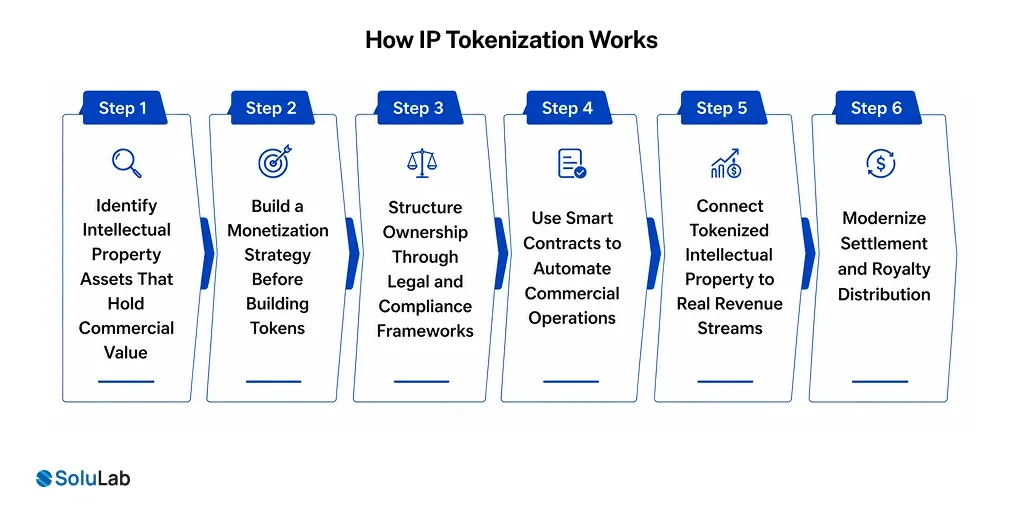
Many founders assume intellectual property tokenization starts with minting a token.
It doesn’t.
Successful tokenization of intellectual property starts long before a smart contract is deployed.
The most successful tokenized intellectual property projects combine legal ownership, compliance frameworks, smart contracts, payment infrastructure, and monetization models into a single ecosystem.
This is why enterprises investing in intellectual property tokenization services focus on business architecture first and blockchain architecture second.
Step 1: Identify Intellectual Property Assets That Hold Commercial Value
Not every intellectual property asset is worth tokenizing.
The strongest intellectual property tokenization projects begin with assets that already generate revenue or have a clear path to commercialization.
Common examples include:
- Patent portfolios
- Software licensing rights
- Copyright-protected content
- Trademarks and brand assets
- Proprietary AI models
- AI training datasets
- Research and pharmaceutical IP
- Trade secrets with measurable commercial value
Before launching an intellectual property tokenization platform, enterprises typically evaluate:
- Ownership rights
- Existing licensing agreements
- Revenue potential
- Market demand
- Regulatory considerations
The goal is simple: identify intellectual property assets that can evolve from static legal holdings into revenue-generating digital assets.
Step 2: Build a Monetization Strategy Before Building Tokens
One of the biggest mistakes businesses make is focusing on token creation instead of value creation.
Investors do not buy tokens.
They buy exposure to future economic value.
This is why leading IP tokenization projects begin with a monetization framework.
For example:
- A biotech company may tokenize future licensing rights tied to a patented drug discovery.
- A SaaS company may tokenize future subscription revenue from a proprietary software platform.
- An AI company may use AI native IP tokenization to monetize exclusive training datasets.
- A global brand may tokenize trademark licensing rights across multiple regions.
The token becomes valuable because it represents participation in a revenue-generating asset.
This approach is one of the primary reasons intellectual property tokenization is increasingly being discussed alongside fund tokenization, private equity tokenization, and debt tokenization initiatives.
Step 3: Structure Ownership Through Legal and Compliance Frameworks
This is where enterprise-grade intellectual property tokenization differs from early blockchain experiments.
A token without legal backing is simply a digital record.
A token connected to enforceable ownership rights becomes an investable asset.
Most organizations pursuing tokenization of IP assets establish:
- Legal wrappers
- Special Purpose Vehicles (SPVs)
- Trust structures
- Licensing entities
These structures connect blockchain ownership to legally recognized intellectual property rights.
This “Rules Before Rails” approach gained significant attention at the Dubai RWA Summit 2026, where regulators and institutional investors emphasized that compliance must be established before tokenization infrastructure is deployed.
For enterprises, this is no longer optional.
It is becoming the standard.
Step 4: Use Smart Contracts to Automate Commercial Operations
This is where blockchain intellectual property starts delivering measurable business value.
Traditional intellectual property management often involves:
- Lawyers
- Licensing agencies
- Payment processors
- Administrative teams
- Auditors
The process is slow.
Expensive.
And often fragmented.
Through intellectual property tokenization, smart contracts automate many of these activities.
They can automatically:
- Execute licensing agreements
- Allocate royalties
- Verify ownership transfers
- Manage compliance rules
- Process revenue distributions
- Enforce governance rights
Instead of spending months reconciling royalty payments, enterprises can automate the entire process.
This is one of the key reasons many organizations pursue intellectual property tokenization solutions as part of broader digital transformation initiatives.
Step 5: Connect Tokenized Intellectual Property to Real Revenue Streams
The token itself is not the innovation. The revenue engine behind it is.
One of the strongest examples comes from Molecule, a decentralized science platform that introduced Intellectual Property Tokens (IPTs).
Rather than simply creating blockchain-based intellectual property for scientific research… Molecule-enabled intellectual property rights associated with biomedical discoveries to be tokenized and funded through global communities.
Through collaborations with VitaDAO, researchers gained access to alternative funding sources while maintaining transparent ownership and commercialization frameworks around their research assets.
The outcome? Research teams gained access to capital.
Investors gained exposure to future commercialization opportunities.
Intellectual property assets became a more liquid and accessible asset class.
The same model is now being explored across:
- Biotechnology
- Artificial Intelligence
- Software Development
- Manufacturing
- Media and Entertainment
A software company can tokenize future licensing revenue.
An AI company can tokenize proprietary datasets.
A pharmaceutical organization can tokenize rights associated with drug development programs.
The possibilities continue expanding as tokenized intellectual property adoption grows.
Step 6: Modernize Settlement and Royalty Distribution
Historically, intellectual property licensing has suffered from one major problem.
Settlement delays.
Royalty payments often require multiple intermediaries, cross-border banking systems, legal reviews, and administrative reconciliation.
Payments can take months.
Sometimes longer.
This is the “broken process” many institutional leaders are trying to eliminate.
Organizations are increasingly integrating tokenized intellectual property with programmable payment infrastructure.
A growing example is Circle’s ecosystem, where solutions such as USDC, Circle Payments Network (CPN), and StableFX are helping modernize how digital assets move across global markets.
For tokenized IP assets, this creates the possibility of:
- Near-instant royalty distribution
- Cross-border settlements
- Multi-currency payouts
- Automated revenue sharing
- Reduced administrative costs
Instead of waiting 90 to 180 days for licensing revenue to arrive, stakeholders can receive distributions automatically when predefined conditions are met.
That is a massive shift in how intellectual property monetization works.
Which Industries Are Leading the Adoption of Intellectual Property Tokenization?
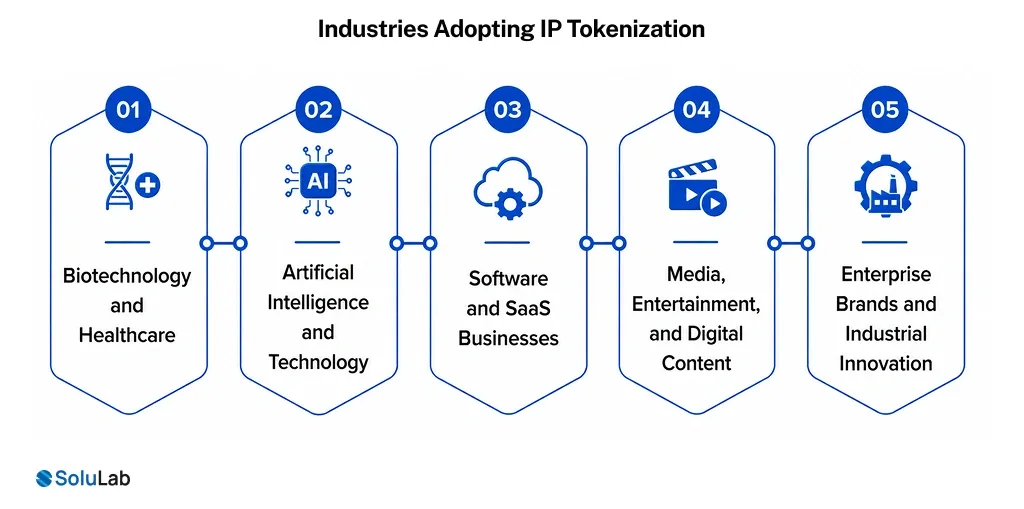
The growth of intellectual property tokenization is being driven by industries that hold high-value intellectual property assets but face challenges around liquidity, licensing, commercialization, and capital access. As tokenized intellectual property moves into mainstream finance, several sectors are emerging as early winners.
1. Biotechnology and Healthcare
Bringing a new drug to market can cost more than $1 billion and take 10 to 15 years, making biotechnology one of the most capital-intensive industries in the world. Through the tokenization of intellectual property, these assets can become investable much earlier.
Key opportunities include:
- Raising non-dilutive capital for research
- Fractionalizing patent ownership
- Accelerating commercialization timelines
- Expanding global investor participation
- Creating transparent licensing frameworks
A strong example is Molecule, which introduced Intellectual Property Tokens (IPTs) for scientific research. Through collaborations with VitaDAO, biomedical projects have secured community-driven funding while maintaining clear ownership and licensing rights around their intellectual property assets.
2. Artificial Intelligence and Technology
AI companies own some of the world’s fastest-growing intellectual property assets, including proprietary models, training datasets, algorithms, and source code.
Through AI native IP tokenization, organizations can:
- Monetize proprietary AI datasets
- Tokenize future licensing revenues
- Track AI ownership and provenance
- Automate royalty distribution
- Create new funding mechanisms without equity dilution
Infrastructure providers such as Google Cloud are helping support blockchain intellectual property ecosystems by enabling secure oracle integrations that verify off-chain AI usage and trigger automated smart contract payments.
3. Software and SaaS Businesses
Software companies are increasingly using intellectual property tokenization to unlock value from recurring licensing revenues and proprietary technology.
SaaS businesses frequently derive over 70% of enterprise value from intellectual property assets such as source code, APIs, algorithms, and proprietary workflows.
Benefits include:
- Monetizing software licensing rights
- Creating IP-backed tokens
- Generating liquidity from recurring revenue
- Supporting global investor participation
- Preserving founder ownership
This aligns closely with the emerging “Non-Dilutive IPO” model, where businesses raise capital against intellectual property assets rather than selling company equity.
4. Media, Entertainment, and Digital Content
The entertainment industry has evolved beyond NFT collectibles and is now exploring tokenized intellectual property as a long-term monetization model.
Organizations can:
- Tokenize music royalties
- Fractionalize content ownership
- Automate royalty payments
- Improve licensing transparency
- Build new fan-investor ecosystems
Platforms such as Royal.io allow artists to tokenize music rights, while Ethernity helps creators monetize digital intellectual property through blockchain-based ownership models.
5. Enterprise Brands and Industrial Innovation
Many global enterprises own valuable trademarks, patents, and proprietary technologies that remain underutilized.
Through intellectual property tokenization solutions, organizations can:
- Automate trademark licensing
- Create global licensing marketplaces
- Monetize dormant patents
- Expand access to institutional investors
- Improve intellectual property management
Companies such as Securitize are helping enterprises launch compliant tokenized intellectual property offerings using institutional-grade standards such as ERC-3643 and regulated secondary market infrastructure.
The common theme across every sector is simple: intellectual property assets are no longer being viewed as static legal documents.
Through tokenizing IP, businesses are transforming patents, trademarks, copyrights, software, and AI assets into liquid, programmable, and revenue-generating digital assets.
Where Does the ROI From Intellectual Property Tokenization Come From?
A single factor rarely drives the return on investment from intellectual property tokenization. Instead, businesses typically benefit from a combination of improved liquidity, capital access, operational efficiency, and faster commercialization.
| Business Area | Traditional Approach | After intellectual property tokenization |
| Capital Raising | Debt financing or equity dilution | Raise capital through IP-backed tokens without giving up company ownership |
| Patent Commercialization | Long negotiations with a limited buyer pool | Global investor and licensing access through tokenized intellectual property |
| Royalty Distribution | Manual processing through multiple intermediaries | Automated payouts through smart contracts |
| Licensing Operations | Contract-heavy and administrative | Programmable intellectual property licensing with built-in compliance |
| Investor Access | Limited to institutional buyers | Fractional ownership opens participation to a broader investor base |
| Settlement Time | Weeks or months for cross-border payments | Near real-time settlements through modern payment infrastructure |
| Asset Liquidity | Intellectual property assets remain largely illiquid | Tradable and transferable tokenized IP assets |
For founders, the impact often extends beyond direct revenue generation.
The biggest gains usually come from:
- Unlocking value from dormant intellectual property assets
- Creating new monetization channels
- Reducing licensing administration costs
- Accelerating commercialization timelines
- Accessing global capital markets without traditional fundraising constraints
A software company can monetize future subscription revenues. A biotech startup can fund patent commercialization before a product reaches the market. An AI company can generate value from proprietary datasets through AI native IP tokenization.
Is Your IP Ready for Tokenization?
Not every intellectual property asset is a strong candidate for tokenization. Before investing in an intellectual property tokenization platform, founders should evaluate whether their IP can support sustainable investor interest and ongoing monetization.
Strong candidates for tokenization typically include:
- Patent portfolios with licensing potential
- Proprietary software and SaaS platforms
- AI models and exclusive datasets
- Trademark licensing programs
- Research and pharmaceutical intellectual property
- Media catalogs and royalty-generating content
If an asset already generates revenue, attracts licensing interest, or solves a meaningful market problem, it often becomes an ideal foundation for tokenized ownership structures.
Organizations exploring tokenization are increasingly combining these assets with broader initiatives such as fund tokenization and private equity tokenization. This is to create new capital formation opportunities around innovation-driven businesses.
The key question is no longer whether an asset can be tokenized.
The real question is whether the asset can generate long-term value for future stakeholders.
How is SoluLab Helpful for Your IPTokenization?
The tokenization of intellectual property is changing how creators and businesses manage, protect, and monetize their IP assets. By converting IP into digital tokens on a blockchain, ownership becomes more transparent, divisible, and tradable.
This not only opens doors for fractional ownership and global investment but also simplifies licensing and royalty distribution.
For Indian and overseas innovators, startups, and content creators, tokenization offers a powerful opportunity to unlock the true value of their creations.
SoluLab, a top asset tokenization development company in USA, can help you tokenize assets securely.
With our 11 years of tokenization expertise, we are here to offer you multiple integrations and services within your budget and requirements.
Contact us today to discuss further.
FAQs
Deepika is a content writer who blends storytelling with strategic thinking. She explores topics across digital innovation, emerging tech, and the evolving blockchain industry. She enjoys breaking down complex ideas into simple, engaging narratives in the growing global markets.