Key Takeaways
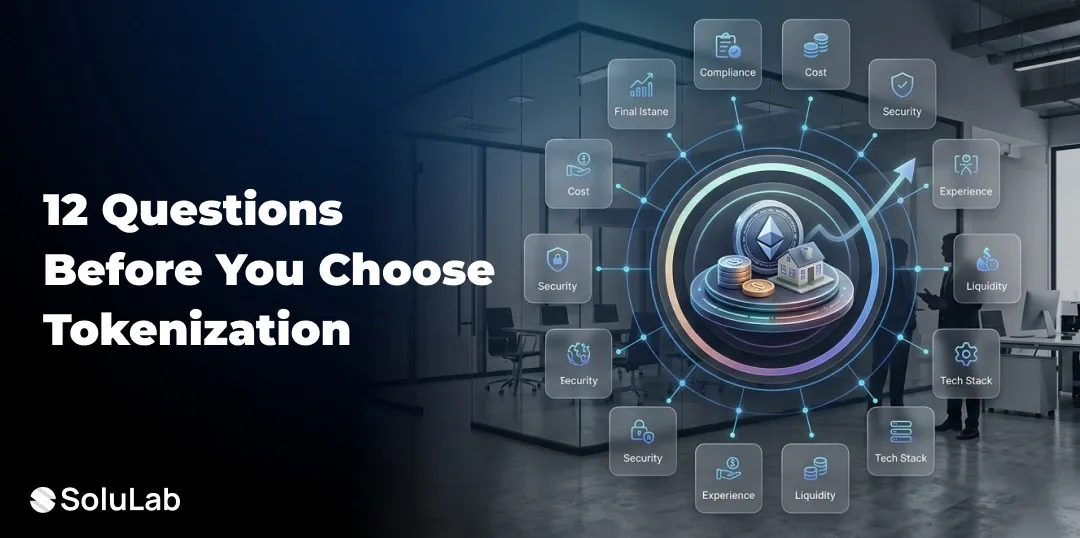
- The right tokenization consulting company directly impacts ROI, compliance, and scalability; not just implementation speed.
- Asking the right 12 questions helps identify gaps in strategy, security, and long-term viability before committing.
- A strong partner offers end-to-end solutions—from consulting and roadmap design to platform development and integration.
- Compliance, data security, and regulatory readiness are non-negotiable in any tokenization strategy.
- AI-led tokenization platforms can unlock faster liquidity, automation, and smarter asset management.
- SoluLab combines tokenization consulting with AI development and enterprise-grade platform building, helping businesses reduce risk and accelerate time-to-market.
The era of “blockchain for blockchain’s sake” is over. Now, the digital asset landscape has matured into a sophisticated ecosystem dominated by Real-World Asset (RWA) tokenization.
Whether you are looking to unlock liquidity in commercial real estate, fractionalize private equity, or digitize high-yield debt instruments, the success of your project hinges entirely on the foundational strategy laid out by your tokenization consulting company.
Also, your tokenization roadmap is more than a timeline; it is a complex blueprint that must harmonize technical architecture, global legal frameworks, and commercial viability.
Unfortunately, the market is still flooded with providers who offer generic solutions that fail under regulatory scrutiny or technical stress. Therefore, before you jump into the partnership, ask these 12 questions to your tokenization consulting company and ensure 100% enriched development.
Why Most Tokenization Roadmaps Fail Before They Even Launch?
There are several reasons why even the enhanced tokenization platform development roadmaps fail during implementation. But the main reason starts with technology and strategy follow-up. Common pitfalls include:
- Regulatory Blind Spots: Failing to account for jurisdiction-specific securities laws (e.g., MiCA in Europe or SEC guidelines in the US).
- Liquidity Deserts: Building a token without a clear path to secondary market trading.
- Operational Silos: Creating a digital asset that cannot “talk” to existing banking or custody systems.
Industrial Example: The TradeLens Shutdown
The TradeLens (IBM and Maersk) project was closed in 2023 because it couldn’t achieve the necessary global regulatory and stakeholder consensus across different jurisdictions.
Also, it is unable to adopt the industrial standards and local support.
To avoid these traps, use the following checklist to vet your tokenization strategy consulting partner.
If you want to clarify your thoughts about RWA tokenization, we have already answered 80 questions for you. To read the answers, click here

List of Questions You Must Ask the Tokenization Consulting Company
Common breakdowns include regulatory gaps, poor liquidity planning, and disconnected systems. Without a structured tokenization consulting process, even technically sound projects fail to scale or sustain. Let’s see how you can mend them in the initial stage itself.
Question 1. Which blockchain/platform and token standards will be used, and why?
Answer: When you ask this question, one should first give you options and then tell you the best, and let you choose what’s in your budget. This tokenization roadmap helps you build your visionary platform.
- Blockchain selection clarity: Whether public, private, or hybrid, the choice must align with transaction volume, cost, and governance needs.
- Token standards alignment: Standards like ERC-1404 or ERC-3643 should match regulatory and asset requirements.
- Performance and scalability evaluation: The platform must handle future growth without re-architecture.
A well-defined answer ensures your blockchain-powered tokenization roadmap is future-ready and avoids technical limitations that could disrupt your asset tokenization services later.
Question 2. How are identity and compliance features integrated into the token design (KYC/KYB checks, transfer rules, sanctions screening)?
Answer: When you reach a tokenization consultancy, they must ask for your location and tell you the compliance details. And then they should align the strong tokenization compliance services with your platform.
- KYC/KYB integration: Identity verification should be automated and enforced before transactions.
- Transfer restrictions: Smart contracts must restrict transfers based on eligibility and jurisdiction.
- Sanctions screening: Integration with compliance tools ensures regulatory adherence.
- On-chain and off-chain coordination: Compliance rules should work seamlessly across systems.
This approach ensures your project aligns with legal considerations in tokenization projects while reducing operational risks.
Question 3. How will the token solution or white-label tokenization platform integrate with existing systems (custody, investor portals, back-office systems)?
Answer: When you ask about integrating any particular technology, AI agents, or any kind of analytical tools to your existing tokenization platform, a good consulting partner should also tell you whether a custom build or a white-label tokenization platform makes more sense for your timeline and budget.
- System interoperability: Integration with custody, CRM, and financial systems is essential.
- API-driven architecture: Seamless communication between on-chain and off-chain systems.
- Data synchronization: Real-time updates to avoid reconciliation issues.
- Operational workflow alignment: Ensures smooth investor onboarding and reporting.
- White-label deployment flexibility: A ready tokenization platform should support faster launch, easy branding, and simple integration with your existing systems.
Without proper integration planning, even advanced enterprise RWA solutions fail to deliver value due to gaps in the tokenization implementation strategy.
Question 4. What is the plan for interoperability and future scalability (multi-chain strategy, upgradability)?
Answer: Nowadays, it’s about how many blockchains a platform can support. To gain this scalability, your tokenization platform development company must express the following services.
- Multi-chain readiness: Ability to expand across multiple blockchains.
- Upgradeable smart contracts: Ensures adaptability without disruption.
- Performance optimization: Handles increasing transaction loads efficiently.
- Future-proof architecture: Designed for evolving regulatory and technical changes.
A forward-thinking blockchain development approach strengthens your tokenization roadmap for businesses and positions your platform for long-term growth.
Question 5. What legal/jurisdictional structure will be used to issue and manage tokens (e.g. SPVs, master registrar)?
Answer: Legal structuring defines how tokenized assets are recognized and enforced. Reliable real-world asset tokenization consulting ensures compliance with best practices.
- SPV structuring: Establishes legal ownership frameworks.
- Jurisdiction selection: Based on tax efficiency and regulatory clarity.
- Ownership mapping: Aligns token ownership with legal rights.
- Documentation readiness: Legal agreements must support token issuance.
This ensures your tokenized assets remain enforceable and aligned with global asset tokenization best practices.
Read more – Launch a Real Estate Tokenization Platform
Question 6. How will regulatory compliance be managed (securities laws, exemptions, licensing, data privacy)?
Answer: You must ask this question as the global regulations are changing rapidly. In-built compliance is a must. Your tokenization consulting company must give a detailed answer for this.
- Jurisdiction-specific compliance: Covers SEC, MiCA, MAS, and other frameworks.
- Licensing and exemptions: Identifies applicable regulatory pathways.
- Data privacy alignment: Ensures GDPR and regional compliance.
- Ongoing monitoring: Keeps the platform compliant post-launch.
A detailed compliance strategy reduces legal risks and strengthens your enterprise-grade RWA tokenization consulting approach.

Question 7. What rights and obligations are defined for token holders (voting, dividends, redemption)?
Answer: The rights of the investor and token holders must be clearly defined by the custom token development company.
- Economic rights clarity: Includes dividends, profit sharing, or yield.
- Governance rights: Voting mechanisms for decision-making.
- Redemption rules: Defines exit and liquidity mechanisms.
- Smart contract enforcement: Automates rights execution.
This ensures that your custom solutions deliver tangible value aligned with practical tokenization use cases in business.
Question 8. How will KYC/AML and sanctions compliance be enforced in practice?
Answer: Operational compliance ensures your platform functions legally across regions. A mature tokenization consulting process embeds compliance into workflows.
- Onboarding workflows: Structured KYC/KYB verification steps.
- Transaction monitoring: Detects suspicious activity in real time.
- Sanctions checks: Automated screening against global lists.
- Audit trails: Maintains compliance records for regulators.
This approach ensures alignment with legal considerations in asset tokenization platforms while maintaining operational efficiency.
Question 9. What specific business objectives and ROI justify tokenization (e.g. liquidity improvement, new investor segments)?
Answer: Tokenization must deliver measurable business value. A strong strategy aligns outcomes with your tokenization roadmap for businesses.
- Liquidity enhancement: Enables fractional ownership and trading.
- Investor expansion: Access to global and retail investors.
- Cost efficiency: Reduces intermediaries and settlement time.
- Revenue growth: Unlocks new monetization models.
A clear ROI framework ensures your tokenization as a service for businesses is commercially viable and strategically sound.
Read more – RWA Legal Consulting Services
Question 10. What governance model and roles will oversee the tokenization program?
Answer: Governance ensures accountability and smooth execution. Reliable enterprise tokenization solutions require structured oversight from a capable partnership.
- Defined roles and responsibilities: Clear ownership across teams.
- Decision-making frameworks: Ensures timely approvals.
- Compliance oversight: Monitors regulatory adherence.
- Conflict resolution mechanisms: Prevent operational delays.
Strong governance enhances execution efficiency and ensures long-term success.
Question 11. What is the consultant’s experience and track record with similar projects?
Answer: Experience reduces risk and improves execution quality. A credible blockchain consulting company with proven results is essential.
- Case studies and references: Demonstrates past success.
- Industry-specific expertise: Experience in similar asset classes.
- Technical capability: Proven delivery of complex solutions.
- Regulatory exposure: Familiarity with compliance frameworks.
Choosing an experienced RWA tokenization development company ensures smoother implementation and fewer surprises.
Question 12. How will security (key management, custody) and ongoing operations be handled post-launch?
Answer: Security and operations define long-term sustainability. Strong AI-native strategy, analysis, and predictive tokenization tools help you in fraud detection. This is the only possible way with a consulting service to ensure reliability in tokenization platform development.
- Key management systems: Secure storage using MPC or HSM.
- Custody solutions: Protects digital assets effectively.
- Audit mechanisms: Regular smart contract and system audits.
- Operational readiness: Incident response and monitoring systems.
A well-planned operational strategy ensures your platform remains secure, scalable, and reliable post-launch.
How to Evaluate Tokenization Consultancy Company Answers and Choose the Right Partner?
When reviewing the responses from a tokenization consulting company, look for depth rather than buzzwords. A good answer mentions specific protocols and legal precedents. A great answer provides a tokenization roadmap checklist that anticipates problems and their solutions before they occur in your RWA tokenization launch process.
| Factor | Red Flag | Green Flag |
| Blockchain Choice | Whatever you prefer. | We recommend X because of Y gas efficiency and Z compliance standard. |
| Legal | We’ll handle that later. | Here is a list of partner law firms and a draft SPV structure. |
| Security | Our code is perfect. | We require two third-party audits and use a hardware security module (HSM). |
| Integration | It works via the cloud. | We provide a RESTful API and Webhooks for your existing ERP system. |
There is a saying that a company is a green flag when they give you options instead of telling you what the best is.

Conclusion
Therefore, from the above discussion, you might have understood what to ask the tokenization consultation company. Now it’s time you implement them and get the best suggestions from an expert RWA tokenization development company.
The benefits of working with the right tokenization consulting company, like SoluLab, are:
- Better legal and compliance planning
- Faster and smoother platform rollout
- Stronger investor trust and transparency
- Easier integration with existing systems
- Long-term scalability and security
As tokenization transitions from a trend to a business infrastructure, the real advantage lies in preparation. Contact us today to bring your tokenization goal into view!
FAQs
Deepika is a content writer who blends storytelling with strategic thinking. She explores topics across digital innovation, emerging tech, and the evolving blockchain industry. She enjoys breaking down complex ideas into simple, engaging narratives in the growing global markets.