Tokenization is no longer a future concept. Enterprises across finance, real estate, supply chain, and digital assets are actively exploring it. Yet most tokenization initiatives never move beyond presentations, pilots, or half-built proofs of concept.
The reason is simple. Teams jump straight into blockchain development without validating the business logic, regulatory readiness, or real user demand.
A tokenization MVP is not about launching a full platform. It is about proving one clear value with the least possible complexity. When done right, it becomes the foundation for scalable growth, faster adoption, and investor confidence.
This roadmap breaks down the six critical decisions that separate tokenization MVPs that grow from those that quietly stall.
Key Takeaways
- The problem: Most tokenization MVPs fail to scale because teams rush builds without validating assets, users, or compliance.
- The solution: A roadmap that balances speed, security, and future compliance from day one.
- How SoluLab helps: SoluLab builds tokenization MVPs that evolve into production-ready platforms—secure, compliant, and designed for measurable growth, not just demos.
Why Most Tokenization Ideas Fail Before the MVP Stage?
Many tokenization ideas sound strong in theory, but collapse during execution. The problem is rarely technology. It is decision-making.
Common reasons tokenization MVPs fail
- Starting with blockchain selection instead of business validation
- Tokenizing assets that have no real liquidity or demand
- Ignoring compliance until late development stages
- Overbuilding features instead of testing core value
- Choosing tools that cannot scale beyond MVP
The MVPs are frequently viewed by enterprises as mini platforms. This results in increased expenses, extended periods, and ambiguous results.
The question that is answered well by a successful data tokenization MVP is as follows: Does this tokenized asset bring about tangible business value today?
Defining the Right Tokenization Use Case Before You Write Code
This decision is the most significant among all the decisions on the roadmap. The enterprises should establish the reason why the tokenization is necessary, and what issue this solves, before any development has been made.
Most tokenization MVPs lack effectiveness due to the fact that the teams leap into building without outlining the asset, the use of asset tokenization, and the end business result. The ability to create a powerful tokenization MVP development process always starts with use-case clarity.
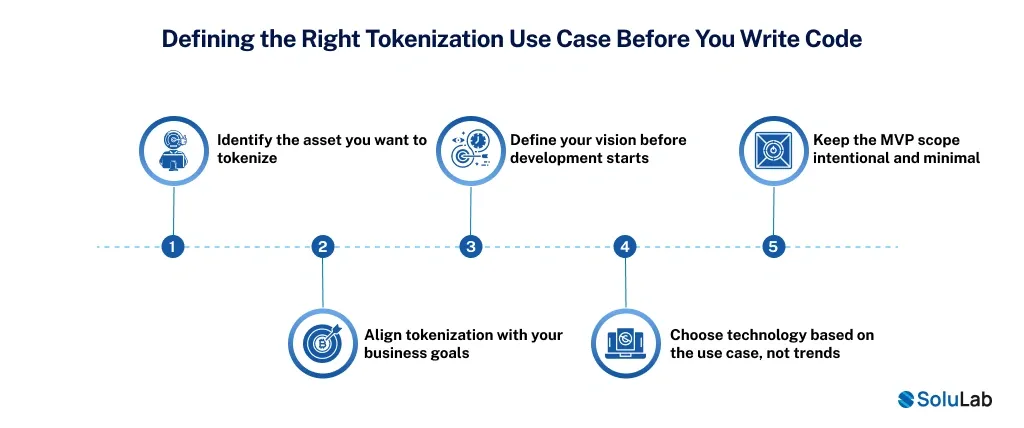
- Identify the asset you want to tokenize
The first step is deciding what asset you are tokenizing. This could be a digital asset, real estate, commodities, fine art, securities, or even operational data. Not every asset is suitable for tokenization, especially at the MVP stage.
The asset you choose must be easy to digitize and capable of maintaining a clear one-to-one link between the real-world value and its digital representation. If users cannot trust that connection, adoption becomes difficult.
From a business perspective, the asset should:
- Solve a real market problem
- Have existing or potential demand
- Benefit from improved liquidity, transparency, or automation
This decision sets the direction for your entire build tokenization MVP journey.
- Align tokenization with your business goals
Once the asset is clear, the next step is aligning tokenization with your business objectives. Tokenization should not exist as a standalone innovation experiment. It should directly support revenue growth, operational efficiency, or market expansion.
Ask practical questions early:
- Who will use this tokenized asset?
- What value does tokenization unlock that traditional systems cannot?
- How does this MVP support long-term growth?
A focused use case helps enterprises avoid overbuilding and ensures that early investment in blockchain MVP development delivers measurable results.
- Define your vision before development starts
A vision is something that creates trust, particularly with token systems. Businesses, stakeholders, and investors would like to know the direction the platform is taking, not only where it is today.
This vision should be supported by:
- A practical business plan indicating how to be in the market and how to expand.
- Proper documentation on how the platform works and how it will improve with time.
When the users are able to see stability and predictability, then it is more likely to make the engagement long-term in lieu of considering the project as a short opportunity.
- Choose technology based on the use case, not trends
Technical decisions are automatically driven by the right use case. The choice of Ethereum, Solana, or another blockchain is determined by such factors as the volume of transactions, compliance requirements, the type of asset, and the support of the ecosystem.
At this point, it is not necessary to develop all the technicalities, but to verify that the selected path can be flexible, secure, and compliant. This model enables tokenization solutions of enterprises to expand beyond MVP without significant redesigns.
- Keep the MVP scope intentional and minimal
A tokenization MVP should validate one core idea. It does not need every feature from day one.
Focus on:
- Asset creation and ownership logic
- Controlled transfer or access
- Basic compliance readiness
This keeps development lean and helps teams test real-world demand quickly. Experienced tokenization development services providers often stress that clarity at this stage saves months of rework later.
How to Choose the Blockchain Stack That Won’t Limit Your MVP Later?
Technology decisions made during MVP often decide whether scaling is easy or painful. The goal is not to choose the most popular blockchain. It is necessary to choose the most appropriate one.
- Public vs private vs hybrid blockchains
- Public blockchains work well for transparency and liquidity
- Private blockchains suit internal enterprise workflows
- Hybrid models balance compliance with openness
Your MVP should align with regulatory expectations, data sensitivity, and long-term adoption plans.
- Token standards and flexibility
Select standards that are widely supported and upgrade-friendly. This ensures future integrations with wallets, exchanges, and compliance tools.
Poor early decisions here often force complete rewrites later.
- Infrastructure and tooling maturity
For enterprises using blockchain MVP development services, the ecosystem matters as much as the chain itself.
Look for:
- Stable development frameworks
- Wallet and custody integrations
- Audit-ready smart contract tooling
- Active developer support
A flexible stack keeps your MVP lean while allowing future expansion.
How to Develop a Tokenization MVP That Suits Your Business Requirement?
Business logic should never be developed without coming up with a development plan. MVP is a compromise between speed, security, and usability.
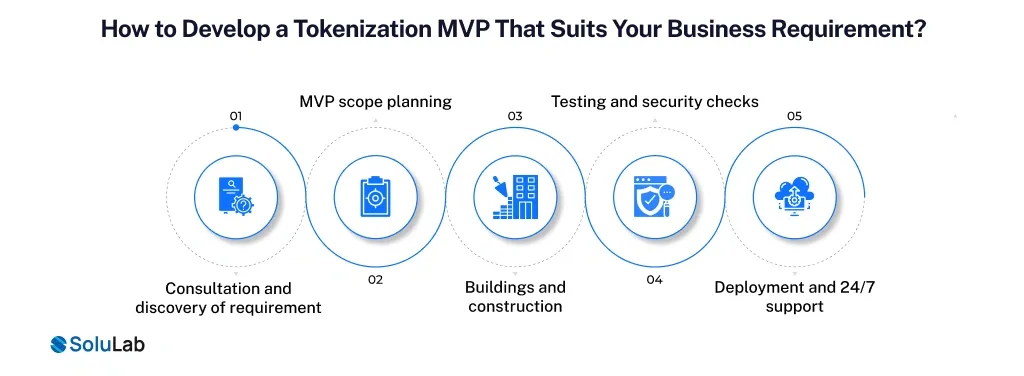
- Consultation and discovery of requirements.
Any winning tokenization MVP starts with extensive consultation. This involves knowledge of your type of asset, business objectives, compliance requirement as well as target users. Clear requirements prevent unnecessary features and minimize the risk of development beforehand.
- MVP scope planning
After defining requirements, it becomes necessary to determine what will and what will not be included in the MVP. There are only essential features, which are prioritized to ensure the validation of the use case in a fast and cost-saving way.
- Buildings and construction
The development team devises a portable and safe architecture that is in tandem with your business workflow. Integrations and token logic, as well as smart contract development, all constructed in a way that allows scaling in the future.
- Testing and security checks
The MVP is also tested in terms of functionality, security, and performance to guarantee reliability on the first day of launch.
- Deployment and 24/7 support
Once deployed, it will be monitored continuously, upgraded and 24/7 support will guarantee it runs smoothly and issues are resolved fast.
This approach is common among expert tokenization platform development services providers who build MVPs meant to grow.
Regulatory, Custody, and Security Decisions You Can’t Postpone
Compliance is not optional in tokenization. It is foundational.
Ignoring it early leads to stalled launches, investor hesitation, or forced redesigns.
Regulatory readiness
Even MVPs must align with applicable laws. This includes:
- Asset classification clarity
- Jurisdiction-specific compliance checks
- KYC and AML readiness
- Data privacy considerations
Enterprises should involve legal and compliance teams before MVP development starts.
Custody and asset control
Decide early how assets and private keys are managed. Common models include:
- Self-custody for internal pilots
- Third-party custody for regulated assets
- Hybrid custody for controlled access
Custody choices directly impact trust and scalability.
Security and audits
Smart contracts do not need to be complex to be risky. At the MVP stage:
- Use well-tested libraries
- Limit contract functionality
- Plan for external audits before public exposure
Security builds confidence among stakeholders and investors, especially for enterprise tokenization solutions.
Conclusion
From the above discussion, you can gain all the insights on tokenization MVP when built with the right use case, lean scope, compliant design, and scalable technology. Enterprises that succeed treat MVPs as strategic assets, not side projects. They build small, learn fast, and expand with confidence.
Whether you are exploring asset tokenization, launching a regulated product, or modernizing legacy systems, a well-planned MVP sets the tone for everything that follows.
Choosing the right tokenization platform development company, like SoluLab, can significantly reduce risk, time, and cost. While ensuring your MVP is ready for real-world adoption.
FAQs
Deepika is a content writer who blends storytelling with strategic thinking. She explores topics across digital innovation, emerging tech, and the evolving blockchain industry. She enjoys breaking down complex ideas into simple, engaging narratives in the growing global markets.