Tokenization is no longer a future concept discussed only in innovation labs. It is actively being used by enterprises to modernize how assets are issued, managed, and transferred. From funds and treasuries to private credit and infrastructure assets, businesses are exploring blockchain as a more efficient financial rail.
As of late 2024, Polygon hosts over $1.1 billion worth of tokenized real-world assets, spread across 270+ live tokenized instruments, making it one of the most active public blockchains for enterprise-grade tokenization. Its low transaction costs, Ethereum compatibility, and growing institutional ecosystem make it suitable for real-world asset use cases, not just crypto-native experiments.
This blog explores tokenization on Polygon from a business perspective. We look at how it works and what assets are being tokenized today. Moreover, what enterprises should consider before starting, how development typically happens, and how Polygon-based tokenization can unlock new growth opportunities.
Key Takeaways
- The problem: High gas fees and slow transaction speeds on legacy blockchains make large-scale tokenization economically unviable.
- The solution: Polygon delivers low-cost, high-speed, and scalable tokenization without compromising Ethereum security.
- How SoluLab helps: SoluLab leverages Polygon to build cost-efficient, scalable tokenization platforms, eventually helping businesses launch faster, control operational costs, and maximize ROI from day one.
What Is Tokenization on Polygon and How Does It Work?
Tokenization on Polygon refers to converting ownership rights of real-world or financial assets into digital tokens secured by the Polygon blockchain. Each token represents a defined economic interest, such as a share in a fund, a unit of debt, or a claim on an underlying asset.
At a technical level, asset tokenization on Polygon relies on smart contracts that define:
- ownership rules
- transfer conditions
- compliance constraints
- redemption or settlement logic
Because Polygon is compatible with Ethereum standards, these smart contracts use familiar token formats while benefiting from lower fees and faster confirmation times.
The joint publication, titled “RWA REPORT 2025,” offers a comprehensive look into the tokenized asset landscape, which it states has grown 224% since the start of 2024. The report identifies several key trends driving this expansion.
From an enterprise viewpoint, the process works as follows:
- The real-world asset is legally structured off-chain
- A token model mirrors that structure on-chain
- transactions and lifecycle events are handled programmatically
This combination allows businesses to automate processes that traditionally rely on intermediaries, paperwork, and delayed settlement.

What Types of Assets Are Being Tokenized on Polygon?
Tokenized assets on Polygon are no longer limited to experimental pilots. Several asset classes are already live and in use, especially in regulated or semi-regulated environments.
1. Financial Instruments and Funds
A growing share of real-world asset tokenization on Polygon involves multiple factors, as given below:
- tokenized money market funds
- yield-bearing dollar products
- short-term treasuries
- structured financial instruments
These assets benefit from near-instant settlement and easier distribution across global jurisdictions.
2. Private Credit and Debt
Private credit is another area seeing strong traction. Enterprises are using the Polygon blockchain for asset tokenization to:
- Issue fractional debt instruments
- manage repayments programmatically
- provide transparent reporting to investors
This model reduces operational friction while improving access to capital across the globe, regardless of any regional barrier.
3. Stablecoins and Settlement Assets
Stablecoins remain a foundational use case. Polygon’s low-cost environment makes it suitable for high-volume settlement assets used in payments, payroll, and cross-border transfers.
4. Infrastructure and Alternative Assets
There are also early but growing use cases around:
- infrastructure-backed assets
- energy and mobility projects
- asset-backed tokens tied to real-world operations
These models highlight how Polygon tokenization platforms can support non-traditional asset classes. However, there are still innovations and solutions required across the security aspects of asset tokenization.
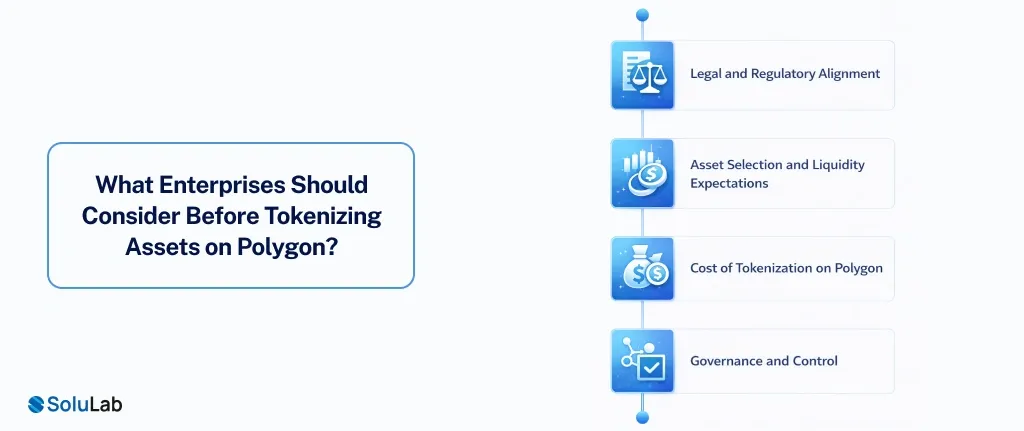
What Enterprises Should Consider Before Tokenizing Assets on Polygon?
While the technology is mature, enterprise adoption requires careful planning beyond smart contracts. Unlike crypto frauds, RWA tokenization is secure, thanks to strict government policies over major dominators of BTC, ETH, stabelcoins and ETFs
1. Legal and Regulatory Alignment
Before launching any enterprise asset tokenization solution, companies must align:
- the legal structure of the asset
- investor rights and disclosures
- jurisdiction-specific compliance requirements
Blockchain simplifies execution, but it does not replace regulatory obligations.
2. Asset Selection and Liquidity Expectations
Not every asset benefits equally from tokenization. Enterprises should evaluate:
- whether fractional ownership adds value
- expected liquidity needs
- Investor demand for on-chain access
Tokenization works best where efficiency and distribution matter.
3. Cost of Tokenization on Polygon
The cost of tokenization on Polygon is generally lower than many alternatives due to:
- minimal transaction fees
- scalable infrastructure
- reusable smart contract components
However, enterprises should still budget for:
- legal structuring
- smart contract development
- platform integration
- compliance tooling
The total cost depends more on business complexity than on blockchain fees.
4. Governance and Control
Tokenized assets often require governance mechanisms such as:
- role-based access
- transfer restrictions
- upgrade paths for contracts
Polygon’s flexibility supports these requirements when designed correctly.
How to Develop a Tokenized Asset on Polygon Step by Step?
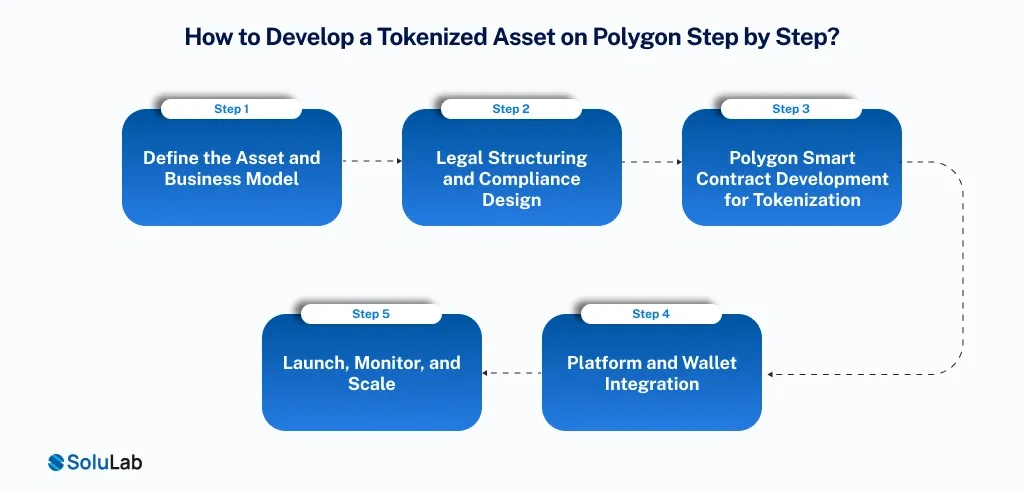
The steps to tokenize assets on Polygon typically follow a structured approach, especially for enterprise use cases.
Step 1: Define the Asset and Business Model
This includes identifying:
- asset type and value mechanics
- investor rights
- lifecycle events such as issuance, yield, or redemption
Clarity here avoids costly redesign later.
Step 2: Legal Structuring and Compliance Design
Before any code is written, enterprises establish:
- legal wrappers
- compliance logic
- investor eligibility rules
These requirements directly influence smart contract design.
Step 3: Polygon Smart Contract Development for Tokenization
At this stage, Polygon smart contract development for tokenization begins. Developers create:
- token contracts representing ownership
- logic for transfers and restrictions
- integration points for off-chain data
Security audits are essential, especially for financial assets.
Step 4: Platform and Wallet Integration
Enterprises often integrate tokenized assets into:
- investor dashboards
- custody solutions
- accounting and reporting systems
Polygon’s ecosystem supports common enterprise integrations.
Step 5: Launch, Monitor, and Scale
Once live, tokenized assets require:
- ongoing monitoring
- governance updates
- performance analysis
Many companies treat this as a long-term infrastructure investment, not a one-time launch.
The whole lifecycle of developing a tokenization platform on Polygon requires 4 to 12 months, based on your feature requirements.
Read more: Top RWA Tokenization Questions Answered for Enterprises Ask in 2026
How Polygon Tokenization Unlocks New Revenue Streams and Global Reach?
Beyond efficiency, tokenized assets on Polygon create new growth opportunities for enterprises.
Access to Global Capital
Tokenization enables assets to be distributed digitally across borders, reducing dependency on local intermediaries. This expands the potential investor base significantly.
1. Faster Capital Cycles
With near-instant settlement, businesses can:
- reduce capital lock-up
- reinvest faster
- improve cash flow predictability
This directly impacts operational efficiency.
2. Programmable Revenue Models
Smart contracts enable:
- automated yield distribution
- performance-based payouts
- dynamic fee structures
These features are difficult to implement with traditional systems.
3. Product Innovation
Enterprises can design entirely new offerings, such as:
- fractional investment products
- hybrid financial instruments
- on-demand liquidity models
This is where Polygon tokenization platforms move from cost savings to revenue generation.

Conclusion
Tokenization is steadily becoming part of mainstream enterprise finance. Therefore, Polygon has positioned itself as a practical network for this transition. Its combination of scalability, cost efficiency, and Ethereum compatibility makes it suitable for serious asset issuance, not just experimentation. As we discussed its clear, enterprises should step up their game now. To make your vision come true at this point, SoluLab is here to support you.
As an asset tokenization development company, we at SoluLab feature:
- Token Liquidity Management
- API and System Interoperability
- Automated KYC/AML
- Fiat and Digital Payment Support
- Custom Wallet Integration
- Platform Analytics Dashboard
- AI-Based Fraud Detection
And also several other features and solutions across multiple industries.
Tokenization is no longer about “if.” For many enterprises, it is now about how and how soon. Contact us today to ensure your growth.
FAQs
Deepika is a content writer who blends storytelling with strategic thinking. She explores topics across digital innovation, emerging tech, and the evolving blockchain industry. She enjoys breaking down complex ideas into simple, engaging narratives in the growing global markets.