Talk to an Expert

What Are the Business Benefits of Blockchain-as-a-Service?

Blockchain-as-a-Service (BaaS)

Building a blockchain solution from scratch can be a massive headache—high costs, complex infrastructure, and the need for a specialized tech team. For many businesses, these hurdles make blockchain feel out of reach. 

Blockchain is no longer solely connected to Bitcoin and cryptocurrencies. Companies are now seeing how it might lower operating expenses and improve equity. 

The global BaaS market was valued at approximately USD 4.3 billion in 2024 and is projected to reach USD 68 billion by 2030, growing at a CAGR of 58%.

Blockchain is generating major advances in efficiency and accountability across a wide range of sectors, from simplifying government operations to changing contract enforcement. In this blog, we’ll explore what blockchain as a service is, use cases, and more. 

What is Blockchain-as-a-Service?

Blockchain-as-a-Service (BaaS) refers to third-party providers who create and manage cloud-based networks for companies developing blockchain applications. This service is a recent addition to the rapidly growing blockchain technology field. 

While blockchain is most commonly associated with cryptocurrency transactions, its use has expanded to secure various types of transactions. As a result, there is a rising demand for hosting services to support these applications.

How Does the Business Model for Blockchain-as-a-Service Work?

The method via which third parties set up, host, and manage a Blockchain network on account of enterprises is referred to as the blockchain-as-a-service business model. In exchange for payments, the service provider provides the services for setting up blockchain technology and infrastructure.

Blockchain-as-a-service for businesses functions much like a web hosting company in many aspects. It gives clients access to cloud-based tools for creating and hosting smart contracts and Blockchain applications within the provider-managed ecosystem.

In conventional businesses, the BaaS integration offers assistance for resource allocation, bandwidth control, data security features, and hosting needs. The ability of businesses to focus on their core competencies rather than the intricacies of Blockchain operations is the largest effect of BaaS on a company.

Blockchain Development Services

How Organizations are Being Shaped by Blockchain-as-a-Service?

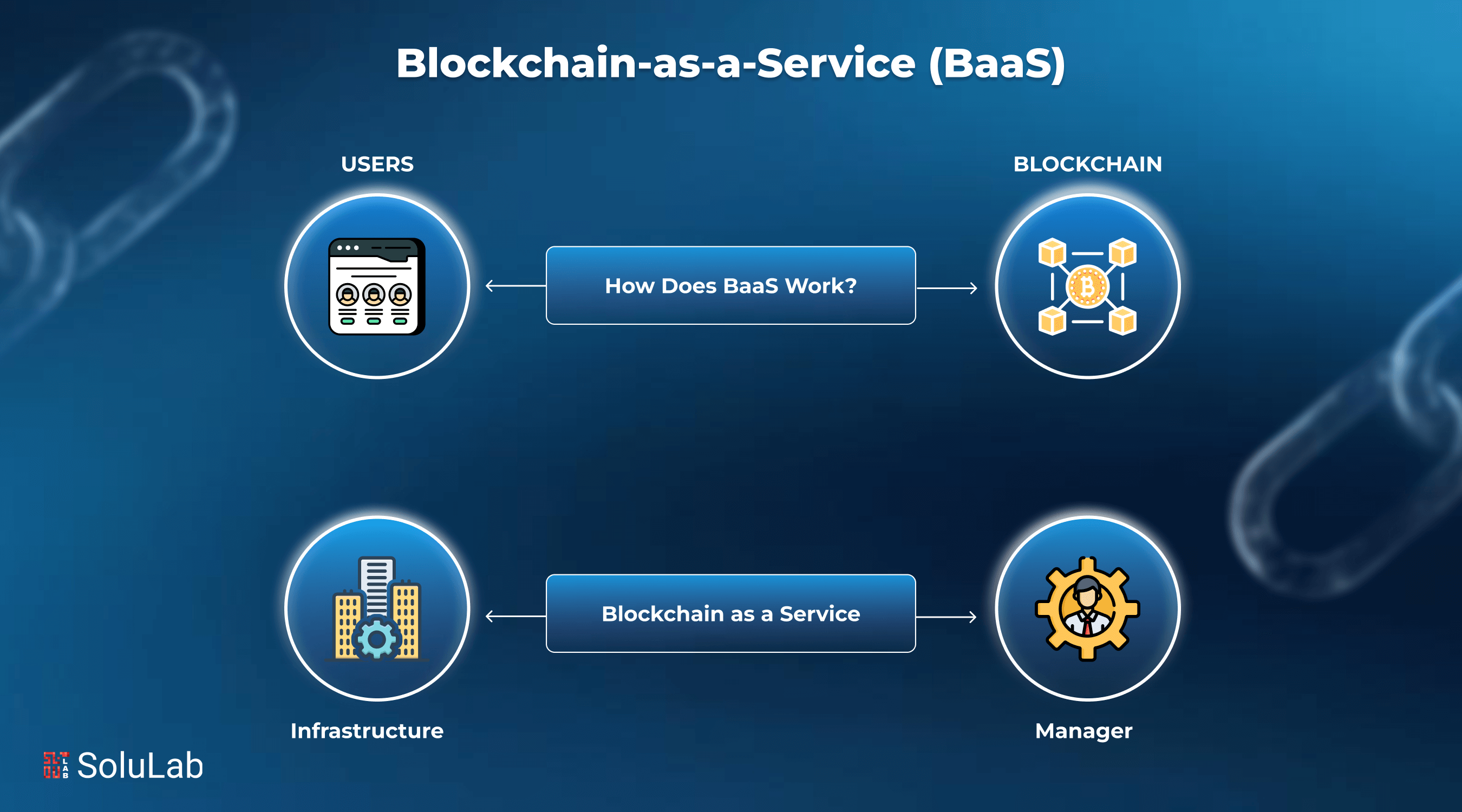
BaaS is transforming businesses with a modern touch. Here’s a breakdown of how the business model for Blockchain-as-a-Service (BaaS) works:

1. Third-Party Provider Management: BaaS providers offer infrastructure for businesses to create and manage their blockchain applications on cloud-based networks. These services handle the technical aspects, including network setup, smart contract creation, and blockchain hosting.

2. Subscription-Based Pricing: Many BaaS platforms charge businesses on a subscription basis, where users pay a recurring fee for accessing blockchain infrastructure and services. Pricing models may include tiered levels based on features, scalability, or usage volume.

3. Transaction Fees: Some BaaS providers charge fees based on the number of transactions processed on their blockchain networks. This can be structured as a pay-per-use or pay-per-transaction model, where costs increase with higher usage.

4. Smart Contract and App Development: BaaS providers often offer additional services like smart contract creation, testing, and deployment. Businesses may pay extra for blockchain integration services or custom app development.

5. Security and Compliance Services: Providers ensure that businesses using their blockchain networks comply with legal and regulatory requirements. Businesses may incur additional costs for security features like encryption, identity management, and auditing.

6. Scalability and Flexibility: BaaS providers offer scalable solutions to accommodate growing businesses. This flexibility allows companies to scale blockchain applications as their business needs evolve without significant upfront infrastructure investment.

7. Partnerships with Enterprises: BaaS providers often partner with large enterprises, offering customized solutions to help them integrate blockchain technology into their existing business operations (e.g., supply chain management, finance).

Read Also: Blockchain in Water Management

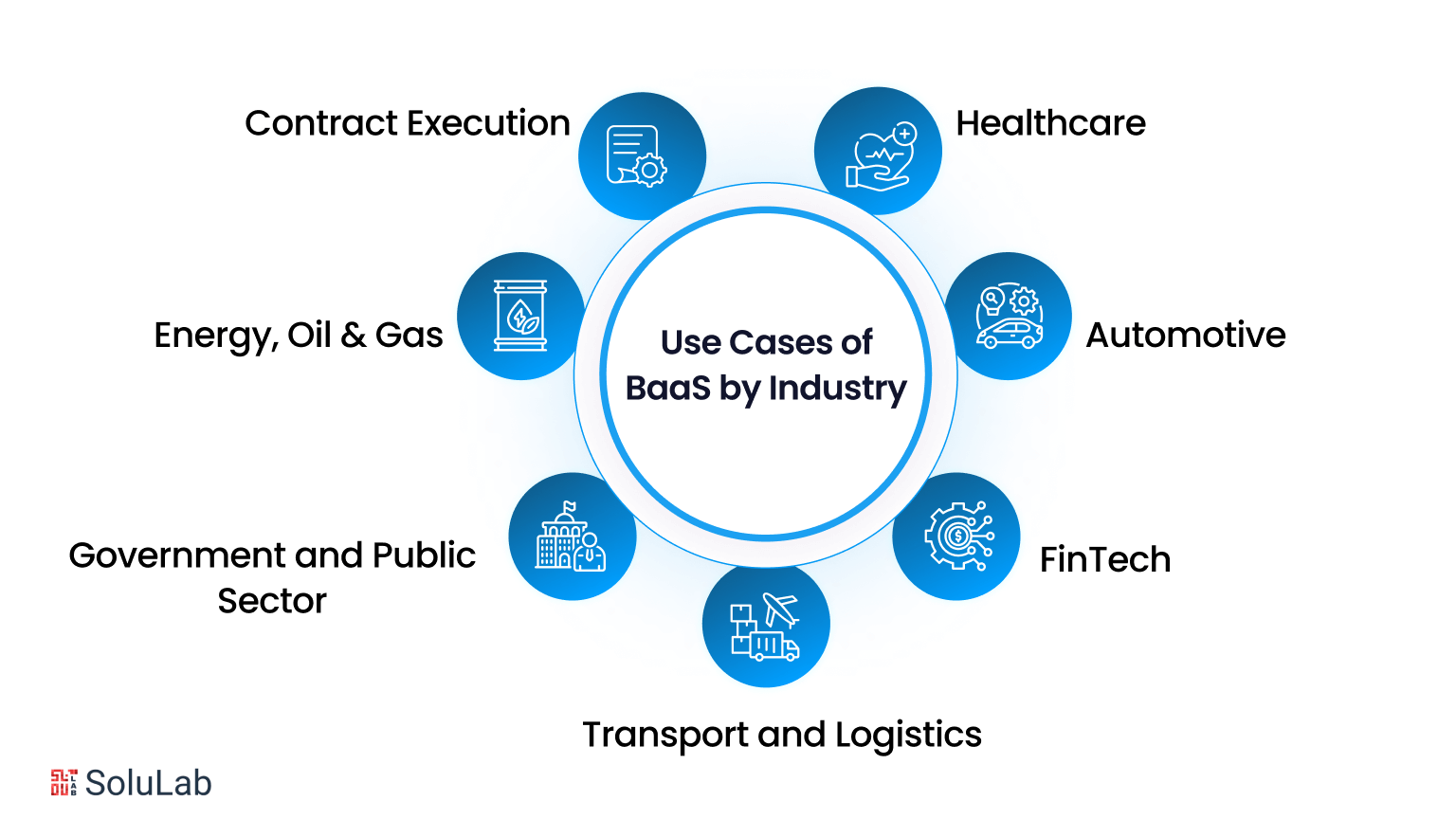
Use Cases of Blockchain-as-a-Service by Industry
Use Cases of BaaS by Industry

Since Blockchain, as previously said, is a data management platform, data-keeping will be at the core of any solution within its domain. The use examples that follow demonstrate how various firms employ blockchain technology for transparency and immunity.

1. Healthcare

Because blockchain maintains a universal and transparent version of patient medical data, it has significantly altered the healthcare industry. Thanks to well-organized and updated data, blockchain technology has facilitated the provision of immediate treatment to individual patients by a number of medical specialists.

Additionally, blockchain helps verify the legitimacy of pharmaceuticals. This implies that the source of any medicine or chemical may be determined. Manufacturers that have been recalling certain ingredients for prescription medications have greatly benefited from this. 

2. Automotive

Handling supply chains and avoiding fake components is the automotive industry’s greatest problem. Here, the blockchain platform as a service comes to the rescue by providing transported automobile parts with end-to-end accessible data. This makes it easier for car companies to locate and distinguish between real and bogus spare parts.

Furthermore, the efficient flow within the sector has been disrupted by Blockchain services in the production and supply chain. Essential components are always available, and companies may achieve maximum output with the fewest possible obstacles.

3. FinTech

Every average banking consumer now feels at ease thanks to blockchain technology in FinTech, since it has simplified several financial procedures, such as the KYC and AML verification processes. 

In addition to enhancing transparency and immutability to avert conflicts. Customers may now use smart cards thanks to blockchain services. These smartcards facilitate quicker financial payments without requiring central authority certification.

4. Transport and Logistics

Identity verification is critical to the logistics and transportation industries, respectively, for both people and products. Passengers may complete the full procedure quickly and easily with only one identity token. In a similar vein, freight movement, verification effectiveness, and fault tolerance.

Blockchain platform-as-a-service offers different sectors and data silos a failsafe method. 

5. Government and Public Sector

Blockchain’s transparency and immutability can greatly improve government processes. Blockchain applications for public operations are changing the way governments operate by providing answers for safe identity management, transparent voting procedures, and effective public records management.

6. Energy, Oil & Gas

To improve energy trade and efficiency, SaaS-based blockchain applications are being used. Blockchain platform Vakt automates transaction settlement and optimizes documentation. Blockchain technology is popular for peer-to-peer energy trade. Users can swap excess renewable energy with neighbors via Powerledger, enhancing energy efficiency and lowering expenses.

7. Contract Execution 

Under the Blockchain’s smart contracts service, a dedicated platform facilitates the execution of contracts, ensuring heightened levels of transparency. The decentralized architecture ensures that all involved parties possess equal access to pertinent information, fostering a fair and equitable environment for contract execution.

Furthermore, this distributed ledger technology not only enhances transparency but also streamlines the contract execution process, reducing the need for intermediaries and associated costs. With automated enforcement of contractual terms and conditions, smart contracts offer efficiency and reliability, thereby revolutionizing traditional contract management practices. This innovative approach not only mitigates disputes but also enhances trust among parties, paving the way for more efficient and secure transactions across various industries.

Read Blog: How Blockchain Is Revolutionizing the Fintech Industry?

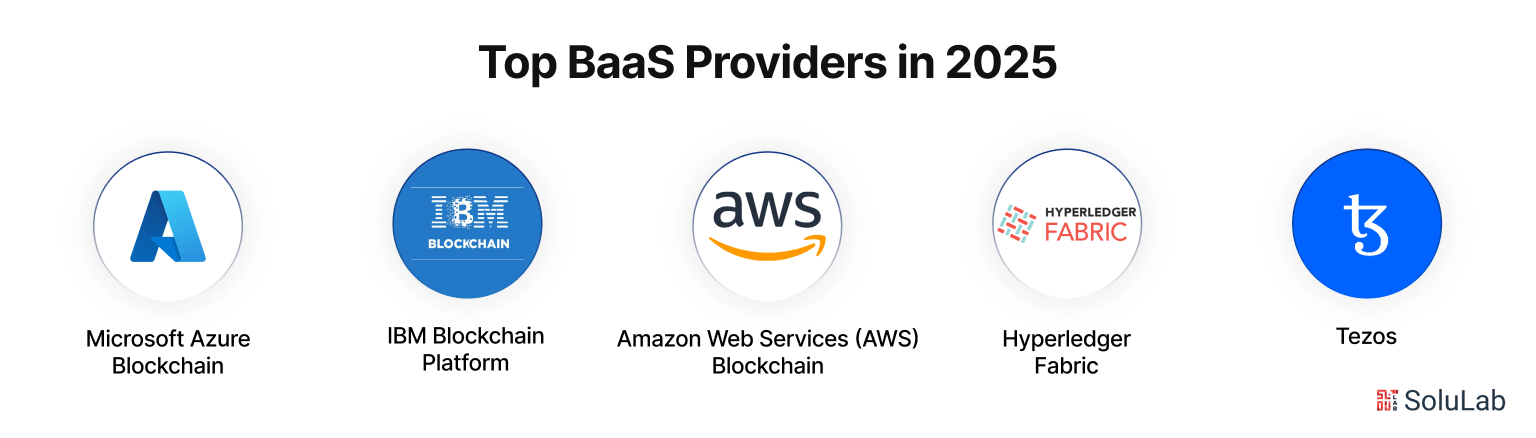
Top Blockchain-as-a-Service (BaaS) Providers in 2025
Top BaaS Providers in 2025

Blockchain-as-a-Service (BaaS) is establishing itself as a game changer for organizations that are interested in utilizing the potential of blockchain technology without the hassles of infrastructure administration. Here, we look at the top BaaS providers who are leading the way in enabling smooth blockchain connectivity for organizations across several sectors.

1. Microsoft Azure Blockchain

  • Overview: Microsoft Azure Blockchain offers a robust suite of services tailored to simplify blockchain development and deployment. With Azure Blockchain Service and Azure Blockchain Workbench, users gain access to tools for building, governing, and deploying blockchain networks effortlessly.
  • Key Features: Seamless integration with Azure services, support for Ethereum and Hyperledger Fabric, built-in governance, and monitoring tools, scalability, and high availability.
  • Market Presence: Widely recognized and trusted by enterprises globally, particularly prevalent in finance, healthcare, and supply chain sectors.

2. IBM Blockchain Platform

  • Overview: The IBM Blockchain Platform provides a comprehensive set of tools and services designed to accelerate blockchain adoption across industries. Offering support for multiple frameworks and deployment options, IBM empowers enterprises to build, operate, and scale blockchain networks with ease.
  • Key Features: Flexible deployment options (cloud, on-premises, hybrid), advanced analytics and insights, integration with IBM Cloud services, and industry-specific solutions for supply chain, finance, and healthcare.
  • Market Presence: Highly regarded by enterprises seeking enterprise-grade blockchain solutions, prevalent in regulated industries where security and compliance are paramount.

3. Amazon Web Services (AWS) Blockchain

  • Overview: AWS Blockchain offers a suite of managed blockchain services that enable users to create and manage blockchain networks effortlessly. With services like Amazon Managed Blockchain and Amazon Quantum Ledger Database (QLDB), users can leverage the scalability, security, and reliability of AWS for their blockchain applications.
  • Key Features: Fully managed blockchain infrastructure, support for popular frameworks like Hyperledger Fabric and Ethereum, integration with other AWS services, and a pay-as-you-go pricing model.
  • Market Presence: Highly adopted across various industries, including finance, gaming, and logistics, AWS Blockchain stands out for its reliability, scalability, and ease of use.

Read Our Blog: Top Blockchain Development Companies in 2025

4. Hyperledger Fabric

Overview: Hyperledger Fabric, an open-source blockchain framework hosted by the Linux Foundation, is designed for enterprise use. It focuses on providing a modular and flexible architecture, enabling businesses to create blockchain solutions for various industries like finance, supply chain, and healthcare.

Key Features: Permissioned blockchain architecture for enhanced security, Modular design allowing businesses to plug in their preferred components, and supports smart contracts, known as “chaincode,” written in general-purpose programming languages.

Market Presence: Hyperledger Fabric is widely adopted by enterprises, particularly in industries requiring secure and scalable blockchain solutions, such as IBM’s Food Trust Network, Walmart’s supply chain initiatives, and more.

5. Tezos

Overview: Tezos is a self-amending blockchain platform that supports smart contracts and decentralized applications (dApps). It is known for its focus on security, scalability, and ease of use, making it a strong choice for businesses looking to implement blockchain solutions.

Key Features: Self-amending protocol, allowing upgrades without hard forks, formal verification for smart contract security and on-chain governance, allowing stakeholders to vote on changes.

Market Presence: Tezos has gained significant traction in the decentralized finance (DeFi) space and among enterprises exploring blockchain applications, including partnerships with major brands like McLaren and the Swiss financial sector.

Hire Blockchain Developers

Final Words

Blockchain technology is changing industries worldwide by providing innovative solutions to enduring problems. Businesses looking to stay competitive can benefit from its efficient, transparent, and safe features. 

The numerous applications of blockchain technology present new opportunities for development and success across industries like advertising, real estate, supply chain management, and banking. With the help of blockchain consulting services, business executives can fully leverage distributed ledger technology to drive innovation and streamline operations by understanding and applying its use cases effectively.

OBORTECH partnered with SoluLab to improve its SmartHub platform by integrating blockchain as a service (BaaS), like a secure staking system, crypto payment gateway, and smart contracts. Overcoming multi-cloud interoperability and UI challenges, the solution enabled OBOT token transactions, improved user engagement, and delivered a scalable, IoT-integrated blockchain ecosystem across the supply chain and finance industries.

SoluLab, a blockchain development company, has a team of experts ready to discuss all your business queries and deliver innovative solutions. Contact us today to discuss further!

FAQs

1. What is Blockchain-as-a-Service (BaaS), and how does it differ from traditional blockchain deployment?

Blockchain-as-a-Service (BaaS) is a cloud-based service model that allows businesses to utilize blockchain technology without the need for extensive in-house infrastructure and expertise. Unlike traditional blockchain deployment, where organizations have to build and maintain their own blockchain networks, BaaS platforms offer pre-built infrastructure and tools for faster and easier deployment.

2. What are the key benefits of using Blockchain-as-a-Service for businesses?

Some key benefits of using Blockchain-as-a-Service include enhanced security, increased transparency, streamlined operations, cost savings, and scalability. By leveraging BaaS, businesses can mitigate security risks, improve trust among stakeholders, automate processes through smart contracts, reduce operational expenses, and quickly scale their operations as needed.

3. Which industries can benefit the most from Blockchain-as-a-Service solutions?

Industries such as finance, healthcare, supply chain, real estate, and logistics stand to benefit the most from Blockchain-as-a-Service solutions. These sectors often deal with sensitive data, complex transactions, and regulatory compliance requirements, making the transparency, security, and efficiency offered by BaaS platforms particularly valuable.

4. Can BaaS help reduce business costs?

Yes! BaaS helps reduce business costs by eliminating the need to build and maintain a full banking or blockchain infrastructure. Since you don’t have to manage the network, you save on infrastructure, talent, and ongoing maintenance. This leads to faster innovation and significant cost savings.

5. How can SoluLab assist businesses in leveraging Blockchain-as-a-Service?

SoluLab, a leading blockchain development company, helps businesses investigate, implement, and optimize Blockchain-as-a-Service solutions. SoluLab’s experienced team can help businesses at every stage of their blockchain journey with custom blockchain applications, integrating BaaS platforms into existing systems, or more.

 

How Does the Blockchain Work?

How does Blockchain Work

Blockchain technology has transformed the way we handle digital transactions and data storage. It serves as a secure and decentralized platform that records and verifies information without intermediaries. 

Imagine a digital ledger that’s shared among a network of computers, where each transaction is securely recorded, transparently visible, and impossible to alter. That’s the core idea behind blockchain—a revolutionary concept with the potential to reshape how we interact online. In this blog, we’re here to break down the basics of blockchain in simple terms. We will learn about how does blockchain work and the intricacies involved in blockchain technology! But first, let’s get to know what blockchain is all about!

What is Blockchain Technology?

Blockchain is a technique for storing data that makes it difficult or impossible for outside parties to alter, hack, or manipulate the system. A distributed ledger, or blockchain, is a network of computers that replicates and disperses transactions between itself.

Blockchain technology is a framework that uses many databases, referred to as the “chain,” connected by peer-to-peer nodes, to store public transactional records or blocks. This type of storage is commonly known as a “digital ledger.”

The digital signature of the owner authorizes each transaction in this ledger, ensuring its authenticity and preventing any manipulation. Because of this, the data in the digital ledger is extremely safe.

To put it another way, the digital ledger is essentially a network of several computers sharing a Google spreadsheet where transactional data are kept according to real purchases. The intriguing aspect is that while everyone may view the data, it cannot be altered.

How Does the Blockchain Technology Work?

You may have seen that a growing number of companies worldwide have been utilizing Blockchain technology in recent years. But how does the blockchain work specifically? Is this a little addition or a big change? Let’s start by dispelling some of the myths surrounding Blockchain technology, as these developments are still in their infancy and might become revolutionary in the future.

Blockchain combines three innovative technologies:

  • Cryptographic keys
  • A distributed ledger on a peer-to-peer network
  • A kind of computation that stores the network’s records and transactions

The two keys used in cryptography are the public key and the private key. These keys facilitate the effective completion of transactions between two parties. These two keys belong to each person, and they are used to create a safe digital identity reference. Perhaps the most significant feature of Blockchain technology is this encrypted identification. This identification, known as a “digital signature” in the context of cryptocurrencies, is used to authorize and manage transactions.

The peer-to-peer network and the digital signature are combined, and a lot of people who function as authorities use the digital signature to agree on transactions and other matters. A mathematical verification confirms their approval of a contract, leading to a successful safe transaction between the two network-connected parties.

Types of Blockchain

Types of Blockchain

There are different types of blockchain. They are as follows.

  • Private Blockchain Networks

Private blockchains run on closed networks and are best suited for private corporations and organizations. Companies may utilize private blockchains to tailor their access and permission preferences, network characteristics, and other critical security features. A private blockchain network is managed by just one authority.

  • Public Blockchain Networks

Bitcoin and other cryptocurrencies evolved from public blockchains, which also helped popularize distributed ledger technology (DLT). Public blockchains also assist to avoid some obstacles and issues, such as security weaknesses and centralized control. DLT distributes data throughout a peer-to-peer network rather than storing it in a single location. A consensus technique is used to verify information validity; proof of stake (PoS) and proof of work (PoW) are two popular consensus approaches. 

  • Permissioned Blockchain Networks

Permissioned blockchain networks, also known as hybrid blockchains, are private blockchains that provide unique access to approved persons. Organizations generally build up these sorts of blockchains to obtain the greatest of both worlds, as it allows for better organization when determining who may join the network and in which transactions.

Read Blog: Permissionless Blockchain: An Overview

  • Consortium Blockchains

Consortium blockchains, like permissioned blockchains, feature both public and private components, but they are managed by numerous organizations. Although these sorts of blockchains are initially more difficult to set up, once operational, they can provide superior security. Furthermore, consortium blockchains are ideal for collaboration across various enterprises.

  • Hybrid Blockchains

Hybrid blockchains combine both public and private blockchains. In a hybrid blockchain, certain sections of the blockchain are public and transparent, but others are private and only available to authorized members. This makes hybrid blockchains excellent for applications that demand a mix of openness and secrecy. For example, in supply chain management, numerous parties can view some information but sensitive data is kept secret.

  • Sidechains

Sidechains are parallel blockchains that provide extra features and scalability. Sidechains allow developers to get creative with new features and apps without compromising the main blockchain’s integrity. Sidechains can also be utilized to manage transactions of the main blockchain, reducing congestion and enhancing scalability.

  • Blockchain Layers

Building several blockchain layers on top of one another is referred to as “blockchain layers.” Every layer can have its own rules, functionality, and consensus mechanism that can communicate with other levels. Due to the capacity to handle transactions concurrently across many levels, this guarantees increased scalability. As an illustration, the Lightning Network is a second-layer solution that facilitates quicker and less expensive transactions by opening up payment channels between users and is built on top of the Bitcoin blockchain.

Read Our Blog: Layer-1 Vs. Layer-2: The Blockchain Scaling Solutions

What is Blockchain as a Service? 

Blockchain as a Service (BaaS) is a cloud-based service that allows users to develop, host, and deploy blockchain applications without the complexity of building and maintaining the underlying infrastructure typically associated with blockchain technology.

Similar to other “as a Service” models like Software as a Service (SaaS) or Platform as a Service (PaaS), BaaS provides users with access to blockchain capabilities on a pay-as-you-go or subscription basis. This means that users can leverage the benefits of blockchain technology, such as decentralization, transparency, and immutability, without needing to invest in hardware, software, or specialized expertise.

Blockchain Development Company

Here’s how it works:

1. Cloud-Based Infrastructure: Blockchain as a Service (BaaS) providers offer blockchain infrastructure hosted on their cloud platforms. This infrastructure typically includes all the necessary components for deploying, managing, and scaling blockchain networks.

2. Pre-Built Solutions: BaaS platforms often provide pre-built blockchain solutions and templates tailored for specific use cases, such as supply chain management, identity verification, or financial transactions. These solutions come with predefined smart contracts, consensus mechanisms, and other necessary features.

3. Development Tools: BaaS platforms offer a range of development tools, APIs, and SDKs that enable developers to easily build, test, and deploy blockchain applications. These tools abstract away much of the complexity associated with blockchain development.

4. Scalability and Flexibility: BaaS platforms typically offer scalability features, allowing customers to easily scale their blockchain networks based on demand. They also provide flexibility in terms of choosing the underlying blockchain protocol, consensus mechanism, and other configuration options.

5. Managed Services: BaaS providers handle various operational aspects of the blockchain infrastructure, such as security, maintenance, and upgrades. This allows customers to focus on developing and deploying their applications without worrying about the underlying infrastructure.

How is Blockchain Used?

Blockchain technology has found applications across various industries, revolutionizing processes and enhancing security and transparency. Let’s explore how blockchain is utilized in different sectors:

1. Finance

In the financial industry, blockchain is widely used for secure and transparent transactions. It has facilitated faster cross-border payments, reduced transaction costs, and minimized the need for intermediaries. Smart contracts powered by blockchain technology automate processes such as loan approvals and trade settlements, streamlining operations and reducing the risk of fraud.

2. Healthcare

Blockchain is transforming the healthcare sector by improving data management and patient care. Electronic health records stored on blockchain platforms ensure data integrity and confidentiality, enabling secure sharing of information among healthcare providers. Additionally, blockchain in healthcare facilitates drug traceability, ensuring the authenticity of pharmaceutical products and combating counterfeit drugs in the market.

3. Supply Chain Management

Blockchain technology is reshaping supply chain management by enhancing transparency and traceability. By recording every step of a product’s journey on a of transparency builds trust among stakeholders and improves overall supply chain efficiency.

4. Real Estate

In the real estate industry, blockchain is revolutionizing property transactions and ownership records. Smart contracts on blockchain platforms enable secure and transparent real estate transactions, eliminating the need for intermediaries such as brokers and lawyers. Blockchain-based property registries ensure accurate and tamper-proof records of ownership, reducing the risk of fraud and disputes in real estate transactions.

Read Blog: Revolutionizing Real Estate With Blockchain Technology

5. Energy

Blockchain technology is being leveraged in the energy sector to enable peer-to-peer energy trading and enhance grid management. Through blockchain-based platforms, energy producers can sell excess energy directly to consumers, creating a decentralized energy market. Smart meters integrated with blockchain technology enable real-time monitoring of energy consumption and transactions, promoting energy efficiency and sustainability.

These examples showcase the diverse applications of blockchain technology across industries, highlighting its potential to revolutionize processes, enhance security, and drive innovation in various sectors.

Features of Blockchain Technology

Features of Blockchain Technology

Here are the key features of blockchain technology:

1. Decentralized: Blockchain is a decentralized system, meaning that there is no single central authority controlling the network. Instead, it is maintained by a network of nodes (computers) that work together to validate transactions.

2. Immutable: Once a transaction is recorded on the blockchain, it cannot be altered or deleted. This is because each block is linked to the previous block through a unique code, making it impossible to change or manipulate the data.

3. Transparent: All transactions on the blockchain are transparent, meaning that anyone can view the entire history of transactions on the network.

4. Distributed Ledger: Blockchain is a distributed ledger technology, meaning that multiple nodes on the network maintain a copy of the entire blockchain, ensuring that all parties have access to the same information.

5. Security: Blockchain technology uses advanced cryptography and encryption techniques to ensure that all transactions are secure and tamper-proof.

6. Upgradability: Many blockchain networks are designed to be upgradable, allowing for changes to be made to the protocol or underlying code without disrupting the network.

7. Scalability: While blockchain technology has made significant progress in terms of scalability, some networks still face limitations in terms of transaction speed and capacity.

8. Interoperability: Blockchain technology is being developed to enable interoperability between different networks, allowing for seamless communication and data exchange between different ecosystems.

Bitcoin vs. Blockchain

Since its first release in 2009, Bitcoin has grown to become the most well-known and prosperous virtual currency to date. Due to its decentralized nature—that is, the lack of a central bank or body overseeing its supply—Bitcoin has become extremely popular. This implies that utilizing Bitcoin entails no transaction costs and anonymous transactions.

Blockchain is a database of past transactions between two parties. As new transactions occur, blocks of data containing details about them are added to the chain in chronological order. The amount of blocks generated following a record makes it harder to modify over time, therefore the Blockchain is always expanding as new blocks are added to it.

Applications of Blockchain

Blockchain technology has the potential to revolutionize various industries and sectors beyond its original use case in cryptocurrency. The decentralized and secure nature of blockchain makes it an attractive solution for a wide range of applications, including:

  • Financial Services: Blockchain can be used to create secure and transparent financial instruments, such as smart contracts, digital identities, and decentralized exchanges. Banks and financial institutions are exploring blockchain technology to improve efficiency and reduce costs.
  • Voting Systems: Blockchain-based voting systems can increase transparency and security in elections. Countries such as Australia and Switzerland are exploring blockchain-based voting systems.
  • Cybersecurity: Blockchain can be used to create secure and decentralized cybersecurity solutions, such as decentralized blockchain identity management and encrypted data storage.
  • Intellectual Property: Blockchain can help protect intellectual property rights by creating a tamper-proof record of ownership and provenance.
  • Gaming: Blockchain can be used to create decentralized gaming platforms, allowing for secure and transparent transactions, and enabling players to own their digital assets.
  • Identity Verification: Blockchain-based identity verification solutions can help create secure and decentralized digital identities, reducing the risk of identity theft and improving security.
  • Food Safety: Blockchain can help track the origin and movement of food products, reducing the risk of food contamination and improving transparency.
  • Education: Blockchain-based education platforms can help create secure and transparent digital credentials, reducing the risk of degree fraud and improving accessibility.
  • Government Services: Blockchain can be used to create secure and transparent government services, such as voting systems, taxation systems, and identity verification.

Benefits of Blockchain Technology

Blockchain technology has numerous benefits that make it an attractive solution for various industries and sectors. Some of the key benefits of blockchain technology include:

1. Increased Transparency: Blockchain technology provides a transparent and tamper-proof record of transactions, making it easier to track and verify the authenticity of data.

2. Improved Security: Blockchain technology uses advanced cryptography and encryption techniques to ensure that data is secure and tamper-proof, making it difficult for hackers to access or manipulate data.

3. Reduced Costs: Blockchain technology can reduce costs by automating processes, eliminating intermediaries, and increasing efficiency.

4. Enhanced Efficiency: Blockchain technology can automate processes, reduce the need for manual intervention, and increase speed and accuracy, making it an attractive solution for industries that require fast and efficient processing.

5. Increased Trust: Blockchain technology can increase trust between parties by providing a secure and transparent record of transactions, making it easier to establish trust in digital transactions.

6. Decentralized Control: Blockchain technology allows for decentralized control, giving individuals and organizations more control over their data and transactions.

7. Improved Data Accuracy: Blockchain technology can improve data accuracy by providing a single source of truth, reducing the risk of errors and inconsistencies.

8. Reduced Risk of Fraud: Blockchain technology can reduce the risk of fraud by providing a secure and transparent record of transactions, making it difficult for fraudsters to manipulate data.

9. Increased Accessibility: Blockchain technology can increase accessibility by providing a secure and transparent way for individuals and organizations to access and share data.

10. Scalability: Blockchain technology can scale to meet the needs of growing industries and sectors, providing a secure and transparent way to manage large amounts of data.

11. Improved Compliance: Blockchain technology can improve compliance by providing a secure and transparent record of transactions, making it easier to meet regulatory requirements.

12. Reduced Counterfeiting: Blockchain technology can reduce counterfeiting by providing a secure and transparent way to track the origin and movement of goods.

13. Improved Supply Chain Management: Blockchain technology can improve supply chain management by providing a secure and transparent way to track the movement of goods.

14. Enhanced Customer Experience: Blockchain technology can enhance customer experience by providing a secure and transparent way to manage customer data and transactions.

15. Increased Value: Blockchain technology can increase value by providing a secure and transparent way to manage digital assets, such as cryptocurrencies.

Overall, blockchain technology has the potential to bring significant benefits to various industries and sectors, from improved security and transparency to increased efficiency and accessibility. As the technology continues to evolve, we can expect to see even more innovative applications of blockchain emerge.

Leading Blockchain Platforms

There are a lot of blockchain platforms out there. The Ethereum blockchain, Hyperledger Fabric, and OpenChain are the three most well-known.

1. Ethereum: Ethereum stands as one of the most widely utilized and respected blockchain platforms in the industry. It is celebrated for its open-source nature and adaptability, making it a preferred choice for various enterprise applications. One of Ethereum’s groundbreaking contributions to the blockchain space is the introduction of smart contracts and decentralized applications (dApps). These innovations have significantly expanded the potential use cases of blockchain technology beyond simple transactions. Ethereum boasts a robust and expansive developer community, fostering continuous innovation and development within its ecosystem. Its native cryptocurrency, Ether, serves as the fuel for executing operations on the platform.

2. Hyperledger Fabric: Hyperledger Fabric caters to specific industry needs, particularly in the finance and manufacturing sectors. It is an open-source blockchain platform designed primarily for permissioned networks. However, it can also support decentralized hosting and storage of applications leveraging smart contracts. Hyperledger Fabric offers a modular framework that empowers organizations to build private blockchains customized to their unique business requirements. This flexibility, combined with its support for smart contracts, enables diverse applications across various industries.

3. OpenChain: OpenChain addresses the requirements of organizations looking to efficiently manage and safeguard digital assets. As an open-source blockchain platform, it allows administrators to establish the rules governing the ledger. Users can then engage in value exchange on the ledger while adhering to these predefined rules. OpenChain’s focus on providing a customizable and scalable solution makes it suitable for a wide range of use cases, from supply chain management to digital asset issuance and tracking.

Hire Blockchain Developers

Conclusion

In conclusion, the blockchain represents a revolutionary technology with the potential to transform numerous industries by providing secure, transparent, and decentralized solutions for various applications. Its underlying principles of immutability, decentralization, and cryptographic security make it a robust and reliable platform for storing and exchanging digital assets and information. From financial transactions and supply chain management to identity verification and decentralized applications, the blockchain offers endless possibilities for innovation and disruption.

As businesses and organizations continue to explore the benefits of blockchain technology, partnering with an experienced blockchain development company becomes crucial. SoluLab stands out as a leading provider of blockchain solutions, offering expertise in developing custom blockchain applications tailored to specific business requirements. With a team of skilled developers and blockchain specialists, SoluLab empowers businesses to harness the full potential of blockchain technology. Whether it’s creating decentralized finance (DeFi) platforms, supply chain tracking systems, or secure digital identity solutions, SoluLab delivers reliable, scalable, and innovative blockchain solutions. Contact us today to embark on your blockchain journey and unlock new opportunities for growth and innovation.

FAQs

1. What exactly is blockchain technology?

Blockchain technology is a decentralized digital ledger that records transactions across a network of computers in a secure and transparent manner. Each block in the chain contains a cryptographic hash of the previous block, creating a chronological and immutable record of transactions.

2. How does blockchain ensure security and trust?

Blockchain ensures security and trust through its decentralized nature and cryptographic mechanisms. Transactions on the blockchain are verified and recorded by multiple participants in the network, making it extremely difficult for any single entity to tamper with the data. Additionally, cryptographic techniques like hashing and digital signatures provide further security by encrypting and authenticating transactions.

3. What are smart contracts, and how do they work on the blockchain?

Smart contracts are self-executing contracts with the terms of the agreement directly written into code. These contracts automatically execute and enforce themselves when predetermined conditions are met, eliminating the need for intermediaries. Smart contracts run on blockchain platforms like Ethereum, leveraging the platform’s decentralized infrastructure to ensure transparency and security.

4. Is blockchain only useful for cryptocurrencies like Bitcoin?

While blockchain technology gained prominence with the rise of cryptocurrencies like Bitcoin, its utility extends far beyond digital currencies. Blockchain can be applied to various industries and use cases, including supply chain management, healthcare, finance, voting systems, and identity verification. Its decentralized and immutable nature makes it suitable for any scenario requiring secure and transparent record-keeping.

5. How can businesses leverage blockchain technology?

Businesses can leverage blockchain technology in numerous ways to streamline operations, enhance security, and drive innovation. Some common applications include supply chain tracking to improve transparency and traceability, digital identity management to securely verify user identities, and decentralized finance (DeFi) platforms for efficient and transparent financial transactions. By incorporating blockchain into their operations, businesses can gain a competitive edge and unlock new opportunities for growth and efficiency.