Talk to an Expert

12 Best DeFi Platforms To Watch Out in 2026

Decentralized finance is rapidly evolving as businesses adopt DeFi platforms to build secure, scalable, and transparent financial products. The DeFi market is expected to grow from $32.36 billion in 2025 to $1,558.15 billion by 2034.  Therefore, enterprises are increasingly exploring decentralized lending, staking, payments, and trading solutions to stay competitive. Choosing the right DeFi development platform is now essential for performance, compliance, and long-term growth.

This blog highlights the top 12 DeFi platforms to watch in 2026, helping businesses identify technologies that offer security, liquidity, and strong real-world utility.

  • The right DeFi platform can cut operational costs by 40% and significantly accelerate financial product deployment.
  • Enterprise-grade DeFi solutions deliver better liquidity, faster transactions, and stronger security across large-scale decentralized ecosystems.

Criteria You Should Consider When Selecting a DeFi Development Platform?

To make an informed selection about a decentralized finance platform, consider some critical points. Consider these factors while choosing a DeFi platform:

1. DeFi Platform Regulations: Complying with regulations is crucial for platform security and reliability. Since decentralized finance firms operate in a legal gray area, this is crucial. Look for platforms that have obtained licenses or permissions to comply with regulations. 

2. Security and Privacy: DeFi platforms handle sensitive financial data and transactions, thus, they should emphasize security and privacy. Look for platforms with safe architecture, powerful encryption, and strong authentication. Some DeFi platforms capture and share user data without consent, so check their privacy policies.

3. Transaction Cost & Efficiency: DeFi development platforms should have low transaction costs and excellent efficiency to make their services affordable and accessible. This is crucial for early decentralized exchange platforms because excessive transaction costs can deter users. Look for systems with efficient infrastructure to cut transaction costs and latency. This becomes especially critical for businesses handling mass crypto payments where efficiency directly impacts operational costs at scale.

4. Trading Options: DeFi platforms should allow multiple cryptocurrency and asset trades. Decentralized exchange app developers should consider this because consumers expect to trade several assets on one platform. Look for platforms with many trading pairs and easy liquidity access.

Using tokens or awards, many decentralized finance companies and platforms encourage customers to use their services. Choose a DeFi development platform based on the value and potential of these tokens or prizes. Find systems that offer tokens or prizes with real value that can be sold or used.

Top 12 DeFi Platforms to Look for in 2026

These 12 DeFi platforms stand out for innovation, user trust, and long-term ecosystem growth. They’re positioned to play a major role in how decentralized finance evolves in 2026.

Aave

1. Aave

Since its launch, Ethereum-based lending protocol Aave has grown into one of the leading DeFi platforms. Its trustless lending and borrowing model eliminates intermediaries and enhances security. Users can deposit assets to earn interest or borrow assets against collateral through smart contracts. As of September 2025, DeFiLama data, Aave TVL is $15 billion. Its dual functionality makes it flexible for users with different financial needs and goals.

Lido Finance

2. Lido Finance

Established in 2020, Lido Finance is one of the most popular liquid staking platforms for Ethereum. As per The Block data, Lido Finance TVL crossed over $30 billion, which allows users to stake ETH and receive stETH in return, offering liquidity while staking. Lido is ideal for ETH holders seeking passive income while maintaining liquidity.

Uniswap

3. Uniswap

Uniswap is a decentralized exchange (DEX) known for efficient, secure, and automated token swaps. Its smart contract-driven design removes intermediaries and reduces fraud risks. As of mid-2025, its total TVL fluctuates around $4.5 billion across all chains. Uniswap V3 introduced concentrated liquidity, enabling users to provide liquidity within specific price ranges for higher capital efficiency.
4. Ethereum

Introduced in 2015, Ethereum is the most widely used blockchain for DeFi applications, supporting a TVL exceeding $62 billion. It powers a massive ecosystem of DeFi protocols, thanks to its mature infrastructure and strong developer community.
Ethereum remains the foundational layer for most DeFi activities.

GMX

5. GMX

GMX is a full-featured decentralized trading platform offering low fees, deep liquidity, and access to multiple cryptocurrencies. It also supports staking, allowing users to participate in network security and earn passive income. As per CryptoMarketCap, after a July 2025 exploit, its TVL was around $265 million as of November 2025.

In 2026, GMX emerged as one of the top platforms for DeFi staking due to its intuitive interface and strong rewards.

Curve Finance

6. Curve Finance

Launched in 2020, Curve Finance is a decentralized exchange optimized for stablecoin trading. It offers extremely low-slippage swaps and efficient trading. Curve’s focus on stablecoins ensures fast, cost-efficient, and reliable trading with high liquidity.
Synthetix

7. Synthetix

Founded in 2018, Synthetix enables the trading of synthetic assets representing commodities, indices, currencies, and more. With a TVL above $1 billion, it provides deep liquidity and high-volume trading. Its wide asset offerings and innovative model make it ideal for experienced traders seeking exposure to synthetic markets.

Binance

8. Binance

Established in 2017, Binance is one of the world’s largest crypto exchanges and offers extensive DeFi services. Its staking platform supports various assets with strong liquidity and security. Binance is a trusted choice for users seeking diverse DeFi tools and high-volume trading.
Kraken

9. Kraken

Founded in 2011, Kraken is a reputable crypto exchange offering DeFi staking services with a TVL of approximately $1.5 billion. It provides a secure platform, wide asset support, and competitive staking rewards. Kraken combines strong security with DeFi features, making it a dependable option for staking and trading.

Maker DAO

10. Maker DAO

MakerDAO powers DAI, a decentralized USD-pegged stablecoin backed by diversified collateral. Users can lock assets like ETH in Maker Vaults to generate DAI. Key features include decentralized governance via MKR holders and stable borrowing via collateralized debt positions (CDPs).

Crypto.com

11. Crypto.com

Founded in 2016, Crypto.com offers a wide suite of DeFi services, including staking, lending, and yield generation. With a TVL above $2 billion, it provides secure trading, strong liquidity, and attractive rewards. Its broad offerings and established brand make it a major player in the DeFi sector.

AQRU

12. AQRU

Launched in 2021, AQRU is a DeFi platform offering high-yield savings accounts for multiple cryptocurrencies. It provides users with competitive interest rates and an easy-to-use interface. AQRU appeals to investors seeking passive income and straightforward crypto savings options.

Best DeFi Platforms cta

Conclusion

Each top DeFi platform brings unique strengths to the market, but building a secure, scalable DeFi product requires the right development partner. This is where technical depth, blockchain expertise, and smart contract reliability matter most. 

SoluLab, a top DeFi development company with a team of 250+ experts, builds DeFi products fast, secure, and designed for long-term growth. From liquidity pools and staking modules to cross-chain architecture and audited smart contracts. We offer end-to-end development that helps businesses launch confidently and scale sustainably.

Our team has delivered DeFi platforms that scale in real-world environments. A strong example is AnRKeyX, the decentralized competitive Esports ecosystem built on Web3 NFTs. Our team led the entire back-end development, working alongside the AnRKeyX UI team to create their custom gDEX protocol. The platform saw a 3× boost in gameplay throughput and a 40% improvement in reward distribution efficiency. 

If you’re ready to build or upgrade your DeFi platform, consult us today and discuss your goal.

FAQs

1. How much does it cost to develop a DeFi platform?

DeFi platform development typically starts from $15,000, depending on features, blockchain selection, security requirements, integrations, and overall project complexity.

2. How long does it take to build a DeFi platform?

Most DeFi platforms take 2 to 3 weeks, while advanced, multi-chain or compliance-heavy solutions may require 2 to 3 months for full development.

3. Why should I choose SoluLab for DeFi platform development?

SoluLab offers 250+ blockchain experts, audited smart contracts, scalable architecture, and end-to-end DeFi development delivering measurable performance, security, and long-term platform reliability.

4. Which industries benefit most from DeFi platform development?

Industries like fintech, gaming, real estate, investments, and cross-border payments gain the most from DeFi platforms through automation, global accessibility, and reduced transaction costs.

5. Why is DeFi wallet development important for a successful DeFi platform?

A reliable DeFi platform needs secure user access, and DeFi wallet development ensures non-custodial control, seamless transactions, and multi-chain support essential for safe decentralized ecosystem growth.
Top 10 DeFi Development Companies in 2026

DeFi in 2026 is no longer just about early adopters– it’s where serious businesses, institutions, and startups are now building real financial products. Users today expect lightning-fast transactions, bulletproof security, and a seamless experience. And with regulations shifting every quarter, working with a DeFi team still operating with 2021 tools is a fast way to fall behind.

Choosing the top DeFi development companies makes P2P transactions effortless, automates financial workflows with secure smart contracts, and builds scalable systems for lending, borrowing, staking, tokenization, and on-chain trading.

In this blog, we’ll break down how to choose the right DeFi development partner and reveal the top 10 DeFi development companies in 2026 you should watch. Let’s dive in!

How to Select the Best DeFi Development Company?

Selecting the right DeFi development partner is crucial for building secure, scalable, and future-ready decentralized applications (dApps). Evaluate expertise, technology skills, and industry experience to ensure long-term success and trust. 

The DeFi technology market is expected to reach ~ US $86.53 billion in 2025, growing further toward US $457.35 billion by 2032 (CAGR ~ 26.9%).

1. Proven Blockchain Expertise: Choose a company with strong knowledge of smart contracts, popular DeFi protocols, and hands-on experience with Ethereum, Solana, Binance Smart Chain, and other major networks.

2. Security-First Development Approach: Ensure they follow strict security standards, conduct smart contract audits, and implement risk mitigation practices to protect digital assets and prevent system vulnerabilities.

3. Portfolio and Case Studies: Evaluate past DeFi projects to understand real-world performance, user experience, and their ability to deliver on complex requirements.

4. Compliance and Regulatory Understanding: Work with partners who understand global crypto regulations and can help you design compliant and legally aligned DeFi solutions.

5. Customization and Scalability Support: Look for tailored feature development, multi-chain compatibility, and infrastructure built to handle long-term user and transaction growth.

6. Post-Launch Maintenance and Upgrades: Make sure they offer continuous improvements, bug fixes, and support as the DeFi ecosystem evolves.

Top 10 DeFi Development Companies to Work With in 2026

Here’s a quick overview of all the top 10 DeFi development companies you should know:

Companies Industries Served Key Features Technology Stack Support & Scalability
SoluLab Finance, Gaming, Supply Chain Smart contract security, token development, UI/UX excellence Ethereum, Polygon, Solana, BNB Chain 24/7 support, scalable DeFi architecture
Innovise Group FinTech, Enterprises Custom DeFi apps, compliance-first builds Hyperledger, Ethereum Long-term maintenance & upgrades
Altoros Banking, Insurance Enterprise DeFi, automation-focused Ethereum, R3 Corda DevOps support & high scalability
Unicsoft Web3, Investment Platforms AI-driven DeFi solutions, staking modules Solana, Polygon, Cardano Continuous optimization & monitoring
Mattelio Startups, SMEs Cost-effective token launch & DEX builds Ethereum, Binance Smart Chain Flexible support plans & fast scaling
Osiz Technology Finance, Healthcare, Real Estate, Gaming, Supply Multi-chain expertise, 24/7 support, and fully scalable Web3 solutions. Ethereum, Hyperledger, BNB Chain Dedicated support teams, long-term maintenance
RWaltz Crypto Trading, Exchanges Ready-made DeFi modules, yield farming Polygon, Tron, Ethereum Quick deployment & scalable upgrades
Kellton Banking, Enterprises Audit-focused development, data security Hyperledger, Ethereum Enterprise-grade scaling & 24/7 support
SciencwSoft Finance, Healthcare Risk management, high-security dApps Ethereum, Avalanche SLA-based support & performance scaling
Lucent innovation E-commerce, Startups Wallet integration, liquidity solutions Solana, BNB Chain Customizable support & modular scaling

Now that you know all the top 10 DeFi development companies, let’s know each one in detail: 

1. SoluLab

SoluLab is a leading DeFi development company known for building secure and scalable decentralized platforms. Their core expertise includes smart contract development, staking platforms, DEXs, tokenization, and liquidity management solutions.

SoluLab works across major blockchain ecosystems like Ethereum, BNB Chain, Polygon, and Solana using Solidity, Rust, and Go. They’ve executed notable DeFi and Web3 projects for fintech startups and global enterprises, backed by strong security audits and compliance-first development practices.


$25-$49


50-249


2014


Los Angeles, CA, USA


Morpheus, NovaPay Nexus

Innowise Group

2. Innowise Group

Innowise Group stands out as a global DeFi development company with strong expertise in smart contracts, DEX platforms, liquidity management, and asset tokenization. Their team works with tech stacks like Ethereum, Polygon, Solana, and Polkadot, ensuring high-performance decentralized products.

They’ve delivered successful blockchain solutions across fintech and Web3 startups, backed by detailed case studies. With strict audit practices, automated checks, and compliance-driven development, Innowise Group ensures every DeFi project is protected from risks and ready for mainstream adoption.


$50-$99


1000+


2007


Warszawa, Poland


OTR, Duck.design

Altoros

3. Altoros

Altoros is a DeFi development firm offering DeFi services — from smart-contract and tokenization solutions to on-chain lending, DApps, and enterprise blockchain deployments. Their tech stack spans public and permissioned blockchains, including Ethereum, Hyperledger Fabric, Corda, and Quorum, giving them versatile blockchain expertise.

Altoros has delivered production-grade blockchain systems for clients across the finance, supply chain, and asset finance sectors, demonstrating real-world success in tokenization and lending infrastructure.


$25 – 60 /hr


250-999


2001


California, USA


Siemens, Cipherhealth

Unicsoft

4. Unicsoft

Unicsoft is a DeFi development company known for delivering secure and scalable DeFi solutions across lending platforms, staking modules, and automated market makers. Their team is skilled in Solidity, Rust, and top chains like Ethereum, Solana, Polygon, and Avalanche.

With rigorous smart contract audits, security testing, and compliance-first development, Unicsoft ensures every project is protected against vulnerabilities. A great choice for startups and enterprises looking for reliable, future-ready DeFi innovation.


$50-$99/hr


50-249


2005


Soquel, California, USA


MakerDAO, SoccerCoin, Hoodifood

Mattelio

5. Mattelio

Mattelio is a DeFi development partner known for building secure, high-performance decentralized applications. Their core services include smart contract development, DeFi exchanges, staking platforms, and token launch solutions.

With strong expertise in Ethereum, BNB Chain, Polygon, and Solidity, they deliver scalable and future-ready blockchain products. They also focus heavily on security, offering rigorous smart contract audits and compliance-driven deployment support.


$25-$50


100-250


2014


California, USA


Esprida, Deutsche Bank

Osiz Technologies

6. Osiz Technologies

Osiz Technologies is a leading blockchain and Web3 development company known for creating secure, scalable, and high-performance digital solutions. Their core expertise covers DeFi platforms, NFT marketplaces, smart contract creation, and enterprise blockchain applications.

They work with a tech stack including Ethereum, Hyperledger, Solana, Tron, BNB Chain, and Polygon. With security practices, in-house auditors, and partnerships with top security and compliance experts, Osiz ensures every product meets global quality standards.


$25-$49


500+


2009


Unites States

RWaltz

7. RWaltz

RWaltz is a DeFi development company that stands out for its security standards — every smart contract undergoes multi-phase internal testing followed by third-party audits, ensuring DeFi platforms are robust and secure.

Their core DeFi services are DEX development, liquidity pool creation, staking modules, and cross-chain bridge integration. Their tech stack spans major blockchains: Ethereum, BNB Chain, and Solana, with development in Solidity and Rust to match each chain’s demands. RWaltz has delivered real-world projects for tokenized assets and yield-farming platforms, showing reliability and deep blockchain expertise.


$80-$99


50+


2000


Alpharetta, Georgia, USA

Kellton

8. Kellton

Kellton delivers secure and scalable DeFi solutions with a strong focus on smart contracts, staking platforms, and decentralized exchanges. Their tech expertise spans major chains like Ethereum, Polygon, BNB Chain, and Hyperledger, supported by Solidity and Rust development.

They have worked on multiple enterprise-grade blockchain projects across fintech and tokenization. Kellton also follows strict audit standards, partnering with leading security auditors to ensure zero vulnerabilities before launch.


$25-$50/hr


1000+


2009


Dallas, Texas, USA

ScienceSoft

8. ScienceSoft

ScienceSoft has offered DeFi services since 2020. The firm has offered end-to-end DeFi development from smart contracts and cross-chain bridges to crypto wallets, decentralised exchanges, lending platforms, tokenisation, and asset-management solutions.

Their tech stack covers major blockchains and frameworks like Ethereum, Solana, Polkadot, Hyperledger, along with languages like Solidity, Rust, Golang and more — giving flexibility across public, private, and hybrid chains. ScienceSoft is ISO 27001-certified and offers full security audits.


$50-$75/hr


200+


1989


Texas, USA

Lucent Innovation

10. Lucent Innovation

Lucent Innovation, a DeFi development firm, builds secure and scalable DeFi platforms, including DEXs, staking systems, and smart contract development. Their team works with top blockchain networks like Ethereum, Polygon, and Binance Smart Chain, using Solidity and Rust for reliable execution.

They have delivered multiple successful Web3 products across finance and tokenisation use cases. With strong security practices and access to trusted audit partners, Lucent Innovation ensures every DeFi project meets global compliance and performance standards.


$65-$75/hr


100+


2013


Wilmington, Delaware, USA

Why SoluLab Stands Out as a Leading DeFi Development Partner in 2026?

SoluLab continues to lead the global DeFi landscape with a track record that blends deep technical expertise, multi-chain innovation, and enterprise-grade security engineering.

We helped a client build a powerful multi-chain decentralized exchange supporting seamless cross-chain swaps, lightning-fast transactions, and secure liquidity management.

Key outcomes included:

  • 4X faster trade execution using optimized smart contracts
  • 60% reduction in gas fees with advanced routing logic
  • Multi-chain interoperability enables cross-chain swaps without compromising performance
  • Automated liquidity provisioning backed by on-chain analytics

This project demonstrates how our engineering teams deliver scalable, secure, and investor-ready DeFi applications.

CTA2

Conclusion

Whether you’re launching a DeFi app, a custom token, or advanced smart contracts, partnering with specialists who understand scalability and real-world adoption is crucial. Always look at experience, transparency, and post-launch support before making a decision.

The DeFi industry is evolving rapidly, and a skilled development partner can help you stay ahead of the curve, build user trust, and grow confidently.

SoluLab, a DeFi development company, can help you build secure, scalable, and future-ready DeFi solutions. Book a free consultation today!

FAQs

1. How long does DeFi development usually take?

The timeline for DeFi development depends on the complexity of your project. Simple DeFi applications, such as basic wallets or token launch platforms, can typically be developed in 3–4 months.

2. What does DeFi development typically cost?

The cost of developing a DeFi platform varies based on features, integrations, and security requirements. A simple DeFi app might start at $10,000, while high-security, multi-chain platforms with AI-driven trading can exceed $100,000.

3. Can I integrate AI into DeFi apps?

Yes. Many leading DeFi development companies provide AI integration services that seamlessly embed AI capabilities like automated trading strategies, fraud detection, etc, into your platform while maintaining blockchain security and regulatory compliance.

4. Will a DeFi development company also provide ongoing maintenance?

Yes. Most professional DeFi development partners offer continuous support, DevOps consulting services, and upgrade management to ensure your platform remains secure and functional post-launch. 

5. Is DeFi legal globally?

Regulatory frameworks for DeFi vary widely across jurisdictions. While some countries fully embrace decentralized finance, others impose strict restrictions or require licensing. A trusted DeFi development company will guide you through compliance requirements.

How Central Bank Digital Currency Development is Transforming Global Economies?

Central Bank Digital Currency DevelopmentThe world of finance is experiencing a deep digital shift. Banking systems are changing fast, fueled by advances in blockchain, mobile payments, and digital finance infrastructure. From contactless payment to artificial intelligence-based financial services, economies are shifting toward quicker, safer, and more accessible financial systems.

At the heart of this shift is the emergence of Central Bank Digital Currencies (CBDCs)—official digital forms of national fiat currencies. In contrast to cryptocurrencies, CBDCs marry central banks’ trust with blockchain technology’s efficiency and transparency.

If you are looking for in depth information on the concept of CBDCs, the article is for you! 

What is a Central Bank Digital Currency (CBDC)?

A CBDC is a digital version of the national currency of a nation, issued and controlled by the central bank. In contrast to cryptocurrencies, CBDCs are legal tender, providing the confidence of fiat money with the efficiency of blockchain.

Key Features:

  • Issued by central banks
  • Supported by national fiat reserves
  • Works digitally but with regulation
  • Secure, programmable, and traceable
Feature Physical Currency CBDC
Form Paper/coins Digital-only
Storage Wallets/safes Digital wallets
Issuer Central bank Central bank
Traceability Low High
Programmability No Yes

Function of Central Banks:

Central banks are both the issuer and regulator, promoting monetary stability and control over policy through the utilization of CBDCs.

How CBDCs Differ from Cryptocurrencies?

Though both Central Bank Digital Currencies (CBDCs) and cryptocurrencies are in digital format and utilize distributed ledger or blockchain technology, there are major differences between them with regard to control, objective, and trust framework.

1. Issuing Authority

Central Bank Digital Currencies are issued and supported by a nation’s monetary or central bank authority, thereby being legal tender. It ensures they are accepted and recognized nationwide, just like physical currency.

Conversely, digital currencies such as Bitcoin and Ethereum are developed by decentralized groups or networks. They do not have a central issuer, implying there’s no government or institution assuring their use or value.

2. Legal Status and Regulation

CBDCs are considered legal tender within a country. This implies that citizens and businesses are bound by law to accept them as payment. They fall under a rigid regulatory system controlled by the central bank.

Cryptocurrencies, on the other hand, tend to operate in a legal gray. They are classified in most places as digital assets or commodities and not as currencies. They are governed by changing regulations, and they are prohibited or banned in some nations.

3. Centralization vs. Decentralization

CBDCs are under the central control of the issuing authority, providing the central bank with full control of transactions, distribution, and monetary policy implementation. Centralization provides more effective policy tools but is a concern with respect to privacy of data and surveillance systems.

Cryptocurrencies are inherently decentralized. They run on peer-to-peer networks where no one has authority. This provides censorship resistance and transparency but restricts the capability to monitor or reverse transactions.

4. Volatility and Stability

CBDCs aim to replicate the value of its nation’s fiat currency, so they remain stable in value. By way of illustration, 1 digital rupee or digital dollar is always equivalent to its physical equivalent.

Most cryptocurrencies, by contrast, are extremely volatile. Their values change according to market demand, speculation, and outside factors. Such volatility makes them good investments but impractical as a means for daily transactions or salary payments.

Parameter CBDC Cryptocurrency
Issuer Central Bank Decentralized (no issuer)
Legal Status Legal tender Not universally accepted
Regulation Fully regulated Partially or unregulated
Volatility Stable Highly volatile
Use Cases National payments, G2P, trade Investment, DeFi, NFTs

CBDCs maintain centralized control and monetary oversight, while cryptocurrencies like Bitcoin or Ethereum offer decentralized, permissionless alternatives.

Why Are Governments Considering CBDCs Now?

As cash use wanes and digital payments surge, central banks worldwide are acting proactively to:

  • Keep monetary control in a more digital world
  • Push back against the rise of unregulated cryptocurrencies and stablecoins
  • Enhance financial inclusion and policy effectiveness
  • Upgrade payment systems for domestic commerce and cross-border trade

Crypto Development Company

CBDCs are not a fad—they’re redefining the future of money, making financial systems smarter, more inclusive, and resilient.

1. Monetary Policy Efficiency and Control

CBDCs enable real-time monitoring and control of the money stock, enhancing the efficacy of central bank monetary policy implementation and oversight.

2. Counter to Waning Cash Use

As digital payments have surpassed cash use worldwide, CBDCs provide a state-supported option for digital payment systems versus private ones.

3. Counter to Stablecoins & Cryptocurrencies

CBDCs guarantee national control over money, countering the influence of unregulated stablecoins and crypto tokens.

4. Economic Modernization

They facilitate the digitalization of financial infrastructure to foster innovation, efficiency, and inclusion.

How CBDC Development Is Facilitating Global Economies?

CBDC development is reshaping economies by strengthening monetary policy, boosting inclusion, enabling faster payments, ensuring transparency, and driving financial innovation.

1. Improving Monetary Policy Implementation

CBDCs make it possible for instant policy implementation—tweaking interest rates or managing liquidity in near real time.

2. Increasing Financial Inclusion

In remote or underserved areas, CBDCs facilitate safe and convenient digital wallets without requiring bank accounts.

3. Simplifying Cross-Border Payments

CBDCs minimize friction on international payments, reducing costs and accelerating settlements.

4. Fighting Financial Crime and Tax Evasion

By enhancing traceability and transparency, CBDCs facilitate tracking of illicit behavior and enhancing tax compliance.

5. Enhancing G2P Payments

Stimulus checks, pensions, and subsidies can be distributed directly to citizens by governments via programmable CBDC wallets.

6. Encouraging Innovation in Financial Services

CBDCs enable programmable money, paving the way for:

  • Smart contracts
  • DeFi integrations
  • Custom digital banking solutions

7. Revolutionizing the Way the World Does Business

From cross-border trade settlements to online marketplaces, CBDCs reframe financial infrastructure for speed, cost-effectiveness, and trust.

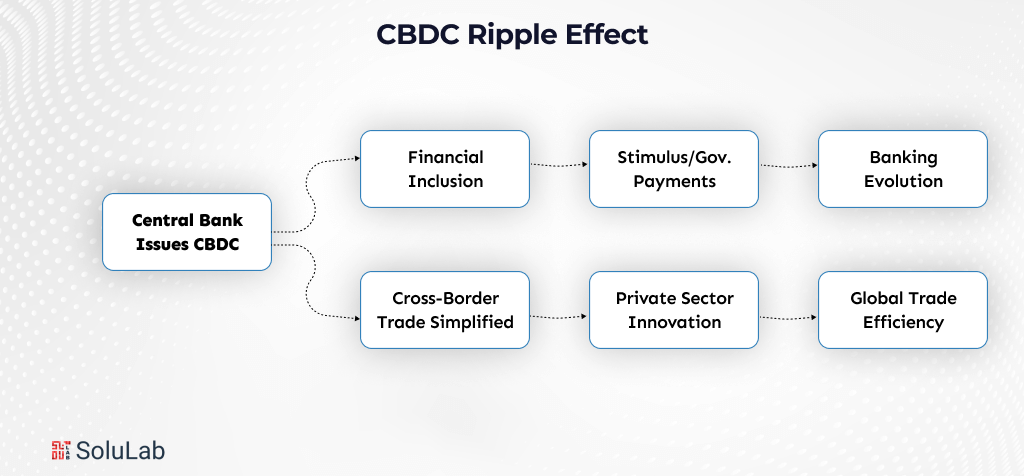
CBDC Ripple Effect 

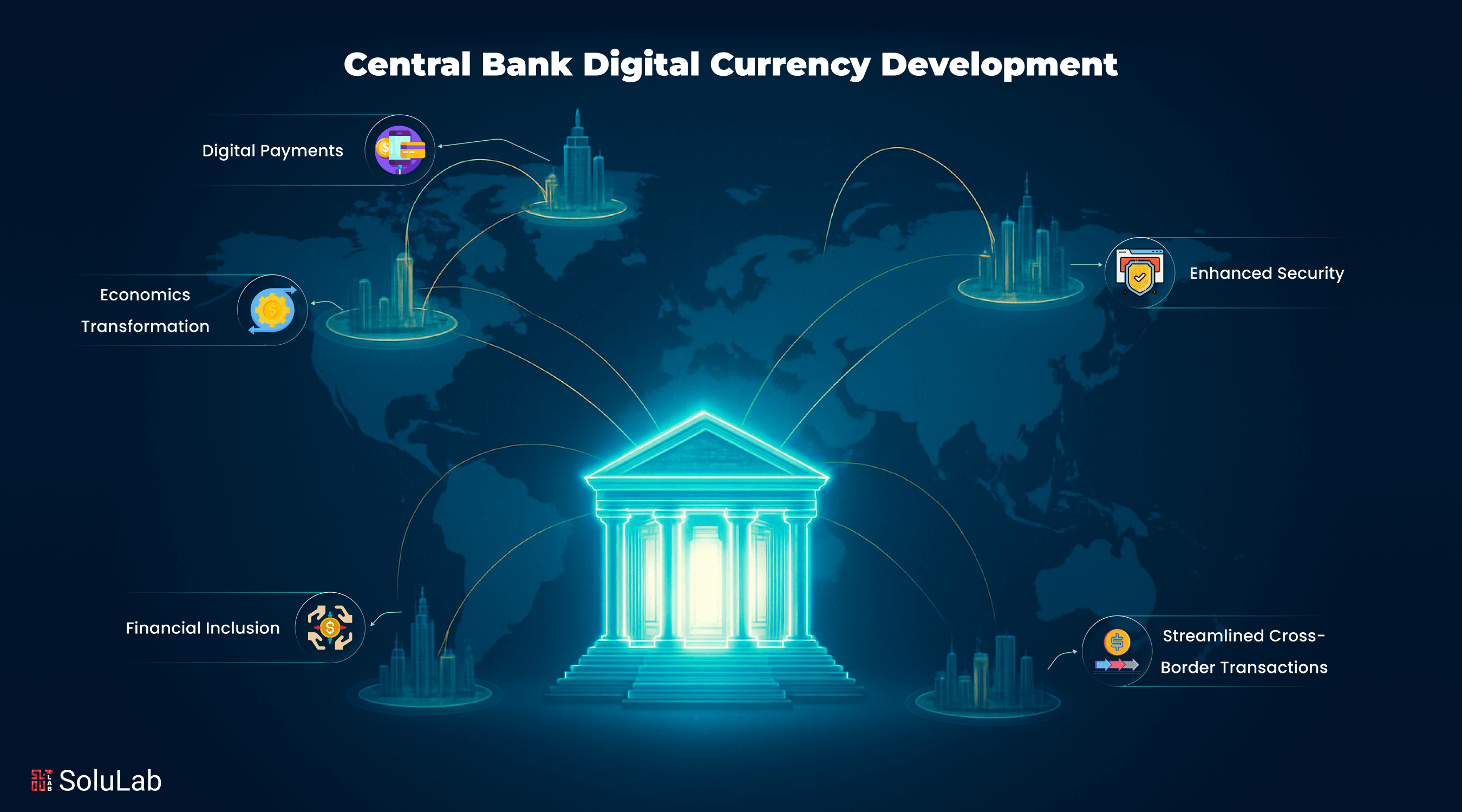
The use of Central Bank Digital Currencies (CBDCs) creates a ripple effect on various sectors of the economy. When a central bank launches a CBDC, it not only digitalizes money but also:

CBDC Ripple Effect

  • Encourages financial inclusion through giving access to secure digital payments to unbanked communities
  • Streamlines cross-border trade by facilitating quicker, cheaper, and more transparent international transactions
  • Enhances government operations, particularly in the distribution of welfare and direct payments to citizens
  • Fosters private sector innovation via programmable money and fintech integration
  • Reverses the conventional banking model, reshaping commercial banks’ and payment service providers‘ roles
  • Enhances global trade efficiency through standardized, interoperable, and transparent payment systems

Generally, CBDC use unleashes a chain reaction of financial modernization, touching every aspect from individual transactions to international trade and policymaking.

The Future of CBDCs

CBDCs are shaping the future of money, with 130+ nations testing digital currencies, global collaborations advancing cross-border use, and long-term potential to transform monetary policy and economies.

1. Global Momentum: Over 130+ countries are experimenting with CBDCs, with flagship initiatives like China’s e-CNY, India’s Digital Rupee, and the EU’s Digital Euro leading the way.
2. Collaborative Innovation: Strategic projects such as mBridge and the BIS Innovation Hub are building multi-CBDC platforms, paving the path for fast, low-cost, and secure cross-border payments.
3. Transformational Impact: Beyond payments, CBDCs promise to redefine monetary policy, strengthen financial inclusion, and accelerate the world’s shift toward cashless, fully digital economies.

Conclusion

Central Bank Digital Currencies are not yet another financial experiment—they’re a foundational change in how the world understands, holds, and uses money. For governments and businesses alike, the news is clear: embracing CBDCs is no longer a choice—it’s a requirement. Early movers will find a competitive advantage in defining the future of financial infrastructure.

As a leading blockchain development company, SoluLab helps governments, financial institutions, and enterprises design and deploy secure, scalable, and compliant CBDC solutions. With deep expertise in blockchain architecture, smart contracts, digital wallets, and regulatory integrations, we empower organizations to unlock the full potential of digital currencies.

If your organization is exploring the potential of Central Bank Digital Currency, contact us to turn vision into reality!

FAQs

1. How can organizations prepare for CBDC integration?

Businesses and financial institutions should focus on upgrading digital infrastructure, ensuring compliance with regulations, and adopting blockchain-based solutions that support seamless CBDC transactions.

2. Are CBDCs already in use globally?

Yes. Countries like China (Digital Yuan), Nigeria (eNaira), and the Bahamas (Sand Dollar) have launched CBDCs. Many others, including the U.S. and European Union, are actively testing or researching them.

3. Will CBDCs replace traditional cash completely?

Not in the near future. CBDCs are expected to coexist with cash and digital payment systems, giving citizens more flexibility while allowing governments to gradually reduce reliance on physical money.

4.How can businesses prepare for a CBDC-driven future?

Businesses should stay updated on regulatory changes, adopt digital-friendly payment systems, and explore blockchain integration to remain competitive as CBDCs reshape financial ecosystems.

5. Why should countries adopt CBDCs if digital banking already exists?

Unlike traditional digital banking, CBDCs are sovereign, programmable, and universally accessible, offering stronger financial inclusion and enabling direct monetary policy tools for governments.